Copyright2000 by the Genetics Society of America
Null Mutations in the
lin-31
Gene Indicate Two Functions During
Caenorhabditis elegans
Vulval Development
Leilani M. Miller, Heather A. Hess,
1David B. Doroquez and Noelle M. Andrews
Department of Biology, Santa Clara University, Santa Clara, California 95053
Manuscript received November 16, 1999 Accepted for publication August 3, 2000
ABSTRACT
Thelin-31gene is required for the proper specification of vulval cell fates in the nematodeCaenorhabditis elegansand encodes a member of the winged-helix family of transcription factors. Members of this important family have been identified in many organisms and are known to bind specific DNA targets involved in a variety of developmental processes. DNA sequencing of 13lin-31alleles revealed six nonsense mutations and two missense mutations within the DNA-binding domain, plus three deletions, one transposon inser-tion, and one frameshift mutation that all cause large-scale disruptions in the gene. The missense mutations are amino acid substitutions in the DNA-binding domain and probably disrupt interactions of the LIN-31 transcription factor with its DNA target. In addition, detailed phenotypic analysis of all 19 alleles showed similar penetrances for several characteristics examined. From our analysis we conclude: (1) the null phenotype oflin-31is the phenotype displayed by almost all of the existing alleles, (2) the DNA-binding domain plays a critical role in LIN-31 function, and (3) direct screens for multivulva and vulvaless mutants will probably yield only null (or strong) alleles oflin-31.
P
ROTEINS belonging to the winged-helix family of ing pathway cause the misspecification of vulval cell transcription factors appear to play important roles fates and typically fall into two broad phenotypic classes, in many developmental processes, including establish- vulvaless (Vul) or multivulva (Muv). In Vul mutants, all ment of body axes, cell fate specification, differentiation six VPCs typically adopt nonvulval (3⬚) cell fates, due of tissues, maintenance of cellular differentiation, and to a less active or completely inactive RTK signaling tumorigenesis (seeKaufmannandKno¨ chel1996 for pathway. In Muv mutants, most or all of the VPCs adopt review of winged-helix proteins). The LIN-31 protein, vulval fates (1⬚ or 2⬚), due to inappropriate activation a member of this winged-helix family, is required for of the RTK pathway. In the dissecting microscope, a the proper specification of vulval cell fates duringCaeno- Muv phenotype is manifested by multiple ectopic pseu-rhabditis elegansvulval development (Milleret al.1993). dovulvae (protrusions) along the ventral side of the During vulval development, six vulval precursor cells animal. Mutations in parallel or modulating pathways (VPCs), which are initially equivalent in developmental may also cause a Vul or Muv phenotype (for review, see potential, differentiate and adopt one of three possible Greenwald1997).vulval cell fates (for review, seeGreenwald1997). The Animals carrying mutations in the lin-31gene, how-different fates of the six VPCs (P3.p–P8.p) are deter- ever, display an interesting phenotype that is unique mined in response to several extracellular signals and among vulval development mutants (Miller et al. are adopted in the pattern 3⬚-3⬚-2⬚-1⬚-2⬚-3⬚. Cells adopt- 1993). In contrast to the Muv and Vul mutations, which ing a 1⬚ or 2⬚ (induced) cell fate give rise to the cells affect all six VPCs in the same way, these mutations that form the vulva, while cells that adopt a 3⬚ (unin- result in a deregulated cell fate phenotype in which duced) cell fate give rise to cells that fuse with the each of the six VPCs can adopt any one of the three hypodermal syncytium that surrounds most of the possible cell fates. Furthermore, opposite cell fate trans-worm. Biochemical and molecular studies of the anchor formations are often observed in the samelin-31mutant cell signaling pathway have revealed a conserved recep- animal, in which a cell distal to the anchor cell expresses tor tyrosine kinase (RTK)/Ras/mitogen-activated pro- an induced cell fate (1⬚ or 2⬚), while a proximal cell tein (MAP) kinase pathway (for review, seeKornfeld simultaneously expresses an uninduced (3⬚) cell fate. 1997). Mutations in genes belonging to this RTK signal- These opposite cell fate transformations indicate that, in lin-31mutants, the choice of cell fate is no longer strictly dependent on proximity to the anchor cell. This
Corresponding author:Leilani M. Miller, Department of Biology, 500 deregulation of vulval cell fate is manifested by variable
El Camino Real, Santa Clara University, Santa Clara, CA 95053.
Vul and/or Muv phenotypes. Inappropriate expression
E-mail: [email protected]
of an induced fate at P3.p, P4.p, or P8.p results in an
1Present address:Yale University School of Medicine, 333 Cedar St.,
SHM CE30, P.O. Box 208024, New Haven, CT 06520-8024. ectopic pseudovulva (protrusion), thus causing the
son and Horvitz 1985),lin-31(n1282, n1290, n1291) (Kim
mal to appear Muv when observed in a dissecting
micro-and Horvitz 1990), lin-31(ga9, ga10, ga37) (Miller et al.
scope. Conversely, inappropriate expression of a 3⬚
non-1993), lin-31(ga57, ga70)(gifts from D. Eisenmann); LGIII: vulval fate by P5.p, P6.p, or P7.p can result in a Vul unc-32(e189); LGV:him-5(e1490).
animal. Some lin-31 mutant animals express both Vul Male mating efficiency:To test for male mating efficiency, double mutant strains containing a lin-31 allele and him-and Muv phenotypes simultaneously. The observation
5(e1490)were constructed. Eachlin-31mutant allele was tested that all six VPCs require wild-type lin-31 activity
sug-in a cross consistsug-ing of 12lin-31; him-5L4 males and 6 unc-gested that lin-31has alternative functions (Miller et
32 hermaphrodites. Successful mating was indicated by the al.1993). Thus, if the deregulated mutant phenotype presence of non-Unc cross-progeny. Each allele was tested in does indeed represent the lin-31null phenotype, the at least two crosses. Male mating efficiency (ME) ratings were assigned according toWood(1988), with ME0 indicating no LIN-31 protein would appear to have two functions: to
male mating and ME3 indicating wild-type male mating levels. promote vulval induction (in P5.p, P6.p, and P7.p) and
L2 division phenotype:The presence of L2 divisions in the to inhibit it (in P3.p, P4.p, and P8.p). However, because
vulval precursor cell lineage was monitored with Nomarski incomplete penetrance is a predictable consequence optics in at least nine animals from eachlin-31strain scored. of a deregulation phenotype, it has been difficult to Animals in the L2 larval stage were identified on the basis of size using a dissecting microscope. These animals were unequivocally establish the null phenotype for lin-31
mounted for Nomarski observation as described in Wood
using phenotypic analysis alone.
(1988), except that 5 mm NaAzide was used to immobilize Epistasis experiments placed thelin-31gene at or near
the larvae. Larval stage was confirmed by gonad size, and VPCs the end of the RTK signaling pathway specifying vulval were spot-checked for inappropriate L2 divisions. To prevent cell fate, and sequence analysis showed it to encode a potential confusion between inappropriate L2 VPC divisions and normal early L3 VPC divisions, only animals whose gonad winged-helix transcription factor (Milleret al. 1993).
arms had not yet extended past P5.p and P7.p were scored. Subsequently, immunolocalization experiments
re-Although this approach ensures that only animals in the L2 vealed that LIN-31 is expressed in the VPCs during the
stage are scored, it necessarily underestimates the number of L2 and L3 larval stages and coimmunoprecipitation ex- possible inappropriate L2 VPC divisions since the entire L2 periments showed that it forms a heterodimer in vivo stage is not scored in each animal. Mutant strains were scored as positive for the L2 division phenotype if at least one animal with the LIN-1 Ets transcription factor that is disrupted
displayed L2 divisions. upon phosphorylation of LIN-31 by MAP kinase (Tan
Cloning oflin-31alleles:Genomic DNA for 13lin-31alleles et al. 1998). These results allowed expansion of the
was cloned by a PCR method adapted fromWilliamset al. model that LIN-31 has two functions: to promote vulval (1992). For most reactions, the PCR primers used were LM34 induction (in its phosphorylated, undimerized form) (5⬘-GGGAATTCATGAACAGGAAAATGTGTGGC-3⬘), and LM35 (5⬘-CCGAATTCGCAAAACTCTATACATATTCCC-3⬘). and to inhibit induction (in its unphosphorylated,
di-Vent DNA polymerase (0.18 units) was used in each reaction. merized form).
The LM34 and LM35 primers bracket the 3901-bp genomic The LIN-31 protein contains a winged-helix
DNA-coding region oflin-31(from 27 nucleotides before the start binding domain, an acidic region, a serine-rich region, codon to 70 nucleotides past the stop codon). For some alleles and a proline-rich region (Miller et al.1993). In this where general location of mutation was known (e.g.,n1049, n376,ga10, andga37), primers internal to LM34 and LM35 study, DNA sequence analysis of 13lin-31mutant alleles
were used. Gel-purified 3.9-kb fragments from two indepen-revealed many early nonsense mutations and several
dent PCR reactions for each mutant allele were cloned using large-scale disruptions of the gene, unequivocally
estab-a TOPO TA cloning kit (Invitrogen, Cestab-arlsbestab-ad, CA).
lishing the null phenotype. DNA sequence analysis also Sequencing of lin-31 alleles: For point mutations and revealed two missense mutations in the winged-helix frameshift mutation, the entire 3.9-kb insert of each mutant allele clone was sequenced on one strand for two independent DNA-binding domain. Although winged-helix proteins
clones per mutant allele. When the same mutation was identi-are clearly involved in many important developmental
fied in both clones, the other strand was also sequenced in regulatory mechanisms, few missense mutations within
that region to confirm the change. Two independent clones this DNA-binding domain have been reported, making were sequenced in the region of then1049deletion. For each it difficult to confirm their functionsin vivo.The identi- of the other deletion or insertion alleles, one clone was se-quenced in the region of the mutation, and the size and fication of these two missense mutations suggests that
position was confirmed by Southern analysis (n376andga37; the winged-helix DNA-binding domain is critical for
Milleret al.1993) or PCR (ga10). Sequencing was performed
LIN-31 function in vivo.
on an ABI (Foster City, CA) automated DNA sequencer.
Immunofluorescence:Rabbit anti-LIN-31 antibodies were a generous gift from P. Tan and S. Kim (Tanet al.1998). Fixed
MATERIALS AND METHODS animals (FinneyandRuvkun1990) were stained with a 1:100
dilution of anti-LIN-31 antibodies as described inMillerand
General methods and strains: Standard techniques were
Shakes(1995).
used for maintenance and handling ofC. elegansstrains ( Bren-ner1974). Animals were grown at 20⬚unless otherwise indi-cated. The animals described as wild type wereC. elegans,
vari-ety Bristol, strain N2 (Brenner1974). Unless otherwise noted, RESULTS
allC. elegansmutations are described inWood(1988).
Muta-Sequence oflin-31mutant alleles:Thelin-31alleles used tions and genetic markers were: LGII:lin-31(e1750, n301, n376,
Figure 1.—Mutant al-leles within thelin-31 geno-mic region. Boxes indicate exons, horizontal lines be-tween boxes indicate in-trons, and open boxes indi-cate nontranslated regions. The type of mutation is de-picted by appropriate sym-bol. The sizes of deletions are indicated above dele-tion lines. DNA sequences that encode specific LIN-31 protein domains or regions are indicated by different hatching patterns. Arrows labeled LM34 and LM35 indicate primers used to clone mostlin-31mutant alleles. The total length of this region is 4593 bp.
different screening methods. e1750, n301, n376, n428, tions using multiple combinations of primers. The Tc1 transposon insertion is located just before the start co-n429,n435,n762,n1048,n1049,n1050, andn1053were
isolated as multivulva animals (Muvs) in a general screen don, and the frameshift mutation (ga9) mapped to the end of the DNA-binding domain. Finally, the two mis-for Muv or Vul animals (FergusonandHorvitz1985).
ga10was isolated in a screen for Muv animals (M. Herman, sense mutations (ga57 and n301) mapped within the DNA-binding domain. Note that all but the two C-termi-personal communication).n1282,n1290,n1291,ga9, and
ga37 were isolated as transposon-induced alleles in a nal deletions affect the DNA-binding domain (see Figure 1), although the sequenced Tc1 insertion is upstream of mutator background (Kim and Horvitz 1990). ga57
and ga70 were isolated in a screen for animals with the DNA-binding domain and may not affect it.
Two putative DNA-binding mutants:DNA sequencing
protruding vulvae (EisenmannandKim2000).
LIN-31 is a 237-amino-acid protein containing a DNA- oflin-31showed that the N-terminal half of the LIN-31 protein consists of a DNA-binding domain similar to binding domain, an acidic region, a serine-rich region,
and a proline-rich region (see Figure 1). To elucidate that of the rat transcription factor HNF-3 (Miller et al.1993). X-ray crystallography studies of the HNF-3␥/ possible functions of these domains, 3.9 kb of genomic
DNA spanning thelin-31coding region was sequenced DNA cocrystal structure by Clark et al. (1993) subse-quently showed that the HNF-3␥DNA-binding domain in 13lin-31mutant alleles (see materials and
meth-ods). Since Taq polymerase, which was used to clone has a winged-helix motif, which resembles the structure of histone H5. Its three␣-helices in the amino-terminal the mutant alleles, can itself induce mutations, two
inde-pendent PCR clones from each noninsertion or nonde- half adopt a compact structure that presents the third (recognition) helix to the major groove, which interacts letion allele were sequenced. The indicated mutation in
each case was the only change within the 3.9-kb cloned with its DNA target through both direct and water-medi-ated major and minor groove base contacts. The car-region exhibited by both clones. The sequence analysis
of 13 lin-31 alleles revealed six nonsense mutations, boxyl-terminal half of the motif includes antiparallel -structure and random coils (“wings”) that interact three deletions, one transposon insertion in the 5⬘end
of the gene, one frameshift mutation, and two missense with the minor groove. The DNA-binding domain of the LIN-31 protein displays a striking similarity to the mutations. In addition, n1291 and n1282, previously
characterized as Tc1 insertions in the 5⬘end of the gene, DNA-binding domains of the fork head/HNF-3-related winged-helix family of proteins (Figure 2;Milleret al. andn1290, another mutator allele (Miller et al.1993),
were not sequenced. The results of these experiments are 1993;KaufmannandKno¨ chel1996). Thus, the overall three-dimensional structures of these DNA-binding do-shown in Figure 1 and summarized in Table 1.
Significantly, all six nonsense mutations map to the mains should also be very similar.
From our sequencing studies, we identified two mis-DNA-binding domain, with two of the alleles (n1053and
e1750) representing identical changes. One deletion sense alleles of thelin-31gene, which are located in the conserved winged-helix DNA-binding domain (Figure (ga10) is large, eliminating the carboxyl third of the
LIN-31 protein, including all of the acidic, serine-rich, 2 and Table 1). One mutant allele,ga57, results in the substitution of the amino acid isoleucine for the highly and proline-rich regions. Another deletion (n376)
effec-tively removes (or alters) the entire carboxyl third of conserved asparagine at the end of the recognition helix (helix 3) within the DNA-binding domain. The HNF-the protein due to HNF-the deletion of HNF-the last splice acceptor
site. Finally, a small deletion (n1049) eliminates the last 3␥/DNA cocrystal structure revealed that this particular asparagine makes contact with its DNA target via hydro-third of the DNA-binding domain. Three additional
alleles (n1050, n428, and n429) are suspected to be gen bonds with water molecules (Clark et al. 1993). Changing it to a hydrophobic isoleucine presumably large deletions of the entire coding region, as PCR
particu-TABLE 1
Molecular analysis oflin-31mutations
Type of DNA Amino acid
Allelea Mutagen mutation change change Position in protein or geneb,c
n301 EMS Missense G to A Arg62to Gln62 Middle of helix 3 in DBD
ga57 EMS Missense A to T Asn68to Ile68 End of helix 3 in DBD
n1053 EMS Nonsense G to A Trp57to amber Middle of DBD (same ase1750)
e1750 EMS Nonsense G to A Trp57to amber Middle of DBD (same asn1053)
n435 EMS Nonsense C to T Gln58to ochre Middle of DBD
n1048 EMS Nonsense C to T Arg62to amber Middle of DBD
n762 EMS Nonsense G to A Trp87to amber Near end of DBD
ga70 EMS Nonsense C to T Arg108to amber End of DBD
ga37d Mutator Insertion Just before start codon (⫺29 bp)
n1282d Mutator Insertion Near 5⬘end of gene
n1290d Mutator Insertion Unknown
n1291d,e Mutator Insertion Near 5⬘end of gene
n1049 EMS Deletion 69 bp Removes last third of DBD (1216–1285)
n376 EMS Deletion 535 bp Removes last splice site (2960–3495)
ga10 EMS Deletion 956 bp Deletes all but DBD (3025–3981)
ga9d Mutator Frameshift 1 bp lost End of DBD (1292)
DBD, DNA-binding domain.
aIn addition,n428,n429, andn1050were not amplified by PCR and are likely to be deletions of the entire coding region (see text).
bThe DNA-binding domain extends from amino acids 13 to 109 (Milleret al.1993).
cFor insertions and deletions, numbers refer to base pairs, with ⫹1 ⫽ A of ATG encoding start codon
(Milleret al.1993).
dTransposon-induced alleles.
eData fromMilleret al.(1993).
lar asparagine side chain is underscored by its conserva- of a glutamine for an extremely highly conserved argi-nine. Although the X-ray crystallography studies of tion in all but a few members of known winged-helix
proteins (Kaufmann and Kno¨ chel 1996). The other HNF-3␥did not indicate that this arginine is specifically involved in binding DNA, this substitution may still af-allele, n301, also lies within the DNA-binding domain
(in the middle of helix 3) and results in the substitution fect how the mutant protein interacts with the DNA.
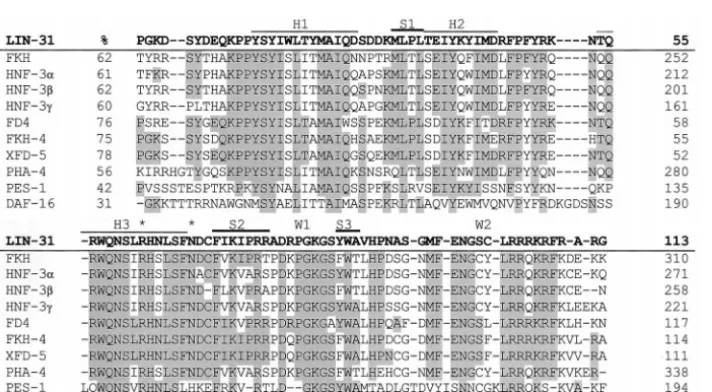
Figure2.—Multiple sequence
align-ment of selected winged-helix DNA-binding domains. LIN-31 (Milleret al.
1993) was compared with the found-ing members of the wfound-inged-helix family:fork head(FKH), cloned from Drosophila (Weigelet al.1989), and HNF-3␣, HNF-3, and HNF-3␥, cloned from rats (Laiet al.1990, 1991). Also included in this alignment are several proteins from the same winged-helix subclass as LIN-31 (defined in
Kauf-mannandKno¨ chel1996): FD4 from
Drosophila (Ha¨cker et al. 1992), FKH-4 from mouse (Kaestneret al.
1993), and XFD-5 from Xenopus (Lefet al.1996), and several winged-helix DNA-binding domains from
C. elegans: PHA-4 (Azzaria et al.
through a folding defect that prevents binding but does not result in significant degradation of the protein.
Phenotype oflin-31alleles:Genetic criteria for
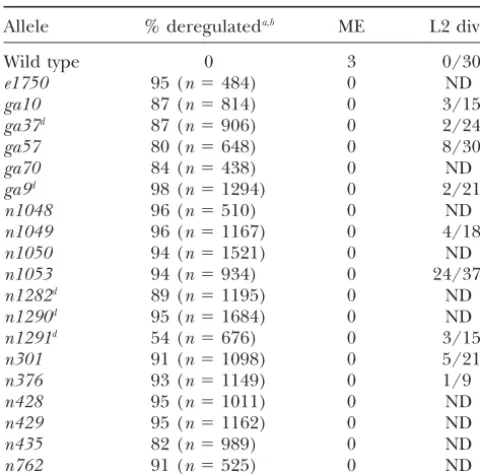
estab-lishing a null phenotype include ease of mutant isola-tion, similarity among strong alleles, phenotypein trans to a deficiency, and the ability to be suppressed by a nonsense suppressor. Previous studies showed allelic similarity for the vulval cell fate deregulation phenotype and also showed that a strong allele acts like a deficiency in transto another allele (Milleret al.1993). To deter-mine if lin-31 alleles display allelic similarity for all known lin-31 mutant phenotypes, we analyzed three phenotypic characteristics: the deregulation of VPC fates, male mating efficiency, and inappropriate cell division of VPCs during the L2 larval stage.
In lin-31 deregulated mutants, VPCs that normally choose induced cell fates sometimes choose uninduced fates and VPCs that normally choose uninduced cell fates sometimes choose induced cell fates (Milleret al. 1993). These mistakes in cell fate determination are manifested at the dissecting microscope level as Vul
Figure 3.—LIN-31 expression patterns in wild-type (N2) or Muv phenotypes, respectively. Because each vulval
and ga57animals. (A) Wild-type (N2) and (B) lin-31(ga57)
precursor cell in alin-31mutant animal appears to make mutant animals stained with anti-LIN-31 antibodies during
an independent decision, these animals can also some-the late L2 or early L3 larval stage. Figure shows midbody
region. Dorsal is to the left, ventral to the right, anterior times display the Vul and Muv phenotypes simultane-toward the bottom, and posterior simultane-toward the top. Figures are ously. All 19lin-31mutant strains produce a high per-negative images of FITC immunofluorescence. Both animals
centage of non-wild-type animals (Muv, Vul, or Muv/ show staining of LIN-31 protein within the nuclei of the VPCs.
Vul), except for n1291, which expressed a somewhat weaker deregulation phenotype (see Table 2). In addi-tion, each mutant strain also exibited both Muv and Vul This particular arginine is very likely to play an especially
phenotypes (data not shown), indicating that each allele critical role in the function of these proteins, as it is
is defective for appropriate adoption of both induced completely conserved in all known winged-helix
pro-and uninduced cell fates. teins (KaufmannandKno¨ chel1996).
In addition to the vulval precursor cell deregulation It is important to determine whether these two
mu-phenotype in hermaphrodites,lin-31mutant males are tant proteins are defective because they are no longer
also mating incompetent (Ferguson and Horvitz able to bind their DNA target or because the amino
1985;Miller et al. 1993), probably due to formation acid substitutions have destabilized the protein enough
of defective mating spicules (S. Baird,personal commu-to cause unfolding and subsequent degradation. Using
nication). The 19lin-31mutant strains were tested for immunolocalization studies, we were able to rule out the
the efficiency of male mating and all 19 were found to second possibility by showing that the LIN-31 protein
be completely mating defective, with a mating efficiency is present in the proper cells at the proper stage of
rating of “0” (ME0; Table 2). development. Figure 3 shows wild-type andlin-31(ga57)
A third phenotype that is observed in lin-31mutant animals stained with antibodies to LIN-31 during the
animals is the occasional inappropriate cell division of late L2 or early L3 stage, when LIN-31 protein is known
a VPC during the L2 larval stage to give rise to either to be present in the nucleus of each vulval precursor
an extra VPC or an extra Pn.a-like neuroblast cell cell (Tan et al. 1998). In these animals, the LIN-31
(Milleret al.1993). VPCs in wild-type animals are quies-protein is observed in the nuclei of the VPCs. The
addi-cent during the L2 larval stage. When cell division of a tional staining cells in thega57animal represent either
VPC during the L2 results in the creation of an extra extra VPCs that are often generated during the L2 larval
VPC inlin-31mutant animals, its fate is also deregulated. stage inlin-31mutant animals or normal VPC divisions
At least one representative allele from each class of in an early L3 animal. lin-31(n301) animals displayed
mutation (missense, nonsense, deletion, insertion, and similar results (data not shown). Thus, bothga57and
frameshift) was analyzed for this phenotype. L2 divisions n301 mutant strains express LIN-31 protein at the
of VPCs were observed in alllin-31mutant strains tested proper time and place, suggesting that their defects
(Table 2). lie in their inability to bind the target DNA, either by
DISCUSSION
TABLE 2
Phenotypic analysis oflin-31mutant alleles In this article, we report the molecular and pheno-typic characterization of 19 mutant alleles of the gene
Allele % deregulateda,b ME L2 div.c
that encodes the winged-helix transcription factor LIN-31. All 19 alleles displayed similar phenotypes, and DNA
Wild type 0 3 0/30
sequencing results indicated that most of these alleles
e1750 95 (n⫽484) 0 ND
must be null alleles. In addition, we show that two
mis-ga10 87 (n⫽814) 0 3/15
ga37d 87 (n⫽906) 0 2/24 sense alleles in the DNA-binding domain are likely to
ga57 80 (n⫽648) 0 8/30 disrupt the interaction of the transcription factor with
ga70 84 (n⫽438) 0 ND its DNA target, revealing the critical importance of the
ga9d 98 (n⫽1294) 0 2/21
DNA-binding domain to the function of the LIN-31
n1048 96 (n⫽510) 0 ND
protein.
n1049 96 (n⫽1167) 0 4/18
The null phenotype of lin-31: Due to the nature of
n1050 94 (n⫽1521) 0 ND
n1053 94 (n⫽934) 0 24/37e the lin-31 mutant phenotype (presence of both Muv
n1282d 89 (n⫽1195) 0 ND
and Vul animals and less than 100% penetrance for
n1290d 95 (n⫽1684) 0 ND
deregulation of VPCs), it has been difficult to
unequivo-n1291d 54 (n⫽676) 0 3/15
cally establish the null phenotype by phenotypic
charac-n301 91 (n⫽1098) 0 5/21e
teristics alone. In this article, allelic similarity was
dem-n376 93 (n⫽1149) 0 1/9
onstrated for threephenotypic characteristics, whereas
n428 95 (n⫽1011) 0 ND
previous analyses had relied on only one phenotype. In
n429 95 (n⫽1162) 0 ND
n435 82 (n⫽989) 0 ND addition, six early nonsense mutations, four insertions n762 91 (n⫽525) 0 ND in the 5⬘end of the gene, one early frameshift mutation, and at least three deletions were identified. Further-ME, male mating efficiency; ND, not determined.
more, P. Tan (personal communication) has shown,
a% deregulated, Muv⫹Vul⫹Muv/Vul animals.
bNumbers from e1750, ga9, n1049, n1050, n1282, n301,
using antibody studies, that there is no detectable LIN-n428,n429, andn435are fromMilleret al.(1993) and were 31 protein for at least two alleles,n1053andga37. included in the table for completeness.
With the establishment of the null phenotype, the
cNumbers indicate number of animals in which any L2
transformation of both induced and uninduced vulval VPC divisions were observed over the total number of animals
scored. Note: given the method of scoring (see materials cell fates in lin-31 null mutants indicates that LIN-31
and methods), this number is variably underestimated and plays an important role in the specification of both types
should not be used to compare relative strength of alleles. of cell fates. This is consistent with models proposing dTransposon-induced alleles.
that LIN-31 functions both to promote and to inhibit
eSome data published inMilleret al.(1993, 1996).
vulval induction (Milleret al. 1993;Tan et al. 1998). Thus, a cell lacking alllin-31activity would be incapable of correctly specifying either an induced or uninduced cell fate. This would require the cell to adopt a VPC at least some of thelin-31mutant alleles represent the
fate in a stochastic manner, resulting in the deregulated null phenotype. Since all 13 of these sequenced mutant
pattern of cell fate specification observed inlin-31 mu-alleles, as well as two previously mapped Tc1 insertions
tants. The adoption of a specific induced or uninduced and the three deletions that likely delete the entire
cell fate in the absence of LIN-31 rather than a default coding region, show similar mutant phenotypes, this
or intermediate cell fate can be explained by a model suggests that LIN-31 protein function is similarly
defec-in which target genes of the LIN-31 transcription factor tive in 18 of the 19 mutant strains. The n1291 strain
are autoregulated, and that stochastic perturbances can was the only one to show a weaker phenotype in any of
cause one of the target proteins to rise above a threshold the phenotypic analyses. Its 54% vulval cell fate
deregu-level, triggering autoactivation and subsequent deactiva-lation phenotype fell significantly below the next
high-tion of other target genes, thus “locking in” a particular est allele of 80% (see Table 2), indicating that it may
cell fate (Milleret al.1993;Tanet al.1998). represent a somewhat weaker allele. It was, however,
A winged-helix DNA-binding domain is essential for
indistinguishable from other alleles in the remaining
two phenotypic analyses (male mating and inappropri- function:While the winged-helix family of DNA-binding proteins is clearly an important one in developmental ate VPC division during the L2 larval stage). Earlier
experiments characterizedn1291as a Tc1 insertion in biology, most of its eukaryotic members have been iden-tified simply by sequence homology, and very few mis-the 5⬘ end of the gene, resulting in a smaller mRNA
(1.4vs.1.5 kb observed in wild-type animals;Milleret sense mutations within the DNA-binding domain have been identified through genetic screens. Thus, defini-al.1993). Thus, with the possible exception ofn1291,
ies in HNF3␣ have identified specific residues in the latter part of the protein is that a mutation leaving more than half of LIN-31 intact results in a protein with some DNA-binding domain important for its stability (
Ste-venset al.2000), but those studies were limited to tran- residual function. These weak alleles would not have been detected in a standard screen for Muvs or Vuls, scription activation assays in tissue culture andin vitro
binding experiments. Other studies have shown that since the penetrance for either phenotype would proba-bly be well below the 31–76% Muv penetrance or the targeted null mutations in HNF3␣and HNF3are lethal
in vivo, but those experiments deleted almost the entire 15–41% Vul penetrance (L. Miller, unpublished re-sults) exhibited by null alleles. Thus, the isolation of protein-coding region (Ang and Rossant 1994;
Weinsteinet al.1994) or at least the entire DNA-bind- weak or other nonnulllin-31alleles awaits the develop-ment of nonstandard mutant screening procedures or ing domain (Kaestneret al.1999). Furthermore, some
transcription factors, such asfushi tarazu, are capable of in vitromutagenesis experiments. Such studies (in prog-ress) may reveal the functional domains responsible for regulating transcription without a DNA-binding domain
(Fitzpatricket al.1992). In this study, we show that the the two different activities of LIN-31 postulated by the model discussed above.
winged-helix domain is indispensable to the function of
the LIN-31 protein. We thank L. Corbett and D. Schatz for help with DNA sequencing; One indication that the LIN-31 DNA-binding domain P. Tan and S. Kim for the generous gift of LIN-31 antibodies; S. Kim, D. Eisenmann, and M. Herman forlin-31alleles; K. Warren for
is critical for function is the number of mutations that
identification of thega70deletion; J. Holzman, K. Warren, R. Childers,
lie within it (Figure 1). Eleven of the 16 alleles with
L. Treat, and K. Donnelly for help with male mating experiments;
known positions are located within the DNA-binding
members of the Kim lab for antibody advice; and P. Schatz, D. Preuss,
domain, including two missense mutations and a small D. Eisenmann, P. Tan, J. Grainger, C. Stephens, and B. Meyer for deletion. The most compelling argument for the impor- comments on the manuscript. This work was supported by National Institutes of Health (NIH) research grant 1 R15 GM52636-01, National
tance of the DNA-binding domain is the existence of
Science Foundation CAREER grant IBN-9600864, and the Clare
the two missense mutations within this domain that
Boothe Luce Foundation. Some nematode strains were supplied by
leave the rest of the protein intact. Since these mutations the Caenorhabditis Genetics Center, which is supported by a contract lie in or near the recognition helix and since LIN-31 between the NIH National Center for Research Resources and the protein is not degraded due to unfolding caused by the University of Minnesota.
amino acid substitutions in these two mutant strains, it is likely that the only defect these mutant proteins
display is an inability to bind the correct target DNA. LITERATURE CITED Furthermore, at least one of these missense alleles
repre-Ang, S.-L.,andJ. Rossant,1994 HNF-3is essential for node and
sents a change in an amino acid that, in a similar winged- notochord formation in mouse development. Cell78:561–574. helix homolog, is known to make contact with the target Azzaria, M., B. Goszczynski, M. A. Chung, J. M. KalbandJ. D. McGhee,1996 A fork head/HNF-3 homolog expressed in the
DNA. The null phenotype of this allele strongly suggests
pharynx and intestine of theCaenorhabditis elegansembryo. Dev.
that the ability to bind target DNA is a critical function Biol.178:289–303.
of the LIN-31 protein. Finally, since the phenotypes of Brenner, S.,1974 The genetics ofCaenorhabditis elegans.Genetics
77:71–94.
alllin-31alleles affecting the DNA-binding domain are
Clark, K. L., E. D. Halay, E. LaiandS. K. Burley, 1993
Co-equivalent to thelin-31null phenotype, it is clear that crystal structure of the HNF-3/fork head DNA-recognition motif this winged-helix domain is essential for protein func- resembles histone H5. Nature364:412–420.
Clifton-Bligh, R. J., J. M. Wentworth, P. Heinz, M. S. Crisp, R.
tion. The importance of this domain in LIN-31 is
consis-Johnet al., 1998 Mutation of the gene encoding human TTF-2
tent with a study showing that a missense mutation in associated with thyroid agenesis, cleft palate and choanal atresia. helix 1 of the DNA-binding domain of a human winged- Nat. Genet.4:399–401.
Eisenmann, D. M.,andS. K. Kim,2000 Protruding vulva mutants
helix protein (TTF-2) results in impaired DNA binding
identify novel loci and Wnt signaling factors that function during
and loss of transcriptional function (Clifton-Blighet C. elegansvulva development. Genetics156:1097–1116. al.1998). Ferguson, E. L.,andH. R. Horvitz,1985 Identification and
charac-terization of 22 genes that affect the vulval cell lineages of the
Standard genetic screens yield only null alleles: All
nematodeCaenorhabditis elegans.Genetics110:17–72.
six existinglin-31nonsense mutations map to the DNA- Finney, M.,andG. Ruvkun,1990 Theunc-86gene product couples binding domain, located in the N-terminal half of the cell lineage and cell identity inC. elegans.Cell63:895–905.
Fitzpatrick, V. D., A. Percival-Smith, C. J. Ingles and H. M.
protein. Interestingly, no late nonsense mutations were
Krause,1992 Homeodomain-independent activity of the fushi
observed, indicating that a LIN-31 protein truncated
tarazu polypeptide in Drosophila embryos. Nature356:610–612.
late in the protein may not result in a phenotype detect- Greenwald, I.,1997 Development of the vulva, pp. 519–541 inC. elegans II, edited byD. L. Riddle, T. Blumenthal, B. J. Meyer
able by standard Muv and Vul screens. While there are
and J. R. Priess.Cold Spring Harbor Laboratory Press, Cold
more codons in the N-terminal half of the LIN-31
pro-Spring Harbor, NY.
tein that are capable of being mutated to a stop codon Ha¨cker, U., U. Grossniklaus, W. J. GehringandH. Ja¨ckle,1992
Developmentally regulatedDrosophilagene family encoding the
in a single step (37vs. 27 in the C-terminal half), this
fork head domain. Proc. Natl. Acad. Sci. USA89:8754–8758.
difference does not adequately explain the complete
Hope, I. A.,1994 PES-1 is expressed during early embryogenesis in
absence of late nonsense mutations. The most likely Caenorhabditis elegansand has homology to the fork head family
of transcription factors. Development120:505–514.
Kaestner, K. H., K. H. Lee, J. Schlo¨ ndorff, H. Hiemisch, A. P. lin-31, aCaenorhabditis elegansHNF-3/fork head transcription fac-tor homolog, specifies three alternative cell fates in vulval
develop-Monaghanet al., 1993 Six members of the mouse forkhead
gene family are developmentally regulated. Proc. Natl. Acad. Sci. ment. Genes Dev.7:933–947.
Miller, L. M., D. A. WaringandS. K. Kim,1996 Mosaic analysis USA90:7628–7631.
Kaestner, K. H., J. Katz, Y. Liu, D. J. DruckerandG. Schu¨ tz,1999 using ancl-1(⫹)extrachromosomal array reveals thatlin-31acts in the Pn.p cells duringCaenorhabditis elegansvulval development. Inactivation of the winged helix transcription factor HNF3 ␣
affects glucose homeostasis and islet glucagon gene expression Genetics143:1181–1191.
Ogg, S., S. Paradis, S. Gottlieb, G. I. Patterson, L. Leeet al., 1997 in vivo. Genes Dev.13:495–504.
Kaufmann, E.,andW. Kno¨ chel,1996 Five years on the wings of The Fork head transcription factor DAF-16 transduces insulin-like metabolic and longevity signals inC. elegans.Nature389:
fork head. Mech. Dev.57:3–20.
Kim, S. K.,andH. R. Horvitz,1990 TheCaenorhabditis elegansgene 994–999.
Stevens, K., L. CirilloandK. S. Zaret,2000 Creating
temperature-lin-10 is broadly expressed while required specifically for the
determination of vulval cell fates. Genes Dev.4:357–371. sensitive winged helix transcription factors: amino acids that stabi-lize the DNA binding domain of HNF3. J. Biol. Chem.275:30471–
Kornfeld, K., 1997 Vulval development inCaenorhabditis elegans.
Trends Genet.13:55–61. 30477.
Tan, P. B., M. R. LacknerandS. K. Kim,1998 MAP kinase signaling
Lai, E., V. R. Prezioso, E. Smith, O. Litvin, R. H. Costa et al.,
1990 HNF-3A, a hepatocyte-enriched transcription factor of specificity mediated by the LIN-1 Ets/LIN-31 WH transcription factor complex duringC. elegansvulval induction. Cell93:569– novel structure is regulated transcriptionally. Genes Dev.4:1427–
1436. 580.
Weigel, D., G. Ju¨ rgens, F. Kuttner, E. SeifertandH. Ja¨ckle,1989
Lai, E., V. R. Prezioso, W. F. Tao, W. S. ChenandJ. E. Darnell,
Jr.,1991 Hepatocyte nuclear factor 3 alpha belongs to a gene The homeotic gene fork head encodes a nuclear protein and is expressed in the terminal regions of the Drosophila embryo. Cell family in mammals that is homologous to the Drosophila
homeo-tic gene fork head. Genes Dev.5:416–427. 57:645–658.
Weinstein, D. C., A. R. Altaba, W. S. Chen, P. Hoodless, V. R. Lef, J., P. Dege, M. Scheucher, V. Forsbach-Birk, J. H. Clement
et al., 1996 A fork head related multigene family is transcribed Preziosoet al., 1994 The winged-helix transcription factor
HNF-inXenopus laevisembryos. Int. J. Dev. Biol.40:245–253. 3is required for notochord development in the mouse embryo.
Lin, K., J. B. Dorman, A. RodanandC. Kenyon,1997 daf-16: an Cell78:575–588.
HNF-3/forkhead family member that can function to double the Williams, B. D., B. Schrank, C. Huynh, R. ShownkeenandR. H.
life-span ofCaenorhabditis elegans[see comments]. Science278: Waterston,1992 A genetic mapping system inCaenorhabditis
1319–1322. elegans based on polymorphic sequence-tagged sites. Genetics
Miller, D. M.,andD. C. Shakes,1995 Immunofluorescence micros- 131:609–624.
copy, pp. 365–394 inMethods in Cell Biology, Volume 48: Modern Wood, W. B.,1988 The Nematode Caenorhabditis elegans.Cold Spring
Biological Analysis of an Organism, edited byH. F. Epsteinand Harbor Laboratory Press, Cold Spring Harbor, NY.
D. C. Shakes.Academic Press, San Diego.