MODIFICATION OF ULTRAVIOLET-INDUCED MUTATION FREQUENCY IN BACTERIA1
c.
0. DOUDNEY AND F. L. HAASGenetics Section, Department of Biology, The Uniuersity of Texas M . D. Anderson Hospital and Tumor Institute, Houston, Texas
Received May 23, 1960
ITKIN (1956, 1958) has cited considerable evidence which indicates that, win bacteria, ultraviolet light (UV) induced mutation is irreversibly estab- lished only after an appreciable delay. Her studies suggest that the induction process is completed during the period prior to the first postirradiation cell division and is dependent on the availability of amino acids. WITKIN suggested that pro- tein synthesis is involved in mutation induction since she found that chloram- phenicol (Chl)
,
an antibiotic which blocks protein synthesis, appreciably lowers the mutation frequency obtained with a given dose of UV.HAAS and DOUDNEY (1957) presented evidence suggesting that the chemical basis for UV-induced mutation involves nucleic acid precursors altered in uiuo
by UV. Later studies (DOUDNEY and HAAS 1958,1959a) indicate that ribonucleic acid (RNA) synthesis, as well as protein synthesis, is involved in the mutation induction process. These results led to the suggestion that RNA and protein are involved in replication of deoxyribonucleic acid (DNA). As one possibility it was suggested that the RNA is modified through incorporation of the UV-altered purine or pyrimidine and that this modification in RNA specificity leads to a change in the genetic specificity of the DNA subsequently formed.
Recent studies (HAAS and DOUDNEY 1959, 1960) demonstrate that DNA syn- thesis is the final step in the mutation induction process. These studies further indicate that protein synthesis must follow DNA synthesis for phenotypic expres- sion of the induced mutation. Chl blocks mutation expression when added to the culture immediately following postirradiation synthesis of DNA. It is clear that the functional mutated gene is formed with DNA replication.
Although the basis of UV-induced mutation has been investigated intensively during the last decade, a number of points remain to be elucidated before any hypothesis for mechanism can be established with certainty. In the first place, the nature of the initial receptor of the UV energy which leads to mutation must be established. While the data of HAAS and DOUDNEY (1957) is most readily interpreted as indicating the UV chromophore to be nucleic acid precursors present in the cell at the time of irradiation, the alternate hypothesis that the genetic material absorbs the UV which leads to mutation receives widespread
1 This investigation is supported in part by research grant C-3323 from the National Institutes
1482 C. 0. DOUDNEY A N D F. L. HAAS
support. Also in question is the biochemical basis for the reversibility (or pre- vention) of mutation following UV exposure (i.e., whether the lowering of muta- tion frequency by various postirradiation treatments is due to an active metabolic event or, conversely, to the physical or chemical “decay” of a “premutational state”). A third factor which must be clarified concerns the nature of the involve- ment of RNA and protein synthesis in mutation induction and in DNA repli- cation.
The present report describes experiments designed to elucidate the nature of the processes leading to postirradiation decline in induced mutation frequency and the involvement of RNA and protein synthesis in DNA replication and in mutation induction. Efforts to characterize the nature of the mutational chromo- phore will be described in another report.
MATERIALS A N D METHODS
The mutations studied result in reversion of the tryptophan requirement of Escherichia coli strain WP2 ( t r + t r + ) . The mutation assay media used was minimal agar medium supplemented with 2.5 percent Difco nutrient broth (DOUDNEY and HAAS 1958). The low level of amino acids supplied by the nutrient broth allows a somewhat limited degree of mutation induction, and the tryptophan present permits the unreverted tr- cells to make enough divisions to develop small, but visible, colonies at proper dilutions, and also enables mutation expression in the reverted tr+ cells. The techniques followed have been previously described
(HAAS and DOUDNEY 1957; DOUDNEY and HAAS 1958, 1959a). Briefly they are as follows. The culture is grown for 15.5 hours at 37°C with aeration in 50 ml portions of minimal medium supplemented with 0.2 mg per ml of DL-tryptophan. It is then held at 6°C for one hour, the cells centrifuged down in the cold, and resuspended in fresh medium at 37°C. This culture is grown for a n additional period of 50 minutes, then chilled to halt further growth. The cells are centrifuged down again, washed once in cold 0.9 percent saline, and finally resuspended in cold minimal medium. Unirradiated suspensions are adjusted to contain about 6 x IOs colony-forming organisms per ml. UV irradiation is for ten seconds at a distance of 30 cm (964 ergs per mm2). After UV exposure the sample is diluted one to four into appropriately supplemented growth medium and incubated for the indicated time interval at 37°C on a reciprocal shaker prior to plating at appropriate dilutions onto mutation assay agar medium. The plates are incubated for three days at 37°C and scored for total survivors (tr-) and induced revertants ( t r + ) . The usual precautions to prevent photoreversal are observed subsequent to UV exposure.
amount of DNA, as determined by the Burton analysis of the same sample, is then subtracted with correction for extinction coefficients. Protein is determined by the Folin method (LOWRY, ROSEBROUGH and RANDALL 1951).
EXPERIMENTAL RESULTS
Mutation frequency decline and macromolecular synthesis: The concept has
been advanced that the level of mutation frequency induced by a given UV dose is related to the timing of DNA synthesis following irradiation. One investigator (WITKIN 1956, 1958) proposed that delay in DNA synthesis would increase mutation since more time would be availeble for protein synthesis, presumably involved in mutation induction. Others proposed that delay in DNA synthesis would decrease mutation since more time would be available for a hypothetical unstable “premutational” state to revert to a state not leading to mutation induc- tion (KIMBALL, GAITHER and WILSON 1959). Both points of view imply that DNA synthesis is the terminal event in mutation induction.
Previous work has demonstrated that UV does cause a delay in DNA synthesis (KELNER 1953). Recently, several workers have shown that resumption of DNA synthesis following UV exposure requires prior synthesis of RNA and protein (HAROLD and ZIPORIN 1958; DOUDNEY 1959; DRACULIC and ERRERA 1959). Incubation with inhibitors blocking either RNA or protein synthesis, prior to initiation of DNA synthesis, leads to an additional lag in DNA synthesis during the time the necessary RNA and protein is formed. Many of the agents and conditions which block RNA or protein synthesis also promote a marked lowering in the expected induced mutation frequency. Whether the mutation frequency decline promoted by these agents can be ascribed to delay in DNA synthesis, or to an active decline process promoted by the inhibitors and independent of delay in DNA synthesis, remains to be resolved. If a quantitative correlation can be established between the effect of these agents on mutation frequency and their effect in delaying DNA synthesis, then the hypothesis suggested by KIMBALL
and co-workers will receive considerable support. However, if decline in mutation frequency is independent of the effect on DNA synthesis, the hypothesis that mutation frequency decline is an active and enzymatically conditioned process
( DOUDNEY and HAAS 1958) will appear more plausible.
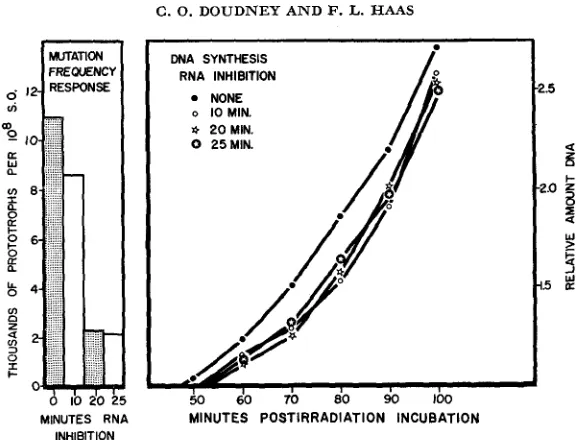
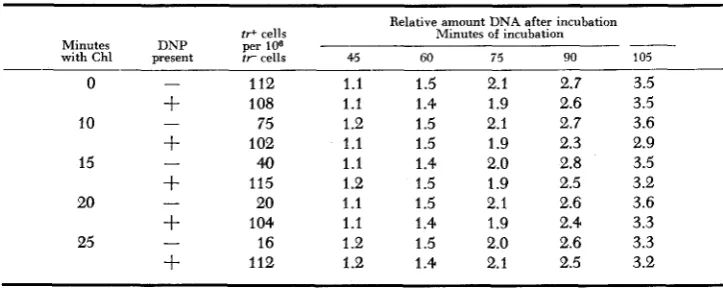
Results of experiments designed to differentiate between the alternatives posed above are presented in Figures 1, 2 and 3, and in Table 1. These experiments measure the effect of increasing periods of immediate postirradiation treatments which block RNA or protein synthesis on the mutation frequency and on the subsequent synthesis of DNA in the culture. The mutation frequency is assayed in this case when the relative amount of DNA has just doubled. However, it makes little difference when the sample is plated after the indicated interval of
1484 C . 0. DOUDNEY A N D F. L. HAAS
MVTATION F R E M N C Y 12 RESPONSE
I
5 MINUTES RNA INHIBITION
DNA SYNTHESIS
i
RNA INHIBITION
NONE
o I O MIN.
60 $0
ro
EO ,so IboMINUTES POSTIRRADIATION INCUBATION
FIGURE 1.-Effect on yield of prototrophs, and on subsequent DNA synthesis in Escherichia coli strain WP2 (tryptophan requiring), of incubation with 6-aza uracil ( 5 m g per 100 ml medium) f o r varying time intervals following UV irradiation ( R N A inhibition). The 6-aza uracil inhibition was reversed after the indicated perioil of incubation in liquid growth medium (minimal medium
+
casein hydrolysate, 2 mg per ml and 0.05 mg per ml m-tryptophan)+
6 AU by the addition of uridine (5 mg per 100 ml). The increase in DNA relative to unincubated controls was followed during subsequent incubation, The times given are from the start of incu- bation following UV irradiation, and include both incubation periods ($ 6 AU and after reversal with uridine). Mutation frequency was assayed by plating after 80-minutes incubation, and prior to cell division (at 90-100 minutes), on nutrient broth supplemented mutation assay agar. Mutation frequency does not vary with plating from 5%-90 minutes. No effect of 6 AU on sur- vival was noted.been shown to block RNA and protein synthesis and also to promote mutation frequency decline
(DOUDNEY
and HAAS 1959b). After the indicated intervals of incubation the effect of 6-aza uracil was reversed by the addition of uracil. Figure 2 demonstrates the effect of incubation of the culture for 10,15,20 and 25 minutes in the absence of nitrogen. This treatment also promotes rapid mutation fre- quency decline ( DOUDNEY and HAAS 1958). After the indicated period of incuba- tion, a mixture of amino acids is added to the medium. Figure 3 demonstrates the effect of depriving this tryptophan-requiring auxotrophic strain of tryptophan for 10, 20 and 25 minutes before adding the amino acid. Similar experiments carried out with chloramphenicol addition (Table 1 ),
and with the addition of the amino acid analogue, p-thienylalanine (results not given), show comparable results. I n the case of Chl addition, the cells were removed from the Chl by rapid centrifugation, washed and resuspended in fresh Chl-free medium.or no effect on subsequent DNA synthesis. There is a very slight delay in DNA synthesis in some experiments which seems to occur with “short-period’’ (five minute) holding of irradiated cultures under conditions where RNA or protein synthesis cannot take place. However, this delay is not correlated with the greater proportion of the mutation frequency decline observed. Only with treatment of at least 20 minutes duration is the maximum amount of decline in mutation frequency obtained. This decline is not associated with any further change in the pattern of DNA synthesis.
Similar results are observed for RNA and protein synthesis in the culture. Net RNA synthesis begins cnly after 25-30-minute postirradiation incubation. and net protein synthesis after 30-minute incubation. Treatments during the first 20 minutes which promote maximum mutation frequency decline do not appreci- ably modify the subsequent synthesis of RNA and protein by the culture.
Dinitrophenol (DNP)
,
which interferes with oxidative phosphorylation, has been shown to prevent decline in mutation frequency (HAAS and DOUDNEY 1958; DOUDNEY and HAAS 1959a). This suggests that the decline process depends onenergy yielding transformations. Table 1 demonstrates that, while the decline promoted by Chl is prevented by the addition of DNP, there is no effect of DNP on subsequent DNA synthesis. DNP interference with the decline in mutation
0 IO 2 0 25 MINUTES TRYPT
CEPRNATION
2.5
4 z n
2.0
5
0a
5
W
>
-1
-
1.5 $
M I N U T E S POSTIRRADIATION INCUBATION
1486 C. 0. D O U D N E Y A N D F. L. HAAS
I
3
a
i
5
W
W
a
0 IO 15 20 25 50 60 70 80 90 0 0
MINUTES N DEPRIVATION MINUTES POSTIRRADIATION INCUBATION
FIGURE 3.-Effect on yield of prototrophs, and on subsequent DNA synthesis, in Escherichia coli strain WP2 (tryptophan requiring) of incubation in nitrogen-free medium (minimal medium from which the ammonium sulfate was omitted) for varying time intervals following UV irradiation. Enzymatically digested casein hydrolysate (2 mg per ml) and DL-tryptophan (0.05 mg per ml) were added after the indicated interval of incubation. The increase in DNA relative to unincubated controls was then followed during subsequent incubation. The times given are from the start of incubation following UV irradiation, and include the incubation periods both without and with amino acids. Mutation frequency was assayed by plating after 80-minutes incubation and prior to cell division (at 90-100 minutes) on nutrient broth supplemented muta- tion assay agar. The mutation frequency does not vary with plating from 20-90 minutes. No effect of nitrogen deprivation on survival was observed.
frequency promoted by the other treatments gave similar results as to DNA syn- thesis. It therefore appears possible to selectively interfere with the decline process without modifying subsequent DNA synthesis.
From the experimental results reported above it is evident that the delay in DNA synthesis following UV exposure, as observed by HAROLD and ZIPORIN
(1958), DOUDNEY (1959) and DRACULIC and ERRERA (1959) when RNA or protein synthesis is blocked, is not related to the mutation frequency decline observed. In fact, as will be discussed later, the delay in DNA synthesis, as observed by these investigators, appears only when net RNA or protein synthesis in the culture is interrupted (after 25-30-minute incubation) ; the RNA and protein requisite to DNA synthesis appears to be formed with the initial doubling
of RNA in the culture. It is quite clear that delay in DNA synthesis cannot be held responsible for reducing the induced mutation frequency following UV irradiation.
Mutation fixation and mutation frequency decline Since it has been shown
RNA or protein formation leads to decline in mutation frequency only provided some significant metabolic event has not taken place. This event we have termed “mutation fixation”. We define mutation fixation specifically, though arbitrarily, as that biosynthetic event which removes the potential mutation from suscepti- bility to all treatments which promote this specific decline process. We wish to make it quite clear that we do not regard mutation fixation as the final step in the induction of mutation; rather, the final step unquestionably appears to be the initial postirradiation synthesis of the genetic complement of DNA. The fact that certain drastic treatments (i.e., incubation in saline [LIEB 19603 ) interfere with mutation induction after the event, defined as mutation fixation, has occurred does not invalidate this concept. Incubation in saline leads to extensive reorgani- zation of cellular metabolism, including breakdown of RNA and requirements for RNA and protein synthesis before DNA synthesis can take place (DOUDNEY and
HAAS, unpublished data). It is therefore not surprising that the “potential muta- tion” may be abolished by such treatments prior to DNA replication and estab- lishment of the mutation in the genome.
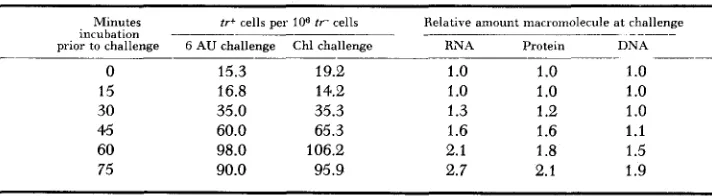
A correlation between RNA synthesis and mutation fixation in UV-irradiated cultures has been described previously (DOUDNEY and HAAS 1959a). The post- irradiation period required for the progression of mutation fixation in the culture can be followed by addition of Chl after varying postirradiation incubation inter- vals. Incubation in the presence of Chl is of sufficient duration to permit “com- plete” mutation frequency decline to take place where the mutation has not been “fixed”; those potential mutations which are fixed will not be affected. This Chl
TABLE 1
Effect of dinitrophenol on “mutation frequency decline” promoted b y chloramphenicol and on subsequent D N A synthesis
ir+ cells Minutes DNP per 106
with Chl present frcells 0 - 112
+
10875
+
10240
+
11520
+
10416
-
10
15
20 -
25 - -
+
112Relative amount DNA after incubation Minutes of incubation
4.5 1.1 1.1 1.2 1.1 1.1 1.2 1.1 1.1 1.2 1 .e
60 75 90
1.5 2.1 2.7 1.4 1.9 2.6 1.5 2.1 2.7
1.5 1.9 2.3 1.4 2.0 2.8 1.5 1.9 2.5 1.5 2.1 2.6 1.4 1.9 2.4 1.5 2.0 2.6 1.4 2.1 2.5
105 3.5 3.5 3.6 2.9 3.5 3.2 3.6 3.3 3.3 3.2
After UV exposure the bacteria were suspended in liquid growth medium (minimal
+
caseni hydrolysate 2 mg per ml and 0.05 mg per ml ;=-tryptophan) containing 20 f i g per ml chloramphenicol and 5 X 1o-S M dinitropherh. Following the indicated periods of incubation a t 37OC, samples of the cultures were rapidly centrifuged out of this medium, resus- pended in fresh growth medium without Chl or DNP and incubation continued. All times given are measured from the start of incubation after UV exposure.1488 C . 0. D O U D N E Y A N D F. L. H A A S
“challenge” technique demonstrates, therefore, that fraction of potential muta- tions which are irreversibly “fixed” at any given interval of incubation following UV irradiation.
LIEB (1960) has questioned the validity of the mutation fixation concept, since she regards the amount of DNA formed during the Chl challenge period as sig- nificant in determining the level of induced mutation frequency observed. How- ever, the level of mutation fixation can be related to postirradiation RNA forina- tion under conditions where both RNA and DNA synthesis, as well as protein synthesis, are blocked during “challenge”. The uracil analogue, 6-aza uriicil, blocks net RNA, DNA and protein synthesis immediately after addition to the culture. Following UV irradiation, short-term incubation with this analogue produces rapid mutation frequency decline which is correlated with that pro- duced by Chl (DOUDNEY and HAAS 1959b). As demonstrated (Figure l ) , inciiba- tion with this analogue for a time period sufficient for maximum mutation fre- quency decline does not modify significantly the timing of subsequent DNA synthesis. Table 2 demonstrates that mutation fixation, measured by challenge with 6-aza uracil, is correlated with RNA synthesis as is mutation fixation when determined by Chl challenge. It is evident, therefore, that RNA synthesized after Chl addition has no role in mutation induction. These results would be expected only if both RNA and protein synthesis are involved in mutation fixation. Block- age of protein synthesis with Chl would prevent mutation fixation but would allow RNA synthesis to proceed. It is also evident that DNA synthesis during the challenge period is not involved in determining the level of mutation frequency since DNA synthesis does not occur in the presence of 6-aza uracil. Although DNA synthesis does occur in the presence of Chl, the level of mutation induction observed at a given time of Chl addition is identical with that obtained at the same time with 6-aza uracil challenge where no DNA synthesis occurs. Further- more, the synthesis of DNA in the presence of Chl may be prevented with no modification in mutation frequency by addition of 6-aza uracil after 20-minute
TABLE 2
Relation of macromolecular synthesis to “mutation fixation” as measured by chloramphenicol and 6-aza uracil “challenge”
Relative amount macromolecule at challenge
_____
Minutes
incubation tr+ cells pel
106 t r cells
DNA
- ~-
prior to challenge G AU challenge Chl challenge RNA Protein
-
0 15.3 19.2 1
.o
1.o
1.o
15 16.8 14.2 1
.o
1.o
1.o
30 35.0 35.3 1.3 1.2 1
.o
45 60.0 65.3 1.6 1.6 1.1
60 98.0 106.2 2.1 1.8 1.5
75 90.0 95.9 2.7 2.1 1.9
~
incubation in Chl. These results make it appear improbable that DNA synthesis in the presence of Chl is the basic factor influencing the level of mutation fix- ation, as contended by LIEB (1960).
An observation which should be emphasized in this regard is that, once the cells have been incubated in the presence of Chl for the minimum time necessary for the decline in mutation frequency to take place, additional incubation in the presence of this inhibitor does not modify the mutation frequency response (Table 3). The decline process is complete to the minimum level attainable within 30-minute incubation in Chl. It is thus evident that the observed number of “potential mutations” sensitive to Chl challenge decreases with the postirradia- tion incubation, not because of a decrease in rate of the mutation frequency de- cline process or other factors, but because the process of mutation fixation has rendered a portion of the potential mutations insensitive. The same arguments hold for comparable results observed with 6-aza uracil challenge.
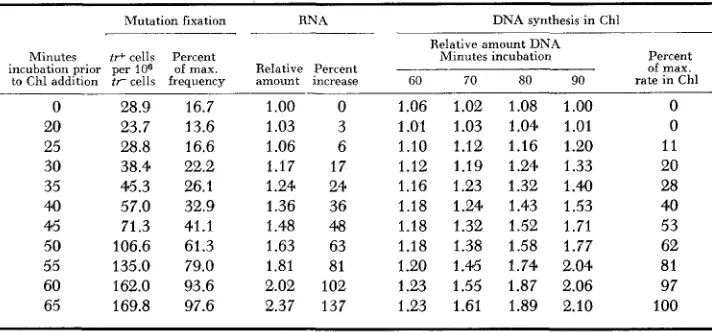
It is evident that if RNA and protein are involved in DNA replication and in mutation fixation (DOUDNEY and HAAS 1958, 1959a), then addition of agents blocking RNA or protein synthesis at a given time of postirradiation incubation would block mutation fixation. Furthermore, DNA synthesis should be blocked where the RNA or protein necessary for DNA replication has not yet been formed. This hypothesis can be tested by use of chloramphenicol since this antibiotic blocks protein synthesis specifically and not DNA synthesis in cells possessing the complete DNA synthesizing mechanism ( DOUDNEY 1960). Table 4 demonstrates that, at any given time of Chl addition following irradia- tion, the capacity of the culture to synthesize DNA without further protein synthesis is related to the amount of postirradiation RNA formed before the antibiotic is added. The culture attains the maximum rate of DNA synthesis in the presence of Chl when RNA has doubled prior to Chl addition. Furthermore, it is evident, from the same data, that a relation exists between mutation fixation and the amount of postirradiation RNA formed. This suggests that mutation
TABLE 3
Mutation frequency decline produced b y chloramphenicol added after various postirradiation incubation periods
Minutes
prior to
tr+ cells per 108 t r cells after incubation in Chl
incubation Minutes in Chl
Chl addition 0 10 15 20 30 40 50 GO
0 112.9 55.0 35.0 30.6 19.6 16.4 17.8 16.5
15 106.8 56.8 34.0 29.6 18.2 16.4 17.8 18.7
30 119.9 62.3 52.1 37.8 28.5 29.8 31.7 30.6
40 115.9 81.3 66.6 41.6 36.5 , 40.7 39.2 38.6
50 111.3 100.6 84.0 87.6 88.0 80.1 76.3 82.1
60 117.6 121.7 107.9 107.6 112.4 118.7 109.8 111.3
1490 C . 0. D O U D N E Y A N D F. L. H A A S
TABLE 4
Relation between “mutation fixation”, amount of R N A synthesized at chloramphenicol addition and subsequent rate of D N A synthesis in presence of chloramphenicol
Mutation fixation
- -
RNA DNA synthesis in Chl Relative amount DNAMinutes ti-+ cells Percent Minutes incubation Percent incubation prior per 106 of max. Relative Percent of max. to Chl addition t r cells frequency amount increase GO 70 80 90 rate i n Chl
0 28.9 16.7 1.00 0 1.06 1.02 1.08 1.00 0
20 23.7 13.6 1.03 3 1.01 1.03 1.04 1.01 0
25 28.8 16.6 1.06 6 1.10 1.12 1.16 1.20 11
30 38.4 22.2 1.17 17 1.12 1.19 1.24 1.33 20
35 45.3 26.1 1.24 24 1.16 1.23 1.32 1.40 28
40 57.0 32.9 1.36 36 1.18 1.24 1.43 1.53 40
45 71.3 41.1 1.48 48 1.18 1.32 1.52 1.71 53
50 106.6 61.3 1.63 63 1.18 1.38 1.58 1.77 62
55 135.0 79.0 1.81 81 1.20 1.45 1.74 2.04 81
60 162.0 93.6 2.02 102 1.23 1.55 1.87 2.06 97
65 169.8 97.6 2.37 137 1.23 1.61 1.89 2.10 100
After UV irradiation the bacteria were diluted into liquid growth medium and incubated. At the indicated times, chloramphenicol was added to separate samples and incubation continued. RNA was determined at the time of Chl addition. Mutation fixation was determined by incubation with Chl for a n additional 45 minutes (a period sufficient for complete Chl-promoted “mutation frequency decline”) and then plating onto nutrient broth supplemented mutation assay agar. Relative increase in DNA was followed during incubation in Chl. The times given are measured from start of incubation following UV exposure. T h e rates of DNA synthesis were calculated for the period between 60 and 90 minutes, and the percent of the maximum rate in Chl then calculated. DNA synthesis i n Chl is linear. The maximum rate of DNA synthesis in Chl was observed with 65-minutes incubation prior to Chl addition. No effect of Chl on survival was observed.
fixation requires the formation of RNA and protein made necessary for DNA replication by the UV irradiation. The data suggest that, if the necessary RNA and protein is formed prior to Chl addition, mutation frequency decline does not take place. The process of mutation fixation therefore appears to be related to the capacity of the cells to synthesize DNA rather than DNA synthesis per se.
the progressive formation of a rate-limiting enzyme system critical for DNA synthesis in the cell is involved.
If we adopt the point of view that the RNA and protein involved in DNA replication functions, not enzymatically, but directly in DNA synthesis ( HAAS and DOUDNEY 1957; DOUDNEY and HAAS 1958, 1959a), then considerations similar to the above would apply. Each cell might rapidly synthesize the total RNA and protein involved, such synthesis requiring only a small part of the time needed for RNA doubling in the culture. Alternately, the RNA and protein required for DNA replication may be synthesized over the entire period required for doubling of RNA in the culture. The latter possibility has a n intriguing implication. Partial formation of the RNA involved in DNA replication prior to Chl addition might lead only to replication of that part of the genome which corresponds genetically to the partially synthesized RNA. In such a case muta- tion frequency decline would take place only for that part of the genome which is not replicated, due to incomplete RNA formation. This suggests the possibility (which should be amenable to test) of “mapping” the genes along the length of the RNA as well as the DNA by this technique. This mapping would be based on differential mutation fixation of different prototrophic characters in a multiple-requiring auxotrophic strain. WITKIN (personal communication) has found evidence from preliminary experiments which indicates that mapping of
genes along the replicating bacterial genome can be accomplished by the Chl challenge technique.
Reduction in mutation frequency by use of purine and pyrimidine analogues:
Several purine and pyrimidine analogues have been shown to promote a decline in mutation frequency, but only after a considerable period of incubation (DOUDNEY and HAAS 1959b). Among these analogues are 5-hydroxyuridine (5-HU) and 6-mercaptopurine. The decline promoted by these analogues is correlated with doubling of RNA in their presence. It appears likely that they exert their effect through incorporation into RNA. The analogues do not block RNA synthesis, but convert synthesis from an “exponential” rate to a “linear” rate. This appears to be typical of those analogues incorporated into RNA or protein and interfering with macromolecular function. These analogues which do not block RNA synthesis do not promote the immediate mutation frequency decline process, as do analogues which are not incorporated, but are capable of
blocking synthesis, i.e., 6-aza uracil (DOUDNEY and
HAAS
1959b). We have suggested that the lower mutation frequency promoted by 5-HU is due to synthesis of “nonfunctional” or “rejected” RNA produced by analogue in- corporation (DOUDNEY and HAAS 1959a). The mutagenic substrate (i.e., the UV-modified purine or pyrimidine) would be used up in the synthesis of this RNA according to this hypothesis.1492 C . 0. DOUDNEY A N D F. L. HAAS
on minimal medium containing a concentration of amino acids which is limiting to mutation frequency (DOUDNEY and HAAS 1959a). Such experiments estab- lished that amino acids sufficient to increase to maximum the induced mutation frequency are taken into the cell within 30-minute postirradiation incubation and prior to any measurable protein synthesis. Incubation in the presence of high levels of amino acids does not change the course of subsequent net protein synthesis, nor modify mutation fixation, although such treatment does prevent mutation frequency decline. Therefore, the amino acids taken into the cell must actually “do something” to increase mutation frequency response. W e have termed this event “mutation stabilization” for convenience in reference. As one possibility it was suggested that the amino acids interact with nucleic acid precursors so as to “stabilize” temporarily the precursors (including the UV- modified precursors) for subsequent nucleic acid synthesis ( DOUDNEY and HAAS
1959a). The possible involvement of nucleotide-amino acid complexes in both nucleic acid and protein synthesis has been previously suggested. However, it seems probable that “mutation stabilization” involves more than formation of amino acid-nucleotide complexes since the blockage of RNA or protein synthesis does not prevent formation of such complexes but does lead to mutation frequency decline. Since no net RNA or protein synthesis can be detected during this period, it may be that RNA and protein synthesis involved in mutation stabiliza- tion is quantitatively minor.
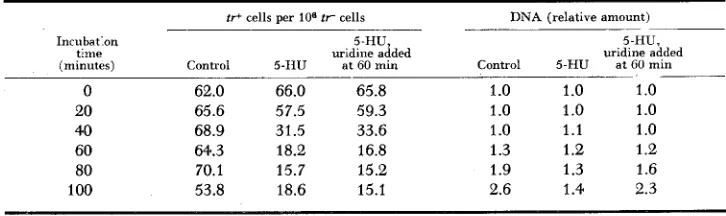
The timing of the loss of ability of 5-HU to reduce the level of mutation frequency has considerable bearing on our insight into the nature of the “pre- mutational” state following UV irradiation. If loss of susceptibility to 5-HU promoted decline (which is found correlated with initial doubling of RNA) is correlated with the mutation stabilization process which occurs considerably earlier, then the data would suggest that, in order to reduce mutation frequency, the 5-HU must interact with amino acids in the same way as the hypothetical mutagenic nucleic acid precursors in mutation stabilization.
Figure
4
shows that the effect of 5-HU in lowering mutation frequency is lost in close correlation with the time course of mutation stabilization; 5-HU added after 30-minute incubation has no effect on the mutation yield. These data are in line with the hypothesis that the “potential mutation” exists initially as a modified nucleic acid precursor, and that both the modified precursor and 5-HU must undergo similar interactions with amino acids in order to exert their respective effects. On this basis, incorporation of the modified precursor leads to mutation, while incorporation of 5-HU leads to production of biologically in- effective RNA.5-HU reduces mutation frequency in correlation with RNA synthesis, no sig- nificant delay in DNA synthesis is observed when the analogue is counteracted by addition of uridine at initiation of DNA synthesis. The RNA and protein formed in the presence of 5-HU must therefore be adequate for DNA synthesis, but inadequate for mutation induction. All enzymes required for DNA synthesis
' I -
C O - 7 7 $0 i o do 5'0 $0 40 do
&
POSTIRRADIATION INCUBATION (MINUTES)
FIGURE 4.-Loss of effectiveness of 5-hydroxyuridine in decreasing mutation yield with incu- bation following UV irradiation. The control curve demonstrates the mutation frequency ob- served with plating on nutrient broth supplemented mutation assay agar after the indicated time of incubation in minimal medium supplemented with casein hydrolysate (2 mg per ml) and DL-tryptophan (0.05 mg per ml). The
+
5HU curve demonstrates the effect on mutation fre- quency of incubation in this same medium supplemented with 5-hydroxyundine (5 mg per 100 ml). The RNA+
5HU curve demonstrate relative RNA increase in the presence of 5-hydroxy- uridine during the same period. The 5HU challenge curve demonstrates the effect upon mutation frequency of addition of 5-hydroxyuridine at the indicated time (rather than zero time), and incubating to the 90-minute postirradiation incubation time prior to plating. No effect of 5- hydroxyuridine on survival was noted.TABLE 5
Effect of incubation with 5-hydroxyuridine on mutation yield and on D N A synthesis
ir+ cells per 108 t r cells
Incubat'on 5-HU,
(minutes) t:me Control 5-IIU uridine added at GO min
0 62.0 66.0 65.8
20 65.6 57.5 59.3
40 68.9 31.5 33.6
60 64.3 18.2 16.8
80 70.1 15.7 15.2
100 53.8 18.6 15.1
D N A (relative amount) -
5-HU,
uridine added
Control 5-€iU at GO min
- _ _ _
1 .o 1 .o 1 .o 1
.o
1.o
1 .o 1 .o 1.1 1 .o1.3 1.2 1 .e
1.9 1.3 1.6
2.6 1.4 2.3
~~
1494 C. 0. DOUDNEY A N D F. L. HAAS
either must have been present following UV exposure or were formed in the presence of 5-HU. The hypothesis that the RNA required is intimately involved in transfer of genetic information fits the 5-HU data since introduction of 5-HU into this RNA could lead to defective RNA. It would be presumed that, in turn, defective DNA unable to perform its obligatory genetic role would be synthesized as a consequence of the defective RNA; the cell would then revert to the ‘‘old” DNA for its genetic information. If this is true, the expected mutation yield would not be observed even though RNA and DNA synthesis took place as usual. Only through further experimentation can this possibility be established or rejected.
D N A synthesis
in
the mutation induction process: W e have previously re- ported experiments which strongly suggest that DNA synthesis is the terminal event in mutation induction (HAAS and DOUDNEY 1959,1960). These experiments also indicate that DNA synthesis must be followed by a period of protein syn- thesis if the induced mutations (reversion of the tryptophan requirement in this case) are to be expressed. It seems quite probable that, in these experiments with strain WP2, we are dealing with the initial action of the reverted gene and that the increase in mutation frequency observed on minimal agar after increasing periods of incubation in complete medium is due to the appearance of the missing enzyme involved in tryptophan synthesis which is controlled by the mutated gene. The most reasonable explanation for the results of the experiments is that the final step in the process of UV-induced mutation requires synthesis of DNA but that the mutation cannot express itself phenotypically until the gene has had time to establish the production of the required enzyme.W e have recently carried out experiments with thymine- and amino acid-re quiring double auxotrophs of E. coli in which the mutation followed was rever- sion of the amino acid requirement. It was found that absence of thymine pre- vents mutation expression in these strains but does not lead to mutation frequency decline as determined by subsequent plating onto amino acid- and thymine-con- taining medium. These results appear to be a direct demonstration of the neces- sity for DNA synthesis in mutation induction. It is quite clear from the experi- ments that delay in DNA synthesis due to lack of thymine does not modify mutation frequency in the absence of the conditions which promote the active de- cline process. These studies of mutation induction in thymine-requiring strains of
E. coli will be fully described in a separate communication.
1495
MINUTES OF POSTIRRADIATION INCUBATION
FIGURE 5.-Relation to RNA and DNA synthesis of loss of susceptibility of “potential muta- tions” to photoreversal with postirradiation incubation. At the indicated times of incubation in liquid growth medium, samples of the culture were chilled and held in ice bath at 2°C either in photoreversing light (two General Electric 500 watt projection bulbs at a distance of six inches) or in the dark for one hour (a period of white light exposure giving maximum photoreversal) prior to plating on nutrient broth supplemented mutation assay agar. At the same times RNA and DNA relative to unincubated controls were determined with identical samples. Maximum mutation frequency observed for control cells (no photoreversal) was approximately 90 proto- trophs per 106 surviving organisms. Survival following this dose of UV was approximately 50 percent. The white light treatment resulted in photoreactivation to the 70 percent level of sur- vival when applied without incubation. This effect was not apparent after 20-minutes incubation.
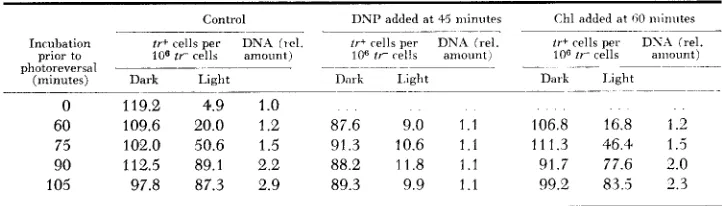
portion of the reversions induced, loss of photoreversibility is correlated with the progression of DNA synthesis. Loss of photoreversibility occws at a rapid rate with initiation of DNA synthesis; at the time that DNA has doubled approxi- mately 85 percent of the potential mutations are no longer photoreversible. The initial loss of photoreversibility, occurring at 20-40-minute incubation and prior to initiation of DNA synthesis, may represent some physical or chemical trans- formation of the potential mutation to a nonphotoreversible state through a process not connected with DNA synthesis. In this regard, the initial loss of photoreversibility appears to be correlated with initiation of RNA synthesis in the culture, although this relation may be fortuitous.
1496 C . 0. D O U D N E Y A N D F. L. HAAS
TABLE 6
Effect of chloramphenicol and dinitrophenol on loss of mutation photoreuersibility
Control DNP added at 45 minutes Chl added at 60 niiniites
. ~ _ _ _ _ _ _ _ ~ ~~
Inrubation t i + cells per DNA fiel. tr+ rells per DNA irel. i r + rells per D S A (rel. prior to 106 ir cells amount) 106 fr cells amount) 106 ti- cells amount) (minutes) Dark Light Daxk Light Dark I i g h t
. - _ _ _ _ - ~
photoreversal ~- -
0 119.2 4.9 1.0 . .
60 109.6 20.0 1.2 87.6 9.0 1.1 106.8 16.8 1.2
75 102.0 50.6 1.5 91.3 10.6 1.1 111.3 46.4 1.5
90 112.5 89.1 2.2 88.2 11.8 1.1 91.7 77.6 2.0
105 97.8 87.3 2.9 89.3 9.9 1.1 99.2 83.5 2.3
After UV Irradration the hacteria were incubated i n liquid grnwth meduuu T o one set of three identical series of cultures dmutrophenol ( 5 X 10 3 M ) was added a t 45 minuies incuhdtiou, to one other set chloramphenicol 120 f i g per m l ) was added at GO minutes incubation 4 t the indicated tuner of inruhation samples were taken, rentrifuged washed with cold minimal medium, recentrifuged and iesuspended i n minimal medium and held In a n ice hath in the dark or
exposed to intense vlhite light for one hour (a period of tune snik,ent for ma\mium photoie\ersal) The inciea-e 111 DNA
ielatl\e t o unmcuhated controls w a s determined a t the tinies the caniples mere tahcn
protein synthesis; it thus appears that protein synthesis is not invol.ied in the process.
The question of involvement of protein synthesis in that earlier loss of photo- reversibility which occurs prior to DNA synthesis cannot readily be tested since treatment with Chl during this period leads to some degree of “mutation fre- quency decline.” However, DNP blocks this earlier loss of photoreversibility indicating that energy is required for the transformations involved
These experiments suggest that the greater proportion of the potential muta- tions induced by UV exist in a state susceptible to photoreversal until DNA replication. Therefore, whatever the nature of the involvement of the potential mutation in the processes of mutation fixation (which occur prior to DNA synthesis), these transformations do not compromise the photoreversibility of the “potential mutation.” This would seem reasonable if the potential mutation exists originally as a mutagenic nucleic acid precursor which may be “photo- reversed” to a nonmutageiiic condition. If this precursor is incorporated into RNA during mutation fixation as we have suggested, then it must be assumed that the mutagenic nucleotide remains photosensitive in the RNA. If, conversely, one assumes that the damage leading to mutation is induced directly in the DNA, either in one o r both strands, then this DNA damage must be photo- reversible until DNA replication. This question cannot be resolved until the nature of the chromophore f o r UV-induced mutation is established. The fact is clear, however, that the initial synthesis of DNA after UV exposure is the “copy- ing” event leading to a photostable “error” in the genome.
DISCUSSION
with which we are concerned in this paper. The second type of UV-induced mutation is stable and is not influenced significantly by postirradiation condi- tions. Similar considerations appear to hold for X-ray induced mutations. While a portion of the latter are influenced by postirradiation conditions, another portion is refractory to these treatments (HAAS and DOUDNEY 1958; KADA, BRUN and MARXOVICH 1960). Complete expression of this latter type of X-ray-induced mutation can be observed within a short period following irradiation and in the absence of DNA synthesis (KADA, DOUDNEY and HAAS 1960). RNA and protein synthesis is required for expression but apparently not for induction.
Since we do not know the chemical nature of the unstable condition which leads to UV-induced mutation at this time, we prefer to refer to it simply as the “potential mutation.” While our studies suggest that the potential mutation is initially in the form of a mutagenic nucleic acid precursor formed by the action of UV on a purine or pyrimidine-containing monomer (HAAS and DOUDNEY
1957), no conclusive evidence exists to support this hypothesis. The possibility remains that the initial UV damage is to the cellular DNA or to other sites. It is quite evident that the potential mutation can be influenced by metabolic conditions. Conditions leading to mutation require RNA and protein synthesis which is quantitatively minor and apparently not related to the gross synthesis of these macromolecules in the culture. The term “mutation stabilization” has been used to indicate those interactions increasing or supporting mutation and occurring prior to any measurable net macromolecular synthesis. The effective- ness of mutation stabilization seems to determine the frequency of mutation under ordinary conditions. In this special sense, the original view of WITKIN
(1956) that protein synthesis determines the level of mutation induction is valid. While the nature of mutation stabilization is not known, it is quite attractive to interpret it as a “templating” or preparatory process to gross macromolecular synthesis in the cell. This possibility is supported by the evidence that 5- hydroxyuridine must participate in a process correlated with mutation stabiliza- tion in order to lower the induced mutation frequency (presumably through subsequent incorporation into RNA).
If mutation stabilization does not occur, it is evident that a n antagonistic or competitive process occurs which removes the potential mutation from pathways leading to mutation induction. This process we have termed “mutation frequency decline.” The process appears to be enzymatic since a Qlo of approximately two
is obtained based on the rate of mutation frequency decline in the culture at various temperatures of incubation (WITKIN 1956; DOUDNEY and HAAS 1958). Energy is required since DNP blocks the process, but it is clear that protein and RNA synthesis is not required in the process. DNA synthesis is evidently not required since the process occurs in the absence of thymine as deduced from studies of UV-induced reversion of the amino acid requirement in thymine- and amino acid-requiring double auxotrophs of E . coli (DOUDNEY and HAAS, unpub- lished results).
1498 C . 0. DOUDNEY A N D F. L. HAAS
mutation frequency decline. If one assumes that the potential mutation resides initially in the DNA existing at the time of UV irradiation, then the decline process may be ascribed to ?epair” of the UV damage. The hypothetical repair mechanism could not involve RNA, DNA or protein synthesis, but would require energy. If the alternate view is taken that the potential mutation resides in a UV-modified nucleic acid precursor, then any process removing this precursor from the synthetic pathway of the nucleic acids involved in genetic replication would prevent mutation. In the case of the auxotrophic reversion the possibility that mutation frequency decline is due to a selective lethal effect caused by blockage of RNA or protein synthesis, on cells bearing potential mutations, cannot be eliminated although such selectivity seems extremely unlikely. In the case of the “color mutants” distinguished on EMB agar this possibility ap- pears to be ruled out since such lethality was not observed with mutation fre- quency decline where the potential mutation-containing cells constituted a relatively large portion of the total survivors (DOUDNEY and HAAS 1958).
Whatever the nature of the mutation frequency decline process, it is evident that this process can be carried to completion without influencing materially the timing or the rate of subsequent macromolecular syntheses definitely involved
in mutation induction. Treatments sufficient to reverse (or prevent) all sus-
ceptible mutations produce little or no effect on subsequent RNA, DNA or protein synthesis. For this reason, the processes involved either in mutation frequency decline or in mutation stabilization would appear to take place prior to the RNA and protein synthesis made necessary by UV irradiation to further DNA replica- tion (HAROLD and ZIPORIN 1959; DOUDNEY 1959; DRACULIC and ERRERA 1959). It should be emphasized that these findings effectively rule out any hypothesis for mutation frequency decline based on treatments which modify only the timing of DNA synthesis so as to take advantage of decay of a “premutational” state at a constant rate (KIMBALL, GAITHER and WILSON 1959), or disappearance of “mutagens” at a rate not influmced by the treatment (LIEB 1960).
Postirradiation incubation in complete medium clearly leads to fixation of the potential mutation in the sense that blockage of RNA or protein synthesis will no longer promote mutation frequency decline after some synthetic event has occurred. Mutation fixation (measured by challenge procedures involving
specific blockage of RNA or protein synthesis) appears to be correlated with
initial doubling of RNA in the culture. There appears to be a relation of the amount of postirradiation RNA synthesized at the time of chloramphenicol ad- dition to the rate of DNA synthesis in the presence of Chl and to the level of induced mutation obtained after Chl challenge. Only where the RNA and protein necessary for genetic replication is formed prior to Chl addition can DNA be produced. If this RNA and protein is not formed at the time Chl is added, the potential mutation is lost through the mutation frequency decline process. It
rather than DNA synthesis per se, is necessary for mutation fixation (since DNA synthesis during the Chl challenge period is’unnecessary)
.
DNA synthesis appears to be firmly established as the terminal event in UV- induced mutation. Loss of susceptibility of the potential mutation to photo- reversal appears to be intimately correlated with doubling of the DNA. Further- more, mutation expression follows DNA synthesis and will not occur in its absence. Protein synthesis following DNA synthesis is necessary for mutation expression (HAAS and DOUDNEY 1959).
A number of hypotheses have been advanced in regard to the mechanism of mutation induction by UV. One possibility is that the W damage occurs to the genetic DNA, and that gene action (the synthesis of RNA on the DNA template) in some manner “fixes” this damage. With subsequent DNA replication the functional mutated gene would be formed. It is difficult to explain a number of observations on this basis. The mutation frequency decline process cannot be reasonably accounted for; the 5-hydroxyuridine effect in decreasing mutation frequency remains unexplained, since it is difficult to see why RNA incorporating 5-HU would be. less effective in fixing mutation according to this hypothesis than “normal” RNA. In our opinion the hypothesis for UV-induced mutation which most adequately reconciles the reported experimental data is that which we have previously advanced ( DOUDNEY and HAAS 1958, 1959a). According to this hypothesis, DNA synthesis involves transfer of information from the parental DNA to the daughter DNA through an RNA-protein intermediate. On this basis, incorporation of a UV-modified RNA precursor into the RNA would lead to a copying error” involving substitution of a different nucleotide pair in the sub- sequently formed daughter DNA.
Little experimental support at the molecular level exists for this indirect mechanism of DNA replication at present. A possibility which might be con- sidered is that the DNA replicates under the usual circumstances according to the scheme proposed by WATSON and CRICK (1953), but following UV irradiation this mechanism is inactivated. In this case, the cell might revert to an alternate mechanism for DNA formation which involves an intermediate transfer of in- formation to RNA. On this basis, we could account for most of the mutation induction data, as well as the necessity for RNA and protein synthesis in DNA replication following UV irradiation.
It is quite clear that none of the above hypotheses or speculations have been established and that a considerable amount of further experimentation is neces- sary before mutation induction will be understood. However, the investigations reported here indicate some of the directions which future experimentation must take. Moreover, in view of the mesmeric effect of the WATSON and CRICK hypothesis for DNA replication on research in this area, with its support at the enzymatic level by the definitive studies of KORNBERG and co-workers, it should be pointed out that no conclusive evidence has been reported to support this direct complementary scheme for DNA replication, either in living systems o r for formation of functioning genetic DNA. Accordingly, other less direct mech-
1500 C. 0. DOUDNEY A N D F. L. H A A S
anisms for DNA replication must be thoroughly investigated and considered. This is especially true in understanding UV-induced genetic change which clearly involves not only DNA synthesis, but also synthesis of the other primary infor- mation-bearing macromolecules of the cell, RNA and protein.
SUMMARY
Postirradiation treatments blocking RNA o r protein synthesis lower markedly the ultraviolet-induced mutation frequency (reversion of tryptophan require- ment) in Escherichia coli strain WP2. Treatments of less than 20 minutes reduce the mutation frequency to a minimal level without significant modification of the time or rate of subsequent synthesis of RNA, DNA and protein. Therefore, the mutation frequency decline process apparently is an active process, probably enzymatically mediated, and not dependent on delay in postirradiation macro- molecular synthesis. The progressive loss of susceptibility of the potential muta- tion to these treatments is closely correlated with the progression of ribonucleic acid synthesis in the culture. A relation exists between the amount of RNA synthesized at the time of chloramphenicol addition, the relative rate of DNA synthesis in the presence of chloramphenicol, and the induced mutation fre- quency. Apparently, only when the RNA and protein necessary for genetic replication is synthesized prior to chloramphenicol addition will DNA be formed. When the RNA and protein involved has not been formed, the potentiality for mutation is lost through the active decline process.
Decline in induced mutation frequency is promoted by 5-hydroxyuridine after a considerable lag. This decline is correlated with the doubling of RNA in the culture suggesting that the analogue causes the decline through incorporation into the RNA. However, loss of susceptibility to the 5-hydroxyuridine-promoted reduction in mutation frequency occurs prior to measurable RNA synthesis and is correlated with the mutation stabilization process. Incubation with 5-hydroxy- uridine of sufficient duration to prevent all sensitive mutations does not delay DNA synthesis.
Several lines of evidence indicate that DNA synthesis is the terminal event in UV-induced mutation. However, delay of DNA synthesis does not modify UV- induced mutation frequency in the absence of the active decline process unless drastic treatments are employed which grossly alter cellular metabolism. Loss of mutation photoreversibility is correlated with DNA synthesis in the culture. Dinitrophenol (but not chloramphenicol) blocks the loss of mutation photo- reversibility.
ACKNOWLEDGMENTS
The authors wish to express their appreciation for the technical assistance of
MISS ETHELYN LIVELY and MR. ROY SKOGLUND in carrying out these
LITERATURE CITED
BURTON, K., 1956
DOUDNEY, C. O., 1959
A study of the conditions and mechanisms of diphenylamine reaction for the
Macromolecular synthesis in bacterial recovery from ultraviolet light.
Inhibition of nucleic acid synthesx by chloramphenicol in synchronized cultures of
Postirradiation modification of ultraviolet induced
Mutation induction and macromolecular synthesis in bacteria. Proc. Natl. Acad. Sci.
Effect of piirke and pyrim;d;ne analogues on reversion of a tryptophan-requiring
Chloramphenicol sensitive DNA synthesis in normal and
A relation of nucleic acid synthesis to radiation induced
Interrelations of nucleic acid and protein synthesis in radiation-induced mutation in
Mutation induction and expression in bacteria. Proc. Natl. Acad. Sci. U.S. 45: 1620-
Correlation of loss of photoreversibility of ultraviolet-induced mutations with deoxy-
Synthesis of protein and of DNA in Escherichia coli
Etude comparee de l'induction de mutants chez
Some biochemical factors in X-ray-induced colorimetric estimation of deoxyribonucleic acid. Biochem. J. 62 : 315-323.
Nature 184: 189-190.
Escherichia coli. J. Bacteriol. 79: 122-234.
mutation frequency and survival in bacteria. Pro-. Natl. Acad. Sci. U.S. 44: 390-398.
U.S. 45: 709-722.
strain of Esdzerichia coli. Nature 184: 114-115.
irradiated bacteria. Biochim. et Biophys. Acta 31 : 459-453.
mutation frequency in bacteria. Proc. Natl. Acad. Sci. U.S. 43: 871-883.
bactxia. Proc. Intern. Conf. Peaceful Uses Atomic Energy, Geneva 22: 336-341.
1624.
ribonucleic acid synthesis. Nature 185 : 637-638. HAROLD, F. M., and Z. Z. ZIPORIN, 1958
irradiated with ultraviolet light. Biochim. et Biophys. Acta 29: 439-440. KADA, T., E. BRUN, and H. MARXOVICH, 1950
Escherichia coli, par les rayons U.V. et le; rayons X. Ann. Inst. Pasteur (In press).
K 4 D A , T., C. 0. DOUDNEY, and F. L. HAAS, 1960 mutation in bacteria. Genetics (Abstr.) 45: 995.
KELNER, A., 1944 Photorestoration of ultraviolet-irradiated Escherichia coli with special refer- ence to the dos?-reduction principle and to ultraviolet-induced mutation. J. Bacteriol. 58 :
5 1 1-522.
Growth, respiration and nucleic acid synthesis i n ultraviolet-irradiated, and in photo- reactivated Escherichia coli. J. Bacteriol. 65 : 252-262.
Reduction of mutation by postirradiation treatment after ultraviolet ar,d various kinds of ionizing radiations. Radiation Res. 10 :
490-497. 19SO
DOUDNEY, C. O., and F. L. HAAS, 1958
1959a
1959b
DRACULIC, M., and M. ERRERA, 1959
HAAS, F. L., and C. 0. DOUDNEY, 1957
1958
1959
1960
1953
KIMBALL, R. F., N. GAITHER, and S. NI. WILSON, 1959
LIEB, M., 1960
LOWRY, 0. H., A. C. ROSEBROUGH, and R. J. R<NDALL, 1951
Deoxyribonucleic acid synthesis and ultraviolet-induced mutation. Biochim. e t
Protein measurement with the Folin Biophys. Acta 37: 155-157.
phenol reagent. J. Biol. Chem. 193: 255-275. MATNEY, T. S., D. M. SHANKEL, and 0. WYSS, 1958
without attendant lethality. J. Bactzriol. 75 : 180-183. NEWCOMBE, H. B., and H. A. WHITEHEAD, 1951
NOVICK, A., and L. SZILARD, 1949
Mutations induced by ultraviolet light
Photoreversal of ultraviolet induced mutagenic
Experiments o n light-reactivat;on of ultraviolet inactivated and lethal effects in Escherichia coli. J. Bacteriol. 61 : 243-251.
1502
CGUR, M., and G. ROSEN, 1950
of desoxypentose nucleic acid and pentose nucleic acid. Arch. Biochem. 25 : 262-276. VISSER, E., and E. CHARGAFF, 1948
pyrimidines i n minute amounts. J. Biol. Chem. 176: 703-714. WATSON, J. D., and F. H. CRICK, 1953
nucleic acid. Nature 171 : W 9 6 7 . WITKIN, E. M., 1956
C. 0. D O U D N E Y A N D F. L. HAAS
The nucleic acids of plant tissue. I. The extraction and estimation
The separation and quantitative estimation of purines and
Genetic implications of the structure of desoxyribose
Time, temperature and protein synthesis: A study of ultraviolet-induced mutation in bacteria. Cold Spring Harbor Symposia Quant. Biol. 21 : 123-140.
Postirradiation metabolism and the timing of ultraviolet-induced mutations in bacteria. Proc. 10th Intern. Congr. Genet. 1 : 280-299.
The effect of posttreatments with chloramphenicol on various ultraviolet-induced mutations in Escherichia coli. Proc. Natl. Acad. Sci. US. 46: 226-232.
1958