
Vol. 4, Issue 2, February 2015
Study of Photon Interaction Parameters for
Some Oxide Glasses as Gamma Ray Shielding
Materials
Sandeep Gupta
1, Gurdeep Singh Sidhu
2Assistant Professor, Department of Physics, Punjabi University College, Dhilwan (Barnala), Punjab, India1
Department of Physics, Govt. Girls Sen. Sec. School, ChakRuldu Singh Wala, Bathinda, Punjab, India2
ABSTRACT: Gamma ray shielding properties of three oxide glasses, viz. 65CaO-35Al2O3 (OG1), 20Na2O-80SiO2
(OG2) and 20Na2O-5Al2O3-75SiO2 (OG3) have been evaluated in terms of exposure buildup factor, equivalent atomic
number parameters. Gamma ray exposure buildup factor for chosen oxide glasses has been computed using five parametric geometric progression energy range of 15 keV – 15 MeV, up to the penetration of 40 mfp. The buildup factors have been studied as functions of incident photon energy and also studied equivalent atomic number (Zeq) as a
function of incident photon energy. The results are presented in the forms of graphs. This change results from the dominance of different interaction process in different energy regions. Also here we conclude that glass samples of high Zeq and low EBF show as good shielding nature.
KEYWORDS: Oxide glasses, Buildup factor, Equivalent atomic number (Zeq), G-P fitting formula.
I. INTRODUCTION
Radiological protection, is the science and practice of protecting people and the environment from the harmful effects of ionizing radiation.Ionizing radiation is widely used in industry and medicine, and can present a significant health hazard. It causes microscopic damage to living tissue, which can result in skin burns and radiation sickness high exposures known as "tissue effects", and statistically elevated risks of cancer at low exposures known as "stochasic effects".Different types of ionizing radiation interact in different ways with shielding material. The effectiveness of shielding is dependent on the stopping power of radiation particles, which varies with the type and energy of radiation and the shielding material used.
so we required materials which are used as shielding from gamma radiation. Oxide glasses are the good systems which are used as shielding materials. Typical applications of radiation shielding glasses are in airport security X-ray screens, for dental clinic, X-ray and radiation protection spectacles, hospital X-ray rooms, laboratories, nuclear facilities, space technology for protecting human being. Apart from good shielding property, the selection of a suitable shielding material is based on availability, effectiveness, application constraints and economic considerations.In easy words, shielding, or the attenuation of gamma radiation, occurs through the interaction of the gamma radiation with matter. The degree to which gamma radiation is attenuated is dependent upon the energy of the incident gamma radiation, the atomic number and density of the elements in the shielding material, and the thickness of the shielding. Composite materials may offer additional benefits in chemical resistance, physical durability, and portability.
II. THEORETICALBACKGROUNDS
The concept of buildup factor is introduced by White [1]; Further Fano [2] recognized the importance of buildup factor in attenuation studies. Eisenhaur and Simmons [3], using the moments method, calculated the point isotropic buildup factors in concrete up to a penetration depth of 40 mfp for energy range 15 keV to 15 MeV.
Vol. 4, Issue 2, February 2015
using these materials to make shields for protection from the ionizing radiations. Different methods such as G-P fitting method [4], invariant embedding method [5]. American National Standards ANSI/ANS 6.4.3 [6] has used point kernel Geometric Progression (G-P) fitting method and provided buildup factor data for 23 elements, one compound (water) and two mixtures (air and concrete) at 25 standard energies in the energy range 0.015- 15.0 MeV up to the penetration depth of 40 mean free path (mfp).
Recently, shielding effectiveness of different materials have been investigated by various researchers, namely, Kumar et al.[7], Kurudirek and Topcuoglu [8], Nil kucuket al.[9], V.P. Singh et al.[10] and Tejbir Singh et al. [11].Chemical composition of oxide glasses (for 100 gm. of glass) are taken from book of J-E Shelby [12]. In the present work, an attempt has been made to verify shielding effectiveness of selected low cost, light weight and low-Z, oxide glasses in the selected energy range by computing equivalent atomic number (Zeq) and exposure buildup factor (EBF) in the
energy region 15 keV-15.0 MeV up to penetration depths of 40 mfp.
III. COMPUTATIONAL WORK
Calculation of mass attenuation coefficient
A narrow beam of mono-energetic photons having an initial intensity I0 is attenuated to an intensity „I‟ after passing
through a layer of material with mass-per-unit-area „x‟, according to the exponential law: I = I0e - /.x
, where is the mass attenuation coefficient. That equation can be rewritten as:
=ln I
I x
0
Therefore, mass attenuation coefficient (m = ) can be calculated by substituting the measured values of I0 , I and
x in above equation.
Calculation of buildup factor
To calculate the buildup factors, the G-P fitting parameters were obtained by the method of interpolations from the equivalent atomic number (Zeq).
A. Calculation of Zeq
Firstly the values of the Compton partial attenuation coefficient (µcompton) and the total attenuation coefficients (µtotal) in
cm2g-1 were obtained for the elements from Z = 4 to 40 and for the chosen oxide glasses systems in the energy range 15 keV to 15.0 MeV, using the XCOM computer programme [13]. The value of Zeq for the oxide glasses system was
calculated by matching the ratio (µcompton /µTotal) of a particular oxide glasses system at a selected energy with the
corresponding ratio of an element at the same energy. For those cases where the ratio value lies between two ratios for known elements, the value Zeq was interpolated using the following formula [14-15]:
1 2
1 2
2 1
log log
) log (log ) log (log
R R
R R Z R R Z
Zeq
(1)
Here, Z1 and Z2 are the elemental atomic numbers corresponding to the ratio (µcomp/µtotal) R1 and R2 respectively and R
is the ratio for the chosen oxide glasses system at a particular energy. Which lies between ratios R1 and R2. The value
of zeqfor the different oxide glasses systems so obtained are given in Table II, III, and IV.
B.Calculations of Geometric Progression (GP) Fitting Parameters
The Zeqvalues obtained from step (A) above were used to calculate GP fitting parameters (a, b, c, d, and X k ) for
exposure buildup factors using the following interpolation formula[14-15]
(2)
whereZ1and Z2are the atomic numbers of elements between which the equivalent atomic number (Zeq) of a given oxide
glasses system lies and P1and P2are the values of G-P fitting parameters corresponding to the atomic numbers Z1 and Z2
Vol. 4, Issue 2, February 2015
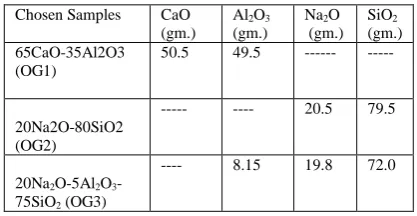
Table I: Chemical composition of oxide glasses (for 100 gm. of glass) [12].
Chosen Samples CaO
(gm.)
Al2O3
(gm.)
Na2O
(gm.) SiO2
(gm.) 65CaO-35Al2O3
(OG1)
50.5 49.5 --- ---
20Na2O-80SiO2 (OG2)
--- ---- 20.5 79.5
20Na2O-5Al2O3
-75SiO2 (OG3)
---- 8.15 19.8 72.0
Table II: Zeqand Energy Absorption G-P Fitting Parameters for
(OG1) in the Energy Range 0.015-15.0 MeV
Energy [MeV]
Zeq a b c d Xk
.0150 .0200 .0300 .0400 .0500 .0600 .0800 .1000 .1500 .2000 .3000 .4000 .5000 .6000 .8000 1.000 1.500 2.000 3.000 4.000 5.000 6.000 8.000 10.00 15.00 15.14 15.29 15.45 15.50 15.56 15.64 15.66 15.90 15.99 14.96 14.50 14.50 14.50 14.50 14.50 14.50 14.50 12.88 13.59 13.58 13.23 13.51 13.63 13.82 13.63 1.0177 1.0407 1.1291 1.2936 1.5179 1.8215 2.6082 3.2037 3.8361 3.7097 3.1212 2.7932 2.5802 2.4381 2.2435 2.1194 1.9420 1.8349 1.6970 1.5997 1.5318 1.4598 1.3695 1.3695 1.2114 .3830 .3790 .3886 .4217 .4994 .5628 .6740 .8491 1.1659 1.4137 1.5545 1.5486 1.5222 1.4858 1.4169 1.3580 1.2374 1.1606 1.0542 .9955 .9457 .9402 .9092 .9139 .8841 .2250 .2148 .2172 .2037 .1685 .1473 .1160 .0577 -.0232 -.0697 -.0954 -.0959 -.0934 -.0890 -.0795 -.0710 -.0500 -.0500 -.0092 .0060 .0210 .0230 .0342 .0335 .0468 11.9164 18.0424 13.8792 14.7057 14.9390 14.6970 13.2731 13.6087 12.9490 16.0999 14.3025 14.9057 15.0887 14.9744 15.1461 14.9953 14.6903 14.8355 11.2431 12.7753 14.2765 15.1227 12.7483 13.5159 14.2702 -.1329 -.2182 -.1195 -.1156 -.0923 -.0789 -.0764 -.0524 -.0106 .0129 .0261 .0275 .0277 .0270 .0254 .0242 .0177 .0110 -.0028 -.0102 -.0231 -.0281 -.0293 -.0298 -.0442
Table III: Zeq and energy absorption G-P fitting parameters
for (OG2) in the energy Range 0.015-15.0 MeV Energy
[MeV]
Zeq a b c d Xk
.0150 .0200 .0300 .0400 .0500 .0600 .0800 .1000 .1500 .2000 .3000 .4000 .5000 .6000 .8000 1.000 1.500 2.000 3.000 4.000 5.000 6.000 8.000 10.00 15.00 11.34 11.38 11.44 11.46 11.47 11.51 11.49 10.56 10.92 10.50 10.50 10.50 10.50 10.50 10.50 10.50 10.50 9.757 10.33 10.66 10.57 10.86 10.81 10.57 10.73 1.0461 1.1077 1.3528 1.7525 2.3816 2.9663 3.9732 4.3669 4.0422 3.5776 3.0060 2.7106 2.5294 2.3969 2.2251 2.1108 1.9370 1.8427 1.7068 1.6147 1.5438 1.4801 1.3893 1.3280 1.2277 .4062 .4162 .4598 .5951 .6822 .8480 1.1389 1.3533 1.7389 1.8340 1.7989 1.7230 1.6512 1.5817 1.4763 1.3928 1.2542 1.1589 1.0504 .9833 .9455 .9281 .9026 .8906 .8886 .2019 .1954 .1850 .1272 .1082 .0559 -.0195 -.0619 -.1251 -.1373 -.1341 -.1341 -.1166 -.1063 -.0915 -.0783 -.0543 -.0351 -.0094 .0087 .0189 .0242 .0329 .0366 .0388 12.1012 14.5305 14.4962 15.7651 14.3164 13.7389 13.0074 12.9377 13.5499 13.8092 13.9036 14.1412 14.2544 14.5235 14.7899 14.7550 14.2844 14.7010 11.3661 13.1413 12.7464 15.9342 12.2827 13.9262 14.7223 -.1060 -.1044 -.0973 -.0666 -.0658 -.0417 -.0043 .0158 .0496 .0534 .0499 .0459 .0427 .0382 .0337 .0291 .0208 .0132 -.0006 -.0115 -.0147 -.0271 -.0229 -.0284 -.0330
Table IV:Zeq and energy absorption G-P fitting parameters for
(OG3) in the energy Range 0.015-15.0 MeV Energy
[MeV]
Zeq a b c d Xk
Vol. 4, Issue 2, February 2015
C. Calculation of exposure build-up factors
The G-P fitting parameters were then used to generate exposure buildup factor data for these materials using the following geometric Progression fitting given by Harima et al. [16]:
1
)
1
)(
1
(
1
)
,
(
K
K
b
x
E
B
x
for K ≠ 1 (3)
B (E,x) = 1+ (b-1)x for K=1 (4) Where
for (5)
IV. RESULT AND DISCUSSION
The exposure buildup factor data has been generated by interpolation method using the G. P. fitting formula for the various gamma ray interaction parameters such as equivalent atomic numbers and buildup factors and have been studied as a function of incident photon energy.
Effect of Incident Photon Energy on Exposure buildup factor of chosen samples:-
The variation of generated exposure buildup factor with incident photon energy at fixed penetration depths for chosen samples is shown in figs. 1-3.
It is observed that exposure buildup factor values of chosen materials start increasing with increase in incident photon energy up to a maximum value at intermediate energies and then further start decreasing with increase in incident photon energy.
It is observed that generated exposure buildup factor values are low in the incident photon energy range 10KeV to 100 KeV. It is due to predominance of photo electric effect in this energy region, which results in fast removal of low energy photons there by not allowing these photons to buildup.
It is further observed that in the energy range 100 KeV to 500 KeV the generated values of exposure buildup factor values are high for a given penetration depth. It is due to dominance of compton effect, which only helps in the degradation of photon energy and fails to remove a photon completely. Because of multiple scattering of photons they exist for longer time in material which leads to a higher value of buildup factor. It is also observed that the generated exposure buildup factor value is very high at incident photon energy around 200 KeV, because of exclusive dominance of compton effect.
Furthermore it is observed that for incident photon energies greater than 1.0 MeV, the dominance of pair production phenomenon over compton effect increases, so values of generated exposure buildup factor decreases.
It is also observed that the generated exposure buildup factors increases with increase in penetration depth for chosen material. This is because of the reason that with increase in penetration depth the probability of multiple scattering increases which results in the increase of multiple scattered photons of low energy, hence in the increased value of generated exposure buildup factor.
tanh( /
2) tanh( 2)
( , )
1 tanh( 2)
a
x X
kK E x
cx
d
Vol. 4, Issue 2, February 2015
Comparison of EBF of chosen oxide glasses with respect to Lead glass EBF calculated by PALLAS code Fig. 4 to 6 shows the variation of ratio of EBF of oxide glasses to EBF of lead glass calculated by PALLAS code [17]. At incident photon energy 0.15 MeV, ratio is increasing with penetration depth, also the increasing rate of OG2 and OG3 is rapid and it becomes 1000 times at 40 mfp as compared to OG1 for which ratio increases only 100 times. But at 1.5 MeV all ratios show similar trends and slightly increase and at 40 mfp it becomes only 4 times for all glasses. At 15 MeV ratio which is less than 1, decreases with increase in penetration depth and at 40 mfp its value are approx. 0.011, 0.008 and 0.008 for the three glasses. So we conclude that at lower energies up to 1.5 MeV EBF of samples is greater than lead glass and at 15 MeV it is lower which further interprets that at higher energy all chosen samples shows good shielding effectiveness than lead but at lower energies lead glass show good shielding nature than all samples.
Comparison of Mass attenuation of coefficient of chosen samples with mass att. coeff.oflead glass calculated by PALLAS Code
Vol. 4, Issue 2, February 2015
10-2 10-1 100 101
10-1 100
R
at
io
O
f ma
ss
at
t.
C
oe
ff.
o
f
oxi
de
g
la
ss/
L
ea
d
G
la
ss
Incident photon Energy (MeV) OG1
OG2 OG3
Fig. 7 Variation of ratio of mass attenuation coeff. of oxide glasses calculated by interpolation method and of lead glass calculated by PALLAS with incident photon energies(in MeV)
Comparison of Equivalent atomic number of chosen samples with equivalent atomic number of concrete[17] Fig 8 shows the comparison of Zeq of oxide glasses and equivalent atomic number of concrete which conclude that all
samples whether oxide glasses or concrete show the almost same values of Zeq with little variation. We know that
concrete is low cost and easily available and by this comparison it can also be concluded that it has a good shielding effect as that of oxide glasses.
0.01 0.1 1 10
-30 -20 -10 0 10 20 30 40 50
Zeq
Incident Photon Energy (MeV) OG1 OG2 OG3 Concrete
Fig. 8 Variation of Equivalent atomic number of oxide glasses and concrete with incident photon energies(in MeV)
V. CONCLUSION
In the present study, it is concluded that the radiation energy exposure parameters are useful for deciding of the shielding effectiveness of oxide glasses used for specific constructions. During interaction of gamma ray photon with matter, the values of these parameters are dependent on the physical and chemical environments of the material. The G-P fitting formula has been successfully applied for the computation of the exposure buildup factor of three oxide glasses. The generated EBF has been studied as a function of penetration depth, photon energy.
Significant increase in EBF has been observed for three oxide glass systems in energy region of 0.2 MeV approximately, where Compton scattering predominates. The variation of EBF with incident photon energy seem to be independent of chemical composition of above materials beyond 2.0 MeV.
By comparing the variation of ratio of EBF of oxide glasses to EBF of lead glass calculated by PALLAS code, it is concluded that at higher energy all chosen samples shows good shielding effectiveness than lead glass but at lower energies lead glass show good shielding nature than all samples.
By comparing the variation of ratio of mass attenuation coeff. of all samples with respect to mass attenuation coefficient of lead glass calculated by PALLAS code, we conclude that From 0.8 to 4 MeV all samples show better shielding effectiveness than lead glass.
Vol. 4, Issue 2, February 2015
REFERENCES
1. G.R.White, “The Penetration and Diffusion of 60Co Gamma-Rays in Water UsingSpherical Geometry”, Phys. Rev. , vol. 80, pp. 154–156, 1950. 2. U.Fano, “Gamma-Ray Attenuation Part II – Analysis of Penetration”,Nucleonics, vol.11, pp. 55–61, 1953
3. C.M.Eisenhaur andG.L.Simmons, “ Point Isotropic Gamma Ray Buildup Factors inConcrete”,Nucl. Sci. Eng., vol. 56, pp. 263–270, 1975 4. Y. Harima, Y. Sakamoto ,S. Tanaka, and M. Kawai,“Validity of the Geometric Progression Formula in Approximating Gamma Ray Buildup
Factors”,Nucl. Sci. Eng.,vol. 94, pp.24- 35, 1986
5. Shimizu, T.Onda and Y. Sakamoto, “Calculations of Gamma-RayBuildup Factors up to Depths of 100 mfp by the Method ofInvariant Embedding, (III) Generation of an Improved Data Set”, J.Nucl. Sci. Technol., vol. 41, pp. 413- 424, 2004
6. Report ANSI/ANS.6.4.3. ,”Gamma-Ray AttenuationCoefficients and Buildup Factors for Engineering Materials”,American Nuclear Society, La Grange Park, Illinois, 1991
7. S.P. Kumar and T.K. Umesh, “Effective Atomic Number of CompositeMaterials for Compton Effect in the Gamma Ray Region”,Appl. Radiat. Isot.,vol. 68, pp. 2443- 2447, 2010
8. M. Kurudirekand S. Topcuoglu, “Investigation of Human Teeth WithRespect to the Photon Interaction,Energy Absorption and BuildupFactor”, Nucl. Instrum. Methods Phys. Res., Sect. B, vol. 269,pp. 1071-1081, 2011
9. Nil kucuk, ZeynalTumsavas and MerveCakir, “Determining Photon Energy Absorption Parameters for Different Samples”, Journal of Radiation Research, vol. 54,pp. 578-586, 2013
VI. P. Singh and N. M. Badiger, “Comprehensive Study of Energy Absorption and Exposure Buildup Factor for Concrete Shielding in Photon Energy Range 0.015–15 MeV upto 40 mfp Penetration Depth: Dependency of Density, Chemical Element, Photon Energy,” International Journal of Nuclear Energy Science and Technology, vol. 7, No. 1, pp. 75–99, 2012
10. Tejbir Singh, Naresh Kumar and Parjit S. Singh,” Chemical Composition Dependence of Exposure Buildup Factors for Some Polymers,” Annals of Nuclear Energy, vol. 36, pp. 114-120, 2009
11. J-E Shelby, “Introduction to Glass Science and Technology”, 2nd Edition, The Royal Society of Chemistry, pp. 33- 34, 2005
12. L. Gerward, N. Guilbert, K.B. Jensen and H. Levring,“X-ray Absorption in Matter.ReengineeringXCOM”,RadiatPhys Chem., vol. 60, pp. 23-24, 2001
13. Y. Harima, “An Approximation of Gamma Ray Buildup Factors by Modified Geometrical Progression”,Nucl. Sci. Eng., vol.83, pp. 299-309, 1983
14. M. J. Maron , “Numerical Analysis: A Practical Approach, Macmillan”, New York, 1987
15. Y. Harima, Y. Sakamoto, S. Tanaka and M. Kawai, “Validity of the Geometric Progression Formula in Approximating Gamma Ray Build up Factors”,Nucl. Sci. Eng., vol. 94, pp. 24-35, 1986
![Fig. 4 to 6 shows the variation of ratio of EBF of oxide glasses to EBF of lead glass calculated by PALLAS code [17]](https://thumb-us.123doks.com/thumbv2/123dok_us/1679746.1211817/5.595.92.513.469.653/shows-variation-ratio-oxide-glasses-glass-calculated-pallas.webp)

