Division III
Sensitivity analysis of the Thermo-Hydro-Mechanical parameters affecting
double walled Nuclear Power Plants behaviour
El-Mahdi Bouhjiti1, 2,*, Julien Baroth1, Frédéric Dufour1, 3 and Benoît Masson4
1 Univ. Grenoble Alpes, CNRS, Grenoble INP†, 3SR, F-38000 Grenoble, France
2 Grenoble INP Partnership Foundation – Chair PERENITI (EDF SEPTEN/DTG/CIH), Grenoble, France 3 Chairholder, Chair PERENITI (EDF SEPTEN/DTG/CIH), Grenoble, France
4 Electricité De France (EDF-SEPTEN), Lyon, France
ABSTRACT
The purpose of this article is to identify the most influent parameters of a given thermo-hydro-mechanical (THM) finite elements (FE) model with regards to nuclear power plants (NPP) ageing. The term ageing here refers to the continuous drying and also crack evolution in time within massive concrete volumes. These two aspects are actually one of the key factors that affect the serviceability of NPPs, especially the air tightness of their nuclear containment buildings (NCB). In this paper, we are particularly interested in two things: (a) the early age cracks that may develop during the first hydration hours and (b) the drying of concrete when exposed to low relative humidity values. After a brief presentation of the proposed weakly coupled THM model, a deterministic analysis is performed using the mean values of our concrete’s THM properties at the Representative Structural Volume (RSV) scale. Then, the effect of the variation of each input parameter on the model’s response is estimated using a qualitative variance based sensitivity analysis. Finally, a list of the selected most influent parameters is retained for calibration purposes and future quantitative in-depth analyses. Code_Aster®, Mfront® and Python routines have been developed to apply the proposed approach to the gusset RSV of the VERCORS mock-up (1:3 scale of a double walled NCB).
INTRODUCTION
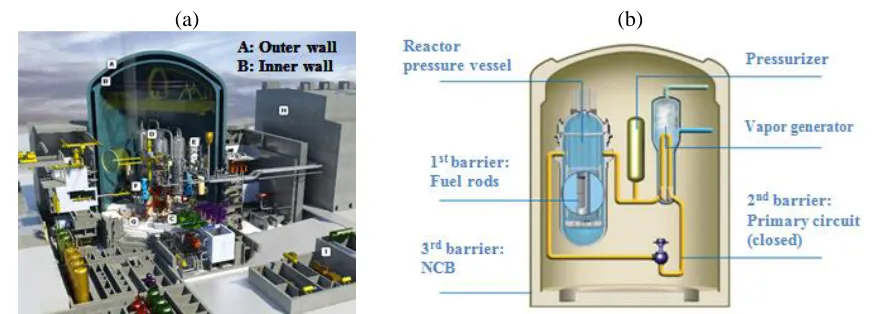
In double walled nuclear containment buildings (NCB – Figure 1a), the inner wall (Figure 2a) is made out of reinforced and prestressed concrete (Figure 2b). Being a part of the third and final barrier, the inner wall ensures most of the static containment in case the first and second defence barriers fail to prevent the escape of radioactive steam or gas (Figure 1b). However, because of the ageing nature of concrete, the air tightness of the inner wall decreases with time which may affect the serviceability of the NCB on the long term. On the one hand, there is the continuous reduction of the concrete’s saturation rate due to drying; which increases the reachable porous domain for air particles. Indeed, the relative humidity in the surrounding environment under operational conditions is usually less than the one in the concrete’s porous media. On the other hand, water content evolution in time induces several delayed strains such as drying shrinkage or drying creep which amplify prestressing losses in the embedded tendons and reduce the compressive loads in concrete thickness. This might lead, particularly, early age cracks to reopen under pressurization loads and therefore increase the air leakage rate through the inner wall. Therefore, the early age cracks and drying of concrete seem to be the most critical aspects with regards to NCB durability and air tightness criteria. In this article, we are investigating the effect of physical or numerical thermo-hydro-mechanical (THM) properties on concrete damage at early age and drying.
*
Corresponding author: [email protected] / [email protected]
†
(a) (b)
Figure 1. (a) Design of double walled NCB (b) Three barriers in NCB (defence in-depth)
After giving a brief review of the used THM model as presented in Bouhjiti and al. (2016), a deterministic analysis is performed using the mean values of VeRCoRs concrete properties issued from Corbin and Garcia (2015). In line with the purpose of this study, the variables of interest are cracking pattern of concrete at early age and its water content evolution in time. Finally, a variance based sensitivity analysis Sobol (2001) is conducted at the scale of the representative structural volume (RSV) of the first lift of the inner wall (the gusset –Figure 3). The most influent parameters are then listed in the order of their importance with regards to the concrete air tightness.
(a) (b)
Figure 2. 3D FE model of the VeRCoRs mock-up (a) Inner wall (b) Embeded prestressing cables
Figure 3. 3D FE model of the VeRCoRs gusset (15° angle of revolution)
Concrete Steel FE 3D Quadratic 1D linear
THERMO-HYDRO-MECHANICAL MODELING OF CONCRETE BEHAVIOUR
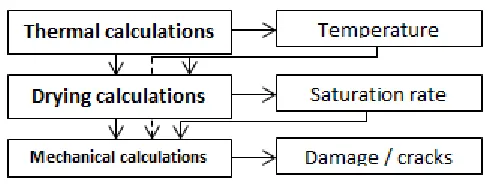
The general modelling strategy is presented in Figure 4 where a weakly coupled (or chained) THM calculations is selected Bouhjiti and al. (2016).
Figure 4. General THM modelling strategy
The thermal behaviour of concrete is modelled using the classical heat equation considering the convective exchange modes and the exothermic nature of cement reaction with water. Accordingly, a source term is added to describe the released heat during hydration Ulm and Coussy (1998).
The second step is about computing the water content evolution in concrete volumes. The diffusivity factor of water is described by Equation 1 from Granger (1995):
(
( )
) (1)
where C refers to the water content (l/m3), is the reference temperature (°K), is the desiccation activation energy (J/mol), R the universal gas constant and the pair (A,B) is obtained by numerical calibration based on the drying test under controlled hydrothermal environment.
The effect of the ambient relative humidity on the concrete’s saturation rate is modelled using Neumann type boundary conditions (Equation 2). The relationship between the relative humidity and the water content is defined by Equation 3 in Thiery and al. (2007).
⃗ ⃗ ( ) (2)
(
(
(
))
)
(3)
where is the hydric exchange coefficient (l/m3
x m/s) and
is the relative humidity.
is the initial water content after the end of hydration (l/m3) and are fitting parameters of the desorption curve. In usual concrete mix design, the initial water content is more than the one needed for cement hydration. This means that concrete remains saturated during its hydration and even afterwards as long as the curing process is applied. For that reason, the ratio can be considered equal to the saturation rate . The final step deals with the mechanical behaviour of concrete. For that purpose, the total strain isdivided into five components (Equation. 4): the elastic strain , the thermal strain , the endogenous
shrinkage , the drying shrinkage and the creep strain . In Equation. 6 basic creep is described
according to the Burger rheological model Foucault and al. (2012) and drying creep is modelled by
(4)
( ) ( ) (5)
(6)
where is the coefficient of thermal, endogenous or drying shrinkage, is the normalized hydration ratio ( ), is the percolation threshold and ( ).
The ageing of the mechanical properties of concrete at early age is modelled using the maturity method De Schutter and Taerwe (1996) based on Equation 7. As for the viscoelastic properties of concrete (parameters related to creep), their dependence on the hydration rate is defined according to De Schutter (1999).
( ) ( ) (
) (7)
where is the fitting parameter which depends on the observed early age evolution of the mechanical property X.
Concrete damage is described according to the isotropic unilateral µ-Mazars damage model Mazars and al. (2015). The compliance tensor is computed using Equation 8 where the damage variable d tends to 1
as the concrete’s equivalent strain exceeds the damage threshold (equal to the yield strain
defined by the ratio of the tensile strength to the Young’s modulus ). The damage state is computed considering elastic strain and a portion of the creep strain Torrenti and al. (2008). To
avoid mesh dependency, the local model is regularized based on the Hillerborg energy criterion. Size effects are modelled by reducing the structural tensile strength by a ratio and by modelling the
spatial variability of concrete’s Young’s modulus E using a log normal random field. Accordingly, the autocorrelated field has a mean value equal to E, a coefficient of variation denoted CVE and a fluctuation length lflu describing the spatial variability of the Young’s modulus (see Table. 1) as detailed in Bouhjiti and al. (2017b).
( )
(8)
Lastly, crack openings are post-processed from the strain field using Equation. 9 Bouhjiti and al. (2017b):
||
( ) ( )
|| (9)
where is the characteristic length of the finite element
√
and|| || (
) with
are the Eigen values of a given tensor .
VARIANCE BASED SENSITIVTY ANALYSIS
decrease (respectively the increase) of the parameter by a coefficient of variation . and are
the obtained responses when the variable varies whereas the other inputs are maintained constant. The first order sensitivity index associated with the parameter writes after standardization:
√ [ ]
∑ √ [ ]
(10)
We are also considering two other indices and for quantitative analysis of the THM parameters
effect which are simply the relative differences between the reference response and or
(Equation. 11).
(11)
If N is the number of inputs, then there are 2N+1 simulations to be run. This min/max approach is a first step of our sensitivity analysis in order to identify the most influent parameters that will be subjected to in-depth probabilistic analysis. Moreover, it allows the identification of the key parameters for calibration purposes using a limited number of simulations.
NUMERICAL ANALYSIS: THM ANALYSIS OF THE VERCORS GUSSET RSV
Numerical experimental design
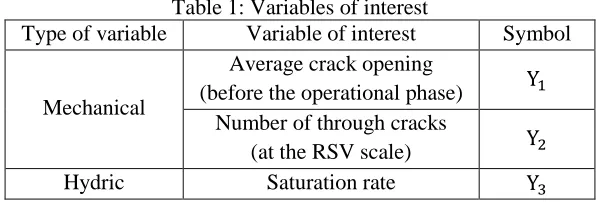
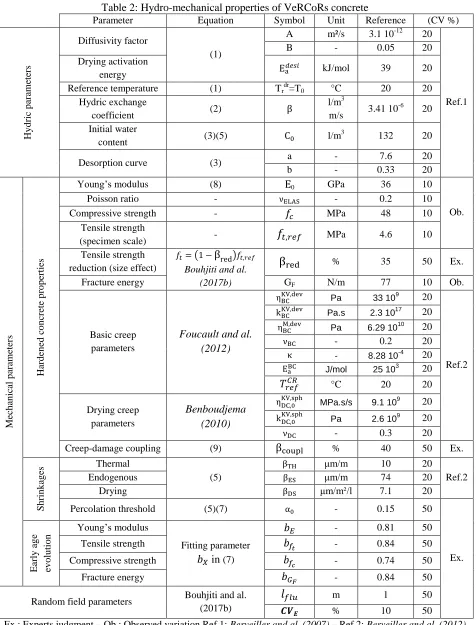
In this study, the variables of interest are presented in Table 1. The various inputs along with the variation domain of each one are detailed in Table 2. Only the hydro-mechanical properties are presented in this paper. More data are available in Bouhjiti and al. (2016 and 2017b) and Corbin and Garcia (2015).
Table 1: Variables of interest
Type of variable Variable of interest Symbol
Mechanical
Average crack opening (before the operational phase)
Number of through cracks (at the RSV scale)
Hydric Saturation rate
Sensitivity analysis of early age cracking
Table 2: Hydro-mechanical properties of VeRCoRs concrete
Parameter Equation Symbol Unit Reference (CV %)
Hy d ric p ar am eter s Diffusivity factor (1)
A m²/s 3.1 10-12 20
Ref.1
B - 0.05 20
Drying activation energy
kJ/mol 39 20
Reference temperature (1) Trdr=T0 °C 20 20
Hydric exchange
coefficient (2)
l/m3
m/s 3.41 10
-6 20 Initial water
content (3)(5) l/m
3 132 20
Desorption curve (3) a - 7.6 20
b - 0.33 20
Me ch an ical p ar am eter s Har d en ed c o n cr ete p ro p er ties
Young’s modulus (8) 0 GPa 36 10
Ob.
Poisson ratio - - 0.2 10
Compressive strength - MPa 48 10
Tensile strength
(specimen scale) - MPa 4.6 10
Tensile strength reduction (size effect)
( ) Bouhjiti and al.
(2017b)
% 35 50 Ex.
Fracture energy GF N/m 77 10 Ob.
Basic creep parameters
Foucault and al. (2012)
Pa 33 109 20
Ref.2
Pa.s 2.3 1017 20
Pa 6.29 1010 20
- 0.2 20
- 8.28 10-4 20
J/mol 25 103 20
°C 20 20
Drying creep parameters Benboudjema (2010)
MPa.s/s 9.1 109 20
Pa 2.6 109 20
- 0.3 20
Creep-damage coupling (9) % 40 50 Ex.
Sh rin k ag es Thermal (5)
μm/m 10 20
Ref.2
Endogenous μm/m 74 20
Drying μm/m²/l 7.1 20
Percolation threshold (5)(7) - 0.15 50
Ex. E ar ly ag e ev o lu tio
n Young’s modulus
Fitting parameter in (7)
- 0.81 50
Tensile strength - 0.84 50
Compressive strength - 0.74 50
Fracture energy - 0.84 50
Random field parameters Bouhjiti and al. (2017b)
m 1 50
% 10 50
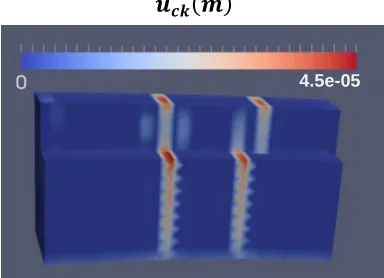
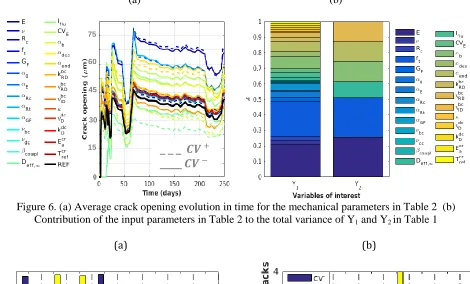
From a predictive point of view, it is important to underline that one analysis using ten random field generations is not, in any case, enough to predict all of the observed cracking patterns. Given the computational time required for such analysis (about 12 hours), Monte Carlo methods seem inaccurate. That remains the major drawback of the use of random fields in the case of strongly nonlinear problems. In the framework of our sensitivity analysis, the random field (uncorrelated) is fixed so as to account for the inputs’ variation effect on concrete cracking only. And the considered cracking pattern is the one showed in Figure 5. In Figure 6a, the evolution of the mean crack opening in the gusset RSV is depicted for all the min and max values of the considered inputs. The main parameters that seem to affect crack opening values are the mean values of the Young’s modulus and the tensile strength, their evolution with the hydration rate and, in a less pronounced way, the endogenous and thermal shrinkage coefficients (Figure 6b and Figure 7a). Based on Figure 7a, the Young’s modulus and the tensile strength have opposite effects; that is expected given the definition of the damage threshold . An increase in
the tensile strength value (or decrease in the Young’s modulus value) would increase the damage threshold but also affects the post-peak behaviour law leading to a more brittle behaviour of concrete Bouhjiti and al. (2017b). A 10 % increase in the Young’s modulus value (which is the intrinsic variation observed on VeRCoRs concrete) would lead to 60 % higher crack opening at early age. On the other hand, the number of cracks would be reduced by 50 %. Meaning that instead of having two cracks as shown in the reference analysis (Figure 5), only one crack is obtained per RSV. The same result is obtained by increasing the tensile strength by 10 % or reducing the endogenous shrinkage coefficient by 20 %. Lastly, the size effect reduction factor seems to affect more the number of cracks rather than the crack opening values. In Figure 7b, 4 cracks are obtained instead of 2 when the is increased by 50 %.
Figure 5. Numerical cracking pattern of VeRCoRs gusset 1 week after casting (2 cracks per RSV)
Sensitivity analysis of concrete drying
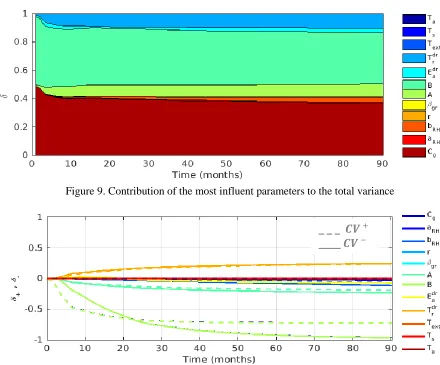
Figure 8 shows the saturation rate evolution with time for all min and max values of the considered hydric parameters in Table 2. The key parameters according to Figure 9 and Figure 10 are the initial water content, the A and B parameters in the diffusivity factor and the reference temperature in the Arrhenius law associated with the drying model (Eq. 1). On the other hand, a 20 % variation of the ambient temperature seems to have no noticeable effect on concrete drying during the operational phase. It is worth noting that the air surrounding the inner wall (intrados side) is 35 °C whereas the air on the extrados side is around 20 °C. Basically, the diffusivity factor has considerably more effect on drying than the desorption curve parameters (Eq. 3) and the surrounding relative humidity; at least, up to 20 % variation of the ambient temperature. In the present study, the temperature is related to the relative humidity by the classical Magnus law in which ‘’ r ’’ the mixing ratio of water in dry air is considered (for VeRCoRs site, it is about 6.3 g/kg Corbin and Garcia (2015)). Compared to the reference analysis, an increase of 20 % of the B parameter (or 20 % decrease of the initial water content) would lead to 80 % less water content in the concrete’s porosity by the end of VeRCoRs ‘’ operational ‘’ life (Figure 8 and
𝒖
𝒄𝒌(𝒎)
Figure 10). Hence, the diffusivity factors have to be identified with more precision at the specimen scale compared to other hydric properties.
(a) (b)
Figure 6. (a) Average crack opening evolution in time for the mechanical parameters in Table 2 (b) Contribution of the input parameters in Table 2 to the total variance of Y1 and Y2 in Table 1
(a) (b)
Figure 7. Numerical relative differences due to the most influent inputs variation for the outputs Y1 and Y2
Figure 8. Saturation rate evolution in time
_ _ _
𝑪𝑽
____𝑪𝑽
_ _ _
𝑪𝑽
____𝑪𝑽
15 30 45 60 75
Figure 9. Contribution of the most influent parameters to the total variance
Figure 10. Numerical relative differences due to the most influent inputs variation (Y3)
CONCLUSIONS
In this paper, a sensitivity analysis is performed to assess the importance of the Thermo-Hydro-Mechanical properties of concrete with regards to its ageing in nuclear containment buildings based on the VeRCoRs mock-up. Two things have been identified as the driving factors of concrete ageing: first the early age cracks and second concrete drying. The variance based analysis we performed shows that for the used THM model, a 10 % variation of the Young’s modulus value or the tensile strength might induce 60 % variation of the observed cracks at early age and increase the spacing between cracks up to 50 %. This shows that, at the RSV scale (15 °) and for any deterministic and predictive analysis, a calibration step might be needed to reproduce at least the same number of cracks regardless of their exact spacing values. Otherwise, due to the use of random fields, several realisations have to be performed for a better description of the cracking pattern probability density function. As for concrete drying, the diffusivity of water particles in the concrete’s porosity and the initial water content in the design mix seem to be the most influent parameters on the long term. Therefore, the identification of such parameters at the specimen scale needs to be precise enough for better predictiveness. Our future work will be geared towards the analysis of the eventual correlations between the most influent parameters using sensitivity approaches of higher orders.
ACKNOWLEDGEMENTS
This work was supported by EDF-SEPTEN/DTG/CIH within the Chair PERENITI agreement with the Grenoble INP Partnership Foundation. The author is grateful to EDF-SEPTEN for the provided in situ measurements at the scale of the operating NCB. The Chair PERENITI partners shall not in any circumstances be deemed liable for the content of this publication which is only binding its author. The 3SR lab is part of the LabEx Tec 21 (Investissements d’Avenir - Grant agreement n°ANR-11-LABX-0030).
REFERENCES
Benboudjema, F. (2010). ‘’Modélisation des déformations différées du béton sous sollicitations bi axiales. Appliquation aux enceintes de confinement de bâtiments réacteurs des centrales nucléaires,’’ PhD thesis UMLV, France.
Berveiller, M., Le Pape, Y., Sudret, B., Perrin F. (2007). ‘’Bayesian updating of long –term creep strains in concrete containment vessels using a non-intrusive stochastic finite element method,‘’ ICASP’10, Tokyo, Japan.
Berveiller, M., Le Pape, Y., Bruno, S. (2012). ‘’Updating the long-term creep strains in concrete containment vessels by using Markov chain Monte Carlo simulation and polynomial chaos expansions,’’ Structure and Infrastructure Engineering, 8 425-440.
Bouhjiti, E-M., Baroth, J., Dufour, F. and Masson, B. (2016). ‘’Damage analysis and prediction of air leakage rate in nuclear reactor containment structures: numerical model validation based on the VeRCoRs mock-up,’’ Proceedings TINCE-03, Paris, France.
Bouhjiti E-M., Baroth J., Dufour F. and Masson, B. (2017b). ‘’Sensitivity analysis of cracking in large reinforced and prestressed concrete structures – Case of the VeRCoRs mock-up,’’ 23rd Congrès Français de la Mécanique, Lille, France.
Code_aster® software: www.code-aster.org and Mfront® software : www.tfel.sourceforge.net
Corbin, M. and Garcia, M. (2015). ‘’Benchmark VeRCoRs report,’’ (conference-service.com/edf-VeRCoRs/welcome.cgi).
De Schutter, G., Taerwe L. (1996). ‘’Degree of hydration-based description of mechanical properties of early age concrete,’’ Materials and Structures, 29 335-344.
De Schutter, G. (1999). ‘’Degree of hydration based kelvin model for the basic creep of early age concrete,’’ Materials and Structures, 30 260-265.
Foucault, A., Michel-Ponnelle, S. and Galenne, E. (2012) ‘’A new creep model for NPP containment behaviour prediction,’’ Proceedings SSCS’2012, Aix-en-Provence, France.
Granger, L. (1995). ‘’Comportement différé du béton dans les enceintes de centrales nucléaires,’’ PhD thesis ENPC, France.
Mazars, J., Hamon, F. and Grange, S. (2015). ‘’A new 3D damage model for concrete under monotonic, cyclic and dynamic loadings,’’ Materials and Structures, 48 3779-3793.
Sobol’, I., M., (2001). ‘’Global sensitivity indices for nonlinear mathematical models and their Monte Carlo estimates,’’ Mathematical and Computers in Simulation, 55 271- 280.
Thiery, M., Baroghel-Bouny, V., Bourneton, N., Villain, G. and Stefani, C. (2007). ‘’Modélisation du séchage des bétons. Analyse des différents modes de transfert hydrique,’’ Revue Européenne de Génie Civil, 11 541-577.
Torrenti, J.M., Nguyen, V. H., Colina, H., Le Maou, F., Benboudjema, F. and Deleruyelle, F. (2008). ‘’Coupling between leaching and creep of concrete,’’ Cement and concrete research, 38 816-821. Ulm, F.-J. and Coussy, O. (1998). ‘’Couplings in early-age concrete: From material modeling to