Copyright 0 1997 by the Genetics Society of America
Mdtilocus Evolution
in
Fire
Ants:
Effects
of
Selection,
Gene
Flow
and
Recombination
Kenneth
G . Ross
Department of Entomology, University of Georgia, Athens, Georpa 30602-2603
Manuscript received September 3, 1996
Accepted for publication December 16, 1996
ABSTRACT
The reproductive success of individual fire ant queens (Sotmopsis invicta) previously has been shown
to be strongly influenced by their genotype at a single enzyme-encoding gene, designated Ppn-3. This
paper presents evidence that a second, tightly linked gene, designated Gp-9, is under similarly strong
selection in these ants. Selection appears to act independently on the two genes and is detectable in
only one of the two social forms of this species (the “polygyne” social form, in which nests contain
multiple fertile queens). Strong directional selection on Pgm-3 in this form involves worker destruction
of all queens with genotype Pgm-? before they reproduce. Selection on Cp9is more complex, involving
both lethality of all Gp&* females and a strong or even complete survival advantage to reproductive
queens with the heterozygous genotype
Gp-Fb.
Pgm-3 and 9 - 9 are tightly linked (r, = 0.0016) andexhibit strong gametic phase disequilibrium in introduced populations in the U.S. This disequilibrium seems not to have stemmed from the founder event associated with the introduction, because the same
associations of alleles found in the U S . apparently occur also in two native populations in Argentina.
Rather, selection acting independently on Pp1-3 and Gp-9, in conjunction with gene flow from the
alternate, “monogyne” social form (in which nests contain a single fertile queen), may explain the
origin of disequilibrium between the two loci in polygyne fire ants.
E
VOLUTIONARY geneticists seek to understandhow the forces of evolution influence distributions of fitness values and genetic variation in wild popula- tions. Understandably, empirical work on the subject is dominated by studies that focus on only one evolution- ary force. Relatively few examples exist of more com- plex systems in which the roles of two or more major
forces have been analyzed simultaneously (e.g.,
MCNEILLY 1968; ANTONOVICS et al. 1971; KOEHN et al. 1983; RIECHERT 1993; CHEVILLON et al. 1995; KING and LAWSON 1995; reviewed in HEDFWK 1985; BARTON and CLARK 1990). Fewer still involve analysis of the effects of several evolutionary forces on complex traits that depend on several genetic factors for their expression (e.g., CL,EGG et al. 1976;Jo~Es et al. 1977; TURNER 1977; ENNOS 1981; SILVER 1985; MALLET et al. 1990; LYITLE 1991; MORITA et al. 1992; HEDRICK 1994; HOLLOCHER and TEMPLETON 1994; PARHAM and OHTA 1996). Inter- est in such complex systems of multilocus evolution stems in part from concerns over the adequacy of single- locus theory and data for depicting evolutionary pro- cesses (LEWONTIN 1974; BIJLSMA 1978; HEDRICK et al. 1978; HEDRICK 1985; BERLOCHER 1993). These con- cerns can be addressed by considering the following issues in particular model organisms. To what extent is variation at different genes associated? What are the
Addressfor correspondence: Kenneth G. Ross, Department of Entomol- ogy, University of Georgia, Athens, GA 30602-2603.
E-mail: [email protected] Genetics 145: 961-974 (April, 1997)
causes of such associations? How do such associations affect distributions of fitness values? How do they influ- ence genetic variation at the population level?
This paper considers these basic issues of multilocus evolution using the fire ant Solenopsis invicta as a model. The study builds on recent progress made in under- standing how selection and gene flow jointly influence a simple genetic polymorphism in these ants. This ge- netic polymorphism has evolved in the context of a distinctive social polymorphism involving the number of reproductive (egg-laying) queens per colony. In the “polygyne” social form of
S.
invicta, in which colonies contain multiple reproductive queens, strong direc- tional selection acts on the enzyme-encoding gene Pgm-? (phosphoglucomutase-3). Nonreproductive females (the
sterile workers and young queens) commonly possess a homozygous genotype designated as P g m - p , but this genotype is never found in reproductive queens (ROSS 1992; ROSS et al. 1996a). Laboratory studies have re- vealed that
P p - P A
is absent because workers selectively destroy all queens possessing it at an early age (KELLERand ROSS 1993). Remarkably, this strong selection is
962 K. G. Ross
SHOEMAKER 1993; ROSS and KELLER 1995a). Thus, Pgm-
3 gene frequency dynamics in polygyne S. invicta are strongly influenced by the combined effects of both selection and gene flow.
In this paper I show that the influence of these two forces on Pgm-3 in S. invicta is more complicated than previously recognized because of the involvement of a second, closely linked gene. This second gene, desig- nated Gp-9 (general protein-9), appears also to be under strong selection, although this selection is more com- plex and of a different form than that acting on Pgm- 3. Significantly, the alleles of Gp-9 are not randomly associated with those of Pgm-3 (large linkage disequilib- ria exist), so that neither the transmission of alleles nor the population gene frequency dynamics are indepen- dent for the two loci. The goals of this paper are to provide an initial description of the genetics of this complex system and to use this information to begin to address pertinent issues concerning multilocus evolu- tion in wild populations of these ants.
MATERIALS AND METHODS
Sample collection: Samples were collected from intro-
duced (US.) and native (Argentina) populations of S. invicta,
and were obtained from nests of both social forms at most sampling sites. Ants were placed in liquid nitrogen or dry ice in the field and were held at -80” in the laboratory pending electrophoresis.
In the United States, samples were obtained mostly from northern Georgia (Putnam and Walton Cos.). Sexuals [adult
males or nonreproductive (winged) queens] and workers
were collected from each putative monogyne colony sampled in Georgia. Monogyny initially was inferred in the field using well established criteria that distinguish nests of the two forms
(GREENBERG et al. 1985). It was confirmed subsequently in
most nests by genotyping eight or more sexuals from each nest at four polymorphic allozyme loci to verify that the geno- type arrays conformed to those expected for the offspring of
a single, monandrous queen (S. invicta queens mate once;
Ross and FLETCHER 1985; SHOEMAKER et al. 1992; Ross et al.
1993). Polygyny was confirmed for all putative polygyne nests sampled in the United States by capturing several mated re- productive queens per nest. Workers were collected from all
polygyne nests sampled in Georgia, and nonreproductive
(winged) and reproductive (wingless) queens were collected opportunistically from these same nests.
Additional samples of introduced fire ants were collected from two sites outside of Georgia. Newly mated monogyne queens (which had just completed a mating flight and were preparing to found colonies) were obtained from Leon Co., Florida, a site over 400 km from the Georgia study site. Polyg- yny has not been observed at this well studied Florida site
(PORTER 1992; TSCHINKEI. 1993). Reproductive polygyne
queens were collected from their nests in Travis Go., Texas,
a site over 1400 km from the Georgia site.
Samples from Argentina were collected from two geo-
graphic populations centered around the cities of Corrientes (Corrientes Province) and Formosa (Formosa Province). These populations, which are separated by a substantial bio-
geographic barrier (the No Parang), are genetically divergent
at several nuclear loci and their mitochondrial DNA (ROSS et
al. 1996a; K. G. ROSS, unpublished data). Nests of both social
forms occur at each site. Workers were collected from all
sampled nests, and queens (nonreproductive and reproduc- tive) were collected opportunistically. Initial determination of the social form of each nest in Argentina was made using field criteria. These determinations were verified for every nest by inspecting the genotype arrays of 12 or more female
nestmates at 10 polymorphic allozyme loci (Ross et al. 1993).
Scoring of genotypes at Pgm-? and Gp-9 Electrophoresis was conducted on horizontal gels of 14% starch, with visualiza- tion of the banding phenotypes accomplished using specific
histochemical staining in the case of Pgm-? and nonspecific
protein staining in the case of c;P9 (SHOEMAKER et al. 1992).
The products of both loci behave as monomers, with two
staining bands of equal intensity in heterozygotes and single
bands in homozygotes and (Pgm-3 only) haploid males. The
locus P p - 3 is expressed and scorable in all life stages of all
individuals. The protein product of 9 - 9 is not detectable in brood or in males of any developmental stage with current protocols. Furthermore, it only becomes detectable in adult females at a minimum posteclosion age of 8-14 days (data not shown).
Progeny studies have confirmed that the electromorphs of
Pgm-? are inherited in Mendelian fashion (ROSS 1992; SHOE-
MAKER et al. 1992). This locus is biallelic in S. invicta in the United States, whereas several additional rare alleles occur in Argentina, the most common of these at a frequency of <0.05
(ROSS et al. 1996a). The two common allelic variants are desig-
nated here as P p - 9 and P p - 7 (corresponding to Pgm-P
and Pgm-9, respectively, of earlier studies). Data presented
below indicate that the products of Gp-9 also exhibit Mende-
lian inheritance. Only two allelic variants have been detected
in S. invicta; these are designated as Cps” and C$-s’.
Both loci were scored in the same individuals in most sam- ples. The exceptions are workers from the Argentina popula-
tions, where Pgm-3 was scored in worker pupae and C p 9 in
worker adults. Thus, two-locus genotypes are not available for these individuals.
Estimation of genotype and allele frequencies: Nests of fire
ants comprise more or less complex families, so that multiple
genotypes scored from a given nest often are not indepen-
dent. To obtain unbiased genotype and allele frequencies
using all collected data, a resampling procedure was em-
ployed whereby a single one- or two-locus genotype was drawn
at random from each nest in a sample, yielding a distribution
of independent genotypes. Genotype and allele frequencies were estimated as the arithmetic mean frequencies for 1000
such resampled genotype distributions from each original
sample. The 95% confidence intervals (CIS) about the fre-
quency estimates for 13-9 were obtained by dropping the 25 highest and 25 lowest frequency values derived from the 1000 resampled distributions.
Family studies: Sixty mated queens originating from 12 polygyne nests from Walton Co., Georgia were held individu- ally in small rearing chambers in the laboratory with several hundred worker adults and brood originating from the same
parent nest (e.g., Ross and FLETCHER 1985). These rearing
units were provided abundant food and water over a period
of 8 weeks, at which time all worker pupae present were
known to be the offspring of the resident queen (based on
reported brood developmental periods; O’NEAL and MARKIN
1975). Several dozen worker pupae and their mother then
were removed from each unit and transferred into secondary
isolation units. After all workers had eclosed, each secondary unit was held for an additional week to ensure that the work-
ers were sufficiently mature that Gp-9was expressed. The Pgm-
3 and Gp-9 genotypes of all 60 queens and of -30 worker
offspring of each queen were determined.
Estimation of disequilibrium: Values of the Hardy-Wein-
Multilocus Evolution in Fire Ants 963
tures of genotype proportions observed at single loci from those expected under Hardy-Weinberg equilibrium (HWE),
were estimated for Cp9 for all classes of females in all study
populations using Equation 3.1 of WEIR (1996). Statistical
significance of the estimates was determined by calculating the chi-squared test statistic (WEIR 1996, Equation 3.6).
Linkage disequilibrium between Pgm-? and Gp9 was mea-
sured for females in each population when data for both loci were available from the same individuals. Values of the
gametic disequilibrium coefficient ( D A B ) , which measures the
association between alleles at the two loci on the same chro- mosome, were estimated for polygyne queens, their mates, and their worker offspring from the family studies using the procedure of WEIR (1996, p. 113). This was possible because monandry, coupled with male haploidy, permits complete specification of all parental and offspring haplotypes when
crossing over is infrequent (as it is between Pgm-3 and (31-9,
see below). Furthermore, because double heterozygote
queens and workers in the families almost invariably exhibited
the cis (coupling) linkage phase (see below), two-locus haplo-
types could be inferred directly from two-locus genotypes in
the Georgia polygyne population by assuming that trans (re-
pulsion) double heterozygotes are absent in the wild. Thus, gametic disequilibrium could be estimated directly from ge-
notypic data for this population. Estimates of DAB could not
be obtained directly from genotypic data in other populations
because the requisite information on the linkage phase of
double heterozygotes is lacking. Nor could this coefficient be
estimated indirectly using the maximum likelihood approach
of HILL (1974), because departures from HWE observed at
both loci violate the assumptions of this method (WEIR and
COCKERHAM 1979).
Values of the composite genotypic disequilibrium coeffi-
cient ( A A B ) , which measures the summed effects of both the
gametic and nongametic components of linkage disequilib- rium, were estimated from genotypic data for females in all populations (WEIR 1996, p. 126). In the case of the Georgia
polygyne population, where DAB values were available, the
nongametic disequilibrium coefficient (DAIB) also could be
estimated, using the relationship D A / B = A,, - D A B . This
nongametic coefficient measures the nonrandom association between alleles at the two loci on alternate homologous chro- mosomes within diploid individuals. Significance of all three linkage disequilibrium coefficients was evaluated by calculat-
ing the appropriate chi-squared test statistics (WEIR 1996, pp.
113-1 14, 125-127). Values of the disequilibrium coefficients
were normalized according to the specific allele frequencies
for that class of individuals (HEDRICK 1987; WEIR 1996), yield-
ing standardized coefficients designated as A r A B , Dl,,, and
DrAIB that were employed for comparisons across life stages
and populations. The rare alleles at Pgm-? in the Argentina
populations were pooled with allele Pgn-7 for all of the dis-
equilibrium analyses.
The potential nonindependence of genotypes scored from single nests creates a problem in specifjmg sample sizes for
calculating the disequilibrium test statistics (e.g., CROZIER et
al. 1987). The appropriate sample size varies between the
total number of genotypes scored (when nestmate relatedness is low) and the number of nests from which these genotypes
were obtained (when nestmate relatedness is high). A reason-
able approximation of the number of independent diploid
genomes sampled ( n ) can be obtained for female social Hy-
menoptera using the formula n = (3/4r)
-
(3N/2), where ris the population-wide average nestmate relatedness for the
relevant class of individuals and N is the number of nests
sampled (PAMILO 1983; SUNDSTROM 1993). The upper limit
for this adjusted sample size is taken to be the total number of genotypes sampled. Estimates of nestmate relatedness, pre-
viously obtained using allozyme markers for all classes of indi-
viduals in all populations studied here (ROSS and FLETCHER
1985; ROSS 1993; ROSS et al. 1996b), were used to calculate
adjusted sample sizes for evaluating disequilibrium.
RESULTS
Genotype
and
allele frequencies at CpS: Estimates of the frequencies of Gp-9 genotypes and alleles in S. inuictu are presented in Tables 1 and 2 for the mono- gyne and polygyne social forms, respectively. In the mo- nogyne form, the alleleGp-9
is fixed in nearly all study populations (Table 1). The exception is the Corrientes population, where one of the 37 monogyne colonies surveyed contained approximately equal numbers of females with the genotypesGpqB
andGp-y‘,
sug- gesting that the mother queen was a heterozygote.Genotype and allele frequencies at Gp9 in the poly- gyne form differ strikingly from those in the monogyne form (Table
2).
The locus exhibits substantial polymor- phism in polygyne populations, with the frequency of alleleGp9”
(which is essentially absent in the monogyne form) ranging from 0.10 in nonreproductive queens from Corrientes to 0.50 in reproductive queens from the United States. Two remarkable patterns are evident in the Gp9 genotype distributions in the polygyne form. First, the genotypeGpp’
is completely absent in the Argentine populations and virtually so in the United States. Given the large sample sizes and substantial fre- quencies of alleleGp9”
in these populations, the near absence ofGp9”’
females cannot be attributed to sam- pling error. Indeed, the binomial probability of samplingas few
Gpp
females as were found in the United States is <0.0001 if this genotype actually occurs at the frequency expected in the absence of selection (predicted from the family data to be 0.05; see below). The virtual absence of genotypeGppb
in the wild thus suggests the presence of strong viability selection against it.The second notable pattern in the Gp-9 data from polygyne populations is the pronounced and consistent elevation in frequency of genotype
Gpp’
in reproduc- tive queens compared to nonreproductive queens and, especially, workers (Table2).
These heterozygotes are represented in reproductive queens at about twice the frequency as in workers in all polygyne populations. In the United States, essentially all reproductive queens are heterozygotes. This elevated frequency of genotypeGp-9’
in reproductive queens corresponds to substan- tially higher frequencies of alleleGp-9”
in these queens than in nonreproductive females (Table 2). The persis- tent elevation in heterozygosity in polygyne reproduc- tive queens is consistent with some advantage of geno- typeGp9’
overGp-9’
in queens attempting to make the transition from nonreproductive to reproductive status. Thus, locus ( 3 - 9 appears to be subject to over- dominant selection in polygyne S. inuictu colonies; via- bility selection removes allGp-9’
females at some time964 K. G. Ross
TABLE 1
Genotype and d e l e frequencies at (31-9 in the monogyne social form of S. i n h in the United States and Argentina
Genotype frequencies Allele frequencies
BB Bb bb B b
Georgia, U S .
Workers [ N = 82, n = 821 1
.o
Nonreproductive queens [ N = 466, n = 6951 1 .0
Nonreproductive queens [ n = 1301" 1 .0
Workers [ N = 37, n = 4431 0.981
Nonreproductive queens [ N = 24, n = 1341 0.958
Florida, U S .
Corrientes, Argentina
(0.935- 1 .O)
(0.875-1.0) Formosa, Argentina
Workers [ N = 35, n = 4171 1
.o
Nonreproductive queens [ N = 28, n = 1521 1
.o
0 0
0
0.019 (0-0.065)
0.042 (0-0.125)
0
0
0 1
.o
0 1.0
0 1.0
0 0.990
0 0.979
(0.973-1.0)
(0.937- 1 .O)
0 1 .0
0 1
.o
0 0
0
0.010 (0-0.027)
0.021 (0-0.063)
0 0
Sample sizes (in brackets) are for the numbers of nests
(N)
and individuals ( n ) from which genetic data were obtained. The95% confidence intervals are in parentheses.
Individuals were not collected in association with nests, so only n is reported.
hinders or precludes Q-9queens from becoming egg 8' 9 were significantly negative (indicating excess hetero-
layers. zygosity) for reproductive queens from all populations,
A telltale effect of this proposed selection on Gp-9 in as well as for the other classes of females from all popu- polygyne S. invicta is the deviations of the observed lations except Corrientes
( x 2
tests, all P<
0.025). Con- genotype proportions from those expected under sistent excess heterozygosity is predicted because of se- Hardy-Weinberg equilibrium ( H W E ) . Estimates of the lection against one or both homozygotes at Gp-9.Hardy-Weinberg disequilibrium coefficient ( D A ) for C p Inheritance of Gp-9 The unusual distributions of
9-
TABLE 2
Genotype and d e l e frequencies at C p 9 in the polygyne social form of S. invicta in the United States and Argentina
Genotype frequencies Allele frequencies
BB Bb bb B b
~~ ~
Georgia, U.S.
Workers [ N = 181, n = 4061 0.407 0.591 0.002 0.702 0.298
Nonreproductive queens [ N = 95, n = 2791 0.202 0.798 0 0.601 0.399
Reproductive queens [N = 215, n = 15351" 0 0.999 0.001 0.500 0.500
Reproductive queens [ N = 30, n = 4511 0 0.994 0.006 0.497 0.503
(0.346-0.460) (0.540-0.654) (0-0.002) (0.673-0.730) (0.270-0.327)
(0.158-0.252) (0.748-0.842) (0.579-0.626) (0.374-0.421)
Texas, U.S.
(0.966-1.0) (0-0.034) (0.483-0.500) (0.500-0.517) Corrientes, Argentina
Workers [ N = 44, n = 5141 0.777 0.223 0 0.889 0.1 1 1
Nonreproductive queens [N = 19, n = 1751 0.792 0.208 0 0.896 0.104
Reproductive queens [ N = 28, n = 1871 0.530 0.470 0 0.765 0.235
(0.660-0.886) (0.114-0.340) (0.830-0.943) (0.057-0.170)
(0.684-0.894) (0.106-0.316) (0.842-0.947) (0.053-0.158)
(0.500-0.536) (0.464-0.500) (0.750-0.768) (0.232-0.250)
Formosa, Argentina
Workers [N = 35, n = 3991 0.682 0.318 0 0.841 0.159
Nonreproductive queens [N = 23, n = 1711 0.628 0.372 0 0.814 0.186
Reproductive queens [ N = 26, n = 1211 0.385 0.615 0 0.692 0.308
(0.572-0.800) (0.200-0.428) (0.786-0.900) (0.100-0.214)
(0.522-0.740) (0.260-0.478) (0.761-0.870) (0.130-0.239)
(0.200-0.577) (0.423-0.800) (0.600-0.789) (0.211-0.400)
Sample sizes (in brackets) are for the numbers of nests ( N ) and individuals ( n ) from which genetic data were obtained. The
li Informative 95% confidence intervals cannot be obtained for these individuals.
Multilocus Evolution in Fire Ants 965
9 genotypes raise concerns about whether the variants scored are actually the products of a single codominant Mendelian locus. One line of evidence often mar- shalled to support this model in Hymenoptera, the pres- ence of single staining bands in haploid males, is not available for Gp9because no gene product is detectable in males. Nonetheless, several other lines of evidence suggest that this model of inheritance is valid. For in- stance, all three putative genotypes have been found in the wild following an intense sampling effort. Also, the occurrence of rare triploid workers in the Georgia poly- gyne population, indicated by uneven intensities of the staining bands at several monomeric allozyme loci, is revealed also by uneven band intensities for the prod- ucts of Gp-9 (unpublished data).
The most compelling evidence for Mendelian inheri- tance of Gp-9 comes from the family studies. Because all 60 polygyne mother queens heading these families were
Gp-9’
heterozygotes, the diploid offspring of each queen should comprise an even mix of heterozygotes and of homozygotes of one class. All 60 progenies in- deed were mixes of heterozygotes and individuals with a single homozygous genotype. Furthermore, the two genotypic classes occurred in ratios indistinguishable from a 1:l ratio in all but five progenies (binomial tests with probability values corrected using the sequential Bonferroni procedure; HOCHBERG 1988). Significantly, the genotype underrepresented in each of these five progenies wasGp-9’
(the segregation ratio in a sixth family possessingGpp‘
andGp-9”
offspring did not differ significantly from 0.50). Thus, data from the fam- ily studies not only are consistent with Gp-9representing a single codominant Mendelian locus, they also reveal the low viability of genotypeGp-9’
under controlled conditions [although the survival of this genotype in laboratory families was substantially higher than in the wild (0.018 us. 0.002)].Linkage of Pgm-3 and Cp9 The association of Gp-9
genotype with reproductive role in polygyne S. inuicta bears some similarities to the previously reported influ- ence of Pgm-3 genotype. Thus, the relationship between the two genes, in terms of both their frequency of re- combination (linkage) and patterns of association be- tween alleles and genotypes in the wild (linkage disequi- librium), is of interest.
The family data permit specification of the two-locus haplotype composition of parents and offspring, and therefore estimation of the recombination frequency, by the following means. The two-locus genotypes of the polygyne mother queens and their daughters were ob-
tained for each family. Because each queen mates with a single haploid male, the array of genotypes in her daughters can be compared with the mother’s genotype to infer the sole two-locus haplotype of the father’s gametes. The father’s haplotypic contribution then can be subtracted from each daughter’s two-locus genotype to infer the mother’s haplotypic contribution to each
offspring. Recombinant offspring of double heterozy- gote mothers stand out in a large progeny when recom- bination frequencies are substantially <0.5 because of their unusual maternal haplotypic endowment (see EP- PERSON and
ALLARD
1987; NEJATI-JAVAREMI and SMITH 1996).Forty-five of the 60 polygyne queens heading families were double heterozygotes. Among the 1290 worker offspring of these queens successfully reared to maturity and genotyped, only two were inferred to be recombi- nants. The frequency of recombination between C p 9 and Pgm-3 in queens ( 7 ) thus is estimated to be 0.16%. Because the two genes are not inherited independently, the associations of their genotypes and alleles in the wild were next examined.
Two-locus genotype frequencies: Observed two-lo-
cus genotype frequencies for nonreproductive females from the polygyne populations are presented in Table
3 along with the frequencies expected if Pgm-3 and (;lo-
9 were independent (the products of the observed fre- quencies at each locus). The “observed” frequencies for zygotes in the Georgia population are calculated from the genotype distributions in the 60 families by assuming that
Gp-9”
andGp-9”
workers actually segre- gate in a 1:l ratio in the families in which they occur. Thus, these represent projected frequencies in zygotes before viability selection acts against C@-p’’. The most prominent departures from expected frequencies in these zygotes involve excesses of genotypes Ppn-?’(+-
9’
and Pgm-u’”wp”,
as well as deficiencies of geno- types Pgm-9’Gp-9‘
and Pgm-3”“ (;Ps””. These patterns are suggestive of strong positive gametic disequilibrium, as confirmed below, because genotypes that can be composed of haplotypes A B or a h are in excess, whereas those that require haplotypes A b or a R are in deficit. This same association of genotypes at the two loci persists in the adult workers and nonreproductive queens, that is, after selection againstq1-9‘
has oc- curred and selection against Pgm-3A” and C+-s’” in queens has begun. The association is evident in the native (Argentina) as well as the introduced (U.S.) pop- ulations.966 K. G. Ross
TABLE 3
Observed and expected two-locus genotype frequencies for Pgm-3 and G p 9 in nonreproductive females of polygyne S. invictu in the United States and Argentina
Pgm-3: AA A a aa
Gp-9: BB Bb bb BB Bb bb BB Bb bb
Georgia, U S .
Zygotes 0.283 0 0 0.133 0.400 0 0.033 0.100 0.050
(0.127) (0.142) (0.014) (0.240) (0.267) (0.027) (0.083) (0.092) (0.009)
Adult workers 0.256 0 0 0.154 0.437 0 0.006 0.145 0.002
(0.090) (0.137) (0.001) (0.244) (0.370) (0.002) (0.062) (0.094) (0)
Nonreproductive queens 0.133 0 0 0.067 0.621 0 0.003 0.176 0
(0.027) (0.106) (0) (0.139) (0.548) (0) (0.036) (0.143) (0)
Nonreproductive queens 0.490 0.022 0 0.305 0.179 0 0.004 0 0
(0.409) (0.103) (0) (0.387) (0.097) (0) (0.003) (0,001) (0)
Formosa, Argentina 0.239 0 0 0.363 0.351 0 0.027 0.019 0
Nonreproductive queens (0.151) (0.089) (0) (0.450) (0.264) (0) (0.029) (0.017) (0)
The expected values (in parentheses) are the products of the genotype frequencies observed at each locus for that class of
individuals. Two-locus genotype frequencies exhibiting consistent strong discrepancies between the observed and expected values
Corrientes, Argentina
are shown in bold.
tially two in the reproductive queens. This selective pro- cess that culminates in reproductive queens is evident already in young nonreproductive queens, in which fre- quencies of the two-locus genotypes involving Pp-3”*
or
Cp-9’
are intermediate between those of workers and of reproductive queens. The two-locus genotype frequencies in reproductive queens from Texas are al- most identical to those seen in Georgia reproductive queens (Figure 1 ) , suggesting that similar processes of selection involving Gp-9 and Pgm-3 occur in association with polygyny in the two areas.Several features of the data from Argentina suggest similarities to the United States, including the lack both of genotype (;P-9’” among adult females and of P p -
3”.’ among reproductive queens (Figure 2 ) . However,
because the apparent selective advantage of
Cp9/’*
over C+-9””” is weaker in reproductive queens in Argentina than in the United States, a greater diversity of common two-locus genotypes is retained in such queens in the native than in the introduced populations. The magni- tude of the heterozygote advantage at Cp-Y in native queens can be quantified by computing the increase in frequency ofC;P-9”*
relative toCp-9””
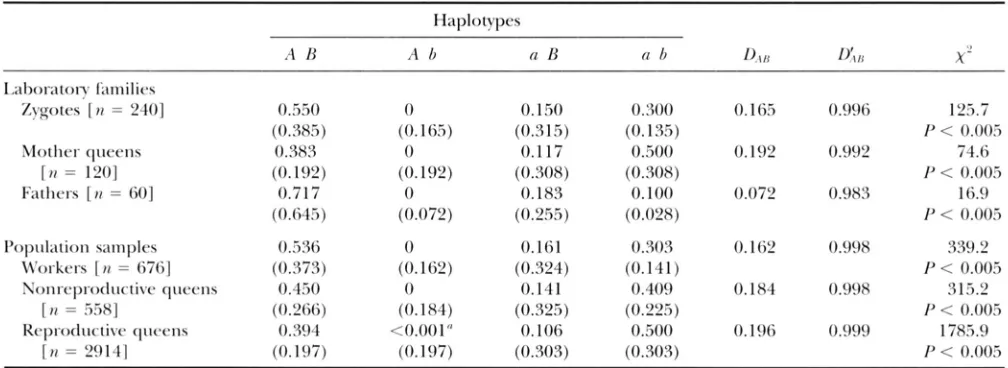
between nonre- productive and reproductive queens (after omitting from consideration queens with genotype P p - 7 ’ “ ) . Heterozygous reproductive queens are overrepresented by a factor of 1.53 in Corrientes and 1.69 in Formosa compared to heterozygous nonreproductive queens from the same sites.Linkage disequilibrium: The ability to specify two- locus haplotype compositions of parents and offspring in the 60 families from the Georgia polygyne popula- tion means that values for the gametic disequilibrium coefficients (D,,,], D ’ A B ) can be obtained directly from these individuals. Estimates for these coefficients are
presented along with the observed and expected fre- quencies of the four haplotypes in the top part of Table 4. The haplotypes A B and a b are far more common than expected under random association of the alleles in the offspring zygotes and their parents, yielding highly significant positive values of DAB near the maxi- mum possible for the observed allele frequencies (indi- cated by values of D r A B close to 1 .O) .
All double heterozygote queens and daughters from the family studies ( n = 636) exhibited the cis linkage phase ( A B / u b ) , with the exception of the two recombi- nant daughters. Thus, trans double heterozygotes can be assumed to be essentially absent in the Georgia poly- gyne population and the haplotype composition of all genotypes in the wild can be inferred. Gametic disequi- librium values estimated in this way from the popula- tion genotypic data are presented in the bottom part of Table 4. For all classes of females, the haplotypes
A Band a b again are far more common than expected if
the alleles at P p - 3 and Cp-Y were randomly associated, yielding highly significant positive values of D A B that
approach the maximum possible values.
The data in Table 4 suggest that haplotype A b is rare
o r nonexistent in the Georgia polygyne population.
Consistent with this conclusion, the three genotypes that require this haplotype ( P p - 9 ”
Gp-9””,
Pgm-v’” C pn.#..l.:l__,.._.. L- .._. I...:" :- r:". A
_.._.
I ) , : -~~
F K ; ~ ' K I < 1 . - O l ~ s c ~ n r t l twtrlocus gcnotypc ficqrlencics for /@n-3 illltl c+-Y i n wrious cl;~sscs o f fcmalcs from introduced
poprdations o f polygync S. invir/rc. The frequencies for female zygotcs fronl (korgiit a r c tlcrivctl from family studies and represent prc?jcctetl v a l ~ ~ e s hefore selection on G/PY occurs. l h r k l y stipplrtl patches represent genotypes present at fre- quencies < 0 . 0 1 ; black p;ltches indicate genotypes that were 1101 f O l I l 1 t l .
the absence of genotype I'gm-3''" (q~9'~''in nonreproduc- tive queens from the Formosa polygyne population (Figure 2) suggests that haplotype A 1) may be missing in this native population as well.
T h e nongametic component of linkage disequilih- rium (Il,.,/,,) was estimated in the Georgia polygyne p o p d a t i o n by calcrllating the composite genotypic disequi- librium (A.lc,) and employing the formula Il..l,,J = A;,,,
- fl..,lJ. For zygotes, the genotype frequencies are those expected if (+-9'"" and (+9" segregatetl in 1:1 ratios in the families in which they occurred; that is, they repre- sent the preselection frequencies.
Estimates o f the magnitude o f all three forms o f dis- equilibrium in the Georgia polygyyne population are presented as the standardized measures
A',.,,,,
U , . , , J , andfl'..,/,l in Figure 3. Values for Zl'),,J consistently are near their positive maxima, and changes in A'..,,{ from o n e class of intlividlrals t o another correspond t o changes of opposite sign in D'..l/,l. In reproductive queens, the
GP-9 GP-9
FIGL!KI:. 'L.-Ohscncd t\vcrlocus gcnotypc lrcqwncics Ibr I'gm-3 and Gp-9in nonrcprod~lcti\c and rcprodurtiw q w c w s
from native populations of polygync .$. i m i d o . The class " o r h - ers" for /'pn-3 in Corricntcs includes the g c ~ o t y p r /fil-7"'
pooled w i t h a l l gcnotypes a t this locus carrying rare :dkles. Darkly stippled patches represent genotypes p r c w n l i\t lic- quencies
<
0.01; black patches indicate gc.notypes t h a t \ccr(*n o t forn1tl.
estimated value of zero for the composite measure
(A';l,l)
corresponds to a large negative ~ a l n e for n o n p - metic disequilibrium (Zl',,,/,l) that o f h t s the large posi- tive gametic disequilibrium ( D ' , . , , j ) . T ~ u s , i n reproduc- tive queens, allele A tends to be strongly associated with allele f3 (and n with 11) within chromosomes, but the converse associations ( A with 0 and n with 11) exist be- tween alleles at the two loci on alternate homologouschromosomes. In the zygotes produced by these
queens, I)',,,,{ increases to nonsignificance, resrdting in a significant positive value for the composite measure. This dramatic change in pattern of nongametic disequi- librium between zygotes and their mothers corresponds with an episode of gene flow from the monogyne form
(see below). In adult workers, D r . , / , , becomes increas-
ingly (and significantly) negative relative t o zygotes, in- dicating a buildup of negative nongametic allelic associ- ations following selection against genotype G / I - ~ " . The trend toward greater negative values of fl',.,/,J continues in nonreproductive queens, in which selection against genotypes
&m-?"
and C$+"" begins. I t culminates a sthese queens are recruited as new reprodrlctives, follow-
K. G . Ross
TABLE 4
Observed and expected two-locus haplotype frequencies and estimates of gametic disequilibrium (DAB, Din) for P p - 3 and C p 9 in polygyne S. invicta from Georgia
Haplotypes
1;aboratot-y fi1milic.s Zygotes [ I I = 2401
I’opulation samples
M’orkers [ n = 6761
Nonreprorluctiw qlleens
Keprorluctivc q w e n s
[ I? = 5.581
[ n = 29141
0.5.50 (0.385)
0.383 (0.192)
0.717 (0.64.5)
0..536
(0.375) 0.4.50
(0.2fiti)
0.394 (0.197)
0 (0.165)
0 (0.192)
0 (0.072)
0 (0.162)
0 (0.184)
<0.001“ (0.197)
0.150 (0.3 1.5)
0.117 (0.308)
0.183 (0.25.5)
0.161 (0.324)
0.141 (0.32.5)
0.106 (0.303)
0.J00 (0.155)
0..500 (0.308)
0.100 (0.028)
0.303 (0.141)
0.409
(0.225) 0..300 (0.303)
0.16.5 0.996 125.7
0.192 0.992 74.6
0.072 0.983 16.9
I’< 0.005
I’ < 0.005
I’ < 0.00.5
0.162 0.998 339.2
0.184 0.998 315.2
0.196 0.999 178.5.9
P < 0.00.3
I’ < 0.009
1’ < 0.003
The sample sizes (in brackets) are toVal counts of haplotypes for each class of individuals. Expected haplotype frequencies
(in parenthrses) are the products o f the allele frequencies. Probability values from the chi-squared test statistics indicate the
probabilities that the alleles I ’ p - 3 ’ and Gp9” (or Ppn-3’ and (;1.9”) are randomly associated o n chromosomes. “ A single haplotype o f this kind was identified (frequency = 0.00054).
in all classes of individuals, coupled with nongametic disequilibrium that becomes increasingly negative fol- lowing each bout of selection and that is reset to almost zero following gene flow from the genetically differenti- ated monogyne form.
T h e linkage phase of double heterozygotes is not known for the polygyne ants from Texas o r Argentina, s o only composite disequilibrium coefficients can be estimated from the genotypic data. These estimates par- allel the results obtained from the Georgia population,
males queens zygoles workers queens queens male rewducavs female adun mreprod. reproductlw,
F K A W J.--Estimates of linkage disequilibrium in various
cliIss(.s o f females from the Georgia polygyne S. invir/n popula-
t i o n and i n the mates o f the reproductive queens. Values are lor t h r normalized disequilibrium coefficients A’,, (compos- it<. linkage disequilibrium), ll‘.,!, (gametic disequilibrium), and I)’,,,,, (nongamctic disc,quilibrillm). which are scaled by l o c a l allelr frequencies to vary between - 1 and + I . Values
that differ significantly from zero are indicated by
*.
Themqjor bouts o f gene f l o w and selection are indicated in a p
proximate relation t o the life stages or castes that they affect.
with small and nonsignificant estimates of A’,.,H in re- productive queens and moderately positive but signifi- cant estimates of this coefficient in nonreproductive queens. If haplotype A b is assumed to be missing in Formosa (see above), then patterns for all three clisequi- librium coefficients for nonreproductive and reproduc- tive queens are identical to those found in Georgia.
Gene flow: Earlier work has suggested that gene flow
into the polygyne population from the monogyne form is extensive in Georgia, and that the major route for this interform gene flow is via polygyne queens mating with monogyne males (ROSS 1992; Ross and StloE-
MAKER 1993; Ross and KIXI.I:.R 199%). These studies
have made use of the large differences in lkm-3 allele frequencies that result from differential selection he- tween the social forms to calibrate the magnitude of gene flow occurring via this route. Because allele fre- quencies at G p 9 also dif‘fer substantially between the forms, gene flow from the monogyne form is certain to have an impact on allele and genotype frequencies at Gp9 in the polygyne form. Moreover, this locus pro- vides an additional marker to infer levels of such gene flow.
A previous study employing genotype frequency data
for l’p-3 in Georgia polygyne queens and workers esti-
mated that monogyne males accounted for
84%
of mat- ings of polygyne queens(Ross
and KKI.I.I.:K 1995a). Aseparate study of 69 laboratory families derived from Georgia polygyne queens indicated that 90% were sired by monogyne males, based on comparison of the in- ferred proportion of fathers possessing genotype
P p -
Multilocus Evolution in Fire Ants 969
1993). This latter method can be used in the present study to infer the proportion of the 60 progenies of polygyne queens sired by monogyne males. Using Pgm- 3 data, the estimate is
77%.
Using data from Gp-9, the figure is 80%. These estimates presumably are not inde- pendent because of disequilibrium between the two genes. Nonetheless, the data provide further evidence for the substantial gene flow into the polygyne form that must be considered in attempts to understand the two-locus frequency dynamics.DISCUSSION
Overview of effects of multiple evolutionary forces in polygyne S. invicta: This study suggests a general scheme for how complex selection acting on two linked genes, in conjunction with gene flow from a genetically differentiated population, influences gene frequencies and disequilibrium in polygyne S. inuicta in Georgia. In the diagram presented as Figure 4, this scheme is superimposed on the generational cycle of the ants. Observed two-locus genotype and haplotype frequen- cies are presented for the different life stages and castes and compared to predicted frequencies when appro- priate. Disequilibrium values estimated for each of these classes are also shown.
Reproductive queens effectively possess only two dif- ferent two-locus genotypes. Because most of these queens are cis double heterozygotes and crossing over is rare, the large majority of gametes produced (90%) are in the cis linkage phase [either both “wild-type”
( A , B ) or both “mutant” ( a , b ) alleles are present on the same chromosome]. Among these cis gametes, over half are haplotype a b. The virtual absence of the trans haplotype A b generates a maximal positive value for gametic disequilibrium (D’An) in reproductive queens (as well as other polygyne females). The large negative value for nongametic disequilibrium (D’A/B) in these queens stems from the preponderance of cis double heterozygotes, in which the wild-type allele at one locus necessarily is paired with the mutant allele at the second locus on the homologous chromosome (Figure 4).
Gp9 cannot be scored in males, so two-locus haplo- type frequencies cannot be obtained directly for these individuals in the polygyne social form. Therefore, the frequencies for such males are assumed to be the same as for their mothers, a reasonable assumption given the low rate of crossing over and the fact that males develop from unfertilized eggs (but see PAMILO (1993) for coun- terexamples from the ant Formica aquilonia)
.
Two-locus haplotype frequencies for monogyne males can be o btained directly from estimates of Pgm-3 allele frequen- cies (ROSS 1992) because Gp9 is monomorphic in this form. Data from the family studies suggest that mono- gyne males account for -80% of successful insemina- tions of polygyne queens. The composite male gamete pool formed by mixing the male gamete pools of the
two forms in an 80:20 ratio (monogyne:polygyne) is lacking haplotype A b (thus yielding the high Dl An
value), and haplotype A B predominates among the remaining gametes because of the proportionately high representation of monogyne males (Figure 4). Mating and fertilization in this polygyne population thus in- volves the union of mostly cis gametes, but the propor- tions of the two cis haplotypes differ markedly between queens and their mates.
The observed distribution of genotypes in female zy- gotes, assuming no diminished survival of genotype
Cp-
9”’, is similar to that expected with random union of gametes from the female and composite male gamete pools (Figure 4). Genotypic diversity increases substan- tially in zygotes (six genotypes) compared to their mothers (two genotypes), with about one-third of zy- gotes possessing the double homozygous genotypes
Pgm-9’” C4-9”” and Pgm-7’“
@-Po,
which are absent in their mothers. The proportion of double heterozygotes (all cis) correspondingly drops from 80% in the moth- ers to 40% in zygotes. The dramatic reduction of this class, coupled with the appearance of double homozy- gotes in which the two wild-type or two mutant alleles are paired between the two loci on alternate homo- logues, explains the sharp positive increase in nonga- metic disequilibrium (DlAln) in zygotes relative to their mothers.Viability selection against
Cp-9”‘
occurs during postzy- gotic development, resulting in the loss in adults of the sole two-locus class involving this genotype (Pgm-7’Gp-
9’).
This genotype, expected at a frequency of 0.05 in zygotes, has the two mutant alleles paired at the two loci on alternate homologues. Thus, its loss explains the more negative value of D’A/n in adult workers from the wild than in zygotes. The five genotypes remaining in workers are observed at frequencies similar to those expected after accounting for the loss of genotype C$-9’”’ (Figure
4).In the mature nonreproductive queens sampled for this study, selection against genotypes Pgm-pA and
Cp-
9’
so evident in reproductive queens apparently al- ready has begun (above). The major class affected is genotype P P - ~ ~Gp-p”,
in which the two wild-type alleles are paired at the two loci on alternate homo- logues. Thus, the onset of such selection on queens has the effect of driving down further the negative value of DlAlIj initially generated by selection againstGp9‘.
K. G. Ross
Georgia Polygyne
S.
invicta Population
and Gp-9BB lost
:IN
genorypermi
a b a 6 A B a b
"
0.50
lrom polygyne nests
0.25
A B a 6 a b
L 20% 80%
0.50 0.8
0.25 0.4
A B a B
a b
A B a 6 a b
I I I
"...
,
selection
v
matingMultilocus Evolution in Fire Ants 971
Number and identity of genes under selection: That
two linked loci under similar strong selection pressures should be discovered by chance in a genome with 2N
=
32
chromosomes (GLANCEY et al. 1976) prompts con- sideration of several points. Foremost among these is whether the genotypes scored at either locus could be artifactual or whether the two putative loci could be markers of a single locus that is the sole target of selec- tion. Extensive earlier studies of the inheritance of Pgm-3 (ROSS 1992; SHOEMAKER et al. 1992) and those re-
ported here for Gp-9 indicate that these behave as co- dominant Mendelian genes, and the contrasting pat- terns of expression of the banding phenotypes assigned to Pgm-3 and Gp-9 in the different sexes and life stages indicate that the products of a single gene were not misinterpreted as the products of two genes. Moreover, the close fit of genotype frequencies in the United States to those predicted by a model incorporating dif- ferent forms of selection on two genes lends credence to the assumption that two separate but linked Mende- lian genes are involved in this system, as does the ability of a two-locus model employing gene flow to account for the disequilibrium in native populations (see be- low). Indeed, the apparent failure of any single-locus model to explain the persistent disequilibrium observed between Pgm-3 and 9 - 9 in Argentina implicates multi- ple genes under selection, although theoretical studies suggest that such genes must interact epistatically in their effects on fitness rather than additively, as as- sumed here (e.g., HARTL and CLARK 1989, pg. 215). Additional population and molecular data are required to definitively resolve the issue of the number of genes under selection.
Assuming that multiple genes are under selection, these may actually be Pgm-3 and Gp-9, or one or both of these loci may mark other genes that are the true targets of selection (e.g., KOJIMA and SCHAFFER 1967; HEDRICK 1982). Differences in the physiological pheno- types of queens with different Pgm-3 genotypes are such as might be expected from variation in activity or stabil- ity of an enzyme involved in glycogen metabolism, such as phosphoglucomutase, a fact that has been used to argue that Pgm-3 is directly responsible for the pheno- typic variation detected by selection (ROSS et al. 1996a). The coincidence of patterns of expression and of selec- tion at Gp-9 suggests that this gene also may be a real target of selection. Expression of Gp-9 is age-depen- dent, the protein product being detectable only in adults over 1 week of age. Workers sampled in the field were older workers, recognizable by their dark cuticles. Workers sampled in the family studies were known to
be no older than 10 days, and appeared considerably younger than the field workers based on cuticle color. Although genotype
Gppb
was consistently underrepre- sented among workers from the laboratory families, it was nonetheless far more common in these families than in the field, suggesting that the lethal effects of the genotype are age-dependent and parallel the time course of expression of ~ p 9 . Significantly,9 - 9
is not lethal in hemizygous (haploid) males; 10% of the fa- thers of the laboratory families were inferred to possess this haplotype. The fact that Gp9 appears not to be expressed in males of any age accords with this finding and further supports the idea that this gene may be an actual target of viability selection.A related issue is whether selection on Gp-9 alone can explain the changes in Pgm-3 genotype frequencies previously attributed to direct selection on Pgm-3. For instance, apparent discrimination against Pgm-3""
queens by workers in the United States could be due instead to discrimination against queens bearing
Gp-
9"",
because Pgm-3"" only occurs on the background of this single Gp9 genotype (other possible two-locus genotypes involving P g m - y do not arise because haplo- type A b is absent). Evidence that this is not the case and that selection acts independently at the two loci, at least in native polygyne populations, comes from the fact that genotypeGp-qB
occurs commonly in reproduc- tive queens in Argentina but P g m - Y nonetheless is completely absent in these queens. The difference in the apparent strength of selection againstGp-9"
queens in the native and introduced populations may be due to differences in selective regimes between the two envi- ronments, to loss of variation in the United States at regulatory loci determining the magnitude of the phe- notypic effects of each locus, or to loss of cryptic varia- tion at either Pgm-3 or (3-9.The existence of two tightly linked genes under strong differential selection in the two social forms raises the question of whether they constitute a super- gene or coadapted gene complex involved in the origin of polygyny in S. invicta (monogyny is presumed to be ancestral; ROSS and KELLER 1995b). On the one hand, appropriate variation at these genes seems to be a ge- netic prerequisite to polygyny, because the absence of allele Pgm-7 or of genotype
Gpv*,
both of which are strongly favored in reproductive queens, presumably would preclude the formation of stable polygyne socie- ties. On the other hand, selection apparently has not produced harmoniously interacting alleles that are the hallmark of epistasis (WADE 1992; WHITLOCK et ul. 1995), but instead seems to act in opposition at the twoFIGURE 4.-Overview of multilocus selection and gene flow in the Georgia polygyne S. invicta population. Observed two-locus genotype and haplotype frequencies (shaded bars) are presented for the different sexes, life stages, and castes (genotypes and
haplotypes present at frequencies < 0.01 are not shown); when available, expected genotype frequencies also are shown (0).
Estimates of gametic and nongametic disequilibrium are shown for each class of individuals (* indicates values significantly
different from zero; see also Figure 3 ) . Data for female zygotes are derived from family studies and represent projected values
972 K. G. Ross
loci in the polygyne form. For example, overdominance at 9 - 9 in reproductive queens opposes directional se- lection against Pgm-9 driven by worker destruction of
Pgm-pA
queens. Thus, the two genes appear not to have evolved as a single integrated genomic unit carrying particular allele combinations favorable to polygyny. Nevertheless, Pgm-3 and 9 - 9 may mark a region of reduced recombination with a concentration of genes involved in the determination of social organization.A recessive lethal expressed in reproductive females, such as
Gp-9,
is subject to strong negative selection that should drive it to low frequency and, perhaps, eventual loss via drift. Positive selection on allele Pgm-7, medi- ated by worker execution of all Pgm-9” queens, appar- ently plays some role in counteracting the negative se- lection on allele($1-9
because of strong gametic disequilibrium. However, the advantage of genotypeGpqb
overCp-s””
in polygyne queens presumably is the major force opposing selective elimination ofGp-9
and thereby maintaining polymorphism at the locus. In the monogyne form, any such advantage to heterozygous queens must be outweighed by disadvantages associated with the presence of the recessive lethal allele, leading to its virtual absence in populations of this form. In- deed, the distribution ofc;P-p
in the two forms may be attributable to differences in their breeding behavior and associated differences in the “cost” to queens of producingCp-pb
offspring. Monogyne queens found new colonies independently, without the assistance of workers (MARKIN et al. 1972). Success in this enterprise requires production of a large number of offspring over a brief period, so that the incipient colony can grow, feed its queen, and defend its territory against other colonies (MARKIN et al. 1973). Any heterozygous mono- gyne queen mated to aGp-9
male would lose half of her new worker force at the most critical point of colony development, resulting in certain death of the colony and queen. Polygyne queens rarely practice indepen- dent colony founding. Instead, they remain in their parent nest or enter another polygyne nest to initiatereproduction (GLANCEY and LOFGREN 1988; PORTER
1991;
Ross
et al. 1996b). Because a large worker force already exists for such queens, there may be little or no fitness penalty to individual polygyne queens that lose half of their offspring due to the lethality of genotypeOrigin of gametic disequilibrium: An important goal of studies of multilocus evolution is to identify the forces responsible for generating gametic disequilib- rium and for maintaining it against the randomizing force of recombination (HEDRICK et al. 1978; ASMUSSEN
and CLEGG 1981; HEDRICK 1982; HASTINGS 1985). De-
termination of the type and amount of selection re- quired to produce disequilibrium is of particular inter- est, because broad claims for the importance of epistatic selection in evolution are bolstered by evidence that epistasis actually causes disequilibrium in wild popula-
Gp-91’.
tions (BARKER 1979; HEDRICK 1985). Any of the forces capable of generating disequilibrium (genetic drift, gene flow between differentiated populations, selec- tion) are more effective when coupled with linkage or inbreeding (HEDRICK et al. 1978; LANGLEY et al. 1978; EPERSON and AL.LARD 1987; ZAPATA and ALVAREZ 1992). Thus, the tight linkage of Pgm-3 and Gp-9 clearly is im- portant in maintaining strong disequilibrium in poly- gyne S. inuicta once it is established. [Inbreeding appar- ently is not important in this regard, as it has not been detected in extensive electrophoretic surveys of native and introduced S. inuicta (ROSS and FLETCHER 1985; ROSS 1993; ROSS et al. 1993, 1996a)l.
With respect to the or@n of gametic disequilibrium, it is tempting to ascribe it to drift associated with the pronounced population bottleneck experienced by fire ants during their recent colonization of the United States (e.g., BERLOCHER 1984; ROSS et al. 1993). How- ever, data from the native polygyne populations suggest that the allelic associations responsible for disequilib- rium were established before the introduction. Patterns of excesses and deficiencies of two-locus genotypes in both Argentine study populations parallel those ob- served in Georgia (Table 3), suggesting that cis haplo- types are more common and trans haplotypes less com- mon than expected by chance in the native as well as introduced ants. This is suggested further by composite disequilibrium values for the Argentine ants that mirror those in the United States. Moreover, the haplotype A 0 appears to be effectively absent in the Formosa population, as it is in Georgia. Independent bottlenecks in the native populations due to historical restrictions of effective population size could explain the origin of disequilibrium, although the specific allelic associations are not necessarily expected to be the same in the two
native populations under this scenario.
Gene flow between the social forms, which are strongly differentiated at Pgm-3 and