Punctuation Prediction for Unsegmented Transcript Based on Word Vector
Xiaoyin Che, Cheng Wang, Haojin Yang, Christoph Meinel
Hasso Plattner InstituteProf.-Dr.-Helmert-Str. 2-3, 14482 Potsdam, Germany
[email protected], [email protected], [email protected], [email protected]
Abstract
In this paper we propose an approach to predict punctuation marks for unsegmented speech transcript. The approach is purely lexical, with pre-trained Word Vectors as the only input. A training model of Deep Neural Network (DNN) or Convolutional Neural Network (CNN) is applied to classify whether a punctuation mark should be inserted after the third word of a 5-words sequence and which kind of punctuation mark the inserted one should be. TED talks within IWSLT dataset are used in both training and evaluation phases. The proposed approach shows its effectiveness by achieving better result than the state-of-the-art lexical solution which works with same type of data, especially when predicting puncuation position only.
Keywords:Punctuation Prediction, Word Vector, Deep Learning, Convolutional Neural Network
1.
Introduction
Generally the text transcript generated by automatic speech recognition (ASR) systems is unpunctuated and unseg-mented. However, the readability of the transcript can be largely improved by the existence of punctuation marks, and the segmentation of the transcript based on punctuation positions will also increase the efficiency of many down-stream natural languages processing (NLP) tasks, such as semantic parsing, question answering or machine transla-tion(Matusov et al., 2007; Wang et al., 2010). It may also act as effective pre-processing to facilitate some other tasks like subtitling(Tiedemann, 2007).
Therefore many efforts, some of which may focus on sim-iliar topic “sentence boundary detection”, have been made to restore or predict the punctuation marks. Most of the re-cent works can be divided into three categories: prosodic or acoustic feature based (Levy et al., 2012; Xie et al., 2012; Sinclair et al., 2014), lexical feature based (Gravano et al., 2009; Lu and Ng, 2010; Ueffing et al., 2013) and the hybrid of previous two (Wang et al., 2012; Xu et al., 2014; Hasan et al., 2014). In this paper, we focus on the lexical aspect only.
A pure lexical model is understandably less powerful than a hybrid model, or even a pure acoustic model. But it is able to cope with the situation either with or without the audio files. Another fact is that the training data of a hy-brid model, which take both lexical and acoustic features as input, must be the standardized ASR transcripts, but a pure lexical model can take any kind of textual material into consideration, which is almost endless and extremely easy to get. However, the posterior probabilities of the in-dependent lexical model can be freely used in late fusion with acoustic features(Tilk and Alum¨ae, 2015; Khomitse-vich et al., 2015). Considering all these facts, we believe a good lexical model is widely applicable.
In previous research efforts, frequently used lexical features include the language model (LM) score, token, part-of-speech (POS) tag, chunk tag and so on. However, we would like attempt another possibility by using the Word Vector. Word vectors are learned through neural language mod-els (Bengio et al., 2003). Each word will be represented
by a comparatively low-dimentional real-valued vector and the lexical similarity between words can be evaluated by the Euclidean distance between their correspondent vectors (Mikolov et al., 2013; Pennington et al., 2014). Thus, word vectors can be used as lexical features in various NLP appli-cations and have achieved many positive results (Collobert et al., 2011; Maas et al., 2011).
When training, some state-of-the-art punctuation prediction approaches chose Conditional Random Fields (CRFs) as the classifier, but only taking traditional types of lexical fea-tures as input. Meanwhile, some recent experiments have shown the effectiveness of the combination of word vec-tor and convolutional neural network (CNN) in the task of sentence classification or sentiment analysis (Kim, 2014; Kalchbrenner et al., 2014). Inspired by these experiments, we would like to attempt this combination in the task of punctuation prediction in this paper.
2.
Model Description
2.1.
Input Preparation
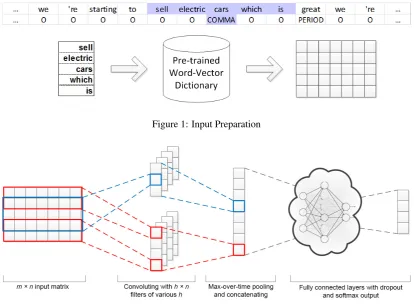
In our approach, all the data are collected from text files, which will be first transformed into a long word sequence. We treat the classification problem as whether a word in the sequence is followed by a punctuation mark. We define 4 classes in total: O (means no punctuation mark followed), COMMA, PERIOD and QUESTION. Exclamation marks or semicolons are classified as PERIOD, while colons or dashes are classified as COMMA. There are no brackets in our data and all the other punctuation marks, such as quotation marks, are just ignored.
For the wordwi in the sequence, we apply an continuous m-words subsequence<wi−(m−1)/2,...,wi−1,wi,wi+1,...,
wi+(m−1)/2>to represent the context. Then-dimensional
Figure 1: Input Preparation
Figure 2: Model Architecture of CNN-1
2.2.
Training Models
We attempt three different models for the training pro-cess. The first model is a typical deep neural network with 3 hidden fully connected layers. We address it as DNN in our experiments. The m×n input matrix will be reshaped into a long vector, which equals to concate-nate themword vectors together, and this long vector acts as the input layer of the neural network. Then each train-ing sample can be represented as{Xi, Yi},i= 1,2, ... , N. Xi ∈ Rm×n,Xi = {x1, x2, ... , xm×n}, whileYi ∈RK,
yi = {y1, y2, ... , yK}. The goal is to find the optimal
weightsW and biasesbwithin cost functionC:
arg min
W,b
C= 1 2N
N
X
i=1
kYiˆ −Yik2+λ 2
L−1 X
l=1
kWlk2
F (1)
whereYiˆ is the predicted output, while the second term in (1) is the weight decay. It is implemented to prevent over-fitting, with the weight decay parameterλwhich is set to 0.0005 in our case. Sigmoid function as (2) is applied to all hidden layers and softmax function as (3) to the output layer.
f(x) = 1
1 +e−x (2)
Sk(y) = e
yk
PK
j=1eyj
, k= 1,2, ... , K (3)
In order to prevent co-adaptation between neurons in the hidden layers, we implement “dropout” on fully connected layers, which randomly “hide” some neurons along with their connections to reduce overfitting (Srivastava et al.,
2014). Dropout is also applied in the fully connected layers in other two models.
The architecture of second model (Fig. 2) is similar as de-scribed by Kim (2014). Takingm×nmatrix as input, a convolutional filter with the kernel size ofh×nwill be ap-plied, in which1≤h < m. Because the value ofnis fixed, the filter acts as a sliding window which moves only verti-cally and works with everyhcontinuous words within the sample. As a result, a feature map withm−h+ 1elements will be generated. Then a max-over-time pooling operation will extract the maximum value as the final feature of this filter. By implementing a group of such filters, with same or different value ofh, multiple features can be achieved and then concatenated together, which will be further fed into two fully connected layers with a softmax output. In this model, the integrity of word representation is guaran-teed during the process of convolution. We will address this model as CNN-1 in later sections.
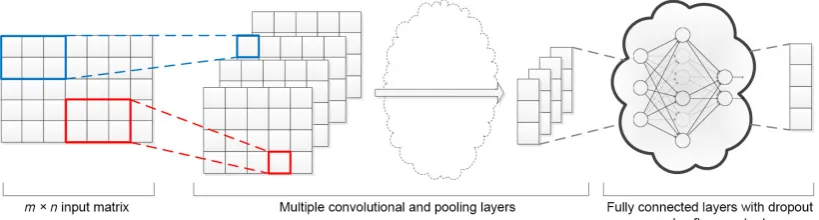
The third model (Fig. 3) is also a variant of CNN, but we will treat them×nfeature matrix no longer asmcomplete word vectors. Instead, each element in the matrix will be treated independently, just like a pixel in an image with a resolution ofm×n. There are 3 typical convolution lay-ers and 1 pooling layer, followed also by 2 fully connected layers and softmax output. This model will be addressed as CNN-2.
2.3.
Implementation
We choose the 50-dimensional pre-trained word vec-tors from GloVe for our experiments1. Compared with
1
Figure 3: Model Architecture of CNN-2
Dataset Words COMMA PERIOD QUESTION
Ref Ueffing et al. (2013) 17207 1096 925 84
Ours 12626 830 808 46
ASR Ueffing et al. (2013) 17344 1084 904 82
Ours 12822 798 810 35
Table 1: Test Sets Details
other publicly available word vector packs, such as 300-dimensional word2vec2, GloVe-50d is a much smaller set, not only dimensional, but also on the total words involved. But for our purpose, GloVe-50d is already sufficient. And in all our experiments, we will use 5-words subsequence as a sample. All above models are trained on CAFFE frame-work (Jia et al., 2014), taking HDF5 as input format and withm= 5, n= 50.
In DNN model, we set the total number of neurons for each layer to 2048, 4096 and 2048. In CNN-1 model, we apply 128 “convolutional + pooling” filter pairs for each window size from 1-word to 4-words, and the two following fully connected layers have 4096 and 2048 neurons respectively. In CNN-2 model, the numbers of filters of three sequen-tial convolutional layers, with pooling layer after the first one, are set to 64, 128 and 128, followed by the same fully connected layers of CNN-1. When running, the resources occupied by 3 models can be ordered by: DNN<CNN-1 <CNN-2.
3.
Evaluation
3.1.
Datasets
We test our models on the IWSLT datasets, which were originally used to evaluate ASR or SLT output. IWSLT datasets consist of TED talks which are openly available online3. There are both punctuated reference transcripts and unpunctuated but segmented ASR transcripts provided. Ueffing et al. (2013) reported the performance of their ap-proach on IWSLT2011 test set, which we would like to compare with. However, we found that the IWSLT2011 dataset we achieved4is smaller than claimed by Ueffing et al. (2013). The detail about the test set can be found in Table 1.
2
https://code.google.com/p/word2vec/
3https://www.ted.com/talks
4
http://hltc.cs.ust.hk/iwslt/index.php/evaluation-campaign/ted-task.html
We divide the training data of machine translation track in IWSLT2012, which also consists of TED talks, into two parts as our training and development sets. Based on TED talk ID, we make sure that there is no overlapping between datasets. The training and development sets contain 2.1M and 296k samples respectively.
Several reports have indicated that the performance of punctuation prediction is largely influenced by the average number of punctuation marks per utterance in the dataset (Wang et al., 2012). It is quite understandable that there will always be a period or question mark at the end of the utterance. In our evaluation, we remove all the segmenta-tion from both the reference and ASR transcripts of IWSLT data files and there is only one single utterance existing in each dataset.
3.2.
Metrics
If we define a word sequence between two punctuation marks as a minimal sentence unit, the average length of such minimal sentence units of our training dataset is 7.8, which means there are over 85% of the words are not fol-lowed by any punctuation mark, in other words, they are the “O” samples. The majority of these “O” samples can be successfully classified by our model and make the gen-eral accuracy of the classification beyond 90%. But in pur-pose of predicting punctuation marks, we care much more about the performance on the samples belonging to the other three “punctuated” classes. Therefore the correctly classified “O” samples will be ignored and we evaluate the performance by:
P recision= #Correctly predicted punctuation marks #All predicted punctuation marks
(4)
Recall=#Correctly predicted punctuation marks #All expected punctuation marks
(5)
F1=
2×P recision×Recall
Model 4-Classes 3-Classes 2-Classes
Pre. Rec. F1 Pre. Rec. F1 Pre. Rec. F1
Ref
CRF Best 49.8 58 53.5 − − − − − 75.8
DNN 60.3 48.6 53.8 62.1 50.1 55.5 86.0 69.2 76.7
CNN-1 55.2 46.4 50.4 57.0 47.9 52.1 83.0 69.8 75.8
CNN-2 57.8 49.9 53.5 59.6 51.5 55.3 83.6 72.3 77.5
DNN-A 54.8 53.6 54.2 56.4 55.2 55.8 79.0 77.3 78.2
CNN-2A 53.4 55.0 54.2 55.1 56.7 55.9 77.6 79.9 78.8
ASR
CRF Best 47.8 54.8 51 − − − − − 64
DNN 54.4 45.6 49.6 56.0 46.9 51.0 77.5 64.9 70.7
CNN-1 49.9 45.2 47.5 51.4 46.6 48.9 73.9 66.9 70.2
CNN-2 51.0 46.8 48.8 52.3 48.1 50.1 74.2 68.1 71.0
DNN-A 49.2 51.6 50.4 50.5 53.0 51.6 70.6 74.1 72.3
CNN-2A 46.4 51.9 49.1 47.6 53.2 50.2 68.2 76.3 72.1
Table 2: Experimental Results on General Accuracy
Model COMMA PERIOD QUESTION
Pre. Rec. F1 Pre. Rec. F1 Pre. Rec. F1
Ref
DNN 58.2 35.7 44.2 61.6 64.8 63.2 0 0 −
CNN-1 48.3 36.3 41.4 60.6 59.6 60.1 0 0 −
CNN-2 53.4 37.6 44.1 60.7 65.4 63.0 0 0 −
DNN-A 48.6 42.4 45.3 59.7 68.3 63.7 0 0 −
CNN-2A 48.1 44.5 46.2 57.6 69.0 62.8 0 0 −
ASR
DNN 47.2 32.0 38.1 59.0 60.9 60 0 0 −
CNN-1 40.2 33.5 36.5 57.8 58.8 58.3 0 0 −
CNN-2 42.1 33.6 37.4 57.5 61.9 59.6 0 0 −
DNN-A 41.0 40.9 40.9 56.2 64.5 60.1 0 0 −
CNN-2A 37.3 40.5 38.8 54.6 65.5 59.6 0 0 −
Table 3: Experimental Results per Class
The original test is addressed as 4-Classes. Then we com-bine the QUESTION and PERIOD together as “full-stop” class to form a 3-Classes test. Furthermore, the “full-stop” and COMMA classes can be combined again as “punctu-ated” in a 2-Classes test. By this configuration, we pre-dict punctuation position only, regardless of the punctua-tion type. We implement 3-Classes and 2-Classes tests be-cause in some applications, such as semi-automated subtitle generation, pre-segmenting the transcript by accurately de-tected punctuation position can save a lot of time for the human staff, but whether it is a comma or a period at the end of the segment is less important.
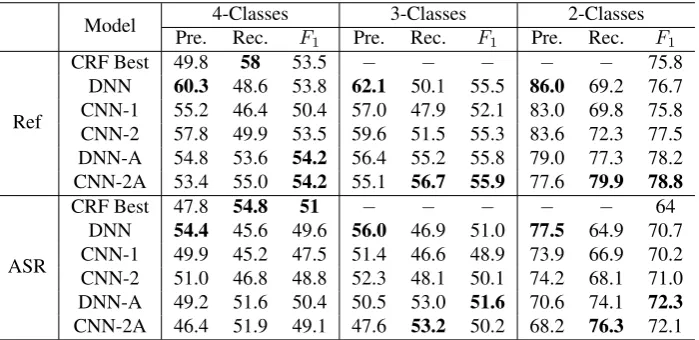
Besides the general accuracy evaluation introduced above, we are also interested in “per-class” performance. The statistics about comma, period and question mark will be collected separately. The general accuracy and per-class performance can be found in Table 2 and Table 3 respec-tively.
3.3.
Results
As shown in Table 2, the general accuracy of the experi-ments on both reference transcripts and ASR output can be found. “CRF best” represent the best model performance reported by Ueffing et al. (2013). “DNN”, “CNN-1” and “CNN-2” are corresponding to the 3 models proposed in this work. Furthermore, since we found out that all three proposed models achieved much higher precision than re-call, we did one additional adjustment to our better
per-formers: half the value of softmax output for class “O”. By this effort (addressed as DNN-A & CNN-2A), more border cases would be classified as “punctuated”, which balanced the precision and recall.
From the stats we can find out that in 2-Classes evaluation, all proposed models perform better than the benchmark, with CNN-2A and DNN-A as best performers on reference transcripts and ASR output respectively. CNN-2A is also the best performer for 4-Classes evaluation on reference. But in ASR 4-Classes evaluation, none of proposed models can outperform the benchmark. These facts show that our approach is good at predicting the punctuation positions, but needs to improve on distinguishing puctuation types. Table 3 shows the per-class performances. Obviously, our proposed models failed to predict even one question mark in the test dataset. We believe there are two reason for this phenomenon: the first is that the QUESTION samples in the training set are not sufficient; the second, which we con-sider as the more crucial one, is that the sample we apply, a 5-word sequence, does not cover the sentence beginning, where the typical question pattern locates, such as “what do you ...” or “how can I ...”. Therefore, the incompetence of proposed model in detecting question mark is understand-able, also still disappointing.
of TED talks. Another interesting finding is that our CNN-1 model, which keeps the integrity of word representation during the convolutional process, achieved worse perfor-mance than the other two. It means, at least in punctuation prediction task, the digits in the word vectors could be con-sidered as independent features.
4.
Conclusion
In this paper we attempted to use word vectors as the features in predicting punctuation marks for unsegmented transcript in a pure lexical approach. The pre-trained word vectors are fed into proposed models based on DNN or CNN for training. The evaluation shows that the proposed approach can achieve quite promising result. In the future we intend to first improve the input word vectors, by apply-ing larger pre-trained set or trainapply-ing our own word vectors, and use longer word sequence as samples. Then we will also attempt to involve prosodic feature.
5.
References
Bengio, Y., Ducharme, R., Vincent, P., and Janvin, C. (2003). A neural probabilistic language model. The Journal of Machine Learning Research, 3:1137–1155. Collobert, R., Weston, J., Bottou, L., Karlen, M.,
Kavukcuoglu, K., and Kuksa, P. (2011). Natural lan-guage processing (almost) from scratch. The Journal of Machine Learning Research, 12:2493–2537.
Gravano, A., Jansche, M., and Bacchiani, M. (2009). Restoring punctuation and capitalization in transcribed speech. In Acoustics, Speech and Signal Processing, 2009. ICASSP 2009. IEEE International Conference on, pages 4741–4744. IEEE.
Hasan, M., Doddipatla, R., and Hain, T. (2014). Multi-pass sentence-end detection of lecture speech. InProc. Interspeech.
Jia, Y., Shelhamer, E., Donahue, J., Karayev, S., Long, J., Girshick, R., Guadarrama, S., and Darrell, T. (2014). Caffe: Convolutional architecture for fast feature embed-ding. InProceedings of the ACM International Confer-ence on Multimedia, pages 675–678. ACM.
Kalchbrenner, N., Grefenstette, E., and Blunsom, P. (2014). A convolutional neural network for modelling sentences. InProceedings of the 52nd Annual Meeting of the Association for Computational Linguistics. Asso-ciation for Computational Linguistics (ACL).
Khomitsevich, O., Chistikov, P., Krivosheeva, T., Epi-makhova, N., and Chernykh, I. (2015). Combining prosodic and lexical classifiers for two-pass punctuation detection in a russian asr system. InSpeech and Com-puter, pages 161–169. Springer.
Kim, Y. (2014). Convolutional neural networks for sen-tence classification. InProceedings of the 2014 Confer-ence on Empirical Methods in Natural Language Pro-cessing (EMNLP).
Levy, T., Silber-Varod, V., and Moyal, A. (2012). The ef-fect of pitch, intensity and pause duration in punctuation detection. In Electrical & Electronics Engineers in Is-rael (IEEEI), 2012 IEEE 27th Convention of, pages 1–4. IEEE.
Lu, W. and Ng, H. T. (2010). Better punctuation prediction with dynamic conditional random fields. InProceedings of the 2010 conference on empirical methods in natu-ral language processing, pages 177–186. Association for Computational Linguistics.
Maas, A. L., Daly, R. E., Pham, P. T., Huang, D., Ng, A. Y., and Potts, C. (2011). Learning word vectors for sentiment analysis. In Proceedings of the 49th Annual Meeting of the Association for Computational Linguis-tics: Human Language Technologies-Volume 1, pages 142–150. Association for Computational Linguistics. Matusov, E., Hillard, D., Magimai-Doss, M., Hakkani-T¨ur,
D. Z., Ostendorf, M., and Ney, H. (2007). Improving speech translation with automatic boundary prediction. InINTERSPEECH, volume 7, pages 2449–2452. Mikolov, T., Yih, W.-t., and Zweig, G. (2013). Linguistic
regularities in continuous space word representations. In
HLT-NAACL, pages 746–751.
Pennington, J., Socher, R., and Manning, C. D. (2014). Glove: Global vectors for word representation. Proceed-ings of the Empiricial Methods in Natural Language Pro-cessing (EMNLP 2014), 12:1532–1543.
Sinclair, M., Bell, P., Birch, A., and McInnes, F. (2014). A semi-markov model for speech segmentation with an utterance-break prior. InFifteenth Annual Conference of the International Speech Communication Association. Srivastava, N., Hinton, G., Krizhevsky, A., Sutskever, I.,
and Salakhutdinov, R. (2014). Dropout: A simple way to prevent neural networks from overfitting. The Journal of Machine Learning Research, 15(1):1929–1958. Tiedemann, J. (2007). Improved sentence alignment for
movie subtitles. In Proceedings of Recent Advances in Natural Language Processing (RANLP), volume 7. Tilk, O. and Alum¨ae, T. (2015). Lstm for punctuation
restoration in speech transcripts. In Sixteenth Annual Conference of the International Speech Communication Association.
Ueffing, N., Bisani, M., and Vozila, P. (2013). Improved models for automatic punctuation prediction for spoken and written text. InINTERSPEECH, pages 3097–3101. Wang, K., Ming, Z.-Y., Hu, X., and Chua, T.-S. (2010).
Segmentation of multi-sentence questions: towards ef-fective question retrieval in cqa services. InProceedings of the 33rd international ACM SIGIR conference on Re-search and development in information retrieval, pages 387–394. ACM.
Wang, X., Ng, H. T., and Sim, K. C. (2012). Dynamic con-ditional random fields for joint sentence boundary and punctuation prediction. InINTERSPEECH.
Xie, L., Xu, C., and Wang, X. (2012). Prosody-based sen-tence boundary detection in chinese broadcast news. In
Chinese Spoken Language Processing (ISCSLP), 2012 8th International Symposium on, pages 261–265. IEEE. Xu, C., Xie, L., Huang, G., Xiao, X., Chng, E. S., and Li,