Relations between Inflectional and Derivation Patterns
Karel Pala
Faculty of Informatics Masaryk University Brno
Radek Sedl´aˇcek
Faculty of Informatics Masaryk University Brno [email protected]
Marek Veber
Faculty of Informatics Masaryk University Brno
Abstract
One of the main goals of this paper is to describe a formal procedure linking inflectional and derivational processes in Czech and to indicate that they can be, if appropriate tools and resources are used, applied to other Slavonic lan-guages. The tools developed at the NLP Laboratory FI MU, have been used, particularly the morphological analyser
ajka and the programI par for
pro-cessing and maintaining the morpholog-ical database.
1 Introduction
In this paper we report on an exploration of the relations between inflection and word derivation (WD) in Czech. At first the inflectional
morphol-ogy has to be mentioned which deals with
forma-tion of word forms by inflecforma-tion, i. e. by mor-phological processes like the declension of nouns, adjectives, pronouns and numerals, the conjuga-tion of verbs, and also forming degrees of ad-jectives and adverbs. The inflectional morphol-ogy (in Czech) is formally quite well described and at present we have reliable software tools at our disposal that make it possible both to generate and recognise arbitrary Czech word forms. They
are ajka a morphological analyser and
genera-tor (Sedl´aˇcek and Smrˇz, 2001) andI par a
pro-gram for morphological database (Veber, 2002). The second area is derivational morphology, i. e. word derivation as such – it describes the
pro-cesses of the derivation of new words (one word expressions) as distinct from basic ones (word bases). These processes operate on the morpheme level whose results follow from the ways of com-bining morphemes (prefixes, stems or roots, in-fixes, suffixes) using suffixation, prefixation and stem alterations (infixation). We have to bear in mind that the consequences of these formal pro-cesses have a semantic nature.
The relations between the WD processes and in-flectional morphology have been extensively stud-ied in Czech linguistic literature, see e. g. (Dokulil, 1962; Karl´ık et al., 1995; Petr, 1986) where one may find informal descriptions of the WD pro-cesses using terms like “fundace” (basic
deriva-tion), as well as mutation, transposition, modifi-cation, adaptation, and others.
The most interesting linguistic analyses link the derivation patterns with the inflectional ones. For example, in Karl´ık (1995) it is pointed out that the nouns with the suffix -tel having agentive meaning belong to the inflectional paradigm muˇz (man). In other words, it is possible to say that some inflec-tional patterns determine the sets of derivainflec-tional suffixes forming semantically consistent groups of nouns.
In this paper we set it as our task to map the re-lations between inflectional and word derivational patterns. In comparison with previous research we present the exploration of a large collection of data: our stem dictionary for Czech contains
385,066 items. The association of selected
in-flectional and WD patterns has been performed
Czech morphological database which contains all the necessary information about the inflectional paradigms in Czech (2,042 paradigms for all 10 POS).
The WD relations as they are described in the linguistic WD theories can be, after some modifi-cations, appropriately linked to the semantic rela-tions as they are used in contemporary ontologies and then applied within the inference engines that form a necessary part of the natural language pro-cessing mechanisms.
However, it is true that algorithmic descriptions of WD relations have been worked out only re-cently and they do not cover the WD processes in all their complexity but just at the basic level.
2 Inflectional analysis
The inflectional analysis is a part of the complex morphemic decomposition of a word and its first task is to identify in a given word form the stem and ending. If the word form is not a lemma (ba-sic form of the word) it is necessary to associate the stem with its respective ending.
It has to be kept in mind that the derivational anal-ysis deals only with lemmata and not with the in-dividual word forms.
For the purpose of this work we perform inflectional analysis with the tool (program)
ajka (Sedl´aˇcek, 1999) which is further
devel-oped in the NLP Laboratory (Sedl´aˇcek and Smrˇz, 2001) at FI MU. It is also used as a standard tool for lemmatization (identification of the basic word forms) and as a morphological tagger.
3 The Basic WD Relation = “fundace”
In the Czech WD theory all words belonging to a given word stock are classified either as motivated or non-motivated.
For motivated words we are able to describe their meaning using another word or words, e. g.
cviˇciˇstˇe (exercising ground, drill square) is a place
where exercising is done. Non-motivated words cannot be described in the same way. Their mean-ing consists only in signifymean-ing the thmean-ing, which is why they are sometimes called words-signs, as e. g. st˚ul (table), tr´ava (grass). Thus it is obvious that when making WD analyses we are more inter-ested in motivated words, since only they display
the derivational structure from which we are able to reconstruct the process of their formation.
Formation of motivated word follows the ba-sic WD relation called “fundace” (Dokulil, 1962). When we find the “fundace”-relation for all
moti-vated words we obtain a complex of relations that
form a hierarchical structure. In WD theory this structure is usually called word derivation nest,
word derivation lattice and word derivation se-quence. Word derivation nests (WDN) will be our
principal focus.
WDN can be defined as a set of all related words that gather around a common stem. The core of WDN is a root of the non-motivated word and other words in WDN are derived from it
ei-ther directly as in led (ice)→led-ov´y (icy) or
indi-rectly through another related word. In this way
word derivation sequences are created, such as led (ice)→led-ov´y (icy)→ledov-ec (glacier)→ ledovc-ov´y (glacial).
The appropriate formal apparatus for repre-senting these relations and structures are graphs. For this purpose the special types of graphs (see Fig. 1), particularly graph-trees are used which further link up into forests. Strictly speaking we are dealing mainly with forests.
The tree nodes are labelled with lemmata, and the next node is created dependent on its predeces-sor. The individual trees then represent the WDN, the WD unions have just one level, subtrees and sequence correspond to the paths in the graph.
4 The Semantic Aspects of the Basic WD
Relation
The semantic component of the “fundace”-relation consists in the fact that meaning of
“funded” words can be derived from the
mean-ing of the “fundmean-ing” one, that they are semanti-cally linked and that language users know these relations and use them in understanding language and also in enriching their knowledge about the universe. Thus uˇcitel (teacher) je ten, kdo uˇc´ı (is
the one who teaches), zoubek (small tooth) je mal´y zub (is a tooth of small size). The meaning that
separate semantic relations – they are the same as other semantic relations, for example the Internal Language Relations defined within EuroWordNet 1, 2 (Vossen, 1998).
For the computer processing of the word mean-ings, it is necessary to bear in mind that seman-tic relations have a common nature irrespective of the forms by which they are expressed. From this point of view, it is obvious that there is no rele-vant difference between WD meaning and ’nor-mal’ lexical meaning as it is treated within the framework of semantic networks that are nowa-days so popular in NLP and Language Engineer-ing. Thus WDN can be understood as semantic networks of a special sort that will soon become relevant in the area of knowledge representation.
5 Word Derivation Analysis
The purpose of WD analysis is to find out the WD structure of the “funded” word by applying the ba-sic WD relation, i. e. to find out its WD base and the respective formant (see below).
WD base can be defined as the part of the “funded” word that is taken over from the “fund-ing” word. Typically it is an identical string that
occurs in both “funded” and “funding” word – various phonological alternations can take place
here, of course. For example, pole (field)→pol-n´ı
(field-ADJ).
The procedure works in the following way: an element is added to the WD base of the word (typ-ically root or stem) and together they form a new word. The added element is usually called formant in Czech WD theory (Dokulil, 1962) and can be formed by one or more morphemes. A formant can be
•a suffix kotel-na (boiler room), which
classi-fies a word as belonging to a more general se-mantic group (here the Czech suffix -na with the inflectional morpheme -a at its end cre-ates the names of places),
•the ending zk´az-a (destruction) where the
in-flectional morpheme also operates as deriva-tional morpheme or the derivaderiva-tional mor-pheme can be considered to be empty,
•prefix s-lepit (glue back together) which just
modifies the meaning of the word but does not change its POS and inflectional paradigm.
Compound formants are also possible, and may consist either of a prefix combined with suffix, e. g. in pˇr´ı-ruˇc-n´ı (reference) or prefix combined with an ending pˇred-mˇest-´ı (suburb).
6 Relations between Inflection and Derivation
The data that can be found in the existing re-sources, e. g. (Karl´ık et al., 1995) are limited in number – they contain selected examples only and show only the main types of WD processes. In-formation about the functional load of the individ-ual suffixes is either missing or is only outlined by means of expressions like “very frequent”,
“fre-quent”, “less frequent” without giving any
num-bers.
To explore the situation more adequately we used a more representative collection of data,
par-ticularly the morphological database I par
to-gether with the stem dictionary which is a part of
the morphological analyserajka.
In other words, all the items in the stem dic-tionary are associated with their respective inflec-tional paradigm(s), e. g. for nouns there are 746 in-flectional paradigms that presently cover 131,188 noun stems. The number of the noun paradigms looks quite large but one should bear in mind that in our algorithmic description of Czech inflection we deal with a detailed hierarchical subclassifica-tion of the noun paradigms which, however, is just based on the 14 main paradigms as they are given in standard grammars of Czech.
others (total 633, not classified 13). In the case of -´ak its functional load is distributed evenly.
freq. % pattern gender sem. feature 641 47.1 vlk MANIM. agentives 326 23.6 flok MINAN.
263 19.1 krk MINAN.
77 5.6 ˇStˇerb´ak MANIM. family names 16 1.2 dup´ak MINAN.
10 0.7 Azt´ek MANIM. names of tribes 10 0.7 hˇrib´ak MINAN.
7 0.5 pulˇc´ık MINAN. names of fungi 6 0.4 koz´ak MINAN.
5 0.4 dub´ak MINAN.
[image:4.612.287.504.88.167.2]5 0.4 Batak MANIM. ethnic groups 13 1.0 various not classified Σ1,379
Table 1: SUBST MASK, suffix: -´ak
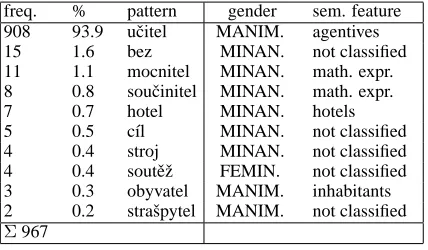
[image:4.612.53.266.122.268.2]freq. % pattern gender sem. feature 908 93.9 uˇcitel MANIM. agentives 15 1.6 bez MINAN. not classified 11 1.1 mocnitel MINAN. math. expr. 8 0.8 souˇcinitel MINAN. math. expr. 7 0.7 hotel MINAN. hotels 5 0.5 c´ıl MINAN. not classified 4 0.4 stroj MINAN. not classified 4 0.4 soutˇeˇz FEMIN. not classified 3 0.3 obyvatel MANIM. inhabitants 2 0.2 straˇspytel MANIM. not classified Σ967
Table 2: SUBST, suffix: -tel
7 Rules for WD Processes
So far we have been talking about the derivation of word forms in terms of morphemes, stems, roots, lemmata, etc. More formally, WD processes em-ploy strings of letters (morphemes) carrying gram-matical and lexical information. It can be observed that the WD processes have quite a regular nature, thus one can express them by means of certain rules (WD patterns)
WD is a hierarchically structured process, which will be reflected in the construction of the rules (WD patterns) – we will build them as cas-cades going from simpler to more complicated patterns.
We start from a linguist’s hypothesis which de-fines a pattern capturing the changes between the word forms and other constraints on the form of grammatical tags associated with the searched entries. Then we can automatically look up
n-The following n-tuple has to be searched for:
form POS-tag condition
1. S-zace SUBST FEM
2. S-stick´y ADJ
3. S-sta SUBST MAS ANIMAL
4. S-smus SUBST MAS UNANIMAL
where “S-” is arbitrary but has to be an identical string for all members of the n-tuple
Table 3: searching the relations, verifying hy-potheses
tuples of the entries in the existing morphological
database (using theI partool), where
1. all the members (=entries) exist in the database;
2. the members of n-tuple fulfil the required hy-pothesis, i. e. the changes between the strings belonging to the individual members of the n-tuple are described in given pattern and en-tries correspond to the additional constraints.
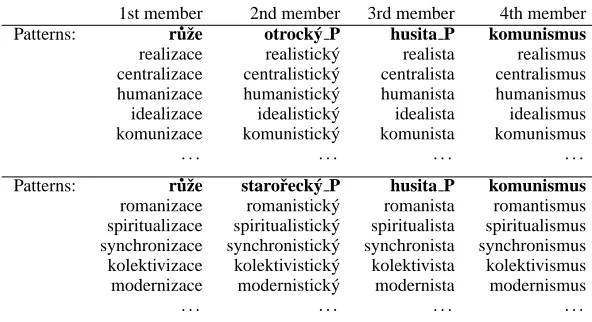
Suppose that there is an algorithm (see Sec-tion 7.1) which in the respective morphological database will find the n-tuples (see Table 4) match-ing the hypothesis formulated by a lmatch-inguist (see Table 3). The linguist can take the derived list of n-tuples and determine which n-tuples are correct and which not. The list of the positive examples will arise together with the list of exceptions not
matching the formulated hypothesis, e. g. pˇr´ıt→
pˇr´ıtel, word form pˇr´ıtel (friend) is derived from “pˇr´at (to wish sb well)”, not “pˇr´ıt se (to argue with sb)”.
It is now clear that by using a hierarchical con-nection of the new pattern to the original one (for the individual members of the n-tuple) it is pos-sible to derive from a single entry not only the neighbouring entries in the n-tuple but also other word forms (generated from the entries included in the n-tuple by means of the respective original patterns).
If the changes in the word form put into effect
by the (new) pattern express1 a well-defined
se-mantic relation, the entries can be “virtualized”,
1
[image:4.612.52.266.310.435.2]1st member 2nd member 3rd member 4th member Patterns: r ˚uˇze otrock´y P husita P komunismus
realizace realistick´y realista realismus centralizace centralistick´y centralista centralismus humanizace humanistick´y humanista humanismus idealizace idealistick´y idealista idealismus komunizace komunistick´y komunista komunismus . . . .
Patterns: r ˚uˇze staroˇreck´y P husita P komunismus
[image:5.612.180.476.83.244.2]romanizace romanistick´y romanista romantismus spiritualizace spiritualistick´y spiritualista spiritualismus synchronizace synchronistick´y synchronista synchronismus kolektivizace kolektivistick´y kolektivista kolektivismus modernizace modernistick´y modernista modernismus . . . .
Table 4: searching of the relations, verifying hypotheses, output
thus we do not need to keep all entries in the lex-icon but only those entries which are basic (moti-vating) word forms for the neighbouring entries of the found n-tuples.
The entries that are thereby eliminated from the lexicon can be constructed according to the new pattern from the basic (motivating) word form. The original word forms can be determined algo-rithmically and their original lexical meaning can be inferred as well.
We will reduce the lexicon using the description of the WD process which yields the predictable changes in the semantics of the derived entries.
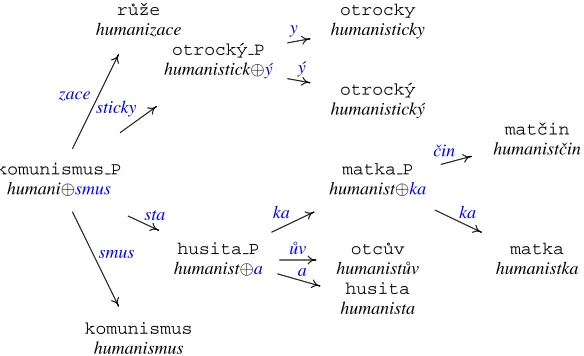
The WD process can be illustrated by the Fig. 1. It can be seen that the sub-entries humanizace
(hu-manisation), humanisticky (humanistically ADV), humanistick´y (humanisticADJ), humanistˇcin (hu-manist’sFEM POSS ADJ), humanistka (human-ist FEM), humanist˚uv (humanist’s MAS POSS ADJ), humanista (humanist MAS), humanismus (humanism), can be assigned:
1. either to the respective infl. paradigms:
humanizace:r˚uˇze humanisticky:otrocky humanistick´y:otrock´y humanistˇcin:matˇcin humanistka:matka humanist˚uv:otc˚uv humanista:husita humanismus:komunismus
2. or to:
humanizace:r˚uˇze humanistick´y:otrock´y P humanista:husita P humanismus:komunismus
3. or to a deriv. pattern (meta-pattern):
humanismus:komunismus P
In the second and third cases, the reduction
of the lexicon can be observed. The pattern
komunismus P derives the word forms by ex-changing the string at the end of the basic (moti-vating) word form:
smus→zace, sticky, sta, smus
and the corresponding change of the attributes of the constructed tag.
For an implementation of these WD patterns, a parallel with Finite State Automata (FST) is use-ful. The property of chaining (Roche and Schabes, 1997) is very suitable here – it allows us to build WD patterns as hierarchical modules. This prop-erty makes it possible to limit the duplicity of the stored information and increase their lucidity.
7.1 WD Relation Mining
We explained how to extend the morphological database employing the regular changes of word forms that can be observed in the course of the WD processes (Osolsobˇe et al., 2002). We have shown that if the WD processes are described by the rules it is possible to reduce our stem dictio-nary and eventually to obtain a dictiodictio-nary of roots. To make the process of searching for the dis-crete description of WD processes simpler we have implemented an algorithm that looks up the relations between the strings corresponding to the individual entries in the morphological database.
komunismus P humani⊕smus
komunismus humanismus
husita P humanist⊕a
husita humanista
otc˚uv humanist˚uv
matka P humanist⊕ka
matka humanistka
matˇcin humanistˇcin otrock´y P
humanistick⊕´y
otrock´y humanistick´y
otrocky humanisticky r˚uˇze
[image:6.612.133.425.85.263.2]humanizace
...... ......
...... ......
...... ... . . . ....... smus
............. . ... sta
...a.... .................... ...˚uv. ... ...
...
ka ...... ... . ... ka ... ˇcin ...
... ... ... . . . . . . . . sticky
... .´y... ... y
... ...
... ...
... ...
... ... ... . . . . . . . . .
zace
Figure 1: Using the derivational pattern to reduce the stem dictionary
To describe the variations of the word forms we will use:
•variables$1,$2, . . . (values∈Σ∗),
•constants / “affixes” :A1,1, A1,2, . . .∈Σ∗
•concatenation operator⊕
•stringsSi∈ {Ai,1, Ai,2, . . .$1,$2, . . .}∗
•conditions – constraints on the values of
given attributes, eventually a determination whether the given word form has to be
present in the database:C1, C2, . . .
7.1.1 Input
The task assumes:
•n . . . number of the word forms searched for,
•n-tuple:(S1, C1). . .(Sn, Cn).
TheSi strings should be written in such a way
so as not to contain the pairs constant – constant, variable – variable standing adjacent.
•two neighbouring constants can be merged
into one
•two variables can be separated byconstant
(empty string).
•if the variable at beginning is required, or at
the end of the string, then we setAi,1, orAi,m
≡
Each stringSithus can be given without loosing
any generality in the following way:
Si ≡ Ai,1⊕$1⊕Ai,2⊕$2⊕
Ai,3⊕. . .⊕$m⊕Ai,m+1 (1)
We know thatAi,j are constants and $j
vari-ables which can take values fromΣ∗. For an
arbi-trary stringSi, a regular grammar can be written
(see Eq. 2).
S →Ai,1$1N1
N1→Ai,2$2N2
. . .
Nm→Ai,m+1
$1|. . .|$m→E E →a|aE|b|bE|. . .
whereE ∈Σ∗
(2)
It can be seen that for each string Si a
non-deterministic transducer can be constructed that takes a word form on the input and on the output, it produces a set of all acceptable evaluations of
the variables$1. . .$m, i. e. a set (possibly empty)
of the m-tuples of members of setΣ∗.
7.1.2 The Algorithm
First we have to select the pairs (Si, Ci) for
which the requirement in the condition states that their corresponding word forms have to occur in the database. Those word forms, strings and pairs will be called located. The word forms that we can determine from the located ones after substi-tution values for the variables in the strings will be labelled as inferred.
variables before the computing the automaton in which the variables occur. Thus we can work with them in a given automaton as with the constants – this simplifies the automaton.
When a given word form is accepted by the
transducer (for stringSi) we obtain the respective
evaluation variables included inSias an output. If
the same variables occur also in other strings they can be substituted (instantiated) by the values.
Thus step by step we will construct the
respec-tive FS automata for located stringsSi using the
instantiation of the variables. If the automaton does not contain any free variables it is obvious that the respective pair is inferred (it can be lo-cated at the same time) – these will be labelled as
inferred+located).
The order in which the individual automata will be applied can be optimised. A certain part of the state space being searched can be eliminated in
ad-vance based on conditions Ci, i. e. it is enough
to search/eliminate entries associated with the pat-terns which guarantee/eliminate some attributes of the tag.
We suppose that by means of located strings all the variables used in the inferred strings can be in-stantiated in such a way that we will be able to de-termine correctly inferred word forms relying only on the knowledge of the located word forms, i. e. in the cases where the inferred strings do not con-tain free variables. In the opposite case the algo-rithm has to stop prematurely.
The optimisation will determine the order in which the individual automata containing free variables will be applied.
We will start with the first automaton following the order determined by the optimisation. Step by step we will go through all the entries and then for all possible evaluations we will instantiate the variables and continue with searching the entries acceptable for the next automaton (according to the given ordering), i. e. we look for the next ele-ment of the respective n-tuple.
If we succeed in the instantiation of all vari-ables and determine all inferred word forms and if all inferred+located word forms are found in the database then the currently determined n-tuple can be sent to the output.
8 The First Results from our Data
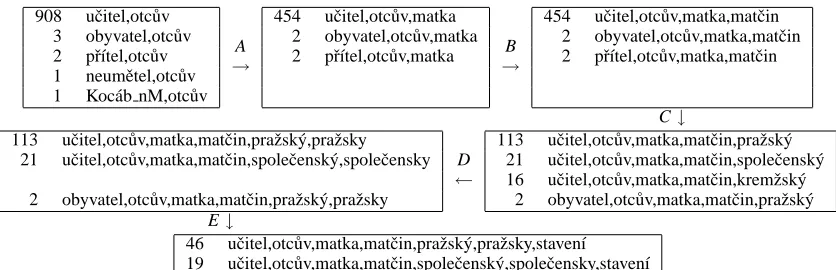
Table 5 displays the individual steps taken dur-ing formdur-ing the respective WD nest. The step A (see Table 5) consisted in the derivation of mas-culine possessives using suffix -˚uv. It is obvious that this derivation is regular, the number of lem-mata has not changed – all of them have been as-signed to the paradigm for the possessives otc˚uv
(father’s). In the step B the gender of noun is
changed from masculine to feminine using
suf-fix -ka. Moreover, in this step the paradigms
neumˇetel a Koc´ab nM have been removed. Also
the number of lemmata assigned to the paradigm
uˇcitel (teacher) has been reduced to half, i. e. from
908 to 454. This means that according to our data (our morphological database) half of the agentives cannot form the feminine counterpart and this re-sult can be expected to be confirmed by examin-ing a larger corpus. The step C is again regu-lar – it consists in the derivation of feminine pos-sessives using suffix -in with a number of lem-mata not being changed. In the step D the ad-jectives are formed by means of suffix -sk´y and this process is less regular. From the possible 454 lemmata belonging to the paradigm uˇcitel the ad-jectives are derived only from 113+21+16=150. Moreover, these adjectives split into three adjec-tive paradigms praˇzsk´y (Prague), spoleˇcensk´y
(so-cial) and kremˇzsk´y (Crems) depending on whether
they form a comparative and adverb or not. The following step is again regular – it involves the derivation of adverbs from adjectives by shorten-ing the last vowel from ´y to y. It can be seen that from the adjectives belonging to the paradigm
kremˇzsk´y such adverbs cannot be formed at all.
The step E is irregular as well and it involves the derivation of the nouns from the respective adjec-tives by replacing the suffix -sk´y for -stv´ı.
9 Conclusions
The purpose of the paper is to show how se-lected word derivation relations in Czech can be
described using the morphological analyserajka
and the program I par which works with the
Czech morphological database. The Czech data necessary for this description are: stem dictionary
908 uˇcitel,otc˚uv 3 obyvatel,otc˚uv 2 pˇr´ıtel,otc˚uv 1 neumˇetel,otc˚uv 1 Koc´ab nM,otc˚uv
A
→
454 uˇcitel,otc˚uv,matka 2 obyvatel,otc˚uv,matka 2 pˇr´ıtel,otc˚uv,matka B
→
454 uˇcitel,otc˚uv,matka,matˇcin 2 obyvatel,otc˚uv,matka,matˇcin 2 pˇr´ıtel,otc˚uv,matka,matˇcin
C↓
113 uˇcitel,otc˚uv,matka,matˇcin,praˇzsk´y,praˇzsky 21 uˇcitel,otc˚uv,matka,matˇcin,spoleˇcensk´y,spoleˇcensky
2 obyvatel,otc˚uv,matka,matˇcin,praˇzsk´y,praˇzsky
D
←
113 uˇcitel,otc˚uv,matka,matˇcin,praˇzsk´y 21 uˇcitel,otc˚uv,matka,matˇcin,spoleˇcensk´y 16 uˇcitel,otc˚uv,matka,matˇcin,kremˇzsk´y
2 obyvatel,otc˚uv,matka,matˇcin,praˇzsk´y E↓
[image:8.612.70.488.82.217.2]46 uˇcitel,otc˚uv,matka,matˇcin,praˇzsk´y,praˇzsky,staven´ı 19 uˇcitel,otc˚uv,matka,matˇcin,spoleˇcensk´y,spoleˇcensky,staven´ı
Table 5: WD nest for -tel
belonging to the 10 parts of speech, the Czech morphological database comprising 2,042 inflec-tional paradigms and the set of the Czech suffixes mentioned in this paper (-tel, -´ak, -˚uv, -ka, -in,
-sk´y, -ck´y, -sky, -cky, -stv´ı, -ismus, -ista, -izace).
Within this task we also demonstrated, using the selected examples, how the inflectional paradigms can be employed to create more general but less regular word derivation patterns, how both can be linked together and how WD patterns can be used to describe the selected WD processes in an algo-rithmic way. This we regard as a relevant contribu-tion to the theory. In our opinion these examples are general enough to show that the whole WD system for Czech can be grasped successfully in this way.
In this research we are working with Czech data only, but we firmly believe that if similar data for Russian, Slovak, Croatian or Serbian etc., were supplied similar results would be arrived at. It is, of course, obvious that different WD rules have to be formulated for other Slavonic languages but if a similar system of inflectional paradigms were used and the corresponding groups of suffixes as well,
using tools like ajka and I par would enable
the mapping of word derivation relations accord-ingly.
The continuation of this research will lead to building a Czech Derivation Dictionary integrated with WD rules and thus later yielding a WD au-tomaton for Czech.
Acknowledgement
This work was supported by Ministry of Educa-tion, Research Program CEZ:J07/98:143300003.
References
Miloˇs Dokulil. 1962. Tvoˇren´ı slov v ˇceˇstinˇe 1 (Word
Derivation in Czech). Nakladatelstv´ı ˇCSAV, Praha. In Czech.
Petr Karl´ık, Marek Nekula, and Zdenka Rus´ınov´a. 1995. Pˇr´ıruˇcn´ı mluvnice ˇceˇstiny (Reference
Gram-mar of Czech). Nakladatelstv´ı Lidov´e noviny, Praha.
In Czech.
Lauri Karttunen and Kent Wittenburg. 1983. A Two-Level Morphological Analysis of English. In Texas
Linguistic Forum, volume 22, pages 217–228.
Kl´ara Osolsobˇe, Karel Pala, Radek Sedl´aˇcek, and Marek Veber. 2002. A Procedure for Word Deriva-tional Processes Concerning Lexicon Extension in Highly Inflected Languages. In Proceedings of the
Conference LREC2002, volume 3, pages 998–1003,
Las Palmas, May 29-31. ELRA.
Jan Petr. 1986. Mluvnice ˇceˇstiny II. (Grammar of
Czech). Academia, Praha. In Czech.
Emmanuel Roche and Yves Schabes, editors. 1997.
Finite-State Language Processing. MIT Press.
Radek Sedl´aˇcek. 1999. Morfologick´y analyz´ator
ˇceˇstiny (Morphological Analyser of Czech). Mas-ter’s thesis, FI MU, Brno. In Czech.
Radek Sedl´aˇcek and Pavel Smrˇz. 2001. A New Czech
Morphological Analyserajka. In Proceedings of
TSD 2001, pages 100–107, Berlin. Springer-Verlag.
Marek Veber. 2002. N´astroje pro textov´e korpusy a
morfologick´e datab´aze (Tools for Text Corpora and Morphological Databases). Ph.D. thesis, FI MU,
Brno. In Czech.