Reestimation and Best-First Parsing Algorithm
for Probabilistic Dependency Grammars
S e u n g m i L e e a n d K e y - S u n C h o i Dept. of C o m p u t e r Science
Korea Advanced Institute of Science and Technology 373-1, Kusung-Dong, YuSung-Gu, Taejon, 305-701, KOREA
e-malh {leesm, kschoi}~orld, kaist, ac. kr
Abstract
This paper presents a reesthnation algorithm and a best-first parsing (BFP) algorithm for probabilistic dependency grummars (PDG). The proposed reestimation algorithm is a variation of the inside-outside algorithm adapted to probabilistic dependency gram- mars. The inside-outside algorithm is a probabilistic parameter reestimation algorithm for phrase structure grammars in Chomsky Normal Form (CNF). Dependency grammar represents a sentence structure as a set of dependency links between arbitrary two words in the sentence, and can not be reestimated by the inside-outside algorithm directly. In this paper, non-constituent objects, complete-llnk and complete-sequence are defined as basic units of dependency structure, and the probabilities of them are rees- timated. The reestimation and BFP algorithms utilize CYK-style chart and the non- constituent objects as chart entries. Both algoritbrn~ have O(n s) time complexities.
1
I n t r o d u c t i o n
There have been many efforts to induce grammars automatically from corpus by utilizing the vast amount of corpora with various degrees of annotations. Corpus-based, stochastic grammar induction has many profitable advantages such as simple acquisition and exten- sion of linguistic knowledges, easy treatment of ambiguities by virtue of its innate scoring mechanism, and fail-soi~ reaction to ill-formed or extra-grammatical sentences.
Most of corpus-based grammar inductions have concentrated on phrase structure gram° mars (Black, Lafferty, and Roukos, 1992, Lari and Young, 1990, Magerman, 1994). The typical works on phrase structure grammar induction are as follows(Lari and Young, 1990, Carroll, 1992b): (1) generating all the possible rules, (2) reestimating the probabilities of rules using the inside-outside algorithm, and (3) finally finding a stable grammar by eliminating the rules which have probability values close to 0. Generating all the rules is done by restricting the number of nonterminals and/or the number of the right hand side symbols in the rules and enumerating all the possible combinations. Chen extracts rules by some heuristics and reestimates the probabilities of rules using the inside-outside algorithm (Chen, 1995). The inside-outside algorithm learns a grammar by iteratively ad- justing the rule probabilities to minimize the training corpus entropy. It is extensively used
as reestimation algorithm for phrase structure grammars.
Most of the works on phrase structure grammar induction, however, have partially succeeded. Estimating phrase structure grammars by minimizing the training corpus on-
tropy does not lead to the desired grammars which is consistent with human intuitions (de Marcken, 1995). To increase the correctness of the learned grammar, Marcken pro- posed to include lexical information to the phrase structure grammar. A recent trend of parsing is also to include lexiccal information to increase the correctness (Magerman, 1994, Collir~, 1996). This means that the lack of lexical information in phrase structure gram- mar is a major weak point for syntactic disambiguation. Besides the lack of lexical in- formation, the induction of phrase structure grnmmar may suffer from structural data sparseness with medium sized training corpus. The structural data sparseness means the lack of information on the grammar rules. An approach to increase the correctness of grammar induction is to learn a grammar from a tree-tagged corpus or bracketed corpus (Pereira and Schabes, 1992, Black, Lafferty, and Roukos, 1992). But the construction of vast sized tree-corpus or bracketed corpus is very labour-intensive and manual construction of such corpus may produce serious inconsistencies. And the structural-data sparseness problem still remains.
The problems of structural-data sparseness and lack of lexical information can be less- ened with PDG. Dependency grammar defines a language as a set of dependency relations between any two words. The basic units of sentence structure in DG, the dependency re- lations are much simpler than the rules in phrase structure grnmmar. So, the search space of dependency grammar may be smaller and the grammar induction may be less affected by the structural-data sparseness. Dependency grammar induction has been studied by Carroll (Carroll, 1992b, Carroll, 1992a). In the works, however, the dependency grammar was rather a restricted form of phrase structure grarnrnarss. Accordingly, they extensively used the inside-outside algorithm to reestimate the grnmmnr and have the same problem of structural-data sparseness.
In this paper, we propose a reestimation algorithm and a best-first parsing algorithm for PDG. The reestimation algorithm is a variation of the inside-outside algorithm adapted to PDG. The inside-outside algorithm is a probabilistic parameter reestimation algorithm for phrase structure grammars in CNF and thus can not be directly used for reestimation of probabilistic dependency grammnrs. We define non-constituent objects, c o m p l e t e - l i n k and c o m p l e t e - s e q u e n c e as basic units of dependency structure. Both of reestimation algorithm and best-first parsing algorithm utilize a CYK-style chart and the non-constituent objects as chart entries. Both algorithms have O(n s) time complexities.
The rest of the paper is organized as follows. Section 2 defines the basic units and de- scribes best-first parsing algorithm. Section 3 describes the reestimation algorithm. Section 4 shows the experimental results of reestimation algorithm on Korean and finally section 5 concludes this paper.
2
P D G Best First Parsing Algorithm
Dependency grammar describes a language with a set of head-dependent relations between any two words in the language. Head-dependent relations represent specific relations such as modiflee-modifier, predicate-argument, etc. In general, a functional role is assigned to a dependency link and specifies the syntactic/semantic relation between the head and the dependent. However, in this paper, we use the minimal definition of dependency grnmmar with head-dependent relations only. In the future we will extend our dependency grammar into one with functions of dependency lln~.
A dependency tree of a n-word sentence is always composed of n-1 dependency links. Every word in the sentence must have its head, except the word which is the head of the sentence. In a dependency tree, crossing links are not allowed.
Salesperson sold the dog buiscuits
Figure 1: Dependency tree: link representations
Figure 1 shows a dependency tree as a hierarchical representation and a link represen- tation respectively. In both, the word ~sold" is the head of the sentence.
Here, we define the non-constituent objects, complete-link and complete-sequence which are used in PDG reestimation and BFP algorithms. A set of dependency links constructed for word sequence wid is defined as complete-link ff the set satisfies following conditions:
• The set has exclusively (wi ~ wj) or (wi ~ wj). • There is neither link-crossing nor llnk-cyele.
• The set is composed of j - i dependency links.
• Every inner word of wij must have its head and thus a link from the head.
Complete-link has directionality. It is determined
by
the direction of the outermost depen- dency relation. If the complete-llnk has (wi --> wj), it is rightward, and if the complete-link has (wi ~-- wj), then it is leftward. Basic complete-link is a dependency link between adjacent two words.Complete-sequence is defined as a sequence of null or more adjacent complete-lknks of same direction. Basic complete-sequence is null sequence of complete-links which is defined on one word, the smallest word sequence. The direction of complete-sequence is determined by the direction of component complete-links. If the complete-sequence is composed of leftward complete-links, the complete-sequence is leftward, and vice versa.
Figure 2 shows abstract rightward complete-llnk for wi,j, rightward complete-sequence for Wi,m, and leftward complete-sequence for Wrn+ld. Double-slashed line means a complete- sequence. Whatever the direction is, a complete-link for wij is always constructed with a dependency link between wi and wj, a rightward complete-sequence from i to ra, and a leftward complete-sequence from j to m + 1, for an m between i and j - 1. Rightward complete-sequence is always composed with a combination of a rightward complete-sequence and a rightward complete-link. On the contrary, leftward complete-sequence is always composed with a combination of a leftward complete-link and a leftward complete-sequence. These restrictions on composition of complete-sequence is for the ease of description of algorithm~ The basic complete-link and complete-sequence are also shown in the Figure 2. Following notations are used to represent the four kinds of objects for a word sequence wij and for an m from i to j-1.
• Lr(i,j): rightward complete.link for wid, i.e. {(wi ---r wj), Sr(i,m), St(rn + 1.n)} • Lt(i,j): leftward complete-link for wi,a, i.e. {(wi ~ wj), S r ( i , m ) , S t ( m + 1,n)}
I
I
W
~
...
/
W
Wm Wm÷l ... Wj
i
+
l
I ~
I
l
Wi
+l
..]
W
i
,, comprehend link
Rightward Complete-link I
Wi
Wk
Wm
Rightward Complete-sequence
Wm+
1
WI
Wj
Leftward Complete-sequence complet~ sequence tmi
Figure 2: Abstract complete-link and complete-sequence
• St(i,
j): rightward complete-sequence for wit/, i.e. {St (i, m), Lr (m, j)}• Sz(i,j):
leftward complete-sequence for wid, i.e.{Lt(~,m), Sdm, j)}
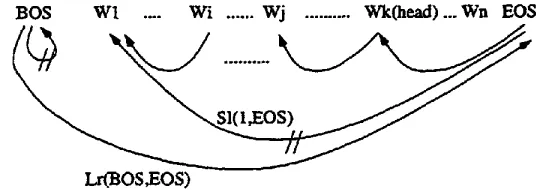
To generalize the structure of a dependency tree, we assume that there are marking tags, BOS (Begin Of Sentence) before w, and EOS (End Of Sentence) after
wn
and that there are always the dependency links,(wBos --+ WEos) and (wk ~-- wEos)
when wk is the head word of the sentence. Then, by definition: any dependency tree of a sentence,wi.n can
be uniquely represented with either aLr(BOS, EOS)
or a Sl(1,EOS) as
depictedin Figure 3. This is because Lr
(BOS, EOS)
for any sentence is always composed of nullSr(BOS, BOS) and St(1,EOS).
The head of a dependency treeWk can
be found in therightmost
Lt( k, EO S)
of &(1,E O S).
BOS Wl .... Wi ... Wj ... Wk(head) ... Wn EOS
Lr(BOS,EOS)
Figure 3: Abstract dependency tree of a sentence
The probability of each object is defined as follows. pCLrCi,j)) = PCwi --~ wj)p(Sr(i, rn))p(SlC m +
l,j))
pCZ,~(i, j)) = pC,v~ . - wj)pCS.(i, m))pC& (m + 1, j))
p(Sr(i, j)) = p(SrCi, m))PCLr(rn, j))
p(St(i, j)) = p(Ll(i, m))p(St (m, j))
i
[image:4.612.110.516.105.300.2] [image:4.612.177.445.489.584.2]The m varies from i to j - 1 for Lz, Lr and
St,
and from i + 1 to j for Si. The best L~ and the best Lr always share the same m. This is because both are composed of the samesub-St
a n d sub-St with rnaYimum probabilities. Basis probabilities are as follows:p(L,.(i, i + 1)) = p(w
p(.Lt(i, i + 1)) = p(tO i ~-- W/+I)
p(Sr(i,i +
1)) - - p ( Z r ( i , i÷
1))p(Sl(i,i +
1)) =p(Lt(i,i +
1))p ( S t ( i , i)) = p ( S r ( i , i)) =
1
Thus, the probability of a dependency tree is defined either by
p(Lr(BOS, EOS))
or byp(st(1, sos).
Leftward/Rightward Complete Link
i Lr/LI
S r - - L ~" I i
Leftward Complete Sequence Rightward Complete Sequence
I I F I I
[image:5.612.111.526.288.420.2]SI [ [ Sl
Figure 4: Best first parsing entries
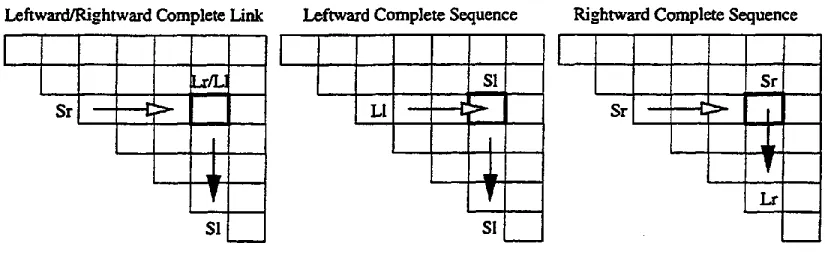
The P D G best-first parsing algorithm constructs the best dependency tree in bottom- up manner, with dynamic programrrdng method using CYK style chart. It is based on complete-link and complete-sequence of non-constituent concept. The parsing algorithm constructs the complete-link.q and complete-sequences for substring, and merges incremen- tally the complete-links into larger complete-sequence and complete-sequences into larger complete-link until the
Lr(BOS, EOS)
with maximum probability is constructed.Eisner (Eisner, 1996) proposed an O(n 3) parsing algorithm for PDG. In their work, basic unit of chart entry is
span
which is also of non-constituent concept. But, the span slightly differs from our complete-sequence and complete-link. When two adjacent spans are merged into a larger span, some conditional tests must be satisfied. In our work, best-first parsing is done by inscribing the four entries with maximum probabilities, Lt (i, j), L~ (i, j ) ,St(i,j),
andSr(i,j)
to each chart positions in bottom-up/left-to-right manner without anyextra condition checking.
Figure 4 depicts the possible combinations of chart entries into a larger Lr, Lt, St, and Sr each. The sub-entries under the white-headed arrow and the sub-entries under the black-headed arrow are merged into a larger entries. The larger entries are inscribed into the bold box.
There is an exception for chart entries of n + l t h column. In the n + l t h column, only the Lt(k,
EOS)
whose sub Sl is null can be inscribed. This is because there can be only one head word for a tree structure. IfLt(k, EOS)
whose sub St is not null is inscribed into the chart, the overall tree structure will have two or more heads.i • i
!
!
The best parse is maximum
Lr(BOS, EOS) in
the chart position (0,n + 1). T h e best parse can also be found by the maximum St(l,EOS)
because theLr(BOS, EOS) is
always composed ofSr(BOS, BOS) and Sl(l,
EOS).
The chart size is n2+4n+3 for n word sentence. For four items (Lr, 2
Ll,
St, a n dSl)
of each chart position, there can be maximally n searches. Thus, the time complexity of the best-fRrst parsing algorithm is O(nS).3
P D G R e e s t i m a t i o n A l g o r i t h m
For reestimation of dependency probabilities of PDG, eight kinds of chart entries are de- fined based on three factors: inside/outside, complete-link/complete-sequence, and left- ward/rightward. In following definitions, f~ is for inside probability and a is for outside prob- ability. Superscripts represent whether the object is complete-link or complete-sequence, l for complete-link and s for complete-sequence. Subscripts of f~ and a are for the direction- ality, r for rightward and l for leftward.
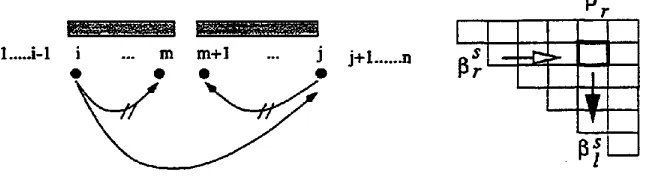
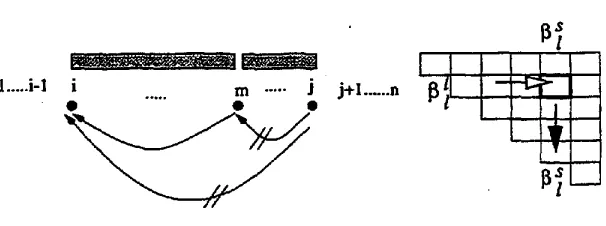
Complete-link Inside Probabilities: jSlr, ~8~ Inside probability of a complete-link is the probability that word sequence wij will be generated when there is a dependency
m
relation between wi and wj. I
= p( i ILr(i,j))
j-I I
m - - i
f (i,j) = pCwi,#lLiCi,
I
m = i
In Figure 5, ~(i,j), the inside probability of Lr(i,j) is depicted. In the left part of the
l...i-I i ... m m + l ... j j+ 1 ... n
[image:6.612.163.488.507.596.2]I I t T
Figure 5: Rightward complete-link Inside probability
L r ( i , j ) is composed of the dependency link between word i and word j (either (wi -+ wj) or
(wi ~-- wj)), S,.(i,
m) and S l ( r n + l , j ) for an m from i to j-1. Inside probability of L t ( i , j ) canbe computed the same as that of Lr (i, j) except for the direction of dependency link between zvi and wj. T h e outermost dependency (zoi ~ wj) must be replaced with (wi ~ wj). Lr and Lt are not defined on word sequence of 1 length, zvi. The unit probabilities for ~ a n d ~ are as follows:
~ ( i , i + ~) = p ( ~ ~ ~,~+~)
l~(i,i +
i) =p(wi ~ wi+~)
~r(BOS, ~OS) = p(~,~)
Any dependency tree of a sentence always has the dependency
(z~BOS -+ Z~EOS) as
the outermost dependency. So the ~ r ( B O S ,EOS)
is the same as the sentence probability which is the sum of probabilities of all the possible parses.Complete-sequence
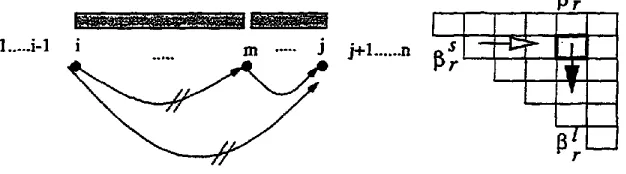
Inside Probabilities: ~r s, ~ Inside probability of complete-sequence is the probability that word sequence wio is generated when there is St(i, j) or
S,(i,j).
/ ~ ( i , j ) =
p(wijl&(i,j))
j-1
= ~
~gCi,=)~Cm,#)
m
=
p(wial&Ci,
j))
J= ~7
~ICi,~)~t(m,#)
n~.=i+l
In Figure 6 and 7, the double-slashed link means complete-sequence, a sequence of null or more adjacent complete-links of same direction. A complete-sequence is composed of sub-
"
l/I
i
1 ... i-1 i ... m ... J j + l ... n ~ n i l
i v
[image:7.612.156.469.511.598.2]t i
Figure 6: Rightward complete-sequence Inside probability
complete-sequence and sub-complete-link. Figure 6 depicts rightward complete-sequence for an m. T h e value of m varies from i to j-1. In Figure 7, St is composed of sub-L~ and sub-St. The inside probability of complete-sequence is the sum of the probabilities t h a t the complete-sequences are constructed with. The basis for inside probabilities of complete- sequence are as follows.
~r s (i, i) = ~ (i, i) = 1
1 ... i - I i ... m ... J j + l ... n ~ - -
,i
Figure 7: Leftward complete-sequence Inside probability
~ ( i , i + 1) = p(L~(i,i + 1)) = p(w~ -+ w~+~)
~t(i,i +
1) =p(Ll(i,i +
1)) =p(wl ~
w/+t)Because
n+lth
word,wEos can
not be a dependent of any other word,l~r(k, EOS)
or~rS(k, EOS)
for k from 1 to n is not computed. And because there can be only one headof a tree,
wEos
must be head of only one word. Thus, in computation offlt(x, EOS) and
fl~(x, EOS),
only the Lts whose sub St is null are considered.C o m p l e t e - l i n k O u t s i d e P r o b a b i l i t y : atr, a~ This is t h e probability of producing the words before i and after j of a sente;ace while complete-link(i.j) generates
wid.
a~(i, j) = n(w~,~-~, n,(i, j), ~j+~,,,)
i= ~ o4(,,,j)~(v,i)
tr=l
a~(i, j) = p(w~,~_x, L,(i, j),w~+~,.)
= ~ o 4 ( i , h ) ~ t ~ , h )
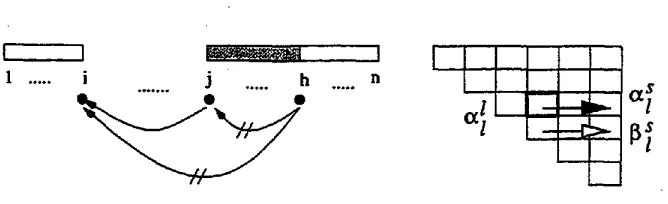
Figure 8 and 9 depict the cases of Lr and Ll to become a substructure of larger
Sr and
1 2 ... v ... i ... j j+l ... n
I~s a s
r
' L
a l F
Figure 8: Rightward complete-link Outside probability
[image:8.612.181.484.100.213.2] [image:8.612.144.519.549.636.2]t
i
~
i
I [
] ... i . . . j o ° . o . h ... n IIi
Figure 9: Leftward complete-link Outside probability
arrow. Likewise, in Figure 9, the outside probability of
Lt in
the bold box is computedby slimming
all the products of the inside probabilities under the white-headed arrow andthe outside probabilities under the black-headed arrow each. This is because, in parsing, the subentries under the white-headed arrows and
Lr/Lz in
the bold boxes are merged into larger entries which are to be inscribed in the boxes under the black-headed arrows. Basis probability for complete-link outside probability is as follow.~(BOS, EOS) =
a~(k, EOS)
is always 0, for k = 1,n +I(EOS)
becausewEos
can not be a dependent ofany other word.
Complete-sequence Outside Probabilities: aSr, ~/ This is the probability of produc- ing word sequence wl,i-1 and Wj+l,n while words i through j construct a complete-sequence.
a,~(i,j) =
p(w1,~-l,Sr(ij),w#+1,.)
n
=
~
~(i,h)~h#,h)
h=j+l
+a~(i, h)l~(] + 1,h)p(wi ~ Wh)
+a~(~, h)Zt(i + 1, h)p(wi ~ ~h)
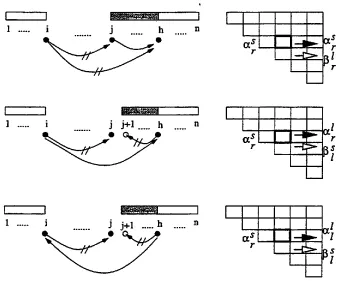
In the above expression, The first term is for the construction of larger
St(i, h)
from the combination ofSr(i,j)
and its adjacent Lr(j: h). The second t e r m me~n~ the construction of largerLr(i,h)
from the combination ofSr(i,j), St(j +
1,h), and the dependency link from wi to wh. The third term is for the largerLt(i,h)
from the combination ofSr(i,]),
Si(j +
1,h) and the dependency link fromwh
towi.
The three terms in the expression aredepicted in Figure 10.
a~(i,j)
= p(w~,i.~,Sdi, j),w,+~,.)
i - 1= E ~tCv,#)~Cv,~)
v----1
+a~C~,j)f~(~, ~ - 1 ) p ( ~ +- w~)
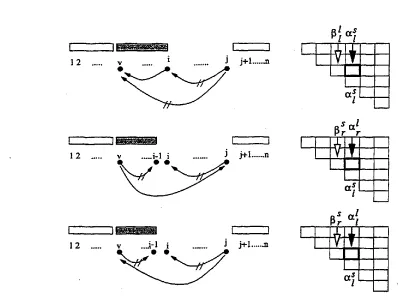
a~ is the sum of all the probabilities that Sl is to become a subentry of larger entries:
St,
L~, and Lt.
The first term in the above expression is for the combination ofSt(v,j)
fromLt (v, i) and St
(i, j). The second is for the construction of Lr (v, j ) fromSt(v, i -
1),St(i, ]),
[image:9.612.157.491.88.190.2]L _ _ _ _ . J ~ I
1 ... i j h ... n
. . . O
, . . o . ° *
I
a $
r
3f
r
I I m I
1 ... i j j + l ... h ... n
r
B i t
a l
rI ' I ~ I
1 ... i J j + l ... h ... n
I
aS i
rFigure 10: Rightward complete-sequence Outside probability
and the dependency link from wv to wj. The third term is for the construction of
L~(v,j)
from
Sr(v,i -
1),St(i,j),
and dependency relation from w i to w~. The three cases are depicted in Figure 11. The basis probabilities for complete-sequence outside probabilities are as follows.~ ( B O S , ZOS) = 4 ( B O S , EOS) = ~?(1, EOS) : 1
The reesthnation algorithm computes the inside probabilities(#r ~, #~, #r', and #t) inscribing them into the chart in bottom-up and left-to-right. The outside probabilities(c~r, a~, a r s, and ~ ) are computed and inscribed into the chart in top-down and right-to-left.
T r a i n i n g The training process is as foflow;
1. Initialize the probabilities of dependency relations between all the possible word pairs.
2. Compute initial entropy.
3. Analyze the training corpus using the known probabilities,
and recalculate the frequency of each dependency relation based on the analysis result.
4. Compute the new probabilities based on the newly counted frequencies. 5. Compute the new entropy.
6. Continue 3 through 5 until the new entropy ~ previous entropy.
I
I
I
I
I
I
I
I
I
I
I
!
I
I
I
I
I
[image:10.612.151.489.97.378.2]I
I
!
I
I
I
I
1 2 ...
v---1
v i J j+l...n
12 ... v ... i-I i ... J j+l ... n
12 ... v ....i.-I i ... J j+l ... n
t~r ~t
ras.
~1,I.
i
T
ct s.
F i g u r e 11: L e f t w a r d c o m p l e t e - s e q u e n c e O u t s i d e p r o b a b i l i t y
T h e a b o v e i t e r a t i o n is c o n t i n u e d u n t i l all t h e p r o b a b i l i t i e s are s e t t l e d d o w n o r t h e t r a i n i n g c o r p u s e n t r o p y c o n v e r g e s t o t h e m i n i m u m . T h e n e w u s a g e c o u n t o f a d e p e n d e n c y r e l a t i o n is c a l c u l a t e d as follows. I n t h e f o l l o w i n g e x p r e s s i o n , t h e O¢~ is 1 if t h e d e p e n d e n c y r e l a t i o n is u s e d i n t h e g i v e n t r e e a n d 0 o t h e r w i s e .
c(wi --+ w j ) =
~p(tree]wl,=)O~(wi ~ wj, tree, wl,,)
tree
_ 1
p(wl,,~)
_ 1
p(~,~)
1
p(wl,.)
_ 1
p(wl,~)
_ 1
p(wl,,~)
_ 1
p(wl,n)
~ p(~ee, wl,.)O=(w~
~ wj, tree, wl,.)
- -
~p(tree, wl,n,w~ ~ wj)
t r e e
- - (ilJl,n, W , ~ W j )
j-1
- - ~ p ( w ~ , n , L r ( i , j ) , S~ (i,
m), & ( ~
+ l , j ) )rct=i j--1
- -
~ p(~,~,~_~, w~,,~, w,~+~,j,wj+~,,~, L,.(i,j), S,.(i, ~), &(m + 1,j))
j - 1
m = i
p(S~(i,m), ,~(rn + l:])[L~(i,j))
[image:11.612.95.493.85.387.2]v(~,~ls~(i, m))
v(w~+~jlsz(m +
l,j))
_ 1 j-z
1 t
-
v(~,~la~(i,j)NCi, j)
Similarly, the usage count of (w~ ~ w#), c(wi ~- w#) is
~a~(i,j)g(i,j).
a ~
Chart has n2+4n+3 number of boxes. The reestimation algorithm computes eight items for each chart box and the computation of each item needs maximally n number of produc- tions and snmrnations respectively. So the time complexity of the algorithm is
O(nS).
The algorithm can be used for class-based (or tag-based) dependency grammar. With the concept of word class/tag, the complexity is affected by the class/tag size due to the class/tag ambiguities of each word. In t h e worst case, the time needed is 8 x t 2 x ns÷4~ ~+sn, so the complexity will be
O(~n a)
with respect to t, the number of classes and n, the length of input string.4
E x p e r i m e n t a l
r e s u l t s o n K o r e a n
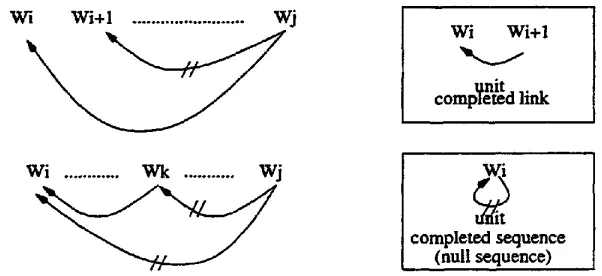
We performed experiment of the reestimation algorithm on Korean language. Korean is a partially ordered language in which the head words are always placed to the right of their dependent words. Under such restriction on word order, an abstract dependency structure for Korean is depicted in Figure 12. Thus, in Korean, both of `sr(i,j) and
Lr(i,j) are
meaningless and not constructed. Only ,St,
Ll
and null `sr(i:i) are considered.Ll(i,j) is
always composed with the combination of null Sr(i,i) and St(i + 1,j).
W i W i + l ... W j
Wi Wi+ 1
it comp~e~d link
W i ... W k ... W j
I I
completed sequence
[image:12.612.169.470.465.603.2](null sequence)
Figure 12: Abstract complete-link and complete-sequence for Korean
Korean sentence is spaced by "word-phrases" which is a sequence of content word and its functional words. In this experiment, the final part of speech(POS) of a "word-phrase" is selected as the representative POS and the inter-word-phrase dependencies are reestimated. We used 54 POS set. The initial probabilities of all the possible dependencies were set equal. The experiment was performed on three kinds of training and test sets extracted from
I
I
l
I
I
I
I
i
!
i
l
I
l
!
l
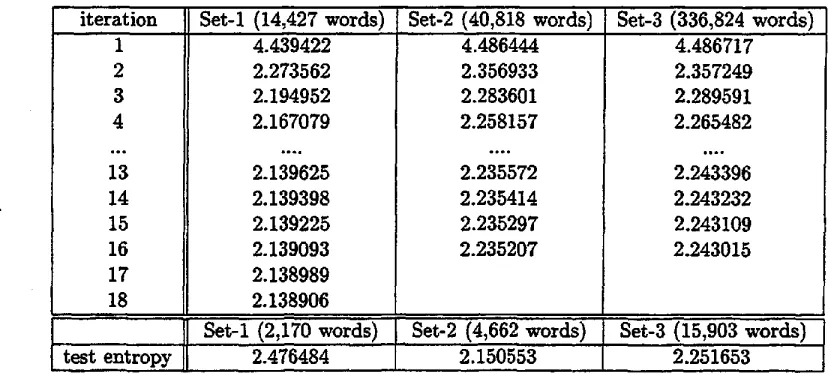
Table 1: Train and test entropies
iteration I Set-1 (14,427 words) ! Set-2 (40,818 words) Set-3 (336,824 words) 1 2 3 4 13 14 15 16 17 18 4.439422 2.273562 2.194952 2.167079 2.139625 2.139398 2.139225 2.139093 2.138989 2.138906 4.486444 2.356933 2.283601 2.258157 2.235572 2.235414 2.235297 2.235207 4.486717 2.357249 2.289591 2.265482 2.243396 2.243232 2.243109 2.243015
1 Set-1 (2;170 words) i Set-2 (4,662 words) Set-3 ~i5,903 words) .... test entropy I 2.476484 ' 2.1505'53 2.251653
K A I S T corpora 1. The convergence of entropies(bits/word) through training iterations and the test corpus entropy are shown in the table 1. Set-1 is extracted from information and communication related texts; the train corpus of set-1 is 1,124 sentences (14,427 words) and the test corpus is 162 sentences (2,170 words). Set-2 is extracted from economy related texts; the train corpus is 3,499 sentences (40,818 words) and the test corpus is 409 sentences (4,662 words). Set-3 is not restricted to a domain; train corpus is 29,169 sentences (336,824 words) and the test corpus is 1917 sentences (15,903 words).
The experiment result shows that the proposed reestimation algorithm converges to a (local) minimum entropy. It shows also that the train and test entropies are not affected much by the domain nor by the size of training corpus. It may be because the reestimation was done on inter-POS dependencies, which is relatively simple. If the reestimation would be done on the dependencies between POS sequences for ~word-phrase" or on the depen- dencies between lexical entities~ the entropies may be affected much by the domain and the size of corpus. We plan such experiments.
Below we show the parsing results of two example Korean sentences. We used the proposed best-first parsing algorithm to find the most probable parse of each sentence. The inter-word-phrase probabilities used for parsing are the reestimated ones for the training set-3. To the right of each Korean word-phrase, the meaning of it in English is given in the square brackets. In the parse representations, each individual inter-word-phrase probability is given to the right of the dependent word-phrase. The probability of each parse is the product of all the inter-word-phrase probabilities in the parse and is given on the top of each parse.
Input Sentence:
1 KAIST(Korean Advanced Institute of Science and Technology) corpora have been under construction since 1994 under Korean Information Base System construction (KIBS) project. It is supported by the Ministry of Culture and Sports, Korea. The KAIST corpora consist of raw text corpus(45,000.000 word- phrases), POS tagged corpus(6,750,000 word-phrases), and tree tagged corpus(30,000 sentences) at present. For our e x p e r i m e n t , we extracted each train/tesz set from the POS tagged corpus.
[image:13.612.105.520.136.323.2]1. ~!~el-o~]-,~ - [the laboratory]
2. ~71-:21- [an electric generator]
3. " ~ l - ~ - ~
[equippedwith]
4. oA-~4. [is]
Parse: 7.893022e-04
(EOS
(4. ~-r..1-
[is]9.996915e-01
(Z.
~4"~-~]'-'~"
[the
laboratory] (3. ~ ] . ~ . o ~ [equipped with](2. ~'~Tl-yl-
[an
electric generator]
7.129873e-02)
1.150859e-01
9.622178e-02))))
Input Sentence:
1. ~ z [tunnel]
2. ~--~- [the front of]
s.
~I~-~ [passing]
4. ~
[when]
5.
~'xFT]
[suddenly]6. ~--71- [the car]
7. ~ - - , ~ - ~ [stopped]
Parse: 3.293545e-06
(EOS
(7. ~--~-ru~ [stopped] 9.996915e-01
(4. --~-~ [when]
S.S28747e-02
(3. ~]',.-},-e. [passing]
9.044279e-01(2. o~_.~. [the front of]
1.785020e-01
(1. '~l~ [tunnel]
9.537951e-02))))
(5. ~-x]-y] [suddenly]
5.879496e-02)
(6.
~..-7}-
[the car]
9.504489e-02)))
5
Conclusion and Further W o r k s
In this paper we have proposed a reestimation algorithm and a best-first parsing algorithm for probabilistic dependency grammars(PDG). The reestimation algorithm is a variation of the inside-outside algorithm adapted to P D G . In both of the reestimation algorithm and the parsing algorithm, the non-constituent objects, complete-link and complete-sequence, are defined as basic units for dependency structures and a CYK-style chart is utilized. Both algorithms have O(n 3) time complexities and can be used for corpus-based, stochastic
I
I
|
i
I
!
I
I
I
I
I
I
I
I
I
!
PDG induction. By experiment on Korean: we have shown that the reestimation algorithm converges to a local minimum and constitute a stable grammar.
Compared to phrase structure grammars, PDG can be a useful and practical scheme for parsing model and language model. It is because dependency tree is much simpler and easily understood than the structure constructed by the phrase structure grammars. Besides the search space of the grammar may be smaller and the effect of structural data sparseness may be less. This also means that the reestimation algorithm for PDG can converge with smaller training corpus. We are planning to evaluate the parsing model based on the reestimated PDG and the PDG-based language model.
References
Black, E., J. Lafferty, and S. Roukos. 1992. "Development and evaluation of a broad- coverage probabilistic grammar of English-language computer manuals". In 30th Annual
Meeting off the Association .for Computatinal Linguistics,
pages 185-192.Carroll, G. 1992a. "Learning probabilistic dependency grammars from labeled text". In
Working Notes, Fall Symposium Series, AAAI,
pages 25-31.Carroll, G. 1992b. "Two Experiments on Learning Probabilistic Dependency Grammars from Corpora". Technical Report CS-92-16, Brown University.
Chen, S.F. 1995. "Bayesian grammar induction for language modeling". In 33rd Anneal
Meeting of the Association .for Computatinal Linguistics,
pages 228-235.Collins, Michael John. 1996. "A N e w Statistical Parser Based on Bigram Lexical Depen- dencies". In COLING-96.
de Marcken, C. 1995. "Lexical heads, phrase structure and the induction of grammar". In
Third Workshop on Very Large Corpora.
Eisner, Jason M. 1996. "Three N e w Probabilistic Models for Dependency Parsing: A n Exploration". In COLING-96, pages 340-345.
Lari, K. and S.J. Young. 1990. "The estimation of stochastic context-free grammars using the inside-outside algorithm".
Computer Speech and Language,
4:35--56.Magerman, David M. 1994.
"Natural Language Parsing as Statistical Pattern Recognition".
Ph.D. thesis, Stanford University.
Pereira, F. and Y. Schabes. 1992. "Inside-outside reestimation from partially bracketed corpora". In
50th Annual Meeting off the Association for Computational Linguistics,
pages 128-135.