Can S u b c a t e g o r i s a t i o n P r o b a b i l i t i e s H e l p a S t a t i s t i c a l Parser?
J o h n Carroll and Guido M i n n e n
School of Cognitive and Computing Sciences
University of Sussex, Brighton, BN1 9QH, UK
{j o h n c a , g u i d o m i } @ c o g s , s u s x . ac. u k
Ted Briscoe
Computer Laboratory,
University
of Cambridge
Pembroke Street,
Cambridge CB2 3QG, U K
ejb,~cl, c a m . ac. u k
A b s t r a c t
Research into the automatic acquisition of lex- ical information from corpora is starting to produce large-scale computational lexicons con- taining data on the relative frequencies of sub- categorisation alternatives for individual verbal predicates. However, the empirical question of whether this type of frequency information can in practice improve the accuracy of a statisti- cal parser has not yet been answered. In this paper we describe an experiment with a wide- coverage statistical grammar and parser for En- glish and subcategorisation frequencies acquired from ten million words of text which shows that this information can significantly improve parse accuracy 1 .
1
I n t r o d u c t i o n
Recent work on the automatic acquisition of lexical information from substantial amounts of machine-readable text (e.g. Briscoe & Carroll, 1997; Gahl, 1998; Carroll & Rooth, 1998) has opened up the possibility of producing large- scale computational lexicons containing data on the relative frequencies of subcategorisa- tion alternatives for individual verbal predi- cates. However, although Resnik (1992), Sch- abes (1992), Carroll & Weir (1997) and others have proposed 'lexicalised' probabilistic gram- mars to improve the accuracy of parse rank- ~This work was funded by U K E P S R C project GR/L53175 'PSET: Practical Simplification of English Text', C E C Telematics Applications Programme project LE1-2111 ' S P A R K L E : Shallow PARsing and Knowledge extraction for Language Engineering', and by an E P S R C Advanced Fellowship to the first author. Some of the work was carried out while the first author was a visitor at the Tanaka Laboratory, Department of Computer Sci- ence, Tokyo Institute of Technology, and at CSLI, Stan- ford University; the author wishes to thank researchers at these institutions for m a n y stimulating conversations.
ing, no wide-coverage parser has yet been con- structed which explicitly incorporates probabil- ities of different subcategorisation alternatives for individual predicates. It is therefore an open question whether this type of information can actually improve parser accuracy in practice.
In this paper we address this issue, describing an experiment with an existing wide-coverage statistical grammar and parser for English (Car- roll & Briscoe, 1996) in conjunction with sub- categorisation frequencies acquired from 10 mil- lion words of text from the British National Corpus (BNC; Leech, 1992). Our results show conclusively that this information can improve parse accuracy.
2 B a c k g r o u n d
2.1 S u b c a t e g o r i s a t i o n A c q u i s i t i o n Several substantial machine-readable subcate- gorisation dictionaries exist for English, either built semi-automatically from machine-readable versions of conventional learners' dictionaries, or manually by (computational) linguists (e.g. the Alvey NL Tools (ANLT) dictionary, Bogu- raev et al. (1987); the COMLEX Syntax dic- tionary, Grishman, Macleod & Meyers (1994)). However, since these efforts were not carried out in tandem with rigorous large-scale classifica- tion of corpus data, none of the resources pro- duced provide useful information on the relative frequency of different subcategorisation frames. Systems which are able to acquire a small number of verbal subcategorisation classes au- tomatically from corpus text have been de- scribed by Brent (1991, 1993), and Ushioda
the relative frequency of six subcategorisation classes. They report that for 32 out of 33 verbs tested their system correctly predicts the most frequent class, and for 30 verbs it correctly pre- dicts the second most frequent class, if there was
o n e .
Manning (1993) reports a larger experiment, also using a PoS tagged corpus and a finite-state NP parser, attempting to recognise sixteen dis- tinct complementation p a t t e r n s - - a l t h o u g h not with relative frequencies. In a comparison be- tween entries for 40 common verbs acquired from 4.1 million words of text and the entries given in the Ozford Advanced Learner's Dictio- nary off Current English (Hornby, 1989) Man- ning's system achieves a precision of 90% and a recall of 43%.
Gahl (1998) presents an extraction tool for use with the BNC that is able to create sub- corpora containing different subcategorisation frames for verbs, nouns and adjectives, given the frames expected for each predicate. The tool is based on a set of regular expressions over PoS tags, lemmas, morphosyntactic tags and sentence boundaries, effectively performing the same function as a chunking parser (c.f. Ab- ney, 1996). The resulting subcorpora can be used to determine the (relative) frequencies of the frames.
Carroll & Rooth (1998) use an iterative ap- proach to estimate the distribution o f subcat- egorisation frames given head words, starting from a manually-developed context-free gram- mar (of English). First, a probabilistic ver- sion of the grammar is trained from a text cor- pus using the expectation-maximisation (EM) algorithm, and the g r a m m a r is lexicalised on rule heads. The EM algorithm is then run again to calculate the expected frequencies of a head word accompanied by a particular frame. These probabilities can then be fed back into the grammar for the next iteration. Carroll & Rooth report encouraging results for three verbs based on applying the technique to text from the BNC.
Briscoe & Carroll (1997) describe a system capable of distinguishing 160 verbal subcate- gorisation classes--a superset of those found in the ANLT and COMLEX Syntax dictionaries-- returning relative frequencies for each frame found for each verb. T h e classes also incorpo- rate information about control of predicative ar- guments and alternations such as particle move-
ment and extraposition. T h e approach uses a robust statistical parser which yields complete though 'shallow' parses, a comprehensive sub- categorisation class classifier, and a priori esti- mates of the probability of membership of these classes. For a sample of seven verbs with multi- ple subcategorisation possibilities the system's frequency rankings averaged 81% correct. (We talk about this system further in section 3.2 be- low, describing how we used it to provide fre- quency data for our experiment).
2.2 L e x i c a l i s e d S t a t i s t i c a l P a r s i n g Carroll & Weir (1997)--without actually build- ing a parsing s y s t e m - - a d d r e s s the issue of how frequency information can be associated with lexicalised g r a m m a r formalisms, using Lexical- ized Tree Adjoining G r a m m a r (Joshi & Schabes, 1991) as a unifying framework. They consider systematically a n u m b e r of alternative probao bilistic formulations, including those of Resnik (1992) and Schabes (1992) and implemented systems based on other underlying grammati- cal frameworks, evaluating their adequacy from both a theoretical and empirical perspective in terms of their ability to model particular distri- butions of data that occur in existing treebanks. Magerman (1995), Collins (1996), Ratna- parkhi (1997), Charniak (1997) and others de- scribe implemented systems with impressive ac- curacy on parsing unseen d a t a from the Penn Treebank (Marcus, Santorini & Marcinkiewicz, 1993). These parsers model probabilistically the strengths of association between heads of phrases, and the configurations in which these lexical associations occur. T h e accuracies re- ported for these systems are substantially bet- ter than their (non-lexicalised) probabilistic context-free g r a m m a r analogues, demonstrat- ing clearly the value of lexico-statistical infor- mation. However, since the grammatical de- scriptions are induced from atomic-labeled con- stituent structures in the training treebank, rather than coming from an explicit generative grammar, these systems do not make contact with traditional notions of argument structure (i.e. subcategorisation, selectional preferences of predicates for complements) in any direct sense. So although it is now possible to extract at least subcategorisation d a t a from large corpora 2 with
some degree of reliability, it would be difficult to integrate the data into this type of parsing system.
Briscoe & Carroll (1997) present a small-scale experiment in which subcategorisation class fre- quency information for individual verbs w~us in- tegrated into a robust statistical (non-lexicalis- ed) parser. The experiment used a test corpus of 250 sentences, and used the s t a n d a r d GEIG bracket precision, recall and crossing measures (Grishman, Macleod & Sterling, 1992) for eval- uation. While bracket precision a n d recall were virtually unchanged, the crossing bracket score for the lexicalised parser showed a 7% improve- ment. However, this difference t u r n e d out not to be statistically significant at t h e 95% level: some analyses got better while others got worse. We have performed a similar, b u t much larger scale experiment, which we describe below. We used a larger test corpus, acquired d a t a from an acquisition corpus an order of magnitude larger, and used a different quantitative evalua- tion measure that we argue is more sensitive to argument/adjunct and a t t a c h m e n t distinctions. We summarise the main features of the 'base- line' parsing system in section 3.1, describe how we lexicalised it (section 3.2), present the results of the quantitative evaluation (section 3.3), give a qualitative analysis of the analysis errors made (section 3.4), and conclude with directions for future work.
3 T h e E x p e r i m e n t
3 . 1 T h e B a s e l i n e P a r s e r
The baseline parsing system comprises:
• an HMM part-of-speech tagger (Elworthy, 1994), which produces either the single highest-ranked tag for each word, or multi- ple tags with associated forward-backward probabilities (which are used with a thresh- old to prune lexical ambiguity);
• a robust finite-state lemmatiser for En- glish, an extended and enhanced version of the University of Sheffield GATE sys- tem morphological analyser (Cunningham
et al., 1995);
• a wide-coverage unification-based 'phrasal' grammar of English PoS tags and punctu- ation;
quire selection preferences automatically from (partially) parsed data.
• a fast generalised L i t parser using this grammar, taking the results of the tagger as input, and performing disambiguation us- ing a probabilistic model similar to that of Briscoe & Carroll (1993); and
• training and test treebanks (of 4600 and 500 sentences respectively) derived semi- automatically from t h e SUSANNE corpus (Sampson, 1995);
The grammar consists of 455 phrase struc- ture rule schemata in the format accepted by the parser (a syntactic variant of a Definite Clause G r a m m a r with iterative (Kleene) op- erators). It is 'shallow' in that no a t t e m p t is made to fully analyse u n b o u n d e d dependen- cies. However, the distinction between argu- ments and adjuncts is expressed, following X- bar theory, by Chomsky-adjunction to maximal projections of adjuncts ( X P ~ X P A d j u n c t ) as opposed to 'government' of arguments (i.e. arguments are sisters within X1 projections; X 1 ~ XO A r g l ... A r g N ) . Furthermore, all analyses are rooted (in S) so the g r a m m a r as- signs global, shallow and often 'spurious' analy- ses to many sentences. Currently, the coverage of this g r a m m a r - - t h e proportion of sentences for which at least one analysis is found--is 79% when applied to the SUSANNE corpus, a 138K word treebanked and balanced subset of the Brown corpus.
Inui et al. (1997) have recently proposed a novel model for probabilistic LR parsing which they justify as theoretically more consistent and principled than the Briscoe & Carroll (1993) model. We use this new model since we have found that it indeed also improves disambigua- tion accuracy.
The 500-sentence test corpus consists only of in-coverage sentences, and contains a mix of written genres: news reportage (general and sports), belles lettres, biography, memoirs, and scientific writing. T h e mean sentence length is 19.3 words (including p u n c t u a t i o n tokens).
3.2 I n c o r p o r a t i n g A c q u i r e d
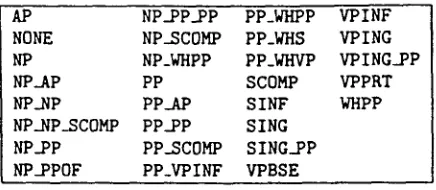
AP NP_PP_PP PP_WHPP NONE NP_SCOMP PP_WHS
NP NP_WHPP PP_WHVP NP_AP PP SCOMP NP_NP PP_AP S INF NP_NP_SCOMP PP_PP SING NP_PP PP_SCOMP SING_PP NP_PPOF PP_VPINF VPBSE
VPINF VPING VPING_PP VPPRT WHPP
Table h V S U B C A T values in the grammar.
was identified. For each verb the acquisition system hypothesised a set of lexical entries cor- responding to frames for which it found enough evidence. Over the complete set of verbs we ended up with a total of 5228 entries, each with an associated frequency normalised with respect to the total number of frames for all hypothe- sised entries for the particular verb.
In the experiment each acquired lexical en- try was assigned a probability based on its nor- malised frequency, with s m o o t h i n g - - t o allow for unseen e v e n t s - - u s i n g the (comparatively crude)
add-1 technique. We did not use the lexical en- tries themselves during parsing, since missing entries would have compromised coverage. In- stead, we factored in their probabilities during parse ranking at the end of the parsing process. We ranked complete derivations based on the product of (1) the (purely structural) deriva- tion probability according to the probabilistic L R model, and (2) for each verb instance in the derivation the probability of the verbal lex- ical entry that would be used in the particu- lar analysis context. The e n t r y was located via the V S U B C A T v a l u e assigned to the verb in the analysis by the immediately dominating verbal phrase structure rule in the grammar: VSUB- CATvalues are also present in the lexical entries since they were acquired using the same gram- mar. Table 1 lists the V S U B C A T values. T h e values are mostly self-explanatory; however, ex- amples of some of the less obvious ones are given
in (1).
(1) They made (NP_WHPP) a great fuss about what to do.
They admitted (PP~COMP) to the authori- ties that they had entered illegally.
It dawned (PP_WHS) on him what he should do.
Some V S U B C A T v a l u e s correspond to several of the 160 subcategorisation classes distinguished by the acquisition system. In these cases the sum of the probabilities of the corresponding entries was used. The finer distinctions stem from the use by the acquisition system of ad- ditional information a b o u t classes of specific prepositions, particles and other function words appearing within verbal frames. In this experi- ment we ignored these distinctions.
In taking the product of the derivation and subcategorisation probabilities we have lost some of the properties of a statistical language model. The product is no longer strictly a prob- ability, although we do not a t t e m p t to use it as such: we use it merely to rank competing analyses. Better integration of these two sets of probabilities is an area which requires further investigation.
3.3 Q u a n t i t a t i v e E v a l u a t i o n
3.3.1 B r a c k e t i n g
We evaluated parser accuracy on the unseen test corpus with respect to the phrasal brack- eting annotation standard described by Carroll
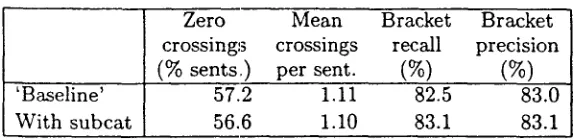
et al. (1997) rather than the original S U S A N N E bracketings, since the analyses assigned by the grammar and by the corpus differ for many constructions 3. However, with the exception of SUSANNE 'verb groups' our annotation standard is bracket-consistent with the treebank analy- ses (i.e. no 'crossing brackets'). Table 2 shows the baseline accuracy of the parser with respect to (unlabelled) bracketings, and also with this model when augmented with the extracted sub- categorisation information. Briefly, the evalu- ation metrics compare unlabelled bracketings derived from the test t r e e b a n k with those de- rived from parses, c o m p u t i n g recall, the ratio of matched brackets over all brackets in the treebank; precision, the ratio of matched brack- ets over all brackets found by the parser; mean crossings, the number of times a bracketed se- quence o u t p u t by the parser overlaps with one from the treebank but neither is properly con- tained in the other, averaged over all sentences;
[image:4.596.49.267.99.194.2]Zero Mean Bracket Bracket crossing:3 crossings recall precision (% sents,) per sent. (%) (%)
'Baseline' 57.2 1.11 82.5 83.0
With s u b c a t 56.6 1.10 83.1 83.1
Table 2: Bracketing evaluation measures, before and after incorporation of s u b c a t information
and zero crossings, the percentage of sentences for which the analysis returned has zero cross- ings (see Grishman, Macleod & Sterling, 1992). Since the test corpus contains only in- coverage sentences our results are relative to the 80°70 or so of sentences t h a t can be parsed. In experiments measuring the coverage of our sys- tem (Carroll & Briscoe, 1996), we found that the mean length of failing sentences was lit- tle different to that of successfully parsed ones. We would therefore argue t h a t the remaining 20% of sentences are not significantly more com- plex, and therefore our results are not skewed due to parse failures. Indeed, in these experi- ments a fair proportion of unsuccessfully parsed sentences were elliptical noun or prepositional phrases, fragments from dialogue and so forth, which we do not a t t e m p t to cover.
On these measures, there is no significant dif- ference between the baseline and lexicalised ver- sions of the parser. In particular, the mean crossing rates per sentence are almost identical. This is in spite of the fact t h a t the two versions return different highest-ranked analyses for 30% of the sentences in the test corpus. T h e reason for the similarity in scores appears to be that the annotation scheme and evaluation measures are relatively insensitive to a r g u m e n t / a d j u n c t and attachment distinctions. For example, in the sentence (2) from the test corpus
(2) Salem ( A P ) - the statewide meeting of war mothers Tuesday in Salem will hear a greeting from Gov. Mark HaYfield.
the phrasal analyses returned by the baseline and lexicalised parsers are, respectively (3a) and (3b).
(3) a ... (VP will hear ( N P a greeting) ( P P from (NP Gov. Mark garfield))) ... b ... ( V P will hear ( N P a greeting ( P P
from ( Y P Gov. Mark Hatfield)))) ...
The latter is correct, b u t the former, incor- rectly taking the P P to be an a r g u m e n t of the verb, is penalised only lightly b y the evalua- tion measures: it has zero crossings, and 75% recall and precision. This t y p e of annotation and evaluation scheme m a y b e a p p r o p r i a t e for
a phrasal parser, such as the baseline version of the parser, which does not have the knowledge to resolve such ambiguities. Unfortunately, it masks differences between such a phrasal parser and one which can use lexical information to make informed decisions b e t w e e n complemen- tation and modification possibilities 4.
3.3.2 G r a m m a t i c a l R e l a t i o n
We therefore also evaluated the baseline and lexicalised parser against the 500 test sentences marked up in accordance with a second, gram- matical relation-based (GR) a n n o t a t i o n scheme (described in detail by Carroll, Briscoe ~ San- fil!ppo, 1998).
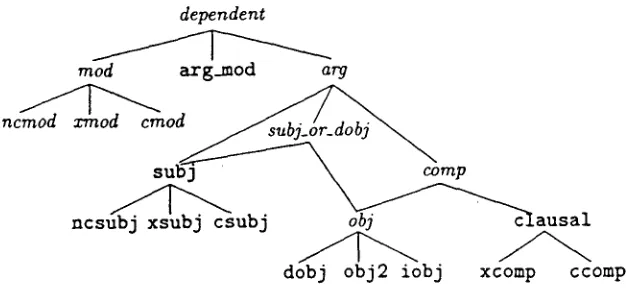
In general, grammatical relations (GRs) are viewed as specifying the syntactic d e p e n d e n c y which holds between a head and a dependent. The set of GRs form a hierarchy; the ones we are concerned with are shown in figure 1. Subj(ect)
GRs divide into clausal (zsubj/csubj), and non- clausal (ncsubj) relations. Comp(lement) GRs
divide into clausal, and into non-clausal direct object (dobj), second (non-clausal) complement in ditransitive constructions (obj2), and indi- rect object c o m p l e m e n t introduced b y a prepo- sition (iobj). In general the parser returns the most specific (leaf) relations in the G R hier- archy, except when it is unable to determine whether clausal s u b j e c t s / o b j e c t s are controlled from within or w i t h o u t (i.e. csubj vs. zsubj, and
[image:5.596.178.465.100.170.2]dependent
rood
arg..mod
a ~ncmod xmod c
m
o
~
ncsu3Zs~ubbjjcsubj
~ a u s a l
dobj obj2 iobj
xcomp
ccomp
Figure 1: Portions of GR hierarchy used. (Relations in
italics
are not returned by the parser).returns
subj
orclausal as
appropriate. Each re- lation is parameterised with a head (lemma) and a dependent (lemma)--also optionally a type and/or specification of grammatical func- tion. For example, the sentence (4a) would be marked up as in (4b).(4) a
Paul intends to leave IBM.
b ncsubj (intend, Paul,_)
xcomp (to, intend, leave)
ncsubj (leave, Paul,_)
do bj (leave, IBM,_)
Carroll, Briscoe & Sanfilippo (1998) justify this new evaluation annotation scheme and compare it with others (constituent- and dependency- based) that have been proposed in the litera- ture.
The relatively large size of the test corpus has meant that to date we have in some cases not distinguished between
c/zsubj
and betweenc/zcomp,
and we have not marked up modifi- cation relations; we thus report evaluation with respect to argument relations only (but includ- ing the relationarg_mod--a
semantic argument which is syntactically realised as a modifier, such as the passive 'by-phrase'). The mean number of GRs per sentence in the test corpus is 4.15.When computing matches between the GRs produced by the parser and those in the corpus annotation, we allow a single level of subsump- tion: a relation from the parser may be one level higher in the GR hierarchy than the ac- tual correct relation. For example, if the parser returns
clausal,
this is taken to match both the more specificzcomp
andccomp.
Also, an un- specified filler (_) for the type slot in theiobj
and clausal
relations successfully matches any actual specified filler. The head slot fillers are in all cases the base forms of single head words, so for example, 'multi-component' heads, such as the names of people, places or organisations are reduced to one word; thus the slot filler corre- sponding to Mr.Bill Clinton
would beClinton.
For real-world applications this might not be the desired behaviour---one might instead want the tokenMr._BiILClinton.
This could be achieved by invoking a processing phase similar to the conventional 'named entity' identification task in information extraction.Considering the previous example (2), but this time with respect to GRs, the sets returned by the baseline and lexicalised parsers are (5a) and (Sb), respectively.
(5) a
ncsubj (hear, meeting,_)
dobj (hear, greeting,_)
io bj (.from, hear, Hatfield)
b ncsubj (hear, meeting,_)
dobj (hear, greeting,_)
The latter is correct, but the former, incor- rectly taking the P P to be an argument of the verb,
hear,
is penalised more heavily than in the bracketing annotation and evaluation schemes: it gets only 67% recall. There is also no mis- leadingly low crossing score since there is no analogue to this in the GR scheme. [image:6.596.127.440.91.236.2]Recall Precision
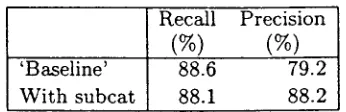
(%)
(%)
'Baseline' 88.6 79.2
W i t h subcat 88.1 88.2
Table 3: G R evaluation measures, before and after incorporation of subcategorisation infor- mation. Argument relations only.
Complementation Modification Co-ordination Textual Misbracketing
N u m b e r 124 134 30 30 40
Table 5: N u m b e r s of errors of each t y p e m a d e by the lexicalised parser.
the percentage of G R s returned b y the parser that are actually correct. In the evaluation, G R recall of the lexicalised parser drops b y 0.5% compared with the baseline, while precision in- creases by 9.0%. The drop in recall is not statis- tically significant at the 95% level (paired t-test,
1.46, 499 dr, p > 0.1), whereas the increase in precision is significant even at the 99.95% level
(paired t-test, 5.14, 499 dr, p < 0.001).
Table 4 gives the number of each t y p e of G R returned by the two models, compared with the correct numbers in the test corpus. T h e base- line parser returns a mean of 4.65 relations per sentence, whereas the lexicalised parser returns only 4.15, the same as the test corpus. This is further, indirect evidence that the lexicalised probabilistic system models the d a t a more ac- curately.
3.4 D i s c u s s i o n
In addition to the quantitative analysis of parser accuracy reported above, we have also per- formed a qualitative analysis of the errors made. We looked at each of the errors m a d e by the lexi- calised version of the parser on the 500-sentence test corpus, and categorised them into errors concerning: complementation, modification, co- ordination, structural a t t a c h m e n t of textual ad- juncts, and phrase-internal misbracketing. Of course, multiple errors within a given sentence m a y interact, in the sense that one error m a y so disrupt the structure of an analysis t h a t it nec- essarily leads to one or more other errors being made. In all cases, though, we considered all of the errors and did not a t t e m p t to determine whether or not one of t h e m was the 'root cause'. Table 5 summarises the n u m b e r of errors of each t y p e over the test corpus.
Typical examples of the five error t y p e s iden- tified are:
c o m p l e m e n t a t i o n ... decried the high rate of
unemployment in the state misanalysed as
decry followed by an N P and a P P comple- ment;
m o d i f i c a t i o n in ... surveillance of the pricing practices of the concessionaires f o r the pur- pose of keeping the prices reasonable, the P P modifier for the purpose o f . . . a t t a c h e d 'low' to concessionaires r a t h e r than 'high' to surveillance;
c o - o r d i n a t i o n the N P priests, soldiers, and other members of the party misanalysed as just two conjuncts, with the first c o n j u n c t containing the first two words in apposi- tion;
t e x t u a l in But you want a job guaranteed when you return, I continued my attack, the (tex- tual) a d j u n c t I ... attack a t t a c h e d to the
VP guaranteed ... return rather than the S
But ... return; and
m i s b r a c k e t i n g Nowhere in Isfahan is this rich aesthetic life of the Persians ... has of mis- analysed as a particle, with the Persians
becoming a separate NP.
There are no obvious trends within each t y p e of error, although some particularly n u m e r o u s sub-types can be identified. In 8 of the 30 cases of textual misanalysis, a sentential textual ad- j u n c t preceded by a c o m m a was a t t a c h e d t o o low. The most c o m m o n t y p e of modification er- ror w a s - - i n 20 of the 134 c a s e s - - m i s a t t a c h m e n t of a P P modifier of N to a higher V P . T h e ma- jority of the c o m p l e m e n t a t i o n errors were ver- bal, accounting for 115 of the total of 124. In 15 cases of incorrect verbal c o m p l e m e n t a t i o n a passive construction was incorrectly analysed as active, often with a following 'by' prepositional phrase erroneously taken to be a complement.
[image:7.596.369.519.99.178.2] [image:7.596.117.290.100.156.2]arg_mod ccomp clausal csubj dobj i o ~ ncsu~ obj2 subj xcomp
'Baseline' 16 39 202 4 415 327 1054 53 14 202
With subcat 9 20 138 3 429 172 1058 39 15 195
Correct 32 16 136 2 428 160 1064 23 13 203
Table 4: Numbers of each type of grammatical relation.
heads, and of phrasal verbs. T h e g r a m m a t i c a l relation extraction module is currently unable to return GRs in which t h e verbal head alone appears in the sentence as a c o n j u n c t - - a s in t h e
V P ... to challenge and counter-challenge the authentication. This can be remedied fairly eas- ily. Phrasal verbs, such as to consist of are iden- tified as such by the subcategorisation acquisi- tion system. The g r a m m a r used by the shal- low parser analyses phrasal verbs in two stages: firstly the verb itself and the following parti- cle are combined to form a sub--constituent, and then phrasal complements are attached. T h e simple mapping from V S U B C A T values to sub- categorisation classes cannot cope with the sec- ond level of embedding of phrasal verbs, so these verbs do not pick up any lexical information at parse time.
4 C o n c l u s i o n s
We surveyed recent work on automatic acquisi- tion from corpora of subcategorisation and as- sociated frequency information. We described an experiment with a wide-coverage statistical g r a m m a r and parser for English and subcate- gorisation frequencies acquired from 10 million words of text which shows t h a t this information can significantly improve the accuracy of recov- ery of grammatical relation specifications from a test corpus of 500 sentences covering a n u m b e r or different genres.
Future work will include: investigating more principled probabilistic models; addressing im- mediate lower-level shortcomings in the current system as discussed in section 3.4 above; adding
mod(ification) GR annotations to the test cor- pus and extending the parser to also return these; and working on incorporating selectional preference information t h a t we are acquiring in other, related work (McCarthy, 1997).
R e f e r e n c e s
Abney, S. (1996). Partial parsing via finite-State
cascades. Natural Language Engineering, 2(4), 337-
344.
Boguraev, B., Briscoe, E., Carroll, J., Carter, D. & Grover, C. (1987). The derivation of a grammatically-indexed lexicon from the Longman Dictionary of Contemporary English. In Proceed- ings of the 25th Annual Meeting of the Association for Computational Linguistics, 193-200. Stanford, CA.
Brent, M. (1991). Automatic acquisition of subcat- egorization frames from untagged text. In Proceed- ings of the 29th Annual Meeting of the Association for Computational Linguistics, 209-214. Berkeley,
CA.
Brent, M. (1993). From grammar to lexicon: unsu- pervised learning of lexical syntax. Computational Linguistics, 19(3), 243-262.
Briscoe, E. & Carroll, J. (1993). Generalized proba- bilistic LR parsing for unification-based grammars.
Computational Linguistics, 19(1), 25-60.
Briscoe, E. & Carroll, J. (1997). Automatic extrac- tion of subcategorization from corpora. In Proceed- ings of the 5th ACL Conference on Applied Natural Language Processing. Washington, DC.
Carpenter, B. & Manning, C. (1997). Probabilistic parsing using left corner language models. In Pro-
ceedings of the 5th ACL/SIGPARSE International Workshop on Parsing Technologies. MIT, Cam- bridge, MA.
Carroll, J. & Briscoe, E. (1996). Apportioning de- velopment effort in a probabilistic LR parsing sys- tem through evaluation. In Proceedings of the 1st ACL/SIGDAT Conference on Empirical Methods in Natural Language Processing, 92-100. University of Pennsylvania, Philadelphia, PA.
Carroll, J., Briscoe, E., Calzolari, N., Federici, S., Montemagni, S., Pirrelli, V., Grefenstette, G., Sanfilippo, A., Carroll, G. & Rooth, M. (1997).
SPARKLE WP1 specification off phrasal parsing.
<http://www.ilc.pi.cnr.it/sparkle.html>.
Carroll, J., Briscoe, E. & Sanfilippo, A. (1998). Parser evaluation: a survey and a new proposal.
In Proceedings of the Ist International Conference on Language Resources and Evaluation, 447-454. Granada, Spain.
[image:8.596.52.499.102.159.2]on Parsing Technologies (IWPT-97), 8-17. MIT, Cambridge, MA.
Carroll, G. & Rooth, M. (1998). Valence induc- tion with a head-lexicalized PCFG. In Proceedings of the 3rd Conference on Empirical Methods in Nat- ural Language Processing. Granada, Spain.
Charniak, E. (1997). Statistical parsing with a c0ntext-free grammar and word statistics. In .Pro-
ceedings of the 14th National Conference on Artifi- cial Intelligence (AAAI-97), 598-603. Providence,
RI.
Collins, M. (1996). A new statistical parser based on bigram lexical dependencies. In Proceedings of the 34th Meeting of the Association for Computational Linguistics, 184-191. Santa Cruz, CA.
Cunningham, H., Gaizauskas, R. & Wilks, Y. (1995). A general architecture for text engineering (GATE) - a new approach to language R~D. Re-
search memo CS-95-21, Department of Computer Science, University of Sheffield, UK.
Elworthy, D. (1994). Does Baum-Welch re- estimation help taggers?. In Proceedings of the 4th ACL Conference on Applied Natural Language Pro- cessing. Stuttgart, Germany.
Gahl, S. (1998). Automatic extraction of sub- corpora based on subcategorization frames from a part-of-speech tagged corpus. In Proceedings of the
COLING-A CL '98. Montreal, Canada.
Grishman, R., Macleod, C. & Meyers, A. (1994). Comlex syntax: building a computational lexicon. In Proceedings of the 15th International Conference on Computational Linguistics (COLING-94), 268-
272. Kyoto, Japan.
Grishman, R., Macleod, C. & Sterling, J. (1992). Evaluating parsing strategies using standardized parse files. In Proceedings of the 3rd ACL Confer- ence on Applied Natural Language Processing, 156- 161. Trento, Italy.
Grishman, R. & Sterling, J. (1992). Acquisition of selectional patterns. In Proceedings of the 14th In- ternational Conference on Computational Linguis- tics (COLING-92), 658-664. Nantes, France. Hornby, A. (1989). Ozford Advanced Learner's Dic- tionary of Current English. Oxford, UK: OUP. Inui, K., Sornlertlamvanich, V., Tanaka, H. & Toku- naga, T. (1997). A new formalization of proba- bilistic GLR parsing. In Proceedings of the 5th A CL/SIGPARSE International Workshop on Pars- ing Technologies (IWPT-97}, 123-134. Cambridge, MA.
Joshi, A. & Schabes, Y. (1991). Tree-adjoining grammars and lexicalized grammars. In M. Nivat & A. Podelski (Eds.), Definability and Recognizabil- ity of Sets of Trees. Elsevier.
Leech, G. (1992). 100 million words of English: the British National Corpus. Language Research, 28(1), 1-13.
Lin, D. (1996). Dependency-based parser evalua- tion: a study with a software manual co.rpus. In R.
Sutcliffe, H-D. Koch & A. McElligott (Eds.), Indus- trial Parsing of Software Manuals, 13-24. Amster- dam, The Netherlands: Rodopi.
Magerman, D. (1995). Statistical decision-tree mod- els for parsing. In Proceedings of the 33rd Annual Meeting of the Association for Computational Lin- guistics. Boston, MA.
Manning, C. (1993). Automatic acquisition of a large subcategorisation dictionary from corpora. In
Proceedings of the 31st Annual Meeting of the As- sociation for Computational Linguistics, 235-242. Columbus, Ohio.
Marcus, M., Santorini, B. & Marcinkiewicz (1993). Building a large annotated corpus of English: The Penn 'IYeebank. Computational Linguistics, 19(2), 313-330.
McCarthy, D. (1997). Word sense disambigua- tion for acquisition of selectional preferences. In
Proceedings of the ACL/EACL'97 Workshop Auto- matic Information Extraction and Building of Lex- ical Semantic Resources for NLP Applications, 52- 61. Madrid, Spain.
Poznanski, V. & Sanfilippo, A. (1993). Detecting dependencies between semantic verb subclasses and subcategorization frames in text corpora. In B. Boguraev & J. Pustejovsky (Eds.), SIGLEX ACL Workshop on the Acquisition of Lexical Knowledge from Tezt. Columbus, Ohio.
Ratnaparkhi, A. (1997). A linear observed time sta- tistical parser based on maximum entropy models. In Proceedings of the 2nd Conference on Empiri- cal Methods in Natural Language Processing. Brown University, Providence, l:~_I.
Resnik, P. (1992). Probabilistic tree-adjoining gram- mar as a framework for statistical natural lan- gfiage processing. In Proceedings of the 14th Inter- national Conference on Computational Linguistics (COLING-g2), 418-424. Nantes, France.
Resnik, P. (1993). Selection and information: a class-based approach to lezical relationships. Uni- versity of Pennsylvania, CIS Dept, PhD thesis. Ribas, P. (1994). An experiment on learning appro- priate selection restrictions from a parsed corpus. In Proceedings of the I 5th International Conference on Computational Linguistics (COLING-9~). Ky- oto, Japan.
Sampson, G. (1995). English for the computer. Ox- ford, UK: Oxford University Press.