A Tool for Efficient Content Compilation
Boris Galitsky
Knowledge-Trail Inc
San Jose CA USA
[email protected]
Abstract
We build a tool to assist in content creation by mining the web for information relevant to a given topic. This tool imitates the process of essay writing by humans: searching for topics on the web, selecting content frag-ments from the found document, and then compiling these fragfrag-ments to obtain a coherent text. The process of writing starts with automated building of a table of content by obtaining the list of key entities for the given topic extracted from web resources such as Wikipedia. Once a table of content is formed, each item forms a seed for web mining. The tool builds a full-featured structured Word document with table of content, section structure, images and captions and web references for all included text fragments.
Two linguistic technologies are employed: for relevance verification, we use similarity computed as a tree similarity between parse trees for a seed and candidate text fragment. For text coherence, we use a measure of agreement between a given and consecutive paragraph by tree kernel learning of their discourse trees.
The tool is available at http://animatronica.io/submit.html.
1
Introducing content compilation problem
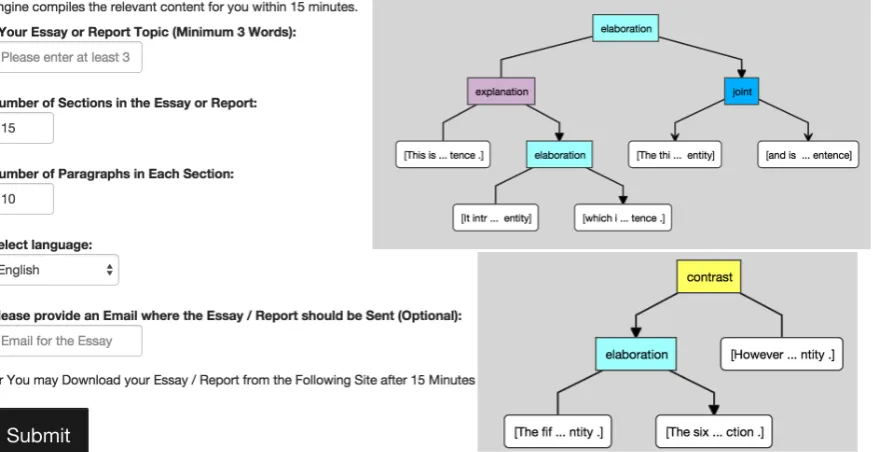
In the modern society, writing and creating content is one of the most frequent human activity. An ar-my of content creators, from students to professional writers produce various kinds of documents for various audiences. Not all of these documents are expected to be innovative, break-through or ex-tremely important. The target of the tool being proposed is assistance with routine document creation process (Fig. 1) where most information is available on the web and needs to be collected, integrated and properly referenced.
A number of content generation software systems are available in specific business domains (John-son 2016). Most of content generation software are template-based which limits their efficiency and volume of produced content (Hendrikx et al 2015). An interesting class of content generation system is based on verbalizing some numerical data. Also, content generation for computer game support turned out to be fruitful (Liapis et al 2013). Deep-learning – based generation of a sequence of words has a limited applicability for large scale content production industrial systems. The goal of this study is to build a content compilation assistance system that would meet the following criteria:
• Produces high volume cohesive text on a given topic in a domain-independent manner;
• Collects text fragments from the web and combines them to assist in research on a given topic, provide systematic references;
• Combines text, image and video resources in the resultant document;
• Suitable for producing a final report and manual editing by students, researchers in various fields in science, engineering, business and law.
On the bottom-left of Fig. 1 we show the main problem that needs to be solved to build a document from fragments collected from the web. For given two fragments, we need to determine if one can rea-sonably follow another in a cohesive manner. W build a discourse representation for each fragment an learn this representation to classify a pair of consecutive paragraphs as cohesive or not.
Figure 1: Content Compilation front end (on the left). The pair of discourse trees to find an appro-priate sequence of mined text fragments (on the right-bottom)
2
Text Fragment Mining Algorithm
To write a document, we first create its table of contents (TOC). To do that, we mine the web for most important attributes associated with an entity we are writing about. For example, if we write a biog-raphy about a person, we find a biogbiog-raphy page about a person of a similar kind (such as a writer or a scientist) and extract a TOC from it. Another option is two mine auto-complete values for this entity. For a scientist, it would be {born, educated, researched, discovered, announced, became well known}. Usually, Wikipedia is a good source of a structure of a TOC for a document on a given topic. TOC items will constitute a seed from which web search query will be formed.
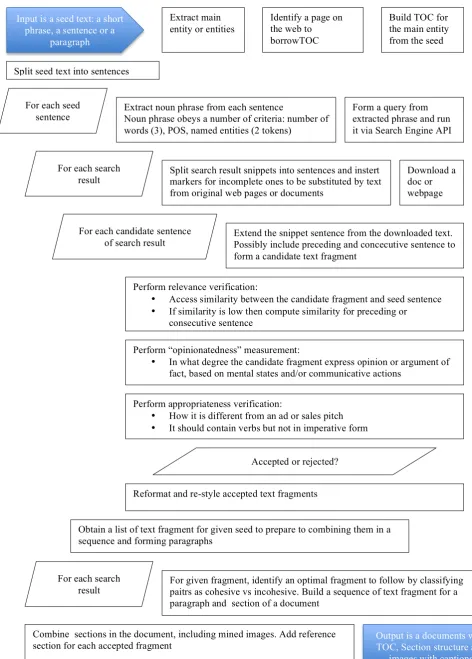
The chart for text fragment mining algorithm is shown in Fig. 2. We start with the seed, one or multiple sentences each of which will form one or more paragraphs about the respective topics of the TOC. These seed sentences can be viewed as either headers or informational centroids of content to be compiled. We now iterate through each original sentence, build block of content for each and then merge all blocks, preceded by their seed sentences together, similar to (Sauper & Barzilay 2000). To find relevant sentences on the web for a seed sentence, we form query as extracted significant noun phrases from this seed sentence: either longer one (three or more keywords, which means two or more modifiers for a noun, or an entity, such as a proper noun). If such queries do not deliver signifi-cant number of relevant sentences formed from search results, we use the whole sentence as a search engine query, filtering our content that is a duplicate to the seed.
Split seed text into sentences Input is a seed text: a short
phrase, a sentence or a paragraph
Extract main entity or entities
Identify a page on the web to borrowTOC
Build TOC for the main entity from the seed
For each seed
sentence Extract noun phrase from each sentence Noun phrase obeys a number of criteria: number of words (3), POS, named entities (2 tokens)
Form a query from extracted phrase and run it via Search Engine API
Split search result snippets into sentences and instert markers for incomplete ones to be substituted by text from original web pages or documents
For each search result
For each candidate sentence
of search result Extend the snippet sentence from the downloaded text. Possibly include preceding and concecutive sentence to form a candidate text fragment
Download a doc or webpage
Perform relevance verification:
• Access similarity between the candidate fragment and seed sentence • If similarity is low then compute similarity for preceding or
consecutive sentence
Perform “opinionatedness” measurement:
• In what degree the candidate fragment express opinion or argument of
fact, based on mental states and/or communicative actions
Perform appropriateness verification:
• How it is different from an ad or sales pitch • It should contain verbs but not in imperative form
Reformat and re-style accepted text fragments Accepted or rejected?
Obtain a list of text fragment for given seed to prepare to combining them in a sequence and forming paragraphs
For each search
result For given fragment, identify an optimal fragment to follow by classifying paitrs as cohesive vs incohesive. Build a sequence of text fragment for a paragraph and section of a document
Combine sections in the document, including mined images. Add reference
[image:3.595.65.538.76.736.2]Relevance is determined based on the operation of syntactic generalization (Galitsky et al 2012), where the bag-of-words approach is extended towards extracting commonalities between the syntactic parse trees of seed sentence and the text mined on the web. Syntactic generalization score is computed as a cardinality of maximal common sub-graph between the parse trees of the seed and candidate sen-tences or text fragments. Syntactic generalization allows a domain-independent semantic measure of topical similarity, delivering stronger relevance than the search engine itself or the keyword statistics. In addition to syntactic generalization, the tool verifies common entities between seed and mined sentence, and applies general appropriateness metric. The overall score includes syntactic generaliza-tion score (the cardinality of maximal common system of syntactic sub-trees) and appropriateness score to filter out less suitable sentences. Finally, mined sentences are re-styled and re-formatted to better fit together. The following section explains how paragraphs are formed from text fragments.
3
Arranging Candidate Text Fragments
To form a coherent sections of a document, text fragments need to agree. For a given candidate frag-ment, we either find its optimal position in a section of a document for the receding and following fragment or paragraph of text, or reject it. To implement this functionality, we build a classifier for a pair of consecutive text fragments (paragraphs) and classify them as a valid (coherent, acceptable agreement) pair or an invalid one (Galitsky et al., 2015). We use a discourse trees representation (Joty et al 2013) where the parse tree information for each elementary discourse unit is retained. To form <Fragment1, Fragment2> pair one can combine the respective discourse trees into a single tree with the root RR (Fig.3). The discourse trees for these pairs are subject to tree kernel learning (Zhang & Lee 2003). We form a positive training set of classifier from the pairs of paragraph which actually fol-low each other and a negative training set - from the ones randomly selected from text (Yahoo! An-swer corpus was used).
4
Conclusions
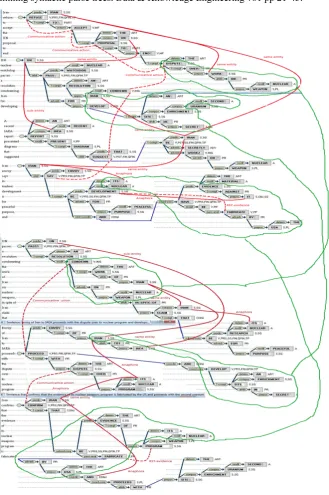
The discourse tree representation used in our content compilation system is a reduction of what is called parse thicket (Galitsky et al., 2015), a combination of parse trees for sentences with discourse-level relationships between words and parts of the sentence in one graph. The straight edges of this graph are syntactic relations, and curvy arcs – discourse relations, such as anaphora, same entity, sub-entity, rhetoric relation and communicative actions. This graph includes much richer information than just a combination of parse trees for individual sentences would. Parse thickets can be generalized at the level of words, relations, phrases and sentences (Fig. 3).
The tool has been advertised using Google AdWords and used by thousand of users searching for “free essay writing” to compile content for a variety of domains, including natural sciences and humanities.
The system is available for general audience at http://animatronica.io/submit.html. Examples of written documents on a wide variety of topics is available at http://mail3.fvds.ru/wrt_latest/.The source code can be obtained at https://github.com/bgalitsky/relevance-based-on-parse-trees under Apache Licence and is a sub-project of Apache OpenNLP https://opennlp.apache.org/.
Reference
Liapis, Antonios, Georgios N Yannakakis,and Julian Togelius. 2013. Sentient Sketchbook: Computer-aided game level authoring.” InFDG, 213–220.
Johnson, MR, 2016. Procedural Generation of Linguistics, Dialects, Naming Conventions and Spoken Sentenc-es. Proceedings of 1st International Joint Conference of DiGRA and FDG.
Galitsky, B., Ilvovsky, D., Kuznetsov, S. O. 2015. Text Classification into Abstract Classes Based on Discourse Structure. Proceedings of Recent Advances in Natural Language Processing, pages 200–207, Hissar, Bulgaria, Sep 7–9 2015.
Galitsky, B., Gabor Dobrocsi, Josep Lluis de la Rosa, 2012. Inferring the semantic properties of sentences by mining syntactic parse trees. Data & Knowledge Engineering v81 pp 21-45.
Figure 3: Parse thickets of two paragraphs assuring document cohesiveness
Hendrikx, Mark, Sebastiaan Meijer, Joeri Van Der Velden, and Alexandru Iosup. 2013. Procedural content gen-eration for games: A survey. ACM Trans. Multimedia Comput. Commun. Appl. 9, 1, Article 1 22 pages.
Zhang, Dell and Wee Sun Lee. 2003. Question classification using support vector machines. In SIGIR ’03: Pro-ceedings of the 26th Annual International ACM SIGIR Conference on Research and Development in Infor-mation Retrieval, pages 26–32, New York, NY, USA, ACM.
Galitsky, B. 2013. Machine Learning of Syntactic Parse Trees for Search and Classification of Text. Engineering Application of Artificial Intelligence, dx.doi.org/10.1016/j.engappai.2012.09.017.
Joty, Shafiq R, Giuseppe Carenini, Raymond T Ng, and Yashar Mehdad. 2013. Combining intra-and multi- sen-tential rhetorical parsing for document-level dis- course analysis. In ACL (1), pages 486–496.