Modeling sentence processing in ACT-R
Shravan Vasishth
Department of Computational Linguistics Saarland University, PO Box 15 11 05
66041 Saarbr¨ucken, Germany [email protected]
Richard L. Lewis
Department of Psychology University of Michigan
Ann Arbor, MI, USA [email protected]
Abstract
We present a series of simulations of behavioral data by casting a simple parsing model in the cognitive architecture ACT-R. We show that constraints de-fined in ACT-R, specifically those relating to acti-vation, can account for a range of facts about hu-man sentence processing. In doing so, we argue that resource limitation in working memory is bet-ter defined as an artefact of very general and in-dependently motivated principles of cognitive pro-cessing.
1 Introduction
Although language processing may be a specialized cognitive faculty, it is possible that it is nevertheless shaped by general constraints on the human cog-nitive architecture. This point has been addressed extensively in the connectionist literature, but we present a somewhat different approach to this prob-lem by casting parsing within the cognitive architec-ture ACT-R (Anderson et al., 2002) and directly us-ing the constraints provided in ACT-R to account for several interesting cross-linguistic facts: the well-known sentential complement/relative clause asym-metry (Gibson, 2000; Grodner and Gibson, 2003) and the subject/object relative clause asymmetry in English (Homes and O’Regan, 1981); and some re-cent results (Vasishth, 2003) involving Hindi re-center embeddings, including a principled account of indi-vidual variation in subject behavior.
In developing this approach, we argue that re-source limitation in working memory is better de-fined as an artefact of very general constraints on information processing – specifically, rehearsal and activation – rather than as an inherent numerical bound on memory capacity (cf. (Gibson, 2000; Hawkins, 1994); also see Section 3.5).
In the rest of this paper, we first introduce the ACT-R architecture. Then we present the results of several simulations of experiments available in the psycholinguistic literature. The paper concludes with a discussion of the potential advantages and
shortcomings of this approach, and of the broader consequences of modeling parsing within a cogni-tive architecture.
2 A brief introduction to the cognitive architecture ACT-R
ACT-R is a theory of the human cognitive
archi-tecture. It allows the development of
computa-tional models that can closely simulate experimental methodologies such as eye-tracking and self-paced reading, and has been used to model a wide array of behavioral data from learning and memory, problem solving and decision making, language and commu-nication, perception and attention, cognitive devel-opment, and individual differences (Anderson et al., 2002).
The ACT-R architecture is attractive as a model-ing tool for three reasons. First, it is based on a wide array of empirical results in various domains of cog-nitive psychology. Second, it is flexible enough to permit the modeler to add their own assumptions and theories about the specific task to be modeled. Finally, ACT-R models yield dependent measures such as reading time in much the same way as hu-mans performing the experiment; e.g., the system can easily be programmed to simulate key presses after it processes material presented on the screen.
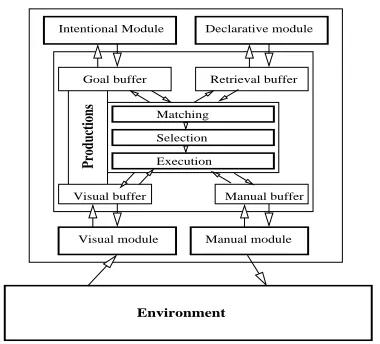
As shown in Figure 1, the architecture consists of
several MODULESsuch as Declarative, Visual, and
Manual. Each module is associated with aBUFFER
which temporarily stores information for a given ac-tion. For example, the visual buffer is used to store an item “seen” by the system in the environment be-fore it is used in the service of some task.
The module that is especially important for the present paper is the Declarative (henceforth, DM). DM represents permanent memory: every fact that
is assumed to be known is encoded as aCHUNKin
Intentional Module Declarative module
Environment
Visual module Manual module Visual buffer Manual buffer
Matching Selection Execution
Retrieval buffer Goal buffer
[image:2.595.90.280.84.256.2]Productions
Figure 1: This is a schematic view of the ACT-R system. “Environment” is the outside world that ACT-R is programmed to interact with. The arrows show the possible flows of information. Productions and the central box with the boxes labeled “Match-ing”, “Selection”, and “Execution” are intended to represent a set of central executive mechanisms and processes.
lisp primitive “nil”.
Each DM chunk has an activation that determines its speed of retrieval, and the probability that it will be retrieved; the initial activation for a given chunk can be set manually.
There is aGOAL BUFFERthat holds a current goal
under consideration (there can be only one goal at one time); this goal is a chunk with a given type and possibly instantiated slots.
The control structure for modeling a sequence of
events is a set of PRODUCTIONS; a production is
simply an if-then statement of the following general form: for a given state of one or more buffers and/or DM, execute some actions. Examples of executing actions are retrieving something from DM; chang-ing a value in one of the goal’s slots; repositionchang-ing the hand over a keyboard; a visual shift of attention; changing the goal to a new one, etc. If the goal is changed, then this new goal now occupies the goal buffer.
Building an ACT-R model is essentially a defi-nition of possible sequences of actions for a given state of affairs. Events like retrievals from DM are triggered by looking at the contents of one or more buffers. For example, the ACT-R system “sees” an item/object on the screen and then encodes it as a vi-sual chunk. This chunk can then be harvested from the visual buffer; it includes (as slot-value
specifi-cations) information about the content of the item seen, its x-y coordinates, etc. One can define an ac-tion based on this informaac-tion, such as retrieving a chunk from DM.
3 Modeling sentence parsing in ACT-R
Previous research suggests that humans employ some variant of left-corner parsing (see, e.g., (Resnik, 1992)), which in essence involves a bottom-up and a top-down (predictive) step. We adopt this parsing strategy in the simulations. In order to model the prediction of syntactic struc-ture based on incrementally appearing input, we as-sume that sentence structure templates are available in declarative memory as underspecified chunks. These chunks are retrieved every time a new word is integrated into the structure, as are prior arguments necessary for semantic integration.
We illustrate the parsing process with a simple example (Figure 2). Suppose that the sentence to be parsed is The girl ran, and suppose that we are sim-ulating self-paced reading (Just et al., 1982). When the word the is seen, a bottom-up and top-down structure building step results in a sentence with an intransitive verb being predicted. This structure be-comes the current goal. Then the word girl is seen and processed, i.e., its lexical entry is retrieved from declarative memory. The noun slot in the goal is then instantiated with that lexical entry. In the next step, if the word ran is seen the relevant lexical item for the verb is retrieved and instantiated with the verb slot of the goal; here, the verb’s argument is also retrieved and integrated with the subcategoriza-tion frame of the verb. If, instead of ran the word
that appears, a new goal is created, with any
pre-viously instantiated slots of the preceding goal be-ing passed on to the new goal, and parsbe-ing proceeds from there.
Each retrieval of a goal from memory results in a surge in its activation, so that repeated retrievals result in increased activation; and the higher the ac-tivation of an item the faster it is processed. At the same time, activation decays according to the power law of forgetting (Anderson et al., 2002). In the same way that the goals undergo decay and reacti-vation, so do the previously seen words. This means that the speed of retrieval of a previously seen argu-ment at a verb will be determined by the activation level of that argument. Thus, the activation of both the goals (predicted structures) and the arguments affect processing.
gen-Det N V1
the S
ran
Det N
girl S
that
t V2
V1
the
NP NP
NP
NP
Det N V1
girl the
S
Det N V1
girl the
S
S’
[image:3.595.91.277.67.228.2]S
Figure 2: A simple illustration of parsing steps in the ACT-R simulations presented.
eral parser in pure ACT-R, before doing this we wanted to first establish whether ACT-R’s reacti-vation mechanisms can account for a reasonable array of facts from the sentence processing litera-ture. In (Lewis and Vasishth, An activation-based
model of sentence processing as skilled memory re-trieval, (tentative title; in preparation)) we provide
a detailed description of a model employing mech-anisms similar to those described here, but one that behaves more like a standard parser.
3.1 English subject versus object relative
clauses
It is well known (Homes and O’Regan, 1981) that English subject relatives are easier to process that object relatives (1). In the parsing model outlined above, we can model this result without changing any ACT-R parameters at all (i.e., we use the default settings for the parameters).
(1) a. The reporter who sent the photographer
to the editor hoped for a good story.
b. The reporter who the photographer sent to the editor hoped for a good story.
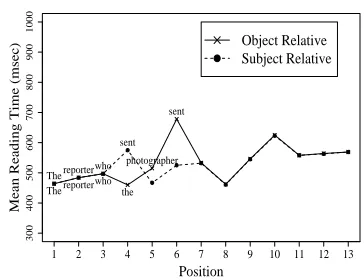
The explanation comes from the decay of the ar-guments of the verb sent: in object relatives the argument reporter decays much more than in the subject relative by the time it is integrated with the verb’s subcategorization frame (Figure 3). This is because more time elapses between the argument being first seen and its retrieval at the verb.1
1A reviewer points out that several head-final languages such as German and Dutch also have a subject relative pref-erence and in these languages the activation level cannot be the explanation. We do not claim that decay is the only constraint operating in parsing; frequency effects (greater preference for
300
400
500
600
700
800
900
1000
Position
Mean Reading Time (msec)
1 2 3 4 5 6 7 8 9 10 11 12 13
Object Relative Subject Relative
Thereporterwho sent
Thereporterwho the photographer
[image:3.595.331.513.84.224.2]sent
Figure 3: The reading times provided by the model. Retrieval of reporter at sent is harder in the object relative because of increased argument decay.
3.2 The SC/RC asymmetry in English
It is also well-known (Gibson, 2000) that a senten-tial complement (SC) followed by a relative clause (RC) is easier to process than an RC followed by an SC:
(2) a. The fact that the employee who the
manager hired stole office supplies wor-ried the executive.
b. #The executive who the fact that the employee stole office supplies worried hired the manager.
As in the previous discussion about relative clauses, in the harder case the decay of the argument
executive at the verb worried is greater compared
to the decay of the argument employee at hired in the easier-process sentence. In addition, the to-tal reading time for the harder sentence is about 120 msec longer.2
3.3 Hindi center embeddings
Previous work (Hakes, 1972), (Konieczny, 2000) has shown that if argument-verb distance is in-creased, processing is easier at the verb. (Vasishth,
more frequently occurring subject relatives) etc. could certainly dominate where the amount of decay is constant in subject and object relatives. It is an open empirical question whether fre-quency alone can account for the subject/object asymmetry in English, but given that we have independent empirical justi-fication for decay (see Section 3.5), the above is a plausible explanation.
2
400 500 600 700 800 900
the fact that the
employee who the manager hired stole
office suppliesworried
the executive
SC/RC (easy); total RT = 7482 msec
the
executive who
the fact that the
employeestole
officesuppliesworried hired
the manager
RC/SC (hard); total RT = 7605 msec
Reading Time (msec)
[image:4.595.80.281.102.226.2]RC/SC SC/RC
Figure 4: Model’s behavior in the complement-clause/relative-clause contrast.
2003) presented similar results in Hindi. The Hindi experiment manipulated distance by comparing the baseline condition (3a) with the case where an ad-verb intervened (3b), a ad-verb-modifying PP inter-vened (3c), and relative clause interinter-vened that mod-ified the preceding NP (3d).
(3) a. Siitaa-ne
Sita-erg
Hari-ko Hari-dat
Ravi-ko Ravi-dat
[kitaab-ko book-acc khariid-neko]
buy-inf
bol-neko tell-inf
kahaa told
‘Sita told Hari to tell Ravi to buy the book.’
b. Siitaa-ne Sita-erg
Hari-ko Hari-dat
Ravi-ko Ravi-dat
[kitaab-ko book-acc jitnii-jaldii-ho-sake
as-soon-as-possible
khariid-neko] buy-inf bol-neko
tell-inf
kahaa told
‘Sita told Hari to tell Ravi to buy the book as soon as possible.’
c. Siitaa-ne Sita-erg
Hari-ko Hari-dat
Ravi-ko Ravi-dat
[kitaab-ko book-acc ek bar.hiya dukaan se
from-a-good-shop
khariid-neko] buy-inf bol-neko
tell-inf
kahaa told
‘Sita told Hari to tell Ravi to buy the book from a good shop.’
d. Siitaa-ne Sita-erg
Hari-ko Hari-dat
Ravi-ko Ravi-dat
[kitaab-ko book-acc jo-mez-par-thii
that-was-on-a-table
khariid-neko] buy-inf
bol-neko tell-inf
kahaa told
‘Sita told Hari to tell Ravi to buy the book that was lying on a/the table.’
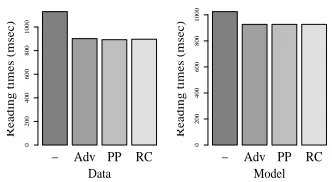
In all the “insertion” cases a statistically signifi-cant speedup was observed at the verb, compared to the baseline condition.
This experiment’s results were replicated in the ACT-R system; the replication is based on the as-sumption that the goal (predicted syntactic struc-ture) is reactivated each time it (i.e., the entire pre-dicted structure) is modified. The intervening items result in an extra retrieval compared to the base-line, resulting in faster processing at the verb. In this model, one parameter was changed: the rate of decay of items. We justify this change in the next sub-section.
The modeling results are shown in Figure 5.
− Adv PP RC
Data
Reading times (msec)
0
200
400
600
800
1000
− Adv PP RC
Model
Reading times (msec)
0
200
400
600
800
1000
Figure 5: Reading times from data versus model, at the first verb.
3.4 Individual variation in Hindi center
embedding data
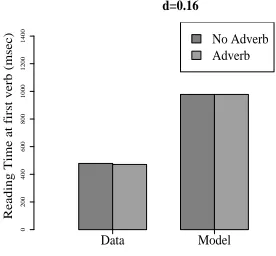
In the Hindi experiment, there was a further varia-tion in the data when individual subjects’ data were considered: only about 48% of subjects showed a speedup at the verb. About 21% showed a slow-down and there was only a few milliseconds differ-ence (essentially no differdiffer-ence) in the reading times for about 31% of the subjects. The observed varia-tion was a systematic trend in the sense that the 47% of the subjects who showed a speedup or slowdown in adverb-insertion case also showed the same trend in the PP- and RC-inserted cases – the probability of this happening is considerably below chance level.
The rate of decay defined in ACT-R’s rehearsal equation can systematically explain this variation.
Consider the situation where a chunk with an
[image:4.595.339.505.354.445.2]0
200
400
600
800
1000
1200
1400
d=0.01
Reading Time at first verb (msec)
Data Model No Adverb Adverb
Figure 6: Modeling speedup.
0
200
400
600
800
1000
1200
1400
d=0.5
Reading Time at first verb (msec)
Data Model
[image:5.595.98.236.448.576.2]No Adverb Adverb
Figure 7: Modeling slowdown.
0
200
400
600
800
1000
1200
1400
d=0.16
Reading Time at first verb (msec)
Data Model
No Adverb Adverb
Figure 8: Modeling no difference in reading time.
recalculated each time a retrieval occurs, according to the following equation.
(4)
Here, is the number of times the chunk was
successfully retrieved,
is the time elapsed since the -th retrieval, and is a decay rate that defaults
to in ACT-R. This equation reflects the log odds
that a chunk would reoccur as function of how it has appeared in the past (Anderson et al., 2002, 17).
It turns out that the parameter take us beyond
boolean predictions: ! results in a speedup;
results in a slowdown; and #" results in
no difference in RT at the verb; see Figures 6 to 8.3
3.5 Comparison with other models
The model presented here is very different in con-ception from existing models of sentence process-ing. For example, consider Early Immediate Con-sistuents (Hawkins, 1994) and Discourse Locality Theory (Gibson, 2000), two theories with
signif-icant empirical coverage. Both theories propose
variants of what we will call the distance hypothe-sis: increasing the distance between arguments and a subsequently appearing verb (head) that selects for them results in increased processing difficulty at the verb. Distance here is quantified in terms of the number of words in a constituent (EIC) or the num-ber of new discourse referents introduced between the arguments and head (DLT).
The present model claims that distance effects are actually a result of argument decay. Prelimi-nary evidence that it is really decay and not EIC-or DLT-defined distance comes from a recent self-paced listening experiment (Vasishth et al., 2004) in which two conditions were contrasted: arguments and verbs with (a) an adjunct intervening, (b) si-lence:
(5) a. vo-kaagaz
that-paper / jisko
whichus-lar.ke-nethat-boy-erg / mez
table ke-piiche
behind
gire-hue fallen
/ dekhaa saw
/
bahut-puraanaa very-old
thaa was
‘That paper which that boy saw fallen behind a/the table was very old.’ b. vo-kaagaz
that-paper / jisko
whichus-lar.ke-nethat-boy-erg /
SILENCE / dekhaa saw
/ bahut-puraanaa very-old thaa
was
‘That paper which that boy saw was very old.’
In (5), the arguments kaagaz, ‘paper’, and lar.kaa, ‘boy’ are separated from the verb dekhaa, ‘saw’ by
an adjunct containing two4discourse referents (5a); or by silence (5b). Subjects were allowed to inter-rupt the silence and continue listening to the rest of the sentence whenever they wanted to. Subjects in-terruped the silence (on an average) after about 1.4 seconds.
Distance based theories predict that having an in-tervening adjunct that introduces discourse referents should result in greater processing difficulty at the verb dekhaa, ‘saw’, compared to when silence in-tervenes. If decay rather than distance is the critical factor here that affects processing, then there should be greater difficulty at the verb in the silence con-dition than when in the items intervene (see Sec-tion 3.3 for why intervening items may facilitate processing). The results support the activation ac-count: introducing silence results in significantly longer reading times at the verb dekhaa than when intervening items occur.
4 Conclusion
These modeling efforts suggest that very general constraints on information processing can provide a principled account of parsing phenomena, and also brings human sentence parsing in closer con-tact with models of human working memory in cog-nitive psychology (Miyake and Shah, 1999).
There are of course certain potential limitations in the work presented here. Several alternative hy-potheses remain to be explored, e.g., the role of competence grammar and its own (possibly theory-internal) operations on processing; the role of expe-rience (Crocker and Brants, 2000), etc. However, the present research is a necessary first step since it provides a basis for such a comparison.
Secondly, there are specific assumptions in the model that may be controversial. For example, we assume that entire sentence structures are predicted as goal chunks, and not verb-types (cf. (Konieczny, 2000)). We are conducting further experiments to explore the predictions made by different assump-tions.
Finally, we have used toy simulations to ex-plore the ACT-R constraint-interaction space, the task of scaling up such a model to parse essentially any kind of input is necessary, but still in the fu-ture. However, we believe that the results presented are suggestive of the way in which a cognitively-oriented parser could be constructed.
4In DLT finite verbs also assumed to introduce a discourse referent.
5 Acknowledgements
We thank the two anonymous reviewers. This re-search was partly funded by the Sonderforschungs-bereich 378 (EM6, NEGRA).
References
J.R. Anderson, D. Bothell, M.D. Byrne, and
C. Lebiere. 2002. An integrated theory of
the mind. MS, available from http://www.act-r.psy.cmu.edu/papers/403/IntegratedTheory.pdf. M. W. Crocker and T. Brants. 2000. Wide-coverage
probabilistic sentence processing. Journal of
Psycholinguistic Research, 29(6):647–669.
Edward Gibson. 2000. Dependency locality theory: A distance-based theory of linguistic complexity. In Alec Marantz, Yasushi Miyashita, and Wayne O’Neil, editors, Image, Language, Brain: Papers
from the First Mind Articulation Project Sympo-sium. MIT Press, Cambridge, MA.
Daniel Grodner and Edward Gibson. 2003. Con-sequences of the serial nature of linguistic input. MS.
David T. Hakes. 1972. On understanding sen-tences: In search of a theory of sentence compre-hension. Microfilm, University of Texas, Austin. John A. Hawkins. 1994. A Performance Theory of
Order and Constituency. Cambridge University
Press, New York.
V.M. Homes and J.K. O’Regan. 1981. Eye fixation patterns during the reading of relative clause sen-tences. Journal of Verbal Learning and Verbal
Behavior, 20:417–430.
M. A. Just, P. A. Carpenter, and J. D. Woolley. 1982. Paradigms and processes in reading com-prehension. Journal of Experimental
Psychol-ogy: General, 111(2):228–238.
Lars Konieczny. 2000. Locality and parsing com-plexity. Journal of Psycholinguistic Research, 29(6):627–645.
Akira Miyake and Priti Shah, editors. 1999.
Mod-els of Working Memory. Cambridge University
Press, New York.
Philip Resnik. 1992. Left–corner parsing and psy-chological plausibility. In Proceedings of
COL-ING, pages 191–197.
Shravan Vasishth, Richard L. Lewis, Rama Kant Agnihotri, and Hans Uszkoreit. 2004. Distin-guishing distance and decay. Submitted.
Shravan Vasishth. 2003. Quantifying processing difficulty in human sentence parsing: The role of decay, activation, and similarity-based interfer-ence. In Proceedings of the EuroCogSci