81
Intelligent Medication System
Priyanka A. Deshmukh
1,
Departmentof Electronics and Telecommunication, Bharati Vidyapeeth’s College of Engineering, Pune.
Email: [email protected]
Abstract- Healthcare can be provided via a variety of methodologies. There is a fast increase in demands of daily monitoring. This is motivating homecare solutions. Thus there is a need to assimilate more and more sensing and data processing capacities with on-site diagnosis and projection. Persistent healthcare is thus the need of the hour especially for Chronic Patients. The patient’s health record is conventionally maintained on paper. This results in huge documentation and also wastage of papers. Patients undergoing long term treatments need to take care of their medicine dose time to time. This becomes tedious in daily hectic schedule. In order to avoid these problems, an Intelligent Medication system is designed using ARM 7 processor, which can be used at home as well as hospitals. Easy and quick human-machine interface is emphasized to make it convenient for the elderly or disabled patients.
Index Terms- On-site Diagnosis, Chronic Patients, Arm 7, Human Machine interface.
1. INTRODUCTION
Health Care sector in India has witnessed a significant growth during the last few years, both in quality and capacity. In spite of such developments, heath care facilities in the country remain inadequate to meet the needs of the citizens A number of such systems and tools have been demonstrated, focusing particularly on health monitoring and information management by the patient himself/herself. At the same time that medical science has made possible new therapies for treating AIDS, cancer, and other once fatal diseases, poor adherence with medication regimens has reached crisis proportions. Medication non-adherence is a problem that applies to all chronic disease states; affects all demographic and socio-economic strata; diminishes the ability to treat diabetes, heart disease, cancer, asthma, and many other diseases. Especially, chronic patients may be benefited from self-management activities, in terms of understanding better their disease, enhancing their communication with their doctor, increasing their self-confidence, and so forth. Chronic patients are engaged on a daily basis in the process of gathering and collecting their personal health information to manage their disease. Such information can include objective elements, i.e., vital signs such as heart rate, temperature, blood pressure, and daily weight, as well as more subjective elements, i.e., various symptoms met during their daily activities, feelings etc.
Most of the patients forget to take the appropriate prescribed medication at the required time. There are occasions when patients remember to take medicines at the stipulated time but forget which pill has to be taken at that particular time. This poses a big problem as it affects the dosage quantum required for the patient that results in not yielding the right recovery result. Hence there is a need of automated dose
reminder and logger. Such a system is designed to remind and log data of the patient in easy way.
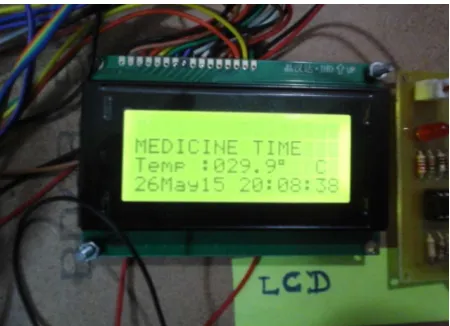
It has been proven that, for the 4 most drug-spending chronic conditions (diabetes, hypertension, hypercholesterolemia, and congestive heart failure), hospitalization rates are significantly lower for patients with higher medication compliance. Also only about 50% of American patients typically take their medicines as prescribed [4]. To establish a multidisciplinary approach to compliance education and management has been pointed out in this 10-step action plan [4]. One solution for this purpose from traditional industry is the One Dose Packaging [5], but it just makes medication more convenient for patients. Noncompliance detecting and recording was introduced by a prototype of Smart Medical Refrigerator [6], a microchip powered tablet package and a Smart Dose Reminder [7]. But they are mainly used as afterward checking measure instead of preventive measure. Their complicate operations are only usable for a well-trained caregiver instead of patient, teenager, elderly, and disabled. Hence a system is enabled with user friendly interfaces such as LCD display, alarms and Speakers. The system is operated easily by all including the patient.
2. THE SYSTEM DESIGN
The system includes an intelligent medicine box, which works as a traditional medicine container such as a drawer of cabinet, and also as a "medicine supervisor", in daily monitoring.
The system includes the following functionalities. 1) Medicine Stock: The Box can register, record,
82 2) Medication Alarm: The Box can send a reminder
to the patient about the time of medicine e.g. by flashing on the screen, loud sound or music from the speakers, flashing of lights, etc.
3) In the main window of the demonstration software will display Patient's Information, Prescription Details, Medication Records, Date and Time, Doctor Information, and Feedback buttons with highlight and large font size, which makes them clearer for users with poor eyesight. The primary entity (tables) of the Medication Database (MDB) is where all prescription and medication information is well organized. Firstly, when a new prescription is issued in hospital, corresponding records are added in by dispatching one prescription into the external memory. Secondly, when user opens the MBox, a timely dose list that should be taken today is retrieved. Communication link includes GSM communication system security. For example: The communication link between the patient’s room and the medical shop using GSM. The corresponding data of the patient is fed here by the hospital’s staff only once. This schedule will be transferred to patient’s room accordingly with the help of wireless communication. Same schedule will be displayed in the respective patient box.
The prescription are to be entered using the Visual Basic software and then sent via GSM to the Patient Number. The corresponding data of the patient is fed here by the hospital’s staff only
once. This schedule will be transferred to patient’s room accordingly with the help of wireless communication. Same schedule will be displayed in the respective patient room. For the patients the
corresponding box drawer of the box will open to help him to know that the dose be taken. Also the loudspeakers help him to know about the amount of dose to be taken.
3. SYSTEM REQUIREMENTS
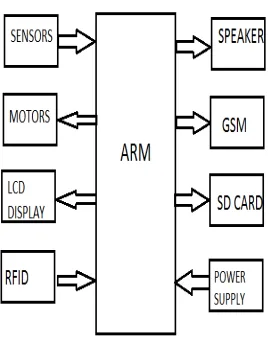
ARM 7 LPC 2138 microprocessor is used for the processing of data. It is 16/32-bit ARM7TDMI-S microcontroller in a tiny LQFP64 or HVQFN package. It has 8/16/32 KB of on-chip static RAM and 32/64/128/256/512 kB of on-chip flash program memory. Embedded ICE RT and Embedded Trace interfaces offer real-time debugging with the On-chip Real Monitor software and high-speed tracing of instruction execution. 8-channel 10-bit ADCs provide a total of up to 16 analog inputs, with conversion times as low as 2.44 ms per channel. Single 10-bit DAC provides variable analog output. The CPU operating voltage range is of 3.0 V to 3.6 V (3.3 V ± 10 %) with 5 V tolerant I/O pads.
Radio-Frequency Identification (RFID) is the use of radio waves to read and capture information stored on a tag attached to an object. A RFID system, is used for patient authentication, is made up of two parts: a tag or label and a reader. RFID tags or labels are embedded with a transmitter and a receiver. Features include Operating Voltage 5V, Baud rate is 9600bps. A typical RFID tag can hold 2KB of data. Temperature sensor is used to sense the temperature. We have used a Temperature sensor called LM35. This temperature sensor can sense the temperature of the atmosphere around it or the temperature of any machine to which it is connected or even can give the temperature of the human body in case if used. The LM35 series are precision integrated-circuit temperature sensors, whose output voltage is linearly proportional to the Celsius (Centigrade) temperature. It is Calibrated directly in degree centigrade, has a linear +10.0mV/degree centigrade scale factor and 0.5 degree centigrade accuracy.
The regular update of regular dosage is done by using a RTC. Most microcontrollers, including the Controller, have a built-in timekeeper called millis() and there are also timers built into the chip that can keep track of longer time periods like minutes or days. However millis() only keeps track of time since the Controller was last powered . That means that when the power is turned on, the millisecond timer is set back to 0. You'd have to program in the date and time and you could have it count from that point on. But if it lost power, you'd have to reset the time. Much like very cheap The RTC chip is a specialized chip that just keeps track of time. It can count leap-years and knows how many days are in a month.
83 GSM (Global System for Mobile communication)
is a digital mobile telephony system. The GSM module is used to enter the prescription through SMS. This SMS is saved in the external EEPROM and thus the timely alerts of medicine are given until the next message of prescription. With the help of GSM module interfaced, we can send short text messages to the Doctor and the medical shop as required. The DC motors help to open and close the medicine box as per the time of medicine dose. SD card is used to save the recorded voice notes about the dose amount that are given using speaker.
4. ADVANTAGES
• Looking at the availability of components, the less complexity and very less power consumption.
• The system tries to replace the conventional paper work management and documentation in the hospitals with the help electronics. In short it supports the eco-friendly concept by reducing the use of papers.
• The system utilizes the existing telecommunication infrastructure, thus no new investments are needed. These facts make the service easy and inexpensive.
• Authentication is provided by means of RFID cards to the patients.
• Simple touch screen and display used to make the system user friendly.
5. RESULTS
[image:3.595.315.558.91.250.2]The results of the system are as shown.
[image:3.595.89.224.124.297.2]Fig. 3.The Intelligent Medicine Box.
Fig. 2. Detailed Block Diagram.
Fig. 5. The VB Window to enter Time of medicine in particular drawer.
[image:3.595.326.557.310.493.2] [image:3.595.325.545.539.681.2]84 6. CONCLUSION
Technological advances and critical needs have led to medication administration devices and tools designed to prevent and reduce medication errors. This paper describes architectures and interfaces of these devices. In this paper a system with pervasive and preventive healthcare solution addressing the medication noncompliance problem is designed. Thus we are trying to provide reliable services to patients in terms of time to time reminders about medicines schedules, refilling of medicines without delay, attending the patient as & when required etc.. Also we are reducing both the physical & mental burden on hospitals staff, caretakers, family members and patients themselves. The medication reminding and recording functions can significantly improve the medication compliance, especially for elderly patients. The system is enabled with friendly interfaces easy data logging and hence use full for all.
REFERENCES
[1] A Triantafyllidis, V Koutkias, I Chouvarda and N Maglaveras, “A Pervasive Health System Integrating Patient Monitoring, Status Logging, and Social Sharing” IEEE Journal Of Biomedical And Health Info., vol. 17, no. 1, pp30- 37, Jan. 2013.
[2] Z. Pangab, Q Chenb, L Zhengb, and E Dubrovab, “An In-home Medication Management Solution Based on Intelligent Packaging and Ubiquitous Sensing”, IEEE explore, ICACT, pp 545 – 550, Jan 2013.
[3] Koop C.E. et al. "Future delivery of health care: Cyber care", IEEE Engineering in Medicine and Biology Magazine, vo1. 27, no. 06, pp29 – 38, Nov-Dec 2008.
[4] Paul Kuwik et aI., "The Smart Medical Refrigerator," IEEE POTENTIALS, vol. 24, no.1, pp 42 – 45, Feb-Mar 2005.
[5] Ronald Sekura, Gwen Gampel Paulson, "Using A Patient-Based Information Technology Approach For Solving Prescription Medication Non-Compliance", Presentation at Information Technology Association of America.
[6] A. Darkins, P. Ryan, R. Kobb, L. Foster, E. Edmonson, B. Wakefield, and A. E. Lancaster, “Care coordination/home telehealth: The systematic implementation of health informatics, home telehealth, and disease management to support the care of veteran patients with chronic conditions,” Telemedicine e-Health, vol. 14, no. 10, pp. 1118–1126, 2008. [7] Branko G. Celler, Fellow, IEEE, and Ross S.
[image:4.595.63.292.94.266.2]Sparks, “Home Telemonitoring of Vital Signs— Technical Challenges and Future Directions,” Fig. 6. The cabinet for particular Dose opens at
[image:4.595.65.281.318.463.2]specified Time in prescription.
Fig. 7. Patient Details Acquired and sent to Doctor
.
[image:4.595.57.282.526.689.2]85 IEEE Journal of Biomedical And Health
Informatics, Vol. 19, No. 1, January 2015, pp82-91.
[8] MTS Medication Technologies, http://www.mts-mt.com/