Valency Frames of Czech Verbs in VALLEX 1.0
Zdeneˇk Z
ˇ abokrtsky´
Center for Computational Linguistics,
Charles University,
Malostranske´ na´m. 25,
CZ-11800 Prague, Czech Republic
[email protected]
Marke´ta Lopatkova´
Center for Computational Linguistics,
Charles University,
Malostranske´ na´m. 25,
CZ-11800 Prague, Czech Republic
[email protected]
Abstract
The Valency Lexicon of Czech Verbs, Version 1.0 (VALLEX 1.0) is a collection of linguisti-cally annotated data and documentation, resul-ting from an attempt at formal description of valency frames of Czech verbs. VALLEX 1.0 is closely related to Prague Dependency Tre-ebank. In this paper, the context in which VALLEX came into existence is briefly outli-ned, and also three similar projects for English verbs are mentioned. The core of the paper is the description of the logical structure of the VALLEX data. Finally, we suggest a few di-rections of the future research.
1
Introduction
The Prague Dependency Treebank1 (PDT) meets the
wide-spread aspirations of building corpora with rich an-notation schemes. The anan-notation on the underlying (tec-togrammatical) level of language description ((Hajicˇova´ et al., 2000)) – serving among other things for training stochastic processes – allows to acquire a considerable amount of data for rule-based approaches in computati-onal linguistics (and, of course, for ’traditicomputati-onal’ linguis-tics). And valency belongs undoubtedly to the core of all rule-based methods.
PDT is based on Functional Generative Description of Czech (FGD), being developed by Petr Sgall and his collaborators since the 1960s ((Sgall et al., 1986)). Wi-thin FGD, the theory of valency has been studied since the 1970s (see esp. (Panevova´, 1992)). Its modification is used as the theoretical background in VALLEX 1.0 (see (Lopatkova´, 2003) for a detailed description of the framework).
Valency requirements are considered for autosemantic words – verbs, nouns, adjectives, and adverbs. Now, its
1http://ufal.mff.cuni.cz/pdt
principles are applied to a huge amount of data – that means a great opportunity to verify the functional criteria set up and the necessity to expand the ‘center’, ‘core’ of the language being described.
Within the massive manual annotation in PDT, the pro-blem of consistency of assigning the valency structure increased. This was the first impulse leading to the deci-sion of creating a valency lexicon. However, the potential usability of the valency lexicon is certainly not limited to the context of PDT – several possible applications have been illustrated in ((Stranˇa´kova´-Lopatkova´ and Zˇabokrt-sky´, 2002)).
The Valency Lexicon of Czech Verbs, Version 1.0 (VALLEX 1.0) is a collection of linguistically annota-ted data and documentation, resulting from this attempt at formal description of valency frames of Czech verbs. VALLEX 1.0 contains roughly 1400 verbs (counting only perfective and imperfective verbs, but not their iterative counterparts).2They were selected as follows: (1) We star-ted with about 1000 most frequent Czech verbs, according to their number of occurrences in a part of the Czech Nati-onal Corpus3 (only ‘by´t’ (to be) and some modal verbs
were excluded from this set, because of their non-trivial status on the tectogrammatical level of FGD). (2) Then we added their perfective or imperfective aspectual counter-parts, if they were missing; in other words, the set of verbs in VALLEX 1.0 is closed under the relation of ‘aspectual pair’.
The preparation of the first version of VALLEX has taken more than two years. Although it is still a work in progress requiring further linguistic research, the first
2Besides VALLEX, a larger valency lexicon (called
PDT-VALLEX, (Hajicˇ et al., 2003)) has been created during the annotation of PDT. PDT-VALLEX contains more verbs (5200 verbs), but only frames occuring in PDT, whereas in VALLEX the verbs are analyzed in the whole complexity, in all their me-anings. Moreover, richer information is assigned to particular valency frames in VALLEX.
version has been already publically released. The whole VALLEX 1.0 can be downloaded from the Internet af-ter filling the on-line registration form at the following address:http://ckl.mff.cuni.cz/zabokrtsky/vallex/1.0/
From the very beginning, VALLEX 1.0 was designed with an emphasis on both human and machine readability. Therefore both linguists and developers of applications within the Natural Language Processing domain can use and critically evaluate its content. In order to satisfy diffe-rent needs of these diffediffe-rent potential users, VALLEX 1.0 contains the data in the following three formats:
Browsable version. HTML version of the data
allows for an easy and fast navigation through the lexicon. Verbs and frames are organized in several ways, following various criteria.
Printable version. For those who prefer to have a
paper version in hand. For a sample from the prin-table version, see the Appendix.
XML version. Programmers can run sophisticated
queries (e.g. based on XPATH query language) on this machine-tractable data, or use it in their appli-cations. Structure of the XML file is defined using a DTD file (Document Type Definition), which natu-rally mirrors logical structure of the data (described in Sec. 3).
2
Similar Projects for English Verbs
42.1 FrameNet
FrameNet ((Fillmore, 2002)) groups lexical units (pairings of words and senses) into sets according to whe-ther they permit parallel semantic descriptions. The verbs belonging to a particular set share the same collection of frame-relevant semantic roles. The ‘general-purpose’ se-mantic roles (as Agent, Patient, Theme, Instrument, Goal, and so on) are replaced by more specific ‘frame-specific’ role names (e.g. Speaker, Addressee, Message and Topic for ‘speaking verbs’).
2.2 Levin Verb Classes
Levin semantic classes ((Levin, 1993)) are constructed from verbs which undergo a certain number of alternations (where an alternation means a change in the realization of the argument structure of a verb, as e.g. ‘conative al-ternation’ Edith cuts the bread – Edith cuts at the bread). These alternations are specific to English. For Czech, e.g. particular types of diatheses can be considered as useful alternations.
Both FrameNet and Levin classification are focused (at least for the time being) only on selected meanings of verbs.
4For comparison of PropBank, Lexical Conceptual
Data-base, and PDT, see (Hajicˇova´ and Kucˇerova´, 2002).
2.3 PropBank
In the PropBank corpus ((Kingsbury and Palmer, 2002)) sentences are annotated with predicate-argument structure. The human annotators use the lexicon conta-ining verbs and their ‘frames’ – lists of their possible complementations. The lexicon is called ‘Frame Files’. Frame Files are mapped to individual members of Levin classes.
There is only a minimal specification of the connecti-ons between the argument types and semantic roles – in principle, a one-argument verb has arg0 in its frame, a two-argument verb has arg0 and arg1, etc. Frame Files store all the meanings of the verbs, with their description and examples.
3
Logical Structure of the VALLEX Data
3.1 Word Entries
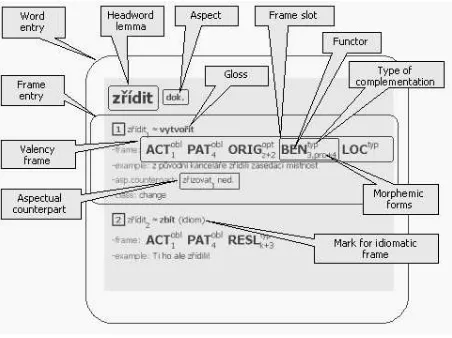
On the topmost level, VALLEX 1.0 is divided into word entries (the HTML ‘graphical’ layout of a word entry is depicted on Fig. 1). Each word entry relates to one or more headword lemmas5 (Sec. 3.2). The word entry
consists of a sequence of frame entries (Sec. 3.5) relevant for the lemma(s) in question (where each frame entry usually corresponds to one of the lemma’s meanings). Information about the aspect (Sec. 3.16) of the lemma(s) is assigned to each word entry as a whole.
Figure 1: HTML layout of a word entry.
Most of the word entries correspond to lemmas in a simple one-to-one manner, but the following two non-trivial situations (and even combinations of them) appear as well in VALLEX 1.0:
5Remark on terminology: The terms used here either belong
lemma variants (Sec. 3.3)
homonyms (Sec. 3.4)
The content of a word entry roughly corresponds to the traditional term of lexeme.
3.2 Lemmas
Under the term of lemma (of a verb) we understand the infinitive form of the respective verb, in case of homonym (Sec. 3.4) followed by a Roman number in superscript (which is to be considered as an inseparable part of the lemma in VALLEX 1.0!).
Reflexive particles se or si are parts of the infinitive only if the verb is reflexive tantum, primary (e.g. ba´t se) as well as derived (e.g. zabı´t se, sˇı´rˇit se, vra´tit se).
3.3 Lemma Variants
Lemma variants are groups of two (or more) lemmas that are interchangable in any context without any change of the meaning (e.g. doveˇdeˇt se/dozveˇdeˇt se). The only diffe-rence usually is just a small alternation in the morphologi-cal stem, which might be accompanied by a subtle stylis-tic shift (e.g. myslet/myslit, the latter one being bookish). Moreover, although the infinitive forms of the variants di-ffer in spelling, some of their conjugated forms are often identical (mysli (imper.sg.) both for myslet and myslit).
The term ‘lemma variants’ should not be confused with the term ‘synonymy’.
3.4 Homonyms
There are pairs of word entries in VALLEX 1.0, the lem-mas of which have the same spelling, but considerably differ in their meanings (there is no obvious semantic re-lation between them). They also might differ as to their etymology (e.g. nakupovat - to buy vs. nakupovat
- to heap), aspect (Sec. 3.16) (e.g. stacˇit pf. - to be enough vs. stacˇit
impf. - to catch up with), or conjugated forms (zˇilo (past.sg.fem) for zˇı´t - to live vs. zˇalo(past.sg.fem) zˇı´t
- to mow). Such lemmas (homonyms)6are
distingu-ished by Roman numbering in superscript. These numbers should be understood as an inseparable part of lemma in VALLEX 1.0.
3.5 Frame Entries
Each word entry consists of a non-empty sequence of frame entries, typically corresponding to the individual meanings (senses) of the headword lemma(s) (from this point of view, VALLEX 1.0 can be classified as a Sense Enumerated Lexicon).
6Note on terminology: we have adopted the term
‘homo-nyms’ from Czech linguistic literature, where it traditionally stands for what was stated above (words identical in the spelling but considerably different in the meaning); in English literature the term ‘homographs’ is sometimes used to express the same notion.
The frame entries are numbered within each word en-try; in the VALLEX 1.0 notation, the frame numbers are attached to the lemmas as subscripts.
The ordering of frames is not completely random, but it is not perfectly systematic either. So far it is based only on the following weak intuition: primary and/or the most frequent meanings should go first, whereas rare and/or idi-omatic meanings should go last. (We do not guarantee that the ordering of meanings in this version of VALLEX 1.0 exactly matches their frequency of the occurrences in con-temporary language.)
Each frame entry7 contains a description of the
va-lency frame itself (Sec. 3.6) and of the frame attributes (Sec. 3.13).
3.6 Valency Frames
In VALLEX 1.0, a valency frame is modeled as a sequence of frame slots. Each frame slot corresponds to one (either required or specifically permitted) complementation8 of
the given verb.
The following attributes are assigned to each slot:
functor (Sec. 3.7)
list of possible morphemic forms (realizations) (Sec. 3.8)
type of complementation (Sec. 3.11)
Some slots tend to systematically occur together. In order to capture this type of regularity, we introduced the mechanism of slot expansion (Sec. 3.12) (full valency frame will be obtained after performing these expansions).
3.7 Functors
In VALLEX 1.0, functors (labels of ‘deep roles’; similar to theta-roles) are used for expressing types of relations between verbs and their complementations. According to FGD, functors are divided into inner participants (actants) and free modifications (this division roughly corresponds to the argument/adjunct dichotomy). In VALLEX 1.0, we also distinguish an additional group of quasi-valency complementations.
Functors which occur in VALLEX 1.0 are listed in the following tables (for Czech sample sentences see (Lopat-kova´ et al., 2002), page 43):
Inner participants:
ACT (actor): Peter read a letter.
ADDR (addressee): Peter gave Mary a book.
7Note on terminology: The content of ‘frame entry’
rou-ghly corresponds to the term of lexical unit (‘lexie’ in Czech terminology).
8
PAT (patient): I saw him.
EFF (effect): We made her the secretary.
ORIG (origin): She made a cake from apples.
Quasi-valency complementations:
DIFF (difference): The number has swollen by 200.
OBST(obstacle): The boy stumbled over a stumb.
INTT (intent): He came there to look for Jane.
Free modifications:
ACMP (accompaniement): Mother came with her children.
AIM (aim): John came to a bakery for a piece of bread.
BEN (benefactive): She made this for her children.
CAUS (cause): She did so since they wanted it.
COMPL (complement): They painted the wall blue.
DIR1 (direction-from): He went from the forest to the village.
DIR2 (direction-through): He went through the forest to the village.
DIR3 (direction-to): He went from the forest to the village.
DPHR (dependent part of a phraseme): Peter talked horse again.
EXT (extent): The temperatures reached an all time high.
HER (heritage): He named the new villa after his wife.
LOC (locative): He was born in Italy.
MANN (manner): They did it quickly.
MEANS (means): He wrote it by hand.
NORM (norm): Peter has to do it exactly according to directions.
RCMP (recompense): She bought a new shirt for 25 $.
REG (regard): With regard to George she asked his teacher for advice.
RESL (result): Mother protects her children from any danger.
SUBS (substitution): He went to the theatre instead of his ill sister.
TFHL (temporal-for-how-long): They interrupted their studies for a year.
TFRWH (temporal-from-when): His bad reminis-cences came from this period.
THL (temporal-how-long ): We were there for three weeks.
TOWH (temporal-to when): He put it over to next Tuesday.
TSIN (temporal-since-when): I have not heard about him since that time.
TWHEN (temporal-when): His son was born last year.
Note 1: Besides the functors listed in the tables above, also value DIR occurs in the VALLEX 1.0 data. It is used only as a special symbol for slot expansion (Sec. 3.12).
Note 2: The set of functors as introduced in FGD is richer than that shown above, moreover, it is still being elaborated within the Prague Dependency Treebank. We do not use its full (current) set in VALLEX 1.0 due to se-veral reasons. Some functors do not occur with a verb at all (e.g. APP - appuertenace, ‘my.APP dog’), some other functors can occur there, but represent other than depen-dency relation (e.g. coordination, ‘Jim or.CONJ Jack’). And still others can occur with verbs as well, but their be-haviour is absolutely independent of the head verb, thus they have nothing to do with valency frames (e.g. ATT -attitude, ’He did it willingly.ATT’).
3.8 Morphemic Forms
In a sentence, each frame slot can be expressed by a li-mited set of morphemic means, which we call forms. In VALLEX 1.0, the set of possible forms is defined either explicitly (Sec. 3.9), or implicitly (Sec. 3.10). In the for-mer case, the forms are enufor-merated in a list attached to the given slot. In the latter case, no such list is specified, because the set of possible forms is implied by the functor of the respective slot (in other words, all forms possibly expressing the given functor may appear).
3.9 Explicitly Declared Forms
The list of forms attached to a frame slot may contain values of the following types:
Pure (prepositionless) case. There are seven
mor-phological cases in Czech. In the VALLEX 1.0 tation, we use their traditional numbering: 1 - nominative, 2 genitive, 3 dative, 4 accusative, 5 -vocative, 6 - locative, and 7 - instrumental.
Prepositional case. Lemma of the preposition (i.e.,
z, za. (‘jako’ is traditionally considered as a con-junction, but it is included in this list, as it requires a particular morphological case in some valency fra-mes).
Subordinating conjunction. Lemma of the
con-junction is specified. The following subordinating conjunctions occur in VALLEX 1.0: aby, at’, azˇ, jak, zda,9zˇe.
Infinitive construction. The abbreviation ‘inf’
stands for infinitive verbal complementation. ‘inf’ can appear together with a preposition (e.g. ‘nezˇ+inf’), but it happens very rarely in Czech.
Construction with adjectives. Abbreviation
‘adj-digit’ stands for an adjective complementation in the given case, e.g. adj-1 (Cı´tı´m se slaby´ - I feel weak).
Constructions with ‘by´t’ . Infinitive of verb ‘by´t’ (to
be) may combine with some of the types above, e.g. by´t+adj-1 (e.g. zda´ se to by´t dostatecˇne´ - it seems to be sufficient).
Part of phraseme. If the set of the possible
le-xical values of the given complementation is very small (often one-element), we list these values di-rectly (e.g. ‘napospas’ for phraseme ‘ponechat na-pospas’ - to expose).
3.10 Implicitly Declared Forms
If no forms are listed explicitly for a frame slot, then the list of possible forms implicitly results from the functor of the slot according to the following (yet incomplete) lists:
LOC: adverb, na+6, v+6, u+2, prˇed+7, za+7, nad+7, pod+7, okolo+2, kolem+2, prˇi+6, vedle+2, mezi+7, mimo+4, naproti+3, pode´l+2 . . .
MANN: adverb, 7, na+4, . . .
DIR3: adverb, na+4, v+4, do+2, prˇed+4, za+4, nad+4, pod+4, vedle+2, mezi+4, po+4, okolo+2, ko-lem+2, k+3, mimo+4, naproti+3 . . .
DIR1: adverb, z+2, od+2, zpod+2, zpoza+2, zprˇed+2 . . .
DIR2: adverb, 7, prˇes+4, pode´l+2, mezi+7, . . .
TWHEN: adverb, 2, 4, 7, prˇed+7, za+4, po+6, prˇi+6, za+2, o+6, k+3, mezi+7, v+4, na+4, na+6, kolem+2, okolo+2, . . .
THL: adverb, 4, 7, po+4, za+4, . . .
EXT: adverb, 4, na+4, kolem+2, okolo+2, . . .
REG: adverb, 7, na+6, v+6, k+3, prˇi+6, ohledneˇ+2, nad+7, na+4, s+7, u+2, . . .
9Note: form ‘zda’ is in fact an abbreviation for couple of
conjunctions ‘zda’ and ‘jestli’.
TFRWH: z+2, od+2, . . .
AIM: k+3, na+4, do+2, pro+4, proti+3, aby, at’, zˇe, . . .
TOWH: na+4 . . .
TSIN: od+2 . . .
TFHL: na+4, pro+4, . . .
NORM: podle+2, v duchu+2, po+6, . . .
MEANS: 7, v+6,na+6,po+6, z+2, zˇe, s+7, na+4, za+4, pod+7, do+2, . . .
CAUS: 7, za+4, z+2, kvu˚li+2, pro+4, k+3, na+4, zˇe, . . .
3.11 Types of Complementations
Within the FGD framework, valency frames (in a narrow sense) consist only of inner participants (both obligatory10
and optional, ‘obl’ and ‘opt’ for short) and obligatory free modifications; the dialogue test was introduced by Pane-vova´ as a criterium for obligatoriness. In VALLEX 1.0, valency frames are enriched with quasi-valency comple-mentations. Moreover, a few non-obligatory free modi-fications occur in valency frames too, since they are ty-pically (‘typ’) related to some verbs (or even to whole classes of them) and not to others. (The other free modi-fications can occur with the given verb too, but are not contained in the valency frame, as it was mentioned above (Sec. 3.7) )
The attribute ‘type’ is attached to each frame slot and can have one of the following values: ‘obl’ or ‘opt’ for inner participants and quasi-valency complementations, and ‘obl’ or ‘typ’ for free modifications.
3.12 Slot Expansion
Some slots tend systematically to occur together. For instance, verbs of motion can be often modified with to and/or through and/or direction-from modifier. We decided to capture this type of regula-rity by introducing the abbreviation flag for a slot. If this flag is set (in the VALLEX 1.0 notation it is marked with an upward arrow), the full valency frame will be obtained after slot expansion.
If one of the frame slots is marked with the upward arrow (in the XML data, attribute ‘abbrev’ is set to 1), then the full valency frame will be obtained after substituting this slot with a sequence of slots as follows:
DIR DIR1 DIR2 DIR3
10It should be emphasized that in this context the term
DIR1 DIR1 DIR2 DIR3
DIR2
DIR1 DIR2
DIR3
DIR3
DIR1 DIR2 DIR3
TSIN
TSIN
THL TTIL
THL TSIN THL TTIL
3.13 Frame Attributes
In VALLEX 1.0, frame attributes (more exactly, attribute-value pairs) are either obligatory or optional. The former ones have to be filled in every frame. The latter ones might be empty, either because they are not applicable (e.g. some verbs have no aspectual counterparts), or be-cause the annotation was not finished (e.g. attribute class (Sec. 3.15) is filled only in roughly one third of frames). Obligatory frame attributes:
gloss – verb or paraphrase roughly synonymous with the given frame/meaning; this attribute is not suppo-sed to serve as a source of synonyms or even of genuine lexicographic definition – it should be used just as a clue for fast orientation within the word entry!
example – sentence(s) or sentence fragment(s) con-taining the given verb used with the given valency frame.
Optional frame attributes:
control (Sec. 3.14)
class (Sec. 3.15)
aspectual counterparts (Sec. 3.16)
idiom flag (Sec. 3.17)
3.14 Control
The term ‘control’ relates in this context to a certain type of predicates (verbs of control)11 and two
corre-ferential expressions, a ‘controller’ and a ‘controllee’. In VALLEX 1.0, control is captured in the data only in the situation where a verb has an infinitive modifier (regar-dless of its functor). Then the controllee is an element that would be a ‘subject’ of the infinitive (which is structurally excluded on the surface), and controller is the co-indexed expression. In VALLEX 1.0, the type of control is stored in the frame attribute ‘control’ as follows:
if there is a coreferential relation between the (unex-pressed) subject (‘controllee’) of the infinitive verb and one of the frame slots of the head verb, then the attribute is filled with the functor of this slot (‘cont-roller’);
11Note on terminology: in English literature the terms ‘equi
verbs’ and ‘raising verbs’ are used in a similar context.
otherwise (i.e., if there is no such co-reference) value ‘ex.’ is used.
Examples:
pokusit se (to try) - control: ACT
slysˇet (to hear), e.g. ‘slysˇet neˇkoho prˇicha´zet’ (to hear somebody come) - control: PAT
jı´t, in the sense ‘jde to udeˇlat’ (it is possible to do it) - control: ex
3.15 Class
Some frames are assigned semantic classes like ‘mo-tion’, ‘exchange’, ‘communica‘mo-tion’, ‘percep‘mo-tion’, etc. However, we admit that this classification is tentative and should be understood merely as an intuitive grouping of frames, rather than a properly defined ontology.
The motivation for introducing such semantic classi-fication in VALLEX 1.0 was the fact that it simplifies systematic checking of consistency and allows for ma-king more general observations about the data.
3.16 Aspect, Aspectual Counterparts
Perfective verbs (in VALLEX 1.0 marked as ‘pf.’ for short) and imperfective verbs (marked as ‘impf.’) are dis-tinguished between in Czech; this characteristic is called aspect. In VALLEX 1.0, the value of aspect is attached to each word entry as a whole (i.e., it is the same for all its frames and it is shared by the lemma variants, if any).
Some verbs (i.e. informovat - to inform, charakterizo-vat - to characterize) can be used in different contexts either as perfective or as imperfective (obouvidova´ slo-vesa, ‘biasp.’ for short).
Within imperfective verbs, there is a subclass of of ite-rative verbs (iter.). Czech iteite-rative verbs are derived more or less in a regular way by affixes such as -va- or -iva-, and express extended and repetitive actions (e.g. cˇı´ta´vat, cho-dı´vat). In VALLEX 1.0, iterative verbs containing double affix -va- (e.g. chodı´va´vat) are completely disregarded, whereas the remaining iterative verbs occur as aspectual counterparts in frame entries of the corresponding non-iterative verbs (but have no own word entries, still).
perfective or imperfective counterparts, not only the lem-mas are specified within the list, but (more specifically) also the frame numbers of the counterpart frames (which is of course not the case for the iterative counterparts, for they have no word entries of their own as stated above).
One frame might have more than one counterpart be-cause of two reasons. Either there are two counterparts with the same aspect (impf. pu˚sobit and impf. zpu˚sobo-vat for pf. zpu˚sobit), or there are two counterparts with different aspects (impf. scha´zet, pf. sejı´t, iter. scha´zı´vat).
3.17 Idiomatic frames
When building VALLEX 1.0, we focused mainly on pri-mary or usual meanings of verbs. We also noted many fra-mes corresponding to peripheral usages of verbs, however their coverage in VALLEX 1.0 is not exhaustive. We call such frames idiomatic and mark them with label ‘idiom’. An idiomatic frame is tentatively characterized either by a substantial shift in meaning (with respect to the primary sense), or by a small and strictly limited set of possi-ble lexical values in one of its complementations, or by occurence of another types of irregularity or anomaly.
4
Future Work
We plan to extend VALLEX in both quantitative and qua-litative aspects. At this moment, word entries for 500 new verbs are being created, and further batches of verbs will follow in near future (selected with respect to their frequency, again). As for the theoretical issues, we in-tend to focus on capturing the structure on the set of frames/senses (e.g. the relations between primary and me-taphorical usages of a verb), on improving the semantic classification of frames, and on exploring the influence of word-formative process on valency frames (for example, regularities in the relations between valency frames of a basic verb and of a verb derived from it by prefixing, are expected).
Acknowledgements
VALLEX 1.0 has been created under the financial sup-port of the projects MSMT LN00A063 and GACR 405/04/0243.
We would like to thank for an extensive linguistic and also technical advice to our colleagues from CKL and UFAL, especially to professor Jarmila Panevova´.
References
Charles Fillmore. 2002. Framenet and the linking be-tween semantic and syntactic relations. In Proceedings of COLING 2002, pages xxviii–xxxvi.
Jan Hajicˇ, Jarmila Panevova´, Zdenˇka Uresˇova´, Alevtina Be´mova´, Veronika Kola´rˇova´, and Petr Pajas. 2003.
PDT-VALLEX: Creating a Large-coverage Valency Lexicon for Treebank Annotation. In Proceedings of The Second Workshop on Treebanks and Linguistic Theories, volume 9 of Mathematical Modeling in Phys-ics, Engineering and Cognitive Sciences, pages 57–68. Vaxjo University Press, November 14–15, 2003.
Eva Hajicˇova´ and Ivona Kucˇerova´. 2002. Argu-ment/Valency Structure in PropBank, LCS Database and Prague Dependency Treebank: A Comparative Pi-lot Study. In Proceedings of the Third International Conference on Language Resources and Evaluation (LREC 2002), pages 846–851. ELRA.
Eva Hajicˇova´, Jarmila Panevova´, and Petr Sgall, 2000. A Manual for Tectogrammatical Tagging of the Prague Dependency Treebank.
Paul Kingsbury and Martha Palmer. 2002. From Tre-ebank to PropBank. In Proceedings of the 3rd Inter-national Conference on Language Resources and Eva-luation, Las Palmas, Spain.
Beth C. Levin. 1993. English Verb Classes and Alter-nations: A Preliminary Investigation. University of Chicago Press, Chicago, IL.
Marke´ta Lopatkova´, Zdeneˇk Zˇ abokrtsky´, Karolina Skwar-ska, and Va´clava Benesˇova´. 2002. Tektogramaticky anotovany´ valencˇnı´ slovnı´k cˇesky´ch sloves. Technical Report TR-2002-15.
Marke´ta Lopatkova´. 2003. Valency in the Prague Depen-dency Treebank: Building the Valency Lexicon. Pra-gue Bulletin of Mathematical Linguistics, (79–80).
Jarmila Panevova´. 1992. Valency frames and the me-aning of the sentence. In Ph. L. Luelsdorff, editor, The Prague School of Structural and Functional Lingu-istics, pages 223–243, Amsterdam-Philadelphia. John Benjamins.
Petr Sgall, Eva Hajicˇova´, and Jarmila Panevova´. 1986. The Meaning of the Sentence in Its Semantic and Prag-matic Aspects. D. Reidel Publishing Company, Dord-recht.
Hana Skoumalova´. 2002. Verb frames extracted from dictionaries. The Prague Bulletin of Mathematical Lin-guistics 77.
Marke´ta Stranˇa´kova´-Lopatkova´ and Zdeneˇk Zˇabokrtsky´. 2002. Valency Dictionary of Czech Verbs: Complex Tectogrammatical Annotation. In Proceedings of the Third International Conference on Language Resour-ces and Evaluation (LREC 2002), volume 3, pages 949– 956. ELRA.
APPENDIX – Sample from the printed version of VALLEX 1.0
798;:<>=?9@BADC EGF5HJLKI AEMF5HI N>OPQ
7>?RS<>=UTV?9@BWMX*YZU[\(]Z^;_Xa`b^dce^fg]>Z5^
7><h*T>ij*klm,n?S:T<9:n5h,@
&g,o>pDM1qrst
u>vxwyazS{;|
798;:<>=?9@BADC EGF5HI
J
Aa#F5HI LK
A#EDF5HI *g
7>?RS<>=UTV?9@]>Z5*\ `9c&S`c~BXU`9[&
7><h*T>ij*klm,n?S:T<9:n5h,@
798;:<>=?9@BADC EGF5HI JLK
7><h*T>ij*klm,n?S:T<9:n5h,@
&9,opd1qrst
798;:<>=?9@BADC E F5HI LK
AE F5HI J*0´µ
C ¥¬;¤
7>?RS<>=UTV?9@]>Z5*\ce0`bXg¶&[· ¸fg]>¹(º»¼S`>½9[5S0]Z,*]&^Sc09Z
7><h*T>ij*klm,n?S:T<9:n5h,@
798;:<>=?9@BADC EGF5HJLKI AEMF5HI Æ, OÇ5È
7>?RS<>=UTV?9@]>Z5*\ [*Xa`bX*¶>[· ¸f*]
7><h*T>ij*klm,n?S:T<9:n5h,@
798;:<>=?9@BADC EGF5HI JLK
AEMF5HI *Ó
P
7>?RS<>=UTV?9@]>Ô9Õ,^9YS\S9e¿Zg>SSd¿[`Õ*ÖSY9Xgc
7><h*T>ij*klm,n?S:T<9:n5h,@
>Ì&ÍpgÙ9° ÐÙ&b.)eÙ9Ã&Ú*$£ÜÛ¿-Ù9-SÐ(ÝSÞ/121346
798;:<>=?9@BADC E F5HI JLK AE
F5HI
7>?RS<>=UTV?9@¿`bSºSßUcÖSàgX*`&Ö0]>Ô9Õ,9B[ºS¸*YXgc
#É(ÊGË©¾9À wyz9{;|
798;:<>=?9@BADC EGF5HI J ´µ
CÎ¥¬5¤³áâ#¥¬;¤
7>?RS<>=UTV?9@ãUX]>Ô9ÕX_*YX[gXä¹ º9¸gY;Xgºe[*Xa]>Ô9Õ,dºSXUºS¸gYZ
7>jSV<h5h,@
798;:<>=?9@BADC EGF5HI JLK
AEMF5HI *Ó
P
7>?RS<>=UTV?9@]>Ô9Õ*`9&YÎ]&^9º9e¼[*XU[5Sç`
7><h*T>ij*klm,n?S:T<9:n5h,@
>Ì&Íp 14 ×5Øt
èêé
Ëu>Ëbë(9Àu>v&ì#Ë í9wî,ï;z|
7S85:<>=M?@ADC(E F5HI J K
7?gRS<>=UTV?9@·bZ59Õßgc~fg]&^SZ5^SY;XgZg\*9º^Y;¸gc\Y[g9º,ÖS¹ Y^ºS^9[Y`9[Y
]>099[Yfg]&^SZ5^SY;XgZg\gg_Xg¹ fg]&^9Z5^SYX*Z\,SºS^9&·bçY;X*X(_*^SS09Õ*ZS^
7j9V<h5h,@³
7?gRS<>=UTV?9@ÿfg]>9\Yd99c · ¸*à5SÖS¹dfg]&99\Ydü]&S[· SÖ ]>9[
·b>¸g¹ef*]>9\Y0ZÖ9f*]>X*¹e9Y¸¼©fg]&S¹efg]&99[Y;X_*`b¸ ;^9X_*^SS
\ZS^#W¹f*]>9\Y0`^üÕSZ>º,Ö¼Â`^ü`bS,· `^S,· 9º^9Y¹
fg]&99\YÎ0ß9^Sçg\Î`^0S9`YZ59Ö
7<h*T&ij*k&l>m*n?S:TS<9:n5h,@³
>÷op³1qrst
7<h*T&ij*k&l>m*n?S:TS<9:n5h,@³
>÷op³1qrst
7<h*T&ij*k&l>m*n?S:TS<9:n5h,@³
>÷op³1qrst
>÷%$e'&;Ð#Ï#¢&b.)e/121354#6
7S85:<>=M?@ADC(EDF5HI JL¦
AªªG¥¬5¤
7?gRS<>=UTV?9@©fg]&S\YGÕXf*]Ö9Õ,Ö³0[YZ55_g\¹ Y;Xg`¼[YZ55_afg]&99
7<h*T&ij*k&l>m*n?S:TS<9:n5h,@³
>÷op³1qrst
7<h*T&ij*k&l>m*n?S:TS<9:n5h,@³
>÷op³1qrst
7?gRS<>=UTV?9@©fg]&S\YG9YZ]&^S`ÔS¹Gfg]&9 `b^dÕ,>·bçXg[YZ5;_Xg`b
7<h*T&ij*k&l>m*n?S:TS<9:n5h,@³
>÷op³1qrst
7<h*T&ij*k&l>m*n?S:TS<9:n5h,@³
>÷op³1qrst
7S85:<>=M?@ADC(E F5HI
J
7<h*T&ij*k&l>m*n?S:TS<9:n5h,@³