Proceedings of the 27th International Conference on Computational Linguistics, pages 2595–2609 2595
Learning Multilingual Topics from Incomparable Corpora
Shudong Hao Computer Science University of Colorado
Boulder, CO, USA [email protected]
Michael J. Paul Information Science University of Colorado
Boulder, CO, USA [email protected]
Abstract
Multilingual topic models enable crosslingual tasks by extracting consistent topics from multi-lingual corpora. Most models require parallel or comparable training corpora, which limits their ability to generalize. In this paper, we first demystify the knowledge transfer mechanism behind multilingual topic models by defining an alternative but equivalent formulation. Based on this analysis, we then relax the assumption of training data required by most existing models, creating a model that only requires a dictionary for training. Experiments show that our new method ef-fectively learns coherent multilingual topics from partially and fullyincomparablecorpora with limited amounts of dictionary resources.
1 Introduction
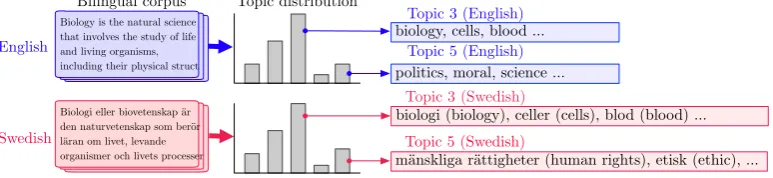
Multilingual topic models provide an overview of document structures in multilingual corpora, by learn-ing language-specific versions of each topic (Figure 1). Their simplicity, efficiency and interpretability make models from this family popular for various crosslingual tasks, e.g., feature extraction (Liu et al., 2015), cultural difference discovery (Shutova et al., 2017; Guti´errez et al., 2016), translation detec-tion (Krstovski et al., 2016; Krstovski and Smith, 2016), and others (Barrett et al., 2016; Agi´c et al., 2016; Hintz and Biemann, 2016).
Typical probabilistic multilingual topic models are based on Latent Dirichlet Allocation (LDA, Blei et al. (2003)), adding supervision on connections between languages. Most models achieve this by making strong assumptions on the training data—they either require aparallel corpusthat has sentence-aligned documents in different languages (e.g.,EuroParl, Koehn (2005)), or acomparable corpusthat has docu-ments of similar content (e.g.,Wikipedia articles paired across languages). These training requirements limit the usage of such models: an adequately large parallel corpus is difficult to obtain, particularly for low-resource languages. For example, only300languages are available on Wikipedia,1 and only 250
languages have more than 1,000 articles. Another common choice for parallel corpus in multilingual research, the Bible, is available in2,530languages (Agi´c et al., 2015).2 However, studies show that its archaic themes and small corpus size (1,189chapters) can limit performance (Hao et al., 2018; Moritz and B¨uchler, 2017). Therefore, the requirement of parallel/comparable corpora for multilingual topic models limits their usage in many situations.
Another line of research focuses on using multilingual dictionaries as supervision (Ma and Nasukawa, 2017; Guti´errez et al., 2016; Liu et al., 2015; Jagarlamudi and Daum´e III, 2010; Boyd-Graber and Blei, 2009). In contrast to parallel corpora, dictionaries are widely available and often easy to obtain. PANLEX, a free online dictionary database, for example, covers 5,700languages and more than one billion dictionary entries (Kamholz et al., 2014; Baldwin et al., 2010).3 Thus, a multilingual topic model built on a dictionary rather than a parallel corpus is potentially applicable to more languages.
This work is licensed under a Creative Commons Attribution 4.0 International License. License details: http://
creativecommons.org/licenses/by/4.0/.
1https://meta.wikimedia.org/wiki/List_of_Wikipedias
2
Biology is the natural science that involves the study of life and living organisms, including their physical struct
Biologi eller biovetenskap är den naturvetenskap som berör läran om livet, levande organismer och livets processer English
Swedish
biology, cells, blood …
biologi (biology), celler (cells), blod (blood) ... Bilingual corpus
Topic 3 (English) Topic distribution
politics, moral, science …
mänskliga rättigheter (human rights), etisk (ethic), … Topic 5 (English)
Topic 3 (Swedish)
[image:2.595.107.494.67.156.2]Topic 5 (Swedish)
Figure 1: Multilingual topic models produce topics where each language has its own version.
A dictionary also allows for training onincomparablecorpora—documents in different languages that are from different sources without direct connections—which have had less research on learning consis-tent topics. With a dictionary, a natural question is how to efficiently utilize the semantic information it carries so that a topic model can produce multilingually coherent topics. This work considers an alterna-tive formulation of a dictionary-based topic model, one that borrows the structure of models used with comparable corpora, but uses a dictionary-based metric to learn connections between documents, instead of explicit connections from a comparable corpus. The main contributions of this work are:
• We summarize existing related work in Section 2 and propose a new formulation of multilingual topic models based on crosslingual transfer learning in Section 3. This new formulation explicitly shows the knowledge transfer mechanism during the generative process.
• Based on this new formulation, in Section 4 we generalize existing multilingual topic models and relax the assumptions of parallel/comparable datasets. Our approach requires only a dictionary, and is empirically shown to perform well even with only limited amounts of available entries.
• We evaluate our new model on five languages from different language families in Section 5. Our proposed model learns multilingually coherent topics and yields around a25%relative improvement in crosslingual classification performance.
2 Multilingual Topic Models
Multilingual topic models generateKtopics from a corpus consisting of multiple languages; each topic has a version specific to each language in the corpus (Figure 1). From a human’s view, a coherent multi-lingual topic should talk about the same thing regardless of the language; from a machine’s view, the suc-cess of multilingual topic models depends on the inferred topics being consistent across languages. For example, given an English-Swedish bilingual topicφ(EN,SV)
k , the probability of an English wordislandand that of its translation in Swedish,¨o, should be similar,i.e.,PrislandEN|φ
(EN,SV)
k
≈Pr¨oSV|φ (EN,SV)
k
. Most multilingual topic models extendLDAwith one or both of two types of “link” information: docu-ment translations and word translations.
Document Links. The polylingual topic model (Mimno et al., 2009; Ni et al., 2009) assumes that during the generative process, a topic distribution θd generates a tuple of comparable documents in different languages,i.e.,d= d(`1), . . . , d(`L)and each language`has its own topic-word distributions, φ(k`). This model has been widely used (Vuli´c et al., 2013; Platt et al., 2010; Smet and Moens, 2009), but it requires a parallel/comparable corpus in order to link documents.
Vocabulary Links. Another type of model uses word translations (Jagarlamudi and Daum´e III, 2010; Boyd-Graber and Blei, 2009) rather than linking documents. A multilingual dictionary is used to con-struct a tree con-structure where each internal node contains word translations, and applies hyper-Dirichlet type I distributions to generate words (Andrzejewski et al., 2009; Minka, 1999; Dennis III, 1991). For each topick, a distribution from rootr to all the internal nodesiis drawn byφk,r ∼Dir(βr), and then a distribution fromito a leaf node is drawn byφ(k,i`) ∼Dirβi(`). A wordw(`)in language`is drawn
from a product of the two multinomial distributions byw(`)∼Multφ
k,r·φ(k,i`)
Variations. Many variations of these ideas have been proposed to deal with non-parallel corpus. Hey-man et al. (2016) proposed C-BILDA, which distinguishes between shared and non-shared topics across languages, based on a document links model. The model, however, requires a comparable dataset that provides document links between languages. A variation proposed by Ma and Nasukawa (2017) deals with non-parallel corpora. This model is essentially a modified version of Jagarlamudi and Daum´e III (2010) and Boyd-Graber and Blei (2009), so we consider this work to be another vocabulary links model. Other models have been proposed for very specific situations that needs additional supervision. For ex-ample, Krstovski et al. (2016) requires scientific article section alignments, and Guti´errez et al. (2016) requires Part-of-Speech (POS) taggers, which are not always available for all languages. WithoutPOS taggers, this model is equivalent to vocabulary links. In our work, we focus on the standard document links and vocabulary links models, which are the most generalizable models.
3 Document Links: A Crosslingual Transfer Perspective
Before we introduce our new approach, we first present an alternative understanding of the document links model from the perspective of crosslingual transfer learning. In multilingual topic models, “knowl-edge” refers to word distributions for a topic in a language`, and we study how multilingual topic models transfer this knowledge from one language to another so that the model provides semantically coherent topics that are consistent across languages.
In the standard document links model, a “link” between a documentd`1 in language`1 andd`2 in`2
indicates that they are translations or closely comparable. In this model, the topic assignments for both documents are independently generated from the same distribution,θd`1,d`2. Thus, the joint likelihood of document links model is:
Pr (wd`1,zd`1,wd`2,zd`2|α, β), (1)
wherewd`andzd`are the word tokens and topic assignments of documentd`. We refer this formulation as thejoint generative model, since the topics and words ofd`1 andd`2 are generatedsimultaneously.
The simultaneousness of this model formulation, in which both languages generate topics jointly, masks the knowledge transfer process. To highlight this process, and to help us generalize the model in the next section, we define an alternative formulation in whichd`1 andd`2 are generatedsequentially.
Assume the topics ofd`1 have already been generated fromθd`1 ∼Dir(α), andnd`1 ∈N
K is a vector of topic counts ind`1. In our alternative formulation, the generation of topics ofd`2 depends ond`1 by
θd`2 ∼ Dir(α+nd`1), where the priorα+nd`1 encourages the distributionθd`2 to be similar toθd`1. This formulation can go the other way,i.e.,generatingd`2 first, and thend`1. The combined likelihood of this formulation is:
Pr (wd`1,zd`1|wd`2,zd`2, α, β)·Pr (wd`2,zd`2|wd`1,zd`1, α, β), (2)
and we refer to this formulation as theconditional generative model.
This alternative formulation explicitly shows the knowledge transfer process across languages by shap-ing the topic parameters for`2to be similar to that of the other language`1, and vice versa. In this
for-mulation, the likelihood of the conditional generative model is different from the joint generative model. In fact, this is an instance of pseudolikelihood(Besag, 1975; Lepp¨a-aho et al., 2017), where the joint likelihood of the two documents is approximated as the product of each document’s conditional likeli-hood given the other,i.e.,Pr(d`1, d`2)≈Pr(d`1|d`2)·Pr(d`2|d`1). As Lepp¨a-aho et al. (2017) suggests, pseudolikelihood is not a numerically accurate approximation to the joint likelihood; Theorem 1 below, however, states that this formulation yields exactly the same posterior estimations ofθandφ.
Theorem 1. The conditional generative model with document links yields the same posterior estimator to the joint generative model using collapsed Gibbs sampling.
D(`1)
d`2= [0,1,0] d`2= [0.1,0.6,0.3]
✓d`2⇠Dirichlet ⇣
↵+ d`2·N
(`1) ⌘
softlink hardlink
n1,`1 n2,`1 n3,`1
[image:4.595.75.526.62.130.2]✓d`2⇠Dirichlet (↵+n2,`1)
Figure 2: An illustration of how topic knowledge is transferred across languages throughHARDLINKand SOFTLINK. To generate observations ind`2, both models uses topics in`1 as prior knowledge to shape
the Dirichlet prior ford`2. This transfer happens inHARDLINK by aligned documents in a comparable corpus, whileSOFTLINKuses a generalized transfer distributionδ.
4 Generalizing Document Links
Obtaining parallel corpora for training the document links model is very demanding, particularly for low-resource languages. Therefore, as the second major contribution in this paper, we generalize the document links model using the formulation described above to require only a bilingual dictionary.
4.1 From Hard Links to Soft Links
Following the above discussion, we introduce our method assuming the directionality from language`1
to`2. We generalize the model above by rewriting the generation of the distributionθd`2:
θd`2 ∼ Dirichlet
α+δd`2 ·N
(`1), (3)
whereN(`1) ∈
N|D(`1)|×K is the matrix of topic counts per document withKtopics in the corpusD(`1) of language`1. This is equivalent to the above document links model whenδd`2 ∈R
|D(`1)|is an indicator
vector that has value1for the corresponding parallel documentd`1 ∈ D(`1)and0elsewhere. We refer this ashard links(HARDLINK), where each documentd`2 ∈D(`2)is informed by exactly one document
d`1, and this link is knowna priorifrom a parallel corpus.
We create soft links(SOFTLINK) by relaxing the assumption thatδd`2 is an indicator vector, instead allowingδd`2 to be anydistribution over documents in D
(`1), a mixture of potentially multiple
docu-ments in language`1to inform parameters for a documentd`2 in language`2. We refer this distribution
as thetransfer distribution. The Dirichlet prior for documentd`2contains topic knowledgeN(`1) trans-ferred from corpusD(`1), encouragingθ
d`2 to be proportionally similar to documents inD
(`1). Figure 2
illustrates this process.
4.2 Defining the Transfer Distribution
The transfer distribution of document d`2 indicates how much knowledge should be transferred from every documentd`1 ∈D(`1). Intuitively, ifd`1 andd`2 have a large amount of overlapping word transla-tions, their topics should be similar as well. Therefore, we define the values ofδbased on the similarity of document pairs using a bilingual dictionary. Specifically, for a documentd`2 ∈ D(`2) , the transfer distribution ofd`2, denoted asδd`2, is a normalized vector of size|D
(`1)|,i.e.,the size of corpusD(`1).
Each cell inδd`2 corresponds to a documentd`1 ∈D
(`1), defined as:
(δd`2)d`1 ∝
| {w`1} ∩ {w`2} |
| {w`1} ∪ {w`2} |
, ∀w`1 ∈d`1 andw`2 ∈d`2, (4)
where {w`} contains all the word types that appear in document d`, and {w`1} ∩ {w`2} indicates all word pairs(w`1, w`2)that can be found in a dictionary as translations. In other words,(δd`2)d`1 is the proportion of words in the document pair(d`1, d`2)that are translations of each other.
Nd
z
Nd
↵
r
K w
w
z i
D(`1)
D(`2)
soft links vocabulary links
i ✓d`1
✓d`2
d`2
(`1) i,k
[image:5.595.96.503.64.161.2](`2) i,k r,k
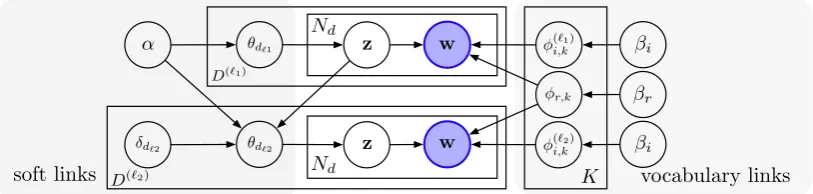
Figure 3: Plate notation of a multilingual topic model using soft links and vocabulary links.
distribution should be more heavily concentrated on documents with higher word-level translation prob-abilities, while reducing the noise negatively transferred from those with low probabilities. To this end, we propose two approaches to help transfer distributions more efficiently focus on specific documents.
4.2.1 Static Focusing: a Threshold Method
The first method is to focus the distribution on the highest values such that values below a threshold are set to0, while the remaining values are renormalized to sum to1. The modified distribution is thus:
e
δd`2
d`1
∝ 1
(δd`2)d`1 > π·max (δ)
·(δd`2)d`1 (5)
where1is an indicator function, andπ ∈[0,1]is thefocal threshold, a fixed parameter that adjusts the threshold. The threshold is defined with respect to the maximum value ofδ. Acorpus-wisethreshold choosesmax(δ) from all theδd`2 inD
(`2) globally, while we also consider adocument-wisethreshold
for each document,π·max (δd`2). We refer these two manners as theselection scope.
4.2.2 Dynamic Focusing: an Annealing Method
Static focusing treats transfer distributionsδ as fixed parameters during sampling, and it is difficult to decide how sparse a transfer distribution should be to achieve optimal performance. Therefore, we propose dynamic focusing, where we avoid choosing a specific focal threshold and selection scope. Specifically, we adjust the transfer distribution during inference dynamically, beginning with a dense transfer distribution and iteratively sharpening the distribution using deterministic annealing (Ueda and Nakano, 1994; Smith and Eisner, 2006; Paul and Dredze, 2015).
Assume at iterationt, the transfer distribution for a documentd`2 is denoted asδd(t`)2. Then at iteration
t0, we anneal its transfer distribution byδ(t0)
d`2
d`1
∝ δd(t) `2
1/τ
d`1
whereτ is a fixed temperature, which we set to0.9in our experiments. We start with non-focused transfer distributions, and apply annealing at scheduling intervals during Gibbs sampling.
Designing an effective annealing schedule is critical. We propose two schedules below.
Fixed Schedule. The simplest schedule is to apply annealing for all transfer distributions everyI iter-ations. In our experiments, we setI = 10(i.e.,t0 =t+ 10) and stop annealing after400iterations. A potential problem with fixed schedule is that it can “over-anneal” the transfer distributions,i.e.,all the mass converges to only one document.
Adaptive Schedule. A robust multilingual topic model should produce similar distributions over topics for a pair of word translationsc= (w`1, w`2), where we callca concept. In other words, given a topick, the probability of expressing a conceptiin language`1should be similar to language`2. Thus, during
iterationt, we calculate ϕ(c`,t), the distribution over K topics for each concept cfor each language `. Using ϕ(c`,t) as features and its language` as labels, we perform five-fold cross-validation by logistic regression for all concepts c. We define the average classification accuracy over the five folds as the
inferred distributions are inconsistent enough to discriminate between languages. This idea is related to adversarial training between languages (Chen et al., 2016).
During Gibbs sampling, we calculateLISafter each iteration, and averageLISeveryI iterations. We anneal all transfer distributions at iterationtonly ifLISt−I:t > LISt−2I:t−I. That is, if the averageLIS score during iterationt−I andthas been increasing since iterationt−2I tot−I, we treat this as a warning sign of increasedLISand thus anneal the transfer distributions. As we sharpenδ by annealing, knowledge transfer between languages becomes more specific.
4.3 Modularity of Models
Multilingual topic models can include the different types of information we described in Section 2: document links, vocabulary links, or both (Hu et al., 2014), while a model with neither is equivalent to LDA. Document links can be either hard or soft, or a mix of both, as the only distinction is whether the transfer distribution is an indicator vector. A complete model with both soft document links and vocabulary links is shown in Figure 3. In Section 5, we experiment with a combination of SOFTLINK andVOCLINK.
5 Experiments
5.1 Data
We use five corpora in five languages from different language groups: Arabic (AR, Semitic), Spanish (ES, Romance), Farsi (FA, Indo-Iranian), Russian (RU, Slavic), and Chinese (ZH, Sinitic). Each language is paired with English (EN, Germanic), and we train multilingual topic models on these language pairs individually. All the corpora listed below are available athttp://opus.nlpl.eu/. For preprocess-ing, we use stemmers to lemmatize and segment Chinese documents, and then remove stop words and the most frequent100word types for each language. Refer to the appendix for additional details.
Training corpora. As in many multilingual studies (Ruder et al., 2017), we use Wikipedia as our training corpus for multilingual topic models, and create two corpora, WIKI-INCO andWIKI-PACOfor each language pair (EN, `). For WIKI-INCO, we randomly select 2,000 documents in each language without any connections, so that no documents are translations of each other (anincomparablecorpus). We also create a partially comparable corpus, WIKI-PACO, which contains around 30% comparable document pairs for each language pair.
Test corpora. We create two test corpora for each language pair(EN, `)from TED Talks 2013 (TED) and Global Voices (GV), which provide categories for each document that can be used as classification labels. The first one,TED+TED, contains documents fromTEDin both languages, while the second one, TED+GVcontains English documents from TEDand non-English documents fromGV. After training a topic model, we useφ(EN)andφ(`) to infer topics from both languages. ForTED+TED, we choose the
five most frequent labels inTEDas the label set (technology,culture,science,global issues, anddesign); forTED+GV, we replaceglobal issuesanddesignwithbusinessandpolitics, since the label set fromGV does not includeglobal issuesanddesign.
Dictionary. We use Wiktionary to extract word translations for VOCLINK and to calculate transfer distribution valuesδ forSOFTLINK. The dictionary is available athttps://dumps.wikimedia.
org/enwiktionary/.
5.2 Inference Settings
For each compared model, we set the number of topicsK = 25. We run the Gibbs samplers for1,000
training iterations and500iterations to infer topic distributions on test corpora. We set Dirichlet priors
α = 0.1andβ = 0.01forHARDLINKandSOFTLINK. ForVOCLINK, we setβr = 0.01for priors from root to internal nodes, andβi= 100from internal nodesito leaves, following Hu et al. (2014).
5.3 Evaluation Metrics
5.3.1 Intrinsic Evaluation: Multilingual Topic Coherence
Typical topic model evaluations include intrinsic and extrinsic measurements. Intrinsic evaluation fo-cuses on topic quality or coherence of the trained topics. The most widely-used metric for measuring monolingual topic coherence is normalized pointwise mutual information (Lau et al., 2014; Newman et al., 2010). Hao et al. (2018) proposed crosslingual normalized pointwise mutual information (CNPMI) by extending this idea to multilingual settings, which correlates well with bilingual speakers’ judgments on topic quality.
Given a bilingual topickin languages`1 and`2, and a parallel reference corpusR(`1,`2), theCNPMI
of topickis calculated as:
CNPMI(`1, `2, k) = 1
C2
C
X
i,j
1
log Prwi(`1), w(j`2)·
log
Prw(i`1), w(j`2)
Prw(i`1)Prw(j`2) (6)
whereCis the cardinality of a topic,i.e.,theCmost probable words in the topic-word distributionφ(k`). The co-occurrence probability of two words,Prwi(`1), w(j`2), is defined as the proportion of document pairs where both words appear. In the results below, we setC= 20, and average theCNPMIscores over
K = 25topics for each model output.
To calculate CNPMI scores, we use 10,000 document pairs from a held-out portion of Wikipedia. CNPMIis an intrinsic evaluation, so it is only available for the training sets,WIKI-PACOandWIKI-INCO.
5.3.2 Extrinsic Evaluation: Crosslingual Classification
A successful multilingual topic model should provide informative features for crosslingual tasks. To show that our model is beneficial to downstream applications, we use crosslingual document classifi-cation to evaluate topic model performance. A high classificlassifi-cation accuracy when testing on a different language from training indicates topic consistency across languages (Hermann and Blunsom, 2014; Kle-mentiev et al., 2012; Smet et al., 2011).
As in other studies on multilingual topic models, we first train topic models on a bilingual corpus
D(`1,`2), and then use topic-word distributionsφ(`1) andφ(`2) to infer document-topic distributions on
unseen documentsD0(`1)
andD0(`2)
. Thus, a classifier is trained onθd`1 with corresponding labels where
d`1 ∈ D0(`1), and tested onθd`2 whered`2 ∈D
0(`2)
, and vice versa. In our experiments, we use WIKI -PACOandWIKI-INCO to train topic models first, and then perform inference on eitherTED+TED (both English and non-English documents from TED) or TED+GV (English documents from TED and non-English fromGV). For each language pair, we train multi-label classifiers using support vector machines (SVM) with five-fold cross-validation on documents in one language and test on the other. The F-1 scores reported below are micro-averaged over all labels.
5.4 Baseline Comparison
We first compareSOFTLINKwith other models:HARDLINK, which is expected to do well on the partially comparable corpus (WIKI-PACO) but poorly on the incomparable corpus (WIKI-INCO), and VOCLINK. We additionally combineSOFTLINK+VOCLINK.
Figure 4 shows the performance (both intrinsic and extrinsic) of all models. For theSOFTLINKmodels, we used the optimal hyperparameter settings, but we compare other settings in Section 5.5.
When the training corpus is partially comparable (WIKI-PACO), all models can learn comparably co-herent topics based on CNPMIscores, though theCNPMIofHARDLINKis lower than all other models. When the data is completely incomparable (WIKI-INCO),HARDLINKloses all connections between lan-guages, so as expected its topics are least coherent. Similarly, when measuring classification perfor-mance,HARDLINKis comparable toVOCLINKonWIKI-PACO, but much worse onWIKI-INCO, where it loses all information. When the test set contains mostly parallel documents (TED+TED), the F-1 scores are higher, but when the test domain changes across languages (TED+GV), the performance drops.
0.30 0.26 0.23 0.19 0.15 cnp m i 0.70 0.50 0.40 0.30 0.60 0.70 0.50 0.40 0.30 0.60 F-1 scores (te st set: te d+te d ) F-1 scores (te st set: te d+gv )
wiki-paco wiki-inco wiki-paco wiki-inco wiki-paco wiki-inco
0.26 0.29 0.24 0.27 0.23 0.26 0.18 0.24 0.58 0.65 0.57 0.64 0.46 0.48 0.34 0.46 0.53 0.58 0.52 0.55 0.41 0.41 0.34 0.47
[image:8.595.66.533.67.146.2]HARDLINK VOCLINK SOFTLINK SOFTLINK+VOCLINK
Figure 4: SOFTLINK consistently outperforms other models on both topic quality evaluation (CNPMI) and classification performance (F-1).
0.0 0.2 0.4 0.6 0.8 1.0
F-1 scores 0.30 0.26 0.23 0.19 0.15 Focal Threshold cnp m i 0.70 0.50 0.40 0.30 0.20 0.60 (te st set: te d+te d ) 0.15 0.19 0.23 0.26 0.30
doc-wise(wiki-paco) doc-wise(wiki-inco) corpus-wise(wiki-paco) corpus-wise(wiki-inco)
0.0 0.2 0.4 0.6 0.8 1.0
Focal Threshold F-1 scores (te st set: te d+gv )
0.0 0.2 0.4 0.6 0.8 1.0
Focal Threshold 0.70 0.50 0.40 0.30 0.20 0.60
(a) TrainingSOFTLINKmodel.
0.0 0.2 0.4 0.6 0.8 1.0
F-1 scores 0.30 0.28 0.25 0.23 0.20 Focal Threshold cnp m i 0.70 0.50 0.40 0.30 0.20 0.60 (te st set: te d+te d ) 0.15 0.19 0.23 0.26 0.30
doc-wise(wiki-paco) doc-wise(wiki-inco) corpus-wise(wiki-paco) corpus-wise(wiki-inco) 0.0 0.2 0.4 0.6 0.8 1.0
Focal Threshold F-1 scores (te st set: te d+gv )
0.0 0.2 0.4 0.6 0.8 1.0 Focal Threshold 0.70 0.50 0.40 0.30 0.20 0.60
[image:8.595.69.526.205.501.2](b) TrainingSOFTLINKwithVOCLINK.
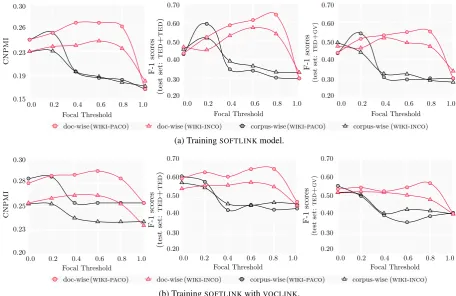
Figure 5: CNPMIscores and F-1 scores of crosslingual classification under different focal thresholds and selection scope of the transfer distribution forSOFTLINKandSOFTLINK+VOCLINK(Section 4.2).
part of the corpus contains direct links for trainingHARDLINK. It is also interesting thatSOFTLINKuses the same dictionary resource asVOCLINK, but has a relative performance increase around25%. It seems SOFTLINK can more efficiently utilize lexical information in a dictionary. We explore this relationship more in Section 5.6.
Finally, we observe that combining SOFTLINK+VOCLINK provides a performance boost over SOFT -LINKin all cases, though the increase is small.
5.5 Comparison of Focusing Methods
We have shown that, when optimized,SOFTLINKcan better utilize dictionary resources and outperform other models. We now focus on different training configurations forSOFTLINK, specifically, different methods of focusing the transfer distribution (Section 4.2).
Figure 5 shows how F-1 and CNPMIscores change with different static focusing methods. We vary the focal threshold and selection scope (i.e., doc-wise or corpus-wise) for transfer distributions. As we increase the focal thresholdπ, more documents are zeroed out in the transfer distributions. When
F-1 scores (TED+TED) F-1 scores (TED+GV) CNPMI LIS Fixed LIS Fixed LIS Fixed
WIKI-PACO 0.627 0.638 0.551 0.534 0.256 0.258
WIKI-INCO 0.551 0.526 0.475 0.470 0.220 0.217
(a) TrainingSOFTLINKmodel.
F-1 scores (TED+TED) F-1 scores (TED+GV) CNPMI LIS Fixed LIS Fixed LIS Fixed
WIKI-PACO 0.640 0.647 0.557 0.543 0.261 0.266
WIKI-INCO 0.546 0.517 0.459 0.465 0.242 0.233
[image:9.595.148.450.61.170.2](b) TrainingSOFTLINKwithVOCLINK.
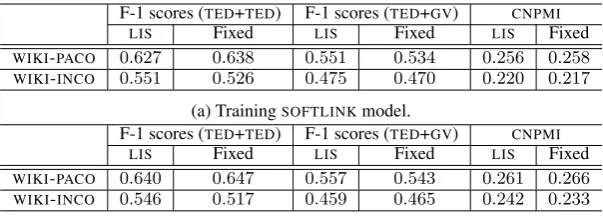
Table 1: Dynamically focusing transfer distributions inSOFTLINKyields competitive results on classifi-cation and topic quality evaluation. There is no significant difference between Fixed andLISschedules.
achieves the best performance. In the extreme case thatπ = 1, the transfer distributions are all zero, soSOFTLINK loses its connections between`1 and`2, and thus degrades to monolingual LDA. When
trainingSOFTLINKwithVOCLINK, the change ofCNPMIand F-1 scores are less obvious as we increase focal threshold, since increasing focal threshold only has an impact on theSOFTLINKcomponent of the model. When the focal threshold is higher, fewer soft links are active, so the model is closer to a plain VOCLINKmodel.
Interestingly, when focal threshold π changes from 0.2 to 0.4, F-1 scores of corpus-wise selection scope trained onSOFTLINKdrops drastically, in contrast to document-wise. This is because using corpus-wise selection could set a large portion of transfer distributions to zero, and only a small number of documents have non-zero transfer distributions. Since corpus-wise selection relies on the entire training corpus, it must be used with caution.
We find that using annealing to dynamically focus the distributions works well and is competitive with static focusing (Table 1). Annealing does better than the majority of settings of static focusing, though is worse than optimally-tuned focusing. We do not observe a significant difference between the two annealing schedules. When combiningSOFTLINKandVOCLINK, the patterns are similar to that of SOFTLINKonly.
5.6 Sensitivity to Dictionary Size
BothVOCLINKandSOFTLINKuse the same dictionary resource, yetSOFTLINKproduces better features for downstream tasks. To understand this behavior better, we experiment with different dictionary sizes to understand how well the models are utilizing the resource.
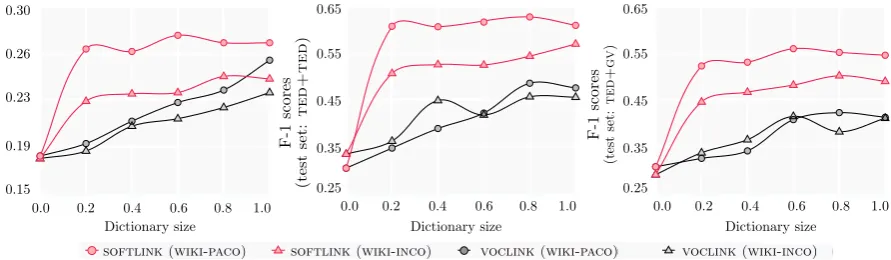
In Figure 6, we use different proportions (20%,40%,. . .,80%) of the dictionary to train SOFTLINK andVOCLINK.4 We observe that the performance ofVOCLINK (both F-1 and CNPMI) increases almost linearly with the dictionary size. In contrast,SOFTLINKis already at its best performance with only 20% of the available dictionary entries. This is further confirmation thatSOFTLINKis using this resource in a more efficient way.
InVOCLINK, knowledge transfer happens through internal nodes of the word distribution priors,i.e.,
word translations pairs, and words without translations are directly connected to the Dirichlet tree’s root. If the dictionary cannot cover all the word types appeared in the training set, VOCLINKwill have a set of word types in`1that cannot transfer enough topic knowledge to`2 and vice versa. The fewer entries
the dictionary provides, the more VOCLINKdegrades to monolingual LDA. In contrast, SOFTLINK can potentially transfer knowledge from the whole corpus. ForSOFTLINK, the dictionary is not used directly for modeling, rather it is only used for linking documents. Thus, knowledge transfer does not heavily rely on the number of entries in the dictionary.
4We use document-wise selection scope and focal thresholdπ= 0.6for training
0.0 0.2 0.4 0.6 0.8 1.0
F-1 scores
0.30
0.26
0.23
0.19
0.15
cnp
m
i
(te
st
set:
te
d+te
d
)
0.15 0.19 0.23 0.26 0.30
doc-wise(wiki-paco) doc-wise(wiki-inco) corpus-wise(wiki-paco) corpus-wise(wiki-inco)
0.0 0.2 0.4 0.6 0.8 1.0
F-1 scores
(te
st
set:
te
d+gv
)
0.0 0.2 0.4 0.6 0.8 1.0
Dictionary size 0.55
0.45
0.35
0.25 0.65
Dictionary size Dictionary size
0.55
0.45
0.35
0.25 0.65
[image:10.595.80.526.72.202.2]softlink (wiki-paco) softlink (wiki-inco) voclink (wiki-paco) voclink (wiki-inco)
Figure 6: Performance ofVOCLINKcontinues increasing when more dictionary entries are added, while SOFTLINKperformance mostly stabilizes after using only20%of available dictionary entries.
5.7 Discussion
The sensitivity to dictionary size is an important factor to be considered in practice. For low-resource languages, a dictionary is easier to obtain than a large parallel corpus (Section 1). Models that rely on dictionaries such asVOCLINK andSOFTLINKare therefore more applicable to low-resource languages than HARDLINK. However, there are also large variations in dictionary size among languages. For example, in Wiktionary, 57 languages have fewer than 1,000entries, while 77 languages have more than100,000entries. For truly low-resource languages, dictionary size could be a limiting factor. Since SOFTLINKcan outperform VOCLINKwith only a limited amount of lexical information, it may be able to transfer knowledge to low-resource languages more effectively than other approaches.
In summary,SOFTLINKrelaxes and generalizesHARDLINKto be adaptable to more situations, while using dictionary information more efficiently thanVOCLINK.
6 Conclusions and Future Work
We have described a new formulation for multilingual topic models which explicitly shows the knowl-edge transfer process across languages. Based on this analysis, we proposed a new multilingual topic model that can learn multilingually coherent topics and provide consistent topic features for crosslingual tasks. Unlike existing models, our approach is flexible and adaptable to incomparable corpora with only a dictionary, which is beneficial in many situations, in particular low-resource settings.
There are many possible directions following this work. First, our formulation of the knowledge transfer process enables future work focusing on how to develop more efficient algorithms that transfer knowledge with minimal supervision. Second, forSOFTLINKwe plan to explore more about character-istics of languages that can lead to better formulations and learning of the transfer distributions.
References
ˇ
Zeljko Agi´c, Dirk Hovy, and Anders Søgaard. 2015. If All You Have is a bit of the Bible: Learning POS Taggers for Truly Low-Resource Languages. In Proceedings of the 53rd Annual Meeting of the Association for Computational Linguistics and the 7th International Joint Conference on Natural Language Processing of the Asian Federation of Natural Language Processing, ACL 2015, July 26-31, 2015, Beijing, China, Volume 2: Short Papers, pages 268–272.
ˇ
Zeljko Agi´c, Anders Johannsen, Barbara Plank, H´ector Mart´ınez Alonso, Natalie Schluter, and Anders Søgaard. 2016. Multilingual Projection for Parsing Truly Low-Resource Languages. Transactions of the Association for Computational Linguistics, 4:301–312.
Timothy Baldwin, Jonathan Pool, and Susan M. Colowick. 2010. PanLex and LEXTRACT: Translating All Words of All Languages of the World. InCOLING 2010, 23rd International Conference on Computational Linguistics, Demonstrations Volume, 23-27 August 2010, Beijing, China, pages 37–40.
Maria Barrett, Frank Keller, and Anders Søgaard. 2016. Cross-lingual Transfer of Correlations between Parts of Speech and Gaze Features. InCOLING 2016, 26th International Conference on Computational Linguistics, Proceedings of the Conference: Technical Papers, December 11-16, 2016, Osaka, Japan, pages 1330–1339.
Julian Besag. 1975. Statistical Analysis of Non-lattice Data.The statistician, pages 179–195.
David M. Blei, Andrew Y. Ng, and Michael I. Jordan. 2003. Latent Dirichlet Allocation. Journal of Machine Learning Research, 3:993–1022.
Jordan L. Boyd-Graber and David M. Blei. 2009. Multilingual Topic Models for Unaligned Text. InUAI 2009, Proceedings of the Twenty-Fifth Conference on Uncertainty in Artificial Intelligence, Montreal, QC, Canada, June 18-21, 2009, pages 75–82.
Xilun Chen, Ben Athiwaratkun, Yu Sun, Kilian Q. Weinberger, and Claire Cardie. 2016. Adversarial Deep Averaging Networks for Cross-Lingual Sentiment Classification. CoRR, abs/1606.01614.
Samuel Y. Dennis III. 1991. On the Hyper-Dirichlet Type 1 and Hyper-Liouville Distributions. Communications in Statistics — Theory and Methods, 20(12):4069–4081.
E. Dario Guti´errez, Ekaterina Shutova, Patricia Lichtenstein, Gerard de Melo, and Luca Gilardi. 2016. Detecting Cross-cultural Differences Using a Multilingual Topic Model. Transactions of the Association for Computa-tional Linguistics, 4:47–60.
Shudong Hao, Jordan L. Boyd-Graber, and Michael J. Paul. 2018. Lessons from the Bible on Modern Topics: Adapting Topic Model Evaluation to Multilingual and Low-Resource Settings. In Proceedings of the 2018 Conference of the North American Chapter of the Association for Computational Linguistics: Human Language Technologies, NAACL-HLT 2018, New Orleans, Louisiana, USA, June 1-6, 2018, Volume 1 (Long Papers), pages 1090–1100.
Karl Moritz Hermann and Phil Blunsom. 2014. Multilingual Models for Compositional Distributed Semantics. InProceedings of the 52nd Annual Meeting of the Association for Computational Linguistics, ACL 2014, June 22-27, 2014, Baltimore, MD, USA, Volume 1: Long Papers, pages 58–68.
Geert Heyman, Ivan Vuli´c, and Marie-Francine Moens. 2016. C-BiLDA: Extracting Cross-lingual Topics from Non-Parallel Texts by Distinguishing Shared from Unshared Content. Data Mining and Knowledge Discovery, 30(5):1299–1323.
Gerold Hintz and Chris Biemann. 2016. Language Transfer Learning for Supervised Lexical Substitution. In Proceedings of the 54th Annual Meeting of the Association for Computational Linguistics, ACL 2016, August 7-12, 2016, Berlin, Germany, Volume 1: Long Papers, pages 118–129.
Yuening Hu, Ke Zhai, Vladimir Eidelman, and Jordan L. Boyd-Graber. 2014. Polylingual Tree-Based Topic Models for Translation Domain Adaptation. InProceedings of the 52nd Annual Meeting of the Association for Computational Linguistics, ACL 2014, June 22-27, 2014, Baltimore, MD, USA, Volume 1: Long Papers, pages 1166–1176.
Jagadeesh Jagarlamudi and Hal Daum´e III. 2010. Extracting Multilingual Topics from Unaligned Comparable Corpora. InAdvances in Information Retrieval, 32nd European Conference on IR Research, ECIR 2010, Milton Keynes, UK, March 28-31, 2010. Proceedings, pages 444–456.
David Kamholz, Jonathan Pool, and Susan M. Colowick. 2014. PanLex: Building a Resource for Panlingual Lex-ical Translation. InProceedings of the Ninth International Conference on Language Resources and Evaluation, LREC 2014, Reykjavik, Iceland, May 26-31, 2014., pages 3145–3150.
Alexandre Klementiev, Ivan Titov, and Binod Bhattarai. 2012. Inducing Crosslingual Distributed Representations of Words. InCOLING 2012, 24th International Conference on Computational Linguistics, Proceedings of the Conference: Technical Papers, 8-15 December 2012, Mumbai, India, pages 1459–1474.
Philipp Koehn. 2005. Europarl: A Parallel Corpus for Statistical Machine Translation.MT Summit.
Kriste Krstovski, David A. Smith, and Michael J. Kurtz. 2016. Online Multilingual Topic Models with Multi-Level Hyperpriors. InNAACL HLT 2016, The 2016 Conference of the North American Chapter of the Associ-ation for ComputAssoci-ational Linguistics: Human Language Technologies, San Diego California, USA, June 12-17, 2016, pages 454–459.
Jey Han Lau, David Newman, and Timothy Baldwin. 2014. Machine Reading Tea Leaves: Automatically Evaluat-ing Topic Coherence and Topic Model Quality. InProceedings of the 14th Conference of the European Chapter of the Association for Computational Linguistics, EACL 2014, April 26-30, 2014, Gothenburg, Sweden, pages 530–539.
Janne Lepp¨a-aho, Johan Pensar, Teemu Roos, and Jukka Corander. 2017. Learning Gaussian Graphical Models with Fractional Marginal Pseudo-Likelihood. International Journal of Approximate Reasoning, 83:21–42.
Xiaodong Liu, Kevin Duh, and Yuji Matsumoto. 2015. Multilingual Topic Models for Bilingual Dictionary Extraction. ACM Transactions on Asian & Low-Resource Langanguage Information Processing., 14(3):11:1– 11:22.
Tengfei Ma and Tetsuya Nasukawa. 2017. Inverted Bilingual Topic Models for Lexicon Extraction from Non-parallel Data. In Proceedings of the Twenty-Sixth International Joint Conference on Artificial Intelligence, IJCAI 2017, Melbourne, Australia, August 19-25, 2017, pages 4075–4081.
David M. Mimno, Hanna M. Wallach, Jason Naradowsky, David A. Smith, and Andrew McCallum. 2009. Polylin-gual Topic Models. InProceedings of the 2009 Conference on Empirical Methods in Natural Language Pro-cessing, EMNLP 2009, 6-7 August 2009, Singapore, A meeting of SIGDAT, a Special Interest Group of the ACL, pages 880–889.
Thomas Minka. 1999. The Dirichlet-tree Distribution.
Maria Moritz and Marco B¨uchler. 2017. Ambiguity in Semantically Related Word Substitutions: an Investigation in Historical Bible Translations. InProceedings of the NoDaLiDa 2017 Workshop on Processing Historical Language, Gothenburg, Sweden, May 22, 2017, pages 18–23.
David Newman, Jey Han Lau, Karl Grieser, and Timothy Baldwin. 2010. Automatic Evaluation of Topic Co-herence. InHuman Language Technologies: Conference of the North American Chapter of the Association of Computational Linguistics, Proceedings, June 2-4, 2010, Los Angeles, California, USA, pages 100–108.
Xiaochuan Ni, Jian-Tao Sun, Jian Hu, and Zheng Chen. 2009. Mining Multilingual Topics from Wikipedia. In Proceedings of the 18th International Conference on World Wide Web, WWW 2009, Madrid, Spain, April 20-24, 2009, pages 1155–1156.
Michael J. Paul and Mark Dredze. 2015. SPRITE: Generalizing Topic Models with Structured Priors. Transac-tions of the Association for Computational Linguistics, 3:43–57.
John C. Platt, Kristina Toutanova, and Wen-tau Yih. 2010. Translingual Document Representations from Dis-criminative Projections. InProceedings of the 2010 Conference on Empirical Methods in Natural Language Processing, EMNLP 2010, 9-11 October 2010, MIT Stata Center, Massachusetts, USA, A meeting of SIGDAT, a Special Interest Group of the ACL, pages 251–261.
Sebastian Ruder, Ivan Vuli´c, and Anders Søgaard. 2017. A Survey of Cross-lingual Word Embedding Models. CoRR, abs/1706.04902.
Ekaterina Shutova, Lin Sun, E. Dario Guti´errez, Patricia Lichtenstein, and Srini Narayanan. 2017. Multilingual Metaphor Processing: Experiments with Semi-Supervised and Unsupervised Learning. Computational Linguis-tics, 43(1):71–123.
Wim De Smet and Marie-Francine Moens. 2009. Cross-language Linking of News Stories on the Web Using Interlingual Topic Modelling. InProceedings of the 2nd ACM Workshop on Social Web Search and Mining, CIKM-SWSM 2009, Hong Kong, China, November 2, 2009, pages 57–64.
Wim De Smet, Jie Tang, and Marie-Francine Moens. 2011. Knowledge Transfer across Multilingual Corpora via Latent Topics. InAdvances in Knowledge Discovery and Data Mining - 15th Pacific-Asia Conference, PAKDD 2011, Shenzhen, China, May 24-27, 2011, Proceedings, Part I, pages 549–560.
Naonori Ueda and Ryohei Nakano. 1994. Deterministic Annealing Variant of the EM Algorithm. InAdvances in Neural Information Processing Systems 7, [NIPS Conference, Denver, Colorado, USA, 1994], pages 545–552.
Ivan Vuli´c, Wim De Smet, and Marie-Francine Moens. 2013. Cross-language Information Retrieval Models Based on Latent Topic Models Trained with Document-aligned Comparable Corpora. Information Retrieval, 16(3):331–368.
Appendix A Pseudolikelihood
Theorem 1. The conditional generative model with document links yields the same posterior estimator to the joint generative model using collapsed Gibbs sampling.
Proof. Suppose the document links model is sampling topic of the m-th token in document d`2. The sampler calculates the conditional topic distribution, and then draw a topic assignment. Using collapsed Gibbs sampling, we calculate the conditional probability of a topick:
Pr (zd`2,m=k|zd`2,−,wd`2;nd`1, α, β) =
Pr (zd`2,m=k,zd`2,−,wd`2;nd`1, α, β)
Pr (zd`2,−,wd`2;nd`1, α, β)
=Pr (zd`2,m=k,zd`2,−,wd`2;nd`1, α) Pr (zd`2,−;nd`1, α)
· Pr (wd`2|zd`2,n=k,zd`2,−;β) Pr (wd`2|zd`2,−, β)
=
Q
k06=kΓ
nk0|d`2+nd` 1,k0+α
·Γ(nk|d`2+nd`1,k+α+1)
Γ(n·|d+nd`1+α+1)
Q
kΓ(nk|d`2+nd`1,k+α)
Γ(n·|d`2+nd`1+Kα)
·
Q
w6=wd
`2,m
Γ(nw|k+β)·Γ
nwd
`2,m|k+β+1
Γ(n·|k+V(`2)β+1)
Q
wΓ(nw|k+β)
Γ(n·|k+V(`2)β)
=Γ nk|d`2+nd`1,k+α+ 1
Γ nk|d`2+nd`1,k+α
· Γ n·|d`2+nd`1+Kα
Γ n·|d`2+nd`1+α+ 1
· Γ
nwd`
2,m|k+β
Γnwd`
2,m|k+β+ 1
· Γ n·|k+V
(`2)β
Γ n·|k+V(`2)β+ 1
=nk|d`2+nd`1,k+α
n·|d`2+nd`1+Kα
· nwd`2,m|k+β
n·|k+V(`2)β
,
wherezd`2,− is all the topic assignments ind`2 except the current one, n·|d`2 the number of tokens in
d`2,nk|d`2 the number of tokens assigned to topickind`2,n·|kthe number of tokens assigned to topic
k,nw|k the number of word typewassigned to topick, andV(`2) the vocabulary size of language`2.
The roles of`1and`2are interchangeable, so both languages use the same conditional distributions. The
last equation of the derivation above gives identical posterior estimation in the original model. Thus, the alternative formulation, despite not a numerically accurate likelihood approximation, does not make a difference for parameter estimation.
Appendix B Dataset Processing Details
B.1 Pre-Processing
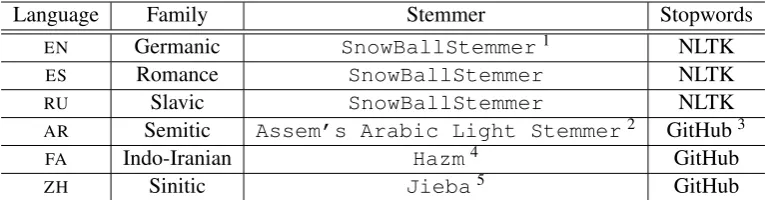
For all the languages, we use existing stemmers to stem words in the corpora and the entries in Wik-tionary. Since Chinese does not have stemmers, we loosely use “stem” to refer to “segment” Chinese sentences into words. We also use fixed stopword lists to filter out stop words. Table 2 lists the source of the stemmers and stopwords.
B.2 Data Source
We list the statistics in Table 3.
1
http://snowball.tartarus.org;
2http://arabicstemmer.com;
3https://github.com/6/stopwords-json
;
4
https://github.com/sobhe/hazm;
Language Family Stemmer Stopwords
EN Germanic SnowBallStemmer1 NLTK
ES Romance SnowBallStemmer NLTK
RU Slavic SnowBallStemmer NLTK
AR Semitic Assem’s Arabic Light Stemmer2 GitHub3
FA Indo-Iranian Hazm4 GitHub
[image:14.595.107.490.62.162.2]ZH Sinitic Jieba5 GitHub
Table 2: List of source of stemmers and stopwords used in experiments.
WIKI-PACO WIKI-INCO TED GV Wikipedia
(forCNPMI) Wiktionary
AR
#docs 2,000 2,000 1,112 2,000 8,862
16,127 #tokens 1,075,691 293,640 1,521,334 466,859 79,740
#types 32,843 19,900 44,982 32,468 1,533,261
ES
#docs 2,000 2,000 1,152 2,000 9,325
31,563 #tokens 475,234 237,561 1,228,469 493,327 1,763,897
#types 35,069 27,465 30,247 28,471 91,428
FA
#docs 2,000 2,000 687 401 9,669
14,952 #tokens 415,620 91,623 1,415,263 89,414 940,672
#types 18,316 9,987 36,670 9,447 46,995
RU
#docs 2,000 2,000 1,010 2,000 9,837
33,574 #tokens 4,368,563 766,887 1,133,098 679,217 2,356,994
#types 51,740 24,341 44,577 47,395 134,424
ZH
#docs 2,000 2,000 1,123 2,000 8,222
23,276 #tokens 3,095,977 303,634 1,428,532 745,307 1,338,116
[image:14.595.115.486.196.375.2]#types 59,431 30,481 71,906 69,872 144,765
Table 3: Statistics of corpora and dictionary in the five languages used in the experiments.
Wikipedia (WIKI-PACO, and WIKI-INCO). For training multilingual topic models, the dataset Wikipedia can be downloaded athttp://opus.nlpl.eu/TED2013.php. For each language pair (EN, `), we create WIKI-INCO, a completely incomparable corpus, where 2,000 EN documents and
2,000non-English documents are randomly chosen but do not contain document-level translations to each other.
We also createWIKI-PACO, a partially comparable corpus. Each language has different proportions of comparable document pairs. See Table 4.
TED Talks 2013 (TED). TED Talks 2013 contains mostly parallel documents, and can be obtained from OPUS:http://opus.nlpl.eu/TED2013.php. Note that not all English documents have translations to another language, which is slightly different from the original assumptions in polylingual topic models.
The classification labels can be obtained from the documents. Each document has several “categories” that can be regarded as labels. Thus, we retrieve those labels, and choose the most frequent five labels for classification:technology,culture,science,global issues, anddesign.
Global Voices (GV). Global Voices can be obtained from OPUS as well: http://opus.nlpl.
eu/GlobalVoices.php. Global Voices corpus has a large number of documents, so for efficiency,
we randomly choose a sample of at most2,000documents for each language.
There’s no label information from the corpus itself. However, the labels can be retrieved from the webpage of each document, at https://globalvoices.org. To make sure Global Voices have
Languages AR ES FA RU ZH
Proportion 12.2% 9.35 % 50.85 % 50.20 % 17.90 %
the same label set to TED Talks, we changed the label set to:technology,culture,science,business, and
politics.
Wiktionary. We use English Wiktionary to create bilingual dictionaries, which can be downloaded at