Modeling Discourse Segments in Lyrics Using Repeated Patterns
Kento Watanabe1, Yuichiroh Matsubayashi1, Naho Orita1, Naoaki Okazaki1,
Kentaro Inui1, Satoru Fukayama2, Tomoyasu Nakano2,
Jordan B. L. Smith2, Masataka Goto2
1Graduate School of Information Sciences, Tohoku University 2National Institute of Advanced Industrial Science and Technology (AIST)
{kento.w,y-matsu,naho,okazaki,inui}@ecei.tohoku.ac.jp,
{s.fukayama,t.nakano,jordan.smith,m.goto}@aist.go.jp
Abstract
This study proposes a computational model of the discourse segments in lyrics to understand and to model the structure of lyrics. To test our hypothesis that discourse segmentations in lyrics strongly correlate with repeated patterns, we conduct the first large-scale corpus study on discourse segments in lyrics. Next, we propose the task to automatically identify segment boundaries in lyrics and train a logistic regression model for the task with the repeated pattern and textual features. The results of our empirical experiments illustrate the significance of capturing repeated patterns in predicting the boundaries of discourse segments in lyrics.
1 Introduction
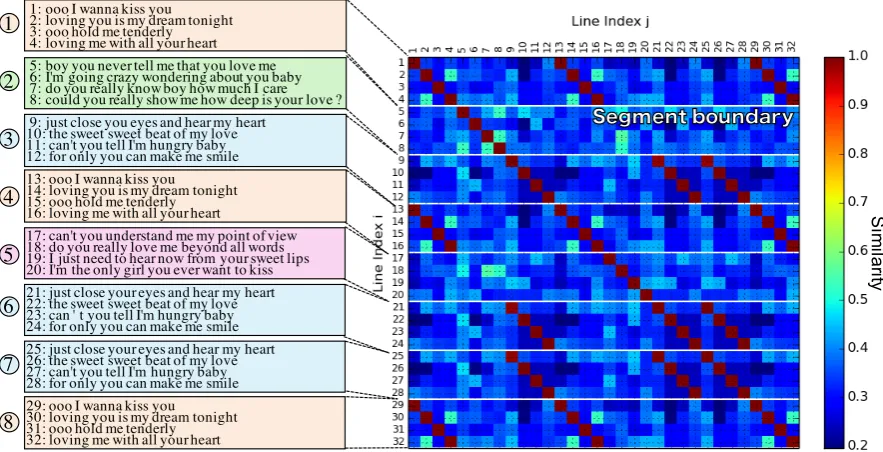
Lyrics are an important element of popular music. They provide an effective means to express the message and emotion of music. Similar to prose text, lyrics are a discourse: i.e., they are, typically, a sequence of related lines, rather than an unconnected stream of lines of arbitrary order. Thus, like texts, lyrics also have a discourse structure consisting discourse segments. Each discourse segment exhibits an individual topic in discourse, and the transition of topics over successive discourse segments constitutes a flow (Austin et al., 2010; Watanabe et al., 2014). Unlike prose text, lyrics have their own peculiar properties, such as frequent repetition of identical or similar phrases and extensive use of rhyme and refrain (Austin et al., 2010), as illustrated in Figure 1. Analogous to prose text, the lyrics in Figure 1 can be viewed as a sequence of discourse segments, wherein each segment is depicted by a colored box. Segments⃝1 and⃝3 appear repeatedly (e.g., segments⃝4 and⃝8 are identical to segment⃝1 ), which is not typically observed in prose text.
Our goal is to reveal the discourse structure of lyrics in popular music by quantitatively analyzing a large-scale lyrics corpus. The motivations behind the goal are as follows. First, there are hardly any studies that have focused on the data-oriented research of the discourse structure of lyrics; however, multiple studies have focused on the structure of music audio (Paulus et al., 2010, for a review). Second, a better understanding of the nature of lyrics structure combined with the existing theories of music audio could lead to a more comprehensive theory of the overall nature of popular music. Third, understanding the nature of lyrics structure will allow us to devise a variety of useful computer systems, such as systems that automatically generate lyrics, assist human lyrics writers, or evaluate the quality of lyrics.
As a first but crucial step toward achieving this goal, this study explores the nature of the discourse structure of lyrics with a focus on the rbyof repeated patterns as an indicator of segment boundaries. We choose discourse segments as our primary focus because exploring discourse segments is a necessary step toward a comprehensive understanding of lyrics structure. To address this issue, we consider the task of computationally predicting the boundaries of discourse segments in lyrics under the assumption that a better prediction model would allow us to better understand the nature of the discourse structure of lyrics.
By conducting a large-scale data analysis, we examine our primary hypothesis thatdiscourse segments in lyrics strongly correlate with repeated patterns. For example, if a sequence of lines in lyrics has a This work is licensed under a Creative Commons Attribution 4.0 International License. License details: http:// creativecommons.org/licenses/by/4.0/
1: ooo I wanna kiss you 2: loving you is my dream tonight 3: ooo hold me tenderly 4: loving me with all your heart 5: boy you never tell me that you love me 6: I'm going crazy wondering about you baby 7: do you really know boy how much I care 8: could you really show me how deep is your love ? 9: just close you eyes and hear my heart
10: the sweet sweet beat of my love 11: can't you tell I'm hungry baby 12: for only you can make me smile 13: ooo I wanna kiss you 14: loving you is my dream tonight 15: ooo hold me tenderly 16: loving me with all your heart
17: can't you understand me my point of view 18: do you really love me beyond all words 19: I just need to hear now from your sweet lips 20: I'm the only girl you ever want to kiss 21: just close your eyes and hear my heart 22: the sweet sweet beat of my love 23: can ' t you tell I'm hungry baby 24: for only you can make me smile 25: just close your eyes and hear my heart 26: the sweet sweet beat of my love 27: can't you tell I'm hungry baby 28: for only you can make me smile 29: ooo I wanna kiss you 30: loving you is my dream tonight 31: ooo hold me tenderly 32: loving me with all your heart 1
2
3
4
5
6
7
8
S
im
ila
rit
[image:2.595.77.519.66.292.2]y
Figure 1: An example of lyrics and corresponding self-similarity matrix (title of lyrics: How Deep Is Your Love?(RWC-MDB-P-2001 No. 81 from RWC Music Database (Goto et al., 2002)))
repetition, such asabcdefabc(each letter represents a line, with repeated letters being repeated lines), we expect the boundaries of the discourse segments tend to agree with the boundaries of the repeated parts as in|abc|def|abc|, where “|” indicates a boundary.
To examine the extent to which these repeated patterns capture the segment structure of lyrics, we use a large-scale corpus of popular music lyrics that contains more than 140,000 songs. This is, to the best of our knowledge, the first study that takes a data-driven approach to exploring the discourse structure of lyrics in relation to repeated patterns.
One issue to be addressed before conducting the corpus study is that no existing corpus has anno-tated the discourse structure of lyrics. In this study, we preliminarily assume that discourse segment boundaries are indicated by empty lines inserted by lyrics writers. We admit that empty lines may not be “true” discourse segment boundaries and discourse segments may exhibit a hierarchical structure (e.g., verse–bridge–chorus structure). These issues could be better addressed by combining the analysis of the discourse structure of lyrics with the structural analysis of music. We believe this direction of research will open an intriguing new field for future exploration.
The remainder of this study is organized as follows. Section 2 reviews related work into the discourse structure of lyrics, with particular focus on the segmentation using repeated patterns. Section 3 presents the first quantitative analysis of the distribution of repeated lines and segments in lyrics and suggests cues that could help to identify the segment boundaries. Section 4 describes our computational model, which predicts the boundaries of discourse segments in lyrics using repeated patterns. Section 5 presents exper-imental results that show the importance of repeated patterns in predicting the boundaries of discourse segments in lyrics. Section 6 concludes and discusses future work. Note that throughout this study, we use the termsegmentto refer to a discourse segment in lyrics.
2 Related work
This section reviews related work into the discourse structure of lyrics, with particular focus on the segmentation of lyrics using repeated patterns.
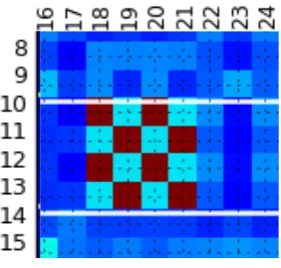
Figure 2: Negative example against pattern (1)
and word/entity repetition (Kan et al., 1998; Reynar, 1999). Although we share the same motivation as these studies, these text segmentation methods do not consider repeated patterns of phrasal segments because this type of repetition is nearly always absent in prose text. On the other hand, segments in lyrics often have repetitions (Austin et al., 2010) as shown in Section 3.1. We aim to capture the segment structure of lyrics using repeated pat-terns.
Previous computational work into lyrics segmentation has fo-cused on identifying the segment labels of lyrics that are already segmented. For example, the structure of lyrics can be represented using labels A–B–C–A–B in which each letter refers to a group of lines; e.g., A might represent a chorus that appears twice. Barate
et al. (2013) proposed a rule-based method to estimating such structure labels ofsegmentedlyrics. Our task differs from this task in that we aim to estimate the segment boundaries ofunsegmentedlyrics using machine learning techniques.
In contrast to the segmentation of lyrics, much previous work has analyzed and estimated the segment structure of music audio signals using repeated musical parts such as verse, bridge, and chorus (Foote, 2000; Lu et al., 2004; Goto, 2006; Paulus and Klapuri, 2006; McFee and Ellis, 2014). To automatically identify these repeated musical parts in music audio signals, a self-similarity matrix (SSM) as shown in Figure 1 is often used. Repeated segments lead to high-valued lines in the off-diagonals of the matrix, and these patterns are used to identify the structure. To capture segments in lyrics using repeated patterns, we apply the SSM to lyrics. Lyrical repetition is known to be an important property of lyrics (Austin et al., 2010), and we expect that repetition patterns would also appear in lyrics as they do in audio signals.
In summary, no previous computational work has exactly focused on the segmentation of lyrics using repeated patterns. Section 3 presents the first quantitative analysis of the distribution of repeated lines and segments in lyrics, and suggests cues that help identify segment boundaries.
3 Statistics of repeated patterns and segment boundaries
As an initial step toward modeling the discourse structure of lyrics, we examine the distribution of seg-ments in lyrics by focusing on repeated patterns. We first show the basic distributions of lyrics and suggest potential cues to indicate segment boundaries in lyrics. To examine the distribution of repeated patterns in lyrics and their relation to segment boundaries, we use a large scale lyrics database that con-tains 144,891 songs1.
3.1 The basic distribution of lyrics
Among the 144,891 songs in the lyrics database, there are 5,666,696 lines and 969,176 segments in total, with segment breaks inferred from empty lines. Per song, there are 39.11 lines and 6.69 segments on average. Most songs have at least one repeated line (84.79% using an exact criterion; 90.34% using a lenient matching criterion of normalized edit distance ≥0.8, explained in the next section). A fair number of songs also have at least one repeated segment (exact match: 37.73%, lenient match: 54.57%). Per song, 13.73 lines and 0.52 segments (both exact match) are repeated at least once on average. These distributions show that repetition of lines and segments occurs frequently in lyrics, in line with our expectations. Next, we suggest potential repeated patterns to help in identifying segment boundaries.
3.2 Correlation between repeated patterns and segment boundaries
To examine what kinds of repeated patterns would help identify segments in lyrics, we use the SSM, similar to previous work into the segmentation of music audio signals (Section 2). Figure 1 shows an example SSM. Throughout this study, we represent theith line in lyrics asl
i (1 ≤ i≤ L), whereLis the number of lines of the lyrics. A degree of similarity betweenliandlj, i.e.,sim(li, lj), is represented
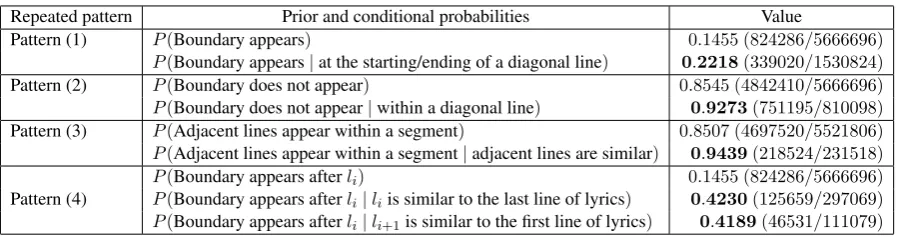
Repeated pattern Prior and conditional probabilities Value
Pattern (1) P(Boundary appears) 0.1455 (824286/5666696)
P(Boundary appears|at the starting/ending of a diagonal line) 0.2218(339020/1530824)
Pattern (2) P(Boundary does not appear) 0.8545 (4842410/5666696)
P(Boundary does not appear|within a diagonal line) 0.9273(751195/810098)
Pattern (3) P(Adjacent lines appear within a segment) 0.8507 (4697520/5521806)
P(Adjacent lines appear within a segment|adjacent lines are similar) 0.9439(218524/231518)
P(Boundary appears afterli) 0.1455 (824286/5666696) Pattern (4) P(Boundary appears afterli|liis similar to the last line of lyrics) 0.4230(125659/297069)
[image:4.595.75.524.60.179.2]P(Boundary appears afterli|li+1is similar to the first line of lyrics) 0.4189(46531/111079) Table 1: Correlation between each repeated pattern and segment boundary
as an intensity at a cell where theith row andjth column overlap. Using the normalized edit distance NED(li, lj), we compute the degree of similarity (Yujian and Bo, 2007): sim(li, lj) = 1−NED(li, lj). The red diagonal lines in Figure 1 are the result of exact line repetitions2. The white horizontal lines in
Figure 1 indicate the true segment boundaries.
After manually examining more than 1,000 lyrics and their SSMs, we suggest the following four types of repeated patterns as indicators of segment boundaries.
(1) The Start and end points of a diagonal line are segment boundaries. Some repeated segments correspond to the red diagonal lines. For example, in Figure 1, segment⃝1 is repeated twice (seg-ments⃝4 and⃝8), and each repetition ,starting at l13 andl29, can be observed as a diagonal line froml1tol4. This suggests that some segments could be divided at the start and end points of such
a diagonal line.
(2) A segment boundary does not appear within a diagonal line. This is related to (1). A segment boundary does not normally appear within a diagonal line because each diagonal line often corre-sponds to a segment.
(3) Similar adjacent lines appear within a segment. Line-level repetitions that are adjacent, such as rhymes and refrains, tend to occur within a segment. For example, linel7rhymes internally withl8
where these lines appear within a segment becausesim(l7, l8)indicates moderate similarity.
(4) A line similar to the first or last line of a song is an indicator of a segment boundary. Lines similar to the first or last line of lyrics tend to be repeated at segment boundaries. For example, in Figure 1, the first and last lines of the song, i.e.,l1andl32, are exactly the same as the first and last
lines of segments⃝4 and⃝8 . This is because the first and last lines of lyrics tend to be part of a chorus section that is often repeated throughout the lyrics.
To examine the extent to which these four patterns correlate with segment boundaries, we compute the prior and conditional probabilities of each pattern using the full lyrics database. Table 1 shows that all conditional probabilities are greater than their corresponding prior probabilities. These results suggest that the above repeated patterns reasonably capture segment boundaries, supporting the use of repeated patterns for modeling the segment structure of lyrics.
Note that pattern (1) does not hold for many cases. Figure 2 illustrates a typical negative example against pattern (1). This figure includes three diagonal lines, but the shorter lines do not agree with a segment boundary at either end. Similar cases are abundant partly because even a repetition of a single line is identified as a diagonal line in this experiment. This problem implies that a single occurrence of our local repeated pattern is not a sufficient clue for identifying a segment boundary. The conflict between patterns (1) and (2) is also shown in Figure 1, where a segment boundary implied by pattern (1) bisects a diagonal line from(l25, l9)to(l32, l16), which goes against pattern (2). This motivates us to
build a machine learning-based model to capture combinations of multiple clues. The subsequent section describes how we represent these repeated patterns as features for predicting segment boundaries.
2The diagonal line ofsim(l
4 Computational modeling of segment patterns in lyrics
To confirm the validity of our four repeated patterns for segment structures, we address the novel task of detecting segment boundaries in lyrics. Given the lyrics of a song where all segments are concatenated (no empty lines), the task is to identify the segment boundaries of the lyrics reproducing the empty lines. We formalize this task as a binary classification problem to predict the end (y = 1) or continuation (y = 0) of a segment between lines li and li+1. We model the conditional probability p(y|i) using
logistic regression with two different types of features: (1) repeated patterns in lyricsand (2) textual expressions appearing at the line boundaries.
4.1 Repeated patterns
We propose four subtypes of repeated pattern features (RPF1, RPF2, RPF3, and RPF4) corresponding to the four hypotheses presented in Section 3.2. Here, matrixM denotes the SSM of the lyrics. Each elementmi,j represents the similarity between linesliandlj, i.e.,mi,j = sim(li, lj).
RPF1 The first repeated pattern (the beginning or end point of a diagonal line in an SSM is a clue for a segment boundary) is formalized as follows. Given two linesiandj, we expect that there exists a boundary after both of these lines if the lines are similar/dissimilar, buti+ 1 andj+ 1are opposite (dissimilar/similar). For a given linei, Equation 1 enumerates a set of linesj(1 ≤j ≤L) where there may be boundaries after lineiand every linej:
gλ(i) ={j|(mi,j−λ)(mi+1,j+1−λ)<0} (1)
Here,λis a threshold for detecting similarity and dissimilarity. The left side of Figure 3 illustrates four likely boundaries for linei= 24with the thresholdλ= 0.6:g0.6(24) ={8,12,20,28}.
Using the function gλ(i), we define feature functionsfλ(RPF1#)(i) andfλ(RPF1v)(i) that assess how likely it is that lineiis located at the beginning or end points of diagonal lines in the SSM:
fλ(RPF1#)(i) =|gλ(i)| (2)
fλ(RPF1v)(i) = |g1
λ(i)|
∑
j∈gλ(i)
|mi,j−mi+1,j+1| (3)
To sum up, fλ(RPF1#)(i) counts the number of likely boundaries after line i and other lines j, and
fλ(RPF1v)(i)computes the mean of the similarity differences at likely boundaries after lineiand other linesj. We define multiple features with different threshold valuesλ.
RPF2 The second repeated pattern (a segment boundary does not appear inside of a diagonal line of an SSM) is formalized analogously to RPF1. Given two lines iandj, we expect that linesiandjare points of continuityif linesiandj are similar andi+ 1andj+ 1are also similar. For a given linei, Equation 4 enumerates a set of linesj(1≤j≤L) whereiandjare points of continuity:
cλ(i) ={j|mi,j ≥λ∧mi+1,j+1≥λ} (4)
The middle of Figure 3 shows an example of continuous points (here,c0.6(10) = {22,26}in this
exam-ple).
Similar to RPF1, Equations 5 and 6 count the number of continuous points and the mean of the similarity differences at continuous points, respectively.
fλ(RPF2#)(i) =|cλ(i)| (5)
fλ(RPF2v)(i) = 1 |cλ(i)|
∑
j∈cλ(i)
Lines 6 and 7 are similar. A segment boundary is unlikely to appear between lines 6 and 7. Some diagonal lines end at line 24 and begin at
line 25. A segment boundary is likely to appear between lines 24 and 25.
[image:6.595.73.519.63.171.2]Two diagonal lines span over lines 9 to 12. Lines 9 to 12 are not likely to divide.
Figure 3: Repeated pattern features: RPF1, RPF2, and RPF3
6 words between ithline and i+1thline
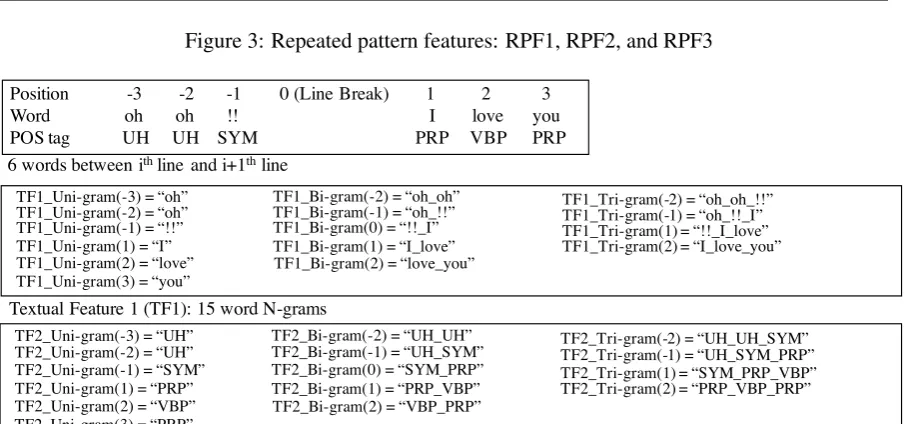
TF1_Uni-gram(-3) = “oh” TF1_Uni-gram(-2) = “oh” TF1_Uni-gram(-1) = “!!”
TF1_Bi-gram(-2) = “oh_oh” TF1_Bi-gram(-1) = “oh_!!” TF1_Bi-gram(0) = “!!_I” TF1_Uni-gram(1) = “I”
TF1_Uni-gram(2) = “love” TF1_Uni-gram(3) = “you”
TF1_Bi-gram(1) = “I_love” TF1_Bi-gram(2) = “love_you”
TF1_Tri-gram(-2) = “oh_oh_!!” TF1_Tri-gram(-1) = “oh_!!_I” TF1_Tri-gram(1) = “!!_I_love” TF1_Tri-gram(2) = “I_love_you”
Position -3 -2 -1 0 (Line Break) 1 2 3 Word oh oh !! I love you POS tag UH UH SYM PRP VBP PRP
Textual Feature 1 (TF1): 15 word N-grams
TF2_Uni-gram(-3) = “UH” TF2_Uni-gram(-2) = “UH” TF2_Uni-gram(-1) = “SYM”
TF2_Bi-gram(-2) = “UH_UH” TF2_Bi-gram(-1) = “UH_SYM” TF2_Bi-gram(0) = “SYM_PRP” TF2_Uni-gram(1) = “PRP”
TF2_Uni-gram(2) = “VBP” TF2_Uni-gram(3) = “PRP”
TF2_Bi-gram(1) = “PRP_VBP” TF2_Bi-gram(2) = “VBP_PRP”
TF2_Tri-gram(-2) = “UH_UH_SYM” TF2_Tri-gram(-1) = “UH_SYM_PRP” TF2_Tri-gram(1) = “SYM_PRP_VBP” TF2_Tri-gram(2) = “PRP_VBP_PRP”
Textual Feature 2 (TF2): 15 Part of speech N-grams
Figure 4: Textual features: TF1 and TF2
RPF3 (similarity with a subsequent line) RPF3 encodes the third repeated pattern, i.e., similar ad-jacent lines belong to the same segment. For a given line indexi, this is quantified by the similarity
sim(li, li+1):
f(RPF3)(i) =m
i,i+1 (7)
The right of Figure 3 shows an example where RPF3 indicates a continuation between lines 6 and 7. RPF4 (similarity with the first and last lines) The fourth repeated pattern (i.e.,a line similar to the first line of the lyrics is likely to be the first line of a segment, anda line similar to the last line of the lyrics is likely to be the last line of a segment) is encoded by two feature functionsf(RPF4b)(i)andf(RPF4e)(i):
f(RPF4b)(i) =m
i,1 (8)
f(RPF4e)(i) =m
i,n (9)
4.2 Textual expressions
Some textual expressions appear selectively at the beginning or end of a segment. For example, the phrase “So I” often appears at the beginning of a line but rarely appears at the beginning of a segment. To exploit such indications of the beginnings/ends of lines, we propose two textual features (TF1 and TF2).
[image:6.595.74.527.174.386.2]Method Pk(%) W D(%) Precision (%) Recall (%) F-measure (%)
Random 49.35 53.67 14.29 12.50 13.33
TF∗ 40.51 44.65 34.95 31.66 33.22
RPF∗ 27.00 32.16 56.05 59.42 57.68
Proposed (ALL) 27.22 32.22 56.58 60.65 58.55
Ablation test
−RPF1 31.38 35.89 51.95 51.32 51.63
−RPF2 30.62 36.73 49.22 57.64 53.10
−RPF3 27.46 32.71 55.59 59.40 57.43
−RPF4 27.64 32.68 55.73 59.94 57.76
−TF1 Uni gram 27.00 31.95 56.90 60.73 58.75
−TF1 Bi gram 26.84 31.88 56.96 61.41 59.10
−TF1 Tri gram 27.32 32.53 55.88 61.42 58.52
−TF2 Uni gram 28.24 31.84 59.40 51.91 55.40
−TF2 Bi gram 26.89 31.25 58.86 58.12 58.49
−TF2 Tri gram 26.67 31.40 57.91 60.23 59.05
−TF1 {Uni,Bi} gram,
TF2 Tri gram 26.58 31.55 57.40 61.21 59.24
[image:7.595.90.512.63.325.2](Best Performance)
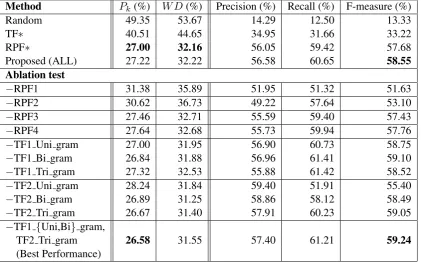
Table 2: Results of ablation tests
1999). Thus, we define wordn-gram features (forn= 1,2,3) around a line boundary. More specifically, we define 15n-gram features at different positions, listed and illustrated with an example in Figure 4. TF2 (part of speech n-grams around a line boundary) Parts of speech (POS), such as particles ordeterminers do not tend to appear at the end of a sentence, and conjunctions do not appear at the beginning of a sentence. We exploit these tendencies by defining features for POS. Similar to TF1, we define POSn-gram features (forn = 1,2,3) around a line boundary. Specifically, we define 15 POS
n-gram features at different positions, as shown in Figure 4.
5 Experiment
We sampled 105,833 English songs from the Music Lyrics Database v.1.2.7 so that each song contains at least five segments. The resulting dataset includes 2,788,079 candidate boundaries and 517,234 actual boundaries. We then split these songs into training (60%), development (20%), and test (20%) sets. For feature extraction, we used the Stanford POS Tagger (Toutanova et al., 2003). To train the segment boundary classifiers, we used the Classias implementation (Okazaki, 2009) of L2-regularized logistic regression. By employing multiple threshold values ofλfrom0.1to0.9with a step size of0.1, we used them all together.
5.1 Performance evaluation metrics
1: I think of you
2: in the spring when gentle rains turn to showers 3: I think of you
4: when the summer breezes dance through the flowers
1
2
3
4
5
6
S
im
ila
rit
y
5: and they whisper your name to me 6: and they bring back these memories 7: and I wonder how I ever lived before 8: without the love in my life that you bring me
9: you are the world to me 10: you're all I see
11: my love for you is more than a simple song 12: it's a symphony growing strong yes stronger over
time
13: you are the world to me 14: you're all I see
15: your love means more than all the diamonds or gold that shines
16: that man could find in a lifetime
17: I think of you
18: when the autumn leaves are painted in color 19: I think of you
20: on those snowy winter nights made for lovers
21: and it ' s not just the memories 22: you and I have a history
23: and I wonder how I ever made it through 24: without the light in my life that you bring me 25: you are the world to me
26: you're all I see
27: my love for you is more than a simple song 28: it ' s a symphony growing strong yes stronger over
time
29: you are the world to me 30: you're all I see
31: your love means more than all the diamonds or gold that shines
[image:8.595.76.519.63.335.2]32: that man could find in a lifetime
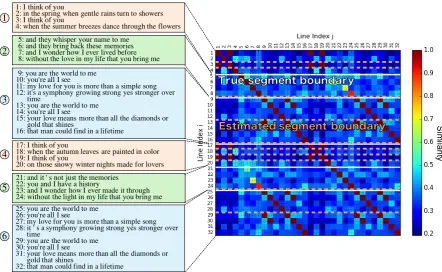
Figure 5: Examples of false positives (title of lyrics: I think of you (RWC-MDB-P-2001 No.87 from RWC Music Database (Goto et al., 2002))). White horizontal lines indicate true segment boundaries. Orange horizontal dashed lines indicate predicted boundaries.
one-half the average line length of the correct segments for each song in the test set.
5.2 Contributions of different features
We investigated the contribution of each feature set by conducting ablation tests over different com-binations of feature sets. The results are shown in Table 2. Random denotes our baseline, a model selecting boundaries with uniform probability P = 0.186, the true frequency of boundaries (P = 517,234/2,788,079). RPF∗ and TF∗denote the models with all repeated pattern features and all textual features, respectively. Proposedindicates the performance of the model with all proposed features. At the top of Table 2, the F-measure of the proposed method was 58.44, or 45 points higher than that of the random baseline.
The results of the ablation tests are shown in the bottom of Table 2. For example, “−RPF1” indicates that we ablated the feature RPF1 from the proposed method, which uses all of the features. Our best-performing model achieved an F-measure of 59.24 by excluding the TF1 unigram and bigram and TF2 trigram features.
The table shows that each type of our RPF features contributes to performance. Note that these four types are not redundant, and each of our hypotheses yielded positive results. Note that removing RPF1 and RPF2, which are intended to capture long-range repeated patterns, decreased the F-measure by 6.92 and 5.45 points, respectively. This result supports the hypothesis that sequences of repeated lines (diagonal lines in the SSM) are important clues for modeling lyrics segmentation.
1: I can believe
2: I've seen you here tonight 3: a girl so beautiful 4: hanging from your arm 5: don't kiss me I'm telling you 6: I never wanna see you again
1
2
3
4
5
6
S
im
ila
rit
y
7: you don't need to say goodbye. 8: I just ask one thing now 9: wipe out all your memories 10: don't you try to change my mind 11: get out of my life
12: don't lie to me! I know your heart is untrue
13: don't make me suffer any more! 14: don't try to change to me now 15: I've made up my mind. 16: my last pretence at pride! 17: I really need you to go 18: you told me that you loved me 19: for now and all time 20: you promised me the truth 21: never to lie but I see you aren't what
you seem
22: I want you to leave me 23: you don't need to say goodbye. 24: I just ask one thing now 25: wipe out all your memories 26: don't you try to change my mind 27: get out of my life
28: don't lie to me! I know your heart is untrue
[image:9.595.77.517.65.348.2]29: don't make me suffer any more! 30: don't try to change to me now 31: I've made up my mind. 32: my last pretence at pride! 33: I really need you to go
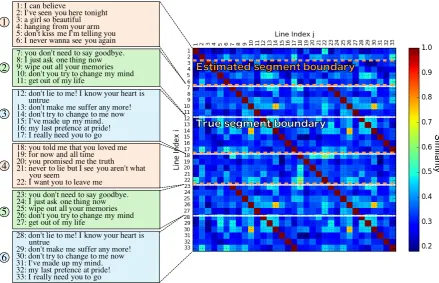
Figure 6: Examples of false negatives (title of lyrics: Don’t lie to me(RWC-MDB-P-2001 No.97 from RWC Music Database (Goto et al., 2002))). White horizontal lines indicate true segment boundaries. Orange horizontal dashed lines indicate predicted boundaries.
5.3 Error analysis
Figures 5 and 6 give two examples of lyrics and SSMs that illustrate typical errors of our best model. Horizontal dashed lines depict predicted boundaries. As shown in Figure 5, the model sometimes overly divides a true segment into segments as small as single lines, false positives that appear to be due to occurrences of repeated single lines (here, lines 1, 3, 17 and 19). This is not a trivial problem because repetitions of single lines sometimes serve as an important clue. In fact, when restricting diagonal lines to be of the length of two or more lines, we considerably lose recall while gaining precision. More investigation is needed for further improvement.
In contrast to the case of Figure 5, Figure 6 shows a typical example of false negatives. We missed a boundary between, for example, lines 11 and 12. For this boundary, we cannot find any clear repeated pattern indicator. Such cases suggest a limitation of repeated pattern features and the need for further refinement of the model. One direction is to incorporate semantics-oriented state-of-the-art techniques for prose text segmentation such as topic tiling (Riedl and Biemann, 2012).
6 Conclusion and future work
information, to extend the modeling of lyric discourse by combining it with audio musical structure, and to embed a resulting model into application systems, such as lyrics generation systems and lyrics composition support systems.
Acknowledgments
This study utilized the RWC Music Database (Popular Music). This work was partially supported by a Grant-in-Aid for JSPS Research Fellow Grant Number JP16J05945, JSPS KAKENHI Grant Numbers JP15K16045 and JP15H01702, and CREST, JST.
References
Dave Austin, Jim Peterik, and Cathy Lynn Austin. 2010.Songwriting for Dummies. Wileys.
Adriano Barate, Luca Andrea Ludovico, and Enrica Santucci. 2013. A semantics-driven approach to lyrics seg-mentation. InProceedings of the 8th International Workshop on Semantic and Social Media Adaptation and Personalization, pages 73–79.
Doug Beeferman, Adam Berger, and John Lafferty. 1999. Statistical models for text segmentation. Journal of Machine learning, 34(1):177–210.
Freddy Y.Y. Choi. 2000. Advances in domain independent linear text segmentation. InProceedings of the 1st North American chapter of the Association for Computational Linguistics conference, pages 26–33.
Jonathan Foote. 2000. Automatic audio segmentation using a measure of audio novelty. In Proceedings of International Conference on Multimedia and Expo 2000, pages 452–455.
Masataka Goto, Hiroki Hashiguchi, Takuichi Nishimura, and Ryuichi Oka. 2002. RWC music database: Popular, classical and jazz music databases. InProceedings of the 3rd of International Society for Music Information Retrieval, volume 2, pages 287–288.
Masataka Goto. 2006. A chorus section detection method for musical audio signals and its application to a music listening station. IEEE Transactions on Audio, Speech, and Language Processing, 14(5):1783–1794.
Min-Yen Kan, Judith L. Klavans, and Kathleen R. McKeown. 1998. Linear segmentation and segment signifi-cance. InProceedings of the 6th International Workshop of Very Large Corpora (WVLC-6), pages 197–205.
Lie Lu, Muyuan Wang, and Hong-Jiang Zhang. 2004. Repeating pattern discovery and structure analysis from acoustic music data. InProceedings of the 6th ACM SIGMM international workshop on Multimedia information retrieval, pages 275–282.
Igor Malioutov and Regina Barzilay. 2006. Minimum cut model for spoken lecture segmentation. In Proceed-ings of the 21st International Conference on Computational Linguistics and the 44th annual meeting of the Association for Computational Linguistics, pages 25–32.
Brian McFee and Daniel PW Ellis. 2014. Learning to segment songs with ordinal linear discriminant analysis. In
Proceedings of International Conference on Acoustics, Speech and Signal Processing 2014, pages 5197–5201. Naoaki Okazaki. 2009. Classias: A collection of machine-learning algorithms for classification. http://www.
chokkan.org/software/classias/.
Jouni Paulus and Anssi Klapuri. 2006. Music structure analysis by finding repeated parts. InProceedings of the 1st ACM workshop on Audio and music computing multimedia, pages 59–68.
Jouni Paulus, Meinard M¨uller, and Anssi Klapuri. 2010. Audio-based music structure analysis. InProceedings of the International Society for Music Information Retrieval Conference (ISMIR), pages 625–636.
Lev Pevzner and Marti A. Hearst. 2002. A critique and improvement of an evaluation metric for text segmentation.
Computational Linguistics, 28(1):19–36.
Martin Riedl and Chris Biemann. 2012. Topictiling: a text segmentation algorithm based on lda. InProceedings of Association for Computational Linguistics 2012 Student Research Workshop, pages 37–42. Association for Computational Linguistics.
Kristina Toutanova, Dan Klein, Christopher D. Manning, and Yoram Singer. 2003. Feature-rich part-of-speech tagging with a cyclic dependency network. In Proceedings of the 2003 Conference of the North American Chapter of the Association for Computational Linguistics on Human Language Technology-Volume 1, pages 173–180.
Kento Watanabe, Yuichiroh Matsubayashi, Kentaro Inui, and Masataka Goto. 2014. Modeling structural topic transitions for automatic lyrics generation. InProceedings of The 28th Pacific Asia Conference on Language, Information and Computation, pages 422–431.