Effective Selectional Restrictions for Unsupervised Relation Extraction
Alan Akbik Larysa Visengeriyeva Johannes Kirschnick Alexander L¨oser
Technische Univerist¨at Berlin Databases and Information Systems Group
Einsteinufer 17, 10587 Berlin, Germany
Abstract
Unsupervised Relation Extraction (URE) methods automatically discover semantic relations in text corpora of unknown con-tent and extract for each discovered rela-tion a set of relarela-tion instances. Due to the sparsity of the feature space, URE is vulnerable to ambiguities and underspeci-fication in patterns. In this paper, we pro-pose to increase the discriminative power of patterns in URE using selectional re-strictions (SR). We propose a method that utilizes a Web-derived soft clustering of
n-grams to model selectional restrictions in the open domain. We comparatively evaluate our method against a baseline without SR, a setup in which standard 7-class Named Entity types are used as SR and a setup that models SR using a fine-grained entity type system. Our results in-dicate that modeling SR into patterns sig-nificantly improves the ability of URE to discover relations and enables the discov-ery of more fine-granular relations.
1 Introduction
In traditional approaches for Relation Extrac-tion (RE), all target relaExtrac-tions (such as BORNIN
or HASWONPRIZE) need to be specified in
ad-vance. For each relation, an extractor is trained or manually created that finds relation instances in text (Jiang and Zhai, 2007). This process is expensive and usually involves manually labeling large amounts of training data, making it difficult to scale RE to large sets of relations. Worse, be-cause target relations must be manually defined in advance, the usefulness of RE in corpora of un-known content is limited (Akbik et al., 2012). This limits their applicability to the open domain where a potentially unbounded number of relations may be expressed in text.
In contrast, Unsupervised Relation Extraction (URE) approaches do not require target relations to be pre-specified, and require no labeled train-ing data (Rosenfeld and Feldman, 2007). Instead, they automaticallydiscoverprominent relations in a given text corpus and extract for each identi-fied relation a list of relation instances. Current methods (Akbik et al., 2012; Yao et al., 2012) uti-lize a vector space model of semantics in which they group co-occurring pairs of entities (referred to asentity pairs) into clusters based on distribu-tional evidence over observed patterns. Each clus-ter is inclus-terpreted as one discovered semantic re-lation and the entity pairs in each cluster as the instances of this relation.
Pattern ambiguities. However, a problem for such approaches is that patterns may be ambigu-ous in the sense that they point to more than one relation. The pattern “[X] GET [Y]”1 for exam-ple may be observed for a person and a product (“Jim got a new VW Beetle.”), a person and a dis-ease (“Jim got H1N1.”) or (colloquially) between a person and a difficult-to-understand topic (“Jim finally got Game Theory.”). Such ambiguous pat-terns can cause entity pairs that belong to different relations (such as<Jim, VW Beetle>and<Jim, H1N1>) to be falsely grouped into the same se-mantic relation. See Table 1 for a structured illus-tration of this example.
This is especially problematic because the num-ber of observed patterns for each individual entity pair is usually disproportionally small compared to the space of all possible patterns. In such a sparse feature space, false evidence caused by am-biguities can potentially have a negative impact on
1
Patterns are denoted with the placeholders [X] for the
subjectentity, and [Y] for theobjectentity of the entity pair they are observed with. In this paper, we use lexico-syntactic patterns extracted from dependency trees. For readability rea-sons, we omit information on dependency links. [X] in this pattern is either a subject or an apposition to the wordGET. Likewise, [Y] is its object.
Sentence Entity pair Pattern Restricted Pattern Yesterday,Jimgot a newVW Beetle. <Jim, VW Beetle> [X]GET[Y] [X:PERSON]GET[Y:PRODUCT]
JimgotH1N1. <Jim, H1N1> [X]GET[Y] [X:PERSON]GET[Y:DISEASE]
[image:2.595.82.514.61.106.2]Jimfinally gotGame Theory. <Jim, Game Theory> [X]GET[Y] [X:PERSON]GET[Y:THEORY]
Table 1: Example of pattern generation from three sentences. Three entity pairs are observed that belong to different relations. For example<Jim, VW Beetle>may belong to a PERSONACQUIREPRODUCT
relation and<Jim, H1N1>to a PERSONINFECTEDWITHDISEASErelation. Without selectional restric-tions, however, the same pattern is observed for all entity pairs, giving false evidence that they share the same relation. With selectional restrictions, different patterns are correctly observed.
the overall relation extraction quality of a URE ap-proach.
Selectional restrictions in patterns. One ap-proach to this problem is to include information on selectional restrictions (SR) to the patterns to increase their discriminative power (Resnik, 1996). We could restrict the patterns to ap-ply only to entities of certain semantic classes or types. So, instead of the pattern “[X] GET
[Y]” for the above mentioned examples we might generate “[X:PERSON] GET [Y:PRODUCT]” for
“Jim got a new VW Beetle.”, “[X:PERSON] GET
[Y:DISEASE]” for “Jim got H1N1.” and so forth (see Table 1).
However, modeling selectional restrictions in URE is not trivial, as it is unclear what type sys-tem and what granularity of types are required. For example, the types of a standard NER tagger (PERSON, LOCATION, ORGANIZATIONetc.) may be too coarse grained for the above example, not being able to distinguish between DISEASE and PRODUCT.
While more fine-grained NER taggers have re-cently been researched (Ling and Weld, 2012), it is unclear whether they can be applied to the open domain. Here, we may encounter a poten-tially unrestricted set of entities of arbitrary types and granularity that varies from corpus to corpus. Also, each entity may have different types depend-ing on how the type hierarchy is modeled; the string “VW Beetle” for instance may refer to a car, a product or a brand.
Contributions. In this paper, we address these challenges and study effective and viable methods for modeling selectional restrictions for URE in the open domain. We evaluate and discuss model-ing SR usmodel-ing Named Entity types from the Stan-ford NER tagger (Finkel et al., 2005) as well as fine-grained Named Entity classes derived from the YAGO knowledge base (Hoffart et al., 2011). In addition, we propose a novel method that
over-comes shortcomings of existing methods by lever-aging a Web-derived clustering of n-grams to model restrictions in an unsupervised fashion. We evaluate all setups against an informed baseline (based on previous work by (Akbik et al., 2012; Rosenfeld and Feldman, 2007)) in which patterns are not restricted.
We observe in all experiments that selectional restrictions significantly improve URE. The best performing setups use fine-grained Named Entity classes and our proposed open domain method, yielding f-measure improvements of 28% and 15% respectively over the baseline. We inspect the clustering results and find that the choice of SR influences the granularity of discovered relations. Based on our findings, we identify limitations of SR and outline challenges for URE.
2 Previous Work
gen-eration step.
Selectional Restrictions. Other recent work has incorporated information from NER taggers into their feature set. (Mesquita et al., 2010) use a standard 4-class NER tagger, but do not indi-vidually evaluate its impact. (Yao et al., 2012) use a very rich feature set, including fine-grained Named Entity types and document topics, to first disambiguate each pattern individually and in a second step perform URE using disambiguated patterns. This approach is problematic for many corpora because it requires a massive redundancy of pattern observations for disambiguation. In their experiments, they handled only patterns that are seen more than 200 times in their corpus. For comparison, in the large data set that we use in this paper, only 9 out of over 36.000 patterns are observed more than 200 times.
Phrasal Clustering.Contrary to previous work we do not propose using a manually established type system for selectional restrictions. Rather, we use a clustering of more than 10 million distinct one-to-five-word-grams from the Google n-gram data set (Lin and Wu, 2009) computed by (Lin et al., 2010). Previous work has leveraged the la-tent semantic information given by phrasal cluster memberships ofn-grams to solve tasks other than URE. For example, (Zhou et al., 2011) increase the performance of deep syntactic parsers with re-gard to long-range dependencies, and (T¨ackstr¨om et al., 2012) transfer linguistic structure using cross-lingual word clusters.
In this work, we interpret each phrasal cluster as an entity type and alln-grams assigned to a cluster as belonging to this type. We incorporate this into the pattern generation step of our URE method and use this information to model selectional restric-tions. Thus, the type system is not manually spec-ified, but rather induced without supervision from a large Web corpus, making it a natural fit for the open domain and URE.
3 Pattern Generation
Pattern generation is the phase in URE in which patterns are generated for each co-occurring entity pair in the observed corpus. Current techniques go through each sentence in the corpus individually and generate<entity pair, pattern, count>tuples. In the following, we present the architecture of our URE system (Section 3.1) and illustrate how we integrate different options for modeling SR into
the pattern generation process. We present options that use types from an NER tagger (Section 3.2), fine-grained entity types from the YAGO knowl-edge base (Section 3.3), as well as the proposed phrasal clustering method (Section 3.4).
3.1 Baseline System
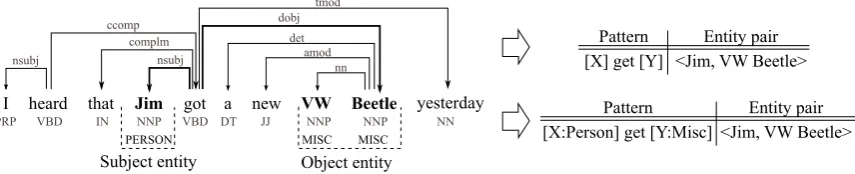
In our system, we use a pattern generation method that makes use of dependency parses. We im-plement the algorithm described in (Akbik et al., 2012). Here, patterns are generated as a sequence of typed dependencies and lemmas of tokens on the shortest path between two entities in a parse. In addition to the tokens on the shortest path (referred to ascore tokens), additional tokens are collected from their vicinity in the dependency tree. The po-sition of the entities are denoted by the placehold-ers “[X]” and “[Y]”. We further prune patterns us-ing lus-inguistically-informed filters, e.g. removus-ing patterns that consist only of direct dependencies between subject and object. We give an example of pattern generation applied to a sentence in Fig-ure 1.
Similarity of entity pairs. Using this tech-nique, we generate a list of pattern-entity pair ob-servation tuples, which we use to construct a pair pattern frequency matrix. Each row vector repre-sents one distinct entity pairei and each column
one distinct pattern pj. The value of the matrix
cellcijis the number of times thateioccurs in the
patternpj. This representation allows us to
com-pute the similarity of two entity pairs by comput-ing the cosine distance between their correspond-ing rows in the pair pattern matrix (Bullinaria and Levy, 2007). We compute the pairwise similarity for all entity pairs to generate a dissimilarity trix and execute a clustering method on this ma-trix.
Clustering. In line with most previous work in URE (Rosenfeld and Feldman, 2007; Wang et al., 2011), we use a Hierarchical Agglomerative Clus-tering (HAC) approach with theaverage linkage
scheme (Han et al., 2011). This approach itera-tively merges the two closest entity pairs to com-pute a dendrogram of cluster merges.
The dendrogram is cut at a point given by the
[X] get [Y] <Jim, VW Beetle> Pattern Entity pair
yesterday
Jim got a new VW
MISC NNP VBD DT JJ
Subject entity
NNP PERSON
NNP
Object entity
nsubj
tmod dobj
det amod
that heard I
[X:Person] get [Y:Misc] <Jim, VW Beetle> Pattern Entity pair
VBD IN PRP
nsubj
ccomp complm
Beetle
[image:4.595.86.514.64.151.2]NN MISC nn
Figure 1: Illustration of the pattern generation process for one example sentence with the entities “Jim” and “VW Beetle”. Part-of-speech and Named Entity class tags are given below the tokens in the sentence. The shortest path between the two entities is highlighted bold in the dependency tree. The word “got” lies along this path, which is lemmatized to produce the pattern [X]GET[Y]. As an option, the Named Entity classes of the entities are included as selectional restrictions into the pattern, yielding the pattern [X:PERSON]GET[Y:MISC].
grid search), guided by cross-validation on a train-ing set (Bergstra and Bengio, 2012). Through such experimentation, we determine that the cut-ting threshold must be set at a high value (for ex-ample around 0.999) to produce good clustering results2.
Clustering result. The clustering produces a set of clusters, which each consist of a set of en-tity pairs. Each resulting cluster is interpreted as one discovered relation, and all entity pairs in the cluster as the instances of this relation. The clus-tering result is then passed to an evaluation step discussed in detail in Section 4.
3.2 Named Entity Type Restrictions
We first extend the system with an option to use standard Named Entity types as selectional re-strictions, in a similar fashion as a previous URE system (Mesquita et al., 2010). We incorporate the Stanford NER 7-class tagger into the sentence parsing pipeline and determine the type of each entity. These types are used to restrict the generic placeholders [X] and [Y] in generated patterns with the types of the subject and object entities.
For the example sentence illustrated in Figure 1, the tagger determines the class PERSONfor “Jim”, and MISC for “VW Beetle”. The latter class is used for all entities that cannot be assigned any of the named classes. We therefore generate the pattern “[X:PERSON] GET[Y:MISC]” in this ex-ample. Because we model entity type restrictions directly into the patterns, we increase the space of all possible patterns and make individual patterns
2We determine different values for other linkage schemes. For example, when using thesingle-linklinkage scheme in HAC, we find a good estimation for the cutting threshold to be 0.9.
more discriminative.
However, as shown in the example in Section 1, the Named Entity classes given by a 7-class tagger are coarse grained and may not include the types necessary to disambiguate all patterns. Also, there is a risk that Named Entity taggers may determine the wrong type for an entity3. This could lead to false evidence that negatively impacts URE.
3.3 Fine-grained Entity Type Restrictions
Because classes from a standard 7-class NER tag-ger may be too coarse grained for URE, we next extend the system with the option of modeling fine-grained Named Entity classes. We choose an approach that requires entities to be disam-biguated and linked to Wikipedia URIs. The YAGO knowledge base then enables us to retrieve fine-grained entity classes for disambiguated enti-ties, such as their Wikipedia categories (of which we use only the head nouns as restrictions). Be-cause many YAGO entities belong to more than
one class, this method returns a set of classes for each entity. For example, the Wikipedia categories for “VW Beetle” are “TAXICAB VEHICLES”,
“AUSTRIAN INVENTIONS”, “INDUSTRIAL DE
-SIGNS”, “SUBCOMPACT CARS” and others. For each entity pair, we retrieve two sets of en-tity classes (one for the subject and one for the object). We determine the Cartesian product over these two sets and create one distinct pattern with selectional restrictions for each combination. For the example sentence, this means that we gener-ate a list of patterns, including “[X:PERSON]GET
[Y:CAR]”, “[X:PERSON] GET [Y:VEHICLE]” and “[X:PERSON]GET[Y:INVENTION]”, each of
Cluster Weight
N-gram lookup Other n-grams in cluster 1) Lookup phrasal clusters for subject
and object entity
2) Add cluster IDs as selectional restrictions to patterns.
VW Beetle
Jim
[X] get [Y] <Jim, VW Beetle>
Pattern Entity pair 805
269 0.4 0.17
VW Beetle 825 0.3 Chrysler Voyager, Toyota Highlander Computer Parts, Office Supplies
Becky, Doug, Eileen, Frances
Pattern Entity pair Weight
[X:269] get [Y:825] 0.12
[X:269] get [Y:805] 0.04
[X:283] get [Y:269] 0.18
[image:5.595.88.516.59.241.2]<Jim, VW Beetle> <Jim, VW Beetle> <Jim, VW Beetle>
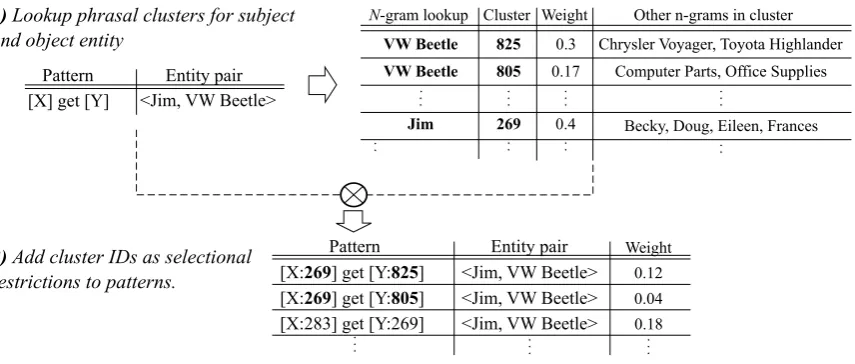
Figure 2: Illustration of the proposed pattern generation process that uses phrasal cluster memberships as selectional restrictions. In 1), phrasal clusters are retrieved for the subject and object of the entity pair. “VW Beetle” for example is in cluster 825, which contains many other car names. In 2) the Cartesian product over the phrasal clusters for subject and object is built and used as selectional restrictions for the pattern generated with the baseline method. This yields a set of patterns with different selectional restrictions.
which is used as a feature. While this method in-creases the overall number of observed patterns by about one order of magnitude, individual patterns are much more discriminative than without selec-tional restrictions.
Limitations. Two things must be noted re-garding this method of determining fine-grained Named Entity classes. Firstly, it does not nec-essarily produce patterns at the desired granu-larity. In Section 1 we discussed the pattern “[X:PERSON]GET[Y:PRODUCT]” to be most ap-propriate, which is not generated by this method. More importantly though, the method is limited to entities that can be disambiguated to the appropri-ate Wikipedia page. While this is possible on the dataset we use for the evaluation, it is much more difficult to determine fine-grained Named Entity classes in the open domain with this method. We therefore implement this option mainly for evalua-tion purposes, in order to determine URE capabil-ities given a fine-grained, high quality type system for selectional restrictions.
3.4 Phrasal Clusters as Restrictions
To address the limitations of the methods de-scribed in 3.3, we propose a method for modeling SR that does not require an existing type system or the disambiguation of entities.
We extend the system with the option of us-ing selectional restrictions derived from a phrasal
clustering computed by (Lin and Wu, 2009) over a dataset of more than 10 million distinct one-to-five-word-grams from the Googlen-gram data set (Lin and Wu, 2009). In this dataset, each n -gram is assigned to ten different phrasal clusters with different association values, also referred to asweights. Weights are between 0 and 1, with a higher value indicating a stronger assignment con-fidence. Because the clustering is based on lexical context,n-grams in a cluster often share semantic properties. For example, the dataset contains clus-ters of entities like cities, cars, movies, etc (Lin and Wu, 2009).
During pattern generation, we look up the phrasal cluster IDs for the lexical representation of an entity and use this ID as selectional restriction. For example, the string “VW Beetle” belongs to phrasal cluster number 825 with weight 0.3. Se-mantically similar strings, such as “Chrysler Voy-ager” and “Toyota Highlander” are also part of this cluster. We can use this information to restrict the subject of the pattern only to strings that belong to cluster 825. Another phrasal cluster for “VW Bee-tle” is cluster 805 (with a lower weight of 0.17), which consists of more general product terms such as “Computer Parts” and “Office Supplies”. “Jim” is found in cluster 269, which contains many per-son first names. See Figure 2 for an illustration of this example.
sets of phrasal clusters retrieved for the subject and object of an entity pair. Because each entity (e.g. its lexical representation) has 10 soft clus-ter memberships, the Cartesian product of phrasal clusters for both entities of an entity pair yields a total of 100 distinct weighted phrasal cluster ID combinations, hereafter referred to as restriction pairs. The weight of each restriction pair is com-puted by building the product of the confidence weights of the respective entity-phrasal cluster as-signments. Each restriction pair is encoded into its pattern by adding to the entity placeholders “[X]” and “[Y]” a qualifier indicating the phrasal clus-ter ID. For each observation and restriction pair, a distinct pattern is generated.
This option increases the overall number of dis-tinct patterns by two orders of magnitude. Patterns are also less humanly readable than their counter-parts that use coarse- or fine-grained Named En-tity types. We use this feature space to evaluate the assumption that we can leverage distributional evidence over a large Web corpus to model selec-tional restrictions in URE without an existing type system.
4 Evaluation
In this section, we perform experiments to mea-sure the impact of different options of modeling selectional restrictions in patterns for URE. We also qualitatively inspect clusters and patterns.
4.1 Experimental Setup
Our experiments are performed on a silver stan-dard dataset of 200.000 sentences crawled from the Web and labeled using distant supervi-sion (Mintz et al., 2009). The sentences contain 4500 distinct entity pairs that are part of the YAGO
knowledge base4. This allows us to compare the results of URE against the YAGOknowledge base.
We compute BCubed (Amig´o et al., 2009) preci-sion, recall andf-measure values, which are com-monly used to extrinsically evaluate clustering re-sults. We perform this evaluation on the following setups:
BASELINE In this setup, we establish the URE quality of the baseline system (see Sec-tion 3.1) without modeling selecSec-tional re-strictions. The baseline is based on the sys-tem described in (Akbik et al., 2012).
4In (Akbik et al., 2012) we illustrate and evaluate the labeling procedure in detail.
NER-7CLASS This scenario simulates previous work by (Mesquita et al., 2010). We evalu-ate the impact of using a standard NER tag-ger to model selectional restrictions (see Sec-tion 3.2).
NER-YAGO In this setup, we evaluate the use of a high quality, fine-grained type system to model selectional restrictions. We retrieve fine-grained entity classes from Wikipedia categories as described in Section 3.3.
PROPOSED-OPEN-1 This setup is a modifica-tion of the proposed method that makes use of phrasal clusters to model selectional restric-tions in the open domain. Here, we only use the cluster with the top weight (instead of all 10) as restriction for an entity.
PROPOSED-OPEN-5 Like PROPOSED-OPEN-1 this is a modification of the proposed method. Here, the top 5 clusters for each string are used as restrictions. We use this setup to as-sess the impact of using only the most likely portion of the full phrasal clusters data set.
PROPOSED-OPEN-FULL The proposed method making use of the full phrasal clusters data set.
In addition to varying the pattern generation method we also experiment with different cut-ting thresholds in the Hierarchical Agglomerative Clustering method. We use two cutting threshold parameters that were determined through experi-mentation (see Section 3.1), namely 0.9995 and 0.9999 (referred to asC0.9995andC0.9999
respec-tively). We also perform a grid search over the pa-rameter space to determine the best cutting thresh-old for each setup, which we refer to asCbest.
4.2 Quantitative Evaluation
Table 2 shows the results of the quantitative eval-uation. At all cutting thresholds, we observe improvements in overall f-measure with all se-tups (except PROPOSED-OPEN-1) over the base-line. These results indicate the value of includ-ing selectional restrictions in the pattern genera-tion step of a URE method. When comparing the different methods, we note that NER-YAGO
and PROPOSED-OPEN-FULL perform best,
C0.9995 C0.9999 Cbest
P R F1 P R F1 P R F1
BASELINE 0.34 0.59 0.43 0.21 0.74 0.33 0.46 0.45 0.46 NER-7CLASS 0.39 0.55 0.46 0.52 0.45 0.48 0.51 0.47 0.49 NER-YAGO 0.74 0.39 0.52 0.65 0.50 0.57 0.65 0.53 0.59
[image:7.595.118.481.62.143.2]PROPOSED-OPEN-1 0.95 0.02 0.04 0.95 0.02 0.04 0.95 0.02 0.04 PROPOSED-OPEN-5 0.70 0.31 0.43 0.59 0.45 0.51 0.57 0.49 0.53 PROPOSED-OPEN-FULL 0.58 0.45 0.51 0.49 0.54 0.51 0.57 0.49 0.53
Table 2: Overview of the results of the comparative evaluation. At all cutting threshold settings, se-tups NER-YAGO and PROPOSED-OPEN-FULL achieve significantly higher f-measure scores than the baseline. We find that at peak performance, the PROPOSED-OPEN-5 setup reaches a similar quality as
PROPOSED-OPEN-FULL.
BASELINE
ID Example patterns Example entity pairs
1 [Y]OWNED BY[X], [X]BUY[Y], <SNCF, Systra>
[Y]PART OF[X], [Y]ACQUIRED BY[X] <Eskom, Arnet Power Station>
2 [X]WIN[Y], [X]RECEIVE[Y], <Cher, Emmy Award>
[Y]WINNING[X], [X]NOMINATED FOR[Y] <Chile, Chilean War for Independence>
3 [X] ’S SON[Y], [Y]BORN TO[X], <Zeus, Heracles>
[X]FATHER OF[Y] [X]DAUGHTER OF[Y] <Carus, Carinus>
4 [X]CREATE[Y] , [Y]BY[X], <Philipps, Compact Disc>
[Y]INVENTED BY[X], [Y]DEVELOPED BY[X] <Kent Beck, Extreme Programming>
NER-YAGO
ID Example patterns Example entity pairs
5 [X:FORMATIONS]FIGHT IN[X:WARS], <Red Army, Russian Civial War>
[X:ORGANIZATIONS]WIN[Y:WARS], <Rebel Alliance, Galactic Civil War>
[Y:CONFLICTS]BETWEEN[X:ORGANIZATIONS]
6 [Y:PEOPLE]STUDENT OF[X:PHILOSOPHERS], <Aristotle, Maimonides>
[Y:PEOPLE]INFLUENCED BY[X:PHILOSOPHERS], <Ayn Rand, Ron Paul>
[X:PHILOSOPHERS]TEACHER OF[Y:PEOPLE]
7 [Y:ALBUMS]BY[X:SINGERS], <Lou Reed, Coney Island Baby>
[Y:ALBUMS]ALBUM BY[X:MUSICIANS], <Bryan Adams, Reckless>
[Y:ALBUMS]PERFORMED BY[X:MUSICIANS]
8 [Y:VENUES]HOME OF[X:TEAMS], <Milwaukee Brewers, Miller Park>
[X:CLUBS]PLAY AT[Y:STADIUMS], <New York Yankees, Yankee Stadium>
[Y:CLUBS]AT[X:LOCATIONS]
PROPOSED-OPEN
ID Example patterns Example entity pairs
[image:7.595.81.521.214.545.2]9 [X:204]IN[Y:809], [X:204]IN[Y:764], <Bob Gale, Back to the Future>
[X:809]IN[Y:764], [X:203]IN[Y:809] <Cher, Zookeeper (film)>
10 [X:18] [Y:452]CANDIDATE, [X:233] [Y:441]POLITICIAN, <Bob Allen, Republican Party>
[X:793] [Y:284]CANDIDATE, [X:259] [Y:441]POLITICIAN <Fob James, Democratic Party>
Table 3: 10 sample clusters found with setups BASELINE, NER-YAGO and PROPOSED-OPEN. Each
cluster is characterized by the top patterns in its centroid and represents one discovered relation. The en-tity pairs that make up the cluster are instances of discovered relations. Cluster 3, for example, represents the CHILDOFrelation which holds between two persons.
with regards to recall. This is because this method produces highly overspecified patterns that do not allow for efficient grouping of entity pairs.
We also note that the cutting threshold setting has a significant impact on recall, precision and
f-measure. At the PROPOSED-OPEN-5 setup, for example, minor variations in the parameter (from
C0.9995 to C0.9999) cause an absolute f-measure
difference of 0.8 points. This observation strongly indicates the importance of finding methods to
ef-fectively parameterize URE.
4.3 Qualitative Evaluation
For each cluster, which represents one discovered relation, we list a small set of representative pat-terns and entity pairs.
Cluster 1, for example, is a cluster that repre-sents company acquisitions, as is indicated by top patterns such as “[Y] ACQUIRED BY [X]” and “[Y] PART OF [X]”. Entity pairs in this cluster are relation instances. This means that<Eskom, Arnet Power Station>is an instance of the COM
-PANYACQUISIONrelation. We find that this clus-ter corresponds most closely to the OWNSrelation from the YAGOknowledge base.
Readability. Generally, we note that using named classes for selectional restrictions (NER -7CLASS and especially NER-YAGO) result in more human readable patterns than their counter-parts in the baseline and proposed methods. Con-siders clusters 6 and 9. Cluster 6 is easy to eval-uate, as the top patterns are human readable. It represents the INFLUENCEDBYrelation that holds between a person and a philosopher. Cluster 9, on the other hand, is characterized by patterns that consist only of prepositions and phrasal cluster IDs. We must consult the entity pairs to determine that this cluster represents the ACTEDIN relation that holds between an actor and a film.
Granularity. In many cases, we find that se-lectional restrictions lead to the discovery of more fine-grained relations. An example of this is clus-ter 7, which denotes a relationship between a singer and the music album she created. All 46 instances in this cluster belong to the more gen-eral CREATED relation from YAGOthat holds be-tween a person and something she created (such as films, novels, albums etc.). This observation has implications for the use of selectional restric-tions in URE, namely that the granularity of dis-covered relations can be influenced by the choice of type system. This also points to difficulties for the method of evaluating URE against an existing knowledge base as discovered relations might dif-fer in granularity from the KB schema. Both these observations merit further investigation in future work.
Ambiguities. We look into errors made by the URE method and find that many errors are due to pattern ambiguities. Cluster 2, for example, mostly corresponds to the YAGO relation HAS
-WONPRIZE. However, the patterns “[X] WIN
[Y]” and “[Y] WINNING [X]” that hold between correct instances such as <Cher, Emmy Award>
also hold between false positives such as<Chile, Chilean War for Independence>. In more discrim-inative setups, this error is not made. For example, cluster 5 contains the more differentiated pattern “[X:ORGANIZATIONS]WIN[Y:WARS]”.
5 Conclusion and Outlook
In this paper, we addressed the problem of pattern ambiguities in URE by evaluating different meth-ods of modeling selectional restrictions. We find that SR generally have a positive impact on re-lation discovery capabilities of our URE method. Significantly, we find a fine-grained type system to be the best setting, especially if URE is applied to a closed domain where most types of interest can be detected. For the open domain, we have pre-sented a method that makes use of a Web-derived phrasal clustering of n-grams. We find our pro-posed method to be effective in reducing pattern ambiguities, with the advantage of being indepen-dent of a manually determined type system. Based on our results, we believe that correctly restricted deep syntactic patterns are the best features for URE.
In a qualitative evaluation of clustering results, we have determined two main issues that merit be-ing addressed in future work in URE. First, auto-matic evaluation of URE remains probleauto-matic, as relations might be discovered that differ in granu-larity or semantics from the knowledge base that is evaluated against. Current evaluation meth-ods penalize such divergence, even though discov-ered relations might still be correct. Second, we found that the parameterization of the clustering approach used in URE greatly influences the re-sult quality and granularity. We find that even mi-nor variations on the cutting threshold parameter for Hierarchical Agglomerative Clustering greatly impact overallf-measure.
Future work will focus on closely investigating clustering techniques and methods for effective parametrization. In addition, we intend to inves-tigate Active Learning (Sun and Grishman, 2012) as a method to include minimal amounts of human feedback to guide the relation discovery process and improve overall URE results.
Acknowledgements
’Scal-able Preservation Environments’ (SCAPE). Larysa Visen-geriyeva, Johannes Kirschnick and Alexander L¨oser re-ceived funding from the Federal Ministry of Economics and Technology (BMWi) under grant agreement “01MD11014A, ’MIA-Marktplatz f¨ur Informationen und Analysen’ (MIA)”.
References
A. Akbik, L. Visengeriyeva, P. Herger, H. Hemsen, and A. L¨oser. 2012. Unsupervised discovery of relations and discriminative extraction patterns. InProceedings of the 24th International Conference on Computational Linguis-tics.
Enrique Amig´o, Julio Gonzalo, Javier Artiles, and Felisa Verdejo. 2009. A comparison of extrinsic clustering eval-uation metrics based on formal constraints. Inf. Retr., 12(4):461–486, August.
James Bergstra and Yoshua Bengio. 2012. Random search for hyper-parameter optimization. The Journal of Ma-chine Learning Research, 13:281–305.
J.A. Bullinaria and J.P. Levy. 2007. Extracting semantic rep-resentations from word co-occurrence statistics: A com-putational study.Behavior Research Methods, 39(3):510– 526.
Jenny Rose Finkel, Trond Grenager, and Christopher Man-ning. 2005. Incorporating non-local information into in-formation extraction systems by gibbs sampling. In Pro-ceedings of the 43rd Annual Meeting on Association for Computational Linguistics, pages 363–370. Association for Computational Linguistics.
Jiawei Han, Micheline Kamber, and Jian Pei. 2011. Data Mining: Concepts and Techniques. Morgan Kaufmann Publishers Inc., San Francisco, CA, USA, 3rd edition. Johannes Hoffart, Fabian M. Suchanek, Klaus Berberich,
Edwin Lewis-Kelham, Gerard de Melo, and Gerhard Weikum. 2011. Yago2: exploring and querying world knowledge in time, space, context, and many languages. InProceedings of the 20th international conference com-panion on World wide web, WWW ’11, pages 229–232, New York, NY, USA. ACM.
Jing Jiang and ChengXiang Zhai. 2007. A systematic explo-ration of the feature space for relation extraction. In Hu-man Language Technologies 2007: The Conference of the North American Chapter of the Association for Computa-tional Linguistics; Proceedings of the Main Conference, pages 113–120.
Dekang Lin and Patrick Pantel. 2001. Dirt: discovery of inference rules from text. InProceedings of the seventh ACM SIGKDD international conference on Knowledge discovery and data mining, pages 323–328. ACM. D. Lin and X. Wu. 2009. Phrase clustering for
discrimi-native learning. In Proceedings of the Joint Conference of the 47th Annual Meeting of the ACL and the 4th Inter-national Joint Conference on Natural Language Process-ing of the AFNLP: Volume 2 - Volume 2, ACL ’09, pages 1030–1038, Stroudsburg, PA, USA. Association for Com-putational Linguistics.
D. Lin, K. Church, H. Ji, S. Sekine, D. Yarowsky, S. Bergsma, K. Patil, E. Pitler, R. Lathbury, V. Rao, et al. 2010. New tools for web-scale n-grams. InProceedings of LREC.
Xiao Ling and Daniel S Weld. 2012. Fine-grained entity recognition. InProceedings of the 26th Conference on Artificial Intelligence (AAAI).
F. Mesquita, Y. Merhav, and D. Barbosa. 2010. Extracting information networks from the blogosphere: State-of-the-art and challenges. In Fourth Int’l AAAI conference on weblogs and social media.
M. Mintz, S. Bills, R. Snow, and D. Jurafsky. 2009. Distant supervision for relation extraction without labeled data. In
ACL/AFNLP, pages 1003–1011.
P. Resnik. 1996. Selectional constraints: An information-theoretic model and its computational realization. Cogni-tion, 61(1):127–159.
B. Rosenfeld and R. Feldman. 2007. Clustering for unsu-pervised relation identification. InProceedings of the six-teenth ACM conference on Conference on information and knowledge management, pages 411–418. ACM.
Ang Sun and Ralph Grishman. 2012. Active learning for relation type extension with local and global data views. InProceedings of the 21st ACM international conference on Information and knowledge management, pages 1105– 1112. ACM.
O. T¨ackstr¨om, R. McDonald, and J. Uszkoreit. 2012. Cross-lingual word clusters for direct transfer of linguistic struc-ture. Proceedings of the North American Chapter of the Association for Computational Linguistics.
P.D. Turney. 2006. Similarity of semantic relations. Compu-tational Linguistics, 32(3):379–416.
W. Wang, R. Besanc¸on, O. Ferret, and B. Grau. 2011. Filter-ing and clusterFilter-ing relations for unsupervised information extraction in open domain. In C. Macdonald, I. Ounis, and I. Ruthven, editors,CIKM, pages 1405–1414. ACM. Limin Yao, Sebastian Riedel, and Andrew McCallum. 2012.
Unsupervised relation discovery with sense disambigua-tion. InProceedings of the 50th Annual Meeting of the Association for Computational Linguistics: Long Papers-Volume 1, pages 712–720. Association for Computational Linguistics.