A Study on Effectiveness of Syntactic Relationship in Dependence
Re-trieval Model
Fan Ding
1,21: Graduate University,
Chinese Academy of Sciences
Beijing, 100080, China
[email protected]
Bin Wang
22: Institute of Computing Technology,
Chinese Academy of Sciences
Beijing, 100080, China
[email protected]
Abstract
To relax the Term Independence Assump-tion, Term Dependency is introduced and it has improved retrieval precision dramati-cally. There are two kinds of term depend-encies, one is defined by term proximity, and the other is defined by linguistic de-pendencies. In this paper, we take a com-parative study to re-examine these two kinds of term dependencies in dependence language model framework. Syntactic rela-tionships, derived from a dependency parser, Minipar, are used as linguistic term dependencies. Our study shows: 1) Lin-guistic dependencies get a better result than term proximity. 2) Dependence retrieval model achieves more improvement in sen-tence-based verbose queries than keyword-based short queries.
1
Introduction
For the sake of computational simplicity, Term Independence Assumption (TIA) is widely used in most retrieval models. It states that terms are statis-tically independent from each other. Though un-reasonable, TIA did not cause very bad perform-ance. However, relaxing the assumption by adding term dependencies into the retrieval model is still a basic IR problem. Relaxing TIA is not easy be-cause improperly relaxing may introduce much noisy information which will hurt the final per-formance. Defining the term dependency is the first step in dependence retrieval model. Two re-search directions are taken to define the term de-pendency. The first is to treat term dependencies as
term proximity, for example, the Bi-gram Model (F. Song and W. B. Croft, 1999) and Markov Ran-dom Field Model (D. Metzler and W. B. Croft, 2005) in language model. The second direction is to derive term dependencies by using some linguis-tic structures, such as POS block (Lioma C. and Ounis I., 2007) or Noun/Verb Phrase (Mitra et al., 1997), Maximum Spanning Tree (C. J. van Rijsbergen, 1979) and Linkage Model (Gao et al., 2004) etc.
Though linguistic information is intensively used in QA (Question Answering) and IE (Infor-mation Extraction) task, it is seldom used in docu-ment retrieval (T. Brants, 2004). In docudocu-ment re-trieval, how effective linguistic dependencies would be compared with term proximity still needs to be explored thoroughly.
In this paper, we use syntactic relationships de-rived by a popular dependency parser, Minipar (D. Lin, 1998), as linguistic dependencies. Minipar is a broad-coverage parser for the English language. It represents the grammar as a network of nodes and links, where the nodes represent grammatical cate-gories and the links represent types of dependency. We extract the dependencies between content words as term dependencies.
To systematically compare term proximity with syntactic dependencies, we study the dependence retrieval models in language model framework and present a smooth-based dependence language model (SDLM). It can incorporate these two kinds of term dependencies. The experiments in TREC collections show that SDLM with syntactic rela-tionships achieves better result than with the term proximity.
Section 3 presents the definition of term depend-ency using syntactic relationships derived by Minipar. Section 4 presents in detail the smooth-based dependence language model. A series of ex-periments on TREC collections are presented in Section 5. Some conclusions are summarized in Section 6.
2
Related Work
Generally speaking, when using term dependencies in language modeling framework, two problems should be considered: The first is to define and identify term dependencies; the second is to integrate term dependencies into a weighting schema. Accordingly, this section briefly reviews some recent relevant work, which is summarized into two parts: the definition of term dependencies and weight of term dependencies.
2.1 Definition of Term Dependencies
In definition of term dependencies, there are two main methods: shallow parsing by some linguistic tools and term proximity with co-occurrence in-formation. Both queries and documents are repre-sented as a set of terms and term dependencies among terms. Table 1 summarizes some recent related work according to the method they use to identify term dependencies in queries and docu-ments.
Methods Document Parsing
Document Proximity
Query Parsing
I: DM,LDM, etc.
II: CULM, RP, etc.
Query Proximity
[image:2.612.71.300.458.544.2]III: NIL IV: BG ,WPLM, MRF, etc.
Table 1. Methods in identifying dependencies
In the part I of table 1, DM is Dependence Lan-guage Model (Gao et al., 2004). It introduces a de-pendency structure, called linkage model. The linkage structure assumes that term dependencies in a sentence form an acyclic, planar graph, where two related terms are linked. LDM (Gao et al., 2005) represents the related terms as linguistic concepts, which can be semantic chunks (e.g. named entities like person name, location name, etc.) and syntactic chunks (e.g. noun phrases, verb phrases, etc.).
In the part II of table 1, CULM (M. Srikanth and R. Srihari, 2003) is a concept unigram language model. The parser tree of a user query is used to identify the concepts in the query. Term sequence in a concept is treated as bi-grams in the document model. RP (Recognized Phrase, S. Liu et al., 2004) uses some linguistic tools and statistical tools to recognize four types of phrase in the query, includ-ing proper names, dictionary phrase, simple phrase and complex phrase. A phrase is in a document if all its content words appear in the document within a certain window size. The four kinds of phrase correspond to variant window size.
In the part IV of table 1, BG (bi-gram language model) is the simplest model which assumes term dependencies exist only between adjacent words both in queries and documents. WPLM (word pairs in language model, Alvarez et al., 2004) relax the co-occurrence window size in documents to 5 and relax the order constraint in bi-gram model. MRF (Markov Random Field) classify the term depend-encies in queries into sequential dependence and full dependence, which respectively corresponds to ordered and unordered co-occurrence within a pre-define-sized window in documents.
From above discussion we can see that when the query is sentence-based, parsing method is pre-ferred to proximity method. When the query is keyword-based, proximity method is preferred to parsing method. Thorsten (T. Brants, 2004) note: the longer the queries, the bigger the benefit of NLP. This conclusion also holds for the definition of query term dependencies.
2.2 Weight of Term Dependencies
In dependence retrieval model, the final relevance score of a query and a document consists of both the independence score and dependence score, such as Bahadur Lazarsfeld expansion (R. M. Losee, 1994) in classical probabilistic IR models. However, Spark Jones et al. point out that without a theoretically motivated integration model, docu-ments containing dependencies (e.g. phrases) may be over-scored if they are weighted in the same way as single words (Jones et al., 1998). Smooth-ing strategy in language modelSmooth-ing framework pro-vide such an elegant solution to incorporate term dependencies.
In the simplest bi-gram model, the probability of bi-gram (qi-1,qi) in document D is smoothed by its
) | ( ) | ( ) , | ( , ) , | ( ) 1 ( ) | ( ) , | ( 1 1 1 1 1 D q P D q q P D q q P where D q q P D q P D q q P i i i i i i i i i i smoothed − − − − − ≡ × − + ×
=λ λ
(1)
Further, the probability of bi-gram (qi-1,qi) in
document P(qi|qi-1,D) can be smoothed by its
prob-ability in collection P(qi|qi-1,C). If P(qi|qi-1,D) is
smoothed as Equation (1), the relevance score of query Q={q1q2…qm} and document D is:
) | ( ) | ( ) | ( log ) | , ( , ) | , ( ) | ( log ) ) | ( ) | ( ) | ( 1 1 log( ) | ( log ) ) | ( ) , | ( ) 1 ( log( ) | ( log )) , | ( ) 1 ( ) | ( log( ) | ( log ) , | ( log ) | ( log ) | ( log 1 1 1 ... 2 1 ... 1 ... 2 1 1 ... 1 ... 2 1 ... 1 ... 2 1 1 ... 2 1 1 D q P D q P D q q P D q q MI usually D q q MI D q P D q P D q P D q q P D q P D q P D q q P D q P D q q P D q P D q P D q q P D q P D Q P i i i i i i m i i i smoothed m i i m
i i i
i i m i i m i i i i m i i m i i i i m i i i smoothed − − − = − = = − − = = − = = − = − × ≡ + = × × − + + ∝ × − + + = × − + × + = + =
∑
∑
∑
∑
∑
∑
∑
∑
λ λ λ λ λ λ (2)In Equation (2), the first score term is independ-ence unigram score and the second score term is smoothed dependence score. Usually λ is set to 0.9, i.e., the dependence score is given a less weight compared with the independence score.
DM (Gao et al., 2004), which can be regarded as the generalization of the bi-gram model, gives the relevance score of a document as:
∑
∑
∈ = + + = L j i j i m i i D L q q MI D L P D q P D Q P ) , ( ... 1 ) , | , ( ) | ( log ) | ( log ) | ( log (3)In Equation (3),L is the set of term dependencies in query Q. The score function consists of three parts: a unigram score, a smoothing factor logP(L|D), and a dependence score MI(qi,qj|L,D).
MRF (D. Metzler and W. B. Croft, 2005) com-bines the score of full independence, sequential dependence and full dependence in an interpolated way with the weight (0.8, 0.1, 0.1).
Though these above models are derived from different theories, smoothing is an important part when incorporating term dependencies.
3
Syntactic Parsing of Queries and
Documents
Term dependencies defined as term proximity may contain many “noisy” dependencies. It’s our belief that parsing technique can filter out some of these noises and syntactic relationship is a clue to define
parser, Minipar, to extract the syntactic depend-ency between words. In this section we will dis-cuss the extraction of syntactic dependencies and the indexing schemes of term dependencies.
3.1 Extraction of Syntactic Dependencie
term dependencies. We use a popular dependency
s
ary
an
des in the parsing result are single w
A dependency relationship is an asymmetric bin relationship between a word called head (or governor, parent), and another word called modifier (or dependent, daughter). Dependency grammars represent sentence structures as a set of dependency relationships. For example, Figure 1 takes the description field of TREC topic 651 as an example and shows part of the parsing result of Minipar.
In Figure 1, Cat is the lexical category of word, d Rel is a label assigned to the syntactic depend-encies, such as subject (sub), object (obj), adjunct (mod:A), prepositional attachment (Prep:pcomp-n), etc. Since function words have no meaning, the dependency relationships including function words, such as N:det:Det, are ignored. Only the depend-ency relationships between content words are ex-tracted. However, prepositional attachment is an exception. A prepositional noun phrase contains two parts: (N:mod:Prep) and (Prep:pcomp-n:N). We combine these two parts and get a relationship between nouns.
Mostly, the no
ords. When the nodes are proper names, diction-ary phrases, or compound words connected by hy-phen, there are more than one word in the node. For example, the 5th and 6th relationship in Figure 1
[image:3.612.326.537.278.442.2]describes a compound word “make up”. We di-vide these nodes into bi-grams, which assume de-pendencies exist between adjacent words inside the
Figure 1. Parsing Result of Minipar
Node2
Node1 Cat1:Rel:Cat2
TREC Topic 651: ”How is the ethnic make-up of the U.S. population changing?”
…
3 makeup N:det:Det the
4 makeup N:mod:A ethnic
5 makeup N:lex-mod:U make
6 makeup N:lex-mod:U -
8 makeup N:mod:Prep of
11 of Prep:pcomp-n:N population
9 population N:det:Det the
10 population N:nn:N U.S.
nodes. If the compound-word node has a relation-ship with other nodes, each word in the compound-word node is assumed to have a relationship with the other nodes. Finally, the term dependencies are represented as word pairs. The direction of syntac-tic dependencies is ignored.
3.2 Indexing of Term Dependencies
And the
of
e that
trieval status value (RSV) has the form: Parsing is a time-consuming process.
documents parsing should be an off-line process. The parsing results, recognized as term dependen-cies, should be organized efficiently to support the computation of relevance score at the retrieval step. As a supplement of regular documents↔words inverted index, the indexing of term dependencies is organized as documents→dependencies lists. For example, Document A has n unique words; each of these n words has relationships with at least one other word. Then the term dependencies inside these n words can be represented as a half-angle matrix as Figure 2 shows.
The (i,j)-th element of the matrix is the number times that tidi and tidj have a dependency in
document A. The matrix has the size of (n-1)*n/2 and it is stored as list of size (n-1)*n/2. Each document corresponds to such a matrix. When ac-cessing the term dependencies index, the global word id in the regular index is firstly converted to the internal id according to the word’s appearance order in the document. The internal id is the index of the half-angle matrix. Using the internal id pair, we can get its position in the matrix.
4
Smooth-based Dependence Model
From the discussion in section 2.2, we can se smoothing is very important not only in unigram language model, but also in dependence language model. Taking the smoothed unigram model (C. Zhai and J. Lafferty, 2001) as the example, there-D D Q w D DML UG Q C w p D w p Q w c D Q RSV α
α ( | ) | |log ) | ( log ) , ( ) , ( =
∑
+ ∩ ∈In Equation (4), c(w,Q) is the frequency of w
Q. The equation has three parts: PDML(w|D), αD and
P(
(4)
in
w|C). PDML(w|D) is the discounted maximum
likelihood estimation of unigram P(w|D), αD is the
smoothing coefficient of document D, and P(w|C) is collection language model. If we use a smooth-ing strategy as the smoothed MI in Equation (2), and replace term w with term pair (wi,wj), we can
get the smoothed dependence model as:
∑
∩ ∈ × + = D L ww smooth i j
j j
i j
i p w w C
D Q w w c ) , ( 0 ) ) | , ( ) | 1 log( ) , ,
( λ (5)
In Equation (5), λ0 is the smoothing coefficient.
Psm (w ,w |D) and Psm (w ,w |C) is the smoothed
w
i j
e the Psmooth(wi,wj|D):
pair with relation-sh i smooth DEP w w p D Q RSV , ( ) , (
ooth i j ooth i j
eight of term pair (wi,wj) in document D and
col-lection C.
4.1 Smoothing P(w ,w |D)
We use two parts to estimat one is the weight of the term
ips in D, P(wi,wj|R,D), the other is the weight of
the term co-occurrence in D, Pco(wi,wj|D). These
two parts are defined as below:
| D | )/ (w C D) | P(w D) | P(w D) | P(w D) | w , (w P | D | R)/ , w , (w C D) R, | w ,
P(wi j D i j × =
tid1 tid2 … tidn-1 tidn
tid1
tid2
…
tidn-1
tidn ⎪
⎪ ⎪ ⎭ ⎪⎪ ⎪ ⎬ ⎫ ⎪ ⎪ ⎪ ⎩ ⎪⎪ ⎪ ⎨ ⎧ 0 * * * * 1 0 ... * * 0 3 ... * * 4 5 .. 0 * 2 0 ... 1 0 i D i j i j i CO = = (6)
|D| is the document length, CD(wi,wj,R) denotes
the count of the dependency (wi,w ) in the
docu-m j i co 1 j
ent D, and CD(wi) is the frequency of word wi in
D. Psmooth(wi,wj|D) is defined as a combination of
the two parts:
P ) λ -(1 D) R, | w , P(w λ D) | w , (w
Psmooth i j 1 i j
×
+ (w ,w |D)
× =
(7) Figure 2. Half-angle matrix of term dependencies
4.2 Smoothing P(wi,wj|C)
bability of term pair . We use docu-m
To directly estimate the pro (w ,w ) in the collection is not easyi j
ent frequency of term pair (wi,wj) as its
approxi-mation. Same as Psmooth(wi,wj|D), Psmooth(wi,wj|C)
consists of two parts: one is the document fre-quency of term pair (wi,wj), DF(wi,wj), the other is
the averaged document frequency of wi and wj.
Then, Psmooth(wi,wj|C) is defined as:
In Equation (8), |C|D is the count of Document in
Collection C.
Finally, if substituting Equation (7) and (8) into Eq
). The final retrieval status value of th
s
To answer the question whether the syntactic de-term proximity,
,w ,R) in Equa-tio
parameter is
ns. Some statistics of the col-lec
rameters (λ,λ,λ), SD
(MB) Doc.
uation (5), there are three parameters (λ0,λ1,λ2)
in RSVDEP(Q,D
e smooth-based dependence model, RSVSDLM, is
the sum of RSVDEP and RSVUG:
) , ( )
, ( )
,
(Q D RSV Q D RSV Q D
RSVSDLM = DEP + UG (9)
5
Experiments and Result
pendencies is more effective than
we systematically compared their performance on two kinds of queries. One is verbose queries (the description field of TREC topics), the other is short queries (the title field of TREC topics). Since the verbose queries are sentence-level, they are parsed by Minipar to get the syntactic dependencies. In short queries, term proximity is used to define the dependencies, which assume every two words in the queries have a dependency.
Our smooth-based dependence language model (SDLM) is used as dependence retrieval model in the experiments. If defining CD(wi j
n (6) to different meanings, we can get a de-pendence model with syntactic dependencie, SDLM_Syn, or a dependence model with term proximity, SDLM_Prox. In SDLM_Syn, CD(wi,wj,R) is the count of syntactic dependencies
between wi and wj in D. In SDLM_Prox,
CD(wi,wj,R) is the number of times the terms wi
and wj appear within a window N terms.
We use Dirichlet-Prior smoothed KL-Divergence model as the unigram model in Equa-tion (9). The Dirichlet-Prior smoothing
set to 2000. This unigram model, UG, is also the baseline in the experiments. The main evaluation metric in this study is the non-interpolated average precision (AvgPr.)
We evaluated the smooth-based dependence language model in two document collections and four query collectio
tions are shown in Table 2.
Three retrieval models are evaluated in the TREC collections: UG, SDLM_Syn and SDLM_Prox. Besides the pa 0 1 2
LM_Prox has one more parameter than SDLM_Syn. It is the window size N of CD(wi,wj,R). In the experiments, we tried the
win-dow size N of 5, 10, 20 and 40 to find the optimal
setting. We find the optimal N is 10. This size is close to sentence length and it is used in the fol-lowing experiments.
Coll. Queries Documents Size #
AP 51-200 Associated Press
(1
489 164,597 988,1989) in
Disk2
TREC7-8 351-450
Ro
Hard bust04 35 hardqueries in 351-450 Robust04
New 651-700 ex.672
Disk 4&5
[image:5.612.314.531.397.561.2](no CR) 3,120 528,155
Table 2. TREC collections
eter ,λ2) were trained on three query
se 700. Each query set
was divided into two halves, and we applied two-fo
Param s (λ0,λ1
ts: 51-200, 351-450 and
651-ld cross validation to get the final result. We trained (λ0,λ1,λ2) by directly maximizing MAP
(mean average precision). Since the parameter range was limited, we used a linear search method at step 0.1 to find the optimal setting of (λ0,λ1,λ2).
Topic Index
0 20 40 60 80 100 120 140 160
Avg
Pr
0.0 .2 .4 .6 .8 1.0
UG SDLM_Syn
Topic Index
0 20 40 60 80 100
Avg
P
r
0.0 .2 .4 .6 .8 1.0
UG SDLM_Syn
Topic Index
0 10 20 30 40
Av
gP
r
0.00 .05 .10 .15 .20 .25 .30 .35
UG SDLM_Syn
Topic Index
0 10 20 30 40 50
Av
gPr
0.0 .2 .4 .6 .8 1.0
UG SDLM_Syn
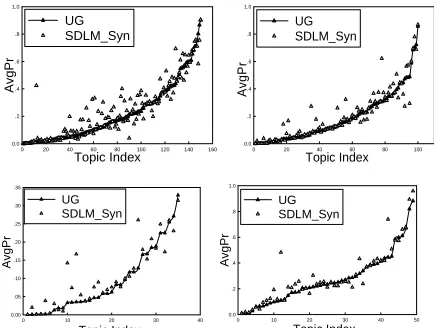
Figure 3 UG vs. SDLM_Syn in verbose queries: Top Left (51-200), Top Right (351-450), Bottom Left (hard topics in 351-450), and Bottom Right
Table 3 and Table 4 respectively. The settings of (λ0,λ1,λ2) used in the experiments are
al
(651-700)
The results on verbose queries and short queries are listed in
UG SDLM_Prox SDLM_Syn collections
AvgPr. AvgPr. %ch over UG (λ0,λ1,λ2) AvgPr. %ch over UG (λ0,λ1,λ2)
AP 0.2159 0.2360 9.31* (1.8,0.6,0.9) 0.2393 10.84* (1.9,0.7,0.9) TREC7-8 0.1893 0.2049 8.24* (1.2,0.1,0.2) 0.2061 8.87* (0.4,0.1,0.9) Robust04_hard 0.0909 0.1049 15.40* (1.2,0.1,0.2) 0.1064 17.05* (0.4,0.1,0.9) Robust04_new 0.2754 0.3022 9.73* (0.7,0.1,0.3) 0.3023 9.77* (0.7,0.1,0.3) Table 3. Comparison results on verbose queries
UG SDLM_Prox SDLM_Syn
collections
AvgPr. AvgPr. %ch over UG (λ0,λ1,λ2) AvgPr. %ch over UG (λ0,λ1,λ2)
AP 0.2643 0.2644 0 (1.3,0.6,0.1) 0.2647 0.15 (1.1,0.5,0.2) TREC7-8 0.2069 0.2076 0.34 (1.2,0.3,0.2) 0.2070 0 (1,0.1,0.2) Robust04_hard 0.1037 0.1044 0.68 (1.2,0.3,0.2) 0.1045 0.77 (1,0.1,0.2) Robust04_new 0.2771 0.2888 4.22* (1.3,0.3,0.4) 0.2869 3.54* (1.3,0.1,0.4) Table 4. Comparison results on short queries
Topic Index
0 20 40 60 80 100 120 140 160
Avg
P
r
0.0 .2 .4 .6 .8 1.0
SDLM_Prox SDLM_Syn
Topic Index
0 20 40 60 80 100
Av
g
Pr
0.0 .2 .4 .6 .8 1.0
SDLM_Prox SDLM_Syn
Topic Index
0 10 20 30 40
AvgPr
0.00 .05 .10 .15 .20 .25 .30 .35
SDLM_Prox SDLM_Syn
Topic Index
0 10 20 30 40 50
A
vg
Pr
0.0 .2 .4 .6 .8 1.0
[image:6.612.66.338.98.491.2]SDLM_Prox SDLM_Syn
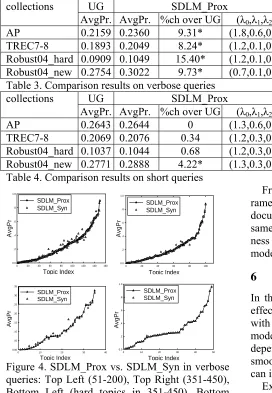
Figure 4. SDLM_Prox vs. SDLM_Syn in verbose queries: Top Left (51-200), Top Right (351-450), Bottom Left (hard topics in 351-450), Bottom Right (651-700)
improvement over UG and SDLM_Syn has robust improvement over SDLM_Prox. In short queries, SDLM has slight improvement over UG and SDLM_Syn is comparative with SDLM_Prox.
To study the effectiveness of syntactic depend-encies in detail, Figure 3 and 4 compare SDLM_Syn and UG, SDLM_Syn and SDLM_Prox topic by topic in verbose queries.
As shown in Figure 3 and Figure 4, SDLM_Syn achieves substantial improvements over UG in the majority of queries. While SDLM_Syn is com-parative with SDLM_Prox in most of the queries, SDLM_Syn still get some noticeable improve-ments over SDLM_Prox.
From Table 3 and 4, we can see while the pa-rameters (λ0,λ1,λ2) change a lot in two different
document collections, there is little change in the same document collection. This shows the robust-ness of our smooth-based dependence language model.
6
Conclusion
In this paper we have systematically studied the effectiveness of syntactic dependencies compared with term proximity in dependence retrieval model. To compare the effectiveness of syntactic dependencies and term proximity, we develop a smooth-based dependence language model that can incorporate different term dependencies.
References
ijsber R
worths, 1979.
varez, s, Ji Nie
e g fo tion
s 200
686-s for l e m a
formation re ,
ges 334–342
b aluati MINI
the E ion o
ndom field model for term dependencies, In Proceedings of
SIGIR’05, Pages 472-479, 2005
Fei Song and W. Bruce Croft. A general language
model for information retrieval. In Proceedings of
SIGIR’99, pages 279-280, 1999.
Jianfeng Gao, JianYun Nie, Guangyuan Wu and Gu
-hong Cao, Dependence Language Model for Info
-mation Retrieval, In Proceedings of SIGIR’04,
Pages:170-177, 2004
Jianfeng Gao, Haoliang Qi, Xinsong Xia and Jian-Yun Nie. Linear Discriminant Model for Information Re-trieval. In Proceedings of SIGIR’05, Pages:290-297,
2005
y Computer Laboratory. 1998
Shuang Liu, Fang Liu, Clement Yu and Weiyi Meng,
An Effective Approach to Document Retrieval via
Utilizing WordNet an ses, In
Pro-in I
Ter ence he
u feld e n. Inf
ess-d men 3–3
atur uage
In-formation Retrieval . In Proceedings of 20th
Interna-tional Conference o nal Linguistics,
e C. J. van R gen. In rmation etrievalfo .
Butter-Carmen Al Philippe Langlai an-Yun , Bahad
Word Pairs in Retrieval, In Pr
Languag
oceeding of RIAO Modelin r Informa4, Pages ing an 705, 2004
Chengxiang
ing method
Zhai and John Lafferty. A stu angua
dy of smooth-lied to ad hoc g
trieval. In
odels
Proceedings of SIGIR’01pp
in
pa , 2001
Dekang Lin, Dep
PAR, Proceedin
endency-gs of Workshop onased Ev on of valuat -f Parsing Systems, Granada, Spain, May,
Donald Metzler and W. Bruce Croft, A Markov ra
1998.
i
r
K. Sparck Jones, S. Walker, and S. E. Robertson, A
probabilistic model of information retrieval: devel-opment and status. Technical Report TR-446,
Cam-bridge Universit
Lioma C. and Ounis I., A Syntactically-Based Query
Reformulation Technique for Information Retrieval, Information Processing and Management (IPM),
El-sevier Science, 2007
M. Mitra, C. Buckley, A. Singhal, and C. Cardie. An Analysis of Statistical and Syntactic Phrases. In
Proceedings of RIAO-97, 5th International Confer-ence “Recherche d’Information Assistee par Ordi-nateur”, pages 200-214, Montreal, CA, 1997. Munirathnam Srikanth and Rohini Srihari, Exploiting
Syntactic Structure of Queries in a Language Mod-eling Approach to IR, In Proceedings of CIKM’03,
Pages: 476-483, 2003
d Recognizing Phra
-2
ceed gs of SIG R’04, Pages: 266 72, 2004
Robert M. Losee. m depend : Truncating t
r Lazars xpansio ormation Proc
Manage t, 30(2):29 03, 1994.
Thorsten Brants. N al Lang Processing in