A Framework Based on Graphical Models with Logic for
Chinese Named Entity Recognition
∗Xiaofeng YU
Wai LAM
Shing-Kit CHAN
Information Systems Laboratory
Department of Systems Engineering & Engineering Management
The Chinese University of Hong Kong
Shatin, N.T., Hong Kong
{xfyu,wlam,skchan}@se.cuhk.edu.hk
Abstract
Chinese named entity recognition (NER) has re-cently been viewed as aclassificationorsequence labelingproblem, and many approaches have been proposed. However, they tend to address this problem without considering linguistic informa-tion in Chinese NEs. We propose a new framework based on probabilistic graphical models with first-order logic for Chinese NER. First, we use Condi-tional Random Fields (CRFs), a standard and the-oretically well-founded machine learning method based on undirected graphical models as a base system. Second, we introduce various types of domain knowledge into Markov Logic Networks (MLNs), an effective combination of first-order logic and probabilistic graphical models for vali-dation and error correction of entities. Experimen-tal results show that our framework of probabilis-tic graphical models with first-order logic signifi-cantly outperforms the state-of-the-art models for solving this task.
1
Introduction
Named entity recognition (NER) is the task of identifying and classifying phrases that denote certain types of named entities (NEs), such as person names (PERs), locations (LOCs) and organizations (ORGs) in text documents. It is a well-established task in the NLP and data mining com-munities and is regarded as crucial technology for many higher-level applications, such as information extraction, question answering, information retrieval and knowledge management. The NER problem has generated much in-terest and great progress has been made, as evidenced by its inclusion as an understanding task to be evaluated in the
∗
The work described in this paper is substantially supported by grants from the Research Grant Council of the Hong Kong Special Administrative Region, China (Project Nos: CUHK 4179/03E and CUHK4193/04E) and the Direct Grant of the Faculty of En-gineering, CUHK (Project Codes: 2050363 and 2050391). This work is also affiliated with the Microsoft-CUHK Joint Laboratory for Human-centric Computing and Interface Technologies.
Message Understanding Conference (MUC), the Multilin-gual Entity Task (MET) evaluations, and the Conference on Computational Natural Language Learning (CoNLL).
Compared to European-language NER, Chinese NER seems to be more difficult (Yuet al., 2006). Recent ap-proaches to Chinese NER are a shift away from manu-ally constructed rules or finite state patterns towards ma-chine learning or statistical methods. However, rule-based NER systems lack robustness and portability. Sta-tistical methods often suffer from the problem of data sparsity, and machine learning approaches (e.g., Hidden Markov Models (HMMs) (Bikel et al., 1999; Zhou and Su, 2002), Support Vector Machines (SVMs) (Isozaki and Kazawa, 2002), Maximum Entropy (MaxEnt) (Borthwick, 1999; Chieu and Ng, 2003), Transformation-based Learn-ing (TBL) (Brill, 1995) or variants of them) might be un-satisfactory to learn linguistic information in Chinese NEs. Current state-of-the-art models often view Chinese NER as aclassificationorsequence labelingproblemwithout con-sidering the linguistic and structural information in Chinese NEs. They assume that entities are independent, however in most cases this assumption does not hold because of the existing relationships among the entities. They seek to locate and identify named entities in text by sequentially classifying tokens (words or characters) as to whether or not they participate in an NE, which is sometimes prone to noise and errors.
exam-ple is the nested ORG “®½°D«uÆO
ÅÆ/School of Computer Science, Tsinghua Univer-sity, Haidian District, Beijing City” which contains two ORGs “uÆ/Tsinghua University” and “OÅÆ
/School of Computer Science” and two LOCs “®
½/Beijing City” and “°D«/Haidian District”. The two ORGs contain ORG salient words “Æ/University” and “Æ/School”, while the two LOCs contain LOC salient words “½/City” and “«/District” respectively.
Inspired by the above observation, we propose a new framework based on probabilistic graphical models with first-order logic which treats Chinese NER1 as a statisti-cal relational learning (SRL) problem and makes use of domain knowledge. First, we employ Conditional Random Fields (CRFs), a discriminatively trained undirected graph-ical model which has theoretgraph-ical justification and has been shown to be an effective approach to segmenting and label-ing sequence data, as our base system. We then exploit a variety of domain knowledge into Markov Logic Networks (MLNs), a powerful combination of logic and probability, to validate and correct errors made in the base system. We show how a variety of domain knowledge can be formu-lated as first-order logic and incorporated into MLNs. We use three Markov chain Monte Carlo (MCMC) algorithms, including Gibbs sampling, Simulated Tempering, as well as MC-SAT, and Maximum a posteriori/Most Probable Expla-nation (MAP/MPE) algorithm for probabilistic inference in MLNs. Experimental results show that our framework based on graphical models with logic yields substantially better NER results, leading to a relative error reduction of up to 23.75% on the F-measure over state-of-the-art mod-els. McNemar’s tests confirm that the improvements we obtained are statistically highly significant.
2
State of the Art
2.1 CRF Model for Chinese NER
Conditional Random Fields (CRFs) (Laffertyet al., 2001) are undirected graphical models trained to maximize the conditional probability of the desired outputs given the cor-responding inputs. CRFs have the great flexibility to en-code a wide variety of arbitrary, non-independent features and to straightforwardly combine rich domain knowledge. Furthermore, they are discriminatively trained, and are of-ten more accurate than generative models, even with the same features. CRFs have been successfully applied to a number of real-world tasks, including NP chunking (Sha and Pereira, 2003), Chinese word segmentation (Penget al., 2004), information extraction (Pintoet al., 2003; Peng and McCallum, 2004), named entity identification (Mc-Callum and Li, 2003; Settles, 2004), and many others.
1
In this paper we only focus on PERs, LOCs and ORGs. Since temporal, numerical and monetary phrases can be well identified with rule-based approaches.
Recently, CRFs have been shown to perform excep-tionally well on Chinese NER shared task on the third SIGHAN Chinese language processing bakeoff (SIGHAN-06) (Zhouet al., 2006; Chenet al., 2006b,a). We follow the state-of-the-art CRF models using features that have been shown to be very effective in Chinese NER, namely the current character and its part-of-speech (POS) tag, sev-eral characters surrounding (both before and after) the cur-rent character and their POS tags, curcur-rent word and several words surrounding the current word.
We also observe some important issues that significantly influence the performance as follows:
Window size: The primitive window size we use is 5 ( 2
characters preceding the current character and 2 following the current character). We extend the window size to 7 but find that it slightly hurts. The reason is that CRFs can deal with non-independent features. A larger window size may introduce noisy and irrelevant features.
Feature representation: For character features, we use
character identities. For word features, BIES representa-tion (each character is beginning of a word, inside of a word, end of a word, or a single word) is employed.
Labeling scheme: The labeling scheme can be BIO, BIOE
or BIOES representation. In BIO representation, each char-acter is tagged as either the beginning of a named entity (B), a character inside a named entity (I), or a character outside a named entity (O). In BIOE, the last character in an entity is labeled as E while in BIOES, single-character entities are labeled as S. In general, BIOES representation is more informative and yields better results than both BIO and BIOE.
2.2 Error Analysis
Even though the CRF model is able to accommodate a large number of well-engineered features which can be easily ob-tained across languages, some NEs, especially LOCs and ORGs are difficult to identify due to the lack of linguistic or structural characteristics. Since predictions are made to-ken by toto-ken, some typical and serious tagging errors are still made, as shown below:
• ORG is incorrectly tagged as LOC: In Chinese, many ORGs contain location information. The CRF model only tags the location information (in the ORGs) as LOCs. For example, “/ìnóÆ/Tangshan Technical Insti-tute” and “°H/Hainan Provincial Committee ” are ORGs and they contain LOCs “/ì/Tangshan” and “°H
/Hainan Province”, respectively. “/ì/Tangshan” and “°H/Hainan Province” are only incorrectly tagged as LOCs. This affects the tagging performance of both ORGs and LOCs.
• LOC is incorrectly tagged as ORG: The LOCs “GZyì
/Sydney Opera” and “®N,/Beijing Gymnasium” are mistakenly tagged as ORGs by the CRF model with-out taking into account the location salient words “yì
• The boundary of entity is tagged incorrectly: This mis-take occurs for all the entities. For example, the PER “)0·°d/Tom Cruise” may be tagged as a PER “)
0/Tom”; the LOC “Ø5r/Bremen” may be tagged as a LOC “5r/Laimei”, which is a meaningless word; the ORG “uúi/Huawei Corporation” may be tagged as an ORG “u/Huawei”. The reasons for these errors are both complicated and varied. However, some of them are related to linguistic knowledge.
• Common nouns are incorrectly tagged as entities: For ex-ample, the two common nouns “yêÆ/Modern Mathe-matics” and “=¬Å¬/Galanz Microwave Oven” may be improperly tagged as a LOC and an ORG. Some tagging errors could be easily rectified. Take the erroneous ORG “½|§/City Committee Organizes,” for example, in-tuitively it is not an ORG since an entity cannot span any punctuation.
3
Our Proposed Framework
3.1 Overview
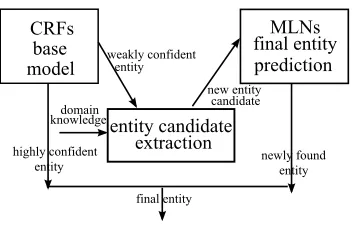
We propose a framework based on probabilistic graphical models with first-order logic for Chinese NER. As shown in Figure 1, the framework is composed of three main com-ponents. The CRF model is used as a base model. Then we incorporate domain knowledge that can be well formulated into first-order logic to extract entity candidates from CRF results. Finally, the Markov Logic Network (MLN), an undirected graphical model forstatistical relational learn-ing, is used to validate and correct the errors made in the base model. We begin by briefly reviewing the necessary background of MLNs, including weight learning and infer-ence.
3.2 Markov Logic Networks
A Markov Network (also known as Markov Random Field) is a model for the joint distribution of a set of variables (Pearl, 1988). It is composed of an undirected graphG= (V, E)and a set of real-valued potential functionsφk. A
First-Order Knowledge Base (KB) (Genesereth and Nisls-son, 1987) is a set of sentences or formulas in first-order logic.
A Markov Logic Network (MLN) (Richardson and Domingos, 2006) is a KB with a weight attached to each formula (or clause). Together with a set of constants representing objects in the domain, it species a ground Markov Network containing one feature for each possi-ble grounding of a first-order formulaFi in the KB, with
the corresponding weight wi. The basic idea in MLNs
[image:3.612.351.527.73.187.2]is that: when a world violates one formula in the KB it is less probable, but not impossible. The fewer for-mulas a world violates, the more probable it is. The weights associated with the formulas in an MLN jointly determine the probabilities of those formulas (and vice versa) via a log-linear model. An MLN is a statisti-cal relational model that defines a probability distribution over Herbrand interpretations (possible worlds), and can
Figure 1: Framework Overview
be thought of as atemplatefor constructing Markov Net-works. Given different sets of constants, it will produce different networks. These networks will have certain reg-ularities in structure and parameter given by the MLN and they are called ground Markov Networks. Suppose
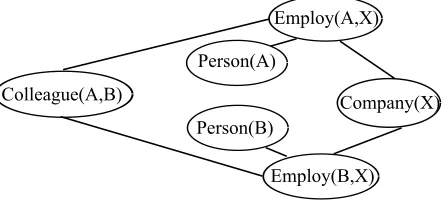
Peter(A), Smith(B) and IBM(X) are 3 constants, a KB and generated features are listed in Table 1. The formula Employ(x,y)⇒Person(x),Company(y)
means xis employed by y and Colleague(x,y)⇒
Employ(x,z)∧Employ(y,z)meansxandyare col-leagues if they are employed by the same company. Fig-ure 2 shows the graph of the ground Markov network defined by the formulas in Table 1 and the 3 constants
Peter(A), Smith(B) and IBM(X). The probability distribution over possible worldsxspecified by the ground Markov NetworkML,Cis given by
P(X =x) = 1
Zexp(
X
wini(x)) =
1
Z Y
φi x{i}
ni(x)
(1)
whereni(x)is the number of true groundings ofFi in
x,x{i} is the true value of the atoms appearing inFi, and
φi x{i}
=ewi.
In the case of Chinese NER, a named entity can be con-nected to another named entity for instance, because they share the same location salient word. Thus in an undirected graph, two node types exist, the LOC nodes and the loca-tion salient word nodes. The links (edges) indicate the rela-tion (LOCs contain locarela-tion salient words) between them. This representation can be well expressed by MLNs.
Table 1: Example of a KB and Generated Features
Fist-Order Logic (KB) Generated Features
∀x,y Employ(x,y)⇒Person(x),Company(y) Employ(Peter,IBM)⇒Person(Peter),Company(IBM)
Employ(Smith,IBM)⇒Person(Smith),Company(IBM)
∀x,y,z Colleague(x,y)⇒Employ(x,z)∧Employ(y,z) Colleague(Peter,Smith)⇒Employ(Peter,IBM)
∧Employ(Smith,IBM)
3.2.1 Learning Weights
Given a relational database, MLN weights can in princi-ple be learned generatively by maximizing the likelihood of this database on the closed world assumption. The gradient of the log-likelihood with respect to the weights is
∂ ∂wi
logPw(X=x) =ni(x)−
X
Pw(X =x0)ni(x0)
(2) where the sum is over all possible databases x0, and Pw(X = x0) is P(X = x0) computed using the
cur-rent weight vector w = (w1, ..., wi, ...). Unfortunately,
computing these expectations can be very expensive. In-stead, we can maximize the pseudo-log-likelihood of the data more efficiently. Ifxis a possible database andxlis
thelth ground atom’s truth value, thepseudo-log-likelihood ofxgiven weightswis
logPw∗(X =x) =
n
X
l=1
logPw(Xl=xl |M Bx(Xl)) (3)
whereM Bx(Xl)is the state ofXl’sMarkov blanket2
in the data. Computing Equation 3 and its gradient does not require inference over the model, and is therefore much faster. We can optimize thepseudo-log-likelihood using the limited-memory BFGS algorithm (Liu and Nocedal, 1989).
3.2.2 Inference
IfF1 andF2 are two formulas in first-order logic,Cis
a finite set of constants including any constants that appear inF1orF2, andLis an MLN, then
P(F1|F2, L, C) =P(F1|F2, ML,C)
= P(F1∧F2|ML,C)
P(F2|ML,C)
=
P
x∈χF1∩χF2P(X=x|ML,C) P
x∈χF2P(X =x|ML,C)
(4)
whereχFiis the set of worlds whereFiholds, andP(x|
ML,C)is given by Equation 1. The question of whether a
knowledge base entails a formulaF in first-order logic is the question of whetherP(F | LKB, CKB,F) = 1, where
LKBis the MLN obtained by assigning infinite weight to
2
The Markov blanket of a node is the minimal set of nodes that renders it independent of the remaining network; in a MLN, this is simply the node’s neighbors in the graph.
Figure 2: A Ground Markov network defined by the formu-las in Table 1 and the constantsPeter(A),Smith(B)
andIBM(X).
all the formulas in KB, andCKB,Fis the set of all constants
appearing in KB orF.
A large number of efficient inference techniques are ap-plicable to MLNs. The most widely used approximate so-lution to probabilistic inference in MLNs is Markov chain Monte Carlo (MCMC) (Gilkset al., 1996). In this frame-work, the Gibbs sampling algorithm is to generate an in-stance from the distribution of each variable in turn, con-ditional on the current values of the other variables. The key to the Gibbs sampler is that one only considers uni-variate conditional distributions-the distribution when all of the random variables but one are assigned fixed values. One way to speed up Gibbs sampling is by Simulated Tem-pering (Marinari and Parisi, 1992), which performs simu-lation in ageneralized ensemble, and can rapidly achieve an equilibrium state. Poon and Domingos (2006) pro-posed MC-SAT, an inference algorithm that combines ideas from MCMC and satisfiability. MC-SAT works well and is guaranteed to be sound, even when deterministic or near-deterministic dependencies are present in real-world rea-soning.
Besides MCMC framework, maximum a posteriori (MAP) inference can be carried out using a weighted sat-isfiability solver like MaxWalkSAT. It is closely related to maximum likelihood (ML), but employs an augmented op-timization objective which incorporates a prior distribution over the quantity one wants to estimate. MAP estimation can therefore be seen as a regularization of ML estimation.
3.3 Domain Knowledge
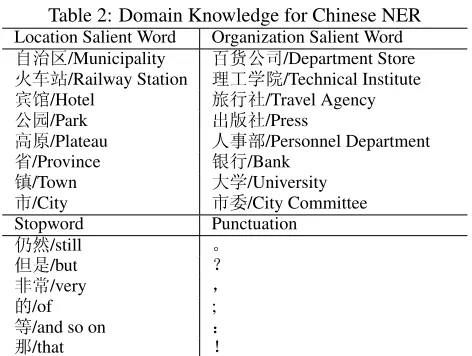
CRF hypotheses. We extract 165 location salient words and 843 organization salient words from Wikipedia3 and the LDC Chinese-English bi-directional NE lists compiled from Xinhua News database, as shown in Table 2. We also make a punctuation list which contains 18 items and some stopwords which Chinese NEs cannot contain. The stop-words are mainly conjunctions, auxiliary and functional words. We extract new NE candidates from the CRF re-sults according to the following consideration:
• Definitely, if a chunk (a series of continuous characters) oc-curs in the training data as a PER or a LOC or an ORG, then this chunk should be a PER or a LOC or an ORG in the test-ing data. In general, a unique strtest-ing is defined as a PER, it cannot be a LOC somewhere else.
• Obviously, if a tagged entity ends with a location salient word, it is a LOC. If a tagged entity ends with an organi-zation salient word, it is an ORG.
• If a tagged entity is close to a subsequent location salient word, probably they should be combined together as a LOC. The closer they are, the more likely that they should be com-bined.
• If a series of consecutive tagged entities are close to a sub-sequent organization salient word, they should probably be combined together as an ORG because an ORG may contain multiple PERs, LOCs and ORGs.
• Similarly, if there exists a series of consecutive tagged enti-ties and the last one is tagged as an ORG, it is likely that all of them should be combined as an ORG.
• Entity length restriction: all kinds of tagged entities cannot exceed 25 Chinese characters.
• Stopword restriction: intuitively, all tagged entities cannot comprise any stopword.
• Punctuation restriction: in general, all tagged entities cannot span any punctuation.
• Since all NEs are proper nouns, the tagged entities should end with noun words.
• The CRF model tags each token (Chinese character) with a conditional probability. A low probability implies a low-confidence prediction. For a chunk with low condi-tional probabilities, all the above assumptions are adopted (The marginal probabilities are normalized, and probabili-ties lower than the user-defined threshold are regarded as low conditional probabilities).
All the above domain knowledge can be formulated as first-order logic to construct the structure of MLNs. And all the extracted chunks are accepted as new NE candidates (or common nouns). We train an MLN to recognize them.
3
[image:5.612.320.556.78.256.2]http://en.wikipedia.org/wiki/.
Table 2: Domain Knowledge for Chinese NER
Location Salient Word Organization Salient Word
g£«/Municipality zÀúi/Department Store
»Õ/Railway Station nóÆ/Technical Institute
U,/Hotel À1/Travel Agency
ú /Park Ñ/Press
p/Plateau <¯Ü/Personnel Department
/Province Õ1/Bank /Town Æ/University
½/City ½/City Committee Stopword Punctuation
E,/still "
´/but º
~/very §
/of ;
/and so on µ
@/that
3.4 First-Order Logic Representation
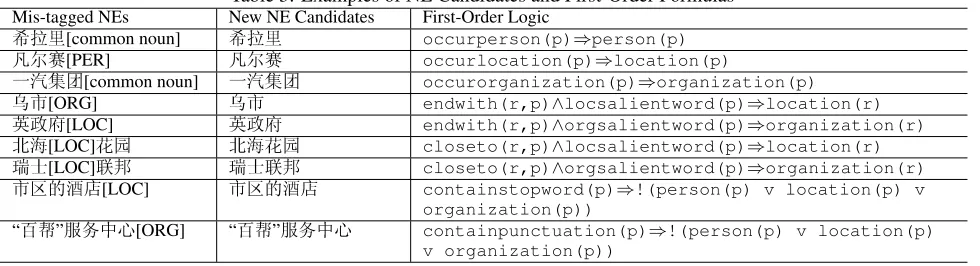
We declared 14predicates(person(candidate),lo cation(candidate),organization(candidat e),endwith(candidate, salientword),clos eto(candidate, salientword),containstop word(candidate),containpunctuation(cand idate), etc) and specified 15 first-order formulas (See Table 3 for some examples) according to the domain knowledge described in Section 3.3. For example, we usedperson(candidate)to specify whether a candi-date is a PER.Formulasare recursively constructed from atomic formulas using logical connectives and quantifiers. They are constructed using four types of symbols: con-stants,variables,functions, andpredicates.Constant sym-bols represent objects in the domain of interest (e.g., “
®/Beijing” and “þ °/Shanghai” are LOCs). Variable symbols (e.g.,randp) range over the objects in the do-main. To reduce the size of ground Markov Network, variables and constants are typed; for example, the vari-abler may range over candidates, and the constant “
®/Beijing” may represent a LOC.Functionsymbols repre-sent mappings from tuples of objects to objects.Predicate symbols represent relations among objects (e.g.,person) in the domain or attributes of objects (e.g.,endwith). A ground atomis an atomic formula all of whose arguments are ground terms (terms containing no variables). For ex-ample, the ground atom location(®½) conveys that “®½/Beijing City” is a LOC.
For example in Table 3, “¿½/Wu City” is mis-tagged as an ORG by the CRF model, but it contains the location salient word “½/City”. So it is extracted as a new entity candidate, and the corresponding formulaendwith(r, p)∧locsalientword(p)⇒location(r)means if
Table 3: Examples of NE Candidates and First-Order Formulas
Mis-tagged NEs New NE Candidates First-Order Logic
F.p[common noun] F.p occurperson(p)⇒person(p)
m[PER] m occurlocation(p)⇒location(p)
ð8ì[common noun] ð8ì occurorganization(p)⇒organization(p)
¿½[ORG] ¿½ endwith(r,p)∧locsalientword(p)⇒location(r)
=?[LOC] =? endwith(r,p)∧orgsalientword(p)⇒organization(r)
°[LOC]s °s closeto(r,p)∧locsalientword(p)⇒location(r)
a¬[LOC]é a¬é closeto(r,p)∧orgsalientword(p)⇒organization(r)
½«ËA[LOC] ½«ËA containstopword(p)⇒!(person(p) v location(p) v organization(p))
“z”ÑÖ¥%[ORG] “z”ÑÖ¥% containpunctuation(p)⇒!(person(p) v location(p) v organization(p))
only belong to one class.
We assume that the relational database contains only bi-nary relations. Each extracted NE candidate is represented by one or more strings appearing as arguments of ground atoms in the database. The goal of NE prediction is to de-termine whether the candidates are entities and the types of entities (query predicates), given the evidence predicates and other relations that can be deterministically derived from the database. As we will see, despite their simplic-ity and consistency, these first-order formulas incorporate the essential features for NE prediction.
4
Experiments
4.1 Dataset
We used People’s Daily corpus (January-Jun, 1998) in our experiments, which contains approximately 357K sen-tences, 156K PERs, 219K LOCs and 87K ORGs, respec-tively. We did some modifications on the original data to make it cleaner. We enriched some tags so that the abbre-viation proper nouns are well labeled. We preprocessed some nested names to make them in better form. We also processed some person names. We enriched tags for differ-ent kinds of person names (e.g., Chinese and transliterated names) and separated consecutive person names.
4.2 The Baseline NER System
We use CRFs to build a character-based Chinese NER sys-tem, with features described in Section 2.1. To avoid over-fitting, we penalized the log-likelihood by the commonly used zero-mean Gaussian prior over the parameters. In addition, we exploit clue word features which can capture non-local dependencies. This gives us a competitive base-line CRF model using both local and non-local information for Chinese NER.
For clue word features, we employ 412 career titles (e.g.,
oÚ/President,Ç/Professor,´ /Police), 59 family ti-tles (e.g.,ww/Father,~~/Sister), 33 personal pronouns (e.g.,\/Your,·/We) and 109 direction words (e.g.,
±/North,HÜ/South) to represent non-local informa-tion. Career titles, family titles and personal pronouns may
Figure 3: An Example of Non-local Dependency. The Ca-reer Title “Ç” Indicates a PER “^”
imply a nearby PER and direction words may indicate a LOC or an ORG. Figure 3 illustrates an example of non-local dependency.
We do not take the advantage of using the golden-standard word segmentation and POS tagging provided in the original corpus, since such information is hardly avail-able in real text. Instead, we use an off-the-shelf Chi-nese lexical analysis system, the open source ICTCLAS (Zhanget al., 2003), to segment and POS tag the corpus. This module employs a hierarchical Hidden Markov Model (HHMM) and provides word segmentation, POS tagging (labels Chinese words using a set of 39 tags) and unknown word recognition. It performs reasonably well, with seg-mentation precision recently evaluated at 97.58%. The re-call of unknown words using role tagging is over 90%.
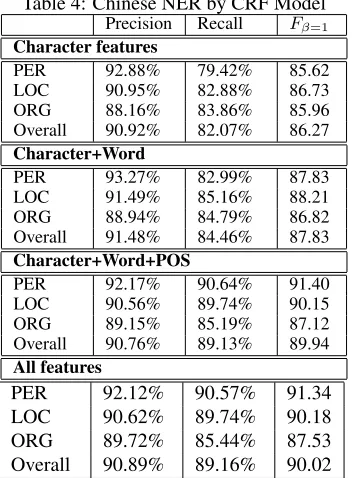
We use one-month corpus for training and 9-day corpus for testing. Table 4 shows the experimental results.
4.3 NER System Based on Graphical Models with
Logic
To test the effectiveness of our proposed model, we extract all the NEs (19,879 PERs, 25,661 LOCs and 11,590 ORGs) from the training corpus. An MLN training database, which consists of 14 predicates, 16,620 constants and 97,992 ground atoms was built.
Table 4: Chinese NER by CRF Model
Precision Recall Fβ=1
Character features
PER 92.88% 79.42% 85.62 LOC 90.95% 82.88% 86.73 ORG 88.16% 83.86% 85.96 Overall 90.92% 82.07% 86.27
Character+Word
PER 93.27% 82.99% 87.83 LOC 91.49% 85.16% 88.21 ORG 88.94% 84.79% 86.82 Overall 91.48% 84.46% 87.83
Character+Word+POS
PER 92.17% 90.64% 91.40 LOC 90.56% 89.74% 90.15 ORG 89.15% 85.19% 87.12 Overall 90.76% 89.13% 89.94
All features
PER 92.12% 90.57% 91.34
LOC 90.62% 89.74% 90.18
ORG 89.72% 85.44% 87.53
[image:7.612.81.298.355.636.2]Overall 90.89% 89.16% 90.02
Table 5: Chinese NER by Graphical Models with Logic
Precision Recall Fβ=1 RER
CRF Baseline
PER 92.12% 90.57% 91.34 LOC 90.62% 89.74% 90.18 ORG 89.72% 85.44% 87.53 Overall 90.89% 89.16% 90.02
Graphical Models (GS Inference)
PER 93.52% 93.32% 93.42 LOC 93.19% 91.91% 92.55 ORG 90.16% 90.71% 90.43
Overall 92.70% 92.09% 92.39 23.75%
Graphical Models (ST Inference)
PER 93.52% 93.32% 93.42 LOC 93.19% 91.91% 92.55 ORG 90.16% 90.71% 90.43
Overall 92.70% 92.09% 92.39 23.75%
Graphical Models (MC-SAT Inference)
PER 93.52% 93.32% 93.42 LOC 93.19% 91.91% 92.55 ORG 90.16% 90.71% 90.43
Overall 92.70% 92.09% 92.39 23.75%
Graphical Models (MAP/MPE Inference)
PER 92.87% 93.15% 93.01 LOC 93.15% 91.61% 92.37 ORG 90.56% 89.10% 89.82
Overall 92.57% 91.58% 92.07 20.54%
of a clause is used as the mean of a Gaussian prior for the learned weight. These weights reflect how often the clauses are actually observed in the training data.
We extract 529 entity candidates to construct the MLN testing database, which contains 2,543 entries and these en-tries are used as evidence for inference. Inference is
per-formed by grounding the minimal subset of the network re-quired for answering the query predicates. We employed 3 MCMC algorithms: Gibbs sampling (GS), Simulated Tem-pering (ST) as well as MC-SAT, and the MAP/MPE algo-rithm for inference and the comparative NER results are shown. The probabilistic graphical models greatly outper-form the CRF model stand-alone by a large margin. It can be seen from Table 5, the probabilistic graphical models integrating first-order logic improve the precision and re-call for all kinds of entities, thus boosting the overall F-measure. We achieve a 23.75% relative error reduction (RER) on F-measure by using 3 MCMC algorithms and a 20.54% RER by using MAP/MPE algorithm, over an al-ready competitive CRF baseline. We obtained the same results using GS, ST and MC-SAT algorithms. MCMC al-gorithms yields slightly better results than the MAP/MPE algorithm.
4.4 Significance Test
Ideally, comparisons among NER systems would control for feature sets, data preparation, training and test proce-dures, parameter tuning, and estimate the statistical sig-nificance of performance differences. Unfortunately, re-ported results sometimes leave out details needed for ac-curate comparisons.
We give statistical significance estimates using McNe-mar’s paired tests4 (Gillick and Cox, 1989) on labeling disagreements for CRF model and graphical probabilistic models that we evaluated directly.
[image:7.612.82.299.357.636.2]Table 6 summarizes the correctness of the labeling de-cisions between the models with a 95% confidence inter-val (CI). These tests suggest that the graphical probabilistic models are significantly more accurate and confirm that the gains we obtained are statistically highly significant.
Table 6: McNemar’s Tests on Labeling Disagreements
Null Hypothesis 95% CI p-value Proposed Model (GS) vs. CRFs 5.71-9.52 <1·10−6 Proposed Model (ST) vs. CRFs 5.71-9.52 <1·10−6 Proposed Model (MC-SAT) vs. CRFs 5.71-9.52 <1·10−6 Proposed Model (MAP/MPE) vs. CRFs 4.50-7.37 <1·10−6
5
Related Work
As a well-established task, Chinese NER has been studied extensively and a number of techniques for this task have been reported in the literature. Most recently, the trend in Chinese NER is to use improved machine learning ap-proaches, or to integrate various kinds of useful evidences, features, or resources.
Fu and Luke (2005) presented a lexicalized HMM-based approach to unifying unknown word identification
4
and NER as a single tagging task on a sequence of known words. Although lexicalized HMMs was shown to be su-perior to standard HMMs, this approach has some disad-vantages: it is a purely statistical model and it suffers from the problem of data sparseness. And the model fails to tag some complicated NEs (e.g., nested ORGs) correctly due to lack of domain adaptive techniques. The F-measures of LOCs and ORGs are only 87.13 and 83.60, which show that there is still a room for improving.
A method of incorporating heuristic human knowledge into a statistical model was proposed in (Wuet al., 2005). Here Chinese NER was regarded as a probabilistic tagging problem and the heuristic human knowledge was used to reduce the searching space. However, this method assumes that POS tags are golden-standard in the training data and heuristic human knowledge is often ad hoc. These draw-backs make the method unstable and highly sensitive to POS errors; and when golden-standard POS tags are not available (this is often the case), it may degrade the perfor-mance.
Cohen and Sarawagi (2004) proposed a semi-Markov model which combines a Markovian, HMM-like extrac-tion process and a dicextrac-tionary component. This process is based on sequentially classifying segments of several ad-jacent words. However, this technique requires that entire segments have the same class label, while our technique does not. Moreover, compared to a large-scale dictionary, our domain knowledge is much easier to obtain.
However, all the above models treat NER as classifi-cation or sequence labeling problem. To the best of our knowledge, MLNs have not been previously used for NER problem. To our knowledge, we first view Chinese NER as astatistical relational learningproblem and exploit do-main knowledge which can be concisely formulated in MLNs, allowing the training and inference algorithms to be directly applied to them.
6
Conclusion and Future Work
The contribution of this paper is three-fold. First, we for-mulate Chinese NER as a statistical relational learning problem and propose a new framework incorporating prob-abilistic graphical models and first-order logic for Chinese NER which achieves state-of-the-art performance. Second, We incorporate domain knowledge to capture the essen-tial features of the NER task via MLNs, a unified frame-work for SRL which produces a set of weighted first-order clauses to predict new NE candidates. To the best of our knowledge, this is the first attempt at using MLNs for the NER problem in the NLP community. Third, our proposed framework can be extendable to language-independent NER, due to the simplicity of the domain knowledge we could access. Directions for future work include learning the structure of MLNs automatically and using MLNs for information extraction (e.g., entity relation
extraction).
References
Daniel M. Bikel, Richard Schwartz, and Ralph M. Weischedel. An algorithm that learns what’s in a name.Machine Learning, 34(1-3):211–231, February 1999.
Andrew Borthwick.A Maximum Entropy Approach to Named Entity Recognition. PhD thesis, New York University, September 1999.
Eric Brill. Transformation-based error-driven learning and natural language processing: A case study in part-of-speech tagging.Computational Linguistics, 21(4):543–565, 1995. Aitao Chen, Fuchun Peng, Roy Shan, and Gordon Sun. Chinese named entity recognition with
conditional probabilistic models. In5th SIGHAN Workshop on Chinese Language Processing, Australia, July 2006.
Wenliang Chen, Yujie Zhang, and Hitoshi Isahara. Chinese named entity recognition with condi-tional random fields. In5th SIGHAN Workshop on Chinese Language Processing, Australia, July 2006.
Hai Leong Chieu and Hwee Tou Ng. Named entity recognition with a maximum entropy approach. InProceedings of CoNLL-03, 2003.
William W. Cohen and Sunita Sarawagi. Exploiting dictionaries in named entity extraction: Com-bining semi-Markov extraction processes and data integration methods. InProceedings of ACM-SIGKDD 2004, 2004.
Guohong Fu and Kang-Kwong Luke. Chinese named entity recognition using lexicalized HMMs.
ACM SIGKDD Explorations Newsletter, 7:19–25, June 2005.
Michael R. Genesereth and Nils J. Nislsson.Logical foundations of artificial intelligence. Morgan Kaufmann Publishers Inc., San Mateo, CA, 1987.
W.R. Gilks, S. Richardson, and D.J. Spiegelhalter.Markov chain Monte Carlo in practice. Chap-man and Hall, London, UK, 1996.
L. Gillick and Stephen Cox. Some statistical issues in the comparison of speech recognition algo-rithms. InProceedings of ICASSP-89, pages 532–535, 1989.
Hideki Isozaki and Hideto Kazawa. Efficient support vector classifiers for named entity recogni-tion. InProceedings of COLING-02, pages 1–7, Taipei, Taiwan, 2002.
John Lafferty, Andrew McCallum, and Fernando Pereira. Conditional random fields: Probabilistic models for segmenting and labeling sequence data. InProceedings of ICML-01, pages 282– 289. Morgan Kaufmann, San Francisco, CA, 2001.
Dong C. Liu and Jorge Nocedal. On the limited memory BFGS method for large scale optimiza-tion.Mathematical Programming, 45:503–528, 1989.
Enzo Marinari and Giorgio Parisi. Simulated Tempering: A new Monte Carlo scheme.Europhysics Letters, 19:451–458, 1992.
Andrew McCallum and Wei Li. Early results for named entity recognition with conditional random fields, feature induction and web-enhanced lexicons. InProceedings of CoNLL-03, 2003. Judea Pearl.Probabilistic reasoning in intelligent systems: networks of plausible inference.
Mor-gan Kaufmann Publishers Inc., San Francisco, CA, 1988.
Fuchun Peng and Andrew McCallum. Accurate information extraction from research papers using conditional random fields. InProceedings of HLT-NAACL 2004, pages 329–336, 2004. Fuchun Peng, Fangfang Feng, and Andrew McCallum. Chinese segmentation and new word
de-tection using conditional random fields. InProceedings of COLING-04, pages 562–568, 2004. David Pinto, Andrew McCallum, Xing Wei, and W. Bruce Croft. Table extraction using conditional
random fields. InProceedings of ACM SIGIR-03, 2003.
Hoifung Poon and Pedro Domingos. Sound and efficient inference with probabilistic and deter-ministic dependencies. InProceedings of AAAI-06, Boston, Massachusetts, July 2006. The AAAI Press.
Matthew Richardson and Pedro Domingos. Markov logic networks. Machine Learning, 62(1-2):107–136, 2006.
Burr Settles. Biomedical named entity recognition using conditional random fields and rich feature sets. InProceedings of the COLING 2004 International Joint Workshop on Natural Language Processing in Biomedicine and its Applications, Geneva, Switzerland, 2004.
Fei Sha and Fernando Pereira. Shallow parsing with conditional random fields. InProceedings of HLT-NAACL 2003, pages 213–220, 2003.
Maosong Sun, Changning Huang, Haiyan Gao, and Jie Fang. Identifying Chinese names in unre-stricted texts.Journal of Chinese Information Processing, 1995.
Youzheng Wu, Jun Zhao, Bo Xu, and Hao Yu. Chinese named entity recognition based on multiple features. InProceedings of HLT-EMNLP 2005, 2005.
Xiaofeng Yu, Marine Carpuat, and Dekai Wu. Boosting for Chinese named entity recognition. In
5th SIGHAN Workshop on Chinese Language Processing, Australia, July 2006.
Hua Ping Zhang, Qun Liu, Xue-Qi Cheng, Hao Zhang, and Hong Kui Yu. Chinese lexical analysis using Hierarchical Hidden Markov Model. In2nd SIGHAN Workshop on Chinese Language Processing, volume 17, pages 63–70, 2003.
Guodong Zhou and Jian Su. Named entity recognition using an HMM-based chunk tagger. In
Proceedings of ACL-02, pages 473–480, Philadelphia, USA, 2002.