
Incremental Joint POS Tagging and Dependency Parsing in Chinese
Jun Hatori1 Takuya Matsuzaki1 Yusuke Miyao3 Jun’ichi Tsujii4 1University of Tokyo / 7-3-1 Hongo, Bunkyo, Tokyo, Japan
2National Institute of Informatics / 2-1-2 Hitotsubashi, Chiyoda, Tokyo, Japan
3Microsoft Research Asia / 5 Danling Street, Haidian District, Beijing, P.R. China
{hatori,matuzaki}@is.s.u-tokyo.ac.jp [email protected] [email protected]
Abstract
We address the problem of joint part-of-speech (POS) tagging and dependency parsing in Chi-nese. In Chinese, some POS tags are often hard to disambiguate without considering long-range syntactic information. Also, the traditional pipeline approach to POS tagging and depen-dency parsing may suffer from the problem of error propagation. In this paper, we propose the first incremental approach to the task of joint POS tagging and dependency parsing, which is built upon a shift-reduce parsing framework with dy-namic programming. Although the incremental approach encounters difficulties with underspeci-fied POS tags of look-ahead words, we overcome this issue by introducing so-called delayed fea-tures. Our joint approach achieved substantial improvements over the pipeline and baseline sys-tems in both POS tagging and dependency pars-ing task, achievpars-ing the new state-of-the-art per-formance on this joint task.
1 Introduction
The tasks of part-of-speech (POS) tagging and de-pendency parsing have been widely investigated since the early stages of NLP research. Among mainstream approaches to dependency parsing, an incremental parsing framework is commonly used (e.g. Nivre (2008); Huang and Sagae (2010)), mainly because it achieves state-of-the-art ac-curacy while retaining linear-time computational complexity, and is also considered to reflect how humans process natural language sentences (Fra-zier and Rayner, 1982).
However, although some of the Chinese POS tags require long-range syntactic information in order to be disambiguated, to the extent of our knowledge, none of the previous approaches have addressed the joint modeling of these two tasks in an incremental framework. Also, since POS tag-ging is a preliminary step for dependency parsing, the traditional pipeline approach may suffer from the problem of error propagation.
In the example sentence in Figure 1, has POS ambiguity between DEG (a genitive marker), which connect two noun phrases as “’s” in En-glish, and DEC (a complementizer), which intro-duces a relative clause. Since both can take the form of NP--NP (NP: noun phrase), it is hard to distinguish these two tags only by considering local context. Based only on local context, a stan-dard n-gram tagger is likely to assign the wrong
tag DEG to , which inevitably makes the fol-lowing parsing step fail to process the sentence correctly. However, knowing that the NP preced-ing is the object of /VV (VV: verb), we can assume that is a complementizer because /DEG is unlikely to follow a verb phrase.
In this paper, we propose the first incremental approach to the task of joint POS tagging and de-pendency parsing. Given a segmented sentence, our model simultaneously considers possible POS tags and dependency relations within the given beam, and outputs the best parse along with POS tags. However, the combined model raises two challenges: First, since the combined search space is huge, efficient decoding is difficult while the na¨ıve use of beam is likely to degrade the search quality. Second, since the proposed model per-forms joint POS tagging and dependency parsing in a left-to-right manner, the model cannot exploit look-ahead POS tags to determine the next action. To deal with the increased search space, we adopt a recently-proposed dynamic programming (DP) extension to shift-reduce parsing (Huang and Sagae, 2010), which enables the model to pack equivalent parser states, improving both speed and accuracy. Also, we overcome the lack of look-ahead POS information by introducing a concept ofdelayed features. The delayed features are those features that include underspecified POS tags, and shall be evaluated at the step when the look-ahead tags are determined. Based on experiments on the Chinese Penn Treebank (CTB) 5, we show that our joint models substantially improve over the
Figure 1: An example sentence from the Chinese Penn Treebank (CTB) 5.
(“The river-side area is the pivot that links China’s across-the-country economic cooperation.”)
wj tj−1 tj−1◦tj−2 wj+11)
wj◦E(wj−1)2) wj◦B(wj+1)2)
E(wj−1)◦wj◦B(wj+1)3)
B(wj) E(wj) P(B(wj)) P(E(wj))
Cn(wj) (n∈ {2, . . . ,len(wj)−1})
B(wj)◦Cn(wj) (n∈ {2, . . . ,len(wj)})
E(wj)◦Cn(wj) (n∈ {1, . . . ,len(wj)−1})
Cn(wj) (ifCn(wj)equals toCn+1(wj))
1) iflen(wj+1)<3; 2) iflen(wj)<3; 3) iflen(wj) = 1.
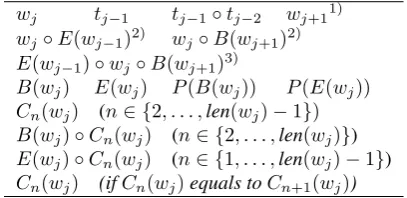
Table 1: Feature templates for the baseline POS tagger, wheretiis the tag assigned to thei-th word
wi,B(w)andE(w)is the beginning and the end-ing character of wordw,Cn(w)is then-th charac-ter ofw,P(c)is the set of tags associated with the single-character wordcbased on the dictionary.
pipeline and baseline systems in both POS tag-ging and dependency parsing accuracy. We also present some discussion on the results and error analysis. Although we specifically focus on Chi-nese in this work, our joint model is applicable to any languages for which a projective shift-reduce parser works well.
2 Baseline Models
First of all, we describe our baseline POS tag-ger and dependency parsers. These models will later be combined into pipelined models, which are then used as the baseline models in Section 4.
2.1 Baseline POS Tagger
We build a baseline POS tagger, which uses the same POS-tagging features as those used in the state-of-the-art joint word segmentation and POS tagging model for Chinese (Zhang and Clark, 2008a). The list of features are shown in Table 1. We train the model with the averaged perceptron (Collins, 2002), and the decoding is performed us-ing the Viterbi algorithm with beam search.
Following Zhang and Clark (2008a), we use a tag dictionary and closed-set tags, which lead to improvement in both speed and accuracy. During training, the model stores all word–tag pairs into a tag dictionary, and for each word occurring more
thanNtimes in the training data, the decoder only
assigns one of the tags that have been seen in the training data. For words that do not exist in the dictionary, the decoder still considers every pos-sible tag. We also construct a dictionary for the closed-set tags (Xia, 2000), and allow the decoder to assign these tags only to the words listed in the dictionary.
2.2 Baseline Parsers
For the baseline parsers for experiments, we build two dependency parsers: a reimplementation of the parser by Huang and Sagae (2010) (here-inafterParser-HS), which is a shift-reduce depen-dency parser enhanced with dynamic program-ming (DP) using graph-structured stack (GSS; Tomita (1991)), and our extension of Parser-HS by incorporating a richer set of features taken from Zhang and Nivre (2011) (hereinafter Parser-ZN), which is originally a non-DP arc-eager depen-dency parser and achieves the current state-of-the-art performance for Chinese dependency parsing. In this section, we briefly describe these models since the features and DP formalism serve as a ba-sis for the joint models described in Section 3.
2.2.1 Shift-reduce parsing
Shift-reduce dependency parsing algorithms in-crementally process an input sentence from left to right. In the framework known as “arc-standard” (Nivre, 2008), the parser performs one of the fol-lowing three actions at each step:
• SHIFT (SH): move the first word in the input queue,q0, onto the stack
• REDUCE-RIGHT (RR): combine the top two trees on the stack,(s0, s1), into a subtreesx0 s1
• REDUCE-LEFT(RL): combine the top two trees on the stack,(s0, s1), into a subtreesy0 s1 whereS = (. . . , s1, s0)is a stack of trees andQ= (q0, q1, . . . , qn−j−1) = (wj, wj+1, . . . , wn−1) is an input queue where j is the index of the first
word in the queueQandnis the number of words
To deal with conflicts between more than one of these actions, each action is associated with a score, and the score of a parser state is the total score of the actions that have been applied. To train the model, we adopt the averaged percep-tron algorithm (Collins, 2002) with early update (Collins and Roark, 2004), following Huang and Sagae (2010). With the early update, whenever the gold action sequence falls off from the beam, the parameters are immediately updated with the rest of the sentence neglected.
2.2.2 Merging equivalent states
Dynamic programming is enabled by merging equivalent states: if two states produce the same feature vector, they are merged into one state. For-mally, a parser state (or configuration) ψ is
de-scribed byh`, i, j, Si, where `is the current step,
[i . . . j]is the span of the top tree s0 in the stack
S = (sd−1, . . . , s0), where dis the depth of the stack. The equivalence of two statesψ:h`, i, j, Si andψ0 :h`0, i0, j0, S0iis then defined as
ψ∼ψ0 iff j=j0∧f~(j, S) =f~(j0, S0), (1)
where f~(j, S) is the feature vector of the state h`, i, j, Si. In practice, just remembering a min-imal set of features calledkernel featuresf~˜(j, S)
suffices to evaluate the equivalence of states: ˜
~
f(j, S) =f~˜(j0, S0)⇒ h`, i, j, Si ∼ h`0, i0, j0, S0i.
(2) By merging equivalent states based on this con-dition, we only need to remember relevant infor-mation from the topd(d= 3in our models) trees on the stack to evaluate the score of the next ac-tions. However, since the stack shrinks when a REDUCE-LEFT/RIGHTaction is applied, you of-ten need to recover the last element of the stack from the history. Following Huang and Sagae (2010), we use a concept ofpredictor statesΠ(ψ) to retain the links to multiple different histories. 2.2.3 Features
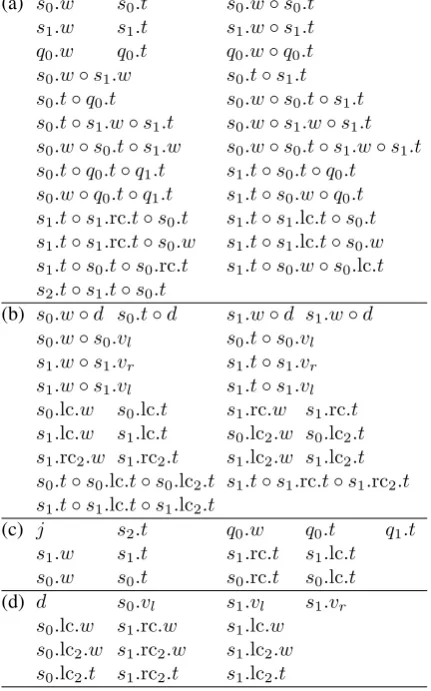
The feature templates used in the baseline parser Parser-HS are listed in Table 2 (a), wheres.wand s.tare the form and tag of the root word of trees, s.rc ands.lc are the right- and left-most children of s, and◦denotes conjunction of features. Note that
these features can be constructed by only using 13 kernel features listed in Table 2 (c). The baseline parser Parser-ZN−additionally utilizes features in
Table 2 (b), whereddenotes the distance between
the root nodes ofs0 ands1, s.vr ands.vlare the numbers of the right and left modifiers ofs,s.rc2
(a) s0.w s0.t s0.w◦s0.t
s1.w s1.t s1.w◦s1.t
q0.w q0.t q0.w◦q0.t
s0.w◦s1.w s0.t◦s1.t
s0.t◦q0.t s0.w◦s0.t◦s1.t
s0.t◦s1.w◦s1.t s0.w◦s1.w◦s1.t
s0.w◦s0.t◦s1.w s0.w◦s0.t◦s1.w◦s1.t
s0.t◦q0.t◦q1.t s1.t◦s0.t◦q0.t
s0.w◦q0.t◦q1.t s1.t◦s0.w◦q0.t
s1.t◦s1.rc.t◦s0.t s1.t◦s1.lc.t◦s0.t
s1.t◦s1.rc.t◦s0.w s1.t◦s1.lc.t◦s0.w
s1.t◦s0.t◦s0.rc.t s1.t◦s0.w◦s0.lc.t
s2.t◦s1.t◦s0.t
(b) s0.w◦d s0.t◦d s1.w◦d s1.w◦d
s0.w◦s0.vl s0.t◦s0.vl
s1.w◦s1.vr s1.t◦s1.vr
s1.w◦s1.vl s1.t◦s1.vl
s0.lc.w s0.lc.t s1.rc.w s1.rc.t
s1.lc.w s1.lc.t s0.lc2.w s0.lc2.t
s1.rc2.w s1.rc2.t s1.lc2.w s1.lc2.t
s0.t◦s0.lc.t◦s0.lc2.t s1.t◦s1.rc.t◦s1.rc2.t
s1.t◦s1.lc.t◦s1.lc2.t
(c) j s2.t q0.w q0.t q1.t
s1.w s1.t s1.rc.t s1.lc.t
s0.w s0.t s0.rc.t s0.lc.t
(d) d s0.vl s1.vl s1.vr
s0.lc.w s1.rc.w s1.lc.w
s0.lc2.w s1.rc2.w s1.lc2.w
s0.lc2.t s1.rc2.t s1.lc2.t
Table 2: (a) Feature templates for Parser-HS; (b) Additional feature templates for Parser-ZN−; (c)
Kernel features for Parser-HS; (d) Additional ker-nel features for Parser-ZN−.
ands.lc2 are the second right- and left-most chil-dren ofs. Note that some of the features described
in Zhang and Nivre (2011), which are associated with dependency labels and head information of stack elements, are not included since our frame-work is based on unlabeled dependencies and the arc-standard strategy. The additional features for Parser-ZN− require the features in Table 2 (d) to
be added into the set of kernel features.
2.2.4 Beam search with DP
In the shift-reduce parsing with dynamic program-ming, we cannot simply apply beam search as in a non-DP shift-reduce parsing, because each state does not have a unique score any more. To de-cide the ordering of states within the beam, the concept ofprefix scoreandinside score(Stolcke, 1995) is adopted. The prefix score ξ is the total
is the score of the tree on the top of the stack. With these scores and a set of predictor statesΠ(ψ) of state ψ, the full description of state ψ takes the
formψ:h`, i, j, S;ξ, η,Πi. The calculation of the prefix and inside scores is described in Huang and Sagae (2010). By using these scores, the ordering of states is defined as
h`, . . .;ξ, η, i ≺ h`, . . .;ξ0, η0, i iff ξ < ξ0∨(ξ =ξ0∧η < η0),
where “ ” denotes “match anything”.
3 Joint POS Tagging and Parsing Model In this section, we describe our models that jointly solve POS tagging and dependency parsing, which are based on the shift-reduce parsers described in Section 2.2. Corresponding to the two baseline parsers Parser-HS and Parser-ZN−, we investigate
two joint models: Joint-HS+and Joint-ZN−.
Al-though the latter uses a richer set of features, the formers can take more advantage of DP because a compact representation of features results in more frequent state packing.
3.1 POS Tagging with Modified Shift Action Our joint parsers incorporate POS tagging during the course of shift-reduce parsing, by modifying the SHIFTaction so that it assigns a tag to the word when it is shifted:
• SHIFT(t) (SH(t)): move the head of the queue, q0, onto the stack, and assign tagtto it.
Along with REDUCE-LEFT/RIGHT actions, our joint model utilizes a total ofn+2actions, wheren
is the number of tags in the given dataset (n= 33 for the CTB-5 tag set (Xia, 2000)). A trace of an example joint parsing is illustrated in Figure 2.
3.2 Training and Decoding
We formulate the task of POS tagging and depen-dency parsing in a joint framework: given an input segmented sentencex, the model tries to find the
best outputythat satisfies: ˜
y= argmax y∈Y(x)
~ w·~θ(y),
where Y(x) is a set of possible outputs forx, w~
is the global feature vector, and ~θ(y) is the
fea-ture vector of y. As in the baseline parsers, we
train our models with the averaged perceptron; the beam search and early update strategy is almost the same except that the update is now caused by an error in POS tagging as well as by an error in
(a) q0.t q0.w◦q0.t s0.t◦q0.t
s0.t◦q0.t◦q1.t s1.t◦s0.t◦q0.t
s0.w◦q0.t◦q1.t s1.t◦s0.w◦q0.t
(b) t◦s0.w t◦s0.t
t◦s0.w◦q0.w t◦s0.t◦q0.w
t◦B(s0.w)◦q0.w t◦E(s0.w)◦q0.w
t◦s0.t◦s0.rc.t t◦s0.t◦s0.lc.t
t◦s0.w◦s0.t◦s0.rc.t t◦s0.w◦s0.t◦s0.lc.t
(c) j s2.t q0.w q−1.t q−2.t
s1.w s1.t s1.rc.w s1.lc.t
s0.w s0.t s0.rc.w s0.lc.t
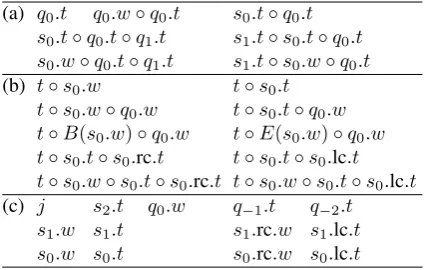
Table 3: (a) List of delayed features for the joint parsers. (b) Syntactic features for the joint parsers, where tis the POS tag to be assigned to q0. (c) Kernel features for the joint parser Joint-HS+.
dependency parsing. Similarly to the baseline tag-ger, we use the tag dictionary and closed-set tags to prune unlikely tags during decoding.
3.3 Features
For the features of the models, we incorporate the union of the features in the baseline tagger and the baseline parsers; features from Parser-HS are used for Joint-HS, and features from Parser-ZN−
for Joint-ZN−. Furthermore, we additionally
in-corporate a set ofsyntactic featuresfor POS tag-ging that capture dependencies between syntactic elements in the stack and the POS to be tagged (described in Section 3.3.1).
The features for the baseline tagger (shown in Table 1) and Parser-ZN− (shown in Table 2 (b))
can be used in situ, because they do not rely on look-ahead POS tags (i.e. POS tags of the words in the queue). However, it is not straightforward to incorporate the features for Parser-HS: in the joint framework, since the look-ahead POS tags are unavailable when the model tries to determine the next action, we cannot easily incorporate those features that include look-ahead POS (listed in Ta-ble 3 (a)). In order to deal with this issue, we intro-duce a concept ofdelayed features, which enables the model to incorporate the look-ahead informa-tion by delayed evaluainforma-tion of feature scores (de-scribed in Section 3.3.2).
Note that the features from the baseline parsers are used for all actions (i.e. SHIFT(t) and
REDUCE-LEFT/RIGHT) while the features from the tagger are only used for SHIFT(t) actions in
step action stackS queueQ translation
0 - φ /?ó/?/?. . .
1 SH(PN) /PN ó/?/?Ù/?. . . : “I”
2 SH(VV) /PNó/VV /?Ù/?*/?. . . ó: “want”
3 SH(BA) /PNó/VV/BA Ù/?*/?åP/?. . . :object marker
4 SH(DT) /PNó/VV/BAÙ/DT */?åP/?ûÑ/?. . . Ù: “this”
5 SH(M) /PNó/VV/BAÙ/DT*/M åP/?ûÑ/?/?. . . *:quantifier
6 RL /PNó/VV/BAÙ/DTy[*/M] åP/?ûÑ/?/?. . .
7 SH(NN) /PNó/VV/BAÙ/DTy[*/M]åP/NN ûÑ/?/?ñí/? åP: “sentence”
8 RR /PNó/VV/BA[Ù/DTy[. . .]]xåP/NN ûÑ/?/?ñí/?
9 RL /PNó/VV/BAy[[. . .]xåP/NN] ûÑ/?/?ñí/?
10 SH(VV) /PNó/VV/BAy[[. . .]xåP/NN]ûÑ/VV /?ñí/? ûÑ: “translate”
Figure 2: A trace of joint shift-reduce parsing for “óÙ*åPûÑñí” (“I want to translate this sentence into English.”), where grandchildren of stack elements are omitted.
Specifically,q−1.tandq−2.tare added in order to accommodate some of the tagging features, while
q0.t andq1.tare removed because the look-ahead POS tags are not available when the equivalence of the states are evaluated. Joint-ZN−additionally
requires kernel features in Table 2 (d).
3.3.1 Syntactic Features
Since our joint framework performs tagging and parsing simultaneously, we can think of incorpo-rating a combined feature of the next tag (to be as-signed toq0) with syntactic information from stack elements, which cannot be used in ann-gram POS
tagger. Specifically, we propose to use the features shown in Table 3 (b). Intuitively, these features try to capture dependencies between the POS to be as-signed and syntactic structure encoded in the trees being built in the stack. For example, at step 9 in Figure 2, the next wordûÑcan be either a noun or a verb. In determining the tag of this word to be VV, the existence of the preceding phrase “/BA [. . .]” on the top of the stack plays an important role, because the phrase headed by represents an object for the following verb; in contrast, in an
n-gram POS tagger, capturing this information is
not easy because/BA is located at a distance of four words. Note that the addition of those syn-tactic features does not require the addition of any elements to the set of kernel features.
3.3.2 Delayed Features
A challenge in the incremental joint approach is that since the shift-reduce model processes an in-put sentence in a left-to-right manner, it cannot ex-ploit look-ahead POS tags, which a pipeline shift-reduce parser can consider, to determine the next action. In our experiment with Parser-HS, the ab-lation of the features including look-ahead POS
results in 0.67% decrease in parsing performance on the development set, suggesting that the look-ahead POS information is indispensable to achieve the state-of-the-art performance. In order to re-lieve this problem, we introduce a concept of de-layed features, which are a set of features that are evaluated later when certain information becomes available. In our model, the parser features that require look-ahead POS information are defined as the delayed features, and shall later be evaluated at the step when the look-ahead POS are determined. Let us see an example in Figure 2. At step 2, a parser encounters a shift-reduce conflict: the next action can be any of REDUCE-LEFT/RIGHT and SHIFT(t). If this were a (non-joint) shift-reduce
parser, the model can utilize the look-ahead POS information by features such as
(s0.t=VV)◦(s1.t=PN)◦(q0.t=BA), to determine the next action, because the POS of all words in the sentence are already given. How-ever, in the joint parser, the POS of the first word in the queue, , remains undetermined until the word is shifted. To deal with this, we define a de-layed featurethat takes look-ahead POS tag(s) as argument(s), as in
(s0.t=VV)◦(s1.t=PN)◦(q0.t=λ1), λ1 =w2.t. At step 3, afterSHIFT(BA) is performed, the de-layed features from the previous step becomes a non-delayed feature
(s0.t=VV)◦(s1.t=PN)◦(q0.t=BA), which can be evaluated in the same way as normal (non-delayed) features.
More formally, each state carries with it a set of delayed feature vectors hd~1, ~d2i, where d~n is the
ar-guments to be filled in1. At each step, a
REDUCE-LEFT/RIGHT actiona adds a set of delayed
fea-tures to the delayed feature vectors of stateψ: hd~1, ~d2i ← hd~1+Φ~1(ψ, a), ~d2+Φ~2(ψ, a)i, whereΦ~1(ψ, a)andΦ~2(ψ, a)are the
first-/second-order delayed features generated by action a be-ing applied toψ. When a SHIFT(t) action is
per-formed, the model fills in the argument in the de-layed features with the newly-assigned tag t, as well as adding new delayed features it generates: hd~1, ~d2i ← hΦ~1(ψ,SH(t)) +T(t, ~d2), ~Φ2(ψ,SH(t))i, where T(t, ~d2) is the resulting feature vector af-ter tag t is filled in to the first argument of the
features in d~2. Note that action SH(t) also adds ~
d0=T(t, ~d1)to its (non-delayed) feature vector. Note that the above formulation with the de-layed features is equivalent to the model with full look-ahead features if the exact decoding is per-formed. Although the approximate search with beam takes the risk of the gold derivation falling off the beam before delayed features are evalu-ated, we show in Section 4 that the current solution works well in practice.
3.4 Deduction System with DP
With the delayed features, a parser state ψ takes
the form ofh`, i, j, S, ~d1, ~d2;ξ, η,Πi. Now, if two equivalent states are still merged according to Eq. (1), one state might have multiple sets of delayed feature vectors depending on the previous action sequences. In order to make the joint model still tractable with the DP formalism, we modify the equivalence condition in Eq. (1): in addition to the condition in Eq. (1), two states now need to share the same delayed feature vectors in order for them to be merged:
j=j0∧f~(j, S) =f~(j0, S0)∧d~1 =d~01∧d~2 =d~02. This guarantees that a parser state has only one unique set of delayed feature vectors.
We can prove by induction that thecorrectness (i.e. the optimality of the deductive system) is still assured (proof omitted due to limited space) even with the delayed features incorporated. However, because any number of REDUCE-LEFT/RIGHT actions can occur between two SHIFTactions, the delayed features might need to refer to unbound-edly deep elements from stack trees; therefore, the
1In our joint models, the use of only the first- and
second-order delayed vectors suffices, because the feature templates refer to the tags of the first two words in the queue at most.
boundedness(see Huang and Sagae (2010)) of the kernel features no longer holds and the worst-case polynomial complexity is not assured. Nonethe-less, we show that our models work sufficiently well in practice, with the aid of beam search.
4 Experiment
4.1 Experimental Settings
We evaluate the performance of our joint parsers and baseline models on the Chinese Penn Tree-bank (CTB) 5 dataset. We use the standard split of CTB-5 described in Duan et al. (2007) and the head-finding rules in Zhang and Clark (2008b).
We iteratively train each of the models and choose the best model, in terms of the tagging curacy (for tagger) or word-level dependency ac-curacy (for parsers and joint parsers) on the devel-opment set, to use in the final evaluation. When building a tag dictionary, we discarded instances that appear less than three times (tuned on the de-velopment set) in the training data. An Intel Core-i7 950 3.2GHz machine is used for evaluation.
4.2 Baseline Performance
First of all, we evaluate the performance of our baseline tagger and parsers described in Section 2. Based on our preliminary experiments, we set the beam size to 16 for the baseline tagger and Parser-HS, and to 32 for Parser-ZN−. Our baseline tagger
achieved a tagging accuracy of 94.15% on the de-velopment set, and 93.82% on the test set. Since most recent works on Chinese POS tagging (e.g. Kruengkrai et al. (2009); Sun (2011)) are joint ap-proaches integrating word segmentation, the only directly-comparable work we could find is Li et al. (2011), where they built a perceptron-based POS tagger with the same feature set as we used (Zhang and Clark, 2008a). They reported 93.51% accu-racy on test set, which is slightly lower than ours.
The upper part of Table 7 shows the perfor-mance of our baseline parsers with a comparison to other state-of-the-art parsers, where (unlabeled) attachment accuracies of word, root, and complete match are shown (with punctuations excluded). Our reimplementation of Huang and Sagae (2010) has reproduced almost the same accuracy. Inter-estingly, Parser-ZN− also has comparable
beam tag Joint-HSdep speed+ tagJoint-ZNdep speed− 4 94.37 79.98 37.5 94.26 80.55 25.4 8 94.57 80.56 19.3 94.64 81.47 13.5 16 94.56 80.97 10.1 94.48 81.50 7.0 32 94.66 80.72 4.7 94.40 81.68 3.3 64 94.50 81.09 2.0 94.50 81.88 1.5 128 - - - 94.43 81.89 0.69
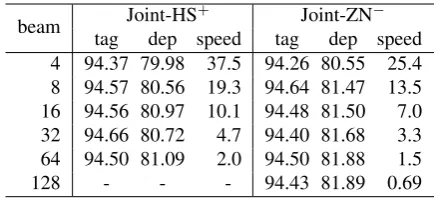
Table 4: Tagging and word-level dependency ac-curacies and parsing speed (in sentence/second) on the development set with respect to beam size.
Model tag word non-root root compl. Parser-HS (100) 85.15 85.61 75.76 34.50 Parser-ZN− 85.77 86.18 77.46 34.99 Pipeline-HS 94.15 78.10 78.49 70.03 26.77 Pipeline-ZN− 78.67 78.92 73.32 27.90 Joint-HS+ 94.56∗ 80.97∗ 81.32 73.64 29.51 Joint-ZN− 94.50∗ 81.88∗ 82.21 74.94 30.26 Table 5: Development result of the proposed mod-els. Joint-HS+/ZN−perform better than
Pipeline-HS/ZN− in terms of both tagging and
word-level dependency accuracies, with statistical sig-nificance of p < 0.05 (denoted by ∗) by MeNe-mar’s test.
4.3 Development Results
Table 4 shows the tagging and word-level depen-dency accuracies of the joint models with respect to the beam size, where “tag” and “dep” show the tagging and word-level dependency accura-cies, and “speed” is the joint parsing speed (in sentence per second). Based on this experiment, we use the beam size of 16 for Joint-HS+ and 64 for Joint-ZN−in the following experiments.2 The
best dependency accuracies are achieved after 36-th and 31-st iterations, respectively.
Table 5 shows the performance of the base-line and joint models on the development set, where “Pipeline-HS” and “Pipeline-ZN+” are the pipeline combinations of the baseline tagger with Parser-HS and Parser-ZN+, respectively. Joint-HS+ and JointZN− have 0.35–0.41% (tagging)
and 2.87–3.21% (word-level dependency) higher accuracies than the pipeline models.
Table 6 shows feature ablation results on the de-velopment set, where “wo/delay”, “wo/dp”, and “wo/syn” correspond to the models that do not use the delayed features, dynamic programming, and syntactic features, respectively. Overall, the
2Due to limited time, the beam size of 32 is used for
Joint-ZN−for the feature ablation experiment shown in Table 6.
Model default wo/delay wo/dp wo/syn Joint-HS+ tag 94.56
±0.00 −0.06 +0.04 dep 80.97 −0.26 −0.22 −0.60 Joint-ZN− tag 94.40 +0.10 +0.05 −0.07 dep 81.68 −0.16 −0.01 −0.23
Table 6: Feature ablation results for the joint mod-els on the development set.
Model tag word root compl. speed Huang+ ’10
(100)
85.20 78.32 33.72 -Zhang+ ’11 86.0 - 36.9 -Li-11-2nd 86.18 78.58 34.02 5.8
Parser-HS 85.12 78.30 32.77 32.7 Parser-ZN− 85.96 80.87 35.03 9.0 Li-11(v2,3rd) 92.80 80.79 75.84 29.11 0.3
Li-11(v1,3rd) 92.89 80.69 75.90 29.06 0.5
Li-11(v1,2nd) 93.08 80.74 75.80 28.24 1.7
Pipeline-HS 93.82 77.13 72.59 25.13 32.7† Pipeline-ZN− 78.04 75.55 26.07 9.0† Joint-HS+ 94.01∗ 79.83∗ 73.86 27.85 9.5 Joint-ZN− 93.94 81.33∗ 77.93 29.90 1.5 Table 7: Final result of the proposed model and the baseline. ∗ denotes the statistical significance
over the corresponding pipeline model (p <0.05). †Only the parsing speed is shown; the tagging
speed was 210.6 sentence/sec.
tagging accuracies are only slightly affected by the ablation of these features (with differences no larger than 0.10%), while the parsing accuracies decreased in most settings. The ablation of the delayed features resulted in 0.26% and 0.16% de-creases of word-level dependency accuracies for Joint-HS+ and Joint-ZN−, showing the
effective-ness of these features. The contribution of the dynamic programming is clearly shown for Joint-HS+with 0.22% improvement in dependency ac-curacy, although no meaningful effect for Joint-ZN−is confirmed; this is probably because the use
of richer features results in less frequent packing of states. Lastly, the ablation of the syntactic fea-tures results in as much as 0.60% and 0.23% de-creases of dependency accuracies for Joint-HS+ and Joint-ZN−. As opposed to our first
expecta-tion, the syntactic features made little effect on the tagging accuracies; on the contrary, the result sug-gests that capturing the dependencies between the stack elements and the next word’s tag is quite ef-fective to improve parsing accuracy.
4.4 Final Results
“Li-error pattern #↓ total error pattern #↑ total NN→VV 61 169 VV→NN 29 128 DEC→DEG 35 65 NN→NR 16 64 DEG→DEC 19 72 JJ→NN 14 62 NN→JJ 11 59 VA→VV 8 12 P→CC 8 13 JJ→NR 6 2 P→VV 8 18 NR→JJ 6 4
Table 8: POS tagging error patterns that decrease (left side) and increase (right side) by joint decod-ing (on dev. set). The numbers of errors made by the baseline tagger (“total”) and the increases and decreases by Joint-ZN+(#↓and #↑) are shown.
11(. . .)” shows the graph-based models by Li et al.
(2011), where v1/2 and 2nd/3rdcorrespond to their
version 1/2 and second-/third-order models. The joint models Joint-HS+ and Joint-ZN− achieve
improvements of 0.19% and 0.12% in tagging ac-curacy over the baseline tagger, and 2.70% and 3.29% improvements in word-level dependency accuracy over the pipeline models, showing the ef-fectiveness of the joint approach. Furthermore, the tagging and parsing accuracies of Joint-ZN−
sur-pass the graph-based models by Li et al. (2011), achieving the new state-of-the-art performance on this joint task. Since our framework is at least comparable in speed to their models, these results suggest that our incremental framework is suitable to this joint task.
4.5 Discussion and Analysis
Table 8 shows the increase and decrease of er-ror patterns of Joint-ZN−over the baseline tagger.
Notably, the joint model has a clear advantage in the disambiguation of DEC and DEG and the dis-crimination of NN from VV. While these tags are those that critically influence the overall syntac-tic structure, the increased error patterns include those tags that are considered less important3 in
deciding the syntactic structure (e.g. NN/NR: gen-eral/proper nouns); this observation is largely sim-ilar to those reported by Li et al. (2011).
It is noteworthy that we obtained the first pos-itive result that the joint decoding does improve POS tagging, while, in contrast, Li et al. (2011) have reported that the joint decoding has negative effect on the tagging accuracy: their third-order models have 0.6–0.7% lower tagging accuracies than their baseline tagger. When comparing our error patterns with those of their model, although the overall increase and decrease of the error
pat-3although VV
→NN errors look like an exceptional case
terns look largely similar, our model has a rela-tively smaller number of increased error patterns than the decreased ones. Therefore, by selectively improving syntactically-important tags, our joint model is considered to have improved the POS tagging accuracy over the baseline tagger.
5 Related Works
In recent years, joint segmentation and tagging have been widely investigated (e.g. Zhang and Clark (2010); Kruengkrai et al. (2009); Zhang and Clark (2008a); Jiang et al. (2008a); Jiang et al. (2008b)). Particularly, our framework of using a single perceptron to solve the joint problem is mo-tivated by Zhang and Clark (2008a). Also, our joint parsing framework is an extension of Huang and Sagae (2010)’s framework, which is described in detail in Section 2.2. In constituency pars-ing, the parsing naturally involves the POS tagging since the non-terminal symbols are commonly as-sociated with POS tags (e.g. Klein and Manning (2003)). Rush et al. (2010) proposed to use dual composition to combine a constituency parser and a trigram POS tagger, showing the effectiveness of taking advantage of these two systems.
In dependency parsing, Lee et al. (2011) re-cently proposed a discriminative graphical model that solves morphological disambiguation and de-pendency parsing jointly. However, their main fo-cus was to capture interaction between morphol-ogy and syntax in morphologically-rich, highly-inflected languages (such as Latin and Ancient Greek), which are unlike Chinese. More recently, Li et al. (2011) proposed the first joint model for Chinese POS tagging and dependency parsing in a graph-based parsing framework, which is one of our baseline systems. On the other hand, our work is the first incremental approach to this joint task. 6 Conclusion
References
Michael Collins and Brian Roark. 2004. Incre-mental parsing with the perceptron algorithm. InProceedings of ACL.
Michael Collins. 2002. Discriminative training methods for hidden markov models: Theory and experiments with perceptron algorithms. In Proceedings of EMNLP.
Xiangyu Duan, Jun Zhao, and Bo Xu. 2007. Probabilistic parsing action models for multi-lingual dependency parsing. In Proceedings of the CoNLL Shared Task Session of EMNLP-CoNLL 2007.
Lyn Frazier and Keith Rayner. 1982. Making and correcting errors during sentence comprehen-sion: Eye movements in the analysis of struc-turally ambiguous sentences. Cognitive Psy-chology, 14:178–210.
Liang Huang and Kenji Sagae. 2010. Dynamic programming for linear-time incremental pars-ing. InProceedings of ACL.
Wenbin Jiang, Liang Huang, Qun Liu, and Yajuan Lu. 2008a. A cascaded linear model for joint Chinese word segmentation and part-of-speech tagging. InProceedings of ACL/HLT.
Wenbin Jiang, Haitao Mi, and Qun Liu. 2008b. Word lattice reranking for Chinese word seg-mentation and part-of-speech tagging. In Pro-ceedings of COLING.
Dan Klein and Christopher D. Manning. 2003. Accurate unlexicalized parsing. InProceedings of ACL.
Canasai Kruengkrai, Kiyotaka Uchimoto, Jun’ichi Kazama, Yiou Wang, Kentaro Torisawa, and Hitoshi Isahara. 2009. An error-driven word-character hybrid model for joint Chinese word segmentation and POS tagging. In ACL, Pro-ceedings of ACL.
John Lee, Jason Naradowsky, and David A. Smith. 2011. A discriminative model for joint morpho-logical disambiguation and dependency pars-ing. InProceedings of ACL.
Zhenghua Li, Min Zhang, Wanxiang Che, Ting Liu, Wenliang Chen, and Haizhou Haizhou. 2011. Joint models for Chinese POS tagging and dependency parsing. In Proceedings of EMNLP.
Joakim Nivre. 2008. Algorithms for deterministic incremental dependency parsing. Comput. Lin-guist., 34:513–553.
Alexander M. Rush, David Sontag, Michael
Collins, and Tommi Jaakkola. 2010. On dual decomposition and linear programming relax-ations for natural language processing. In Pro-ceedings of EMNLP.
Andreas Stolcke. 1995. An efficient probabilis-tic context-free parsing algorithm that computes prefix probabilities. Computational Linguistics, 21:165–201.
Weiwei Sun. 2011. A stacked sub-word model for joint chineseword segmentation and part-of-speech tagging. InProceedings of ACL. Masaru Tomita. 1991. Generalized LR Parsing.
Kluwer Academic Publishers.
Fei Xia. 2000. The part-of-speech tagging guide-lines for the penn chinese treebank (3.0). Tech-nical Report IRCS-00-07, University of Penn-sylvania Institute for Research in Cognitive Sci-ence Technical Report, October.
Yue Zhang and Stephen Clark. 2008a. Joint word segmentation and POS tagging using a single perceptron. InProceedings of ACL-08: HLT. Yue Zhang and Stephen Clark. 2008b. A tale
of two parsers: investigating and combining graph-based and transition-based dependency parsing using beam-search. In Proceedings of EMNLP.
Yue Zhang and Stephen Clark. 2010. A fast decoder for joint word segmentation and POS-tagging using a single discriminative model. In Proceedings of EMNLP.


![Clinical and cost effectiveness of mechanical support for severe ankle sprains: design of a randomised controlled trial in the emergency department [ISRCTN 37807450]](data:image/gif;base64,R0lGODlhAQABAIAAAP///wAAACH5BAEAAAAALAAAAAABAAEAAAICRAEAOw==)