156
Internet Of Things (Iot) Based Garbage Clearing
System Nodemcu
1Assistant Prof. R.L.Tirupatamma,
2E.Haritha,
3K.Thri Sandhya,
4G.Sampath,
5Ch.Venkata Krishna
Electronics and Communication Engineering, waste management. It impacts the health and environment of our society. It may cause numerous severe diseases for the nearby people. This will humiliate the appraisal of the affected area. The garbage monitoring and clearing are one of the primary problems of the present era. The present methods used for monitoring and clearing the garbage are time consuming process. They will take more human effort, time and cost which can easily be avoided with our present technologies. It requires ‗smartness based waste management system. This paper is proposed IoT based garbage clearing system using NodeMcu. The garbage cleaning system checks the waste level over the dustbins by using Sensor systems. Once it detected immediately this system altered to concern authorized through SMS. For this system used NodeMcu as an interface between the sensor system and SMS server. To monitor and integrate an IP based web server is developed for the desired information which is related to the various level of waste in different locations. This is used in the greenish in the environment and support for Swatch Baharat for cleanness.Keywords—WiFi Wireless network, NodeMCU, SMS Server, Internet of Things (IoT), HTTP Post.
1. INTRODUCTION
Presently many existing expertise mechanism are available for handling as well as managing garbage. But, there is lacking for gathering information is a major challenging task. This miscommunication will affect the fast national growth rate in dense suburban area and also it is increasing demand for urban ecological protection. This is a major Challenging in waste management system to create a prototype because the lack of coordination among government, people and local authority for shipping and processing waste. Currently the waste gathering is conventional which acquire a lot of labors and is time overwhelming process.
In Bengaluru kind of city affected a cruel garbage crisis since August 2012 onwards, as two dumpsites in the suburbs of the urban were close by villagers against weakening the ecological and health situation. The municipality came to be idle as huge kind of garbage put down spotted on lane and open plot cross urban. The crisis condition pressed the Bruhat Bengaluru MahanagaraPalike (BBMP) to make amend in route near sustainable devastate organization exercise. The BBMP determined to impose waste parting and distribute waste processing to redirect squander left from the landfills and endeavor. During which BBMP initiated and gave emphasis on many programs such as Information Education and Communication (IEC) campaign and Wake-Up Clean-Up Campaign. IEC campaign was established to endorse waste isolation at base. technology about the garbage gathering and clearance from their area. The government had made a public awareness through daily and electronic media for cleanness program. This program was theoretical exhibition about the waste management by bringing in cooperation all the people including administration authority, mass producer, business place, NGOs and ecological association, firm squander specialist, service contributor and society at outsized in to one stage and construct great size agreement about sustainable dissipate organization exercise.
157 new direction for integrating IOT for green
environment by cleaning the garbage.
2. PURPOSE
Internet of Things (IoT) garbage clearing system using NodeMcu is cost effective device for garbage clearing. This system does is it gives a real
time indicator of the garbage level in a waste bin at any given time. Using the data from smart device, we can then optimize waste collection routes and ultimately reduce fuel consumption. It allows garbage bin collectors to plan their daily/weekly pick up schedule.
Figure 1: IoT based Garbage clearing system
3. HARDWARE USED
A. NodeMCU
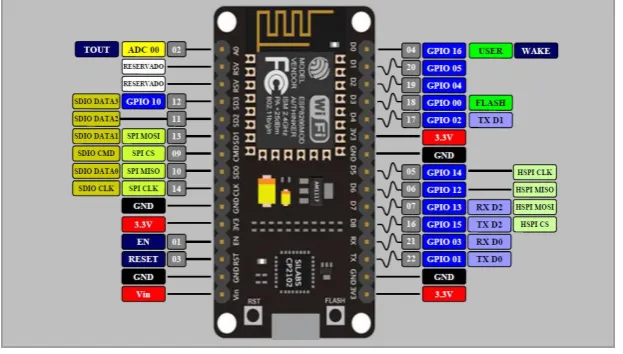
NodeMcu consist of both microcontroller and Wi-Fi module on single chip. It can be configured as router or station mode. When NodeMcu hosts the application, it is able to boot up directly from an external flash. It has integrated
cache memory to improve the performance of the system, and to minimize the memory requirements. With the Wi-Fi station mode, wireless internet access can be added to microcontroller-based applications with simple connectivity through UART interface.
Figure 2: NodeMCU.
B. Ultrasonic Sensor
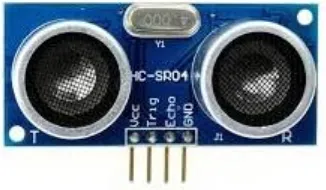
Ultrasonic sensors are used for distance measuring system. These sensors regularly transmit a short burst of ultrasonic sound to a target, which
158 to the target using the speed of sound within the medium.
Figure 3: Ultrasonic Sensor
Features: Ultrasonic Sensor
Input Supply voltage: 5V (DC). Input Supply current: 15mA.
Transmit Modulation frequency: 40Hz. Output voltage: 0 – 5V (Output high when
obstacle detected in its range).
Transmit Beam Angle: Max 15 degree. Maximum measurable Distance: 2cm –
400cm.
Accuracy in distance: 0.3cm. Communication: Positive TTL pulse.
C. Force Sensor
The Force sensor acts as a force sensing resistor in an electrical circuit. When the force sensor is force free, its resistance is very high. When a force is applied to this, there is a proportional decrease in resistance. It is used to measurement of loads.
Figure 4: Force Sensor
Features: Of Force Sensor
Force sensor sizes: Max=20‘‘x24‘‘ Min=0.2‘‘x0.2‘‘.
Force sensor Device thickness: 0.008‘‘ to 0.50‘‘.
Force sensor force sensitivity range < 100g to >10kg
Force sensor temperature range: -30C to +70C
D. Wi-Fi Router
159 Wi-Fi Router Features:
High Capacity Load Balancing Scalability
Network Management System Role Based Access Control
Indoor as well as Outdoor coverage options
Ability to Measure Performance Network Access Control
Ability to communicate with both 2.4 GHz devices and 5 GHz devices
Figure 5: Wi-Fi Router
E. Regulated Power Supply
A regulated power supply is an embedded circuit. It converts unregulated AC into a constant
DC. Rectifier converts AC supply into DC. Its function is to supply a stable 5V, 1Amp.
Figure 5: Regulated Power Supply
F. Sms Web Server
SMS Web Server is an application programming interface (API). It uses standard internet protocols. SMS Web Server is completely vendor, platform and language independent, enabling multiple methods of connection.
160 Figure 6: SMS WEB SERVER
G. Led Indicators
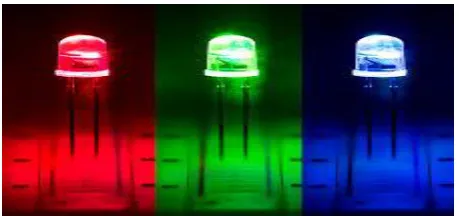
A light-emitting diode (LED) is a semiconductor light source that emits light when
current flows through it. These are used for the status of the system and waste Bin
Figure 7: LED INDICATORS
4.
IoT Based Garbage CollectorIn the proposed system, the level of garbage in the dustbins is detected with the help of Ultrasonic sensor. Force sensor is used to measure the weight of the garbage bin. When the measured value of sensors exceeds a certain threshold value Then red led becomes ON (i.e.it indicates dustbin is filled else green led is ON) this information with Google maps location where the dust bin is located is communicated to android device through SMS Server. Android device will detects, in which area dustbin is located, by comparing coordinates and updates the location and inform the respective vehicle to collect the waste. NodeMcu is used to interface the sensor system with SMS Server. This will help in managing the garbage collection efficiently.
161 Figure 7: Block diagram of Garbage Clearing System
H. Motivation
The key motivation is in achieving efficiency in at the national level. The organization is inadequate to address the existing identified problems in garbage clearing. There is no community participation towards management of garbage clearing and sanitation. Effective guideline garbage clearing must be provided to the public according to the regional requirements and constraints. This job can be done by NGOs present in the area. In order to maintain clean and hygienic environment in the area around us, we are using the technology for better garbage monitoring system.
5. SYSTEM IMPLIMENTATION
The system is implemented with the help of different modules which are explained in this section.
I. User settings
The user opens the web page with 192.168.4.1 IP address, after successful connection with correct system SSID and password.
He has to enter Correct Router SSID and Password which has external internet. User has to provide authorized person
mobile Number and Geo-Location using Google Maps.
Tirumala Engineering College Geo Location from Google maps
https://goo.gl/maps/DiotwVKkw3T2
Figure 10: User Setting page
J. Status Indicators
Once the user login successfully he would be able to access the information like status and location of the bin to mobile and IP address.
Two LEDs green and red will be placed on the bin.
162 Figure 11: Status Indicators at bin
K. SMS
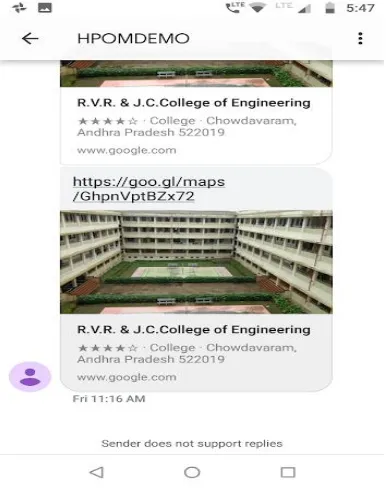
The Web Server sends a message saying that the dust bin is filled along with the position i.e.,
latitude and longitude of the bin to the garbage collectors number.
Figure 12: SMS received from system
6. RESULTS AND DISCUSSIONS
The hardware components should be connected properly and the Wi-Fi Router should be placed near to Bin to provide signals to NodeMcu.When the user clicks on the Map button, he will be taken to the Google Maps where the location of the bin is displayed.
7. CONCLUTION
In the entire world, garbage cleaning is a major challenging one. If it is not properly dispose or cleaned which will causes lot of deceases and
163 doing his part in maintain a clean environment
around him. A web server is also been set up through which the municipal authorities also get information about the garbage bins in their area.
8. FUTURE WORK
This paper is providing lot of opportunity for improvement and future scope. In this project, the following enhancements can be made.
This project is made for demo concern; it can be taken to product level
It can be made durable, by making it compact and cost effective
All the components and controlling unit can be embedded on the bin
Two bins can be placed to collect wet and dry waste separately. Wet garbage can be decomposed and used for making biogas. In future we can design android application
to find the nearest bin to users
REFERENCES
[1] BelalChowdhury, Morshed U Chowdhury ―RFIDbased Real-time Smart Waste Management System‖,
In 2007 Australasian Telecommunication Networks and Applications Conference December 2nd – 5th 2007, Christchurch, New Zealand.
[2] SauroLonghi, DavideMarzioni†, EmanueleAlidor, Gianluca Di Bu` o, Mario Prist, Massimo Grisostomi and MatteoPirro ―Solid Waste Management Architecture using Wireless Sensor Network technology‖ in Universit`aPolitecnicadelle
Marche, Dipartimento di
Ingegneriadell‘Informazione Via BrecceBianche. snc, 60131 Ancona, Italy 2012.
[3] ShubhamThakker, R.Narayanamoorthi, ―Smart and Wireless Waste Management‖ in IEEE Sponsored 2nd
International Conference on Innovations in Information Embedded and Communication Systems 2015.
[4] Andrei Borozdukhin, Olga Dolinina and VitalyPechenkin, ―Approach to the Garbage Collection in the Smart Clean City Project‖ in, Yuri Gagarin State Technical University of Saratov, Saratov, Russia 2016.
[5] Belal Chowdhury, Morshed U Chowdhury, "RFID-based Real-time Smart Waste Management System", 2007 Australasian Telecommunication Networks and Applications Conference, December 2nd-5th 2007.
[6] Abhay Shankar Bharadwaj, Rainer Rego, AnirbanChowdhury, ―IoT Based Solid Waste Management System‖ in Frugal Labs Tech Solutions Private Limited, Bengaluru, Karnataka, India 2016.
[7] Jetendra Joshi, Joshitha Reddy, Praneeth Reddy, Akshay Agarwal, Rahul Agarwal, Amrit Bagga, Abhinandan Bhargava, "Cloud Computing Based Smart Garbage Monitoring System", 2016 3rd International Conference on Electronic Design (ICED), August 11–12, 2016.
[8] Dr.N.Sathish Kumar, B.Vijaylakshmi, R. Jenifer Prathana, A. Shankar, ―IOT Based Smart Garbage alert system using Arduino UNO‖ IEEE 2016.
[9] GaikwadPrajakta, JadhavKalyani, MachaleSnehal, ―Smart Garbage Collection System in Residential
Area‖ in IJRET: International Journal of Research in Engineering and Technology, March 2015.
[10] Kanchan Mahajan, Prof.J.S.Chitode, ―Waste Bin Monitoring System Using Integrated Technologies‖ in
IJERT: International Journal of Innovative Research in Science, Engineering and Technology, July 2014.