A Meta-Algorithm for the Generation of Referring Expressions
Emiel Krahmer, Sebastiaan van Erk and Andr´e Verleg
TU/e, Eindhoven University of Technology,
The Netherlands
email:
[email protected]
Abstract
This paper describes a new approach to the generation of referring expres-sions. We propose to formalize a scene as a labeled directed graph and describe content selection as a subgraph con-struction problem. Cost functions are used to guide the search process and to give preference to some solutions over others. The resulting graph al-gorithm can be seen as a meta-alal-gorithm in the sense that defining cost functions in different ways allows us to mimic — and even improve— a number of well-known algorithms.
1
Introduction
The generation of referring expressions is one of the most common tasks in natural language generation, and has been addressed by many re-searchers in the past two decades (including Ap-pelt 1985, Dale 1992, Reiter 1990, Dale & Had-dock 1991, Dale & Reiter 1995, Horacek 1997, Stone & Webber 1998, Krahmer & Theune 1999 and van Deemter 2000). As a result, there are many different algorithms for the generation of referring expressions, each with its own object-ives: some aim at producing the shortest possible description, others focus on efficiency or realistic output. The degree of detail in which the various algorithms are described differs considerably, and as a result it is often difficult to compare the vari-ous proposals. In addition, most of the algorithms
are primarily concerned with the generation of de-scriptions only using properties of the target ob-ject. Consequently, the problem of generating re-lational descriptions (i.e., descriptions which in-corporate references to other objects to single out the target object) has not received the attention it deserves.
Malouf 2000) in a single algorithm.
The outline of this paper is as follows. In sec-tion 2, we describe how scenes can be described as labeled directed graphs and show how content se-lection can be formalized as a subgraph construc-tion problem. Secconstruc-tion 3 contains a sketch of the branch and bound algorithm, which is illustrated with a worked example. In section 4 it is argued that by defining cost functions in different ways, we can mimic various well-known algorithms for the generation of referring expressions. We end with some concluding remarks in section 5.
2
Graphs
Consider the following scene:
Figure 1: An example scene
In this scene, as in any other scene, we see a finite set of entities with properties and relations . In this particular scene, the set
is the set of entities, !
dog, chihuahua, doghouse, small, large, white, brown is the set of properties and"# next to, left of, right of, contain, in is the set of relations. A scene can be represented in various ways. One common representation is to build a database, listing the properties of each element of :
$%
Here we take a different approach and represent a scene as a labeled directed graph. Let ()*,+-be the set of la()*,+-bels (with and disjoint, i.e.,
/.0 1 ). Then, a labeled directed graph
2
4365798;: , where 5=<> is the set of vertices (or nodes) and8?<@5BAC(DAE5 is the set of labeled
directed arcs (or edges). The scene given in Fig-ure 1 can be represented by the graph in FigFig-ure 2. Keep in mind that the labels are only added to ease reference to nodes. Notice also that proper-ties (such as being a dog) are always modelled as loops, i.e., edges which start and end in the same node, while relations may (but need not) have dif-ferent start and end nodes.
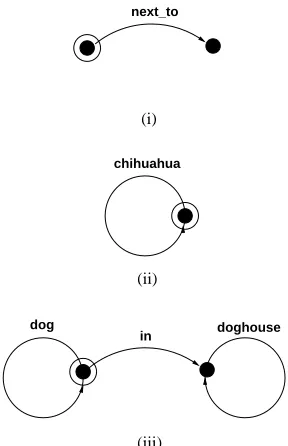
Now the content determination problem for re-ferring expressions can be formulated as a graph construction task. In order to decide which in-formation to include in a referring expression for an object ?FG5 , we construct a connected dir-ected labeled graph over the set of labels ( and an arbitrary set of nodes, but including . This graph can be understood as the “meaning repres-entation” from which a referring expression can be generated by a linguistic realizer. Informally, we say that a graph refers to a given entity iff the graph can be “placed over” the scene graph in such a way that the node being referred to is “placed over” the given entity and each edge can be “placed over” an edge labeled with the same la-bel. Furthermore, a graph is distinguishing iff it refers to exactly one node in the scene graph.
Consider the three graphs in Figure 3. Here and elsewhere circled nodes stand for the intended ref-erent. Graph (i) refers to all nodes of the graph in Figure 2 (every object in the scene is next to some other object), graph (ii) can refer to bothH and , and graph (iii) is distinguishing in that it can only refer to H. Notice that the three graphs might be realized as something next to something else, a chihuahua and the dog in the doghouse re-spectively. In this paper, we will concentrate on the generation of distinguishing graphs.
Formally, the notion that a graph I
365KJL98MJN: can be “placed over” another graph
2
O365QPR98MP7: corresponds to the notion of a sub-graph isomorphism. I can be “placed over”
2
iff there exists a subgraph
2MS
O365 PUT98 PUT: of
2
such thatI is isomorphic to
2 S
. I is isomorphic to 2 S
iff there exists a bijectionVXWY5 J[Z 5 PUT such that for all nodes\]9^?F_5 J and all`aFb(
c
\]`d9^;efFb8 J@g
c
Vihj\Q`d9Vihj^;ekFb8 PUT
In words: the bijective function V maps all the nodes inI to corresponding nodes in
2 S
lm
Figure 2: A graph representation of Figure 1.
tu vw
Figure 3: Some graphs for referring expressions, with circles around the intended referent.
and^ inI is matched by an edge with the same label between the
2 S
counterparts of\ and^ , i.e.,
Vihj\ andVihj^ respectively. WhenI is isomorphic to some subgraph of2
by an isomorphismV , we writeI~
, we define that the pair
c
\]9Ie refers to the pair
c
^L
2
e iff I is connected and
I ~k
2
and Vihj\ ^ . Furthermore,
c
different from^ such that
c
e. The problem considered in this paper can now be formalized as follows: given a graph2
\]9Ie uniquely refers to
c
^L
2
e .
Consider, for instance, the task of finding a pair
c
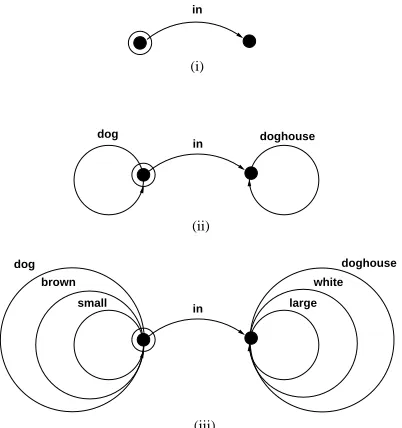
\Q9Ie which uniquely refers to the node labeled in Figure 2. It is easily seen that there are a number of such pairs, three of which are depic-ted in Figure 4. We would like to have a mechan-ism which allows us to give certain solutions pref-erence over other solutions. For this purpose we shall use cost-functions. In general, a cost func-tion is a function which assigns to each sub-graph of a scene sub-graph a positive number. As we shall see, by defining cost functions in different ways, we can mimic various algorithms for the generation of referring expressions known from the literature.
A note on problem complexity The basic de-cision problem for subgraph isomorphism (i.e., testing whether a graphI is isomorphic to a sub-graph of 2
Figure 4: Three distinguishing node-graph pairs referring toH in Figure 2.
restriction does not reduce the theoretical com-plexity. However, as soon as we define an up-per bound on the number of edges in a distin-guishing graph, the problem loses its intractability and becomes solvable in polynomial
c
e time. Such a restriction is rather harmless for our cur-rent purposes, as it would only prohibit the gen-eration of distinguishing descriptions with more than properties, for an arbitrary large . In general, there are various classes of graphs for which the subgraph isomorphism problem can be solved much more efficiently, without postulating upper bounds. For instance, if
2
andI are planar graphs the problem can be solved in time linear in the number of nodes of 2
(Eppstein 1999). Ba-sically, a planar graph is one which can be drawn on a plane in such a way that there are no cross-ing edges (thus, for instance, the graph in Figure 2 is planar). It is worth investigating to what ex-tent planar graphs suffice for the generation of re-ferring expressions.
3
Outline of the algorithm
In this section we give a high-level sketch of the algorithm. The algorithm (called
make-ReferringExpression) consists of two main
components, a subgraph construction algorithm (called findGraph) and a subgraph isomorphism testing algorithm (called matchGraphs). We
assume that a scene graph
2
36598;: is given. The algorithm systematically tries all relevant subgraphsI of the scene graph by starting with the subgraph containing only the node \ (the target object) and expanding it recursively by trying to add edges from2
which are adjacent to the subgraph I constructed so far. In this way we know that the results will be a connected sub-graph. We refer to this set of adjacent edges as the
I neighbors in
2
(notation:
2
.neighbors(I )). The algorithm returns the cheapest distinguishing subgraph I which refers to \ , if such a distin-guishing graph exists, otherwise it returns the empty graph0"31Y1: .
3.1 Cost functions
We use cost functions to guide the search process and to give preference to some solutions over oth-ers. If I 365 J 98 J : is a subgraph of ming over the costs associated with the nodes and edges of H. Formally:
We require the cost function to be monotonic. That is, adding an edge to a (non-empty) graph can never result in a cheaper graph. Formally:
¦§2;S
This assumption helps reducing the search space substantially, since extensions of subgraphs with a cost greater than the best subgraph found so far can safely be ignored. The costs of the empty, un-defined graph are infinite, i.e.
c
©ea«ª .
3.2 Worked example
We now illustrate the algorithm with an example. Suppose the scene graph
2
is as given in Figure 2, and that we want to generate a referring expres-sion for object H in this graph. Let us assume for the sake of illustration that the cost function is defined in such a way that adding a node or an edge always costs 1 point. Thus: for each\¬F5QP and for each
Here and elsewhere, we use the following notation. Let
makeReferringExpression(\ ) bestGraph := ;
I := 3Á\] 1: ;
return findGraph(\ , bestGraph, I );
findGraph(\ , bestGraph,I )
if (bestGraph.cost ¨)I .cost) then return bestGraph fi; distractors :=
Â
F
2
hnodesà matchGraphs
c
\]9I
2
eUÃ ÅÄ
Æ\] ;
if (distractors =1 ) then returnI fi;
for each edge F
2
.neighbors(I ) do
Ç
WÈ findGraph(\ , bestGraph, IÉ¡
¤
);
ifÇ
.cost¨ bestGraph.cost then bestGraph :=
Ç
fi; rof;
return bestGraph;
Figure 5: Sketch of the main function (makeReferringExpression) and the subgraph construction func-tion (findGraph).
ÊË
ÌÍ ÎÏ
in
ÐÑ ÒÓ
H =
H =
(i)
(ii)
(iii)
H =
chihuahua
left_of brown
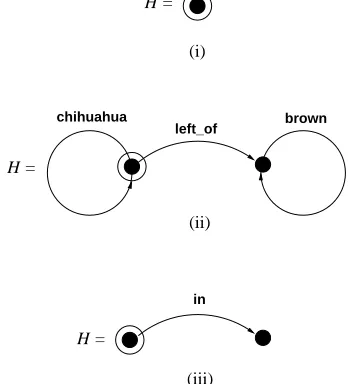
Figure 6: Three values for I in the generation process forH .
(In the next section we describe a number of more interesting cost functions and discuss the impact these have on the output of the algorithm.) We call the function makeReferringExpression (given in Figure 5) withH as parameter. In this function the variable bestGraph (for the best solution found so far) is initialized as the empty graph and the variable I (for the distinguishing subgraph un-der construction) is initialized as the graph
con-taining only node H ((i) in Figure 6). Then the function findGraph (see also Figure 5) is called, with parameters H , bestGraph and I . In this function, first it is checked whether the costs of
I (the graph under construction) are higher than the costs of the bestGraph found so far. If that is the case, it is not worth extending I since, due to the monotonicity constraint, it will never end up being cheaper than the current bestGraph. The initial value of bestGraph is the empty, undefined graph, and since its costs are astronomically high, we continue. Then the set of distractors (the ob-jects from which the intended referent should be distinguished, Dale & Reiter 1995) is calculated. In terms of the graph perspective this is the set of nodes in the scene graph
2
(other then the target node\ ) to which the graph I refers. It is easily seen that the initial value ofI , i.e., (i) in Figure 6, refers to every node in
2
. Hence, as one would expect, the initial set of distractors is 2
distract-matchGraphs(\ ,I ,^ , ) matching :=Vihj\ÕÆ^L ;
Ö
then return true fi; if
Ö
Æ1 then return false fi; choose a fresh, unmatched× from
Ö
ifÙ is a valid extension of the mapping
then if matchHelper(matching+ÛVihj׿*ÙH ,
Ö
Figure 7: Sketch of the function testing for subgraph isomorphism (matchGraphs).
ors are ruled out) or the costs ofI exceed the costs of the bestGraph found so far. While bestGraph is still the empty set (i.e., no distinguishing graph has been found yet), the algorithm continues un-tilI is a distinguishing graph. Which is the first distinguishing graph to be found (if one or more exist) depends on the order in which the adjacent edges are tried. Suppose for the sake of argument that the first distinguishing graph to be found is (ii) in Figure 6. This graph is returned and stored in bestGraph. The costs associated with this graph are 5 points (two nodes and three edges). At this stage in the generation process only graphs with lower costs are worth investigating, which yields a drastic reduction of the search space. In fact, there are only a few distinguishing graphs which cost less. After a number of iterations the algorithm will find the cheapest solution (given this particu-lar, simple definition of the cost function), which is (iii) in Figure 6.
3.3 Subgraph Isomorphism testing
Figure 7 contains a sketch of the part of the al-gorithm which tests for subgraph isomorphism, matchGraphs. This function is called each time the distractor set is calculated. It tests whether the
pair
c
\]9Ie can refer to
c
^L
2
e, or put differently, it checks whether there exists an isomorphism V such that I ~
2
with Vihj\BÜ^ . The function matchGraphs first determines whether the looping edges starting from node\ (i.e., the properties of
\ ) match those of^ . If not (e.g.,\ is a dog and ^ is a doghouse), we can immediately discard the matching. Otherwise we start with the matching
Vihj\G^ , and expand it recursively. Each recur-sion step a fresh and as yet unmatched node× from
I is selected which is adjacent to one of the nodes in the current matching. For each× we calculate the set Ø
of possible nodes in 2
to which × can be matched. This set consist of all the nodes in
2
which have the same looping edges as× and the same edges to and from other nodes in the domain of the current matching functionV :
Ø
The matching can now be extended withVihj×áÆÙ , for ÙâF
Ø
found which has exactly as much elements as I has nodes, we have found a subgraph isomorph-ism. If there are still unmatched nodes in I or if all possible extensions with a node× have been checked and no matching could be found, the test for subgraph isomorphism has failed.
3.4 A note on the implementation
The basic algorithm outlined in Figures 5 and 7 has been implemented in Java. Various optimiz-ations increase the efficiency of the algorithm, as certain calculations need not be repeated each iter-ation (e.g., the set 2
.neighbors(I )). In addition, the user has the possibility of specifying the cost function in a way which he or she sees fit.
4
Search methods and cost functions
Arguably, the algorithm outlined above is a meta-algorithm, since by formulating the cost func-tion in certain ways we can simulate various al-gorithms known from the generation literature.
4.1 Full (relational) Brevity Algorithm
The algorithm described in the previous section can be seen as a generalization of Dale’s (1992) Full Brevity algorithm, in the sense that there is a guarantee that the algorithm will output the shortest possible description, if one exists. It is also an extension of the Full Brevity algorithm, since it allows for relational descriptions, as does the Dale & Haddock (1991) algorithm. The latter algorithm has a problem with infinite recursions; in principle their algorithm could output descrip-tions like “the dog in the doghouse which con-tains a dog which is in a doghouse which ...etc.” Dale & Haddock propose to solve this problem by stipulating that a property or relation may only be included once. In the graph-based model de-scribed above the possibility of such infinite re-cursions does not arise, since a particular edge is either present in a graph or not.
ã
Notice incidentally that Dale’s (1992) Greedy Heuristic algorithm can also be cast in the graph framework, by sort-ing edges on their descriptive power (measured as a count of the number of occurrences of this particular edge in the scene graph). The algorithm then adds the most discrimin-ating edge first (or the cheapest, if there are various equally distinguishing edges) and repeats this process until a distin-guishing graph is found.
4.2 Incremental Algorithm
Dale & Reiter’s (1995) Incremental Algorithm, generally considered the state of the art in this field, has the following characteristic properties. (1) It defines a list of preferred attributes, list-ing the attributes which human speakers prefer for a certain domain. For example, when dis-cussing domestic animals, speakers usually first describe the “type” of animal (dog, cat), before absolute properties such as “color” are used. If that still is not sufficient to produce a distin-guishing description, relative properties such as “size” can be included. Thus, the list of preferred attributes for this particular domain could be
3 type, color, size: . The Incremental Algorithm now simply iterates through this list, adding a property if it rules out any distractors not pre-viously ruled out. (2) The algorithm always in-cludes the “type” attribute, even if it is not distin-guishing. And (3) the algorithm allows subsump-tion hierarchies on certain attributes (most notably for the “type” attribute) stating things like afox ter-rieris adog, and adogis ananimal. In such a hier-archy we can specify what the basic level value is (in this case it is dog). Dale & Reiter claim that there is a general preference for basic level values, and hence their algorithm includes the basic level value of an attribute, unless values subsumed by the basic level value rule out more distractors.
from an empirical point of view however, since in various domains it is very common to not in-clude type information, for instance when the do-main contains only objects of the same type (see van der Sluis & Krahmer 2001). (3) The subsump-tion hierarchy can be modelled in the same way as preferred attributes are: for a given attribute, the basic level value should have the lowest costs and the values farthest away from the basic level value should have the highest costs. This implies that adding an edge labeled dog is cheaper than adding an edge labeled chihuahua, unless more (or more expensive) edges are needed to build a distinguishing graph includingdogthan are re-quired for the graph includingchihuahua. Assum-ing that the scene representation is well-defined, the algorithm never outputs a graph which con-tains both dogandchihuahua, since there will al-ways be a cheaper distinguishing graph omitting one of the two edges.
So, we can recast the Incremental Algorithm quite easily in terms of graphs. Note that the original Incremental Algorithm only operates on properties, looped edges in graph terminology. It is worth stressing that when all edges in the scene graph are of the looping variety, testing for sub-graph isomorphism becomes trivial and we re-gain polynomial complexity. However, the above graph-theoretical formalization of the Incremental Algorithm does not fully exploit the possibilities offered by the graph framework and the use of cost functions. First, from the graph-theoretical per-spective the generation of relational descriptions poses no problems whatsoever, while the incre-mental generation of relational descriptions is by no means trivial (see e.g., Theune 2000, Krahmer & Theune 1999). In fact, while it could be argued to some extent that incremental selection of prop-erties is psychologically plausible, this somehow seems less plausible for incremental generation of relational extensions.
Notice that the use of a
&
As Dale & Reiter (1995:248) point out, redundant prop-erties are not uncommon. That is: in certain situations people may describe an object as “the white bird” even though the simpler “the bird” would have been sufficient (cf. Pech-mann 1989, see also Krahmer & Theune 1999 for discus-sion). However, a similar argument seems somewhat far-fetched when applied to relations. It is unlikely that someone would describe an object as “the dog next to the tree in front of the garage” in a situation where “the dog in front of the garage” would suffice.
cost function to simulate subsumption hierarch-ies for properthierarch-ies carrhierarch-ies over directly to relations; for instance, the costs of adding a edge labeled
next to should be less than those of adding one labeledleft oforright of. Hence,next towill be pre-ferred, unless usingleft oforright ofhas more dis-criminative power. Another advantage of the way the graph-based algorithm models the list of pre-ferred attributes is that more fine-grained distinc-tions can be made than can be done in the Incre-mental Algorithm. In particular, we are not forced to say that values of the attribute “type” are always preferred over values of the attribute “color”. In-stead we have the freedom to assign edges labeled with a common type value (e.g.,dog) a lower cost than edges labeled with uncommon colors (such asVandyke-brown), while at the same time edges labeled with obscure type values, such as polish owczarek nizinny sheepdog, can be given a higher cost than edges labeled with common colors such asbrown.
4.3 Stochastic cost functions
One of the important open questions in natural language generation is how the common, rule-based approaches to generation can be combined with recent insights from statistical NLP (see e.g., Langkilde & Knight 1998, Malouf 2000 for par-tial answers). Indeed, when looking at the Incre-mental Algorithm, for instance, it is not directly obvious how statistical information can be integ-rated in the algorithm. Arguably, this is differ-ent when we have cost functions. One can easily imagine deriving a stochastic cost function from a sufficiently large corpus and using it in the graph-theoretical framework (the result looks like but is not quite a Markov Model). As a first approxima-tion, we could define the costs of adding an edge
c¥¤
e in terms of the probability c¥¤
e that
¤
oc-curs in a distinguishing description (estimated by counting occurrences):
5
Concluding remarks
In this paper, we have presented a general graph-theoretical approach to content-determination for referring expressions. The basic algorithm has clear computational properties: it is NP com-plete, but there exist various modifications (a ban on non-looping edges, planar graphs, upper bound to the number of edges in a distinguish-ing graph) which make the algorithm polynomial. The algorithm is fully implemented. The graph perspective has a number of attractive proper-ties. The generation of relational descriptions is straightforward; the problems which plague some other algorithms for the generation of relational descriptions do not arise. The use of cost func-tions allows us to model different search meth-ods, each restricting the search space in its own way. By defining cost functions in different ways, we can model and extend various well-known al-gorithms from the literature such as the Full Brev-ity Algorithm and the Incremental Algorithm. In addition, the use of cost functions paves the way for integrating statistical information directly in the generation process.
Various important ingredients of other genera-tion algorithms can be captured in the algorithm proposed here as well. For instance, Horacek (1997) points out that an algorithm should not col-lect a set of properties which cannot be realized given the constraints of the grammar. This prob-lem can be solved, following Horacek’s sugges-tion, by slightly modifying the algorithm in such a way that for each potential edge it is immedi-ately investigated whether it can expressed by the realizer. Van Deemter’s (2000) proposal to gener-ate (distributional) distinguishing plural
descrip-'
A final advantage of the graph model certainly deserves further investigation is the following. We can look at a graph such as that in Figure 2 as a Kripke model. The advantage of this way of looking at it, is that we can use tools from modal logic to reason about these structures. For example, we can reformulate the problem of determining the content of a distinguishing description in terms of hybrid logic (see e.g., Blackburn 2000) as follows:
äiåçæNè
Aéêìëîí
±
é7ï#ð ä§ñÀæ]ò
In words: when we want to refer to nodeë, we are looking for
that distinguishing formula
æ
which is true of (“at”)ë but not
of anyé different fromë. One advantage of this perspective
is that logical properties which are usually considered prob-lematic from a generation perspective (such as not having a certain property), fit in very well with the logical perspective.
tions (such as the dogs) can also be modelled quite easily. Van Deemter’s algorithm takes as input a set of objects, which in our case, translates into a set of nodes from the scene graph. The algorithm should be reformulated in such a way that it tries to generate a subgraph which can refer to each of the nodes in the set, but not to any of the nodes in the scene graph outside this set. Krahmer & Theune (1999) present an extension of the Incremental Al-gorithm which takes context into account. They argue that an object which has been mentioned in the recent context is somehow salient, and hence can be referred to using fewer properties. This is modelled by assigning salience weights to ob-jects (basically using a version of Centering The-ory (Grosz et al. 1995) augmented with a recency effect), and by defining the set of distractors as the set of objects with a salience weight higher or equal than that of the target object. In terms of the graph-theoretical framework, one can easily ima-gine assigning salience weights to the nodes in the scene graph, and restricting the distractor set es-sentially as Krahmer & Theune do. In this way, distinguishing graphs for salient objects will gen-erally be smaller than those of non-salient objects.
Acknowledgements
Thanks are due to Alexander Koller, Kees van Deemter, Paul Piwek, Mari¨et Theune and two an-onymous referees for discussions and comments on an earlier version of this paper.
References
Appelt, D. (1985), Planning English Referring Expres-sions, Artificial Intelligence 26:1-33.
Blackburn, P. (2000), Representation, Reasoning, and Relational Structure: A Hybrid Logic Manifesto, Logic Journal of the IGPL 8(3):339-365.
Dale, R. (1992), Generating Referring Expressions: Constructing Descriptions in a Domain of Objects and Processes, MIT Press, Cambridge, Massachu-setts.
Dale, R. & N. Haddock (1991), Generating Refer-ring Expressions Involving Relations, Proceedings of EACL, Berlin, 161-166.
van Deemter, K. (2000), Generating Vague Descrip-tions, Proceedings INLG, Mitzpe Ramon.
Eppstein, D. (1999), Subgraph Isomorphism in Planar Graphs and Related Problems, J. Graph Algorithms and Applications 3(3):1-27.
Garey, M. & D. Johnson (1979), Computers and
Intractability: A Guide to the Theory of
NP-Completeness, W.H. Freeman.
Grosz, B., A. Joshi & S. Weinstein (1995), Centering: A Framework for Modeling the Local Coherence of Discourse, Computational Linguistics 21(2):203-225.
Horacek, H. (1997), An Algorithm for Generating Ref-erential Descriptions with Flexible Interfaces, Pro-ceedings of the 35th ACL/EACL, Madrid, 206-213.
Krahmer, E. & M. Theune (1999), Efficient Generation of Descriptions in Context, Proceedings of Work-shop on Generation of Nominals, R. Kibble and K. van Deemter (eds.), Utrecht, The Netherlands.
Langkilde, I. & K. Knight (1998), The Practical Value
of ó -Grams in Generation, Proceedings INLG,
Niagara-on-the-lake, Ontario, 248-255.
Malouf, R., (2000), The Order of Prenominal Adject-ives in Natural Language Generation, Proceedings of the 38th ACL , Hong Kong.
Pechmann, T. (1989), Incremental Speech Produc-tion and Referential OverspecificaProduc-tion, Linguistics 27:98–110.
Reiter, E. (1990), The Computational Complexity of Avoiding Conversational Implicatures, Proceedings of the 28th ACL , 97-104.
van der Sluis, I. & E. Krahmer (2001), Generating Referring Expressions in a Multimodal Context: An Empirically Motivated Approach, Proceedings CLIN, W. Daelemans et al. (eds), Rodopi, Amster-dam/Atlanta.
Stone, M. & B. Webber (1998), Textual Economy Through Close Coupling of Syntax and Semantics, Proceedings INLG, Niagara-on-the-lake, Ontario, 178-187.