Language Modeling for Spoken Dialogue System based on
Filtering using Predicate-Argument Structures
Koichiro Yoshino
1Shinsuke M ori
1Tatsu ya Kawahara
1 (1) School of Informatics, Kyoto University, Yoshida-Honmachi, Sakyo-ku, Kyoto, Japan.A
BSTRACTWe present a novel scheme of language modeling for a spoken dialogue system by effectively filtering query sentences collected via a Web site of wisdom of crowds. Our goal is a speech-based information navigation system by retrieving from backend documents such as Web news. Then, we expect that users make queries that are relevant to the backend documents. The relevance measure can be defined with cross-entropy or perplexity by the language model generated from the documents in a conventional manner. In this article, we propose a novel criteria that considers semantic-level information. It is based on predicate-argument (P-A) pairs and their relevance to the documents (or topic) is defined by a naive Bayes score. Experimental evaluations demonstrate that the proposed relevance measure effectively selects relevant sentences used for a language model, resulting in significant reduction of the word error rate of speech recognition as well as the semantic-level error rate.
1 Introduction
The tasks of spoken dialogue systems have been extended from simple transactions to general information navigation based upon user requests. Ideally, these systems should handle not only simple, keyword-based queries that current voice search systems respond to but also vague and complex user requests related to, for example, tourist guides or news briefings. This type of application can be achieved through document retrieval in a corresponding domain. For example, we can turn to tourist guidebooks or relevant Wikipedia entries for information on the tourist domain (Misu and Kawahara, 2010). An intelligent dialogue system can be created by restricting the domain and using the knowledge from that domain (Kawahara, 2009). An interactive news navigator that generates dialogues based on news article archives has been developed along this concept (Yoshino et al., 2011).
The automatic speech recognition (ASR) module for spoken dialogue systems (SDSs) needs an appropriate language model (LM) adapted to the task domain and style. Even an ASR system with a very large vocabulary cannot cover all proper nouns or named entities (NEs), which are critical in information retrieval. Ideally, an LM should be trained with a large-scale matched corpus, but in many cases this is not realistic. Therefore, two approaches are commonly adopted. The first involves mixing document texts of the target domain with a dialogue corpus of style expressions. The other involves collecting relevant texts, possibly from spoken-style sentences, from the Web (Sarikaya et al., 2005; Sethy et al., 2005; Misu and Kawahara, 2006; Bulyko et al., 2007). These approaches try to cover the target domain and style of speech in an indirect way, but the resultant model will inevitably contain a large amount of irrelevant texts.
In general, information navigation systems with speech interfaces have a set of backend documents for retrieval (Schalkwyk et al., 2010). These systems require matching between the backend documents and the user utterance. Based on this assumption, we define a similarity measure of collected sentences from the Web (=expected user utterances) with the backend documents, and select well-matched sentences for LM training.
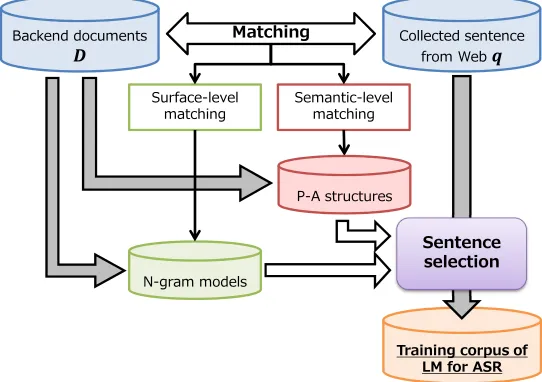
The overall flow of the proposed method is shown inFigure 1. In this paper, we assume two corpora: backend documents (D) and collected sentences (q) from the Web. Superficial matching, in which the method filters sentences based on the similarity in word sequences to the backend documents, is described in Section 2. N-gram model likelihood based on KL divergence is used in this method, and it is equivalent to the conventional perplexity-based method. In Section 3, we propose using deep semantic similarity based on P-A structures. This proposed method provides better filtering, considering not only surface words but also semantic cases. It is suitable forinformation navigation systems that require P-A structures. In Section 4, we propose the combined usage of the two filtering methods mentioned above. The method enables us to take both advantages of the two methods. We evaluate the conventional and proposed methods with ASR accuracy (word error rate (WER)), predicate-argument structure error rate (PAER), and test set perplexity in Section 5.
2 KL Divergence of N-gram Models
Backend documents
ࡰ
Training corpus of LM for ASR Collected sentence
from Web
MatchingSurface-level matching
Semantic-level matching
N-gram models
P-A structures
[image:3.420.82.353.75.266.2]Sentence selection
Figure 1: Overview of the proposed method
between two probability distributions (Kullback and Leibler, 1951). KL divergence of sentence
qand backend documentsDis defined as
K L(q||D) = X
m
Pq(wm)log2
Pq(wm)
PD(wm), (1) wherew1w2, ...,wnis the word sequence in sentenceq.PDandPqare the probability distribu-tions ofDandq. We define these probability distributions with n-gram (tri-gram) models. We assume that queryqconsists of one sentence, and most of the time the n-gram distribution trained from only one sentence becomes unique. Then, the probabilityPq(W)becomes to 1. We can then make the approximation to KL divergence:
K L(q||D) ≈ X m
log2 1
PD(wm) (2)
= −X
m
log2PD(wm). (3)
This formulation is equivalent to cross-entropyX E:
X E(q,D) = −X m
Pq(wm)log2PD(wm) (4)
≈ −X
m
log2PD(wm). (5)
The cross-entropy has two components: self information Pq(wm)and mutual information
can be mapped to the definition of perplexityP P.
H(q,D) = −1n n X
m=1
log2PD(wm). (6)
P P(q,D) = 2H(q,D). (7)
There is already a method to filter sentencesqbased on the perplexity defined with targeted backend documentsD(Misu and Kawahara, 2006). In this approach, we construct an n-gram model from the backend documentsDand use the perplexity as a superficial similarity measure. This is equivalent to the KL divergence betweenqandD. We compute the perplexityP P(q,D)
to every collected sentence, and then rank them for the filtering.
3 Similarity based on Predicate-Argument Structure
In the conventional filtering method described in the previous section, the matching is performed using word-level similarity measure. However, it is difficult to select sentences that semantically match the backend documents because this method is based on surface information. This is problematic because information navigation systems work based on semantic structures of user utterance (Yoshino et al., 2011). We therefore propose a similarity measure based on P-A structures to select sentences that match the backend documents on the deep semantic level. In this section, our focus is on the semantic structures that are defined with P-A structures. In the conventional approach, the similarity measure is defined with a generative model
PD(wi). In this section, we adopt a discriminative approach and calculateP(D|wi)to predict the significant sentences.
3.1 Predicate-Argument Structure
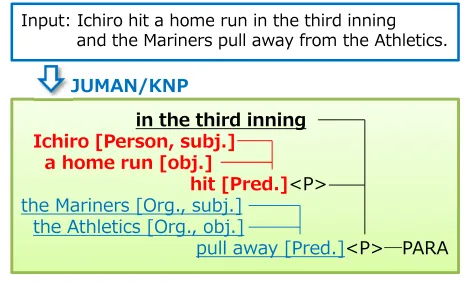
The P-A structure is automatically generated by a semantic parser (Figure 2). This P-A structure has a sub-structure that contains a predicate (wp), argument (wa), and its semantic case (ws) (called a “P-A pair”). The P-A structures consist of various arguments that depend on one predicate with its semantic case. We used the JUMAN/KNP1analyzer to parse sentences and obtain the structures automatically. However, not every P-A pair is meaningful in information navigation; actually, only a fraction of the patterns are useful. For example, in the baseball domain, key patterns include “[A (agent) beat B (object)]” and “[A (agent) hit B (object)]”, and in the business domain, “[A (agent) sell B (object)]” and “[A (agent) acquire B (object)]”. The useful information structure is depending on the domain, and information extraction techniques have been investigated (Grishman, 2003). Conventionally, templates for information extraction have been hand-crafted (Ramshaw and Weischedel, 2005), but this heuristic process is so costly that it cannot be applied to the wide variety of domains on the Web. A method to automatically define domain-dependent templates for information extraction to be used in a flexible information navigation system has been proposed (Yoshino et al., 2011).
3.2 Significance Measure based on P-A structures
We extract important P-A pairs from the backend documentsDand create matches between the extracted pairs and a question sentenceqto measure the similarity based on the semantic
in the third inning
Ichiro [Person, subj.]
a home run [obj.]
hit [Pred.]
<P>
the Mariners [Org., subj.]
the Athletics [Org., obj.]
pull away [Pred.]<P>─PARA
Input: Ichiro hit a home run in the third inningand the Mariners pull away from the Athletics.
[image:5.420.100.332.71.212.2]JUMAN/KNP
Figure 2: Example of predicate-argument (P-A) structure extraction.
significance. A previous study (Yoshino et al., 2011) has shown that an extraction method based on a Naive Bayes classifier is effective. In this method, the conditional probability of a documentD(e.g., baseball) given a wordwiis defined as
P(D|wi) =
C(wi,D) +xDγ
C(wi) +γ , (8) whereγis a smoothing factor estimated with a Dirichlet prior (Teh et al., 2006) using the Chinese Restaurant Processes (CRP). To calculate the conditional probabilities, we use sentences
¯
Dof other domains that are extracted at random with the same population ofD. xD, a normalization factor that depends on the size ofD, is defined as
xD = P
jC(wj,D) P
kC(wk)
. (9)
The P-A structure has a minimum sub-structure P-A pair (PAi) containing the predicate (wp), argument (wa), and its semantic case (ws). With the above definition, we define the conditional probabilityP(D|PAi)as
P(D|PAi) = p
P(D|wp,ws)×P(D|wa). (10)
3.3 Clustering of Named Entities
The statistical method often encounters the problem of data sparseness due to mismatch between the training set and the test set, especially with the named entities (NEs). To solve this problem, we cluster NEs that appear in the training set. NEs are one of the information structures that can be automatically generated by a semantic parser in accordance with a pre-defined category. An example of automatically labeled NEs is shown in theFigure 2, in which a labeler assigns person and organization labels to the entities.
Ichiro (agent) hit
Lopez (agent) hit
[image:6.420.78.325.71.177.2]Ichiro(agent) hit
[Person] (agent) hit Make summation to calculate score of clustered P-A template
These P-A structures have the same P-A patterns “[Person] (agent) hit”
Cluster P-A structures that have the same patterns.
∈ |
Figure 3: Clustering of named entities (NEs).
P-A pairs are clustered to the same template. We extend the probability of argumentP(wa)as
P(D|Ni) = X
k(wk∈Ni)
P(D|wk)P(wk), (11)
whereNiis the NE class that is included in argumentswa. This clustering enables us to reduce lexicon mismatches between the backend documentsDand question sentencesq, leading to more robust matching.
3.4 Filtering with P-A Templates
For each question sentenceq, we calculate the mean of everyP(D|PAi)contained in the sentence
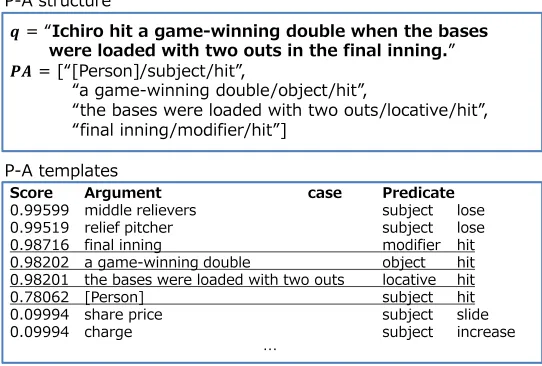
q, which is defined asP(D|qPA). An example of this scoring is shown inFigure 4. The input sentenceqhas four P-As. We take the mean of their scores to calculateP(D|qPA).
Every sentence is ranked withP(D|qPA), for selection to be used to train the LM for ASR. With this method, we can select sentences that are more relevant to the backend documents and more likely to be asked by users.
4 Combination of Sentence Selection Methods
We described two similarity measures for the backend documentsDand question sentencesqin Section 2 and 3. Considering their advantages, we propose a combination of the two methods using ranks and scores.
4.1 Method based on Sentence Rank
In this method, we sort question sentencesqwith the above-describedP P(q,D)andP(D|qPA) and rank them asP PrankandPArank. We then re-sort the sentences by summing the two ranks:
P Prank+PArank, for final selection.
4.2 A Method using Normalized Score
We re-define a new score by usingP P(q,D)and P(D|qPA). The range ofP(D|qPA)is 0<
Score Argument case Predicate 0.99599 middle relievers subject lose 0.99519 relief pitcher subject lose 0.98716 final inning modifier hit 0.98202 a game-winning double object hit 0.98201 the bases were loaded with two outs locative hit 0.78062 [Person] subject hit 0.09994 share price subject slide 0.09994 charge subject increase
…
= “Ichiro hit a game-winning double when the bases
were loaded with two outs in the final inning.”
ࡼ= [“[Person]/subject/hit”,
“a game-winning double/object/hit”,
“the bases were loaded with two outs/locative/hit”, “final inning/modifier/hit”]
[image:7.420.81.352.75.258.2]P-A templates P-A structure
Figure 4: An example ofP(D|qPA)calculation. sigmoid function.
P P0= 1
1+e−P P. (12)
A mixing ratio of 3:7 was set after a trial experiment.
5 Experimental Evaluation
We evaluated LMs constructed by the proposed methods with ASR. These LMs were constructed from selected sentences by using the four proposed filtering methods. We compared these models by using three indexes: word error rate (WER), predicate-argument structure error rate (PAER), and adjusted perplexity. PAER is based on the parsing accuracy of recognized sentences. Since the LMs have a different vocabulary size, we used adjusted perplexity, which penalizes smaller-vocabulary LMs.
5.1 Experimental Setting
We prepared an evaluation task using a news navigation system (Yoshino et al., 2011) in the professional baseball domain. Details of the test sets are shown inTable 1.
To trainP P(q,D)andP(D|qPA), we prepared backend documentsDof baseball articles from Mainichi newspaper articles (CD-Mainichi newspaper database 2000–2009). To train the LM for ASR, we used question-style sentencesqtaken from the baseball domain in the Yahoo! QA corpus2(a collection of queries on a Web site). The specification of the corpus are shown in Table 2. We used Julius3(Lee and Kawahara, 2001) as the ASR engine.
2This corpus was provided by Yahoo!JAPAN and National Institute of Informatics, Japan. 3http:
Table 1: Specification of test sets. Task Users Utterances News navigation 10 2,747
Table 2: Specification of training sets.
Usage Corpus Sentences
Backend documentsD Mainichi newspaper articles 176,852 Pool of sentencesqfor training Yahoo!QA entertainment: Baseball 403,602
WER
Corpus size
10.0 10.5 11.0 11.5 12.0 12.5 13.0 13.5
P(D|q_PA)
PP(q,D)
[image:8.420.90.319.211.354.2]PP_rank+PA_rank
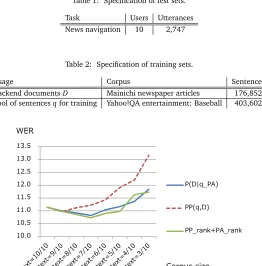
Figure 5: WER on news navigation task.
5.2 Experimental Results
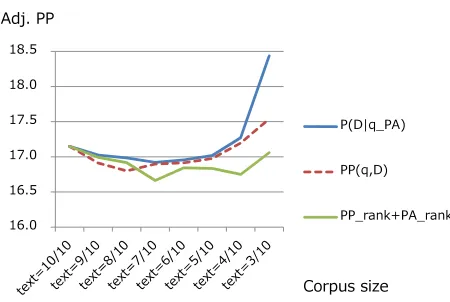
The WER, PAER, and adjusted perplexity results are shown inFigure 5, 6, and 7, respectively. The horizontal axes are the relative size of the training set. There was a significant difference between the proposed method (P(D|qPA), text=7/10) and the baseline (text=10/10, no filtering), with the significance level of less than 0.05 (p<0.05.) There is no significant difference between the proposed methodP(D|qPA)and the combinedP Prank+PArankrank or the combinedP P(q,D)andP(D|qPA)score. Only the combinedP Prank+PArankrank is shown in these graphs because there was not a distinguishable difference between the rank-based method and the normalized score-based method.
PAER
Corpus size
20.0 20.5 21.0 21.5 22.0 22.5 23.0 23.5
P(D|q_PA)
PP(q,D)
[image:9.420.104.330.70.214.2]PP_rank+PA_rank
Figure 6: PAER on news navigation task.
Adj. PP
Corpus size
16.0 16.5 17.0 17.5 18.0 18.5
P(D|q_PA)
PP(q,D)
PP_rank+PA_rank
Figure 7: Adjusted perplexity on news navigation task.
6 Conclusion
[image:9.420.104.329.247.398.2]References
Bulyko, I., Ostendorf, M., Siu, M., Ng, T., Stolcke, A., and Çetin, O. (2007). Web resources for language modeling in conversational speech recognition.ACM Trans. Speech Lang. Process., 5(1):1:1–1:25.
Grishman, R. (2003). Discovery methods for information extraction. InProc. ISCA & IEEE Workshop on Spontaneous Speech Processing and Recognition, pages 243–247.
Kawahara, T. (2009). New perspectives on spoken language understanding: Does machine need to fully understand speech? InProc. IEEE-ASRU, pages 46–50.
Kullback, S. and Leibler, R. (1951). On information and sufficiency.The Annals of Mathematical Statistics, 22(1):79–86.
Lee, A. and Kawahara, T. (2001). Julius–an open source real-time large vocabulary recognition engine. InProc. EuroSpeech, pages 1691–1694.
Misu, T. and Kawahara, T. (2006). A bootstrapping approach for developing language model of new spoken dialogue system by selecting web texts. InINTERSPEECH, pages 9–13. Misu, T. and Kawahara, T. (2010). Bayes risk-based dialogue management for document retrieval system with speech interface.Speech Communication, 52(1):61–71.
Ramshaw, L. and Weischedel, R. M. (2005). Information extraction. InIEEE-ICASSP, volume 5, pages 969–972.
Sarikaya, R., Gravano, A., and Gao, Y. (2005). Rapid language model development using external resources for new spoken dialog domains. InProc. ICASSP, volume 1, pages 573–576. Schalkwyk, J., Beeferman, D., Beaufays, F., Byrne, B., Chelba, C., Cohen, M., Garret, M., and Strope, B. (2010). Google search by voice: A case study.
Sethy, A., Georgiou, P. G., and Narayanan, S. (2005). Building Topic Specific Language Models from Webdata Using Competitive Models. InProc. Interspeech, pages 1293–1296.
Teh, Y. W., Jordan, M. I., Beal, M. J., and Blei, D. M. (2006). Hierarchical dirichlet processes.
Journal of the American Statistical Association, 101:1566–1581.