RTG based surface realisation for TAG
Claire Gardent CNRS/LORIA [email protected]
Laura Perez-Beltrachini Universit´e Henri Poincar´e/LORIA
Abstract
Surface realisation with grammars inte-grating flat semantics is known to be NP complete. In this paper, we present a new algorithm for surface realisation based on Feature Based Tree Adjoining Grammar (FTAG) which draws on the observation that an FTAG can be translated into a Reg-ular Tree Grammar describing its deriva-tion trees. We carry out an extensive test-ing of several variants of this algorithm using an automatically produced testsuite and compare the results obtained with those obtained using GenI, another FTAG based surface realiser.
1 Introduction
As shown in (Brew, 1992; Koller and Striegnitz, 2002), Surface Realisation is NP-complete. Var-ious optimisation techniques have therefore been proposed to help improve practical runtimes. For instance, (Kay, 1996) proposes to reduce the num-ber of constituents built during realisation by only considering for combination constituents with non overlapping semantics and compatible indices. (Kay, 1996; Carroll and Oepen, 2005; Gardent and Kow, 2007) propose various techniques to re-strict the combinatorics induced by intersective modifiers all applying to the same structure. And (Koller and Striegnitz, 2002; Gardent and Kow, 2007) describe two alternative techniques for re-ducing the initial search space.
In this paper, we focus on the optimisation mechanisms of two TAG based surface realisers namely, GENI (Gardent and Kow, 2007) and the
algorithm we present in this paper namely, RT-GEN(Perez-Beltrachini, 2009). GENI’s optimisa-tion includes both a filtering process whose aim is to reduce the initial search space and a two step, “substitution before adjunction”, tree combination phase whose effect is to delay modifier adjunc-tion thereby reducing the number of intermediate structures being built. In RTGEN on the other hand, the initial FTAG is converted to a Regu-lar Tree Grammar (RTG) describing its derivation trees and an Earley algorithm, including sharing and packing, is used to optimise tree combination. We compare GENIwith several variants of the proposed RTGEN algorithm using an
automati-cally produced testsuite of 2 679 input formulae and relate the RTGEN approach to existing work on surface realisation optimisation.
The paper is structured as follows. We first present the grammar used by bothGENIand
RT-GEN, namely SEMXTAG(Section 2). We then de-scribe the two surface realisation algorithms (Sec-tion 3). In Sec(Sec-tion 4, we describe the empirical evaluation carried out and present the results. Fi-nally, Section 5 situates RTGEN with respect to related work on surface realisation optimisation.
2 SemXTag
2.1 FTAG.
A Feature-based TAG (Vijay-Shanker and Joshi, 1988) consists of a set of (auxiliary or initial) el-ementary trees and of two tree-composition oper-ations: substitution and adjunction. Initial trees are trees whose leaves are labeled with substitu-tion nodes (marked with a downarrow) or termi-nal categories. Auxiliary trees are distinguished by a foot node (marked with a star) whose cate-gory must be the same as that of the root node. Substitution inserts a tree onto a substitution node of some other tree while adjunction inserts an aux-iliary tree into a tree. In an FTAG, the tree nodes are furthermore decorated with two feature struc-tures (called top and bottom) which are unified during derivation as follows. On substitution, the top of the substitution node is unified with the top of the root node of the tree being substituted in. On adjunction, the top of the root of the auxiliary tree is unified with the top of the node where ad-junction takes place; and the bottom features of the foot node are unified with the bottom features of this node. At the end of a derivation, the top and bottom of all nodes in the derived tree are unified. Finally, each sentence derivation in an FTAG is associated with both a derived tree rep-resenting the phrase structure of the sentence and a derivation tree recording how the correspond-ing elementary trees were combined to form the derived tree. Nodes in a derivation tree are la-belled with the name of a TAG elementary tree. Edges are labelled with a description of the opera-tion used to combine the TAG trees whose names label the edge vertices.
2.2 FTAG with semantics.
To associate semantic representations with natu-ral language expressions, the FTAG is modified as proposed in (Gardent and Kallmeyer, 2003).
NPj
John
name(j,john)
Sc
NP↓s VPcb
Vba
runs
run(a,s)
VPx
often VP*
often(x)
⇒name(j,john), run(a,j), often(a)
Figure 1: Flat Semantics for “John often runs”
Each elementary tree is associated with a flat semantic representation. For instance, in Fig-ure 1,1the trees for John, runs and often are asso-ciated with the semantics name(j,john), run(a,s) and often(x) respectively. Importantly, the argu-ments of a semantic functor are represented by unification variables which occur both in the se-mantic representation of this functor and on some nodes of the associated syntactic tree. For in-stance in Figure 1, the semantic index s occur-ring in the semantic representation of runs also occurs on the subject substitution node of the as-sociated elementary tree. The value of semantic arguments is determined by the unifications re-sulting from adjunction and substitution. For in-stance, the semantic indexsin the tree for runs is unified during substitution with the semantic in-dex labelling the root node of the tree for John. As a result, the semantics of John often runs is {name(j,john),run(a,j),often(a)}.
2.3 SemXTAG.
SEMXTAG is an FTAG for English augmented with a unification based compositional semantics of the type described above. Its syntactic cover-age approaches that of XTAG, the FTAG devel-oped for English by the XTAG group (The XTAG Research Group, 2001). Like this grammar, it contains around 1300 elementary trees and cov-ers auxiliaries, copula, raising and small clause constructions, topicalization, relative clauses, in-finitives, gerunds, passives, adjuncts, ditransitives and datives, ergatives, it-clefts, wh-clefts, PRO constructions, noun-noun modification, extraposi-tion, sentential adjuncts, imperatives and resulta-tives.
2.4 Converting SemXTAG to RTG
As shown in (Schmitz and Le Roux, 2008), an FTAG can be converted to a Regular Tree Gram-mar describing its derivation tree. In this section, we briefly sketch this conversion process. For a more precise description of this FTAG to RTG conversion, the reader is referred to (Schmitz and Le Roux, 2008).
1
Cx/Cx abbreviate a node with category C and a
top/bottom feature structure including the feature-value pair
In the FTAG-to-RTG conversion, each SEM X-TAG elementary tree is converted to a rule that
models its contribution to a TAG derivation tree. A TAG derivation involves the selection of an ini-tial tree, which has some nodes requiring substi-tution and some permitting adjunction. Let us think of the potential adjunction sites as requiring, rather than permitting, adjunction, but such that the requirement can be satisfied by ‘null’ adjunc-tion. Inserting another tree into this initial tree sat-isfies one of the substitution or adjunction require-ments, but introduces some new requirements into the resulting tree, in the form of its own substitu-tion nodes and adjuncsubstitu-tion sites.
Thus, intuitively, the RTG representation of a SEMXTAGelementary tree is a rule that rewrites
the satisfied requirement as a local tree whose root is a unique identifier of the tree and whose leaves are the introduced requirements. A requirement of a substitution or adjunction of a tree of root categoryX is written asXS orXA, respectively.
Here, for example, is the translation to RTG of the FTAG tree (minus semantics) for run in Figure 1, using the word anchoring the tree as its identifier (the upperscripts abbreviates features structures: b/t refers to the bottom/top feature structure and the upper case letters to the semantic index value,
[idx:X]is abbreviated toX):
SS[t:T]→runs(SA[t:T,b:C]N PS[t:S]V PA[t:C,b:B]VA[t:B,b:A])
The semantics of the SemXTAG tree are carried over as-is to the corresponding RTG rule. Fur-ther, the feature structures labelling the nodes of the SemXTAG tree are converted into the RTG rules so as to correctly interact with substitution and adjunction (see (Schmitz and Le Roux, 2008) for more details on this part of the conversion pro-cess).
To account for the optionality of adjunction, there are additional rules allowing any adjunction requirement to be rewritten as the symbolǫ, a ter-minal symbol of the RTG.
The terminal symbols of the RTG are thus the tree identifiers and the symbol ǫ, and its non-terminals are XS and XA for each terminal or
non-terminalXof SemXTAG.
3 TAG-based surface realisation
We now present RTGEN and describeGENI, and compare the optimisations they propose to deal with the task complexity.
GENIand RTGENare similar on several points.
They use the same grammar, namely SEMXTAG
(cf. Section 2). Further, they both pipeline three main steps. First, lexical selection selects from the grammar those elementary trees whose seman-tics subsumes part of the input semanseman-tics. Second, the tree combining phase systematically tries to combine trees using substitution and adjunction. Third, the retrieval phase extracts the yields of the complete derived trees, thereby producing the generated sentence(s).
GENIand RTGEN differ however with respect to the trees they are working with (derived trees inGENIvs derivation trees in RTGEN). They also differ in how tree combination is handled. We now describe these differences in more detail and ex-plain how each approach address the complexity issue.
3.1 GenI
The tree combining phase in GENI falls into two main steps namely, filtering and tree combining.
Filtering. The so-called polarity filtering step aims to reduce the initial search space. It elim-inates from the initial search space all those sets ofTAGelementary trees which cover the input
se-mantics but cannot possibly lead to a valid derived tree. In specific, this filtering removes all tree sets covering the input semantics such that either the category of a substitution node cannot be canceled out by that of the root node of a different tree; or a root node fails to have a matching substitu-tion site. Importantly, this filtering relies solely on categorial information – feature information is not used. Furthermore, auxiliary trees have no im-pact on filtering since they provide and require the same category thereby being “polarity neutral el-ements”.
present in the grammar. To handle intersective modifiers, the delayed modifiers insertion strategy from (Carroll et al., 1999) is adapted to TAG as follows. First, all possible derived trees are ob-tained using only substitution. Next, adjunction is applied. Although the number of intermediate structures generated is still2nfornmodifiers, this strategy has the effect of blocking these2n
struc-tures from multiplying out with other strucstruc-tures in the chart.
3.2 RTGen
RTGen synthesises different techniques that have been observed in the past to improve surface re-alisation runtimes. We first describe these tech-niques i.e., the main features of RTGEN. We then present three alternative ways of implement-ing RTGENwhich will be compared in the
evalu-ation.
3.2.1 RTGen’s main features
A main feature of RTGEN is that it focuses on building derivation rather than derived trees. More specifically, the first two steps of the surface real-isation process (lexical selection, tree combining) manipulate RTG rules describing the contribution of the SEMXTAG elementary trees to the deriva-tion tree rather than the elementary tree them-selves. The derived trees needed to produce actual sentences are only produced in the last phase i.e., the retrieval phase.
This strategy is inspired from a similar ap-proach described in (Koller and Striegnitz, 2002) which was shown to be competitive with state of the art realisers on a small sample of example in-put chosen for their inherent complexity. (Koller and Striegnitz, 2002)’s approach combines trees using a constraint based dependency parser rather than an Earley algorithm so that it is difficult to assess how much of the efficiency is due to the parser and how much to the grammar con-version. Intuitively however, the motivation un-derlying the construction of a derivation rather than a derived tree is that efficiency might be in-creased because the context free derivation trees (i) are simpler than the mildly context sensitive trees generated by an FTAG and (ii) permit draw-ing on efficient parsdraw-ing and surface realisation
al-gorithms designed for such grammars.
Second, RTGENmakes use of the now standard semantic criteria proposed in (Kay, 1996; Carroll et al., 1999) to reduce the number of combinations tried out by the realiser. On the one hand, two con-stituents are combined by the algorithm’s infer-ence rules only if they cover disjoint parts of the input semantics. On the other hand, the seman-tic indices present in both the input formula and the lexically retrieved RTG trees are used to pre-vent the generation of intermediate structures that are not compatible with the input semantics. For instance, given the input formula for “John likes Mary”, semantic indices will block the generation of “likes John” because this constituent requires that the constituent for “John” fills the patient slot of “likes” whereas the input semantics requires that it fills the agent slot. In addition, chart items in RTGENare indexed by semantic indices to
ef-ficiently select chart items for combination. Third, RTGEN implements a standard Earley algorithm complete with sharing and packing. Sharing allows for intermediate structures that are common to several derivations to be represented only once – in addition to not being recomputed each time. Packing means that partial derivation trees with identical semantic coverage and similar combinatorics (same number and type of substi-tution and adjunction requirements) are grouped together and that only one representative of such groups is stored in the chart. In this way, interme-diate structures covering the same set of intersec-tive modifiers in a different order are only repre-sented once and the negative impact of intersec-tive modifiers is lessened (cf. (Brew, 1992)). . As (Carroll and Oepen, 2005) have shown, packing and sharing are important factors in improving ef-ficiency. In particular, they show that an algorithm with packing and sharing clearly outtperforms the same algorithm without packing and sharing giv-ing an up to 50 times speed-up for inputs with large numbers of realizations.
3.2.2 Three ways to implement RTGen
reflect a different division of labour between con-straint solving and structure building. To experi-ment with these several configurations, we exploit the fact that the FTAG-to-RTG conversion proce-dure developed by Sylvain Schmitz permits spec-ifying which features should be preserved by the conversion.
RTGen-all. In this configuration, all the feature structure information present in the SEMXTAG el-ementary trees is carried over to the RTG rules. As a result, tree combining and constraint solving proceed simultaneously and the generated parse forest contains the derivation trees of all the out-put sentences.
RTGen-level0. In the RTGen-level0 configura-tion, only the syntactic category and the seman-tic features are preserved by the conversion. As a result, the grammar information used by the (derivation) tree building phase is comparable to that used by GENI filtering step. In both cases,
the aim is to detect those sets of elementary trees which cover the input semantics and such that all syntactic requirements are satisfied while no syn-tactic resource is left out. A further step is addi-tionally needed to produce only those trees which can be built from these tree sets when applying the constraints imposed by other features. In GENI, this additional step is carried out by the tree com-bining phase, in RTGEN, it is realised by the
ex-traction phase i.e., the phase that constructs the derived trees from the derivation trees produced by the tree combining phase.
RTGen-selective. Contrary to parsing, surface realisation only accesses the morphological lex-icon last i.e., after sentence trees are built. Be-cause throughout the tree combining phase, lem-mas are handled rather than forms, much of the morpho-syntactic feature information which is necessary to block the construction of ill-formed constituents is simply not available. It is therefore meaningful to only include in the tree combining phase those features whose value is available at tree combining time. In a third experiment, we au-tomatically identified those features from the ob-served feature structure unification failures during runs of the realisation algorithm. We then use only
these features (in combination with the semantic features and with categorial information) during tree combining.
4 Evaluation
To evaluate the impact of the different optimisa-tion techniques discussed in the previous secoptimisa-tion, we use two benchmarks generated automatically from SEMXTAG(Gottesman, 2009).
The first benchmark (MODIFIERS) was
de-signed to test the realisers on cases involving in-tersective modifiers. It includes 1 789 input for-mulae with a varying number (from 0 to 4 modifi-cations), type (N and VP modifications) and distri-bution of intersective modifiers (nmodifiers dis-tributed differently over the predicate argument structures). For instance, the formula in (1) in-volves 2 N and 1 VP modification. Further, it combines lexical ambiguity with modification complexities, i.e. for the snore modifier the gram-mar provides 10 trees.
(1) l1 : ∃(x1, hr, hs), hr ≥ l2, hs ≥ l3, l2 :
man(x1), l2 : snoring(e1, x1), l2 : big(x1), l3 :
sleep(e2, x1), l4:soundly(e2)
(A snoring big man sleeps soundly)
The second benchmark (COMPLEXITY) was designed to test overall performance on cases of differing complexity (input formulae of increas-ing length, involvincreas-ing verbs with a various number and types of arguments and with a varying num-ber of and types of modifiers). It contains 890 dis-tinct cases. A sample formula extracted from this benchmark is shown in (2), which includes one modification and to different verb types.
(2) h1 ≥ l4, l0 : want(e, h1), l1 : ∃(x1, hr, hs), hr ≥
l1, hs ≥l0, l1 :man(x1), l1 :snoring(e1, x1), l3 :
∃(x2, hp, hw, hu), hp ≥ l3, hw ≥ l4, hu ≥ l5, l3 :
monkey(x2), l4:eat(e2, x2, e3), l5:sleep(e3, x2)
(The snoring man wants the monkey to sleep)
To evaluateGENIand the various configurations
of RTGEN(RTGEN-all, RTGEN-level0, RTGEN -selective), we ran the 4 algorithms in batch mode on the two benchmarks and collected the follow-ing data for each test case:
• Unpacked chart size : the number of interme-diate and final structures available after un-packing (or at the end of the tree combining process in the case ofGENI).
• Initial Search Space (ISS) : the number of all possible combinations of elementary trees to be explored given the result of lexical selec-tion on the input semantics. That is, the prod-uct of the number of FTAG elementary trees selected by each literal in the input seman-tics.
• Generation forest (GF) : the number of derivation trees covering the input semantics.
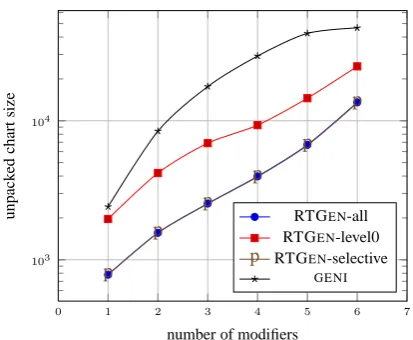
The graph in Figure 2 shows the differences be-tween the different strategies with respect to the unpacked chart size metric.
A first observation is that RTGEN-all outper-forms GENI in terms of intermediate structures built . In other words, the Earley sharing and packing strategy is more effective in reducing the number of constituents built than the filtering and substitution-before-adjunction optimisations used by GENI. In fact, even when no feature informa-tion is used at all (RTGEN-level0 plot), for more complex test cases, packing and sharing is more effective in reducing the chart size than filtering and operation ordering.
Another interesting observation is that RTGEN
-all and RTGEN-selective have the same impact on chart size (their plots coincide). This is unsurpris-ing since the features used by RTGEN-selective
have been selected based on their ability to block constituent combination. The features used in RTGEN-selective mode arewh,xp,assign-comp,
mode,definite,inv,assign-case,rel-clause,
extractedandphon, in addition to the categorial
and semantic information. In other words, using all 42 SEMXTAGgrammar features has the same impact on search space pruning as using only a small subset of them. As explained in the previ-ous section, this is probably due to the fact that contrary to parsing, surface realisation only ac-cesses the morphological lexicon after tree com-bining takes place. Another possibility is that the grammar is under constrained and that feature val-ues are missing thereby inducing overgeneration.
Zooming in on cases involving three modifiers,
0 1 2 3 4 5 6 7 p RTGEN-selective
GENI
Figure 2: Performance of realisation approaches on the MODIFIERSbenchmark, average unpacked chart size as a function of the number of modifiers.
we show in Table 1 the average results for various efficiency metrics2. This provides a more detail view of the performance of the differences among the three RTGENvariants.
strategy GF chart unpacked-chart seconds RTGen-all 15.05 918.31 2,538.98 0.99
RTGen-level0 1,118.06 2,018 6,898.28 1.41
RTGen-selective 27.08 910.34 2,531.23 0.44
Table 1: Average results on 610 test cases from the MODIFIERS benchmark. Each test case has 3 modifications, distributed in various ways be-tween adjectival and adverbial modifications. The second column, Generation Forest (GF), is the number of derivation trees present in the gener-ated parse forest. The third and fourth columns show the chart and unpacked chart sizes, respec-tively. The last column shows the runtime in sec-onds.
This data shows that running RTGEN with no feature information leads not only to an increased chart size but also to runtimes that are higher in average than for full surface realisation i.e., reali-sation using the full grammar complete with
con-2
0
Initial Search Space (ISS) size
u p RTGEN-selective
GENI
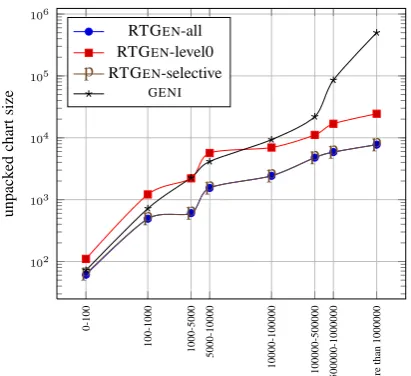
Figure 3: Performance of realisation approaches on the COMPLEXITY benchmark, average
un-packed chart size as a function of the ISS com-plexity.
straints.
Interestingly, it also shows that the selective mode (RTGEN-selective) permits improving run-times while achieving almost perfect disambigua-tion in that the average number of derivadisambigua-tion trees (GF) produced is close to that produced when using all features. The differences between the two generation forests stems from packing. Using only a subset of features favors packing, thereby reducing the number of chart items built, but in-troduces over- generation.
Graph 3 and Table 2 confirm the results ob-tained using the MODIFIERSbenchmark on a
test-set (COMPLEXITY) where input complexity varies not only with respect to modification but also with respect to the length of the input and to the de-gree of lexical ambiguity. Typically, in a TAG, one word or one semantic literal may be associated ei-ther with one tree or with up to several hundred trees (e.g., ditransitive verbs and verbs with sev-eral subcategorisation types). By varying the type and the number of verbs selected by the seman-tic literals contained in the input semanseman-tics, the COMPLEXITY benchmark provides a more exten-sive way to test performance on cases of varying complexity.
strategy GF chart unpacked-chart seconds RTGen-all 14.77 693.39 2,427.82 0.81
RTGen-level0 162.02 2,114.16 6,954.84 1.09
RTGen-selective 15.31 692.9 2,427.2 0.36
Table 2: Average results on 335 cases with
10000< ISS ≤100000, from the COMPLEXITY
benchmark. The columns show the same perfor-mance metrics as in Table 1.
5 Related work
Much work has already been done on optimising surface realisation. Because surface realisation often draws on parsing techniques, work on pars-ing optimisation is also relevant. In this section, we briefly relate our proposal to another gram-mar converting approach (Koller and Striegnitz, 2002); to another chart based approach (Carroll and Oepen, 2005); and to approaches based on statistical pruning (White, 2004; Bangalore and Rambow, 2000).
5.1 Optimising surface realisation
Encoding into another grammatical formalism.
As already mentioned, the RTGEN approach is closely related to the work of (Koller and Strieg-nitz, 2002) where the XTAG grammar is con-verted to a dependency grammar capturing its derivation trees. This conversion enables the use of a constraint based dependency parser, a parser which was specifically developed for the efficient parsing of free word order languages and is shown to support an efficient handling of both lexical and modifier attachment ambiguity.
Our proposal differs from this approach in three main ways. First, contrary to XTAG, SEM
re-stricted to a few hand constructed example inputs.
Chart generation algorithm optimisations.
(Carroll and Oepen, 2005) provides an extensive and detailed study of how various techniques used to optimise parsing and surface realisation impact the efficiency of a surface realiser based on a large coverage Head-Driven Phrase Structure grammar. Because they use different grammars, gram-mar formalisms and different benchgram-marks, it is difficult to compare the RTGEN and the HPSG approach. However, one point is put forward by (Carroll and Oepen, 2005) which it would be interesting to integrate in RTGEN(Carroll and
Oepen, 2005) show that for packing to be effi-cient, it is important that equivalence be checked through subsumption, not through equality. RT-GEN also implements a packing mechanism with subsumption check, i.e. different ways of cov-ering the same subset of the input semantics are grouped together and represented in the chart by the most general one. One difference however it that RTGEN will pack analyses together as long
as the new ones are more specific cases. It will not go backwards to recalculate the packing made so far if a more general item is found (Stefan and John, 2000). In this case the algorithm will pack them under two different groups.
Statistical pruning. Various probabilistic tech-niques have been proposed in surface realisation to improve e.g., lexical selection, the handling of intersective modifiers or ranking. For instance, (Bangalore and Rambow, 2000) uses a tree model to produce a single most probable lexical selec-tion while in White’s system, the best paraphrase is determined on the basis of n-gram scores. Fur-ther, to address the fact that there are n! ways to combine any n modifiers with a single con-stituent, (White, 2004) proposes to use a language model to prune the chart of identical edges rep-resenting different modifier permutations, e.g., to choose between fierce black cat and black fierce
cat. Similarly, (Bangalore and Rambow, 2000)
as-sumes a single derivation tree that encodes a word lattice (a{fierce black, black fierce}cat), and uses
statistical knowledge to select the best linearisa-tion. Our approach differs from these approaches in that lexical selection is not filtered, intersective
modifiers are handled by the grammar (constraints on the respective order of adjectives) and the chart packing strategy (for optimisation), and ranking is not performed. We are currently exploring the use of Optimality Theory for ranking.
6 Conclusion
We presented RTGEN, a novel surface realiser for FTAG grammars which builds on the observation that an FTAG can be translated to a regular tree grammar describing its derivation trees. Using automatically constructed benchmarks, we com-pared the performance of this realiser with that of
GENI, another state of the art realiser for FTAG. We showed that RTGEN outperforms GENI in
terms of space i.e. that the Earley sharing and packing strategy is more effective in reducing the number of constituents built than the filtering and substitution-before-adjunction optimisations used by GENI. Moreover, we investigated three ways of interleaving phrase structure and feature struc-ture constraints and showed that, given a naive constraint solving approach, the interleaving ap-proach with selective features seems to provide the best space/runtimes compromise.
Future work will concentrate on further investi-gating the interplay in surface realisation between phrase structure and feature structure constraints. In particular, (Maxwell and Kaplan, 1994) shows that a more sophisticated approach to constraint solving and to its interaction with chart process-ing renders the non interleaved approach more ef-fective than the interleaved one. We plan to exam-ine whether this observation applies to SEMXTAG
and RTGEN. Further, we intend to integrate Op-timality Theory constraints in RTGENso as
sup-port ranking of multiple outputs. Finally, we want to further optimise RTGEN on intersective modi-fiers using one the methods mentioned in Section 5.
References
Bangalore, S. and O. Rambow. 2000. Using TAGs, a tree model and a language model for generation. In Proceedings of TAG+5, Paris, France.
of the 14th conference on Computational linguistics, pages 610–616, Morristown, NJ, USA. Association for Computational Linguistics.
Carroll, J. and S. Oepen. 2005. High efficiency re-alization for a wide-coverage unification grammar. 2nd IJCNLP.
Carroll, J., A. Copestake, D. Flickinger, and V. Pazna´nski. 1999. An efficient chart generator for (semi-)lexicalist grammars. In Proceedings of EWNLG ’99.
Gardent, C. and L. Kallmeyer. 2003. Semantic con-struction in FTAG. In 10th EACL, Budapest, Hun-gary.
Gardent, C. and E. Kow. 2007. Spotting overgenera-tion suspect. In 11th European Workshop on Natu-ral Language Generation (ENLG).
Gottesman, B. 2009. Generating examples. Mas-ter’s thesis, Erasmus Mundus Master Language and Communication Technology, Saarbrucken/Nancy.
Kay, Martin. 1996. Chart generation. In Proceedings of the 34th annual meeting on Association for Com-putational Linguistics, pages 200–204, Morristown, NJ, USA. Association for Computational Linguis-tics.
Koller, A. and K. Striegnitz. 2002. Generation as de-pendency parsing. In Proceedings of the 40th ACL, Philadelphia.
Maxwell, J. and R. Kaplan. 1994. The interface be-tween phrasal and functional constraints. Computa-tional Linguistics, 19(4).
Perez-Beltrachini, L. 2009. Using regular tree grammars to reduce the search space in surface realisation. Master’s thesis, Erasmus Mundus Master Language and Communication Technology, Nancy/Bolzano.
Schmitz, S. and J. Le Roux. 2008. Feature uni-fication in TAG derivation trees. In Gardent, C. and A. Sarkar, editors, Proceedings of the 9th In-ternational Workshop on Tree Adjoining Grammars and Related Formalisms (TAG+’08), pages 141– 148, T¨ubingen, Germany.
Stefan, Oepen and Carroll John. 2000. Parser engi-neering and performance profiling. Journal of Nat-ural Language Engineering, 6(1):81–98.
The XTAG Research Group. 2001. A lexicalised tree adjoining grammar for english. Technical report, Institute for Research in Cognitive Science, Univer-sity of Pennsylvannia.
Vijay-Shanker, K. and AK Joshi. 1988. Feature Struc-tures Based Tree Adjoining Grammars. Proceed-ings of the 12th conference on Computational lin-guistics, 55:v2.