Citation Summarization Through Keyphrase Extraction
Vahed Qazvinian
Department of EECS University of Michigan
Dragomir R. Radev
School of Information and Department of EECS University of Michigan
Arzucan ¨Ozg ¨ur
Department of EECS University of Michigan
Abstract
This paper presents an approach to sum-marize single scientific papers, by extract-ing its contributions from the set of cita-tion sentences written in other papers. Our methodology is based on extracting sig-nificant keyphrases from the set of cita-tion sentences and using these keyphrases to build the summary. Comparisons show how this methodology excels at the task of single paper summarization, and how it out-performs other multi-document sum-marization methods.
1 Introduction
In recent years statistical physicists and computer scientists have shown great interest in analyzing complex adaptive systems. The study of such sys-tems can provide valuable insight on the behav-ioral aspects of the involved agents with potential applications in economics and science. One such aspect is to understand what motivates people to provide then+ 1streview of an artifact given that they are unlikely to add something significant that has not already been said or emphasized. Cita-tions are part of such complex systems where ar-ticles use citations as a way to mention different contributions of other papers, resulting in a col-lective system.
The focus of this work is on the corpora cre-ated based on citation sentences. A citation sen-tence is a sensen-tence in an article containing a ci-tation and can contain zero or more nuggets (i.e., non-overlapping contributions) about the cited ar-ticle. For example the following sentences are a
few citation sentences that appeared in the NLP literature in past that talk about Resnik’s work.
The STRAND system (Resnik, 1999), for example, uses structural markup information from the pages, without looking at their content, to attempt to align them.
Resnik (1999) addressed the issue of language identification for finding Web pages in the languages of interest.
Mining the Web for bilingual text (Resnik, 1999) is not likely to provide sufficient quantities of high quality data..
The set of citations is important to analyze be-cause human summarizers have put their effort collectively but independently to read the target article and cite its important contributions. This has been shown in other work too (Elkiss et al., 2008; Nanba et al., 2004; Qazvinian and Radev, 2008; Mei and Zhai, 2008; Mohammad et al., 2009). In this work, we introduce a technique to summarize the set of citation sentences and cover the major contributions of the target paper. Our methodology first finds the set of keyphrases that represent important information units (i.e., nuggets), and then finds the best set ofksentences to cover more, and more important nuggets.
Our results confirm the effectiveness of the method and show that it outperforms other state of the art summarization techniques. Moreover, as shown in the paper, this method does not need to calculate the full cosine similarity matrix for a document cluster, which is the most time consum-ing part of the mentioned baseline methods.
1.1 Related Work
2008; Mei and Zhai, 2008; Elkiss et al., 2008). Other work (Bradshaw, 2003; Bradshaw, 2002) benefits from citations to determine the content of articles and introduce “Reference Directed Index-ing” to improve the results of a search engine.
In other work, (Nanba and Okumura, 1999) an-alyze citation sentences and automatically cate-gorize citations into three groups using 160 pre-defined phrase-based rules to support a system for writing a survey. Previous research has shown the importance of the citation summaries in un-derstanding what a paper contributes. In partic-ular, (Elkiss et al., 2008) performed a large-scale study on citation summaries and their importance. Results from this experiment confirmed that the “Self Cohesion” (Elkiss et al., 2008) of a citation summary of an article is consistently higher than the that of its abstract and that citations contain additional information that does not appear in ab-stracts.
Kan et al. (2002) use annotated bibliographies to cover certain aspects of summarization and sug-gest using metadata and critical document features as well as the prominent content-based features to summarize documents. Kupiec et al. (1995) use a statistical method and show how extracts can be used to create summaries but use no annotated metadata in summarization.
Siddharthan and Teufel describe a new task to decide the scientific attribution of an article (Sid-dharthan and Teufel, 2007) and show high hu-man agreement as well as an improvement in the performance of Argumentative Zoning (Teufel, 2005). Argumentative Zoning is a rhetorical clas-sification task, in which sentences are labeled as one of Own, Other, Background, Textual, Aim, Basis, Contrast according to their role in the au-thor’s argument. These all show the importance of citation summaries and the vast area for new work to analyze them to produce a summary for a given topic.
The Maximal Marginal Relevance (MMR) summarization method, which is based on a greedy algorithm, is described in (Carbonell and Goldstein, 1998). MMR uses the full similarity matrix to choose the sentences that are the least similar to the sentences already selected for the summary. We selected this method as one of our
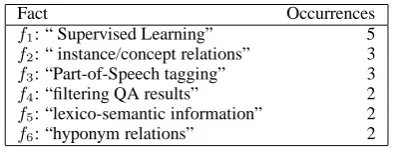
Fact Occurrences
f1: “ Supervised Learning” 5 f2: “ instance/concept relations” 3 f3: “Part-of-Speech tagging” 3 f4: “filtering QA results” 2 f5: “lexico-semantic information” 2 f6: “hyponym relations” 2
Table 2: Nuggets of P03-1001 extracted by anno-tators.
baseline methods, which we have explained in more details in Section 4.
2 Data
In order to evaluate our method, we use the ACL Anthology Network (AAN), which is a collec-tion of papers from the Computacollec-tional Linguistics journal and proceedings from ACL conferences and workshops and includes more than13,000 pa-pers (Radev et al., 2009). We use 25 manually an-notated papers from (Qazvinian and Radev, 2008), which are highly cited articles in AAN. Table 1 shows the ACL ID, title, and the number of cita-tion sentences for these papers.
The annotation guidelines asked a number of annotators to read the citation summary of each paper and extract a list of the main contribu-tions of that paper. Each item on the list is a non-overlapping contribution (nugget) perceived by reading the citation summary. The annota-tion strictly instructed the annotators to focus on the citing sentences to do the task and not their own background on the topic. Then, extracted nuggets are reviewed and those nuggets that have only been mentioned by 1 annotator are removed. Finally, the union of the rest is used as a set of nuggets representing each paper.
Table 2 lists the nuggets extracted by annotators for P03-1001.
3 Methodology
Our methodology assumes that each citation sen-tence covers 0 or more nuggets about the cited papers, and tries to pick sentences that maximize nugget coverage with respect to summary length.
ex-ACL-ID Title # citations
N03-1017 Statistical Phrase-Based Translation 180
P02-1006 Learning Surface Text Patterns For A Question Answering System 74 P05-1012 On-line Large-Margin Training Of Dependency Parsers 71 C96-1058 Three New Probabilistic Models For Dependency Parsing: An Exploration 66 P05-1033 A Hierarchical Phrase-Based Model For Statistical Machine Translation 65 P97-1003 Three Generative, Lexicalized Models For Statistical Parsing 55
P99-1065 A Statistical Parser For Czech 54
J04-4002 The Alignment Template Approach To Statistical Machine Translation 50 D03-1017 Towards Answering Opinion Questions: Separating Facts From Opinions ... 42
P05-1013 Pseudo-Projective Dependency Parsing 40
W00-0403 Centroid-Based Summarization Of Multiple Documents: Sentence Extraction, ... 31 P03-1001 Offline Strategies For Online Question Answering: Answering Questions Before They Are Asked 27 N04-1033 Improvements In Phrase-Based Statistical Machine Translation 24
A00-2024 Cut And Paste Based Text Summarization 20
W00-0603 A Rule-Based Question Answering System For Reading Comprehension Tests 19 A00-1043 Sentence Reduction For Automatic Text Summarization 19 C00-1072 The Automated Acquisition Of Topic Signatures For Text Summarization 19 W05-1203 Measuring The Semantic Similarity Of Texts 17 W03-0510 The Potential And Limitations Of Automatic Sentence Extraction For Summarization 15
W03-0301 An Evaluation Exercise For Word Alignment 14
A00-1023 A Question Answering System Supported By Information Extraction 13 D04-9907 Scaling Web-Based Acquisition Of Entailment Relations 12 P05-1014 The Distributional Inclusion Hypotheses And Lexical Entailment 10 H05-1047 A Semantic Approach To Recognizing Textual Entailment 8 H05-1079 Recognising Textual Entailment With Logical Inference 9
Table 1: List of papers chosen from AAN for evaluation together with the number of sentences citing each.
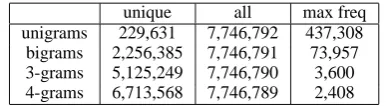
unique all max freq unigrams 229,631 7,746,792 437,308
bigrams 2,256,385 7,746,791 73,957 3-grams 5,125,249 7,746,790 3,600 4-grams 6,713,568 7,746,789 2,408
Table 3: Statistics on the abstract corpus in AAN used as the background data
pressed using N-grams, and thus these building units are the key elements to our summarization. For each citation sentence di, our method first ex-tracts a set of important keyphrases, Di, and then tries to find sentences that have a larger number of important and non-redundant keyphrases. In order to take the first step, we extract statistically sig-nificantly frequent N-grams (up toN = 4) from each citing sentence and use them as the set of representative keyphrases for that citing sentence.
3.1 Automatic Keyphrase Extraction
A list of keyphrases for each citation sentence can be generated by extracting N-grams that occur significantly frequently in that sentence compared to a large corpus of such N-grams. Our method for such an extraction is inspired by the previ-ous work by Tomokiyo and Hurst (Tomokiyo and Hurst, 2003).
A language model, M, is a statistical model that assigns probabilities to a sequence of N -grams. Every language model is a probability dis-tribution over allN-grams and thus the probabili-ties of allN-grams of the same length sum up to 1. In order to extract keyphrases from a text us-ing statistical significance we need two language models. The first model is referred to as the Back-ground Model (BM) and is built using a large text corpus. Here we build the BM using the text of all the paper abstracts provided in AAN1. The second language model is called the Foreground Model (FM) and is the model built on the text from which keyphrases are being extracted. In this work, the set of all citation sentences that cite a particular target paper are used to build a fore-ground language model.
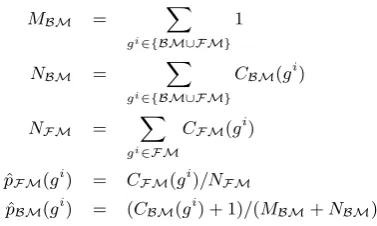
Letgi be anN-gram of sizeiandCM(gi) de-note the count ofgiin the modelM. First, we ex-tract the counts of eachN-grams in both the back-ground (BM) and the foreground corpora (FM).
MBM =
X
gi∈{BM∪FM}
1
NBM =
X
gi∈{BM∪FM}
CBM(gi)
NFM =
X
gi∈FM
CFM(gi)
ˆ
pFM(gi) = CFM(gi)/NFM
ˆ
pBM(gi) = (CBM(gi) + 1)/(MBM+NBM)
The last equation is also known as Laplace smoothing (Manning and Schutze, 2002) and han-dles the N-grams in the foreground corpus that have a 0 occurrence frequency in the background corpus. Next, we extract N-grams from the fore-ground corpus that have significant frequencies compared to the frequency of the same N-grams in the background model and its individual terms in the foreground model.
To measure how randomly a set of consecu-tive terms are forming anN-gram, Tomokiyo and Hurst (Tomokiyo and Hurst, 2003) use pointwise divergence. In particular, for anN-gram of sizei, gi= (w
1w2· · ·wi),
δgi(FMikFM1) = pˆFM(gi) log(
ˆ
pFM(gi)
Qi
j=1pˆFM(wj)
)
This equation shows the extent to which the terms forming gi have occurred together ran-domly. In other words, it indicates the extent of in-formation that we lose by assuming independence of each word by applying the unigram model, in-stead of theN-gram model.
In addition, to measure how randomly a se-quence of words appear in the foreground model with respect to the background model, we use pointwise divergence as well. Here, pointwise di-vergence defines how much information we lose by assuming thatgiis drawn from the background model instead of the foreground model:
δgi(FMikBMi) = pˆFM(gi) log(pˆFM(g i)
ˆ
pBM(gi))
(Corley and Mihalcea, 2005) applied or uti-lized lexical based word overlap measures.
{overlap measures, word overlap, lexical based, utilized lexical}
Table 4: Example: citation sentence for W05-1203 written by D06-1621, and its extracted bi-grams.
We set the criteria of choosing a sequence of words as significant to be whether it has posi-tive pointwise divergence with respect to both the background model, and individual terms of the foreground model. In other words we extract allgi fromFMfor which the both properties are posi-tive:
δgi(FMikBMi)>0
δgi(FMikFM1)≥0
The equality condition in the second equation is specifically set to handle unigrams, in which ˆ
pFM(gi) =Qij=1pˆFM(wj).
In order to handle the text corpora and build-ing the language models, we have used the CMU-Cambridge Language Model toolkit (Clarkson and Rosenfeld, 1997). We use the set of cita-tion sentences for each paper to build foreground language models. Furthermore, we employ this tool and make the background model using nearly 11,000 abstracts from AAN. Table 3 summarizes some of the statistics about the background data.
Once keyphrases (significantN-grams) of each sentence are extracted, we remove allN-grams in which more than half of the terms are stopwords. For instance, we remove all stopword unigrams, if any, and all bigrams with at least one stop-word in them. For 3-grams and 4-grams we use a threshold of 2 and 3 stopwords respectively. Af-ter that, the set of remainingN-grams is used to represent each sentence and to build summaries. Table 4 shows an example of a citation sentence from D06-1621 citing W05-1203 (Corley and Mi-halcea, 2005), and its extracted bigrams.
3.2 Sentence Selection
of N-grams, denoted by Di. Then, the goal is to pick sentences (sets) for each paper that cover more important and non-redundant keyphrases. Essentially, keyphrases that have been repeated in more sentences are more important and could rep-resent more important nuggets. Therefore, sen-tences that contain more frequent keyphrases are more important. Based on this intuition we define the reward of building a summary comprising a set of keyphrases Sas
f(S) =|S∩A|
where A is the set of all keyphrases from sen-tences not in the summary.
The set function f has three main properties. First, it is non-negative. Second, it is mono-tone (i.e., For every set v we have f(S +v) ≥ f(S)). Third,f is sub-modular. The submodular-ity means that for a setvand two setsS ⊆T we have
f(S+v)−f(S)≥f(T +v)−f(T)
Intuitively, this property implies that adding a set v toS will increase the reward at least as much as it would to a larger set T. In the summariza-tion setting, this means that adding a sentence to a smaller summary will increase the reward of the summary at least as much as adding it to a larger summary that subsumes it. The following theorem formalizes this and is followed by a proof.
Theorem 1 The reward functionfis submodular.
Proof
We start by defining a gain function G of adding sentence (set) Di toSk−1 where Sk−1 is the set
of keyphrases in a summary built usingk−1 sen-tences, andDiis a candidate sentence to be added:
G(Di,Sk−1) =f(Sk−1∪Di)−f(Sk−1)
Simple investigation through a Venn diagram proof shows thatGcan be re-written as
G(Di,Sk−1) =|Di∩(∪j6=iDj)− Sk−1|
Let’s denoteDi∩(∪j=6 iDj)by∩i. The follow-ing equations prove the theorem.
Sk−1⊆ Sk Sk′−1⊇ Sk′
∩i∩ Sk′−1⊇ ∩i∩ Sk′ ∩i− Sk−1 ⊇ ∩i− Sk | ∩i−Sk−1| ≥ | ∩i−Sk| G(Di,Sk−1)≥ G(Di,Sk)
f(Sk−1∪Di)−f(Sk−1)≥f(Sk∪Di)−f(Sk)
Here, S′
k is the set of all N-grams in the vo-cabulary that are not present in Sk. The gain of adding a sentence,Di, to an empty summary is a non-negative value.
G(Di,S0) =C ≥0
By induction, we will get
G(Di,S0)≥ G(Di,S1)≥ · · · ≥ G(Di,Sk)≥0
2
Theorem 1 implies the general case of submodu-larity:
∀m, n,0≤m≤n≤ |D| ⇒ G(Di,Sm)≥ G(Di,Sn)
Maximizing this submodular function is an NP-hard problem (Khuller et al., 1999). A common way to solve this maximization problem is to start with an empty set, and in each iteration pick a set that maximizes the gain. It has been shown be-fore in (Kulik et al., 2009) that iff is a submod-ular, nondecreasing set function and f(∅) = 0, then such a greedy algorithm finds a setS, whose gain is at least as high as (1 −1/e) of the best possible solution. Therefore, we can optimize the keyphrase coverage as described in Algorithm 1.
4 Experimental Setup
Summary generated using bigram-based keyphrases ID Sentence
P06-1048:1 Ziff-Davis Corpus Most previous work (Jing 2000; Knight and Marcu 2002; Riezler et al 2003; Nguyen et al 2004a; Turner and Charniak 2005; McDonald 2006) has relied on automatically constructed parallel corpora for training and evaluation purposes.
J05-4004:18 Between these two extremes, there has been a relatively modest amount of work in sentence simplification (Chandrasekar, Doran, and Bangalore 1996; Mahesh 1997; Carroll et al 1998; Grefenstette 1998; Jing 2000; Knight and Marcu 2002) and document compression (Daume III and Marcu 2002; Daume III and Marcu 2004; Zajic, Dorr, and Schwartz 2004) in which words, phrases, and sentences are selected in an extraction process. A00-2024:9 The evaluation of sentence reduction (see (Jing, 2000) for details) used a corpus of 500 sentences and their reduced forms in human-written abstracts. N03-1026:17 To overcome this problem, linguistic parsing and generation systems are used in the sentence condensation approaches of Knight and Marcu (2000)
and Jing (2000).
P06-2019:5 Jing (2000) was perhaps the first to tackle the sentence compression problem.
Table 5: Bigram-based summary generated for A00-1043.
Algorithm 1 The greedy algorithm for summary
generation
k←the number of sentences in the summary Di ←keyphrases indi
S ← ∅
forl= 1 tokdo
sl←arg maxDi∈D|Di∩(∪j6=iDj)|
S ← S ∪sl
forj= 1 to|D|do
Dj ←Dj−sl
end for end for returnS
nugget sets, each sentence was annotated with the nuggets it contains. This results in a sentence-fact matrix that helps with the evaluation of the summary. The summarization goal and the intu-ition behind the summarizing system is to select a few (5 in our experiments) sentences and cover as many nuggets as possible. Each sentence in a cita-tion summary may contain 0 or more nuggets and not all nuggets are mentioned an equal number of times. Covering some nuggets (contributions) is therefore more important than others and should be weighted highly.
To capture this property, the pyramid score seems the best evaluation metric to use. We use the pyramid evaluation method (Nenkova and Pas-sonneau, 2004) at the sentence level to evaluate the summary created for each set. We benefit from the list of annotated nuggets provided by the annotators as the ground truth of the summariza-tion evaluasummariza-tion. These annotasummariza-tions give the list of nuggets covered by each sentence in each citation summary, which are equivalent to the summariza-tion content unit (SCU) as described in (Nenkova
and Passonneau, 2004).
The pyramid score for a summary is calculated as follows. Assume a pyramid that hasntiers,Ti, where tierTi > Tj ifi > j (i.e.,Ti is not below Tj, and that if a nugget appears in more sentences, it falls in a higher tier.). TierTi contains nuggets that appeared inisentences, and thus has weight i. Suppose |Ti|shows the number of nuggets in tierTi, andQiis the size of a subset ofTiwhose members appear in the summary. Further suppose Qshows the sum of the weights of the facts that are covered by the summary. Q=Pni=1i×Qi. In addition, the optimal pyramid score for a sum-mary withXfacts, is
M ax=
n
X
i=j+1
i× |Ti|+j×(X− n
X
i=j+1 |Ti|)
wherej = maxi(Pnt=i|Tt| ≥ X). The pyra-mid score for a summary is then calculated as fol-lows.
P = Q M ax
This score ranges from 0 to 1, and a high score shows the summary contains more heavily weighted facts.
4.1 Baselines and Gold Standards
are basically a random selection of 5 sentences from the pool of sentences in the citation sum-mary. Generally we expect the summaries cre-ated by the greedy method to be significantly bet-ter than random ones.
In addition to the gold and random summaries, we also used 4 baseline state of the art sum-marizers: LexRank, the clustering C-RR and C-LexRank, and Maximal Marginal Relevance (MMR). LexRank (Erkan and Radev, 2004) works based on a random walk on the cosine similar-ity of sentences and prints out the most frequently visited sentences. Said differently, LexRank first builds a network in which nodes are sentences and edges are cosine similarity values. It then uses the eigenvalue centralities to find the most central sen-tences. For each set, the top 5 sentences on the list are chosen for the summary.
The clustering methods, C-RR and C-LexRank, work by clustering the cosine similarity network of sentences. In such a network, nodes are sen-tences and edges are cosine similarity of node pairs. Clustering would intuitively put nodes with similar nuggets in the same clusters as they are more similar to each other. The C-RR method as described in (Qazvinian and Radev, 2008) uses a round-robin fashion to pick sentences from each cluster, assuming that the clustering will put the sentences with similar facts into the same clus-ters. Unlike C-RR, C-LexRank uses LexRank to find the most salient sentences in each cluster, and prints out the most central nodes of each cluster as summary sentences.
Finally, MMR uses the full cosine similarity matrix and greedily chooses sentences that are the least similar to those already selected for the sum-mary (Carbonell and Goldstein, 1998). In partic-ular,
M M R= arg min di∈D−A
h
max dj∈A
Sim(di, dj)i
where A is the set of sentences in the summary, initially set to A = ∅. This method is different from ours in that it chooses the least similar sen-tence to the summary in each iteration.
4.2 Results and Discussion
As mentioned before, we use the text of the ab-stracts of all the papers in AAN as the
back-ground, and each citation set as a separate fore-ground corpus. For each citation set, we use the method described in Section 3.1 to extract signif-icantN-grams of each sentence. We then use the keyphrase set representation of each sentence to build the summaries using Algorithm 1. For each of the 25 citation summaries, we build 4 differ-ent summaries using unigrams, bigrams, 3-grams, and 4-grams respectively. Table 5 shows a 5-sentence summary created using algorithm 1 for the paper A00-1043 (Jing, 2000).
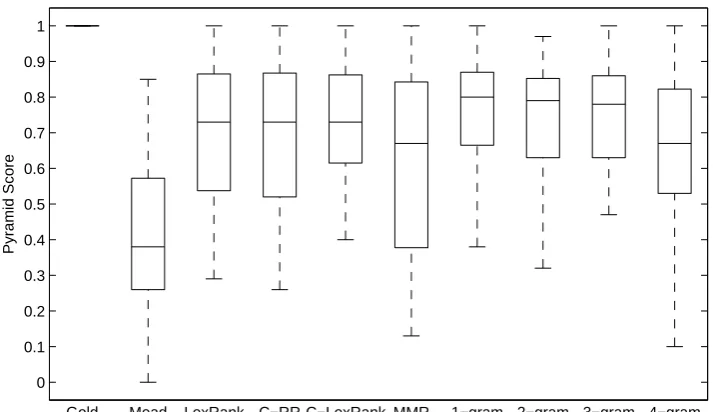
The pyramid scores for different methods are reported in Figure 1 together with the scores of gold standards, manually created to cover as many nuggets as possible in 5 sentences, as well as summary evaluations of the 4 baseline methods described above. This Figure shows how the keyphrase based summarization method when employing N-grams of size 3 or smaller, outperforms other baseline systems significantly. More importantly, Figure 1 also indicates that this method shows more stable results and low varia-tion in summary quality when keyphrases of size 3 or smaller are employed. In contrast, MMR shows high variation in summary qualities making sum-maries that obtain pyramid scores as low as 0.15.
Another important advantage of this method is that we do not need to calculate the cosine simi-larity of the pairs of sentences, which would add a running time ofO(|D|2|V|)in the number of
doc-uments,|D|, and the size of the vocabulary|V|to the algorithm.
5 Conclusion and Future Work
0 0.1 0.2 0.3 0.4 0.5 0.6 0.7 0.8 0.9 1
Gold Mead LexRank C−RR C−LexRank MMR 1−gram 2−gram 3−gram 4−gram
Pyramid Score
Figure 1: Evaluation Results (summaries with 5 sentences): The median pyramid score over 25 datasets using different methods.
greedy algorithm will result in a near-optimum set of covered nuggets using only 5 sentences. Our experiments in this paper confirm that the sum-maries created based on the presented algorithm are better than randomly generated summary, and also outperform other state of the art summariza-tion methods in most cases. Moreover, we show how this method generates more stable summaries with lower variation in summary quality whenN -grams of size 3 or smaller are employed.
A future direction for this work is to perform post-processing on the summaries and re-generate sentences that cover the extracted nuggets. How-ever, the ultimate goal is to eventually develop systems that can produce summaries of entire research areas, summaries that will enable re-searchers to easily and quickly switch between fields of research.
One future study that will help us generate better summaries is to understand how nuggets are generated by authors. In fact, modeling the nugget coverage behavior of paper authors will help us identify more important nuggets and dis-cover some aspects of the paper that would
oth-erwise be too difficult by just reading the paper itself.
6 Acknowledgements
This work is in part supported by the National Science Foundation grant “iOPENER: A Flexi-ble Framework to Support Rapid Learning in Un-familiar Research Domains”, jointly awarded to University of Michigan and University of Mary-land as IIS 0705832, and in part by the NIH Grant U54 DA021519 to the National Center for Inte-grative Biomedical Informatics.
Any opinions, findings, and conclusions or rec-ommendations expressed in this paper are those of the authors and do not necessarily reflect the views of the supporters.
References
Bradshaw, Shannon. 2002. Reference Directed
Index-ing: Indexing Scientific Literature in the Context of Its Use. Ph.D. thesis, Northwestern University.
Conference on Research and Advanced Technology for Digital Libraries.
Carbonell, Jaime G. and Jade Goldstein. 1998. The use of MMR, diversity-based reranking for reorder-ing documents and producreorder-ing summaries. In
SI-GIR’98, pages 335–336.
Clarkson, PR and R Rosenfeld. 1997. Statistical lan-guage modeling using the cmu-cambridge toolkit.
Proceedings ESCA Eurospeech, 47:45–148.
Elkiss, Aaron, Siwei Shen, Anthony Fader, G¨unes¸ Erkan, David States, and Dragomir R. Radev. 2008. Blind men and elephants: What do citation sum-maries tell us about a research article? Journal of
the American Society for Information Science and Technology, 59(1):51–62.
Erkan, G¨unes¸ and Dragomir R. Radev. 2004. Lexrank: Graph-based centrality as salience in text summa-rization. Journal of Artificial Intelligence Research.
Jing, Hongyan. 2000. Sentence reduction for auto-matic text summarization. In Proceedings of the
sixth conference on Applied natural language pro-cessing, pages 310–315, Morristown, NJ, USA.
As-sociation for Computational Linguistics.
Kan, Min-Yen, Judith L. Klavans, and Kathleen R. McKeown. 2002. Using the Annotated Bibliogra-phy as a Resource for Indicative Summarization. In
Proceedings of LREC 2002, Las Palmas, Spain.
Khuller, Samir, Anna Moss, and Joseph (Seffi) Naor. 1999. The budgeted maximum coverage problem.
Inf. Process. Lett., 70(1):39–45.
Kulik, Ariel, Hadas Shachnai, and Tami Tamir. 2009. Maximizing submodular set functions subject to multiple linear constraints. In SODA ’09, pages 545–554.
Kupiec, Julian, Jan Pedersen, and Francine Chen. 1995. A trainable document summarizer. In SIGIR
’95, pages 68–73, New York, NY, USA. ACM.
Manning, Christopher D. and Hirich Schutze. 2002.
Foundations of Statistical Natural Language Pro-cessing. The MIT Press, Cambridge, Mas-sachusetts, London, England.
Mei, Qiaozhu and ChengXiang Zhai. 2008. Generat-ing impact-based summaries for scientific literature. In Proceedings of ACL ’08, pages 816–824.
Mohammad, Saif, Bonnie Dorr, Melissa Egan, Ahmed Hassan, Pradeep Muthukrishan, Vahed Qazvinian, Dragomir Radev, and David Zajic. 2009. Using citations to generate surveys of scientific paradigms. In NAACL 2009, pages 584–592, June.
Nanba, Hidetsugu and Manabu Okumura. 1999. To-wards multi-paper summarization using reference information. In IJCAI1999, pages 926–931.
Nanba, Hidetsugu, Noriko Kando, and Manabu Oku-mura. 2004. Classification of research papers us-ing citation links and citation types: Towards au-tomatic review article generation. In Proceedings
of the 11th SIG Classification Research Workshop,
pages 117–134, Chicago, USA.
Nenkova, Ani and Rebecca Passonneau. 2004. Evalu-ating content selection in summarization: The pyra-mid method. Proceedings of the HLT-NAACL
con-ference.
Qazvinian, Vahed and Dragomir R. Radev. 2008. Sci-entific paper summarization using citation summary networks. In COLING 2008, Manchester, UK.
Radev, Dragomir, Timothy Allison, Sasha Blair-Goldensohn, John Blitzer, Arda C¸ elebi, Stanko Dimitrov, Elliott Drabek, Ali Hakim, Wai Lam, Danyu Liu, Jahna Otterbacher, Hong Qi, Horacio Saggion, Simone Teufel, Michael Topper, Adam Winkel, and Zhu Zhang. 2004. MEAD - a platform for multidocument multilingual text summarization. In LREC 2004, Lisbon, Portugal, May.
Radev, Dragomir R., Pradeep Muthukrishnan, and Va-hed Qazvinian. 2009. The ACL anthology network corpus. In ACL workshop on Natural Language
Processing and Information Retrieval for Digital Li-braries.
Siddharthan, Advaith and Simone Teufel. 2007. Whose idea was this, and why does it matter? at-tributing scientific work to citations. In Proceedings
of NAACL/HLT-07.
Teufel, Simone. 2005. Argumentative Zoning for Im-proved Citation Indexing. Computing Attitude and
Affect in Text: Theory and Applications, pages 159–
170.
Tomokiyo, Takashi and Matthew Hurst. 2003. A lan-guage model approach to keyphrase extraction. In