Data-Driven Parsing with Probabilistic Linear Context-Free Rewriting
Systems
Laura Kallmeyer and Wolfgang Maier
SFB 833, University of T¨ubingen
{lk,wmaier}@sfs.uni-tuebingen.de
Abstract
This paper presents a first efficient imple-mentation of a weighted deductive CYK parser for Probabilistic Linear Context-Free Rewriting Systems (PLCFRS), to-gether with context-summary estimates for parse items used to speed up pars-ing. LCFRS, an extension of CFG, can de-scribe discontinuities both in constituency and dependency structures in a straight-forward way and is therefore a natural candidate to be used for data-driven pars-ing. We evaluate our parser with a gram-mar extracted from the German NeGra treebank. Our experiments show that data-driven LCFRS parsing is feasible with a reasonable speed and yields output of competitive quality.
1 Introduction
Data-driven parsing has largely been dominated by Probabilistic Context-Free Grammar (PCFG). The use of PCFG is tied to the annotation princi-ples of popular treebanks, such as the Penn Tree-bank (PTB) (Marcus et al., 1994), which are used as a data source for grammar extraction. Their an-notation generally relies on the use of trees with-out crossing branches, augmented with a mech-anism that accounts for non-local dependencies. In the PTB, e.g., labeling conventions and trace nodes are used which establish additional implicit edges in the tree beyond the overt phrase struc-ture. In contrast, some other treebanks, such as the German NeGra and TIGER treebanks allow anno-tation with crossing branches (Skut et al., 1997).
Non-local dependencies can then be expressed di-rectly by grouping all dependent elements under a single node.
However, given the expressivity restrictions of PCFG, work on data-driven parsing has mostly excluded non-local dependencies. When us-ing treebanks with PTB-like annotation, label-ing conventions and trace nodes are often dis-carded, while in NeGra, resp. TIGER, tree trans-formations are applied which resolve the crossing branches (K ¨ubler, 2005; Boyd, 2007, e.g.). Espe-cially for these treebanks, such a transformation is questionable, since it is non-reversible and implies information loss.
Some research has gone into incorporating non-local information into data-driven parsing. Levy and Manning (2004) distinguish three approaches: 1. Non-local information can be incorporated di-rectly into the PCFG model (Collins, 1999), or can be reconstructed in a post-processing step af-ter PCFG parsing (Johnson, 2002; Levy and Man-ning, 2004). 2. Non-local information can be incorporated into complex labels (Hockenmaier, 2003). 3. A formalism can be used which accom-modates the direct encoding of non-local informa-tion (Plaehn, 2004). This paper pursues the third approach.
non-CFG:
A
γ
LCFRS: •
A
• •
γ1 γ2 γ3
Figure 1: Different domains of locality
adjacent strings (see Fig. 1). PCFG techniques, such as Best-First Parsing (Charniak and Cara-ballo, 1998), Weighted Deductive Parsing (Neder-hof, 2003) and A∗ parsing (Klein and Manning, 2003a), can be transferred to LCFRS. Finally, German has attracted the interest of the parsing community due to the challenges arising from its frequent discontinuous constituents (K ¨ubler and Penn, 2008).
We bring together these developments by pre-senting a parser for probabilistic LCFRS. While parsers for subclasses of PLCFRS have been pre-sented before (Kato et al., 2006), to our knowl-edge, our parser is the first for the entire class of PLCFRS. We have already presented an applica-tion of the parser on constituency and dependency treebanks together with an extensive evaluation (Maier, 2010; Maier and Kallmeyer, 2010). This article is mainly dedicated to the presentation of several methods for context summary estimation of parse items, and to an experimental evaluation of their usefulness. The estimates either act as figures-of-merit in a best-first parsing context or as estimates for A∗parsing. Our evaluation shows that while our parser achieves a reasonable speed already without estimates, the estimates lead to a great reduction of the number of produced items, all while preserving the output quality.
Sect. 2 and 3 of the paper introduce probabilis-tic LCFRS and the parsing algorithm. Sect. 4 presents different context summary estimates. In Sect. 5, the implementation and evaluation of the work is discussed.
2 Probabilistic LCFRS
LCFRS are an extension of CFG where the non-terminals can span not only single strings but, in-stead, tuples of strings. We will notate LCFRS with the syntax of simple Range Concatenation
Grammars (SRCG) (Boullier, 1998), a formalism
that is equivalent to LCFRS.
A LCFRS (Vijay-Shanker et al., 1987) is a tu-ple hN, T, V, P, Si where a) N is a finite set of non-terminals with a functiondim: N → Nthat determines the fan-out of eachA∈N; b)TandV
are disjoint finite sets of terminals and variables; c)S ∈N is the start symbol withdim(S) = 1; d)
P is a finite set of rules
A(α1, . . . , αdim(A))→A1(X1(1), . . . , X (1)
dim(A1)) · · ·Am(X1(m), . . . , Xdim(m)(Am))
form≥0whereA, A1, . . . , Am ∈ N,Xj(i) ∈
V for 1 ≤ i ≤ m,1 ≤ j ≤ dim(Ai) and
αi ∈ (T ∪V)∗ for 1 ≤ i ≤ dim(A). For all
r∈P, it holds that every variableXoccurring in
roccurs exactly once in the left-hand side (LHS) and exactly once in the right-hand side (RHS).
A rewriting rule describes how the yield of the LHS non-terminal can be computed from the yields of the RHS non-terminals. The rules
A(ab, cd) → ε and A(aXb, cY d) → A(X, Y)
for instance specify that 1.hab, cdiis in the yield ofA and 2. one can compute a new tuple in the yield ofAfrom an already existing one by wrap-pingaandbaround the first component andcand
daround the second.
For everyA∈N in a LCFRSG, we define the yield ofA,yield(A)as follows:
a) For everyA(~α)→ε,~α∈yield(A); b) For every rule
A(α1, . . . , αdim(A))→A1(X1(1), . . . , X (1)
dim(A1)) · · ·Am(X1(m), . . . , Xdim(m)(Am))
and all τ~i ∈ yield(Ai) for 1 ≤ i ≤ m,
hf(α1), . . . , f(αdim(A))i ∈yield(A)wheref
is defined as follows: (i)f(t) =tfor allt∈T, (ii)f(Xj(i)) = τ~i(j) for all1 ≤ i ≤ m,1 ≤
j ≤dim(Ai)and (iii)f(xy) = f(x)f(y)for
allx, y∈(T∪V)+.fis the composition
func-tion of the rule.
c) Nothing else is inyield(A).
The language is then{w| hwi ∈yield(S)}. The fan-out of an LCFRSGis the maximal fan-out of all non-terminals in G. Furthermore, the RHS length of a rewriting rulesr∈Pis called the
rank of r and the maximal rank of all rules inP
is called the rank ofG. We call a LCFRS ordered if for everyr∈P and every RHS non-terminalA
the RHS ofr,X1 precedesX2 in the RHS iffX1
precedesX2in the LHS.
A probabilistic LCFRS (PLCFRS) (Kato et al., 2006) is a tuple hN, T, V, P, S, pi such that hN, T, V, P, Si is a LCFRS and p : P → [0..1] a function such that for all A ∈ N:
ΣA(~x)→Φ~∈Pp(A(~x)→Φ) = 1~ .
3 The CYK Parser
We use a probabilistic version of the CYK parser from (Seki et al., 1991), applying techniques of weighted deductive parsing (Nederhof, 2003).
LCFRS can be binarized (G ´omez-Rodr´ıguez et al., 2009) and ε-components in the LHS of rules can be removed (Boullier, 1998). We can there-fore assume that all rules are of rank2and do not containεcomponents in their LHS. Furthermore, we assume POS tagging to be done before pars-ing. POS tags are non-terminals of fan-out1. The rules are then either of the formA(a)→εwithA
a POS tag anda∈Tor of the formA(~α)→B(~x)
or A(~α) → B(~x)C(~y) where ~α ∈ (V+)dim(A), i.e., only the rules for POS tags contain terminals in their LHSs.
For everyw ∈ T∗, wherew =w1. . . wnwith
wi ∈ T for 1 ≤ i ≤ n, we define: P os(w) :=
{0, . . . , n}. A pair hl, ri ∈ P os(w)×P os(w)
with l ≤ r is a range inw. Its yield hl, ri(w) is the string wl+1. . . wr. The yield ~ρ(w) of a
vec-tor of ranges ρ~ is the vector of the yields of the single ranges. For two rangesρ1 =hl1, r1i, ρ2 =
hl2, r2i: ifr1 =l2, thenρ1·ρ2 =hl1, r2i;
other-wiseρ1·ρ2 is undefined.
For a given rule p : A(α1, . . . , αdim(A)) →
B(X1, . . . , Xdim(B))C(Y1, . . . , Xdim(C)) we
now extend the composition functionf to ranges, given an input w: for all range vectors ρ~B and
~
ρC of dimensions dim(B) and dim(C)
respec-tively, fr(ρ~B, ~ρC) = hg(α1), . . . , g(αdim(A))i
is defined as follows: g(Xi) = ρ~B(i) for all
1 ≤ i ≤ dim(B), g(Yi) = ρ~C(i) for all
1 ≤i≤dim(C)andg(xy) = g(x)·g(y)for all
x, y ∈ V+. p : A(fr(ρ~B, ~ρC)) → B(ρ~B)C(ρ~C)
is then called an instantiated rule.
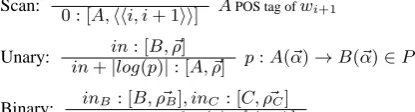
For a given input w, our items have the form [A, ~ρ] where A ∈ N, ρ~ ∈ (P os(w) ×
P os(w))dim(A). The vector ~ρ characterizes the span ofA. We specify the set of weighted parse
Scan:
0 : [A,hhi, i+ 1ii] APOS tag ofwi+1
Unary: in+in: [B, ~ρ]
|log(p)|: [A, ~ρ] p:A(~α)→B(~α)∈P
Binary: inB : [B, ~ρB], inC: [C, ~ρC]
inB+inC+log(p) : [A, ~ρA]
wherep:A(ρ~A)→B(ρ~B)C(ρ~C)is an instantiated rule. Goal:[S,hh0, nii]
Figure 2: Weighted CYK deduction system
add SCANresults toA
whileA 6=∅
remove best itemx:IfromA addx:ItoC
ifIgoal item
then stop and output true else
for ally:I′deduced fromx:Iand items inC:
if there is nozwithz:I′∈ C ∪ A
then addy:I′toA
else ifz:I′∈ Afor somez
then update weight ofI′inAtomax(y, z)
Figure 3: Weighted deductive parsing
items via the deduction rules in Fig. 2. Our parser performs a weighted deductive parsing (Nederhof, 2003), based on this deduction system. We use a chartCand an agendaA, both initially empty, and we proceed as in Fig. 3.
4 Outside Estimates
In order to speed up parsing, we add an estimate of the log of the outside probabilities of the items to their weights in the agenda. All our outside esti-mates are admissible (Klein and Manning, 2003a) which means that they never underestimate the ac-tual outside probability of an item. However, most of them are not monotonic. In other words, it can happen that we deduce an itemI2from an itemI1
where the weight ofI2 is greater than the weight
ofI1. The parser can therefore end up in a local
maximum that is not the global maximum we are searching for. In other words, our outside weights are only figures of merit (FOM). Only for the full SX estimate, the monotonicity is guaranteed and we can do true A∗ parsing as described in (Klein and Manning, 2003a) that always finds the best parse.
POS tags:
0 : [A,h1i] Aa POS tag
Unary: in: [B,~l]
in+log(p) : [A,~l] p:A(~α)→B(~α)∈P
Binary: inB : [B,~lB], inC: [C,~lC]
inB+inC+log(p) : [A,~lA]
wherep :A(α~A) → B(α~B)C(α~C) ∈ P and the
follow-ing holds: we defineB(i) as{1 ≤ j ≤ dim(B)|α~B(j)
occurs inα~A(i)}and C(i)as{1 ≤ j ≤ dim(C)|α~C(j)
occurs in α~A(i)}. Then for all i, 1 ≤ i ≤ dim(A):
~lA(i) = Σj∈B(i)~lB(j) + Σj∈C(i)~lC(j).
Figure 4: Inside estimate
4.1 Full SX estimate
The full SX estimate, for a given sentence length
n, is supposed to give the minimal costs (maxi-mal probability) of completing a categoryXwith a spanρinto anS with spanhh0, nii.
For the computation, we need an estimate of the inside probability of a categoryCwith a span
ρ, regardless of the actual terminals in our in-put. This inside estimate is computed as shown in Fig. 4. Here, we do not need to consider the number of terminals outside the span of C (to the left or right or in the gaps), they are not rel-evant for the inside probability. Therefore the items have the form [A,hl1, . . . , ldim(A)i], where
A is a non-terminal andli gives the length of its
ith component. It holds that Σ1≤i≤dim(A)li ≤
lenmax−dim(A) + 1.
A straight-forward extension of the CFG algo-rithm from (Klein and Manning, 2003a) for com-puting the SX estimate is given in Fig. 5. For a given range vectorρ=hhl1, r1i, . . . ,hlk, rkiiand
a sentence length n, we define its inside length
vector lin(ρ) as hr1 − l1, . . . , rk − lki and its outside length vector lout(ρ) ashl1, r1 −l1, l2 −
r1, . . . , lk−rk−1, rk−lk, n−rki.
This algorithm has two major problems: Since it proceeds top-down, in the Binary rules, we must compute all splits of the antecedent X span into the spans of A and B which is very expensive. Furthermore, for a categoryAwith a certain num-ber of terminals in the components and the gaps, we compute the lower part of the outside estimate several times, namely for every combination of number of terminals to the left and to the right (first and last element in the outside length
vec-Axiom :
0 : [S,h0,len,0i] 1≤len≤lenmax
Unary: w: [A,~l]
w+log(p) : [B,~l] p:A(α~)→B(~α)∈P
Binary-right:
w: [X,~lX]
w+in(A,~l′A) +log(p) : [B,~lB]
Binary-left:
w: [X,~lX]
w+in(B,~lB′ ) +log(p) : [A,~lA]
where, for both rules, there is an instantiated rule p : X(~ρ) → A(ρ~A)B(ρ~B) such that~lX = lout(ρ), ~lA = lout(ρA),~lA′ =lin(ρA),~lB =lout(ρB,~lB=lin(ρB.
Figure 5: Full SX estimate top-down
tor). In order to avoid these problems, we now abstract away from the lengths of the part to the left and the right, modifying our items such as to allow a bottom-up strategy.
The idea is to compute the weights of items rep-resenting the derivations from a certain lowerC
up to someA(Cis a kind of “gap” in the yield of
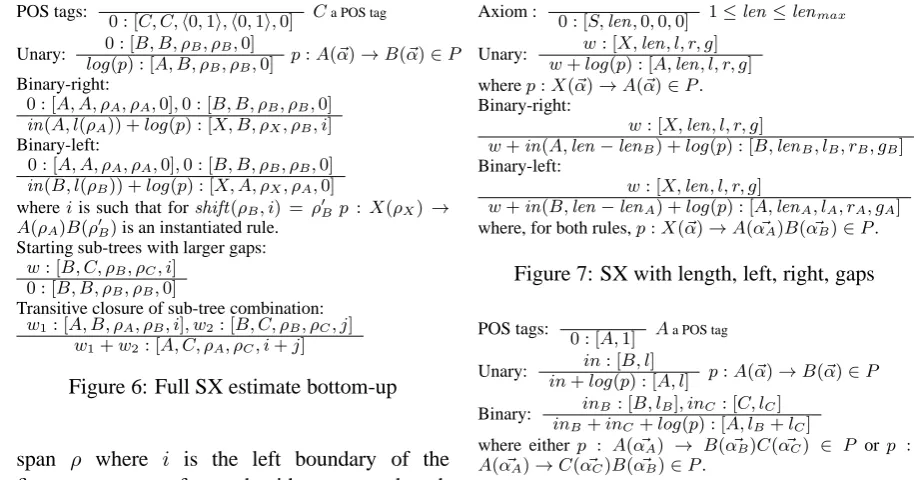
A) while summing up the inside costs of off-spine nodes and thelogof the probabilities of the corre-sponding rules. We use items[A, C, ρA, ρC,shift]
where A, C ∈ N and ρA, ρC are range vectors,
both with a first component starting at position0. The integershift ≤lenmaxtells us how many
po-sitions to the right theCspan is shifted, compared to the starting position of theA.ρAandρC
repre-sent the spans ofC andAwhile disregarding the number of terminals to the left the right. I.e., only the lengths of the components and of the gaps are encoded. This means in particular that the length
nof the sentence does not play a role here. The right boundary of the last range in the vectors is limited to lenmax. For anyi,0 ≤ i ≤ lenmax,
and any range vectorρ, we defineshift(ρ, i)as the range vector one obtains from addingito all range boundaries inρandshift(ρ,−i)as the range vec-tor one obtains from subtractingifrom all bound-aries inρ.
The weight of [A, C, ρA, ρC, i] estimates the
costs for completing aC tree with yieldρC into
anAtree with yieldρAsuch that, if the span ofA
starts at positionj, the span ofCstarts at position
i+j. Fig. 6 gives the computation. The value of in(A,~l)is the inside estimate of[A,~l].
POS tags:
0 : [C, C,h0,1i,h0,1i,0] Ca POS tag
Unary: 0 : [B, B, ρB, ρB,0]
log(p) : [A, B, ρB, ρB,0] p:A(~α)→B(~α)∈P
Binary-right:
0 : [A, A, ρA, ρA,0],0 : [B, B, ρB, ρB,0]
in(A, l(ρA)) +log(p) : [X, B, ρX, ρB, i]
Binary-left:
0 : [A, A, ρA, ρA,0],0 : [B, B, ρB, ρB,0]
in(B, l(ρB)) +log(p) : [X, A, ρX, ρA,0]
whereiis such that forshift(ρB, i) = ρ′B p: X(ρX) → A(ρA)B(ρ′
B)is an instantiated rule.
Starting sub-trees with larger gaps:
w: [B, C, ρB, ρC, i] 0 : [B, B, ρB, ρB,0]
Transitive closure of sub-tree combination:
w1: [A, B, ρA, ρB, i], w2: [B, C, ρB, ρC, j] w1+w2: [A, C, ρA, ρC, i+j]
Figure 6: Full SX estimate bottom-up
span ρ where i is the left boundary of the first component of ρ and with sentence length
n is then given by the maximal weight of
[S, C,h0, ni,shift(−i, ρ), i]. Among our esti-mates, the full SX estimate is the only one that is monotonic and that allows for true A∗parsing.
4.2 SX with Left, Gaps, Right, Length
A problem of the previous estimate is that with a large number of non-terminals the computation of the estimate requires too much space. Our ex-periments have shown that for treebank parsing where we have, after binarization and markoviza-tion, appr. 12,000 non-terminals, its computation is not feasible. We therefore turn to simpler es-timates with only a single non-terminal per item. We now estimate the outside probability of a non-terminal A with a span of a length length (the sum of the lengths of all the components of the span), with left terminals to the left of the first component, right terminals to the right of the last component andgapsterminals in between the components of the A span, i.e., filling the gaps. Our items have the form[X,len,left,right,gaps]
withX∈N,len+left+right+gaps ≤lenmax,
len ≥dim(X),gaps≥dim(X)−1.
Let us assume that, in the rule X(~α) → A(α~A)B(α~B), when looking at the vector ~α, we
havelef tAvariables forA-components preceding
the first variable of aB component, rightA
vari-ables for A-components following the last
vari-Axiom :
0 : [S,len,0,0,0] 1≤len≤lenmax
Unary: w: [X,len, l, r, g]
w+log(p) : [A,len, l, r, g]
wherep:X(α~)→A(~α)∈P. Binary-right:
w: [X,len, l, r, g]
w+in(A,len−lenB) +log(p) : [B,lenB, lB, rB, gB]
Binary-left:
w: [X,len, l, r, g]
w+in(B,len−lenA) +log(p) : [A,lenA, lA, rA, gA]
where, for both rules,p:X(~α)→A(α~A)B(α~B)∈P.
Figure 7: SX with length, left, right, gaps
POS tags: 0 : [A,1] Aa POS tag
Unary: in+inlog: [(B, lp) : []A, l] p:A(α~)→B(~α)∈P
Binary: in inB : [B, lB], inC: [C, lC]
B+inC+log(p) : [A, lB+lC]
where eitherp : A(α~A) → B(α~B)C(α~C) ∈ P or p : A(α~A)→C(α~C)B(α~B)∈P.
Figure 8: Inside estimate with total span length
able of aB component and rightB variables for
B-components following the last variable of aA
component. (In our grammars, the first LHS argu-ment always starts with the first variable fromA.) Furthermore,gapsA=dim(A)−lef tA−rightA,
gapsB=dim(B)−rightB.
Fig. 7 gives the computation of the estimate. The following side conditions must hold: For
Binary-right to apply, the following constraints
must be satisfied: a)len+l+r +g = lenB+
lB+rB+gB, b)lB≥l+lef tA, c) ifrightA>0,
thenrB≥r+rightA, else (rightA= 0),rB =r,
d)gB ≥ gapsA. Similarly, for Binary-left to
ap-ply, the following constraints must be satisfied: a) len+l+r+g=lenA+lA+rA+gA, b)lA=l,
c) ifrightB > 0, then rA ≥ r +rightB, else
(rightB = 0),rA=r d)gA≥gapsB.
The valuein(X, l)for a non-terminalX and a length l, 0 ≤ l ≤ lenmax is an estimate of the
probability of anXcategory with a span of length
l. Its computation is specified in Fig. 8.
The SX-estimate for a sentence length n and for some predicate C with a range characterized by ρ~ = hhl1, r1i, . . . ,hldim(C), rdim(C)ii where
len = Σdimi=1(C)(ri −li) and r = n−rdim(C)
is then given by the maximal weight of the item
Axiom :
0 : [S,len,0,0] 1≤len≤lenmax
Unary: w: [X,len,lr, g]
w+log(p) : [A,len,lr, g]
wherep:X(~α)→A(~α)∈P. Binary-right:
w: [X,len,lr, g]
w+in(A,len−lenB) +log(p) : [B,lenB,lrB, gB]
Binary-left:
w: [X,len,lr, g]
w+in(B,len−lenA) +log(p) : [A,lenA,lrA, gA]
where, for both rules,p:X(α~)→A(α~A)B(α~B)∈P.
Figure 9: SX estimate with length, LR, gaps
4.3 SX with LR, Gaps, Length
In order to further decrease the space complex-ity, we can simplify the previous estimate by sub-suming the two lengths left and right in a sin-gle length lr. I.e., the items now have the form
[X,len,lr,gaps]withX∈N,len+lr+gaps ≤ lenmax,len ≥dim(X),gaps ≥dim(X)−1.
The computation is given in Fig. 9. Again, we definelef tA,gapsA,rightAandgapsB,rightB
for a rule X(~α) → A(α~A)B(α~B)as above. The
side conditions are as follows: For Binary-right to apply, the following constraints must be satisfied: a)len+lr +g=lenB+lrB+gB, b)lr <lrB,
and c)gB ≥gapsA. For Binary-left to apply, the
following must hold: a)len +lr +g = lenA+
lrA+gA, b) if rightB = 0thenlr = lrA, else
lr <lrAand c)gA≥gapsB.
The SX-estimate for a sentence length n
and for some predicate C with a span ρ~ =
hhl1, r1i, . . . ,hldim(C), rdim(C)ii where len =
Σdimi=1(C)(ri−li)andr=n−rdim(C)is then the
maximal weight of[C,len, l1+r, n−len−l1−r].
5 Evaluation
The goal of our evaluation of our parser is to show that, firstly, reasonable parser speed can be achieved and, secondly, the parser output is of promising quality.
5.1 Data
Our data source is the German NeGra treebank (Skut et al., 1997). In a preprocessing step, following common practice (K ¨ubler and Penn, 2008), we attach punctuation (not included in the NeGra annotation) as follows: In a first pass,
us-ing heuristics, we attach punctuation as high as possible while avoiding to introduce new crossing branches. In a second pass, parentheses and quo-tation marks preferably attach to the same node. Grammatical function labels on the edges are dis-carded.
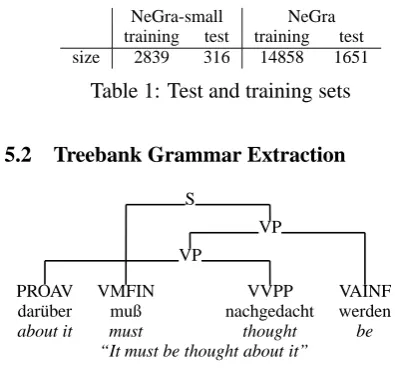
We create data sets of different sizes in order to see how the size of the training set relates to the gain using context summary estimates and to the output quality of the parser. The first set uses the first 4000 sentences and the second one all sentences of NeGra. Due to memory limitations, in both sets, we limit ourselves to sentences of a maximal length of 25 words. We use the first 90% of both sets as training set and the remaining 10% as test set. Tab. 1 shows the resulting sizes.
NeGra-small NeGra training test training test size 2839 316 14858 1651
Table 1: Test and training sets
5.2 Treebank Grammar Extraction
S
VP
VP
PROAV VMFIN VVPP VAINF
dar¨uber muß nachgedacht werden
about it must thought be
“It must be thought about it”
Figure 10: A sample tree from NeGra
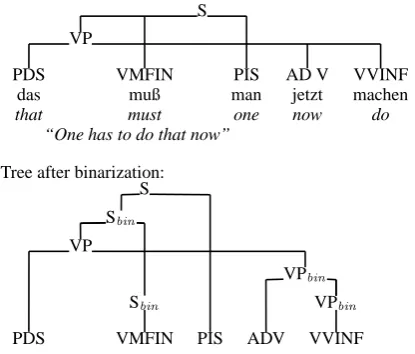
As already mentioned, in NeGra, discontinu-ous phrases are annotated with crossing branches (see Fig. 10 for an example with two discontin-uous VPs). Such discontinuities can be straight-forwardly modelled with LCFRS. We use the al-gorithm from Maier and Søgaard (2008) to extract LCFRS rules from NeGra and TIGER. It first cre-ates rules of the form P(a) → ε for each pre-terminal P dominating some terminal a. Then for all other nonterminals A0 with the children
A1· · ·Am, a clause A0 → A1· · ·Am is
cre-ated. The arguments of the A1· · ·Am are
sin-gle variables where the number of arguments is the number of discontinuous parts in the yield of a predicate. The arguments of A0 are
discontinuous parts of the yield of A0 are
ob-tained from the yields of its daughters. Differ-ent occurrences of the same non-terminal, only with different fan-outs, are distinguished by corre-sponding subscripts. Note that this extraction al-gorithm yields only monotone LCFRS (equivalent to ordered simple RCG). See Maier and Søgaard (2008) for further details. For Fig. 10, we obtain for instance the rules in Fig. 11.
PROAV(Dar¨uber)→ε VMFIN(muß)→ε
VVPP(nachgedacht)→ε VAINF(werden)→ε
S1(X1X2X3)→VP2(X1,X3) VMFIN(X2) VP2(X1,X2X3)→VP2(X1,X2) VAINF(X3) VP2(X1,X2)→PROAV(X1) VVPP(X2)
Figure 11: LCFRS rules for the tree in Fig. 10
5.3 Binarization and Markovization
Before parsing, we binarize the extracted LCFRS. For this we first apply Collins-style head rules, based on the rules the Stanford parser (Klein and Manning, 2003b) uses for NeGra, to mark the resp. head daughters of all non-terminal nodes. Then, we reorder the RHSs such that the sequence
γ of elements to the right of the head daughter is reversed and moved to the beginning of the RHS. We then perform a binarization that proceeds from left to right. The binarization works like the trans-formation into Chomsky Normal Form for CFGs in the sense that for RHSs longer than 2, we in-troduce a new non-terminal that covers the RHS without the first element. The rightmost new rule, which covers the head daughter, is binarized to unary. We do not use a unique new non-terminal for every new rule. Instead, to the new symbols introduced during the binarization (VPbin in the
example), a variable number of symbols from the vertical and horizontal context of the original rule is added in order to achieve markovization. Fol-lowing the literature, we call the respective quan-tities v and h. For reasons of space we restrict ourselves here to the example in Fig. 12. Refer to Maier and Kallmeyer (2010) for a detailed presen-tation of the binarization and markovization.
The probabilities are then computed based on the rule frequencies in the transformed treebank, using a Maximum Likelihood estimator.
S
VP
PDS VMFIN PIS AD V VVINF
das muß man jetzt machen
that must one now do
“One has to do that now”
Tree after binarization: S
Sbin
VP
VPbin
Sbin VPbin
PDS VMFIN PIS ADV VVINF
Figure 12: Sample binarization
5.4 Evaluation of Parsing Results
In order to assess the quality of the output of our parser, we choose an EVALB-style metric, i.e., we compare phrase boundaries. In the con-text of LCFRS, we compare sets of items [A, ~ρ]
that characterize the span of a non-terminal Ain a derivation tree. One set is obtained from the parser output, and one from the corresponding treebank trees. Using these item sets, we compute labeled and unlabeled recall (LR/UR), precision (LP/UP), and the F1 measure (LF1/UF1). Note
that ifk = 1, our metric is identical to its PCFG equivalent.We are aware of the recent discussion about the shortcomings of EVALB. A discussion of this issue is presented in Maier (2010).
5.5 Experiments
In all experiments, we provide the parser with gold part-of-speech tags. For the experi-ments with NeGra-small, the parser is given the markovization settingsv= 1andh= 1. We com-pare the parser performance without estimates (OFF) with its performance with the estimates de-scribed in 4.2 (SIMPLE) and 4.3 (LR). Tab. 2 shows the results. Fig. 13 shows the number of items produced by the parser, indicating that the estimates have the desired effect of preventing un-necessary items from being produced. Note that it is even the case that the parser produces less items for the big set with LR than for the small set with-out estimate.
OFF SIMPLE LR UP/UR 72.29/72.40 70.49/71.81 72.10/72.60
UF1 72.35 71.14 72.35
LP/LR 68.31/68.41 64.93/66.14 67.35/66.14
LF1 68.36 65.53 65.53
Parsed 313 (99.05%) 313 (99.05%) 313 (99.05%)
Table 2: Experiments with NeGra-small
50 100 150 200 250 300 350 400 450 500
16 18 20 22 24
No. of items (in 1000)
Sentence length
OFF (NeGra) LR (NeGra) OFF (NeGra-small) SIMPLE (NeGra-small) LR (NeGra-small)
Figure 13: Items produced by the parser
lower F-score. However, while the losses in terms ofF1are small, the gains in parsing time are
sub-stantial, as Fig. 13 shows.
Tab. 3 shows the results of experiments with
NeGra, with the markovization settings v = 2
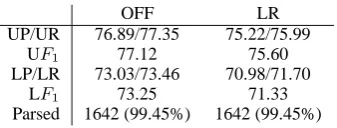
and h = 1 which have proven to be successful for PCFG parsing of NeGra (Rafferty and Man-ning, 2008). Unfortunately, due to memory re-strictions, we were not able to compute SIMPLE for the large data set.1 Resp. LR, the findings are comparable to the ones for NeGra-short. The speedup is paid with a lowerF1.
OFF LR
UP/UR 76.89/77.35 75.22/75.99 UF1 77.12 75.60 LP/LR 73.03/73.46 70.98/71.70
LF1 73.25 71.33 Parsed 1642 (99.45%) 1642 (99.45%)
Table 3: Experiments with NeGra
Our results are not directly comparable with PCFG parsing results, since LCFRS parsing is a
1
SIMPLE also proved to be infeasible to compute for the small set for the markovization settingsv = 2andh = 1
due to the greatly increased label set with this settings.
harder task. However, since the EVALB met-ric coincides for constituents without crossing branches, in order to place our results in the con-text of previous work on parsing NeGra, we cite some of the results from the literature which were obtained using PCFG parsers2: K ¨ubler (2005) (Tab. 1, plain PCFG) obtains 69.4, Dubey and Keller (2003) (Tab. 5, sister-head PCFG model) 71.12, Rafferty and Manning (2008) (Tab. 2, Stan-ford parser with markovizationv= 2andh = 1) 77.2, and Petrov and Klein (2007) (Tab. 1, Berke-ley parser) 80.1. Plaehn (2004) obtains 73.16 La-beledF1using Probabilistic Discontinuous Phrase
Structure Grammar (DPSG), albeit only on sen-tences with a length of up to 15 words. On those sentences, we obtain 81.27.
The comparison shows that our system deliv-ers competitive results. Additionally, when com-paring this to PCFG parsing results, one has to keep in mind that LCFRS parse trees con-tain non-context-free information about disconti-nuities. Therefore, a correct parse with our gram-mar is actually better than a correct CFG parse, evaluated with respect to a transformation of Ne-Gra into a context-free treebank where precisely this information gets lost.
6 Conclusion
We have presented the first parser for unrestricted Probabilistic Linear Context-Free Rewriting Sys-tems (PLCFRS), implemented as a CYK parser with weighted deductive parsing. To speed up parsing, we use context summary estimates for parse items. An evaluation on the NeGra treebank, both in terms of output quality and speed, shows that data-driven parsing using PLCFRS is feasi-ble. Already in this first attempt with a straight-forward binarization, we obtain results that are comparable to state-of-the-art PCFG results in terms of F1, while yielding parse trees that are
richer than context-free trees since they describe discontinuities. Therefore, our approach demon-strates convincingly that PLCFRS is a natural and tractable alternative for data-driven parsing which takes non-local dependencies into consideration.
2
References
Boullier, Pierre. 1998. A Proposal for a Natural Lan-guage Processing Syntactic Backbone. Technical Report 3342, INRIA.
Boyd, Adriane. 2007. Discontinuity revisited: An im-proved conversion to context-free representations. In The Linguistic Annotation Workshop at ACL
2007.
Charniak, Eugene and Sharon A. Caraballo. 1998.
New figures of merit for best-first probabilistic chart parsing. Computational Linguistics, 24.
Collins, Michael. 1999. Head-driven statistical
mod-els for natural language parsing. Ph.D. thesis,
Uni-versity of Pennsylvania.
Dubey, Amit and Frank Keller. 2003. Probabilistic parsing for German using sisterhead dependencies. In Proceedings of ACL.
G´omez-Rodr´ıguez, Carlos, Marco Kuhlmann, Giorgio Satta, and David Weir. 2009. Optimal reduction of rule length in linear context-free rewriting systems. In Proceedings of NAACL-HLT.
Hockenmaier, Julia. 2003. Data and models for
Statis-tical Parsing with Combinatory Categorial Gram-mar. Ph.D. thesis, University of Edinburgh.
Johnson, Mark. 2002. A simple pattern-matching al-gorithm for recovering empty nodes and their an-tecedents. In Proceedings of ACL.
Kato, Yuki, Hiroyuki Seki, and Tadao Kasami. 2006. Stochastic multiple context-free grammar for rna pseudoknot modeling. In Proceedings of TAG+8.
Klein, Dan and Christopher D. Manning. 2003a. A* Parsing: Fast Exact Viterbi Parse Selection. In
Pro-ceedings of NAACL-HLT.
Klein, Dan and Christopher D. Manning. 2003b. Fast exact inference with a factored model for natural language parsing. In In Advances in Neural
Infor-mation Processing Systems 15 (NIPS).
K¨ubler, Sandra and Gerald Penn, editors. 2008.
Pro-ceedings of the Workshop on Parsing German at ACL 2008.
K¨ubler, Sandra. 2005. How do treebank annotation schemes influence parsing results? Or how not to
compare apples and oranges. In Proceedings of
RANLP 2005.
Kuhlmann, Marco and Giorgio Satta. 2009. Treebank grammar techniques for non-projective dependency parsing. In Proceedings of EACL.
Levy, Roger and Christopher D. Manning. 2004. Deep dependencies from context-free statistical parsers: correcting the surface dependency approximation. In Proceedings of ACL.
Maier, Wolfgang and Laura Kallmeyer. 2010. Discon-tinuity and non-projectivity: Using mildly
context-sensitive formalisms for data-driven parsing. In
Proceedings of TAG+10.
Maier, Wolfgang and Timm Lichte. 2009. Charac-terizing Discontinuity in Constituent Treebanks. In
Proceedings of Formal Grammar 2009.
Maier, Wolfgang and Anders Søgaard. 2008. Tree-banks and mild context-sensitivity. In Proceedings
of Formal Grammar 2008.
Maier, Wolfgang. 2010. Direct parsing of discontin-uous constituents in german. In Proceedings of the
SPMRL workshop at NAACL HLT 2010.
Marcus, Mitchell, Grace Kim, Mary Ann
Marcinkiewicz, Robert MacIntyre, Ann Bies,
Mark Ferguson, Karen Katz, and Britta
Schas-berger. 1994. The Penn Treebank: Annotating
predicate argument structure. In Proceedings of
HLT.
Nederhof, Mark-Jan. 2003. Weighted Deductive
Pars-ing and Knuth’s Algorithm. Computational
Lin-guistics, 29(1).
Petrov, Slav and Dan Klein. 2007. Improved inference for unlexicalized parsing. In Proceedings of
HLT-NAACL 2007.
Plaehn, Oliver. 2004. Computing the most proba-ble parse for a discontinuous phrase-structure gram-mar. In New developments in parsing technology. Kluwer.
Rafferty, Anna and Christopher D. Manning, 2008.
Parsing Three German Treebanks: Lexicalized and Unlexicalized Baselines. In K¨ubler and Penn (2008).
Seki, Hiroyuki, Takahashi Matsumura, Mamoru Fujii, and Tadao Kasami. 1991. On multiple context-free grammars. Theoretical Computer Science, 88(2).
Skut, Wojciech, Brigitte Krenn, Thorten Brants, and
Hans Uszkoreit. 1997. An Annotation Scheme
for Free Word Order Languages. In Proceedings of
ANLP.
Vijay-Shanker, K., David J. Weir, and Aravind K. Joshi. 1987. Characterizing structural descriptions produced by various grammatical formalisms. In