Algorithms for Generating Referring Expressions:
Do They Do What People Do?
Jette Viethen
Centre for Language Technology Macquarie University
Sydney NSW 2109 [email protected]
Robert Dale
Centre for Language Technology Macquarie University
Sydney NSW 2109 [email protected]
Abstract
The natural language generation litera-ture provides many algorithms for the generation of referring expressions. In this paper, we explore the question of whether these algorithms actually produce the kinds of expressions that people pro-duce. We compare the output of three ex-isting algorithms against a data set consist-ing of human-generated referrconsist-ing expres-sions, and identify a number of significant differences between what people do and what these algorithms do. On the basis of these observations, we suggest some ways forward that attempt to address these dif-ferences.
1 Introduction
The generation of referring expressions (hence-forth GRE) — that is, the process of working
out what properties of an entity should be used to describe it in such a way as to distinguish it from other entities in the context — is a re-current theme in the natural language generation literature. The task is discussed informally in some of the earliest work on NLG (in particular,
see (Winograd, 1972; McDonald, 1980; Appelt, 1981)), but the first formally explicit algorithm was introduced in (Dale, 1989); this algorithm, often referred to as the Full Brevity (FB)
algo-rithm, has served as a starting point for many sub-sequent GREalgorithms. To overcome its
limita-tion to one-place predicates, Dale and Haddock (1991) introduced a constraint-based procedure that could generate referring expressions involv-ing relations; and as a response to the computa-tional complexity of ‘greedy’ algorithms likeFB,
Reiter and Dale (Reiter and Dale, 1992; Dale and Reiter, 1995) introduced the psycholinguistically motivated Incremental Algorithm (IA). In recent
years there have been a number of important ex-tensions to the IA. The Context-Sensitive exten-sion (Krahmer and Theune, 2002) is able to gerate referring expressions for the most salient en-tity in a context; the Boolean Expressions algo-rithm (van Deemter, 2002) is able to derive ex-pressions containing boolean operators, as in the cup that does not have a handle; and the Sets algorithm (van Deemter, 2002) extends the ba-sic approach to references to sets, as in the red cups. Some approaches reuse parts of other al-gorithms: the Branch and Bound algorithm (Krah-mer et al., 2003) uses the Full Brevity algorithm, but is able to generate referring expressions with both attributes and relational descriptions using a graph-based technique. There are many other al-gorithms described in the literature: see, for exam-ple, (Horacek, 1997; Bateman, 1999; Stone, 2000; Gardent, 2002). Their general aim is to produce naturalistic referring expressions, often explicitly by means of an attempt to follow the same kinds of principles that we believe people might be fol-lowing when they produce language — such as the Gricean maxims (Grice, 1975). However, the al-gorithms have rarely been tested against real data from human referring expression generation.1
In this paper, we present a data set containing human-produced referring expressions in a limited domain. Focussing specifically on the algorithms
1The only exceptions we know of to this deficit are not
directly concerned with the kinds of properties people select, but with phenomena such as how people group entities to-gether (Funakoshi et al., 2004; Gatt, 2006), or with multi-modal referring expressions where the linguistic part is not necessarily distinguishing by itself (van der Sluis and Krah-mer, 2004).
presented in (Dale, 1989), (Dale and Haddock, 1991) and (Reiter and Dale, 1992), we explore how well these algorithms perform in the same context. There are significant differences between the referring expressions produced by humans, and those produced by the algorithms; we explore these differences and consider what it means for work in the generation of referring expressions.
The remainder of this paper is structured as fol-lows. In Section 2, we introduce the data set of human-produced referring expressions we use; in Section 3, we introduce the representational framework we use to model the domain underly-ing this data; in Section 4 we introduce the three algorithms considered in this paper; in Section 5 we discuss the results of using these algorithms on the data that represents the model of our do-main; in Section 6 we discuss the differences be-tween the output of the algorithms and the human-produced data; and in Section 7 we draw some conclusions and suggest some steps towards ad-dressing the issues we have identified.
2 The Data
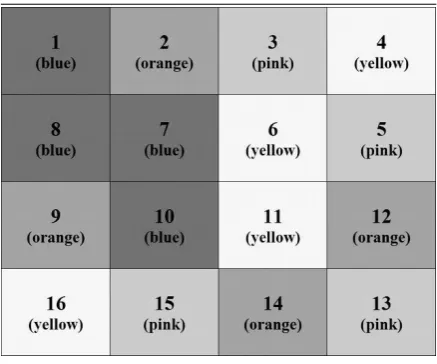
Our human-produced referring expressions are drawn from a physical experimental setting con-sisting of four filing cabinets, each of which is four drawers high, located in a fairly typical aca-demic office. The cabinets are positioned directly next to each other, so that the drawers form a four-by-four grid; each drawer is labelled with a num-ber between 1 and 16 and is coloured either blue, pink, yellow, or orange. There are four drawers of each colour which are distributed randomly over the grid, as shown in Figure 1.
Subjects were given a randomly generated num-ber between 1 and 16, and asked to produce a de-scription of the numbered drawer using any prop-erties other than the number. There were 20 partic-ipants in the experiment, resulting in a total of 140 referring expressions. Here are some examples of the referring expressions produced:
(1) the top drawer second from the right [d3]
(2) the orange drawer on the left [d9]
(3) the orange drawer between two pink ones [d12]
(4) the bottom left drawer [d16]
Since the selection of which drawer to describe was random, we do not have an equal number of
Figure 1: The filing cabinets
descriptions of each drawer; in fact, the data set ranges from two descriptions of Drawer 1 to 12 de-scriptions of Drawer 16. One of the most obvious things about the data set is that even the same per-son may refer to the same entity in different ways on different occasions, with the differences being semantic as well as syntactic.
We are interested in comparing how algorithms for referring expression generation differ in their outputs from what people do; since these al-gorithms produce distinguishing descriptions, we therefore removed from the data set 22 descrip-tions which were ambiguous or referred to a set of drawers. This resulted in a total of 118 distinct re-ferring expressions, with an average of 7.375 dis-tinct referring expressions per drawer.
As the algorithms under scrutiny here are not concerned with the final syntactic realisation of the referring expression produced, we also nor-malised the human-produced data to remove su-perficial variations such as the distinction between relative clauses and reduced relatives, and between different lexical items that were synonymous in context, such ascolumnandcabinet.
Four absolute properties used for describing the drawers can be identified in the natural data pro-duced by the human participants. These are the colour of the drawer; its row and column; and in those cases where the drawer is situated in one of the corners of the grid, itscornerhood.2 A number
of the natural descriptions also made use of the
2A question we will return to below is that of how we
Property Count % (out of possible)
Row 95 79.66% (118)
Column 88 73.73% (118)
Colour 63 53.39% (118)
Corner 11 40.74% (27)
Relation 15 12.71% (118)
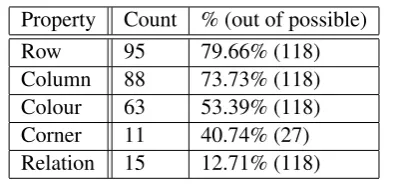
Table 1: The properties used in descriptions
following relational properties that hold between drawers: above, below, next to, right of, left of and between. In Table 1, Countshows the number of descriptions using each property, and the percent-ages show the ratio of the number of descriptions using each property to the number of descriptions for drawers that possess this property (hence, only 27 of the descriptions referred to corner drawers). We have combined all uses of relations into one row in this table to save space, since, interestingly, their overall use is far below that of the other prop-erties: 103 descriptions (87.3%) did not use rela-tions.
Most algorithms in the literature aim at gen-erating descriptions that are as short as possi-ble, but will under certain circumstances pro-duce redundancy. Some authors, for example (van Deemter and Halld´orsson, 2001), have sug-gested that human-produced descriptions are of-ten not minimal, and this is an intuition that we would generally agree with. However, a strong tendency towards minimality is evident in the human-produced data here: only 29 out of 118 de-scriptions (24.6%) contain redundant information. Here are a few examples:
• the yellow drawer in the third column from the left second from the top[d6]
• the blue drawer in the top left corner[d1]
• the orange drawer below the two yellow drawers[d14]
In the first case, either thecolourorcolumn proper-ties are redundant; in the second,colourandcorner, or only the grid information, would have been suf-ficient; and in the third, it would have been suffi-cient to mention one of the two yellow drawers.
3 Knowledge Representation
In order to use an algorithm to generate referring expressions in this domain, we must first decide
how to represent the domain. It turns out that this raises some interesting questions.
We use the symbols {d1, d2. . . d16} as our unique identifying labels for the 16 drawers. Given some di, the goal of any given algorithm is then to produce a distinguishing description of that entity with respect to a context consisting of the other 15 drawers.
As is usual, we represent the properties of the domain in terms of attribute–value pairs. Thus we have, for example:
• d2: hcolour, orangei, hrow, 1i, hcolumn, 2i,
hright-of,d1i,hleft-of,d3i,hnext-to,d1i,hnext-to, d3i,habove,d7i
This drawer is in the top row, so it does not have a property of the formhbelow,d2i.
The four corner drawers additionally possess the property hposition, corneri. Cornerhood can be inferred from the row and column informa-tion; however, we added this property explicitly because several of the natural descriptions use the property of cornerhood, and it seems plausible that this is a particularly salient property in its own right.
This raises the question of what properties should be encoded explicitly, and which should be inferred. Note that in the example above, we explicitly encode relational properties that could be computed from others, such asleft-ofand right-of. Since none of the algorithms explored here uses inference over knowledge base properties, we opted here to ‘level the playing field’ to enable fairer comparison between human-produced and machine-produced descriptions.
A similar question of the role of inference arises with regard to the transitivity of spatial relations. For example, if d1 is above d9 and d9 is above
d16, then it can be inferred thatd1 is transitively
aboved16. In a more complex domain, the imple-mentation of this kind of knowledge might play an important role in generating usful referring ex-pressions. However, the uniformity of our domain results in this inferred knowledge about transitive relations being of little use; in fact, in most cases, the implementation of transitive inference might even result in the generation of unnatural descrip-tions, such asthe orange drawer (two) right of the blue drawerford12.
next-tois a generalisation of the relationsleft-ofand right-of. The only algorithm of those we exam-ine here that provides a mechanism for exploring a generalisation hierarchy is the Incremental Al-gorithm (Reiter and Dale, 1992), and this cannot handle relations; so, we take the shortcut of ex-plicitly representing the next-torelation for every left-of andright-of relation in the knowledge base. We then implement special-case handling that en-sures that, if one of these facts is used, the more general or more specific case is also deleted from the set of properties still available for the descrip-tion.3
4 The Algorithms
As we have already noted above, there is a con-siderable literature on the generation of referring expressions, and many papers in the area provide detailed algorithms. We focus here on the follow-ing algorithms:
• The Full Brevity algorithm (Dale, 1989) at-tempts to build a minimal distinguishing de-scription by always selecting the most dis-criminatory property available; see Algo-rithm 1.
LetLbe the set of properties to be realised in our description; letPbe the set of properties known to be true of our intended referentr(we assume thatPis non-empty); and letCbe the set of distractors (the contrast set). The initial conditions are thus as follows:
– C={hall distractorsi}; – P ={hall properties true of ri}; – L={}
In order to describe the intended referentrwith respect to the contrast setC, we do the following:
1. Check Success:
if|C|= 0thenreturnLas a distinguishing description
elseifP=∅thenfail else gotoStep 2. 2. Choose Property:
for eachpi∈Pdo:
Ci←C∩ {x|pi(x)}
Chosen property ispj, whereCjis the smallest set.
gotoStep 3.
3. Extend Description (wrt the chosenpj):
L←L∪ {pj}
C←Cj
P ←P− {pj}
gotoStep 1.
Algorithm 1: The Full Brevity Algorithm
3This is essentially a hack; however, there is clearly a need
for some mechanism for handling what we might think of as equivalence classes of properties, and this is effectively a simple approach to this question.
1. Check Success
ifStack is emptythenreturnLas a DD elseif|Cv|= 1thenpop Stack &gotoStep 1 elseifPr=∅thenfail
else gotoStep 2 2. Choose Property
foreach propertypi∈Prdo
p0
i←[r\v]pi
Ni←N⊕p0i
Chosen prediction ispj, whereNjcontains
the smallest setCvfor v.
gotoStep 3
3. Extend Description (w.r.t the chosen p) Pr←Pr− {p}
p←[r\v]p
forevery other constant r’ inpdo
associater0with a new, unique variablev0
p←[r0\v0]p
pushDescribe(r’,v’) ontoStack
initialise a setP0
rof facts true ofr0
N ←N⊕p gotoStep 1
Algorithm 2: The Relational Algorithm
MakeReferringExpression(r,C,P) L← {}
else returnL∪ {htype, BasicLevelValue(r, type)i}
endif endif returnfailure
FindBestValue(r,A,initial-value) ifUserKnows(r,hA,initial-valuei) =true thenvalue←initial-value
elsevalue←no-value
endif
if (more-specific-value←MoreSpecificValue(r,A, value))6=nil∧
(new-value←FindBestValue(A, more-specific-value))6=nil∧
(|RulesOut(hA,new-valuei)|>|RulesOut(hA,
valuei)|)
thenvalue←new-value endif
• The relational algorithm from (Dale and Had-dock, 1991) uses constraint satisfaction to in-corporate relational properties while avoiding infinite regress; see Algorithm 2.
• the Incremental Algorithm (Reiter and Dale, 1992; Dale and Reiter, 1995) considers the available properties to be used in a descrip-tion via a preference ordering over those properties; see Algorithm 3.
For the purpose of this study, the algorithms were implemented in Common LISP. The mechanism described in (Dale and Reiter, 1995) to handle generalisation hierarchies for values for the dif-ferent properties, referred to in the algorithm here as FindBestValue, was not implemented since, as discussed earlier, our representation of the domain does not make use of a hierarchy of properties.
5 The Output of the Algorithms
Using the knowledge base described in Section 3, we applied the algorithms from the previous sec-tion to see whether the referring expressions they produced were the same as, or similar to, those produced by the human subjects. This quickly gave rise to some situations not explicitly ad-dressed by some of the algorithms; we discuss these in Section 5.1 below. Section 5.2 discusses the extent to which the behaviour of the algorithms matched that of the human data.
5.1 Preference Orderings
The Incremental Algorithm explicitly encodes a preference ordering over the available properties, in an attempt to model what appear to be semi-conventionalised strategies for description that people use. This also has the consequence of avoiding a problem that faces the other two algo-rithms: since the Full Brevity Algorithm and the Relational Algorithm choose the most discrimina-tory property at each step, they have to deal with the case where several properties are equally dis-criminatory. This turns out to be a common sit-uation in our domain. Both algorithms implicitly assume that the choice will be made randomly in these cases; however, it seems to us more natural to control this process by imposing some selection strategy. We do this here by borrowing the idea of preference ordering from the Incremental Algo-rithm, and using it as a tie-breaker when multiple properties are equally discriminatory.
Not includingtypeinformation (i.e., the fact that some di is a drawer), which has no discrimina-tory power and therefore will never be chosen by any of the algorithms,4 there are only four
differ-ent properties available for the Full Brevity Algo-rithm and the Incremental AlgoAlgo-rithm:row,column, colour, andposition. This gives us 4! = 24 different possible preference orderings. Since some of the human-produced descriptions use all four proper-ties, we tested these two algorithms with all 24 preference orderings.
For the Relational Algorithm, we added the five relations next to, left of, right of, above, and below. This results in 9! = 362,880 possible preference orderings; far too many to test. Since we are primarily interested in whether the algorithm can generate the human-produced descriptions, we re-stricted our testing to those preference orderings that started with a permutation of the properties used by the participants; in addition to the 24 pref-erence orderings above, there are 12 prefpref-erence or-derings that incorporate the relational properties.
5.2 Coverage of the Human Data
Overall, the Full Brevity Algorithm is able to gen-erate 82 out of the 103 non-relational descriptions from the natural data, providing a recall of 79.6%. The recall score for the Incremental Algorithm is 95.1%, generating 98 of the 103 descriptions. As these algorithms do not attempt to generate rela-tional descriptions, the relarela-tional data is not taken into account in evaluating the performance here.
Both algorithms are able to generate all the non-relational minimal descriptions found in the human-produced data. The Full Brevity Algo-rithm unintentionally replicates the redundancy found in nine descriptions, and the Incremental Algorithm produces all but five of the 29 redun-dant descriptions.
Perhaps surprisingly, the Relational Algorithm does not generateanyof the human-produced de-scriptions. We will return to consider why this is the case in the next section.
6 Discussion
There are two significant differences to be consid-ered here: first, the coverage of redundant descrip-tions by the Full Brevity and Incremental
Algo-4Consistent with much other work in the field, we
rithms; and second, the inability of the Relational Algorithm to replicate any of the human data.
6.1 Coverage of Redundancy
Neither the Full Brevity Algorithm nor the Incre-mental Algorithm presumes to be able to generate relational descriptions; however, both algorithms are able to produce each of the minimal descrip-tions from the set of natural data with at least one of the preference orderings. Both also generate several of the redundant descriptions in the nat-ural data set, but do not capture all of the human-generated redundancies.
The Full Brevity Algorithm has as a primary goal the avoidance of redundant descriptions, so it is a sign of the algorithm being consistent with its specification that it covers fewer of the redun-dant expressions than the Incremental Algorithm. On the other hand, the fact that it produces any
redundant descriptions signals that the algorithm doesn’t quite meet its specification. The cases where the Full Brevity Algorithm produces redun-dancy are when an entity shares with another en-tity at least two property-values and, after choos-ing one of these properties, the next property to be considered is the other shared one, since it has the same or a higher discriminatory power than all other properties. This is a situation that was not considered in the original algorithm; it is related to the problem of what to do when two properties have the same discriminatory power, as noted ear-lier. In our domain, the situation arises for corner drawers with the same colour (d4 and d16), and drawers that are not in a corner but for which there is another drawer of the same colour in each of the same row and column (d7andd8).
The Incremental Algorithm, on the other hand, generates redundancy when an object shares at least two property-values with another object and the two shared properties are the first to be con-sidered in the preference ordering. This is pos-sible for corner drawers with the same colour (d4
andd16) and for drawers for which there is another
drawer of the same colour in either the same row, the same column, or both (d5,d6,d7,d8,d10,d11,
d13,d15).
In these terms, the Incremental Algorithm is clearly a better model of the human behaviour than the Full Brevity Algorithm. However, we may ask why the algorithm does not cover all the redun-dancy found in the human descriptions. The
re-dundant descriptions which the algorithm does not generate are as follows:
(5) the blue drawer in the top left corner[d1]
(6) the yellow drawer in the top right corner[d4]
(7) the pink drawer in the top of the column sec-ond from the right[d3]
(8) the orange drawer in the bottom second from the right[d14]
(9) the orange drawer in the bottom of the second column from the right[d14]
The Incremental Algorithm stops selecting prop-erties when a distinguishing description has been constructed. In Example (6), for example, the algorithm would select any of the following, de-pending on the preference ordering used:
(10) the yellow drawer in the corner
(11) the top left yellow drawer
(12) the drawer in the top left corner
The human subject, however, has added informa-tion beyond what is required. This could be ex-plained by our modelling of cornerhood: in Ex-amples (5) and (6), one has the intuition that the noun corner is being added simply to provide a nominal head to the prepositional phrase in an incrementally-constructed expression of the form
the blue drawer in the top right . . ., in much the same way as the head noun draweris added, whereas we have treated it as a distinct property that adds discriminatory power. This again em-phasises the important role the underlying repre-sentation plays in the generation of referring ex-pressions: if we want to emulate what people do, then we not only need to design algorithms which mirror their behaviour, but these algorithms have to operate over the same kind of data.
6.2 Relational Descriptions
in the human data, so the Relational Algorithm is already disadvantaged. The relatively poor per-formance of the algorithm is then compounded by its insistence on continuing to use relational prop-erties: an absolute property will only be chosen when either the currently described drawer has no unused relational properties left, or the number of distractors has been reduced so much that the discriminatory power of all remaining relational properties is lower than that of the absolute prop-erty, or the absolute property has the same discrim-inatory power as the best relational one and the ab-solute property appears before all relations in the preference ordering.
Consequently, whereas a typical human de-scription of drawerd2would bethe orange drawer
above the blue drawer, the Relational Algorithm will produce the descriptionthe drawer above the drawer above the drawer above the pink drawer. Not only are there no descriptions of this form in the human-produced data set, but they also sound more like riddles someone might create to inten-tionally make it hard for the hearer to figure out what is meant.
There are a variety of ways in which the be-haviour of this algorithm might be repaired. We are currently exploring whether Krahmer et al’s (2003) graph-based approach to GRE is able to
provide a better coverage of the data: this algo-rithm provides the ability to make use of differ-ent search strategies and weighting mechanisms when adding properties to a description, and such a mechanism might be used, for example, to coun-terbalance the Relational Algorithm’s heavy bias towards the relations in this domain.
7 Conclusions and Future Work
We have noted a number of regards in which the algorithms we have explored here do not produce outputs that are the same as those produced by hu-mans. Some comments on the generalisability of these results are appropriate.
First, our results may be idiosyncratic to the specifics of the particular domain of our experi-ment. We would point out, however, that the do-main is more complex, and arguably more real-istic, than the much-simplified experimental con-texts that have served as intuitions for earlier work in the field; we have in mind here in particular the experiments discussed in (Ford and Olson, 1975), (Sonnenschein, 1985) and (Pechmann, 1989). In
the belief that the data provides a good test set for the generation of referring expressions, we are making the data set publicly available5, so others may try to develop algorithms covering the data.
A second concern is that we have only explored the extent to which three specific algorithms are able to cover the human data. Many of the other al-gorithms in the literature take these as a base, and so are unlikely to deliver significantly different re-sults. The major exceptions here may be (a) van Deemter’s (2002) algorithm for sets; recall that we excluded from the human data used here 16 ref-erences that involved sets; and, as noted above, (b) Krahmer et al’s (2003) graph-based approach to GRE, which may perform better than the
Re-lational Algorithm on descriptions using relations. In future work, we intend to explore to what extent our findings extend to other algorithms.
In conclusion, we point to two directions where we believe further work is required.
First, as we noted early in this paper, it is clear that there can be many different ways of refer-ring to the same entity. Existing algorithms are all deterministic and therefore produce exactly one ‘best’ description for each entity; but the human-produced data clearly shows that there are many equally valid ways of describing an entity. We need to find some way to account for this in our algorithms. Our intuition is that this is likely to be best cashed out in terms of different ‘refer-ence strategies’ that different speakers adopt in different situations; we are reminded here of Car-letta’s (1992) distinction between risky and cau-tious strategies for describing objects in the Map Task domain. More experimentation is required in order to determine just what these strategies are: are they, for example, characterisable as things like ‘Produce a referring expression that is as short as possible’ (the intuition behind the Full Brevity Algorithm), ‘Just say what comes to mind first and keep adding information until the description dis-tinguishes the intended referent’ (something like the Incremental Algorithm), or perhaps a strategy of minimising the cognitive effort for either the speaker or the hearer? Further psycholinguistic experiments and data analysis are required to de-termine the answers here.
Our second observation is that the particular re-sults we have presented here are, ultimately,
en-5The data set is publicly available from
tirely dependent upon the underlying representa-tions we have used, and the decisions we have made in choosing how to represent the properties and relations in the domain. We believe it is im-portant to draw attention to the fact that precisely how we choose to represent the domain has an im-pact on what the algorithms will do. If we are aiming for naturalism in our algorithms for refer-ring expression generation, then ideally we would like our representations to mirror those used by hu-mans; but, of course, we don’t have direct access to what these are.
There is clearly scope for psychological exper-imentation, perhaps along the lines initially ex-plored by (Rosch, 1978), to determine some con-straints here. In parallel, we are considering fur-ther exploration into the variety of representations that can be used, particularly with regard to the question of which properties are considered to be ‘primitive’, and which are generated by some in-ference mechanism; this is a much neglected as-pect of the referring expression generation task.
References
D. E. Appelt. 1981. Planning Natural Language
Ut-terances to Satisfy Multiple Goals. Ph.D. thesis, Stanford University.
J. Bateman. 1999. Using aggregation for selecting content when generating referring expressions. In Proceedings of the 37th Meeting of the ACL, pages 127–134.
J. C. Carletta. 1992.Risk-taking and Recovery in Task-oriented Dialogue. Ph.D. thesis, University of Edin-burgh.
R. Dale and N. Haddock. 1991. Generating referring
expressions involving relations. InProceedings of
the 5th Meeting of the EACL, pages 161–166, Berlin, Germany.
R. Dale and E. Reiter. 1995. Computational interpreta-tions of the Gricean maxims in the generation of re-ferring expressions. Cognitive Science, 19(2):233– 263.
R. Dale. 1989. Cooking up referring expressions. In Proceedings of the 27th Meeting of the ACL, pages 68–75.
W. Ford and D. Olson. 1975. The elaboration of the noun phrase in children’s description of objects. Journal of Experimental Child Psychology, 19:371– 382.
K. Funakoshi, S. Watanabe, N. Kuriyama, and T. Toku-naga. 2004. Generating referring expressions using perceptual groups. InProceedings of the 3rd INLG, pages 51–60.
C. Gardent. 2002. Generating minimal definite
de-scriptions. In Proceedings of the 40th Meeting of
the ACL, pages 96–103.
A. Gatt. 2006. Structuring knowledge for reference
generation: A clustering algorithm. InProceedings
of the 11th Meeting of the EACL.
H. P. Grice. 1975. Logic and conversation. In P. Cole
and J. Morgan, editors, Syntax and Semantics
Vol-ume 3: Speech Acts, pages 43–58. Academic Press.
H. Horacek. 1997. An algorithm for generating ref-erential descriptions with flexible interfaces. In Pro-ceedings of the 35th Meeting of the ACL, pages 127– 134.
E. Krahmer and M. Theune. 2002. Efficient
context-sensitive generation of referring expressions. In
K. van Deemter and R. Kibble, editors,
Informa-tion Sharing: Reference and PresupposiInforma-tion in Lan-guage Generation and Interpretation, pages 223– 264. CSLI.
E. Krahmer, S. van Erk, and A. Verleg. 2003.
Graph-based generation of referring expressions.
Compu-tational Linguistics, 29(1):53–72.
D. D. McDonald. 1980. Natural Language Generation
as a Process of Decision-making Under Constraints. Ph.D. thesis, Massachusetts Institute of Technology.
T. Pechmann. 1989. Incremental speech
produc-tion and referential overspecificaproduc-tion. Linguistics, 27:89–110.
E. Reiter and R. Dale. 1992. A fast algorithm for the generation of referring expressions. InProceedings of the 14th Meeting of the ACL, pages 232–238.
E. Rosch. 1978. Principles of categorization. In
Cog-nition and Categorization, pages 27–48. Lawrence Erlbaum, Hillsdale, NJ.
S. Sonnenschein. 1985. The development of referen-tial communication skills: Some situations in which
speakers give redundant messages. Journal of
Psy-cholinguistic Research, 14:489–508.
M. Stone. 2000. On identifying sets. InProceedings
of the 1st INLG, pages 116–123.
K. van Deemter and M. M. Halld´orsson. 2001. Logi-cal form equivalence: The case referring expressions generation. InProceedings of the 8th ENLG.
K. van Deemter. 2002. Generating referring expres-sions: Boolean extensions of the incremental algo-rithm. Computational Linguistics, 28(1):37–52.
I. van der Sluis and E. Krahmer. 2004. Evaluating multimodal NLG using production experiments. In Proceedings of the 4th LREC, pages 209–212, 26-28 May.
T. Winograd. 1972.Understanding Natural Language.