Spontaneous Lexicon Change
L u c S t e e l s O,2) and F r f d 6 r i c K a p l a n (1,a) (1) Sony CSL Paris - 6 R u e Ainyot, 75005 Paris
(2) V U B AI Lab - Brussels
(3) LIP6 - 4, place Jussieu 75232 Paris cedex 05
A b s t r a c t
The paper argues that language change can be explained through the stoehasticity observed in real-world natural language use. This the- sis is demonstrated by modeling language use through language games played in an evolv- ing population of agents. We show that the artificial languages which the agents sponta- neously develop based on self-organisation, do not evolve even if the population is changing. Then we introduce stochasticity in language use and show that this leads to a constant innova- tion (new forms and new form-meaning associ- ations) and a maintenance of variation in the population, if the agents are tolerant to varia- tion. Some of these variations overtake existing linguistic conventions, particularly in changing populations, thus explaining lexicon change.
1 I n t r o d u c t i o n
Natural language evolution takes place at all levels of language (McMahon, 1994). This is partly due to external factors such as language contact between different populations or the need to express new meanings or support new modes of interaction with language. But it is well-established that language also changes spontaneously based on an internal dynam- ics (Labov, 1994). For example, many sound changes, like from / b / to / p / , / d / to / t / , and / g / to / k / , which took place in the evolution from proto-Indo-European to Modern Germanic languages, do not have an external motivation. Neither do many shifts in the expression of meanings. ~-br example, the expression of fu- ture tense in English has shifted from "shall" to "will", even though "shall" was perfectly suited and "will" meant something else (namely "wanting to"). Similarly, restructuring of the grammar occurs without any apparent reason.
For example, in Modern English the ,~uxiliaries come before the main verb, whereas in Old En- glish after it: ('he conquered be would' (Old English) vs. 'he would be conquered' (Mod- ern English)). This internal, apparently non- functional evolution of language has been dis- cussed widely in the linguistic literature, lead- ing some linguists to strongly reject the possi- bility of evolutionary explanations of language (Chomsky, 1990).
cause a language c o m m u n i t y should also have a natural tendency towards coherence, otherwise communication would not be effective. An ade- quate explanatory model of lexicon change must therefore show [1] how a coherent lexicon may arise in a group of agents, [2] how nevertheless the lexicon may remain internally varied and ex- hibit constant innovation, and [3] how some of this variation may be amplified to become dom- inant in the population. These three quite dif- ficult challenges are taken up in the next three sections of the paper.
2 H o w a c o h e r e n t l e x i c o n m a y a r i s e
To investigate concretely how a lexicon may originate, be t r a n s m i t t e d from one generation to the next, and evolve, we have developed a minimal model of language use in a dynam- ically evolving population, called the naming game (Steels, 1996). The naming game has been explored through computational simula- tions and is related to systems proposed and investigated by (Oliphant, 1996), (MacLennan, 1991), (Werner and Dyer, 1991), a.o. It has even been implemented on robotic agents who de- velop autonomously a shared lexicon grounded in their sensori-motor experiences (Steels and Vogt, 1997), (Steels, 1997). The naming game focuses on associating form and meaning. Ob- viously in human natural languages both form and meaning are non-atomic entities with com- plex internal structure, but the results reported here do not depend on this internal complexity. We assume a set of agents A where each agent a E A has contact with a set of ob- jects (9 = {o0,...,o~}. The set of objects constitutes the environment of the agents. A word is a sequence of letters randomly drawn from a finite alphabet. The agents are all as- sumed to share the same alphabet. A lexicon £
is a time-dependent relation between objects,
words, and a score. Each agent a E A has his own set of words Wa,t and his own lexicon L~,t C Oa × W~,t x iV', which is initially empty. An agent a is therefore defined at a time t as a pair at = < W~,t, L~,t >. There is the possibil- ity of s y n o n y m y and homonymy: An agent can associate a single word with several objects and a given object with several words. It is not re- quired t h a t all agents have at all times the same set of words and the same lexicon.
We assume that environmental conditions identify a context C C O. The speaker selects one object as the topic of this context f~ E C. He signals this topic using extra-linguistic com- munication (such as through pointing). Based on the interpretation of this signalling, the hearer constructs an object score 0.0 < eo < 1.0 for each object o E C reflecting the likelihood that o is the speaker's topic. If there is absolute certainty, one object has a score of 1.0 and the others are all 0.0. If there is no extra-linguistic communication, the likelihood of all objects is the same. If there is only vague extra-linguistic communication, the hearer has some idea what the topic is, but with less certainty. The mean- ing scope p a r a m e t e r am determines the number of object candidates the hearer is willing to con- sider. The meaning focus p a r a m e t e r Cm deter- mines the tolerance to consider objects t h a t are not the center of where the speaker pointed to. In the experiments reported in this paper, the object-score is determined by assuming t h a t all objects are positioned on a 2-dimensional grid. The distance d between the topic and the other objects determines the object-score, such t h a t
.
t d ~ (1)
eobject - - 1 + ~-~.~j
¢.~ is the meaning focus factor.
To name the topic, tile speaker retrieves from his lexicon all the associations which involve fs- This set is called the association-set of f~. Let o E (9 be an object, a E .4 be an agent, and t a time moment, then the association-set of o is
Lo, } (2)
Each of the associations in this set suggests a w o r d w to use for identifying o with a score 0.0 < u _< 1.0. T h e speaker orders the w o r d s based on these scores. H e then chooses the as- sociation with the largest score a n d transmits the w o r d w h i c h is part of this association to the hearer.
N e x t the hearer receives the w o r d w trans- mitted by the speaker. T o handle stochasticity the hearer not only considers the w o r d itself a
set of candidate w o r d s W related to w. T h e s e
are all the w o r d s in the word-set of the hearer
Wh,t
that are either equal to w or related witha ] determines how far this distance can be. A score is imposed over the members of the set of candidate words:
1
- (a)
1 +
Cf is the form-focus factor. The higher this factor, the sharper the hearer has been able to identify the word produced by the speaker, and therefore the less tolerant the hearer is going to be to accept other candidates.
For each word wj in W, the hearer then retrieves the association-set that contains it. He constructs a score-matrix which contains for each object a row and for each word- form a column. The first column contains the object-scores co, the first row the form-scores rn~ 3 . Each cell in the inner-matrix contains the association-score for the relation between tile object and the word-form in the lexicon of the hearer:
W l W2
m w 1 7 r ~ w 2 . . . l t < o l , w t > ~/'<o ! ,w2 > " ' "
?t<o2 ,wl > 2/' < o2 ,W2 > "'"
Obviously many cells in the matrix may be e m p t y (and then set to 0.0), because a certain relation between an object and a word-form may not be in the lexicon of tile hearer. Note also t h a t there may be objects identified by lexicon lookup which are not in the initial context C. They are added to the matrix, but their object- score is 0.0.
The final state of an inner matrix cell of the score matrix is c o m p u t e d by taking a weighted sum of (1) the object-score eo on its row, (2) the word-form score m,,, on its column, and (3) the association-score a<o,~,> in the cell itself. Weights indicate how strong the agent is wily ing to rely on each source of information. One object-word pair will have the best score and the corresponding object is the topic fh chosen by the hearer. The association in the lexicon of this object-word pair is called the winning asso- ciation. This choice integrates extra-linguistic information (the object-score), word-form am- biguity (the word-form-score), and the current state of the hearer's lexicon (the association-
s c o r e ) .
The hearer then indicates to the speaker what topic he identified. In reM-world language games, this could be through a subsequent ac- tion or through another linguistic interaction. When a decision could be made and fh = f , the game succeeds, otherwise it fails.
The following adaptations take place by the speaker and tile hearer based on the outcome of the game.
1. T h e g a m e s u c c e e d s This means that speaker and hearer agree on the topic. To re- enforce the lexicon, the speaker increments the score u of the association that he preferred, and hence used, with a fixed quantity 5. And decre- ments the score of the n competing associations with 5. 0.0 and 1.0 remain the lower and Ul> perbound of u. An association is competing if it associates the topic f , with another word. The hearer increments by 5 tile score of the associ- ation that came out with the best score in the score-matrix, and decrements the n cornpeting associations with 5. An association is compet- ing if it associates the wordform of the winning association with another meaning.
2. T h e g a m e fails There arc several cases: 1. The Spcaker does not know a word It could be that the speaker failed to re- trieve from the lexicon an a.ssociation covering tire topic. In that case, the game fails but the speaker may create a new word-form w t and as- sociate this with the topic f~ in his lexicon. This happens with a word creation probability w~.
2. The hearer does not know the word. In other words there is no association in the lexicon of the hearer involving the word-tbrm of the winning association. In that case, tile game ends in failure but the hearer may extend his lexicon with a word absorption probability w~. tie associates the word-form with the highest form-score to the object with the highest object-
s c o r e .
3. There is a mismatch between fh and fs. In this case, both speaker and hearer' have to adapt their lexicons. The speaker and the hearer decrement with 5 the association that they used.
80 T ,fi:/'/Coh ... i r V lu "' I l/
t,0tl /
!
. . . .I I
10 t ] Lanou,mgi Chano':'
oS~A,-~' , i . . . . . o
Closacr sF~-tem ~ Ona agen! ©hangQs ~ OnQ agtnl ehangQs
evlfv200 g~lmes ~ ewn/200 g,lmes:
.7O
,60
50
20
lO
0
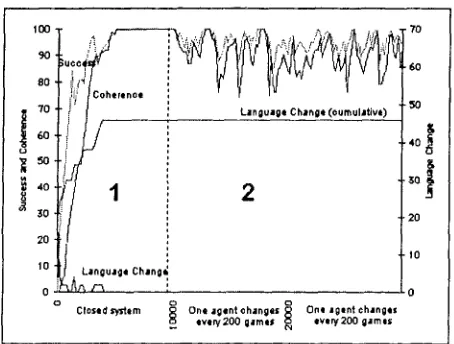
Figure 1: The graphs show for a population of 20 agents and 10 meanings how a coherent set of form-meaning pairs emerges (phase 1). In a second phase, an in- and outflow of agents (1 in/outflow per 200 games) is introduced, the language stays the same and high success and coherence is maintained.
a m a x i m u m and lexicon coherence (measured as the average spread in the population of the most d o m i n a n t form-meaning pairs) is high (100 %) In the early stage there is important lexi- con change as new form-meaning pairs need to be generated from scratch by the agents. Lexi- con change is defined to take place when a new form-meaning pair overtakes another one in the competition for the same meaning.
Phase 2 demonstrates that the lexicon is re- silient to a flux in the population. An in- and outflow of agents is introduced. A new agent coming into the population has no knowledge at all about the existing set of conventions. Suc- cess and coherence therefore dip but quickly re- gain as the new agents acquire the existing lex- icon. High coherence is maintained as well as high average game success. Between the begin- ning of the flux and the end (after 30,000 lan- guage games), the population has been renewed 5 times. Despite of this, the lexicon has not changed. It is t r a n s m i t t e d across generations without change.
3 H o w a l e x i c o n m a y i n n o v a t e a n d m a i n t a i n v a r i a t i o n
So, although this model explains the forma- tion and transmission of a lexicon it does not explain why a lexicon might change. Once
a winner-take-M1 situation emerges, competing forms are completely suppressed and no new in- novation arises. Our hypothesis is t h a t innova- tion and maintenance of variation is caused by stochasticity in language use (Steels and Ka- plan, 1998). Stochasticity naturally arises in real world human communication and we very much experienced this in robotic experiments as well. Stochasticity is modeled by a number of additional stochastic operators:
1. Stochasticity in non-linguistic communica- tion can be investigated by probabilistically introducing a random error as to which ob- ject is used as topic to calculate the object- score. The probability is called the topic- recognition-stochasticity T.
2. Stochasticity in the message transmission process is caused by an error in produc- tion by the speaker or an error in percep- tion by the hearer. It is modeled with a second stochastic operator F, the form- stochasticity, which is the probability t h a t a character in the string constituting the word form mutates.
3. Stochasticity in the lexicon is caused by er- rors in m e m o r y lookup by the speaker or the hearer. These errors are modeled us- ing a third stochastic operator based on a parameter A, the memory-stochasticity, which alters the scores of the associations in the score matrix in a probabilistic fash- ion.
[image:4.612.70.297.49.221.2]T ... ' ... E
0,9
0,8
0,7 L U I m
0,4 J
0,3-
0,2
0,I -
O a F=O,3
i t
F=O ~ F=O
tmcnes
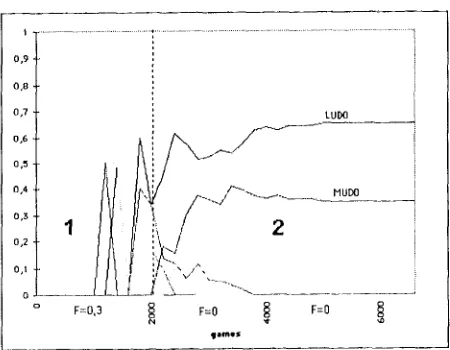
Figure 2: Competition diagram in the presence of form-stochasticity and a broad form-scope. The diagram shows all the forms competing for the same meaning and the evolution of their score. When F = 0.3 new word-forms are occasionally introduced resulting in new word- meaning associations. When F = 0.0 the in- novation dies out although some words are still able to maintain themselves due to the hearer's broad focus.
1. Stochasticity introduces innovation in the lexicon. There is no longer a clear winner-take- all situation, whereby the lexicon stays in an equilibrium state. Instead, there is a rich dy- namics where new forms appear, new associa- tions are established, and the domination pat- tern of associations is challenged. The different sources of stochasticity each innovate in their own way: Topic-stochasticity introduces new form-meaning associations for existing forms. Form-stochasticity introduces new forms and hence potentially new form-meaning associa- tions. Memory-stochasticity shifts the balance among the word-meaning associations compet- ing for the expression of the same meaning.
2. Tolerance to stochasticity, due to a broad scope (high a f) and a weak focus (low ¢ ] ) , maintains variation. For e x a m p l e , suppose a form "ludo" is t r a n s m i t t e d by the speaker but the hearer ha.s only "mudo" in his lexicon. If the form-focus factor is low and if both forms refer in the respective agents to the same ob- ject, their communication will be successful, be- cause the word-score of "mudo" will not devi- ate t h a t much from "ludo". Neither the hearer nor the speaker will change their lexicons. Sim-
ilar effects arise when the agent broadens the meaning scope and weakens its meaning focus to deal with meaning stochasticity, caused by error or uncertainty in the non-linguistic com- munication.
4 H o w v a r i a t i o n is a m p l i f i e d
Although stocha.sticity and the agent's m- creased tolerance to cope with stochasticity ex- plain innovation and the maintenance of varia- tion, they do not in themselves explain lexicon change. Particularly when a language is already established~ the new form-meaning pairs do not manage to overtake the dominating pair. To get lexicon change we need an additional factor that amplifies some of the variations present in the population. Several such factors arc proba- bly at, work. The most obvious one is a change in the population. New agents arriving in the commnnity may first acquire a minor variant which they then start to propagate further. Af- ter a while this variant could become in turn the dominant variant. We have conducted a se- ries of experiments to test this hypothesis, with remarkable results. Typically there is a period of stability (even in the presence of uncertainty and stochasticity) followed by a period of insta- bility and strong competition, again followed by a period of stasis. This phenomenon has been observed for natural languages ~nd is known in biology as punctuated equilibria (t';ldredge and Gould, 1972).
[image:5.612.76.301.55.230.2]I(~) ~ ... ~ohlrt n, 140
k
~ ~ i ~ ;'i ~1 k ~',.< ~ 2 o
8o 'i."t h' ~ , , ~'.i '/ i,! ',)- ~' ~:! ~ i i
°
I:;q7
80 8
40
20 i : Oni i l I M Oat I~lnt $mlll 20
i : iml~ tv¢l'" I I F(,O~ Llnoui/m hlnol
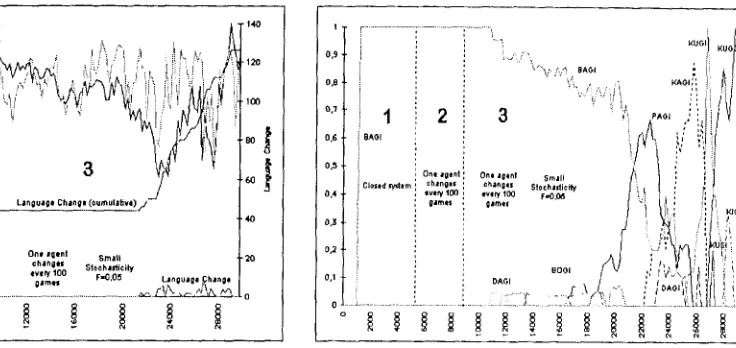
Figure 3: The diagram shows that change re- quires both the presence of uncertainty and stochasticity, high tolerance (due to broad scope and diffuse focus) and a flux in the popula- tion. The lexicon is maintained even in the case of population change (phase 2), but starts to change when stochasticity is increased (phase
3).
a certain period a new phase of stability starts. A companion figure (figure 4) focuses on the competition between different forms for the same meaning. In the initial stage there is a winner-take-all situation (the word "bagi"). When stochasticity is present, new forms start to emerge but they are not yet competitive. It is only when the flux in the population is positive that we see one competitor "pagi" be- coming strong enough to eventually overtake "bagi". "bagi" resulted from a misunderstand- ing of "pagi". There is a lot of instability as other words also enter into competition, giv- ing successive dominance of "kagi", then "kugi" and then "kugo". A winner-take-all situation arises with "kugo" and therefore a new period of stability sets in. Similar results can be seen for stochasticity in non-linguistic communica- tion and in the lexicon.
5 C o n c l u s i o n s
The paper has presented a theory that explains spontaneous lexicon change based on internal factors. The theory postulates that (1) coher- ence in language is due to self-organisation, i.e. the presence of a positive feedback loop between the choice for using a form-meaning pair and the success in using it, (2) innovation is due
' I t ... ... i ... '.. °}K0°V
0,9 i : ; ' ' i
°e t : " , ' ~'~ I!
o,/ i : i " ~ " ~ : : l I l i
t " ' 2 ' 3 "' ,°, l i~
0~; B~.O '. I"
, i I
l., {(} i n l moint : One I$1nl Small ~ " I
" " , : , . . . . o . . . . ~ "i } : : ! )qoo
) , ~ ii / / : " h
° . l i
i:
ili
e 0 0
Figure 4: The diagram shows the competition between different forms for the same meaning. We clearly see first a rapid winner-take-all situa- tion with the word "bagi", then the rise of com- petitors until one ("pagi") overtakes the others. A period of instability follows after which a new dominant winner ("kugo") emerges.
to stochasticity, i.e. errors ill form transmis- sion, non-linguistic communication, or memory access, (3) maintenance of variation is due to the tolerance agents need to exhibit in order to cope with stochasticity, namely the broadening of scope and the weakening of focus, and finally (4) amplification of variation happens due to change in the population. Only when all four factors are present will effective change be ob- served.
These hypotheses have been tested using a formal model of language use in a dynamically evolving population. The model has been im- plemented and subjected to extensive computa- tional simulations, validating the hypotheses.
6 A c k n o w l e d g e m e n t
[image:6.612.79.354.52.226.2] [image:6.612.151.519.54.228.2]R e f e r e n c e s
J. Batali. 1998. Computational simulations of the emergence of grammar. In J. Hurford, C. Knight, and M. Studdert-Kennedy, ed-
itors, Approaches to the Evolution of Lan-
guage. Edinburgh University Press, Edin- burgh.
N. Chomsky. 1990. Rules and representations.
Brain and Behavior Science, 3:1-15.
N. Eldredge and S. Gould. 1972. Punctuated equilibria: an alternativeto phyletic gradual-
ism. In T. Schopf, editor, Models in palaeobi-
ology, pages 82-115, San Francisco. Freeman and Cooper.
S. Kirby and J. Hurford. 1997. Learning, cul- ture and evolution in the origin of linguistic constraints. In P. Husbands and I. Harvey,
editors, Proceedings of the l~burth European
Conference on Artificial Life, pages 493-502. MIT Press.
W. Labov. 1994. Principles of Linguistic
Change. Volume I: Internal Factors. Back- well, Oxford.
B. MacLennan. 1991. Synthetic ethology: An approach to the study of communication. In
C. bangton, editor, Artificial Life II, Red-
wood City, Ca. Addison-Wesley Pub. Co. A. Mclntyre. 1998. Babel: A testbed for re-
search in origins of language. To appear in COLING-ACL 98, Montreal.
A. McMahon. 1994. Understanding Language
Change. Cambridge University Press, Cam- bridge.
M. Oliphant. 1996. The dilemma of saussurean
communication. Biosystems, 1--2(37):31-a8.
L. Steels and F. Kaplan. 1998. Stochasticity as a source of innovation in language games. In C. Adami, R. Belew, H. Kitano, and C. Tay-
lor, editors, Proceedings of Artificial Life VI,
Los Angeles, June. MIT Press.
L. Steels and P. Vogt. 1997. Grounding adap- tive language games in robotic agents. In
I. Harvey and P. Husbands, editors, Proceed-
ings of the ,{th European Conference on Arti- ficial Life, Cambridge, MA. The MIT Press. L. Steels. 1996. Self-organizing vocabularies.
In C. Langton, editor, Proceeding of Alife 17,
Nara, Japan.
L. Steels. 1997. The origins of syntax in vi- sually grounded robotic agents. In M. Pol-
lack, editor, Proceedings of the 15th Interna-
tional Joint Conference on Artificial Intelli- gence, Los Angeles. Morgan Kauffman Pub- lishers.
G. M. Werner and M. G. Dyer. 1991. Evolution of communication in artificial organisms. In C. G Langton, C. Taylor, and J.D. Farmer,
editors, Artificial Life II, VoI.X of SFI Stud-