Connectivity in Bag Generation
A r t u r o T r u j i l l o a n d S i m o n B e r r y * S c h o o l of C o m p u t e r a n d M a t h e m ~ t i c a l S c i e n c e s T h e R o b e r t G o r d o n U n i v e r s i t y , St A n d r e w S t r e e t
A b e r d e e n A l / l 1 f i g S c o t l a n d
{ i a t , c s 5 s by } (c~_ sct us. vgu.ac, ul<
A b s t r a c t
'Fhis l)aper presents a pruning tech- nique which can bc used to reduce the number of paths searched in rule-based b~g generators of the type proposed by (Poznafiski el; al., 1!)95) and (l'opowMl, 1995). Pruning the search space in these generators is important given the. com- putational cost of bag generation. 'rhe technique relies on a connectivity con- straint between the semantic indices as- sociated with each lexical sign in a ba R. Testing the algorithm on a range of sen- tences shows reductions in the~ genera- tion time and the nmnber of edges con- stru cl.cd.
1 I n t r o d u c t i o n
Bag generation is a form of natural language gel> er;ttion in which the input is ;~ bag (Mso known as a inultiset: a set in which rcpe~ted elements are significant) of lexicM elements and the output is a grammatical sentence or a statistically most prob- able permutation with respect to some. bmguage model.
Bag generation has been considered within the st~tistieal and rule-based paradigms of computa- tional linguistics, and catch has handled this prob- lem differently (Chen and Lee, 1994; Whitelock, 1994; Popowich, 1995; Tn0illo , 1995). This pa- per only considers ruh' based approaches to this problem.
Bag generation has received particulm: atten- tion in lexicalist approaches to MT, as exempli- tied by Shake-and-Bake generation (Beaven, 1992; Whitelock, 1994). One can also envisage applica- tions of bag generation to generation fi'om mini- *Now at S [ 1 A R P L~tboral, ories of I"mrope, Ox- h)rd Science [)ark, Oxford OX4 4CA. E-ma~il: simon~sh~Lrp.co, nk
tmdly recursiw', semantic ropresentactions (Cope.s- take ct al., 1995) and other semantic fi'ameworks which separate scoping fi'om content information (l{eyle, 1995). ht these frameworks, the unordered natllFe ()f predicate or relation sets makes the aI> plict~tion o[' bag generation techniques attra.ctiw:. A notational convention used in the I)al)er is that items such as 'dogt' stand for simplitied lex- ical signs of the. form (Shieber, 198(0:
SI'M - - [ ttl/I,N = d o g ] . . . . [ attc:~l = 1 J
In such signs, the semantic argument will be re- ferred to as an qndex' and will be shown as n subscril)t to a lexeme; in the above exmnple, the index has been giwm the unique type 1.
The term index is borrowed rl'Olll IIPSG (Pol- lard and Sag, 1994) where indices ~u'e used as ar- guments to relations; however these indices tnay also be equated with dis(-onrse referents in l)lt:I' (Kamp and I{eyle, 1993). As with most lexical- ist generators, semantic variables ttttlSl; [)c distin- guished in order to disallow tr;mslationally incor- rect permutations of the target bag. We distin- guish variables by uniquely typing them.
Two assumptions are made regarding [cxieal- semantic indexing.
A s s m n p t i o n 1 All lea'teal signs must be indexed, including fltnetional and nonprcdicative elements (Calder cl al., 1989).
A s s u m p t i o n 2 All le.~ical signs must be con- necled to each other. 7'wo lea:ical signs arc con- nected if they are directly connected; furthermore, the connectivity rclation is h'an.silivc.
D e f i n i t i o n 1 7'wo signs, A, 11, are directly con- nccled if there cxisl at least two paths, PathA, Palht3, such that A:PathA is token identical with
B:PathB.
The indices involved in determining connec- tivity arc; specified as pa.rameters for a pro._ ticul;tr formalism, l'k)r exanq)le, in tlPSG,
play a m a j o r role in preventing the generation of incorrect translations.
[CAT=S 1 ~ [oKr=NP l [O~T=VP
1) [SEM=E~]J LS~M:A~G1 :=~]
L~:M=IEL.,,~o'~=IIljj
[CAT=NP] [CAT=Det 1 rcA~'=Na ] 2)L~.=I ~ j ~
Ls,~:.,,,~ ~ =l~l L~E~=@[,,~<----V1]]
[CAT=N1]
3) [ ~ , _ ~ j
[oa,,=m]
[image:2.596.79.291.89.256.2][OAT=Eli [ c K r = P P ] [CAT=vPl
Figure
CAT= A [CAT---- N1
SEM:ARG1 : ~ ] ]
CAT= N1 [OAT = P P
SI,'M: ARG1 ~[~]] ]
[ CAT = N 1 [ OA'I'= P
[SEM__@~^lm3~][ --=~J] [CAT=NP ] CAT= Vtra rCAT=N p ]
1: Simple unification grammar.
It will be shown t h a t it is possible to exploit the connectivity Assumption 2 above in order to achieve a reduction in the n u m b e r of redundant wfss constructed by b o t h types of generator de- scribed in section 2.
3.1 U s i n g C o n n e c t i v i t y for P r u n i n g Take the following bag:
Ex. 2 {dogl,thcl,brown:,big:}
(corresponding to 'the big brown dog'). Assume t h a t the next wfss to be constructed by the gen- erator is the NP 'the dog'. Given the g r a m m a r in Figure 1, it is possible to deduce t h a t ' b r o w n ' can never be part of a complete NP constructed from such a substring. This can be determined as follows. If this adjective were part of such a sentence, ' b r o w n ' would have to appear as a leaf in some constituent t h a t combines with 'the dog' or with a constituent containing 'the dog'. From the g r a m m a r , the only constituents t h a t can com- bine with ' d o g ' are VP, V t r a and P. However, none of these constituents can have ' b r o w n l ' as a leaf: ill the case of P and V t r a this is trivial, since they are b o t h categories of a ditferent lexi- cal type. In the case of the VP, ' b r o w n l ' cannot appear as a leaf either because expansions of the VP are restricted to NP complements with 2 as their semantic index, which in turn would also re- quire adjectives within them to }lave this index. l,'urthermore, 'brown1' cannot OCCUr as a loaf in a deel)er constituent in the VP t)ecause such an occurrence would be associated with a different index. In such cases ' b r o w n ' would modify a dif- ferent noun with a different index:
Ex. a { the], dog] , withl ,2 , the~ , lnvwn2 , collar2}
A naive i m p l e m e n t a t i o n of this deduction would a t t e m p t to expand the VP depth-ill'st, left to right, ill order to a c c o m m o d a t e ' b r o w n ' in a com- plete derivation. Since this would not be possible, the NP 'the dog' would be discarded. This ap- proach is grossly inefficient however. W h a t is re- quired is a more tractable algorithm which, given a wfss and its associated sign, will be able to deter- mine whether all remaining lexical elements can ever form part of a complete sentence which in- cludes t h a t wfss.
Note t h a t deciding whether a lexical sign can appear outside a phrase is determined purely by the g r a m m a r , and not by whether the lexical ele- ments share the same index or not. Thus, a more complex g r a m m a r would allow 'the m a n ' from the bag
Ex. 4 {thel,manl,shaves<l,],himselfl}
even though 'himself' has the same index as 'the IIlan'.
3.2 O u t e r D o m a i n s
T h e approach introduced here compiles the rel- evant information of[line fi'om the g r a m m a r and uses it to check for connectivity during bag gener- ation. T h e compilation process results in a set of (Sign,Lex,Bindings) triples called outer domains.
'l'his set is based on a unification-based phrase structure g r a m m a r defined as follows:
D e f i n i t i o n 2 d g r a m m a r is a tuple (N, 7 ; P , S ) , where P is a sct of productions ce ~ /3, a is a sign, /3 is a list of signs, N is the set of all ee, T is the set of all signs appearing as elements of [3 which unify with lexical entries, and S is the start sign.
Outer domains are defined as follow:
D e f i n i t i o n 3 { ( S i g n , Lcx, B i n d s ) I Sign C N tO T, Lcx ~ T and there exists a derivation Oe ~ /31Signt /32 L e J /33 or a ~ f11Lez] /32,S'iqnl /33, and Sign' a unifier f o r Sign, Lez j a unifier f o r Lcx, and Binds the set of all path pairs <SignPath, L e x P a l h > such thai Sign':SignPath is Ioken identical with LezS :LexPath}
Intuitively, the outer domains indicate t h a t preterminal category Lex ('an appear in a com- plete sentence with subconstituent Sign, such t h a t l,cx is not a leaf of Sign. Using ideas from d a t a flow analysis (Kennedy, 1981), predictive parser constructions (Aho et al., 1986) and feature gram- m a r compilation (Trujillo, 1994) it is possible to construct such a set of triples. Outer domains thus represent elements whi(:h m a y lie outside a subtree of category Sign in a complete sentential
they would be indicated through paths such as SYNSEM :LOCAL:CONTI,INT:INI) EX.
'[b ensure that only connected lexical signs are
generated and analysed, the following assumt)tion
must also be made:
A s s u m p t i o n 3 A grammar will only generate or analyse connected lexical signs.
2 B a g G e n e r a t i o n A l g o r i t h m s
Two main tyl)es of rule-based bag generators have been proposed. The first type consists of a parser
suitably relaxed to take into account the un- ordered character of tile input (Whitelock, 1994; Popowich, 1995; Trujillo, 1995). For example, in generators based on a chart 1)arser, the hm(tanmn- tal rule is applie(1 only when the edges to be ('om- bined share no ]exical leaves, in contrast to re- quiring that the two edges have source and target nodes in common. The other type of generator ap- plies a greedy algorithm to an initial solution in order Co find a grammatical sentence (1)oznafiski et al., 1.995).
2.1 R e d u n d a n c y i n B a g G e n e r a t i o n One disadvantage with the above generators is that they construct a nnnd)er of strnctures which need Dot have been computed at all. In buihl-- ing these structures, the generator is e[fcctively searching branches of the search space which never lead to a COml)lete sentence. Consider the the tbl- lowing input bag:
{ dog, barked, the, brown, big}
Previous rest,archers (Ih:ew, 1992; l)hillil)s, 1993) have noted that from such a lx~g, tile following strings ;u:e generated but none can fi)rtn part of a (;omplete sentence (note that indices are omit- ted when there is no possibility of conrnsion; # indicates that the subs|ring will never be part of ~ complete sentence):
Ex. 1 # the dog the dog barked # the brown dog
For simph'~ cases in chart based generators such unnecessary strings do not create many problems, but for k)nger sentences, each additional su bstring implies a further branclt in the search tree to be considered.
Since tile (;Oml)Utational ('Oml)lexity of the greedy bag generator (Poznafiski (% al., 1995) is
polynolni&l (i.e. O(?,.d)), the cf]'ect of ,'(~(hlnda,lt
sul)structnres is not as detrimentM as for parser based generators. Neverthelc'ss, a (:ert~in am(rant of mmccesm~ry work is t)erformed. 'lk) show this, consider the test-rewrite sequence for l!'~xaml)h'. I:
Test: (log barked the brown big R.ewrite: __ barked the d o g brown big Test: barked (the dog) brown big R e w r i t e : __ (the dog) b a r k e d brown big Test: ((the (log) barked) brown big
R e w r i t e : the b r o w n dog barked __ big
Test: ((the (brown (log)) h a r k e d ) b i g R e w r i t e : tile b i g (brown dog) barked _. T e s t : ((the (big (brown clog))) barked) ('ter-
minate)
In this scqnence donble und(,rscorc (__.) indi- cates the starting position of a moved constituent; the moved constituent itself is given in bold t~ce; the bracketing indicates analysed constituents (for expository purposes the algorithm has been over- simplified, but the general idea remains the
salne).
Now consider the step where 'brown' is inserte(l 1)etwe(;n '|tie' and 'dog'. This action causes the complete structure for 'the dog barked' to be dis- carded and replaced with that for %he brown (tog barked', which in turn is discarded and replaced by 'the big brown dog barked'.2.2 P r e v i o u s W o r k
A number of prnning techniqtms have I)een sug- gested to re(hwe the mnom,t of redundancy in bag generators. Brew (19921 proposed a constraint propagation technique which eliminates branches during I)ag generation by considering the nec- essary lh,~ctor-argument relationships that exist between the component basic signs of categorial signs. These relationships form a graph indic:Lt- ing the necessary conditions for a lexical item to form part of a comt/h'.te sentence. Such graphs can 1)e use(l to elinlinate 1;he substrings in l'3xaml)le 1.
Unh)rtunately the technique exploits specilic as- l)ects of categorial grammars an(l it is not <:lear how the.y may he used with other formalisms.
Trujillo (1995) adapts some of Brew's ideas 1,o phrase structure grammars by ('emil|ling l!'of low functions and constructing adjacency graphs. While this al)l)roach reduces the size of the search sl)ace , it; does not prune it; sulllciently for cert,|in classes of rood|tiers.
Phillips (199'.{) proposes handling ine[ticiency ~1; the expense of completeness. Ills idea is to main- l.a.il~ a queue, of rood|liable constituents (e.g. N Is) in order to delay their combination with other constituents until rood|tiers (e.g. Pl's) have been ana.lysed. While practical, this approach can lead to alternative wdid sentences not being gen(;r;(.t(~(I.
3 C o n n e c t i v i t y R e s t r i c t i o n s
derivation. The following definition specifies how outer domains are used:
D e f i n i t i o n 4 A lexical sign Lea/ is in the outer domain of Sign' if[ there is a triple (Sign,Lex, Binds) in outer domains such that Sign and Lex unify with Sign I and Lez j respectively, and there is at least one pair <PathS, PathL> E Binds such that Sign':PathS unifies with LezQPathL.
In compiling outer domains, inner domains are used to facilitate computation. Inner domains are defined as follows:
D e f i n i t i o n 5 {(Sign, Lex, Binds) I Sign C N U T, Lex 6 7' and there exists a derivation (~ :~ /31LezS f12, with Sign I a unifier for Sign, Le~ s a uni- fier for Lex, and Binds the set of all path pairs <SignPath, LexPath> such that Sign':SignPath is token identical with LezS :LexPath}
The inner domains thus express all the possible terminal categories which may be derived from each nonterminal in the grammar.
To be able to exploit connectivity during gen- eration, inner and outer domains contain only triples in which Binds has at least one element. In this way, only those lexical categories which are directly connected to the sign are taken into ac- count; the implication of this will become clearer later.
As an example, the outer domain of NP as de- rived from the above g r a m m a r is:
(N P[sem:arg l:X],Vtra[sem:arg2:Y], { <sem:argl.,sem:arg2 > } )
(NP[~em:arg~:X],Vt~a[sem :arga:Y],
{ <sem:argl,sem:arga > } )
(NP[~o,n:~rgl:X],P[~em:~rga:Y],
{ <sem:argl,sem:arg3> })
This set indicates that for any NIP, the only ter- minal categories not contained in the subtree with root NP, and with which the NP shares a seman- tic index, are Vtra and P. For instance, the first triple arises from the following tree:
S
NP/sem:argl:X] VP[sem:arg2:X]
V t r a [ s e m : a r g 2 : X ] NP a.a P r u n i n g t h r o u g h O u t e r D o m a i n s a n d
Connectivity
The pruning technique developed here operates on grammars whose analyses result in connected leaves.
Consider SOllle wfss W constructed from a bag B and with category C; this category, in the form of a sign, will include syntactic and lexical-semantic
information. Such a wfss will have been con- structed during the bag generation process. Now, either W includes all the input elements as leaves, in which case W constitutes a complete sentence, or there are elements in the input bag which are not part of W. In the latter case, for bags obeying Assmnption 2, the following condition holds for any W that can form part of a complete sentence: C o n d i t i o n 1 Let L be the set of leaves appearing in W, let a be the .graph (V, Fd, where V : {C3 U B - L, and E - - { {x,y} ] x,y 6 V a n d y is in the outer domain of x}. Then G is connected.
'lb show that; this condition indeed holds, con- sider a grammatical ordering of some input bag B, represented as the string W:
ce.. T&.w
By Assumption 2, the lexical elements in the bag, and therefore in any grammaticM ordering of it, are connected. Now consider reducing this string using the production rule:
D ~ 7 5
to give the string W':
O~,. D..o2
In this case, the signs in W' will also be connected. This can be shown by contradiction:
P r o o f 1 Assume that there is some sign ~ in W' to which D is not connected. Then grammar G would allow disconnected strings to be generated, contrary to Assumption 3. 7'his is because D would not be able to rewrite 7161 in such a way that both daughters were connected to ~, leading to a disconnected string.
The situation in string W' is analogous to that in Condition 1. By identifying signs which are directly connected in E, it is possible to determine whether g is connected and consequently whether C can form part of a complete derivation, instead of simply comparing the value of index paths, it is more restrictive to use outer domains since they give us precisely those elements which are directly connected to a sign and are in its outer domain. 3.4 E x a m p l e
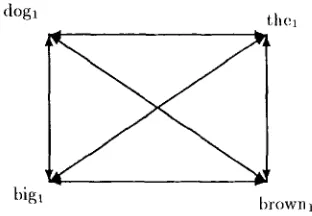
Consider P~xample 2. 'Ib eliminate the wfss 'the dog' from further consideration, a connected graph of lexical signs is constructed before gen- eration is started (Figure 2). This graph is built by nsing the outer domain of each lexical element to decide which of the remaining elements could possibly share an index with it in a complete sen- tence.
dog1
big1
1LhcI
brown i Figure 2: Initial commcted graph.
[image:5.596.96.252.58.166.2] [image:5.596.310.493.410.528.2]When a new wfss is constructed during genera- |ion, say by application of the modified fimdame.n- tal rule or during the rewrite phase in a greedy al- gorithm, this initial graph is u p d a t e d and tested for connectivity. If the u p d a t e d graph is not con- neeted then the proposed wfss cannot form part of a complete sentence. Updating the graph involves three steps, l"irstly every node in the graph which is a leaf' of tit(' new wfss is deleted, toge.t.lmr with its associated ares. Secondly, a new node corre- sponding to tit(: new wNs is added to the graph. Finally, a new arc is added to the graph between the uew node and every other node lying in its outer domain. The u p d a t e d (disconnected) graph t h a t ensnes after constructing ' t h e clog' is shown in Figure 3; this NP is therefore rejected.
%|it dog'l
big1 4 ~ brown1
Figure 3: Updated disconnected graph after the wfss 'the dog' is constructed.
4
C o m p i l i n g C o n n e c t i v i t y
D o m a i n s
For reasons of space, the c o m p u t a t i o n of outer do- mains cannot be described fully here. T h e broad outline, however, is as follows. First, the inner domains of the g r a m m a r are calculated. This in- volves the calculation of the fixed point of set equations, analogous to those used in the con- struction of First sets for predictive parsers (Aho et al., 1986; Trujillo, 1994). Given the inner do- mains of each category in the g r a m m a r , the con- struction of the outer domains involves the com- putation of the lixed point of set equations relat- ing the outer domain of a category to the inner domain of its sisters and to the outer domain of its mother, in a manner analogous to the eoinpu- tation of Follow sets.
I)uring c o m p u t a t i o n , the set of Binds is mono- tonically increased as difDreut ways of directly connecting sign and lexeme arc found.
5
R e s u l t s
T h e abow~' pruning tcchnique has been tested on bags of different sizes including different combina- tkms of modifiers. Sentences were generated using two versions of a modified chart parser. In one, ew'.ry inactive edge constructed was added to the chart. In the. other, every inactive edge was tested to see if it led to a disconnected graph; if it did, then the edge was discarded. T h e results of the experiment are shown in Table 1. The implemen- tation was in Prolog on a Sun S p a r e S | a t | o n 10; the generation timings do not include garbage collec- tion time. The g r a m m a r used for the experiment consisted of simplified, feature-based versions of the 11) rules in G P S G ; there were 18 rules and 50 lexical entries. Compilation of the outer do- mains for these rules took apt)roximately 37 min- utes, and the resulting set occupies 40K of m e n > ory. In the general case, however, tile size of the outer domains is O(n2), where n is the number of distinct signs; this n u m b e r can be controlled by employing equivalence classes of different lev- els of specificity for pre-terminal and non-terminal signs.
Chart Gen. + Pruning Hag size Time Edgcs Time Edges
2 0.1 15 8.1 15
4 0.3 37 (1.4 36
7 1.5 103 2.0 99
7 0.9 72 11.0 67
I] 5.1 213 3.9 138
12 2.6 133 3.4 123
15 9.0 294 7.2 186
15 117.6 448 11.1 253
17 2.3 126 2.6 1105
'l'al~le 1: Effect of pruning (times in secs). Only one reading was generated for each bag, corresponding to one a t t a c h m e n t site for PPs. 'l'he tMJe shows t h a t the technique ctm yieht re- ductions in the number of edges (both active aud inactive) and time taken, especially for longer sen- tences, while retaining the overheads at an accept- able level.
6
Conclusion
A technique fl)r pruning the search space of a bag generator has been i m p l e m e n t e d and its usefulness shown in Lhe geueration of different types of con- structions. The technique relies on a connectivity constraint imposed on the semantic relationships
expressed in the input bag. In order to apply the algorithm, outer domains needed to be compiled from the grammar; these are used to discard wfss by ensuring l'exical signs outside a wfss can indeed appear outside that string.
Exploratory work employing adjacency con- straints during generation has yielded further im- provements in execution time when applied in con- junction with the pruner. If extended appropri- ately, these constraints could prune the search space even further. This work will be reported at a later date.
A c k n o w l e d g m e n t s
Two anonymous reviewers provided very useful comments; we regret not being able to do justice to all their suggestions.
R e f e r e n c e s
A. V. Aho, R. Sethi, and J. D. Ullman. 1986.
Compilers - Principles, Techniques, and Tools.
Addison Wesley, Reading, MA.
J. L. Beaven. 1992. Lexicalist Unification Based
Machine Translation. Ph.D. thesis, Depart- ment of Artificial Intelligence, University of Ed- inburgh, Edinburgh, UK.
C. Brew. 1992. Letting the cat out of the bag:
Generation for Shake-and-Bake MT. In Pro-
ceedings of the 14th COLING, pages 610-16, Nantes, France, August.
J. Calder, M. Reape, and H. Zeevat. 1989. An algorithm for generation in unification catego-
rial grammar. In Proceedings of the Fourth Eu-
ropean Conference of the ACL, pages 233-40, Manchester, England, April.
It.H. Chen and Y.S. Lee. 1994. A corrective train- ing algorithm for adaptive learning in bag gen-
eration. In New Methods in Language Process-
ing, Manchester, UK.
A. Copestake, D. Flickinger, R. Malouf, S. Riehe-
mann, and I. Sag. 1995. Translation using
minimal recursion semantics. In Proceedings of
the 6th International Conference on Theoretical and Methodological Issues in Machine Transla- tion, Leuven, Belgium, July.
II. Kamp and U. Reyle. 1993. From Discourse
to Logic - Introduction to Modeltheoretic Se- mantics of Natural Language, Formal Logic and Discourse Representation Theory, volume 42 of
Studies in Linguistics and Philosophy. Kluwer Academic, Dordrecht, The Netherlands.
Ken Kennedy. 1981. A survey of data flow analy- sis techniques. In Muchnick and Jones (1981), chapter 1, pages 5-54.
Steven S. Muchnick and Neil D. Jones, editors.
1981. Program Flow Analysis: Theory and Ap-
plications. Software. Prentice-Hall, Englewood Cliffs, NJ.
J. D. Phillips. 1993. Generation of text from log-
ical formulae. Machine Translation, 8(4):209-
35.
C. Pollard and I. Sag. 1994. Head Driven Phrase
Structure Grammar. Chicago University Press, IL.
Fred Popowich. 1995. Improving the efficiency of a generation algorithm for Shake and Bake machine translation using Head-Driven Phrase
Structure Grammar. In Proceedings of Natural
Language Understanding and Logic Program- ming V, Lisbon, Portugal, May.
V. Poznafiski, J. L. Beaven, and P. Whitelock. 1995. An efficient generation algorithm for lex-
iealist MT. In Proceedings of the 33rd Annual
Meeting of the Association for Computational Linguistics, Boston, MA, June.
Uwe Reyle. 1995. On reasoning with ambigui-
ties. In Proceedings of the Seventh Conference
of the European Chapter of the Association for Computational Linguistics, pages 1-15, Dublin, Ireland, March.
C. J. Rupp, M. A. Rosner, and R. L. Johnson, ed-
itors. 1994. Constraints, Language and Com-
putation. Academic Press, London.
S. M. Shieber. 1986. An Introduction to
Unification-based Approaches to Grammar, vol-
ume 4 of CSLI Lecture Notes. CSLI, Stanford,
CA.
A. Trujillo. 1994. Computing FIRST and FOL- LOW functions for Feature-Theoretic gram-
mars. In Proceedings of the 15th COLING,
pages 875-80, Kyoto, Japan, August.
A. Trujillo. 1995. Lexicalist Machine Translation
of Spatial Prepositions. Ph.D. thesis, Computer Laboratory, University of Cambridge, April.
Pete Whitelock. 1994. Shake-and-bake transla- tion. In Rupp et al. (1994), pages 339-59.