A C D - R O M Retrieval S y s t e m with Multiple Dialogue A g e n t s
K e i i c h i
Sakai, T s u y o s h i Yagisawa, and M i n o r u Fujita
C a n o n I n c . , Media. T e c h n o l o g y L a b o r a t o r y8 9 0 - 1 2 K a s h i m M a , S a i w a i - k u , I ( a w a s a k i , 211, J a p a n { k e i i c h i ,
yag428 ,rainoru}©cis. canon, co. jp
A b s t r a c t
In this paper, we proposed a new diMogue system with multiple dialogue agents. In our new system, three types of agents: a) domain agents, b) strat- egy agents, and c) context agents were realized. T h e y give the follmving advantages to the user:
• the domain age.nts make the user aware of the b o u n d a r y between the domains.
• the strategy agents make the user aware of the difference between the strategies.
• the context agents help the user to deal with multiple goals.
We expect that the complex behaviors of the sys- tem will become more visible to the user in dif- ferent situations. The experimental results show t h a t the user can retrieve effectively and obtain the expected goals easily by using these multiple agents.
1
I n t r o d u c t i o nRecently, research into 'multi-agent systenF is in- creasing. The multi-agent systeln is now one of the promising solutions to achieve a complicated system (Maes, 91; Nishida and Takada, 93; Nagao aud Takeuchi, 94).
The multi-agent system which silnulates co- operation between qmman-agents' is realized by an integration of simplified autonomous flmctions. And ms a result it achieves a complicated system in total. It also has a latent potential to make a very flexible system.
Thus, we believe that if we introduce the con- cept of the nmlti-agent system into a dialogue sys- tem, we are able to construct a more sophisticated system which is able to treat various linguistic phenomena and to understand or to solw., nmre cmnplicated problems.
Focusing on dialogue systelns, while most cur- rent dialogue systems can treat only one domain (a small world for a single service), some re- search(Goddeau et al., 94; Nalnba et 31., 94) which aims at increasing the domains, what is called a transportable system(Grosz, 83; Paris, 89) are lmW on-going. Ill such systems, information re.- trieval across multil)le domains is realized using the relational databases. However in our systeln,
it is difficult to retrieve information across nmlti- pie donlains, I)ecause the information is retrieved from CD-ROMs in which a large a m o u n t of texts are contained, 1)y using full-text retrieval tech- niques.
And while there are robust and useful strategies in certain goals, there isn't an all-powerful sterat- egy which covers all goals. If a robust strategy in a certain goal is introduced into tile system, the user misunderstands that the system hKs an all- powerful strategy. Thus, in our system the user sometimes gets into trouble as follows:
• the user misunderstands that the information contained across several d a t a sources call be obtained at once.
• the user is confused between a certain re- trieval strategy which is robust in a certain goal and another siml)le but rather redmldant strategy.
Furthernmre, it is difficult to manage a dis- course involving multiple goals in current diMogue systems. This is because most current systems aren't robust enough for a n a p h o r a and they are able to manage only a single and simple context. This sometimes causes the following problem:
• the user has to manage the nmltiple contexts involving multiple goals, because the system only ma.nages a single context. And ithis makes it hard for the user to use the system. As the result, the user also gets lost in the system. In this paper, we focus on how to make the user aware of what the system Call or cannot do. Thus, we propose a nev¢ dialogue system with mul- tiple agents, in which we introduce the concept of multi-agent system into our dialogue system. Ill our system, three types of dialogue agents are re~ alized: 1) for each domain, 2) for each strategy and 3) for each context. These agents take turns and play their roles according to the discourse sit- uations. With these agents, our system will haw; the following characteristics:
• the domain agents mM~e the user aware of the 1)oundary between unintegrated domains. • the strategy agents make the user aware of
the difference, between the don lain oriented strategies.
• the context agents make it ea.sy for the user t o
deal with tit(; coml)licatcd discourse involving multiple goals.
In this pal)er, we first Cxl)lain our l)aseline spo- ken dialogue systeln T A R S A N which deM with multiple domains. Secondly, we describe the prob- lems which arise when wc extend the system into multiple domains. After that, we propose a new
dialogue systeln
with nmltiple diMogue agents.We ,also describe the results of the examinations on the l)rOl)OSC(l system. Finally, we conclude the pal)cr.
2 T h e b a s e l i n e s y s t e m : T A R S A N
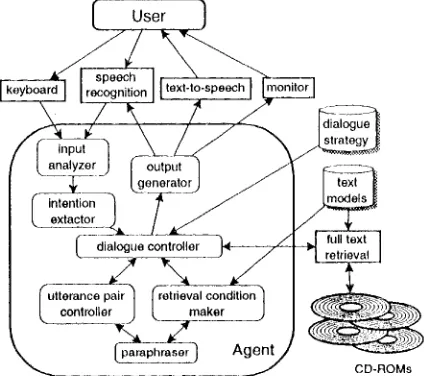
We have been constructing a spoken diah)gue system which retrieves inforlnatlon froln a large anlount of texts contained ill CD-ROMs, named T A R S A N ( S a k a i et al., 94; Sakai et al., 95). Fig- ure 1 shows the contiguration of the baseline syso tern T A R S A N for multiple domains.
(,o,.,,,'oo
]
t
/
(uttoranct, pair~
~triova~
[image:2.596.59.271.310.498.2]( cordrollor ) L _ makor _ J
Figure 1: T h e configuration of T A R S A N ft." mul- tiple domains
T A R S A N retrieves the information using the folh)wing processes:
1. Tile inlmt analyzer analyzes the result of the speech recognition or the sentence re(:eived frOlll keyboard.
2. T h e intention e x t r a c t o r extracts the user's intcntion (i.e. question, answer, (:ondition (:hange, and so on) 1)ased on the analysis of the modality.
3. T h e uttera.nce l)air controller deals with not only a silnl)le pair of QA I)ut also deals with tollow-u 1) questions bused on utteran(:e lmir controlling.
4. T h e retrieval (:ondition maker makes retrieval conditions which is sent to the fnll text re- trieval 1)rocess by. the dialogue controller de.- scribed below. T h e retrieval conditions are created 1)y refl'xring the ' t e x t - m o d e l s ' , which
define the relation betwcell the inlmt words and the retrieval conditions.
5. T h e 1)araphr~user translates various CXl)res- sions of the inputs into a single donlain ori- ented con(:el)t.
6. T h e diah)gue controller dctcrlnines the sys- t e m ' s l)ehavior (to retrieve and to answer the result, or to request lnorc rctricvM conditions to the user) by referring the retrieval condi- tions and the diMogue strategy.
7. T h e o u t l m t generator generates the o u t p u t sentence, to be announ(:ed by the text-to- speech 1)rocess and the information to be dis- 1)layed on the monitor.
Our current system T A R S A N is able to access the folh)wing four CD-ROMs:
C D - R O M I : sight-seeing infl)rmation in J a p a n (i.e. name, locat.ion, explanation, and so on of temples, hot springs, golf courses, and so on)(Kosaido, 90).
C D - R O M 2 : hotel inforlnation in J a p a n (i.e. name, telel)hone number, room charges, equip,nent, and so o n ) ( J T B , 92).
C D - R O M 3 : Japanese and foreign cinema infor- mation(i.e, tith', cast, director, story, and so ,,n)(PIA, 90).
C D - R O M 4 : Jalmnese professional base- ball player information(i.e, name, belonging team, records, and so on)(NMfigai, 90).
T A R S A N treats c D - R O M 1 and 2 as a single travel domain, CD-R,OM3 as a cinema domain, and C D - R O M 4 as a baseball domain.
3 P r o M e m s
As we described ill the introduction, we have ad- dressed three main l)robh'ms ill our (liMogue. sys- tenl. T w o problmns derive froln the e×tension of the system to multil)h', domains. And the last Olle derives from the single p a t h contextual manage- lllellt,
1. T h e first problem is t h a t the user nfisunder- stands t h a t the information contained across several d a t a sources call be obtaincd by a silt- gle input sentence. T h e fl)llowing are exam- 1)les of requests ac(:ross domains: T h e first e.x- ample is contained in the cinema (lomain and in the travel domain, and the second exam- l)le is contailmd ill the b~Lseball dolnmn and in the cinema domain.
l']xamph~ l: " tStm, ag,..ch, i MoTnoe. g a .sh..uen s i t a c i g a n o b'utai "hi n a t t a o n a c v , w o , s h i r i t a i . "
(i want to know tim hot
sl)ring
which is th(~ scene of the cinema whose s|,ar is Ymnaguchi Momoe.)E x a m p l e 2: "Puro yakyu.u acn.shu dat~.a haiywlt fla
ah'u,t,vu, e n sita eiga wo o,shiete."
Figure 2: Three types of agents
2. T h e second p r o b l e m is t h a t the user nfisun- derstands t h a t the system h ~ an Ml-powcrfifi strategy, if it has a robust s t r a t e g y for a cer- tain purpose. Suppose t h a t several discourse strategies exist in a single dialogue agent: one is a very sophisticated b u t very goal spe- cific s t r a t e g y which allows the user to reach the goal immediately, and a n o t h e r is a very simple b u t r e d u n d a n t s t r a t e g y which has the ability to achieve a n y kind of goal. In this case, the user m a y conflme the potential of these strategies and feel uncomfortable a b o u t the gap.
3. T h e last problem is t h a t the user has to man- age multiple contexts concerning to multiple goals, because the system isn't enough ro- bust for a n a p h o r a and only manages a sin- gle context. And this makes it hard for the user to use the s y s t e m . Table 1 is an exam- ple t h a t the user compares the information between Hakone and Nikko 1. The example shows t h a t the user ha.s m a n a g e d the context himself, which seems very complicated.
We have ,also assmncd t h a t these three problems arise because the s y s t e m only has a single diMogue agent. A single dialogue agent usually deals with everything and this makes the user invisible what the system can or cannot do. Thus, we propose a new diMogue system with multiple agents which make the s y s t e m ' s ability more visible to the user.
4
Dialogue system with multiple
dialogue agents
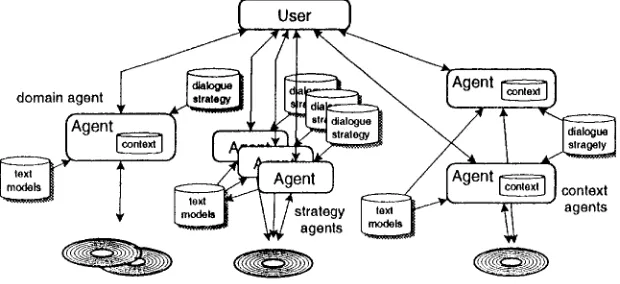
In this section, we introduce a new dialogue sys- t e m with multiple, dialogue agents. T h e purpose is to make the user aware of what the system can or cannot do. In our system, three types of di- alogue agents are realized: 1) for each donaain, 2) for each s t r a t e g y and 3) for the each context. Here, we call these agents as 1) domain agents, 2) s t r a t e g y agents, 3) context agents, respectively. Figure 2 shows a brief sketch of these three types of agents. These agents take turns and play their
1 They are famous sight-seeing places in Japan.
Table 1: An example t h a t the user manage the multil)le-goals by oneself
'usrl: H a k o n c ni aru o n s c n wo oshiete.
(Tell me the hot springs in Hakone Town.) sysl: 16 k e n a r i m a s u .
(There are 16 hot springs.)
usr2: Nikko deha. (How about in Nikko?)
sys2: C h u u z e n j i o n s e n , N i k k o y u m o t o o n s e n ga a r i m a s u .
(There are Chuuzenji onsen and Nikko yumoto
onsen.)
usr3: H a k o n e n i h a j i i n ga a r i m a s u k a . (Are there any temples in Hakone?)
sys3: A m i d a dera, K u d u r y u M y o j i n , S a u n j i nado 7 ken a r i m a s u .
(There are 7 temples; Amida dera, Kuduryu Myojin, Saunji, and so on.)
usr4: Nikko niha. (How about in Nikko?) sys4: N i k k o Toshoguu ga a r i m a s u .
(There is Nikko Toshoguu.) usr5: S o n o s e t s u m c i wo kikitai.
(Please explain it.)
sys5: T o k u g a w a I e y a s u no rei wo m a t s u r u . . . . (The soul of Tokugawa Ieyasu is worshipped.
...)
roles according to the discourse situations. T h e details of these agents are as follows.
4.1 T h e d o m a i n a g e n t s
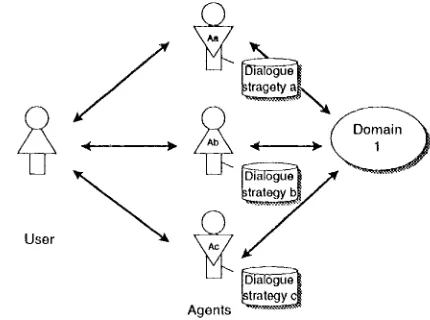
To solve the first problem, we realized domain agents which perform information retrieval ill each different domain. Figure 3 shows a brief sketch of the domain agents. T h e domain agents per- form the basic interaction between the user and the system to retrieve the information in the ba- sic m a n n e r specific to each domain. In every do- main agent, indispensable and basic conditions for information rctrievM are defined. Using these conditions, the domain agent communicates with the user and performs the information retrievM. And when the user's input 1-noves from one do- main to another domain, the domain agent will also change. T h u s with the domain agents, the user is made aware of the b o u n d a r y between the domains. We expect this mechanisnl to prevent the user from asking the question across uninte-
[image:3.596.119.429.61.203.2]User
Agents
Figure 3: The donmin agents
/
User
Agents
Figure 4: The strategy agents
Table 2: An examl)le of two agents try to make an action
llsr:
C.agt:
T.agt:
" Y a m n g u c h i M o m o c ga s h u e n ,sita ciga no butai ni n a t t a o n s e n we ~qhiritai."
(I want to know the hot spring wlfich is the scene of the cinema whose mmn (:rest is Ya- maguchi Mom<)e. )
" I z u no odoriko, S h u n k i n s h o , nado 13 ken a r i m a s u . "
(There are 13 cinemas: Izu no Odoriko, Slmnkinsho, and so on)
" J o u k c n ni gaitou,~uru onscn ha arima.~en."
(There is no hot spring satisfying the condition.)
grated multiple domains. For exmnl)le, in the case of the example 1 in section 3, two agents dealing with the <:inema domain and the travel domain try to make each action as Table 2 shows 2. Thus the, user will be aware of the b o u n d a r y between the two domains.
4.2 T h e s t r a t e g y a g e n t s
To solve the second probleln, we reMized the strat- egy agents which 1)crforins informatioll retrieval according to each specific strategy for the infor- mation retrieval. Figure 4 shows a brief sketch of the strategy agents. The strategy agents handle the interaction between the user and the system to retrieve the information in the manner specific to each task. In every strategy agent, task spe- cific conditions for tim information retriewd are defined. Using the task specifc conditions, the strategy agent is al)le to use the default condition specific to the task and is able to give advice or t<> give choices to the user. Thus with the strat- egy agents, the user is made aware of the strategy which is specific to the task an<l this mechanism prcvcnts the user using the task specific strategy for other tasks.
In the current system, there are two strategy agents for the travel dmnain:
2Travel agent is able to retrive and find "the hot spring which is the scene of Izu no odoriko".
b u s i n e s s t r i p s t r a t e g y a g e n t : indispensable c<mdition for the inlmt is the destination, and the optional con<liti<)ns are the room charge and the circumstances. When the optional con<litions arc not defined by the user, the strategy agent will rex:olmncnd some choices to the user. The default responses arc the name of the hotel and its telephone number in this task.
r e c r e a t i o n s t r a t e g y a g e n t : indisl)ensablc con- dition for the input is the recreation equip- ment and the number of participants and the other conditions are optional. When the optional conditions are not defined by the user, the strategy agent will recommend some choices to the user. The default responses are also the name of the hotel and its telephone lmnJ)er in this task.
These strategy agents not Olfly allow the user to use the system easily 1)ut ~dso hell> the user to 1)e aware of the <:haraeteristies of the diah)gue strategy specific to the task.
Table 3 ct)mpares the difference between using the domain agent for travel and the business trip strategy agent. As you can see from the table, more frielldly discourse is achieved when using the strategy agent.
4.3 T h e c o n t e x t a g e n t s
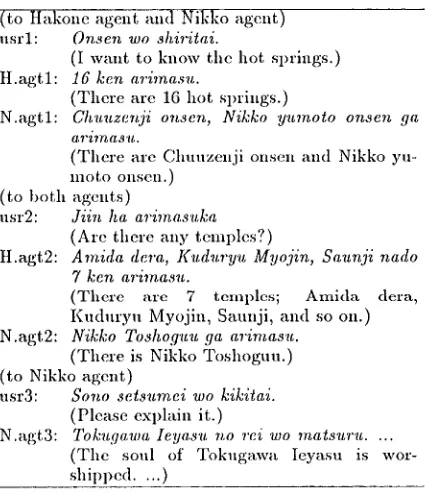
To solve the last l)rol)lem, we realized the context agents which perform the information retrieval dc- lmndent ill different contexts. The context agent is defined when the user n mves from one context to another. Figure 5 shows a brief sketch of the context agents. Using the context agents the user can easily compare the re, sults relating to lnultiplc goals.
[image:4.596.290.505.59.219.2] [image:4.596.65.268.60.218.2]Table 3: T h e comparison between the discourse
using the domain agent and the strategy agent
domain agent for travel agt0: Hal, Ryokou eejent desu.
(Hello, I'm travel agent.) usrl: Toitori ahi no hoteru wo shiritai.
(I want to know the hotels in Tottori city.) agtl: 34 ken arimaau. (34 rows exist.)
usr2: Ekimae ni aru hoteru.
(Land cireulnstatlee is neat' the station.) a g t 2 : 8 ken arimasu. (8 rows exist.)
usr3: shukuhaku ryou ga 8000yen ika deha. (And room charge is under 8000yen.) agt3: Hoka no jouken "Ricehi jouken ga ekimae"
wo nokoshi masulca.
(Do you keep another condtion, "Land cir- emnstanee is near the station"?)
usr4: Hal. (Yes.)
agt4: A A A h, oteru, hoteru B B B desu. (AAA hotel and hotel BBB exist.) usr5: Sono denwabangou wo oshiete.
(Tell me the telephone nmnhers.)
agt5: A A A hoteT~t no dcnwabangou ha X X X - X X X X , ho~er~ B B B no denwabanou ha
Y Y Y . Y Y Y Y dean.
(The telephone numher of AAA hotel is XXX-XXXX, and the one of hotel BBB is YYY-YYYY.)
agt0:
usrl: agtl:
usr2: agt2:
business trip strategy agent
Hai, Shucchou eejen~o dean. Dochira ni shucchou nasai masu ka.
(Hello, I'm business trip agent. Where at'e you goingo to go?)
Tot~ori shi dean. (Tottori city.)
Riechi joukcn ha ekimae, shukuhaku ryou ha 80OOyen ika de yoro.shii des'uka.
(Circumstance is near the station, and room charge is under 8000yen. Are these OK?) Hal. (Yes.)
2ken arimaau. A A A hoteru no denwabangou ha X X X - X X X X , hoteru B B B no denwabanou ha Y Y Y - Y Y Y Y desu.
(2 hotels exist. The telephone number of AAA hotel is XXX-XXXX, and the one of hotel BBB is YYY-YYYY.)
5
E x a m i n a t i o n s
In this section, we described the examinations of the prol)osed system. In order to examine the ef- fectiveness of the multiple dialogue agent system (new system), we compare it with the single dia- logue agent system (old system). Here the single dialogue agent is the domain agent for the travel domain.
We evaluated the system by counting the nun> ber of the interactions between the user and the system (Tnrns), the number of inl)ut characters of the users (Characters), and session time (Sec- onds) t h a t subjects took to reach the same goal with new system and the old one. Eight sul)jects examined these systems. T h e y are all typists, b u t novices with diah)gue systems. T h e y were given a brief explanation of both systems and practiced on t h e m for a b o u t q u a r t e r an hour each. We divide
User
Agents
Figure 5: The context agents
Table 4: The dialogue using two context agents
(to ttakone agent and Nikko agent) usrl: Onsen wo sMritai.
(I want to know the hot springs.) H.agtl: 16 ken arimasu.
(There are 16 hot springs.)
N.agtl: Gh.uuzenji onsen, Nikko gumoto onsen ga
ari?~a3,1l,.
(There are Chuuzenji onsen and Nikko yu- moto onsen.)
(to both agents)
usr2: Jiin ha arimas'u, ka (Are there any temples?)
H.agt2: Amida dera, Kuduryu Myojin, Saunji nado 7 ken arimaau.
(There are 7 temples; Amida dera, Kudnryu Myojin, Saunji, and so on.) N.agt2: Nikko Toahoguu 9 a arimaxu.
(There is Nikko Toshoguu.) (to Nikko agent)
usr3: Sono aetaumei wo kil~itai. (Please explain it.)
N.agt3: Tokugawa Ieyasu no rei wo matsuru . . . . (The soul of Tokugawa Ieyasu is wor- shipped . . . . )
tile subjects into two groups. G r o u p 1 examined new system first and old one next, and group 2 did old system first and new one next.
5.1 E x a m i n a t i o n 1
T h e following goal is given to every subject:
G o a l 1: You will go to Kurashiki City on busi- ness. Find a suitable hotel a. (You m a y select different hotels with each system.)
T h e relevant agent in the new system is the busi- ness trip agent. Table 5 shows the results (aver- ages of Turns, Characters, and Seconds) of exam- ination 1. These results show not only t h a t both groups needed less diMogue using new systeln than using old system, but also t h a t group 1 needed less dialogue, especially less session time (360:640), when they used old system than group 2. This
aThere are 41 hotels in Kurasldki City.
[image:5.596.316.519.61.220.2] [image:5.596.78.292.87.547.2] [image:5.596.316.529.274.521.2]nmans t h a t the user is Mile to learn how to use the old (strategy-less) systenl by using new sys- t e m with a typical strategy. ~rc also lnenti}m t h a t all six subjects who selected different hotels were h a p p y a b o u t the hotel using the new system.
Table 5: T h e results of cxanlination 1 Lohl --4 new new ~ old' Tm'ns /;7.3 3.0" 3.5 5.5 Characters / 75 18 25 56 Seconds [640 175 190 3 6 0
5.2 E x a m i n a t i o n 2
T h e following goal is given to every subject: G o a l 2: You have to sele(:t K a n a z a w a or Sendai
for sight-seeing. Colnl)are them using some retrieved inlbrlmtti<)n, and seh'ct one. T h e relevant agents in the new systeln arc K a n a z a w a agent and Scndai agent. Tal)le 6 is the results of examination 2. These results show an interesting phenomenon t h a t in the ca.se of the dia- logue comparing multiple goals with these Colnpli- cared processes, the user tends to stop comparing by session time (from five nfinutes to ten minites) in favour of the obtained retrieval results. And thc new system is able~ to obtain more ret:riewd results than thc old system. Thus the new system is b e t t e r t h a n the old system in the case of dealing with multil)le goals.
Table 6: T h e results of exalnination 2
old --* new new ~ old Turns 7.0 10.3 9.3 8.5 Chm'actcrs 79 54 51 96 Seconds 442 420 458 526
6 C o n c l u s i o n
In this paper, we proposed a new dialogn(' sys- t e m with multiph' diah)gue agents. In our new system, three types of agents were realized. T h e y were' a) domain agents, b) s t r a t c g y agents, and e) context agents. These agents give the fl)lh)wing advantages to the user:
* the domain agcnts prevent the user fi'om asking the questions across unintegrated do- mains.
. the s t r a t e g y agents make the user aware of the difference between the domain oriented strategies.
• the context agents make it e~Lsy for the user to deal with the complicated discourse inw)lving multiple goals.
Using these agents, we exl)ect the user to nnder- stand w h a t the system can or eanlmt do. T h e ex- perilnental resnlts show t h a t the user can retrieve effectively and obtain the expected goals easily by using these multiple agents.
A c k n o w l e d g e m e n t
The, authors wish to thank l)r. Hideyuki T a m u r a , head of the Me(lift Tcchnology Lab., for giving the ol)portunity of this study, Dr. Yasuhiro Komori and T o m Wachtel for suitable advice in translat- ing this p a p e r into English, and m e m b e r s of the Intelligcl~t Media Div. for usefifl discussions.
R e f e r e n c e s
Cdeile L.Paris. 1989. T h e Use of Exl)licit User Modcls in a Generation System for Tailor- ing Answers to the User's Level of Exl)crtisc. User Models in Diah)g Systems, l)p.200 pp.232. S1)ringel'-V-erlag , A.Kobsa, \V.\Vahler (t;Ms.). God(lean I)., Brill E., Glass J., Pao C., Phillips M,
Polifroni .]., Sem~tf S., and Zue V. 1994. GAW~A XY: A tlnman-langn;tge Interfitce to On- line Travel Information. In Proceedinqs of ICSLP-94, S13-11.
Grosz B.J. 1983. A Transl)ortable Natural- Language Interface System. In Proceedings of CoT@;rence on Applied Natural Language Pro- ee,~sing, pp.25 pp.30.
J T B . 1992. JTB's Accommodation Information
(Electronic Book YRRS-094). ed. by Nakw jime R. J T B . Tokyo.
Kosaido. 1990. TAB[GURA (Electronic Book Yl/RS-028). ed. by Nihon-Kanko-Kyokai C o l 1)oration. Tokyo.
Maes P. 1991. T h e Agent Network Architecture (ANA). S I G A R T bulletin (2), 4.
Nagao K. and Taken(:hi A. 1994. Social Inter- action: Multimodal Conversation with Social Agents. In Proceedings of AAAI-94, pp. 22- 28. N a m b a Y., Tsuji H., and Kinngawa H. 1994. Nat- ural Language Interface for Multil)le Systems Sequential Control (In Japanese). I P S J Vol.35 No.l, 1)1).20 34.
Nichigai. 1990. Th, e pr@ssional baseball (Ele(:- tronic Book YRRS-023). Morioka It. and Nichi- gai Asscoeiates Co. Tokyo.
Nishida T. and Takeda H. 1993. Towards the Knowledgeable Commnnity. In Proceedings of [nternation, al Conference on Building and Shar- ing of Very-Large Scale Knowledge Bases '93 (KB ~ KS '93), pp. 157-166. ()hnlsha.
PIA. 199(}. PIA cinema club (Electronic Book YRRS-016). ed. by W a t a n a b e K. P I A Co. Sakai K., Ikcda Y., and Fujita M. 1994. R o b u s t
Discourse Processing Considering Misrecogni- tion in Sl)oken Diah)gne System. In Proceedings of [CSLP-94, S17-7.
Sakai K., Ikeda Y., and Fujita M. 1995. Gaidansu Sisutemu no Maruehi Domein-ka no Kokoromi
[image:6.596.92.253.138.194.2] [image:6.596.88.249.429.485.2]