D o m a i n C o m m u n i c a t i o n K n o w l e d g e
Owen
Rambow*
Department of Computer and Information Science
University of Pennsylvania
Philadelphia, PA 19104
Abstract
This paper advances the hypothesis that any text plan- ning task relies, explicitly or implicitly, on domain- specific text planning knowledge. This knowledge, "do- main communication knowledge", is different from both domain knowledge and general knowledge about com- munication. The paper presents the text generation system Joyce, which represents such knowledge explic- itly.
T h e Joyce Text Generation
System
The Joyce text generation system is a part of the soft- ware design environment Ulysses (Korelsky and Ulysses Staff, 1988; Rosenthal el al., 1988). Ulysses is a graph- ical environment for the design of secure, distributed software systems. The design proceeds hierarchically by top-down refinement. A formal specification inter- face and a theorem prover allow the user to formally verify the flow security of the designed system.Joyce is part of the user interface. Joyce generates different types of texts about software designs:
• It generates annotations of the design which are in- tended to serve as system documentation during and after the design process.
• It is used to explain the result of a heuristic security design tool, the "flow analyzer".
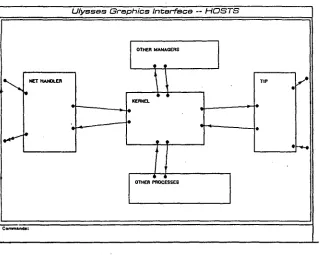
The texts Joyce generates are specifically conceived of as written texts: there is no feature for interactive natural-language explanation. The texts may be several paragraphs long. The text in figure 1 is an annotation of the component "Host"; the graphical representation of the first level of the design of the Host is shown in fig- ure 2. (This picture corresponds to the first of the two paragraphs of the text.) The text annotates the soft- ware design by describing its structure and interpreting it in terms of its security characteristics.
*The research reported in this paper was carried out while the author was at Odyssey Research Associates, Ithaca, NY. It was supported by the Air Force Systems Command at Rome Air Development Center under Con- tract No. F30602-85-C-0098
S t r u c t u r e o f
Joyce
Joyce consists of three separate modules, which perform distinct tasks and access their own knowledge bases.
1. The text planner produces a list of propositions, which represents both the content and the structure of the intended text. Thus, the task of Joyce's text planner is similar in definition to TEXT's (McKe- own, 1985), but different from that of Penman (Hovy, 1988), which expects the content selection task to have already been performed. Each proposition is ex- pressed in a language-independent, conceptual frame- like formalism. It encodes a minimal amount of infor- mation, but can be realized as an independent sen- tence if necessary. The text planner draws on domain communication knowledge expressed in a high-level schema language (see below).
2. The sentence planner takes the list of propositions and determines how to express them in natural language. This task includes choosing lexicaliza- tions and a syntactic structure for each propositions, and assembling these lexico-syntactic structures into larger sentences. It draws on knowledge captured in the conceptual/Engish dictionary.
H O S T : G e n e r a l S t r u c t u r e a n d S e c u r i t y F e a t u r e s The multilevel Host is a complex component of the Sta- tion. It contains a Kernel, a TIP, a Process, a Net Han- dler and a group of Managers. The Process, the TIP, the Managers and the Net Handler communicate only through the Kernel. The manifestly secure Process and the Managers perform auxiliary functions. The Process is low-level. The TIP serves as interface to a User; the Net Handler handles communication with a Net. The security statuses of the TIP, the Managers and the Net Handler have not yet been specified.
The Kernel is a complex component. Its security status has not yet been specified. The Kernel contains a Mes- sage Switch, an Adress Register and a Locator. The Adress Register, the Locator and the Message Switch communicate directly with each other. The low-level Adress Register and the multilevel Locator are data- bases. The Message Switch handles communication with the TIP, the Process, the Managers and the Net Handler. The security status of the Message Switch has not yet been specified.
Figure 1: The HOST Text
text generation systems by avoiding ambiguity. In this paper, "text planning" will always be used in this nar- rower sense.
The three modules have been implemented in a pipelined manner. Execution is interleaved temporally, so that surface text is produced shortly after the gener- ation process is initiated. However, data need only flow in one direction; each module knows what information the next module requires.
T e x t P l a n n i n g i n J o y c e : t h e T a s k
Since there was no corpus of texts available for analysis prior to the design of the text planning component, the first task of the design was to assemble such a corpus. Specialists in the design of secure software were asked to produce short descriptions of their designs, concentrat- ing on the structure and security features of the designs. This exercise provided useful insight into the problem. In particular, it became obvious that a text planner, whether human or machine, would face the following problems:
• Even if virtually unlimited domain knowledge is avail- able (i.e, human experts), it is impossible to translate this knowledge directly into the knowledge required for writing texts about that domain. How to write about a new domain must be learned. Typically, hu- mans do this by repeatedly going through a cycle of text production, critique and revision.
• The underlying representation in Ulysses (its domain representation) is designed in a way best suited for the formal modeling and mathematical verification of security properties, rather than for the storage and
retrieval of information. Therefore, the text planner must interpret the data in order to communicate it. It is not sufficient to simply retrieve data.
• The texts in the corpus have a clear rhetorical struc- ture, but the relations that hold between the rhetori- cal blocks are not very varied: using the terminology of RST (Mann and Thompson, 1987), they are by and large restricted to the e l a b o r a t e , b a c k g r o u n d and s e q u e n c e relationships. This rhetorical "flat- ness" effectively rules out an approach to planning these texts which is based only or even largely on rhetorical considerations.
• Since there are numerous objects in the domain, with an ever larger number of interconnections between them, "paths" through the domain representation cannot be relied on for providing the organizing prin- ciple for text planning: the text would become repet- itive and long. Furthermore, the decision of which of the many possible paths to take would still remain open. A "procedural strategy" (Paris and McKeown, 1986) is not sufficient to plan the text.
The question, then, is: how can text be planned in those domains and applications in which previously pro- posed strategies seem to fail for reasons particular to the domain or application? (This Js essentially the sec- ond of Hovy's "unsolved problems in the planning of paragraphs", (Hovy, 1989)).
T e x t P l a n n i n g a n d D o m a i n C o m m u n i c a t i o n K n o w l e d g e
Three Types of
Knowledge
Recent research in text planning has stressed the impor- tance for text planning of what may be called "commu- nication knowledge", general and domain-independent knowledge about how to use language in order to achieve communicative goals. Communication knowl- edge includes rhetoric and knowledge about thematic 1 structure. Rhetoric relates complex goals of communi- cation to other, more elementary goals of communica- tion. Thematic knowledge relates the thematic func- tion of sentence elements to the thematic function of elements in adjacent sentences. Communication knowl- edge is independent of any particular domain knowl- edge. However, between domain and communication knowledge one may identify a third type of knowl- edge, which I will call "domain communication knowl- edge". Domain communication knowledge relates do- main knowledge to all aspects of verbal communication, including communicative goals and function. It is nec- essarily domain-dependent. However, it is not the same as domain knowledge; it is not needed to reason about
1The term "thematic" will refer, in this paper, to the communicative structure of a sentence, and will group together the phenomena that have been identified as topic/comment or theme/theme.
U l y s s B ~ G t ~ p h i c s I n c a r ~ G ~ - - H O S T S
NET
t'IA,qOI.ER
~ t
~ KIERNEL
OTHER
MANAGERS
It
/I
OTHER
PROCESSES
TIP
el--.~.,. O
¢ ~ n m a e 4 = :
Figure 2: The HOST Graphical Representation
the domain, it is needed to communicate about the domain. For example, consider the task of describing some objects in some domain. Communication knowl- edge about thematic structure implies a strategy that describes those objects together that share some fea- ture. Domain knowledge can supply information about which objects share which feature. But if there are many different features, the task remains of choosing the feature according to which the descriptions will be grouped together. This choice must be based on knowl- edge which is neither general knowledge about com- munication (since the choice depends on the particular features of objects in the domain), but it is not actual domain knowledge, either (since it is only needed for planning communiction).
What is the role of domain communication knowledge in text planning? Rather than trying avoid the stigma of domain-specifity, I propose to tackle the problem head-on, and posit the hypothesis that all text planning tasks require domain communication knowledge; The rest of this section will attempt to motivate this hypoth- esis by investigating two other text planning systems. The following section then discusses the representation of domain communication knowledge in Joyce.
D o m a i n C o m m u n i c a t i o n K n o w l e d g e in O t h e r S y s t e m s
Researchers whose principal interest lies in the repre- sentation and use of rhetorical or thematic knowledge have paid less attention to domain-specific problems in text planning. I will analyze two text planning systems in order to illustrate the hypothesis that any text plan- ning task involves domain communication knowledge.
• McKeown's T E X T (McKeown, 1985) uses schemas to encode rhetorical knowledge 2. These schemas "cap- ture patterns of textual structure that are frequently used by a variety of people" (McKeown, 1985, p. 37). Each schema consists of a list of rhetorical predi- cates; the predicates can be matched against the do- main representation and reMized by a proposition, or they can be instantiated by another schema. The schemas/predicates represent basic rhetorical opera- tions, such as identification, c o m p a r e a n d con- t r a s t and c o n s t i t u e n c y .
The rhetorical schemas are domain-independent, but the text planner needs to relate them to a given do- main in order to produce a text plan. This is where domain communication knowledge is needed. The domain communication knowledge is implicitly en-
[image:3.596.123.450.38.293.2]coded in the "semantics" of the rhetorical predicates: "these are semantics in the sense that they define what a predicate m e a n s in a database system" (McK- eown, 1985, p. 45). The semantics are implemented as functions that access the data base. The semantics are dependent on the structure of the data base, but independent of its domain. However, the domain of the texts is precisely the s t r u c t u r e of the data base, not the d o m a i n of the data base. In this sense, ~ the semantics are specific to the domain of the texts. (A similar analysis would apply to other interfaces to data bases that are based on principally on rhetoric, such as Maybury's JENNY (Maybury, 1989).) By way of example, consider McKeown's discussion of TEXT's response to the user query "What is a ship?" (McKeown, 1985, p. 47). Using its rhetorical com- munication knowledge, TEXT decides that the first predicate to be matched is the i d e n t i f i c a t i o n pred- icate. Communication knowledge cannot, however, be used to interpret the domain representation in or- der to find appropriate information that might serve to identify a ship. Neither is domain knowledge suf- ficient: the domain representation encodes the facts that a ship is a water-going vehicle and that it travels on the surface, but it does not reveal that these two facts are exactly what is needed to identify a ship.
Thus the different types of knowledge have very dif- ferent purposes in TEXT: rhetorical knowledge re- lates the discourse goal to a sequence of constituent communicative goals. Each communicative goal can in turn be related to another set of communicative goals. Once the recursive expansion of communica- tive goals comes to an end, domain communication knowledge (the semantics function) relates each com- municative goal to domain knowledge and produces a proposition.
• TWRM-TOPOGRAPHIC, a system under develop- ment at the University of Constance (see (Sonnen- berger, 1988)), produces natural language abstracts from texts. The generation component of TWRM- TOPOGRAPHIC uses a similar system architecture to TEXT, but relies on different knowledge. Its generation component, developped by Gabi Sonnen- berger, uses an explicit encoding of thematic knowl- edge to guide the text planning process. The start- ing point of the abstracting and generation process is a representation of the contents of a text, the "text graph". It expresses the thematical relations between text spans. A discourse strategy is chosen on the ba- sis of the thematic progression pattern of the text graph. The graph determines the sequence of propo- sitions for realization.
Thus, domain-independent knowledge about typical patterns of thematic progression guides the text plan- ning process. Here, no semantics are needed since the information about thematic roles is already expressed
by the text graph from which the discourse strategies draw their information. It is in constructing the text graph that domain communication knowledge is used so that the relevance of domain facts to the commu- nicative process can be encoded. The use of domain communication knowledge is crucial to the text plan- ning process, but remains implicit.
M a k i n g D o m a i n C o m m u n i c a t i o n K n o w l e d g e E x p l i c i t
If the hypotheses that any text planning task requires domain communication knowledge is correct, then the question arises about how to represent and use such knowledge. Usually, domain communication knowledge is simply represented as LISP code (such as the seman- tics in TEXT), or implicitly encoded into the input to the text planner (such as the text graph in TWRM- TOPOGRAPHIC). Some other knowledge representa- tion formalism is needed.
Domain Communication Knowledge
Representation
i nJoyce
In choosing a formalism for representing domain communication knowledge, a fact becomes apparent: though certain types of texts (such as Russian folk tales) may be generated by a context-free formalism such as a "story grammar" (or even a "mildly context- sensitive" formalism such as a TAG), this is not true in general. A context-free formalism cannot capture in full generality the knowledge needed to plan texts. On the other hand, if domain communication knowledge is to be an interesting concept, then its representation must be restricted in some way; simply using, say, LISP code does not represent much insight into the process of text planning. A good approach may be, therefore, to choose a restricted formalism and then to enquire in what ways it needs to be expanded to allow for the types of operations that text planning requires.
These considerations have lead to the choice of domain-specific schemas as the basis for text planning in Joyce. These schemas are similar in form to those used by McKeown. Basically, a schema is an ordered set of instructions. The instructions can be calls to other schemas, recursive calls to the same schema, or they can produce a specific proposition and add it to the text representation. The schemas support conditional branching and iteration. In addition, two new instruc- tions represent extensions to the context-free formalism.
• A portion of the text plan can be edited. To do this, a schema is called, but any propositions that are cre- ated (by the schema or by any schema it calls) are not added to the text representation. They are kept on a separate list in the order they are created. When the execution of the schema terminates, an editing func- tion is applied to the list. This editing function can be a default function, or it can be explicitly named
in the call to the schema. It can delete propositions, change their order, change their contents or create new ones. The choice of an editing function depends on the domain and on the particular requirements of the text. This type of revision is different from the revision Meteer discusses in (Meteer, 1988), as it is situated at the text plan level, rather than the sen- tence level. The same remark holds for Gabriel's Yh system (Gabriel, 1988). Its complex architecture ex- ecutes a cycle of text production, observation by "ex- perts" and text modification. However, these experts are all situated at the sentence planning level; the text plan is produced by domain-specific text plan- ners (such as an "array expert"), and is not itself subject to revision.
• Schemas can post to a "blackboard", and check this blackboard for messages. This allows for additional control and communication between schemas which are called at different times during the text planning process and cannot communicate with each other by passing arguments.
Instead of being templates that limit the structure of the text to certain preconceived types, the schemas are now an explicit and compact representation of domain communication knowledge.
E x a m p l e
Consider the first paragraph of the sample text in fig- ure 1. It describes the component "Host". A rhetorical schema might specify a sequence of the i d e n t i f i c a t i o n predicate (the first sentence), the c o n s t i t u e n c y pred- icate (the second and third sentences) and several a m - p l i f i c a t i o n predicates (the remaining four sentences). This analysis shows t h a t the resulting text has a well- formed rhetorical structure. However, this analysis in itself does not constitute a text plan, since the text planner must know how to relate the rhetorical predi- cates to the domain knowledge, i.e., how to choose infor- mation from the domain representation to realize each predicate. The system maintains many different kinds of information about each component: its name; its parent, sibling, and subcomponents in the hierarchical model; its ports; its security level; its secutiy status; the location and size of its icon on the screen; various information relating to the formal specification of the component. Choosing different types of information to realize each predicate will result in very different texts:
• For example, the i d e n t i f i c a t i o n could be accom- plished by reporting the name of a comonent and its location on the screen, or by describing its con- nectivity with its sibling components.
• In order to describe the c o n s t i t u e n c y of a compo- nent, the text planner will most likely report the sub- components of a component, but it could also dicuss its ports. It may or may not discuss the way the subcomponents are connected (their connectivity).
d e f s c h e m a describe-complex-component 1. c o n d i t i o n not-atomic-component? $. l o c a l - v a r i a b l e relevant-components
are (get-relevant-components self) 3. t h e m e self
~. e x c l u s i v e - c h o i c e toplevel-id or lower-id 5. contains
6. e x c l u s l v e - c h o l c e star-connectivity
or complete-connectivity
or default-connectivity
7. e x c l u s i v e - c h o l c e enforced-security or not-secure 8. e d i t - f o r - t h e s e - o b j e c t s
objects (exclude-from coins relevant-components)
s c h e m a security-functional-features
edit-function join-same-concepts 9. force-paragraph
10. f o r - t h e s e - o b j e c t s relevant-components: general
Figure 3: The DESCRIBE-COMPLEX-COMPO- NENT Schema
• T h e notion of amplification is so general as to allow any of the information in the domain representation to realize the rhetorical predicate.
T h e domain communication knowledge needed to m a k e these decisions is explicitly represented in Joyce by schemas. A n example of such a schema is found in figure 3. It provides the basic framework for the first paragraph of the H O S T text.
In this schema, each numbered line represents an in- struction. Executing every instruction in turn will ac- complish the goal associated with the schema, namely to describe a cornlpex component. Special operators are represented in boldface. W o r d s in R o m a n font repre-
sent either calls other schemas, or variables or functions.
W o r d s and numbers in italics are comments. (The ac- tual lisp-based representation of this schema in Joyce contains some additional parentheses, of course.)
This particular schema is only applicable if the com- ponent to which its is applied is not atomic. T h e Host meets this condition (line 1). Line 2 sets up a local variable, and line 3 defines the theme (topic) of the paragraph to be the Host. Line 4 identifies the com- ponent under discussion: the particular choice of h o w to identify a component depends on whether it is the top-level component, or whether it has a parent com- ponent. Since the Host does have a parent component, schema lower-id (not shown here) is chosen. Its execu- tion generates three propositions, identifying the Host by its parent component, its complexity and its security level. T h e sentence planner merges these propositions into the first sentence.
In order to describe the constituents of the compo- nent under discussion, Joyce first calls the contains
schema which lists the subcomponents of the Host (line
nent. The simple solution would be to follow a proce- dural strategy and to list all connections between sub- components (The Net Handler communicates with ~he Kernel. The Kernel communicates with the Managers.
...). However, for certain types of connectivity there are descriptive shortcuts: for example, all subcompo- nents may communicate with all other subcomponents, or all subcomponents may communicate with exactly one central subcomponent (as is the case of the Host in the sample paragraph). In fact, if no descriptive shortcut is available, it turns out that the resulting text is so cumbersome that it is better not to describe the connectivity at all (the user may consult the graphical representation). The text planner must be able to iden- tify these special cases of connectivity and choose the applicable descriptive strategy, or initiate the default strategy if no shortcuts are available (fine 6).
Joyce amplifies on the previously given information by giving some additional information about the Host (line 7; no additional security information is available for the Host, so no proposition is generated), and about each of its subcomponents. Joyce has already deter- mined that one component, the Kernel, contains sub- components of its own (and is thus a "relevant" com- ponent - line 2). The second paragraph of the HOST text is devoted to it, so it is not discussed in the para- graph about the Host. For the remaining subeompo- nents, Joyce decides to give a brief description of their function and of their security features. However, Joyce must also decide on how to order the information. No order can be specified on rhetorical grounds, since no component is more salient than the others. Joyce tries to group together those components that perform sim- ilar functions, thus avoiding the need to repeat func- tional descriptions: The (...) Process and the Man- agers perform auxiliary functions. This is encoded in the e d i t - f o r - t h e s e - o b j e c t s instruction of the schema (line 8). It calls schema s e c u r i t y - f u n c t i o n a l - f e a t u r e s on the reduced set of subcomponents (without the Ker- nel). Instead of sending propositions to the sentence planner as they are generated by schema security- f u n c t i o n a l - f e a t u r e s , the propositions are saved un- til comlpeteion of the iteration. Then editing func- tion join-same-concepts is applied, which rearranges the propositions, and they are then sent to the sen- tence planner. The sentence planner can exploit the adjacency of similar propositions, and forms single sen- tences.
The paragraph is then completed (line 9) and the general text planner called recursively on the Kernel (line 10).
D o m a i n C o m m u n i c a t i o n K n o w l e d g e a n d " P l a n n i n g F r o m F i r s t P r i n c i p l e s " If the thesis that all text planning tasks require domain communication knowledge is correct, then it would ap- pear that "planning from first principles", i.e. text
planning using only general knowledge about communi- cation and knowledge about the domain (and a reader model), would he impossible. This conclusion is non- sensical: clearly, human text planners succeed in writ- ing about new domains. But if text planning from first principles is possible, as anecdotal evidence sug- gests, then what is the status of domain communication knowledge?
Consider the following approach to text planning: Supposing that for any given domain only a finite num- ber of facts is known, one could list all possible order- ings of the elements of all subsets of these facts and use pure communication knowledge along with a reader model to evaluate each of these text plans. The com- munication knowledge would serve as a constraint on possible text plans, or as an evaluation metric for the quality of a text plan (the fewer violations of commu- nicative principles it exhibits, the better). This brute- force bottom-up approach can be refined by using gen- eral communication knowledge to do some preliminary top-down planning. For example, a rhetorical predicate can refine a high-level communicative goal into a set of more easily achievable goals, as in TEXT. Nonetheless, even in this approach it is necessary to form all possible sequences of relevant domain information that together may achieve a lower-levi goal and perform extensive rea- soning based on communication knowledge and the user model.
These approaches thus represent true text planning from first principles, since they do not require domain communication knowledge. But they require reason- ing about an exponential number of possible text se- quences. They are computationally unattractive for any true applications. In order to make text planning more efficient, domain communication knowledge is re- quired. Thus, costly text planning from first principles can be understood as the process of acquiring or compil- ing domain communication knowledge. Ways in which domain facts can contribute to achieving a particular communicative goal are deduced by a complex process using only domain and communication knowledge, but once such reasoninghas been performed, its results are explicitly encoded in the domain communication knowl- edge representation. This knowledge can then be used for subsequent text planning tasks. Intuitively, this ex- plains why humans get better and faster at generating a given type of text about a specific domain once they have done so several times.
This view is analogous to Patten's proposal (Patten, 1988) to precompile communication planning knowl- edge according to the theory of register. However, his proposal is aimed at what in Joyce is classified as sen- tence planning knowledge, since register-related deci- sions are made by the sentence-planner in Joyce. Do- main communication knowledge might be considered a precompilation of genre knowledge.
Further Research
A fundamental issue remains as an open research ques- tion: what is the mode of interaction between domain communication knowledge and general communication knowledge? Three views are possible:
1. Does text planning start with general communication knowledge, with the domain-specific knowledge tak- ing over in order to relate "atomic" communicative goals to domain facts (as in TEXT)?
2. Is there a continuum from general domain- independent knowledge via s'pecific but domain- independent knowledge to domain-dependent com- munication knowledge (Moore and Paris's M o t i - v a t i o n plan operator for motivating replacements (Moore and Paris, 1989) is an example of a specific but domain-independent communication strategy)? This would suggest a multi-layered representation of these different types of communication knowledge.
3. Is general communication knowledge implicitly en- coded into the domain communication knowledge (as in Joyce)? In this view, general communication knowledge would be used explictly only during the process of compiling domain communication knowl- edge.
This underlying issue affects the more particular questions that the proposed representation formalism for domain communication knowledge raises:
1. Is a schema-based approach an adequate representa- tion for domain communication knowledge?
2. What types of editing functions are needed?
3. How do genre and user-tailoring affect domain com- munication knowledge?
Acknowledgments
I would like to thank Robert Dale, Richard Kittredge, Tanya Korelsky, Libby Levison and Bonnie Webber for helpful comments and discussions about various drafts of this paper.
Bibliography
Richard P. Gabriel. Deliberate writing. In David D. McDonald and Leonard Bolc, editors, Natural Lan- guage Generation Systems, pages 1-46. Springer Ver- lag, 1988.
Eduard H. Hovy. Planning coherent multisentential text. In Proceedings of the 26th Annual Meeting,
pages 163-169, Buffalo, 1988. ACL.
Eduard I-I. Hovy. Some unsolved problems in the plan- ning of paragraphs. In Extended Abstracts Presented at the Second European Natural Langugae Generation
Workshop, Edinburgh, 1989.
Lidija Iordanskaja, Richard Kittredge, and Alain Polgu~re. Implementing the meaning-text model for language generation. Paper presented at COLING- 88, 1988.
Lidija Iordanskaja, Richard Kittredge, and Alain Polgu~re. Lexical selection and paraphrase in a meaning-text generation model. Technical report, Odyssey Research Associates, 1988.
Tatiana Korelsky and Ulysses Staff. Ulysses: a com- puter security modeling environment. In Proceedings
of the 14th National Conference on Security and Pri- vacy, Baltimore, 1988. NBS.
William C. Mann and Sandra A. Thompson. Rhetori- cal structure theory: A theory of text organization. Technical report, ISI, 1987.
Mark T. Maybury. Knowledge based text generation. Technical report, RADC, 1989.
Kathleen McKeown. Text Generation. Cambridge Uni- versity Press, Cambridge, 1985.
Igor A. Mel'Suk. Dependency Syntax: Theory and Practice. State University of New York Press, New York, 1988.
Marie W. Meteer. The implication of revisions for natu- ral language generation. In Proceedings of the Fourth International Workshop on Natural Language Gener- ation, Catalina Island, 1988.
Marie W. Meteer. The spokesman natural language generation system. Technical report, BBN Systems and Technologies Corporation, 1989.
Johanna D. Moore and CEcile L. Paris. Planning text for advisory dialogues. In Proceedings of the 27th Annual Meeting, Vancouver, 1989. ACL.
Cecile L. Paris and Kathleen R. McKeown. Discourse strategies for describing complex physical objects. In Gerard Kempen, editor, Natural Language Gen- eration, pages 97-115. Martinus Nijhoff Publishers, 1986.
Terry Patten. Compiling the interface between text planning and realization. In Proceedings of the A A A I Workshop on Text Planning and Realization, St.Paul, 1988.
David Rosenthal, Tatiana Korelsky, Daryl McCullogh, Owen Rambow, and D.G.Weber. The Ulysses inte- grated modeling environment and its relationship to KBSA. Heuristics, 1(2):42-49, 1988.
Dietmar RSsner. The automated news agency SEM- TEX - a text generator for German. In G. Kempen, editor, Natural Language Generation: New Results in Artificial Intelligence, Psychology and Linguistics,
Gabi Sonnenberger. Flexible Generierung yon natiirlichsprachigen Abstracts aus Textrepr~en- tationsstrukturen. In