PE
2rr Corpus:
Manual Error Annotation of Automatically Pre-annotated MT Post-edits
Maja Popovi´c
Mihael Arˇcan
Humboldt University of Berlin
Insight Centre for Data Analytics
Berlin, Germany
NUI Galway, Ireland
[email protected]
[email protected]
Abstract
We present a freely available corpus containing source language texts from different domains along with their automatically generated translations into several distinct morphologically rich languages, their post-edited versions, and error annotations of the performed post-edit operations. We believe that the corpus will be useful for many different applications. The main advantage of the approach used for creation of the corpus is the fusion of post-editing and error classification tasks, which have usually been seen as two independent tasks, although naturally they are not. We also show benefits of coupling automatic and manual error classification which facilitates the complex manual error annotation task as well as the development of automatic error classification tools. In addition, the approach facilitates annotation of language pair related issues.
Keywords:machine translation, post-editing, error annotation
1.
Introduction
The amount of post-edited translation outputs as well as the amount of data containing annotated machine translation errors is growing in the recent years, with more and more applications and growing need for such data. The process of improving a machine-generated translation is a natural task – post-edited translations are a by-product of the pro-fessional translation workflow, whereas (explicit) transla-tion error classificatransla-tion, which is a very difficult task, is not. On the other hand, the two tasks are actually highly related – post-editing can be viewed as implicit error annotation, since each edit operation is actually a correction of a trans-lation error. Despite of this fact, these two tasks have almost always been seen and performed completely separated and independent. Therefore, data containing error annotations of actual post-edit operations are scarce. The corpusPE2rr aims to improve this situation, containing post-edited trans-lation outputs where each post-edit operation is assigned to a particular error class.
In addition, another discrepance in the error classification experiments and corpora can be observed: manual error classification and automatic error classification have always been carried out completely separately from each other. Whereas the results of manual error annotation present a valuable resource for development of automatic error clas-sification tools, this independent approach makes detailed analysis of drawbacks of automatic tools difficult. The
PE2rr corpus has been created by merging these two tasks together: automatic error classification has been performed as a first step, and the manual error classification has been performed as a correction of these automatically pre-annotated errors. A very important advantage of this ap-proach is also reducing the effort of the complex and time-consuming manual error classification process, since cor-recting pre-annotated errors is easier and faster than looking for the errors and defining them from scratch. We believe that the approach can also improve the inter-annotator (and intra-annotator) agreement, however this aspect will be
in-vestigated in future work.
The benefits for the community can be manifold:
• facilitating improvement and development of auto-matic error classification and error prediction tools;
• further usage as additional post-edited and/or error an-notated data for quality estimation and error predic-tion, automatic-post-editing, etc.;
• investigating correlations between automatic evalua-tion metrics and certain errors;
• indicating most prominent problems of the state-of-the-art SMT systems for the described target lan-guages as well as for a number of related ones. We also believe that our positive experience of joining post-editing, automatic and manual error classification will be further used for more language pairs and by professional translators, and that the community will derive valuable knowledge about the annotation process and translation er-rors from the corpus we presented.
1.1.
Related work
Publicly available post-edited data have been used for a while for quality estimation and error prediction WMT
tasks1, also for automatic post-editing task (Bojar et al.,
2015). Parts of the corpora are also error annotated, though only with basic edit distance operations (substitution, dele-tion, insertion and shift) or binary tags (“ok” for correct words and “bad” for erroneous ones). Another corpus con-taining same type of edit annotation is the TRACE cor-pus (Wisniewski et al., 2013) which consists of French-English and French-English-French post-edited translation outputs annotated with basic edit distance error types.
Detailed manual error analysis has been often used in the last decade to determine the most prominent errors for par-ticular task/translation system (e.g. (Vilar et al., 2006) at
1
the beginning, (Lommel et al., 2014) recently), as well as to investigate impacts of different error classes to various aspects of translation quality ((Kirchhoff et al., 2012; Fed-erico et al., 2014). Nevertheless, none of these error analy-ses have been carried out on post-edits, only on raw trans-lation outputs.
Manual error analysis of Finish post-edits has been carried out in (Koponen, 2013) in order to investigate discrepances between the estimated cognitive effort and actual technical effort, however, to the best of our knowledge, the corpus is not publicly available.
The publicly availableTARAX ¨U corpus (Avramidis et al., 2014) contains both post-edited as well as error annotated translation outputs, whereby the two tasks were carried out completely separately, and even not on the same set of translation outputs.
The Terra corpus (Fishel et al., 2012) is a publicly avail-able collection of manually error annotated corpora2which
has been used for assessment of the automatic classification tools Addicter (Zeman et al., 2011) and Hjerson (Popovi´c, 2011). The corpora were annotated by different research teams independently and the annotation strategies were dif-ferent: from a free annotation using only the source text and the translation output without taking into account any reference translation, to a flexible reference-based annota-tion where a reference translaannota-tion has also been taken into account. Although this corpus has been very valuable for automatisation of error classification, all data sets pose dif-ficulties for detailed and precise assessment of automatic tools and their further development, because (i) standard reference translations differ much more from translation outputs than post-edits, so that automatic error annotation tools tag a large number of actually correct words and (ii) manual and automatic error classification were performed completely independently.
2.
Data sets
The corpusPE2rr contains Serbian and SlovenianSMT gen-erated translations from English and German source texts, as well as a part of the TARAX ¨U corpus, namely Ger-man, Spanish and EnglishSMTgenerated translations from English, Spanish and German source texts. The Serbian and Slovenian languages, as Slavic languages, have quite free word order and are highly inflected. The derivational morphology is also rich, multiple negation is used, and there are no articles, only determiners. Similarly, German is also a morphologically rich language and a very chal-lenging language for machine translation. Spanish is gen-erally less inflective than the Slavic languages and Ger-man, however the number of possible verb inflections is rather high. The following domains/genres were used: news texts from the enhanced version3of the SETimes
(Ty-ers and Alperen, 2010) corpus for English→Serbian, Eu-roParl (Koehn, 2005) for English/German→Slovenian and OpenSubtitles4 for all language pairs. All the corpora
are downloaded from the OPUS web site5 (Tiedemann,
2http://terra.cl.uzh.ch/terra-corpus-collection.html 3http://nlp.ffzg.hr/resources/corpora/setimes/ 4
http://www.opensubtitles.org/ 5
http://opus.lingfil.uu.se/
2012). It should be noted that the OpenSubtitles corpus contains transcriptions and translations of spoken language thus being slightly peculiar for machine translation. From theTARAX ¨U corpus, the post-edited part containingWMT
News texts is used.
Table 1 gives an overview of the total amount of sentences and words used for generation of the corpusPE2rr for each domain and translation direction.
All translations have been generated using phrase-based Moses (Koehn et al., 2007), where the word alignments were built with GIZA++ (Och and Ney, 2003). The 5-gram language model was built with the SRILM toolkit (Stolcke, 2002). For each translation output, a system was trained on the corresponding in-domain parallel data.
3.
Post-editing and error annotation
For the Serbian and Slovenian MT outputs, both tasks, i.e. post-editing and error annotation, were performed by MT researchers with some experience with human translation. The annotators are native speakers of the target languages and fluent in both source languages. For theTARAX ¨U data, post-editing was performed by professional translators and error annotation was performed by MT researchers fluent both in the corresponding source and target languages. The evaluation has been carried out in three steps: first, each machine generated translation has been post-edited. Then, automatic error classification has been applied to as-sign an error category to each post-edit operation. Finally, manual inspection and correction of these error labels has been carried out.
In addition to standard error classification, first steps to-wards the annotation of the most prominent language(-pair) related issues (Popovi´c and Arˇcan, 2015) has been carried out.
source language text
machine translation
post-editing
post-edited machine translation
automatic error annotation (Hjerson)
error (pre-)annotated original and post-edited translations
error correction and/or expansion
error annotated original and post-edited translations
machine translation system (Moses)
identifying language related issues
[image:2.595.319.526.516.714.2]issue annotations
Figure 1: Procedure of generating thePE2rr corpus.
source target language texts translation direction domain seg words words edits (%) English→Serbian SEtimes 300 7311 6848 2080 (30.4) OpenSub 440 4352 3589 1157 (32.2) German→Serbian OpenSub 440 4182 3490 1171 (33.6) English→Slovenian EuroParl 100 3008 2664 397 (14.9) OpenSub 440 4352 3702 1201 (32.4) German→Slovenian EuroParl 100 2553 2177 495 (22.7) OpenSub 440 4182 3619 1125 (31.1) English→German News 255 5582 5588 2575 (46.1) Spanish→German News 101 2411 2255 902 (40.0) German→Spanish News 40 961 1040 485 (46.7) German→English News 240 5044 5198 1554 (29.9) total 2896 43938 40170 13142 (32.7)
Table 1: Number of source language segments and running words together with number of generated target language segments, running words and post-edited words for each domain and each translation direction.
technical effort (edit distance) none low medium large text 0 0-25% 25-50% >50% en-sr SEtimes 7.0 28.0 46.7 17.3 en-sr OpenSub 27.0 16.8 30.7 25.4 de-sr OpenSub 28.0 14.3 28.6 29.1 en-sl EuroParl 18.0 60.0 18.0 4.0 en-sl OpenSub 29.1 16.2 27.7 27.0 de-sl EuroParl 11.0 41.0 41.0 7.0 de-sl OpenSub 25.0 18.4 31.6 25.0 en-de News 2.7 9.8 35.7 51.8 es-de News 4.0 15.8 52.5 27.7 de-es News 7.5 15.0 20.0 57.5 de-en News 5.0 31.7 45.0 18.3 total 19.2 20.6 34.0 26.2
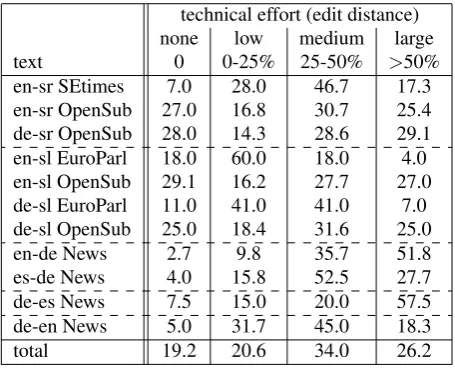
Table 2: Distribution of target language sentences (%) ac-cording to performed technical effort (edit distance).
3.1.
Post-editing
Post-editing has been performed to create a fully fluent and adequate translation which is of the same quality level as a standard human translation. Only a minimal post-editing necessary to achieve an acceptable translation quality (ad-equate and fluent translation) has been performed, without taking into account potential editors’ preferences concern-ing style, lexical choice, grammatical structure, etc. Ta-ble 1 shows number of segments and running words in all source texts and in all generated machine translation out-puts together with the number of post-edited words (which is about 30% on average).
Apart from that, a division of performed technical effort into four categories is presented in Table 2. It can be seen that overall, about one third of the segments required medium technical effort, 20% segments required only small intervention, 20% were already acceptable, and about 25% required significant modifications. Edit distances for each segment in the form ofWERare a part of the corpus, too.
3.2.
Error annotation
The task of error annotation consisted of assigning an er-ror class to each post-edit operation and was performed in two stages. The first stage consisted of automatic pre-annotation by Hjerson (Popovi´c, 2011), a tool for automatic error classification which enables categorisa-tion into five error classes: addicategorisa-tion, infleccategorisa-tional error (verb tense/person/mood, case, gender, number), lexical error (mistranslation), omission, and word order error. For Slovenian translations, lemmas were generated by Obelix (Grˇcar et al., 2012). For Serbian translations, “poor man’s” version of Hjerson (Popovi´c et al., 2015), based on first four letters of words instead of lemmas, was used. For theTARAX ¨U target languages, the TreeTagger6was used.
The second stage consisted of correcting or expanding these automatically generated error classes. Three additional er-ror classes which were observed as recurrent and frequent were introduced:
• contraction
separated, incorrect or missing (parts of) com-pounds/contractions:
Serbian and Slovenian negation particle+verb contrac-tions, German preposition+article contraccontrac-tions, Slove-nian preposition+pronoun contractions, Spanish ar-ticle+preposition and verb+pronoun contractions, as well as different types of compounds in all languages.
• derivation
incorrect POS, verb aspect, verb prefix, passive/past-participle confusion, possessive adjectives and pro-nouns
• untranslated
out-of-vocabulary words in the source language which remained untranslated in the output
Apart from that, some errors can be assigned to more than one error class – a number of contractions, derivations, in-flections, mistranslations and unknown words can be placed
6
[image:3.595.56.284.304.488.2]at an incorrect position in a sentence, i.e. they are also re-ordering errors. This phenomenon is not possible to detect by the state-of-the-art automatic error classification tools so that these multiple tags were assigned during the manual evaluation.
3.2.1. Distribution of manual error classes
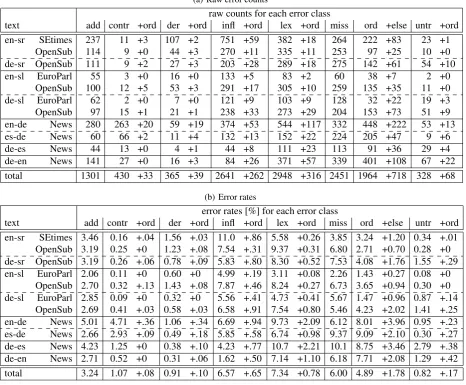
Distribution of error classes in the corpus PE2rr are pre-sented in Table 3 in the form of raw counts and error rates for each of the error categories. The error rates are obtained by dividing raw counts with total number of running words and therefore are suitable for comparison of different trans-lation outputs.
3.2.2. Annotation of language related issues
Different language combinations exhibit different error dis-tributions in the translation output which often relates to linguistic characteristics of involved languages as well as to divergences between them. Those relations have been investigated in (Popovi´c and Arˇcan, 2015) and the follow-ing has been discovered:
• there is a number of frequent error patterns, i.e. obsta-cles (issues) forSMTsystems
• nature and frequency of many issues depend on lan-guage combination and translation direction
• some of translation errors depend on domain and text type, mostly differing for written and spoken lan-guage.
Manual inspection of source sentences and their corre-sponding machine translations annotated by Hjerson using the independent reference translations together with their corresponding source sentences has been carried out in these experiments, and the phenomena were only counted, not annotated.
In this work, we carried out a preliminary experiment of an-notating the part of thePE2rr corpus with these issues. The labels were assigned on the segment level and the distribu-tions of the ten most frequent issues for each annotated text are presented in Table 4.
Finding the best definition of issues and the best method for annotating is still a part of the ongoing research, but de-tecting and defining an issue is certainly much easier when inspecting errors in the form of edit operations instead of errors with respect to the independent references.
3.3.
Comparison between manual and automatic
error annotation results
The comparison between Hjerson counts and manual clas-sification counts has been carried out in the same way as in (Popovi´c and Burchardt, 2011), namely:
• comparison of error distributions within one transla-tion output as well as across different translatransla-tion out-puts in the form of Spearman correlation coefficients;
• precision, recall and confusions between different er-ror classes.
[image:4.595.305.543.68.147.2]de-en News Hjerson error class add infl lex miss ord x prec. PE2rr 58.1 84.2 67.4 61.5 88.4 99.2 prec. Terra 29.0 37.5 29.6 48.4 15.3 96.0 recallPE2rr 56.0 91.8 84.6 62.2 95.5 98.9 recall Terra 16.7 92.3 85.8 45.8 51.4 55.3
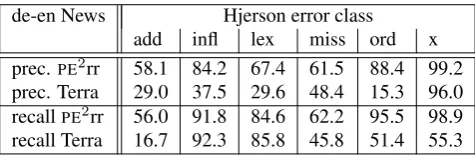
Table 5: Precision and recall for Hjerson error categories for the German→English News part of the PE2rr corpus compared with the similar text from the Terra corpus. Label “x” stands for correct words (not edited/no error).
The correlations were already very high in the experiments reported in (Popovi´c and Burchardt, 2011), but using the
PE2rr corpus resulted in a significant increase in recalls and especially precisions for all error classes. Table 5 presents precision and recall for Hjerson classes with re-gard to manual classes. The results are reported for the German→English News part of thePE2rr corpus and com-pared with the same text type7from the Terra corpus
anal-ysed in (Popovi´c and Burchardt, 2011) where independent reference translations were used for automatic error classi-fication and the results are afterwards compared with results of a completely independent manual error analysis. This means that the PE2rr corpus, where the reference transla-tions are post-edited translation outputs and a manual error annotation has been carried out on pre-annotated texts, can give much better and more reliable insights into particular flaws of an automatic error classification tool.
A detailed analysis of Hjerson performance, being an im-portant direction for future experiments, is however out of the scope of this work. Nevertheless, it should be already noted that Hjerson definitely exhibits a significant number of confusions between lexical errors, omissions and addi-tions – addressing this problem should be one of the first steps for its improvement.
4.
Summary and Outlook
We have presented a freely available corpus8 containing
automatically generated translations into several highly in-flective languages, their post-edited versions, and error an-notations of the performed post-edit operations. We believe that the corpus will be useful for many distinct applications. The main advantage of the approach used for creation of the corpus is the fusion of post-editing and error classifica-tion tasks, which have usually been seen as two indepen-dent tasks, although naturally they are not. In addition, we show benefits of coupling automatic and manual error clas-sification which facilitates the complex manual error anno-tation task as well as the development of automatic error classification tools.
Future work on the presented corpus includes adding more language pairs and domains to the collection, further anno-tation and investigation of the language related obstacles, and further in-depth analysis and improvement of the state-of-the-art methods for automatic translation error analysis.
7
Language pair, machine translation system type, translation direction and domain are the same, the exact sentences are not.
8
(a) Raw error counts
raw counts for each error class
text add contr +ord der +ord infl +ord lex +ord miss ord +else untr +ord en-sr SEtimes 237 11 +3 107 +2 751 +59 382 +18 264 222 +83 23 +1
OpenSub 114 9 +0 44 +3 270 +11 335 +11 253 97 +25 10 +0 de-sr OpenSub 111 9 +2 27 +3 203 +28 289 +18 275 142 +61 54 +10 en-sl EuroParl 55 3 +0 16 +0 133 +5 83 +2 60 38 +7 2 +0
OpenSub 100 12 +5 53 +3 291 +17 305 +10 259 135 +35 11 +0 de-sl EuroParl 62 2 +0 7 +0 121 +9 103 +9 128 32 +22 19 +3 OpenSub 97 15 +1 21 +1 238 +33 273 +29 204 153 +73 51 +9 en-de News 280 263 +20 59 +19 374 +53 544 +117 332 448 +222 53 +13 es-de News 60 66 +2 11 +4 132 +13 152 +22 224 205 +47 9 +6 de-es News 44 13 +0 4 +1 44 +8 111 +23 113 91 +36 29 +4 de-en News 141 27 +0 16 +3 84 +26 371 +57 339 401 +108 67 +22 total 1301 430 +33 365 +39 2641 +262 2948 +316 2451 1964 +718 328 +68
(b) Error rates
error rates [%] for each error class
text add contr +ord der +ord infl +ord lex +ord miss ord +else untr +ord en-sr SEtimes 3.46 0.16 +.04 1.56 +.03 11.0 +.86 5.58 +0.26 3.85 3.24 +1.20 0.34 +.01
OpenSub 3.19 0.25 +0 1.23 +.08 7.54 +.31 9.37 +0.31 6.80 2.71 +0.70 0.28 +0 de-sr OpenSub 3.19 0.26 +.06 0.78 +.09 5.83 +.80 8.30 +0.52 7.53 4.08 +1.76 1.55 +.29 en-sl EuroParl 2.06 0.11 +0 0.60 +0 4.99 +.19 3.11 +0.08 2.26 1.43 +0.27 0.08 +0
OpenSub 2.70 0.32 +.13 1.43 +.08 7.87 +.46 8.24 +0.27 6.73 3.65 +0.94 0.30 +0 de-sl EuroParl 2.85 0.09 +0 0.32 +0 5.56 +.41 4.73 +0.41 5.67 1.47 +0.96 0.87 +.14
OpenSub 2.69 0.41 +.03 0.58 +.03 6.58 +.91 7.54 +0.80 5.46 4.23 +2.02 1.41 +.25 en-de News 5.01 4.71 +.36 1.06 +.34 6.69 +.94 9.73 +2.09 6.12 8.01 +3.96 0.95 +.23 es-de News 2.66 2.93 +.09 0.49 +.18 5.85 +.58 6.74 +0.98 9.37 9.09 +2.10 0.30 +.27 de-es News 4.23 1.25 +0 0.38 +.10 4.23 +.77 10.7 +2.21 10.1 8.75 +3.46 2.79 +.38 de-en News 2.71 0.52 +0 0.31 +.06 1.62 +.50 7.14 +1.10 6.18 7.71 +2.08 1.29 +.42 total 3.24 1.07 +.08 0.91 +.10 6.57 +.65 7.34 +0.78 6.00 4.89 +1.78 0.82 +.17
Table 3: Distribution of error classes: number and percentage of words belonging to each of the eight error classes; counts for multiple error classes are added to each of the corresponding categories by “+n”. Percentage is calculated with respect to total number of running words.
SEtimes & OpenSubtitles EuroParl & OpenSubtitles News
en-sr de-sr en-sl de-sl en-de
[image:5.595.65.532.73.458.2]n-infl 62.2 oov 15.5 n-infl 27.3 n-infl 28.6 det-infl 55.0 a-infl 34.0 phrase-struct 12.0 v-infl 18.7 oov 11.0 comp 40.0 v-infl 18.8 n-infl 11.5 a-infl 15.3 v-infl 10.7 phrase-struct 31.0 n-coll 14.6 v-infl 8.0 ppast-infl 8.7 a-infl 9.3 n-infl 23.0 prep 10.2 question 6.5 v-reord-local 7.3 ppast-moss 9.0 a-infl 21.0 ppast-infl 9.2 ppast-miss 6.5 prep 5.7 phrase-struct 7.7 v-infl 20.0 literal 8.2 v-aux-miss 5.5 literal 4.8 v-fin-miss 7.3 prep 20.0 v-aux-miss 7.8 prep 5.0 det-infl 4.7 prep 5.3 v-reord 19.0 pron-ext 6.0 literal 5.0 v-aux-miss 4.0 comp-oov 5.3 det-miss 17.0 v-reord-local 5.4 v-aux-ext 4.0 v-aux-ext 4.0 v-aux-ext 5 oov 14.0
Table 4: Distribution of segment level language related issues (normalised with the total number of segments) for five translation outputs.
5.
Acknowledgements
This publication has emanated from research supported by TRAMOOC project (Translation for Massive Open Online Courses) partially funded by the European Com-mission under H2020-ICT-2014/H2020-ICT-2014-1 under
6.
Bibliographical References
Avramidis, E., Burchardt, A., Hunsicker, S., Popovi´c, M., Tscherwinka, C., Torres, D. V., and Uszkoreit, H. (2014). The taraX ¨U Corpus of Human-Annotated Ma-chine Translations. InProceedings of the 9th Interna-tional Conference on Language Resources and Evalua-tion (LREC-14), pages 2679–2682, Reykjavik, Iceland, May.
Bojar, O., Chatterjee, R., Federmann, C., Haddow, B., Huck, M., Hokamp, C., Koehn, P., Logacheva, V., Monz, C., Negri, M., Post, M., Scarton, C., Specia, L., and Turchi, M. (2015). Findings of the 2015 workshop on statistical machine translation. In Proceedings of the 10th Workshop on Statistical Machine Translation (WMT-15), pages 1–46, Lisbon, Portugal, September. Federico, M., Negri, M., Bentivogli, L., and Turchi, M.
(2014). Assessing the Impact of Translation Errors on Machine Translation Quality with Mixed-effects Models. InProceedings of the Conference on Empirical Methods in Natural Language Processing (EMNLP-14), pages 1643–1653, Doha, Qatar, October.
Fishel, M., Bojar, O., and Popovi´c, M. (2012). Terra: a Collection of Translation Error-Annotated Corpora. In
Proceedings of the 8th International Conference on Lan-guage Resources and Evaluation (LREC-12), pages 7– 14, Istanbul, Turkey, May.
Grˇcar, M., Krek, S., and Dobrovoljc, K. (2012). Obeliks: statistiˇcni oblikoskladenjski oznaˇcevalnik in lematiza-tor za slovenski jezik. In Proceedings of the 8th Lan-guage Technologies Conference, pages 89–94, Ljubljana, Slovenia, October.
Kirchhoff, K., Capurro, D., and Turner, A. (2012). Evalu-ating user preferences in machine translation using conjo int analysis. InProceedings of the 16th Annual Confer-ence of the European Association for Machine Transla-tion (EAMT-12), pages 119–126, Trento, Italy, May. Koehn, P., Hoang, H., Birch, A., Callison-Burch, C.,
Fed-erico, M., Bertoldi, N., Cowan, B., Shen, W., Moran, C., Zens, R., Dyer, C., Bojar, O., Constantin, A., and Herbst, E. (2007). Moses: open source toolkit for sta-tistical machine translation. InProceedings of the 45th Annual Meeting of the ACL on Interactive Poster and Demonstration Sessions, pages 177–180, Prague, Czech Republic, June.
Koehn, P. (2005). Europarl: A Parallel Corpus for Sta-tistical Machine Translation. InProceedings of the MT Summit X, pages 79–86, Phuket, Thailand, September. Koponen, M. (2013). This translation is not too bad; an
analysis of post-editor choices in a machine translation post-editing task. In Proceedings of the 2nd Workshop on Post-editing Technology and Practice, pages 1–9, Nice, France, September.
Lommel, A., Burchardt, A., Popovi´c, M., Harris, K., Avramidis, E., and Uszkoreit, H. (2014). Using a new analytic measure for the annotation and analy-sis of MT errors on real data. In Proceedings of the 17th Annual Conference of the European Association for Machine Translation (EAMT-14), pages 165–172, Dubrovnik, Croatia.
Och, F. J. and Ney, H. (2003). A Systematic Comparison
of Various Statistical Alignment Models. Computational Linguistics, 29(1):19–51, March.
Popovi´c, M. and Arˇcan, M. (2015). Identifying main ob-stacles for statistical machine translation of morpholog-ically rich South Slavic languages. In Proceedings of the 18th Annual Conference of the European Associa-tion for Machine TranslaAssocia-tion (EAMT-15), pages 97–104, Antalya, Turkey.
Popovi´c, M. and Burchardt, A. (2011). From Human to Automatic Error Classification for Machine Translation Output . In Proceedings of the 15th Annual Confer-ence of the European Association for Machine Transla-tion (EAMT-11), pages 265–272, Leuven, Belgium, May. Popovi´c, M., Arˇcan, M., Avramidis, E., Burchardt, A., and Lommel, A. R. (2015). Poor man’s lemmatisation for automatic error classification. InProceedings of the 18th Annual Conference of the European Association for Ma-chine Translation (EAMT-15), pages 105–112, Antalya, Turkey.
Popovi´c, M. (2011). Hjerson: An Open Source Tool for Automatic Error Classification of Machine Translation Output. The Prague Bulletin of Mathematical Linguis-tics, (96):59–68, October.
Stolcke, A. (2002). SRILM – an extensible language mod-eling toolkit. In Proceedings of the 7th International Conference on Spoken Language Processing (ICSLP-02), pages 901–904, Denver, CO, September.
Tiedemann, J. (2012). Parallel data, tools and interfaces in OPUS. InProceedings of the 8th International Con-ference on Language Resources and Evaluation (LREC-12), pages 2214–2218, Istanbul, Turkey, May.
Tyers, F. M. and Alperen, M. (2010). South-East Eu-ropean Times: A parallel corpus of the Balkan lan-guages. InProceedings of the LREC Workshop on Ex-ploitation of Multilingual Resources and Tools for Cen-tral and (South-) Eastern European Languages, pages 49–53, Valetta, Malta, May.
Vilar, D., Xu, J., D’Haro, L. F., and Ney, H. (2006). Er-ror Analysis of Statistical Machine Translation Output. In Proceedings of the 5th International Conference on Language Resources and Evaluation (LREC-06), pages 697–702, Genoa, Italy, May.
Wisniewski, G., Singh, A. K., Segal, N., and Yvon, F. (2013). Design and analysis of a large corpus of post-edited translations: quality estimation, failure analysis and the variability of post-edition. InProceedings of the MT Summit XIV, pages 117–124, Nice, France, Septem-ber.