Recognizing Relation Expression between Named Entities based on
Inherent and Context-dependent Features of Relational words
Toru Hirano†, Hisako Asano‡, Yoshihiro Matsuo†, Genichiro Kikui†
†NTT Cyber Space Laboratories, NTT Corporation
‡Innovative IP Architecture Center, NTT Communications Corporation
[email protected] [email protected]
{matsuo.yoshihiro,kikui.genichiro}@lab.ntt.co.jp
Abstract
This paper proposes a supervised learn-ing method to recognize expressions that show a relation between two named en-tities, e.g., person, location, or organiza-tion. The method uses two novel fea-tures, 1) whether the candidate words in-herently express relations and 2) how the candidate words are influenced by the past relations of two entities. These features together with conventional syntactic and contextual features are organized as a tree structure and are fed into a boosting-based classification algorithm. Experimental re-sults show that the proposed method out-performs conventional methods.
1 Introduction
Much attention has recently been devoted to us-ing enormous amount of web text coverus-ing an ex-ceedingly wide range of domains as a huge knowl-edge resource with computers. To use web texts as knowledge resources, we need to extract informa-tion from texts that are merely sequences of words and convert them into a structured form. Although extracting information from texts as a structured form is difficult, relation extraction is a way that makes it possible to use web texts as knowledge resources.
The aim of relation extraction is to extract se-mantically related named entity pairs, X andY, and their relation, R, from a text as a struc-tured form [X, Y, R]. For example, the triple [Yukio Hatoyama, Japan, prime minister] would be extracted from the text “Yukio Hatoyama is the prime minister of Japan”. This extracted triple
provides important information used in informa-tion retrieval (Zhu et al., 2009) and building an ontology (Wong et al., 2010).
It is possible to say that all named entity pairs that co-occur within a text are semantically related in some way. However, we define that named en-tity pairs are semantically related if they satisfy either of the following rules:
• One entity is an attribute value of the other.
• Both entities are arguments of a predicate.
Following the above definition, explicit and im-plicit relations should be extracted. An exim-plicit re-lation means that there is an expression that shows the relation between a named entity pair in a given text, while an implicit relation means that there is no such expression. For example, the triple [Yukio Hatoyama, Kunio Hatoyama, brother] extracted from the text “Yukio Hatoyama, the Democratic Party, is Kunio Hatoyama’s brother” is an explicit relation. In contrast, the triple [Yukio Hatoyama, the Democratic Party, member] extracted from the same text is an implicit relation because there is no expression showing the relation (e.g. member) between “Yukio Hatoyama” and “the Democratic Party” in the text.
only a few methods have been proposed so far (Hasegawa et al., 2004; Banko and Etzioni, 2008; Zhu et al., 2009). We therefore addressed the problem of how to determine relations between a given pair.
We used a three-step approach to address this problem. The first step is to recognize an expres-sion that shows explicit relations between a given named entity pair in a text. If no such expression is recognized, the second step is to estimate the relationship that exists between a given named en-tity pair that has an implicit relation. The last step is to identify synonyms of the relations that are recognized or estimated in the above steps. In this paper, we focus on the first step. The task is se-lecting a phrase from the text that contains a re-lation expression linking a given entity pair and outputting the expression as one showing the rela-tionship between the pair.
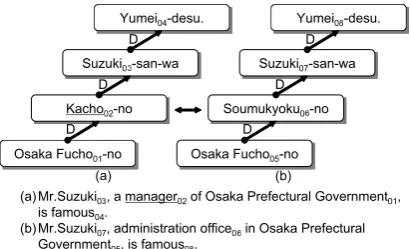
In our preliminary experiment, it was found that using only structural features of a text, such as syntactic or contextual features, is not good enough for a number of examples. For instance, the two Japanese sentences shown in Figure 1 have the same syntactic structure but (a) contains a relation expression and (b) does not. We therefore assume there are clues for recognizing relation expressions other than conventional syntactic and contextual information. In this paper, we propose a supervised learning method that includes two novel features of relational words as well as con-ventional syntactic and contextual features. The novel features of our method are:
Inherent Feature: Some words are able to
ex-press the relations between named entities and some are not. Thus, it would be useful to know the words that inherently express these relations.
Context-dependent Feature: There are a
num-ber of typical relationships that change as time passes, such as “dating” ⇒ “engage-ment”⇒“marriage” between persons. Fur-thermore, present relations are influenced by the past relations of a given named entity pair. Thus, it would be useful to know the past relations between a given pair and how the relations change as time passes.
In the rest of this paper, Section 2 references re-lated work, Section 3 outlines our method’s main features and related topics, Section 4 describes our experiments and experimental results, and Section 5 briefly summarizes key points and future work to be done.
2 Related Work
The “Message Understanding Conference” and “Automatic Content Extraction” programs have promoted relational extraction. The task was stud-ied so as to extract predefined semantic relations of entity pairs in a text. Examples include the supervised learning method cited in (Kambhatla, 2004; Culotta and Sorensen, 2004; Zelenko et al., 2003) and the bootstrapping method cited in (Pan-tel and Pennacchiotti, 2006; Agichtein and Gra-vano, 2000). Recently, open information extrac-tion (Open IE), a novel domain-independent ex-traction paradigm, has been suggested (Banko and Etzioni, 2008; Hasegawa et al., 2004). The task is to detect semantically related named entity pairs and to recognize the relation between them with-out using predefined relations.
Our work is a kind of open IE, but our approach differs from that of previous studies. Banko (2008) proposed a supervised learning method us-ing conditional random fields to recognize the re-lation expressions from words located between a given pair. Hasegawa (2004) also proposed a rule-based method that selects all words located be-tween a given pair as a relation expression if a given named entities appear within ten words. The point of these work is that they selected relation expressions only from the words located between
Osaka Fucho01-no
Osaka Fucho01-no
Kacho02-no
Kacho02-no
Yumei04-desu.
Yumei04-desu.
Suzuki03-san-wa
Suzuki03-san-wa
D D
D
Osaka Fucho05-no
Osaka Fucho05-no
Soumukyoku06-no
Soumukyoku06-no
Yumei08-desu.
Yumei08-desu.
Suzuki07-san-wa
Suzuki07-san-wa
D D
D
(a)Mr.Suzuki03, a manager02of Osaka Prefectural Government01, is famous04.
(b)Mr.Suzuki07, administration office06in Osaka Prefectural Government05, is famous08.
[image:2.595.309.515.566.690.2](a) (b)
given entities in the text, because as far as English texts are concerned, 86% of the relation expres-sions of named entity pairs appear between the pair (Banko and Etzioni, 2008). However, our tar-get is Japanese texts, in which only 26% of entity pair relation expressions appear between the pair. Thus, it is hard to incorporate previous approaches into a Japanese text.
To solve the problem, our task was to select a phrase from the entire text that would include a relation expression for connecting a given pair.
3 Recognizing Relation Expressions between Named Entities
To recognize the relation expression for a given pair, we need to select a phrase that includes an expression that shows the relation between a given entity pair from among all noun and verb phrases in a text. Actually, there are two types of candi-date phrases in this case. One is from a sentence that contains a given pair (intra-sentential), and the other is from a sentence that does not (inter-sentential). For example, the triple [Miyaji21,
Ishii22, taiketsu12] extracted from the following
text is inter-sentential.
(S-1) Chumokoku11-no taiketsu12-ga
mamonaku13 hajimaru14.
(The showcase11match12will start14soon13.)
(S-2) Ano Miyaji21-to Ishii22-toiu
kanemochi23-niyoru yume24-no
kikaku25.
(The dream24event25between the rich mens23, Miyaji21and Ishii22.)
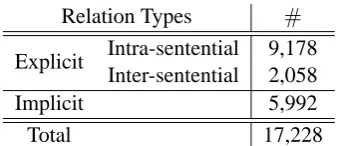
According to our annotated data shown in Ta-ble 2, 53% of the semantically-related named en-tity pairs are intra-sentential and 12% are inter-sentential. Thus, we first select a phrase from those in a sentence that contains a given pair, and if no phrase is selected, select one from the rest of the sentences in a text.
We propose a supervised learning method that uses two novel features of relational words as well as conventional syntactic and contextual fea-tures. These features are organized as a tree struc-ture and are fed into a boosting-based classifica-tion algorithm (Kudo and Matsumoto, 2004). The highest-scoring phrase is then selected if the score
exceeds a given threshold. Finally, the head of the selected phrase is output as the relation expression of a given entity pair.
The method consists of four parts: preprocess-ing (POS taggpreprocess-ing and parspreprocess-ing), feature extraction, classification, and selection. In this section, we describe the idea behind using our two novel fea-tures and how they are implemented to recognize the relation expressions of given pairs. Before that, we will describe our proposed method’s con-ventional features.
3.1 Conventional Features
Syntactic feature
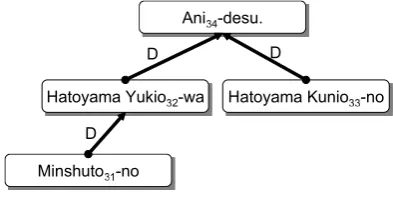
To recognize the intra-sentential relation ex-pressions for a given pair, we assume that there is a discriminative syntactic structure that consists of given entities and their relation expression. For example, there is a structure for which the com-mon parent phrase of the given pair, X = “Ha-toyama Yukio32” andY = “Hatoyama Kunio33”,
has the relation expression, R = “ani34” in the
Japanese sentence S-3. Figure 2 shows the depen-dency tree of sentence S-3.
(S-3) Minshuto31-no Hatoyama Yukio32-wa
Hatoyama Kunio33-no ani34-desu.
(Yukio Hatoyama32, the Democratic Party31, is Kunio Hatoyama33’s brother34.) To use a discriminative structure for each can-didate, we make a minimum tree that consists of given entities and the candidate where each phrase is represented by a case marker “CM”, a depen-dency type “DT”, an entity class, and the string and POS of the candidate (See Figure 3).
Minshuto31-no Minshuto31-no
Hatoyama Yukio32-wa Hatoyama Yukio32-wa
Ani34-desu. Ani34-desu.
Hatoyama Kunio33-no Hatoyama Kunio33-no D
[image:3.595.312.509.598.697.2]D D
X:person X:person Phrase Phrase
Phrase Phrase
Candidate Candidate Phrase
Phrase
Y:person Y:person
CM:wa CM:wa DT:DDT:D
STR:Ani34
STR:Ani34 POS:NounPOS:Noun CM:φ CM:φ DT:ODT:O
CM:no
CM:no DT:DDT:D Inh:1Inh:1
Crank:1 Crank:1
[image:4.595.72.290.70.204.2]Cprob:0.23 Cprob:0.23
Figure 3: Intra-sentential feature tree
Contextual Feature
To recognize the inter-sentential relation ex-pressions for a given pair, we assume that there is a discriminative contextual structure that con-sists of given entities and their relation expression. Here, we use a Salient Referent List (SRL) to ob-tain contextual structure. The SRL is an empirical sorting rule proposed to identify the antecedent of (zero) pronouns (Nariyama, 2002), and Hirano (2007) proposed a way of applying SRL to rela-tion detecrela-tion. In this work, we use this way to apply SRL to recognize inter-sentential relation expressions.
We applied SRL to each candidate as follows. First, from among given entities and the candi-date, we choose the one appearing last in the text as the root of the tree. We then append noun phrases, from the chosen one to the beginning of the text, to the tree depending on case markers, “wa” (topicalised subject), “ga” (subject), “ni” (indirect object),“wo” (object), and “others”, with the following rules. If there are nodes of the same case marker already in the tree, the noun phrase is appended as a child of the leaf node of them. In other cases, the noun phrase is appended as a child of the root node. For example, we get the SRL tree shown in Figure 4 with the given entity pair, X = “Miyaji21” and Y = “Ishii22”, and the
candidate, “taiketsu12”, with the text (S-1, S-2).
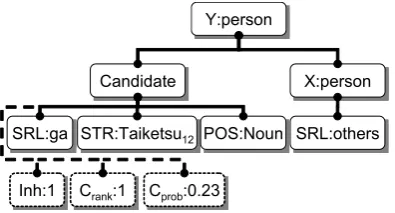
To use a discriminative SRL structure, we make a minimum tree that consists of given entities and the candidate where each phrase is represented by an entity class, and the string and POS of the can-didate (See Figure 5). In this way, there is a prob-lem when the candidate is a verb phrase, because
ga: Taiketsu12
ga: Taiketsu12
Ishii22 Ishii22
others: Miyaji21 others: Miyaji21
others: Chumoku11
[image:4.595.320.506.70.158.2]others: Chumoku11
Figure 4: Salient referent list tree
only noun phrases are appended to the SRL tree. If the candidate is a verb phrase, we cannot make a minimum tree that consists of given entities and the candidate.
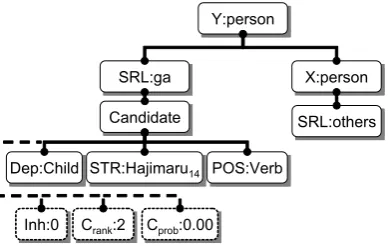
To solve this problem, a candidate verb phrase is appended to the feature tree using a syntactic structure. In a dependency tree, almost all verb phrases have some parent or child noun phrases that are in the SRL tree. Thus, candidate verb phrases are appended as offspring of these noun phrases represented syntactically as “parent” or “child”. For example, when given the entity pair,
X = “Miyaji21” and Y = “Ishii22”, and the
can-didate, “hajimaru14” from the text (S-1, S-2), a
feature tree cannot be made because the candi-date is not in an SRL tree. By extending the way the syntactic structure is used, “hajimaru14” has a
child node “taiketsu12”, which is in an SRL tree,
and this makes it possible to make the feature tree shown in Figure 6.
3.2 Proposed Features
To recognize intra-sentential or inter-sentential re-lation expressions for given pairs, we assume there are clues other than syntactic and contex-tual information. Thus, we propose inherent and
SRL:ga SRL:ga
Candidate Candidate
Y:person Y:person
X:person X:person
SRL:others SRL:others STR:Taiketsu12
STR:Taiketsu12 POS:NounPOS:Noun
Inh:1
Inh:1 CCrankrank:1:1 CCprobprob:0.23:0.23
[image:4.595.314.512.588.694.2]SRL:ga
SRL:ga
Dep:Child
Dep:Child
Candidate
Candidate
Y:person
Y:person
X:person
X:person
SRL:others
SRL:others
STR:Hajimaru14
STR:Hajimaru14 POS:VerbPOS:Verb
Inh:0
[image:5.595.308.518.68.136.2]Inh:0 CCrankrank:2:2 CCprobprob:0.00:0.00
Figure 6: Extended inter-sentential feature tree
context-dependent features of relational words.
Inherent Feature of Relational words
Some words are able to express the relations be-tween named entities and some are not. For exam-ple, the word “mother” can express a relation, but the word “car” cannot. If there were a list of words that could express relations between named enti-ties, it would be useful to recognize the relation expression of a given pair. As far as we know, however, no such list exists in Japanese. Thus, we estimate which words are able to express rela-tions between entities. Here, we assume that al-most all verbs are able to express relations, and accordingly we focus on nouns.
When the relation expression, R, of an entity pair,XandY, is a noun, it is possible to say “Y is
RofX” or “Y isX’sR”. Here, we can say noun
R takes an argumentX. In linguistics, this kind of noun is called a relational noun. Grammatically speaking, a relational noun is a simple noun, but because its meaning describes a “relation” rather than a “thing”, it is used to describe relations just as prepositions do. To estimate which nouns are able to express the relations between named enti-ties, we use the characteristics of relational nouns. In linguistics, many researchers describe the rela-tionship between possessives and relational nouns (Chris, 2008). Thus, we use the knowledge that in the patterns “BofA” or “A’sB”, if wordB is a relational noun, the corresponding word A be-longs to a certain semantic category. In contrast, if wordBis not a relational noun, the correspond-ing word A belongs to many semantic categories (Tanaka et al., 1999). Figure 7 shows scattering of the semantic categories of “mother” and “car”
Semantic categories
R
el
at
ive
F
re
qu
en
cy
Semantic categories
Re
la
tiv
e
Fr
eq
ue
nc
[image:5.595.85.281.70.193.2]y
Figure 7: Scattering of semantic category of “mother” (left) and “car” (right).
acquired by the following way.
First, we acquired A and B using the patterns “A no B”1 from a large Japanese corpus, then mapped wordsA into semantic categories C= {
c1, c2,· · ·, cm}using a Japanese lexicon (Ikehara
et al., 1999). Next, for each word B, we calcu-lated a scattering scoreHc(B)using the semantic category of corresponding wordsA. Finally, we estimated whether a word is a relational noun by usingk-NN estimation with positive and negative examples. As estimated results, “Inh:1” shows that it is a relational noun and “Inh:0” shows that it is not. In both cases, the result is appended to the feature tree as a child of the candidate node (See Figure 3, 5, or 6).
Hc(B) =−∑
c∈C
P(c|B)logmP(c|B)
P(c|B) = f req(c, B) f req(B)
In our experiments, we acquired 55,412,811 pairs of A andB from 1,698,798 newspaper ar-ticles and 10,499,468 weblog texts. As training data, we used the words of relation expressions as positive examples and other words as negative ex-amples.
Context-dependent Feature of Relational words
There are a number of typical relationships that change as time passes, such as “dating” ⇒ “en-gagement”⇒ ‘marriage” between persons. Fur-thermore, present relations are affected by the past relations of a given named entity pair. For in-stance, if the past relations of a given pair are “dat-ing” and “engagement” and one of the candidates is “marriage”, “marriage” would be selected as the relation expression of the given pair. Therefore, if
Pair of entity class rm rn PT(rn|rm) Count(rm, rn)
dating 0.050 102
hperson,personi dating marriage 0.050 101 engagement 0.040 82
marriage 0.157 786
hperson,personi engagement engagement 0.065 325
wedding 0.055 276
president 0.337 17,081
hperson,organizationi vice president vice president 0.316 16,056
CEO 0.095 4,798
fellow 0.526 61
hperson,organizationi researcher manager 0.103 12
member 0.078 9
alliance 0.058 8,358
horganization,organizationi alliance accommodated 0.027 3,958 acquisition 0.027 3,863 mutual consultation 0.022 2,670
hlocation,locationi neighbour support 0.015 1,792 visit 0.012 1,492
war 0.077 78,170
[image:6.595.74.519.67.374.2]hlocation,locationi war mutual consultation 0.015 15,337 support 0.010 10,226
Table 1: Examples of calculated relation trigger model between entity classes defined by IREX
we know the past relations of the given pair and the typical relational change that occurs as time passes, it would be useful to recognize the rela-tion expression of a given pair.
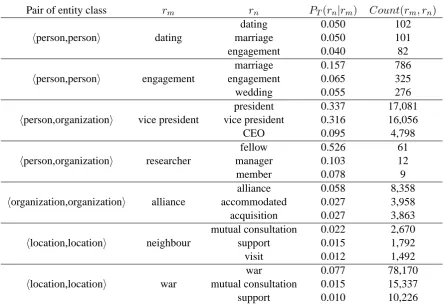
In this paper, we represent typical relational changes that occur as time passes by a simple re-lation trigger model PT(rn|rm). Note that rm
is a past relation and rn is a relation affected by
rm. This model disregards the span between rn
andrm. To make the trigger model, we
automat-ically extract triples [X, Y, R] from newspaper articles and weblog texts, which have time stamps of the document creation. Using these triples with time stamps for each entity pair, we sort rela-tions in order of time and count pairs of present and previous relations. For example, if we ex-tract “dating” occurring for an entity pair on Jan-uary 10, 1998, “engagement” occurring on Febru-ary 15, 2001, and “marriage” occurring on De-cember 24, 2001, the pairshdating, engagementi,
hdating, marriagei, and hengagement, marriagei are counted. The counted score is then summed
up by the pair of entity class and the trigger model is calculated by the following formula.
PT(rn|rm) =
Count(rm, rn)
∑
rnCount(rm, rn)
For the evaluation, we extracted triples by named entity recognition (Suzuki et al., 2006), re-lation detection (Hirano et al., 2007), and the pro-posed method using the inherent features of rela-tional words described in Section 3.2. A total of 10,463,232 triples were extracted from 8,320,042 newspaper articles and weblog texts with time stamps made between January 1, 1991 and June 30, 2006. As examples of the calculated relation trigger model, Table 1 shows the top three proba-bility relationsrnof several relationsrm between
Japanese standard named entity classes defined in the IREX workshop2. For instance, the rela-tion “fellow” has the highest probability of being changed from the relation “researcher” between person and organization as time passes.
To obtain the past relations of a given pair in the input text, we again used the triples with time stamps extracted as above. The only relations we use as past relations,Rm={rm1, rm2,· · ·, rmk},
are those of a given pair whose time stamps are older than the input text. Finally, we calcu-lated probabilities with the following formula us-ing the past relations Rm and the trigger model
PT(rn|rm).
PT(rn|Rm) =max{PT(rn|rm1),
PT(rn|rm2),· · ·, PT(rn|rmk)}
Using this calculated probability, we ranked candidates and appended the rank “Crank” and
the probability score “Cprob” to the feature tree
as a child of the candidate node (See Figure 3, 5, or 6). For example, if the past relations Rm
were “dating” and “engagement” and candidates were “marriage”, “meeting’, “eating”, or “drink-ing”, the candidates probabilities were calculated and ranked as “marriage” (Cprob:0.15, Crank:1),
“meeting” (Cprob:0.08, Crank:2), etc.
3.3 Classification Algorithms
Several structure-based learning algorithms have been proposed so far (Collins and Duffy, 2002; Suzuki et al., 2003; Kudo and Matsumoto, 2004). The experiments tested Kudo and Matsumoto’s boosting-based algorithm using sub-trees as fea-tures, which is implemented as a BACT system.
Given a set of training examples each of which is represented as a tree labeling whether the can-didate is the relation expression of a given pair or not, the BACT system learns that a set of rules is effective in classifying. Then, given a test in-stance, the BACT system classifies using a set of learned rules.
4 Experiments
We conducted experiments using texts from Japanese newspaper articles and weblog texts to test the proposed method for both intra- and inter-sentential tasks. In the experiments, we compared the following methods:
Conventional Features: trained by conventional
syntactic features for intra-sentential tasks as
Relation Types #
Explicit Intra-sentential 9,178 Inter-sentential 2,058
Implicit 5,992
[image:7.595.327.498.69.142.2]Total 17,228
Table 2: Details of the annotated data
described in Section 3.1, and contextual fea-tures for inter-sentential tasks as described in Section 3.1.
+Inherent Features: trained by conventional features plus inherent features of relational words described in Section 3.2.
++Context-dependent FeaturesTM: trained
by conventional and inherent features plus context-dependent features of relational words with the trigger model described in Section 3.2.
++Context-dependent FeaturesCM: trained
by conventional and inherent features plus context-dependent features of rela-tional words with a cache model. We evaluated this method to compare it with Context-dependent FeaturesTM to show the
effectiveness of the proposed trigger model. The cache model is a simple way to use past relations in which the probabilityPC(rcand)
calculated by the following formula and the rank based on the probability is appended to every candidate feature tree.
PC(rcand) = |
rcandin past relations|
|past relations|
4.1 Settings
P recision Recall F
Conventional Features 63.5%(3,436/5,411) 37.4%(3,436/9,178) 0.471 +Inherent Features 67.2%(4,036/6,001) 43.9%(4,036/9,178) 0.531 ++Context-dependent FeaturesTM 70.7%(4,460/6,312) 48.6%(4,460/9,178) 0.576
++Context-dependent FeaturesCM 67.5%(4,042/5,987) 44.0%(4,042/9,178) 0.533
Table 3: Experimental results of intra-sentential
P recision Recall F
Conventional Features 70.1%(579/825) 28.1%(579/2,058) 0.401 +Inherent Features 77.1%(719/932) 34.9%(719/2,058) 0.480 ++Context-dependent FeaturesTM 75.2%(794/1,055) 38.5%(794/2,058) 0.510
++Context-dependent FeaturesCM 74.3%(732/985) 35.5%(732/2,058) 0.481
Table 4: Experimental result of inter-sentential
were given, but only 2,058 of them had relation expressions.
We conducted five-fold cross-validation over 17,228 entity pairs so that sets of pairs from a sin-gle text were not divided into the training and test sets. In the experiments, all features were auto-matically acquired using a Japanese POS tagger (Fuchi and Takagi, 1998) and dependency parser (Imamura et al., 2007).
4.2 Results
Tables 3 and 4 show the performance of several methods for intra-sentential and inter-sentential.
P recision is defined as the percentage of cor-rect relation expressions out of recognized ones.
Recall is the percentage of correct relation ex-pressions from among the manually annotated ones. The F measure is the harmonic mean of precision and recall.
A comparison with the Conventional Fea-tures and Inherent FeaFea-tures method for intra-/inter-sentential tasks indicates that the proposed method using inherent features of relational words improved intra-sentential tasks F by 0.06 points and inter-sentential tasks F by 0.08 points. Us-ing a statistical test (McNemar Test) demonstrably showed the proposed method’s effectiveness.
A comparison with the Inherent Features and Context-dependent FeaturesTM method showed
that the proposed method using context-dependent features of relational words improved intra-/inter-sentential task performance by 0.045 and 0.03
points, respectively. McNemar test results also showed the method’s effectiveness.
To further compare the usage of context-dependent features, trigger models, and cache models, we also used Context-dependent FeaturesCM method for comparison. Tables
3 and 4 show that our proposed trigger model performed better than the cache model, and McNemar test results showed that there was a significant difference between the models. The reason the trigger model performed better than the cache model is that the trigger model correctly recognized the relation expressions that did not appear in the past relations of a given pair. Thus, we can conclude that using typical relationships that change as time passes helps to recognize relation expressions between named entities.
5 Conclusion
We proposed a supervised learning method that employs inherent and context-dependent features of relational words and uses conventional syntac-tic or contextual features to improve both intra-and inter-sentential relation expression recogni-tion. Our experiments demonstrated that the method improves the F measure and thus helps to recognize relation expressions between named entities.
References
Agichtein, Eugene and Luis Gravano. 2000. Snow-ball: Extracting relations from large plain-text col-lections. In Proceedings of the 5th ACM conference on Digital libraries, pages 85–94.
Banko, Michele and Oren Etzioni. 2008. The tradeoffs between open and traditional relation extraction. In Proceedings of the 46th Annual Meeting on Associ-ation for ComputAssoci-ational Linguistics: Human Lan-guage Technologies, pages 28–36.
Brin, Sergey. 1998. Extracting patterns and rela-tions from the world wide web. In WebDB Work-shop at 6th International Conference on Extending Database Technology, pages 172–183.
Chris, Barker, 2008. Semantics: An international handbook of natural language meaning, chap-ter Possessives and relational nouns. Walter De Gruyter Inc.
Collins, Michael and Nigel Duffy. 2002. Convolution kernels for natural language. Advances in Neural Information Processing Systems, 14:625–632.
Culotta, Aron and Jeffrey Sorensen. 2004. Depen-dency tree kernels for relation extraction. In Pro-ceedings of the 42nd Annual Meeting on Association for Computational Linguistics, pages 423–429.
Fuchi, Takeshi and Shinichiro Takagi. 1998. Japanese morphological analyzer using word co-occurrence - jtag. In Proceedings of the 36th Annual Meet-ing of the Association for Computational LMeet-inguis- Linguis-tics and 17th International Conference on Compu-tational Linguistics, volume 1, pages 409–413.
Hasegawa, Takaaki, Satoshi Sekine, and Ralph Grish-man. 2004. Discovering relations among named entities from large corpora. In Proceedings of the 42nd Annual Meeting on Association for Computa-tional Linguistics, pages 415–422.
Hirano, Toru, Yoshihiro Matsuo, and Genichiro Kikui. 2007. Detecting semantic relations between named entities in text using contextual features. In Pro-ceedings of the 45th Annual Meeting on Association for Computational Linguistics, pages 157–160.
Ikehara, Satoru, Masahiro Miyazaki, Satoru Shirai, Akio Yoko, Hiromi Nakaiwa, Kentaro Ogura, Masa-fumi Oyama, and Yoshihiko Hayashi. 1999. Ni-hongo Goi Taikei (in Japanese). Iwanami Shoten.
Imamura, Kenji, Genichiro Kikui, and Norihito Ya-suda. 2007. Japanese dependency parsing using se-quential labeling for semi-spoken language. In Pro-ceedings of the 45th Annual Meeting on Association for Computational Linguistics, pages 225–228.
Kambhatla, Nanda. 2004. Combining lexical, syntac-tic, and semantic features with maximum entropy models for extracting relations. In Proceedings of the 42nd Annual Meeting on Association for Com-putational Linguistics, pages 178–181.
Kudo, Taku and Yuji Matsumoto. 2004. A boosting algorithm for classification of semi-structured text. In Proceedings of the 2004 Conference on Empiri-cal Methods in Natural Language Processing, pages 301–308.
Nariyama, Shigeko. 2002. Grammar for ellipsis res-olution in japanese. In Proceedings of the 9th In-ternational Conference on Theoretical and Method-ological Issues in Machine Translation, pages 135– 145.
Pantel, Patrick and Marco Pennacchiotti. 2006. Espresso: Leveraging generic patterns for automat-ically harvesting semantic relations. In Proceed-ings of the 21st International Conference on Com-putational Linguistics and the 44th annual meeting of the Association for Computational Linguistics, pages 113–120.
Suzuki, Jun, Tsutomu Hirao, Yutaka Sasaki, and Eisaku Maeda. 2003. Hierarchical directed acyclic graph kernel: Methods for structured natural lan-guage data. In Proceedings of the 41st Annual Meeting on Association for Computational Linguis-tics, pages 32–39.
Suzuki, Jun, Erik McDermott, and HIdeki Isozaki. 2006. Training conditional random fields with mul-tivariate evaluation measures. In Proceedings of the 43th Annual Meeting on Association for Computa-tional Linguistics.
Tanaka, Shosaku, Yoichi Tomiura, and Toru Hitaka. 1999. Classification of syntactic categories of nouns by the scattering of semantic categories (in japanese). Transactions of Information Processing Society of Japan, 40(9):3387–3396.
Wong, Wilson, Wei Liu, and Mohammed Bennamoun. 2010. Acquiring semantic relations using the web for constructing lightweight ontologies. In Proceed-ings of the 13th Pacific-Asia Conference on Knowl-edge Discovery and Data Mining.
Zelenko, Dmitry, Chinatsu Aone, and Anthony Richardella. 2003. Kernel methods for relation ex-traction. Journal of Machine Learning Research, 3:1083–1106.