Class-Driven Attribute Extraction
Benjamin Van Durme, Ting Qian and Lenhart Schubert
Department of Computer Science University of Rochester Rochester, NY 14627, USA
Abstract
We report on the large-scale acquisition of class attributes with and without the use of lists of representative instances, as well as the discovery of unary attributes, such as typically expressed in English through prenominal adjectival modifica-tion. Our method employs a system based on compositional language processing, as applied to the British National Corpus. Ex-perimental results suggest that document-based, open class attribute extraction can produce results of comparable quality as those obtained using web query logs, indi-cating the utility of exploiting explicit oc-currences of class labels in text.
1 Introduction
Recent work on the task of acquiring attributes for concept classes has focused on the use of pre-compiled lists of class representative instances, where attributes recognized as applying to multi-ple instances of the same class are inferred as be-ing likely to apply to most, or all, members of that class. For example, the class US President
might be represented as a list containing the en-triesBill Clinton,George Bush,Jimmy Carter, etc. Phrases such asBill Clinton’s chief of staff ..., or search queries such aschief of staff bush, provide evidence that the classUS Presidenthas as an at-tributechief of staff.
Usually the focus of such systems has been on on binaryattributes, such as the examplechief of staff, while less attention has been paid tounary
c
2008. Licensed under the Creative Commons Attribution-Noncommercial-Share Alike 3.0 Unported li-cense (http://creativecommons.org/licenses/by-nc-sa/3.0/). Some rights reserved.
class attributes such asillegal for the classDrug, or warm-blooded for the class Animal.1 These
attributes are most typically expressed in English through prenominal adjectival modification, with the nominal serving as a class designator. When attribute extraction is based entirely on instances and not the class labels themselves, this form of modification goes undiscovered.
In what follows we explore both the impact of gazetteers in attribute extraction as well as the acquisition and filtering of unary class attributes, through a process based on logical form genera-tion from syntactic parses derived from the British National Corpus.
2 Extraction Framework
Extraction was performed using a modified ver-sion of the KNEXT system, a knowledge
acquisi-tion framework constructed for large scale genera-tion of abstracted logical forms through composi-tional linguistic analysis. The following provides an overview of KNEXT and its target knowledge
representation, Episodic Logic.
2.1 Episodic Logic
Automatically acquiring general world knowledge from text is not a task that provides an immedi-ate solution to any real world problem.2 Rather,
the motivation for acquiring large stores of back-ground knowledge is to enable research within other areas of artificial intelligence, e.g., the con-struction of systems that can engage in dialogues about everyday topics in unrestricted English, use
1Almuhareb and Poesio (2004) treat unary attributes as
values of binary attributes; e.g.,illegalmight be the value of alegalityattribute. But for many unary attributes, this is a stretch.
2Unless one regularly needs reminding of facts such as, A
WOMAN MAY BOIL A GOAT.
(Some e0:
[e0 at-about Now0] [(Many.det x :
[x ((attr athletic.a) (plur youngster.n))] [x want.v
(Ka (become.v
(plur
((attr professional.a) athlete.n))))]) ** e0])
Figure 1: Example EL formula; square brackets indicate a sentential infix syntax of form [subject pred object...],Ka
reifies action predicates, andattr“raises” adjectival predicates to predicate modifiers;e0is the situation characterized by the sentence.
common sense in answering questions or solv-ing problems, pursue intrinsic goals independently, and show awareness of their own characteristics, biography, and cognitive capacities and limita-tions. An important challenge in the pursuit of these long-range goals is the design and implemen-tation of a knowledge represenimplemen-tation that is as ex-pressively rich as natural language and facilitates language understanding and commonsense reason-ing.
Episodic Logic (EL) (Schubert and Hwang, 2000), is a superset of FOL augmented with cer-tain semantic features common to all human lan-guages: generalized quantification, intensionality, uncertainty, modification and reification of predi-cates and propositions, and event characterization by sentences. An implementation of EL exists as the EPILOGsystem (Schaeffer et al., 1993), which
supports both forward and backward inference, along with various specialized routines for dealing with, e.g., color, time, class subsumption, etc. EPI -LOGis under current development as a platform for
studying a notion of explicit self-awareness as de-fined by Schubert (2005).
As an indication of EL’s NL-like syntax, figure 1 contains the output of EPILOG’s
parser/logical-form generator for the sentence, Many athletic youngsters want to become professional athletes.
2.2 KNEXT
If “deep” language understanding and common-sense reasoning involve items as complex and structured as seen in figure 1, then automated knowledge acquisition cannot simply be a mat-ter of accumulating rough associations between word strings, along the lines “(Youngster) (want become) (professional athlete)”. Rather, acquired knowledge needs to conform with a systematic,
highly expressive KR syntax such as EL.
The KNEXT project is aimed at extracting such
structured knowledge from text. One of the major obstacles is that the bulk of commonsense knowl-edge on which people rely is not explicitly written down – precisely because it is common. Even it were written down, most of it could not be reliably interpreted, because reliable interpretation of lan-guage is itself dependent on commonsense knowl-edge (among other things).
In view of these difficulties, KNEXThas initially
focused on attempting to abstract world knowl-edge “factoids” from texts, based on the logical forms derived from parsed sentences. The idea is that nominal pre- and post-modifiers, along with subject-verb-object relations, captured in logical forms similar to that in figure 1, give a glimpse of the common properties and relationships in the world – even if the source sentences describe in-vented situations. For example, the following were extracted by KNEXT, then automatically
verbal-ized back into English for ease of readability: • SOME NUMBER OF YOUNGSTERS MAY WANT
TO BECOME ATHLETES.
• YOUNGSTERS CAN BE ATHLETIC.
• ATHLETES CAN BE PROFESSIONAL.
2.3 Attribute Extraction viaKNEXT
In order to study the contribution of lists of in-stances (i.e., generalizedgazetteers) to the task of attribute extraction, the version of KNEXT as
pre-sented by Schubert (2002) was modified to provide output of a form similar to that of the extraction work of Pas¸ca and Van Durme (2007).
KNEXT’s abstracted, propositional output was
automatically verbalized into English, with any re-sultant statements of the form,A(N) X MAY HAVE A(N) Y, taken to suggest that the classXhas as an attribute the propertyY.
KNEXT was designed from the beginning to
Pas¸ca and Van Durme (2007) described the re-sults of an informal survey asking participants to enumerate what they felt to be important attributes for a small set of example classes. Some of these resultant attributes were not of the form targeted by the authors’ system. For example, nonprofit
was given as an important potential attribute for the classCompany, as well as legal for the class
Drug. These attributes correspond tounary predi-cates as compared to the targetedbinarypredicates underlying such attributes ascost(X,Y)for the class
Drug.
We extracted such unary attributes by focusing on verbalizations of the form, A(N) X CAN BE Y
as inAN ANIMAL CAN BE WARM-BLOODED.
3 Experimental Setting
3.1 Corpus Processing
Initial reports on the use of KNEXT were focused
on the processing of manually created parse trees, on a corpus of limited size (the Brown corpus of Kucera and Francis (1967)). Since that time the system has been modified into a fully automatic extraction system, making use of syntactic parse trees generated by parsers trained on the Penn Treebank.
For our studies here, the parser employed was that of Collins (1997) applied to the sentences of the British National Corpus (BNC Consortium, 2001). Our choice of the BNC was motivated by its breadth of genre, its substantial size (100 mil-lion words) and its familiarity (and accessibility) to the community.
3.2 Gazetteers
KNEXT’s gazetteers were used as-is, and were defined based on a variety of sources: miscella-neous publicly available lists, as well as manual enumeration. The classes covered can be seen in the Results section in table 2, where the minimum, maximum and mean size were 2, 249, and 41, re-spectively.
3.3 Filtering out Non-predicative Adjectives
Beyond the pre-existing KNEXT framework,
ad-ditional processing was introduced for the extrac-tion of unary attributes in order to filter out vacu-ous or unsupported propositions derived from non-compositional phrases.
This filtering was performed through the cre-ation of three lists: a whitelist of accepted
pred-icative adjectives; a graylist containing such adjec-tives that are meaningful as unary predicates only when applied to plural nouns; and a blacklist de-rived from Wikipedia topic titles, representing lex-icalized, non-compositional phrases.
WhitelistThe creation of the whitelist began with calculating part-of-speech (POS) tagged bigram counts using the Brown corpus. The advantage of using a POS-tagged bigram model lies in the saliency of phrase structures, which enabled fre-quency calculations for both attributive and pred-icative uses of a given adjective. Attributive counts were based on instances when an adjective appears in the pre-nominal position and modifies another noun. Predicative counts were derived by sum-ming over occurrences of a given adjective after all possible copulas. These counts were used to compute a p/a ratio - the quotient of predicative count over attributive count - for each word classi-fied by WordNet (Fellbaum, 1998) as a having an adjectival use. After manual inspection, two cut-off points were chosen at ratios of .06 and 0, as seen in table 1.
Words not appearing in the Brown corpus (i.e. having 0 count for both uses), were sampled and inspected, with the decision made to place the majority within the whitelist, excluding just those with suffixes including -al, -c, -an, -st, -ion, -th, -o, -ese, -er, -on, -i, -x, -v, and -ing.
This process resulted in a combined whitelist of 14,249 (usually) predicative adjectives.
p/a ratio (r) Cut-off decision
r≥.06 keep the adjective*
0< r < .06 remove the adjective*
otherwise keep the adjective*
Table 1: Cut-off decision given the p/a ratio of an adjective.*Note: except for hand-selected cases.
GraylistWe manually constructed a short list (cur-rently 33 words) containing adjectives that are gen-erally inappropriate as whitelist entries, but could be acceptable when applied to plurals. For exam-ple, the verbalized propositionOBJECTS CAN BE SIMILAR was deemed acceptable, while a state-ment such asAN OBJECT CAN BE SIMILAR is erroneous because of a missing argument.
words, such as prepositions or adverbs; 3) must begin with an adjective and end with a noun (de-termined by WordNet); and 4) does not contain any numerical characters or miscellaneous sym-bols that are usually not meaningful in English. Therefore, each title in the resultant list is liter-ally a short noun phrase with adjectives as pre-modifiers. It was observed that in these encyclope-dia titles, the role of adjectives is predominantly to restrict the scope of the object that is being named (e.g. CRIMINAL LAW), rather than to describe its attributions or features (e.g. DARK EYES). More often than not, only cases similar to the sec-ond example can be safely verbalized as X CAN BE Y from a noun phrase Y X, with Y being the pre-nominal adjective.
We further refined this list by examining trigram frequencies as reported in the web-derived n-gram collection of Brants and Franz (2006). For each ti-tle of the form(Adj N) ..., we gathered trigram fre-quencies for adverbial modifications such as(very Adj N) ..., and(truly Adj N) .... Intuitively, high rel-ative frequency of such modification with respect to the non-modified bigram supports removal of the given title from the blacklist.
Trigram counts were collected using the modi-fiers: absolutely, almost, entirely, highly, nearly,
perfectly, truly and very. These counts were summed for a given title then divided by the afore-mentioned bigram score. Upon sampled inspec-tion, all three-word titles were kept on the black-list, along with any two-word title with a resultant ratio less than 0.028. For example, the titlesHardy Fish,Young Galaxy, andSad Bookwere removed, whileCommon Cause,Bouncy Ball, andHeavy Oil
were retained.
4 Results
From the parsed BNC, 6,205,877 propositions were extracted, giving an average of 1.396 propo-sitions per input sentence.3 These results were
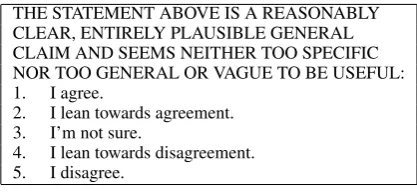
then used to explore the necessity of gazetteers, and the potential for extracting unary attributes. Quality judgements were performed using a 5 point scale as seen in figure 2.
3These approximately six million verbalized
propo-sitions, along with their underlying logical form and respective source sentence(s), may be browsed in-teractively through an online browser available at:
http://www.cs.rochester.edu/u/vandurme/epik
THE STATEMENT ABOVE IS A REASONABLY CLEAR, ENTIRELY PLAUSIBLE GENERAL CLAIM AND SEEMS NEITHER TOO SPECIFIC NOR TOO GENERAL OR VAGUE TO BE USEFUL: 1. I agree.
2. I lean towards agreement. 3. I’m not sure.
4. I lean towards disagreement. 5. I disagree.
Figure 2:Instructions for scaled judging.
4.1 Necessity of Gazetteers
From the total set of extracted propositions, 638,809 could be verbalized as statements of the formX MAY HAVE Y. There were 71,531 unique classes (X) for which at least a single candidate at-tribute (Y) was extracted, with 9,743 of those hav-ing at least a shav-ingle such attribute that was sup-ported by a minimum of two distinct sentences.
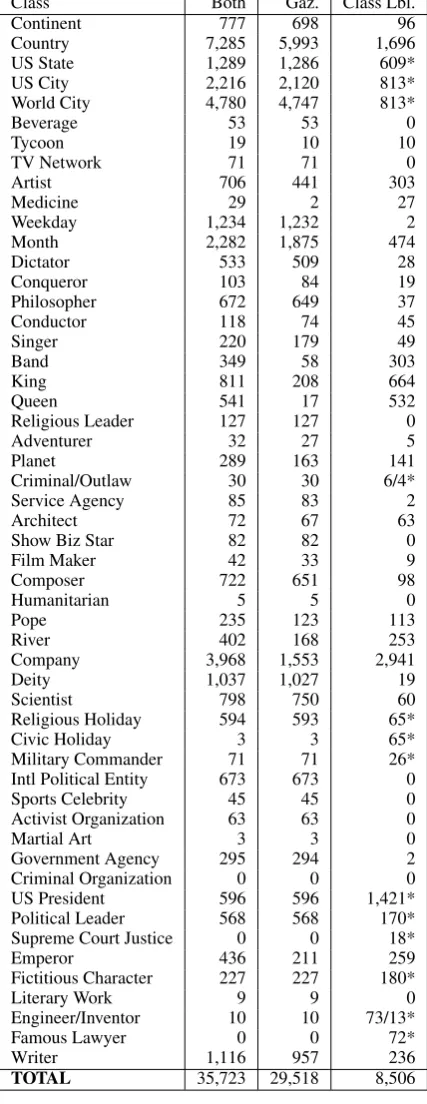
Table 2 gives the number of attributes extracted for the given classes when using only gazetteers, when using only the given names as class labels, and when using both together. While instance-based extraction generated more unique attributes, there were still a significant number of results de-rived based exclusively on class labels. Further, as can be seen for cases such as Artist, class-driven extraction provided a large number of at-tribute candidates not observed when relying only on gazetteers (701 total candidate attributes were gathered based on the union of 441 and 303 can-didates respectively extracted with, and without a gazetteer forArtist).
We note that this volume measure is potentially biased against class-driven extraction, as no ef-fort was made to pick an optimal label for a given gazetteer, (the original hand-specified class labels were retained). For example, one might expect the labelDrinkto generate more, yet still appropriate, propositions thanBeverage, Actor and/or Actress
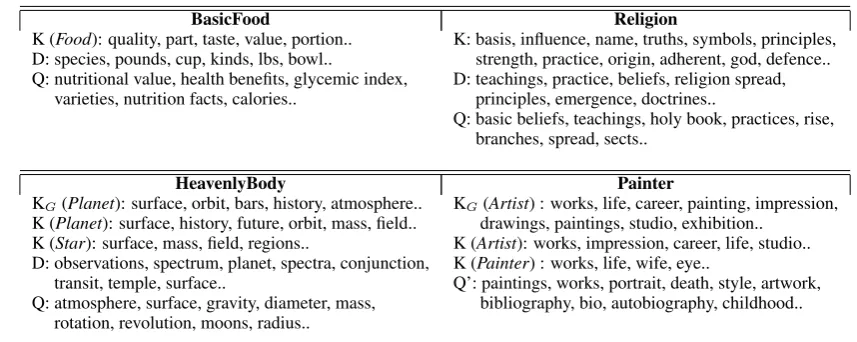
as compared toShow Biz Star, or the semantically similar Book versusLiterary Work. This is sug-gested by the entries in the table based on using supertypes of the given class, as well as in figure 3, which favorably compares top attributes discov-ered for select classes against those reported else-where in the literature.
BasicFood Religion
K (Food): quality, part, taste, value, portion.. K: basis, influence, name, truths, symbols, principles, D: species, pounds, cup, kinds, lbs, bowl.. strength, practice, origin, adherent, god, defence.. Q: nutritional value, health benefits, glycemic index, D: teachings, practice, beliefs, religion spread,
varieties, nutrition facts, calories.. principles, emergence, doctrines..
Q: basic beliefs, teachings, holy book, practices, rise, branches, spread, sects..
HeavenlyBody Painter
KG(Planet): surface, orbit, bars, history, atmosphere.. KG(Artist) : works, life, career, painting, impression, K (Planet): surface, history, future, orbit, mass, field.. drawings, paintings, studio, exhibition..
K (Star): surface, mass, field, regions.. K (Artist): works, impression, career, life, studio.. D: observations, spectrum, planet, spectra, conjunction, K (Painter) : works, life, wife, eye..
transit, temple, surface.. Q’: paintings, works, portrait, death, style, artwork, Q: atmosphere, surface, gravity, diameter, mass, bibliography, bio, autobiography, childhood..
rotation, revolution, moons, radius..
Figure 3: Qualitative comparison of top extracted attributes; KGis KNEXTusing gazetteers, K (class) is KNEXTfor a class label similar to the heading, D and Q are document- and query-based results as reported in (Pas¸ca et al., 2007), Q’ is query-based results reported in (Pas¸ca and Van Durme, 2007).
The noticeable drop in quality for the class
Planet when only using gazetteers (3.2 mean judged acceptability) highlights the recurring problem of word sense ambiguity in extraction. The names of Roman deities, such as Mars or Mer-cury, are used to refer to a number of conceptu-ally distinct items, such as planets within our so-lar system. Two of the attributes judged as poor quality for this class werebarsandcustomers, re-spectively derived from the noun phrases: (NP (NNP Mars) (NNS bars)), and (NP (NNP Mer-cury) (NNS customers)). Note that in both cases the underlying extraction is correctly performed; the error comes from abstracting to the wrong class. These NPs may arguably support the ver-balized propositions, e.g.: A CANDY-COMPANY MAY HAVE BARS, and A CAR-COMPANY MAY HAVE CUSTOMERS.
These examples point to additional areas for improvement beyond sense disambiguation: non-compositional phrase filtering for all NPs, rather than just in the cases of adjectival modification (Mars bar is a Wikipedia topic); and relative dis-counting of patterns used in the extraction pro-cess4. This later technique is commonly used in
specialized extraction systems, such as constructed by Snow et al. (2005) who fit a logistic regression model for hypernym (X is-a Y) classification based on WordNet, and Girju et al. (2003) who trained a classifier to look specifically for part-whole rela-tions.
4For example, (NP (NNP X) (NNS Y)) may be more
se-mantically ambiguous than, e.g., the possessive construction (NP (NP (NNP X) (POS ’s)) (NP (NNS Y))).
4.2 Unary Attributes
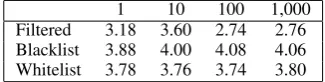
Table 4 shows how filtering non-compositional phrases from CAN BE propositions affects extrac-tion volume. Table 5 shows the difference between such post-filtered propositions and those that were deleted. As our filter lists were not built fully au-tomatically, evaluation was performed exclusively by an author with negligible direct involvement in the lists’ creation (so-as to minimize judgement bias).
As examples, the top ten unary attributes for select classes are given in table 6, which the au-thors believe to be high quality on average, with some bad entries present. Attributes such as
pre-raphaeliteforPainterare considered obscure, while those such asfavouriteforAnimalare con-sidered unlikely to be useful as a unary predicate.
The importance of class-driven extraction can be seen in results such as those given for the class Ap-ple. Even if it were the case that gazetteer-based extraction could deliver perfect results for those classes whose instances occasionally appear ex-plicitly in text, there are a number of classes for which such instances are entirely lacking. For ex-ample, there are many instances of the class Com-panywhich have been individually named and ap-pear in text with some frequency, e.g., Microsoft, Walmart, or Boeing. However, despite the many real-world instantiations of the class Apple, this does not translate into a list of individually named members in text.5 If our goal is to acquire
at-tributes for as many classes as possible, our results
5Instances ofAppleare referred to directly as such; “an
Class Both Gaz. Class Lbl.
Continent 777 698 96
Country 7,285 5,993 1,696
US State 1,289 1,286 609*
US City 2,216 2,120 813*
World City 4,780 4,747 813*
Beverage 53 53 0
Tycoon 19 10 10
TV Network 71 71 0
Artist 706 441 303
Medicine 29 2 27
Weekday 1,234 1,232 2
Month 2,282 1,875 474
Dictator 533 509 28
Conqueror 103 84 19
Philosopher 672 649 37
Conductor 118 74 45
Singer 220 179 49
Band 349 58 303
King 811 208 664
Queen 541 17 532
Religious Leader 127 127 0
Adventurer 32 27 5
Planet 289 163 141
Criminal/Outlaw 30 30 6/4*
Service Agency 85 83 2
Architect 72 67 63
Show Biz Star 82 82 0
Film Maker 42 33 9
Composer 722 651 98
Humanitarian 5 5 0
Pope 235 123 113
River 402 168 253
Company 3,968 1,553 2,941
Deity 1,037 1,027 19
Scientist 798 750 60
Religious Holiday 594 593 65*
Civic Holiday 3 3 65*
Military Commander 71 71 26*
Intl Political Entity 673 673 0
Sports Celebrity 45 45 0
Activist Organization 63 63 0
Martial Art 3 3 0
Government Agency 295 294 2
Criminal Organization 0 0 0
US President 596 596 1,421*
Political Leader 568 568 170*
Supreme Court Justice 0 0 18*
Emperor 436 211 259
Fictitious Character 227 227 180*
Literary Work 9 9 0
Engineer/Inventor 10 10 73/13*
Famous Lawyer 0 0 72*
Writer 1,116 957 236
TOTAL 35,723 29,518 8,506
Table 2: Extraction volume with and without using gazetteers.*Note: When results are zero after gaz. omission, values are reported for super-types, such asHolidayfor the sub-typeCivic Holiday, orCityforUS City. A/B scores re-ported for each class used separately, e.g.,Engineer/Inventor.
Class Both Gazetteer Class Label
King 1.2 1.9 1.3
Composer 1.5 1.5 2.1
River 1.9 1.9 1.5
Continent 1.5 1.9 2.0
Planet 1.9 3.2 1.6
Table 3: Average judged acceptability for the top ten at-tributes extracted for the given classes when using/not-using gazetteer information.
Collection Size Original% ofCAN BE
Original total 6,204,184 100
-Filtered total 5,382,282 87
-Original CAN BE 2,895,325 46 100
Filtered CAN BE 2,073,417 33 72
Whitelist 812,146 15 28
Blacklist 19,786 1< 1
Table 4: Impact of filtering on volume. For example, those propositions removed because of the whitelist comprised 15% of the total propositions extracted, or 28% of those specifi-cally verbalized asX CAN BE Y.
indicate the benefits of exploiting the explicit ap-pearance of class labels in text.
5 Related Work
Pas¸ca and Van Durme (2007) presented an ap-proach to attribute extraction based on the use of search engine query logs, a previously unex-plored source of data within information extrac-tion. Results confirmed the intuition that a sig-nificant number of high quality, characteristic at-tributes for many classes may be derived based on the relative frequency with which anonymous users request particular pieces of information for known instances of a concept class. Pas¸ca et al. (2007) compared the quality of shallow attribute extraction techniques as applied to documents ver-sus search engine query logs, concluding that such methods are more applicable to query logs than to documents. We note that while search queries do seem ideally suited for extracting class attributes, existing large-scale collections of query logs are proprietary and thus unavailable to the general re-search community. At least until such a resource becomes available, it is of interest to the commu-nity that (qualitatively) similar extraction results may be achieved exclusively using publicly avail-able document collections.
avail-1 10 100 1,000 Filtered 3.18 3.60 2.74 2.76 Blacklist 3.88 4.00 4.08 4.06 Whitelist 3.78 3.76 3.74 3.80
Table 5: Mean evaluated acceptability for 50 unary at-tributes randomly sampled from each of the given levels of support (attribute occurred once, less than 10 times, less than 100 times, ...). Filtered refers to the final “clean” results, Blacklist and Whitelist refer to propositions deleted due to the given list.
Painter famous, romantic, distinguished, celebrated,well-known, pre-raphaelite, flemish, dutch, abstract
Animal dead, trapped, dangerous, unfortunate, intact,hungry, wounded, tropical, sick, favourite Drug dangerous, powerful, addictive, safe, illegal,experimental, effective, prescribed, harmful,
hallucinatory
Apple red, juicy, fresh, bad, substantive, stuffed,shiny, ripe, green, baked Earthquake disastrous, violent, underwater, prolonged,powerful, popular, monstrous, fatal, famous,
epic
Table 6:Top ten unary attributes for select classes, gathered exclusively without the use of gazetteers.
able via Wikipedia to populate a KB based on a variant of the logic underlying the Web On-tology Language (OWL). Results were limited to 14 predefined relation types, such as diedInYear
and politicianOf, with membership of instances within particular concept classes inferred based on Wikipedia’s category pages. Authors report 5 mil-lion so-calledontologicalfacts being extracted.
Almuhareb and Poesio (2004) performed at-tribute extraction on webtext using simple extrac-tion patterns (e.g., “the * of the C [is|was]”, and “[a|an|the] * C [is|was]”, which respectively match
The color of the rose was redandA red rose was ...), and showed that such attributes could improve concept clustering. Subsequently they tested an alternative approach to the same problem using a dependency parser, extracting syntactic relations such as (ncmod, rose, red) and (ncsubj, grow, rose) (Almuhareb and Poesio, ). They concluded that syntactic information is relatively expensive to de-rive, and serves primarily to alleviate data spar-sity problems (by capturing dependencies between potentially widely separated words) that may no longer be an issue given the scale of the Web. We take a different view, first because attribute extrac-tion is an offline task for which a 60% overhead cost (reported by the authors) is not a major is-sue, but more importantly because we regard
ap-proaches that process language compositionally as ultimately necessary for deeper meaning represen-tation and language understanding.
Following intuitions similar to those laid out by Schubert (2002), Banko et al. (2007) presented TextRunner, the latest in a series of ever more so-phisticated general information extraction systems (Cafarella et al., 2005; Etzioni et al., 2004). The authors constructed a non-parser based extractor for open domain text designed to efficiently pro-cess web-sized datasets. Results are in the form of bracketed text sequences that hint at a sentence’s underlying semantics. For example, (Bletchley Park) was location of (Station X).
Cimiano et al. (2005) performed a limited form of class-driven extraction in order to induce class hierarchies via the methods of Formal Concept Analysis (FCA). For example, acaris both drive-ableandrentablebased on its occurrence in object position of the relevant verbs. Abikeshares these properties withcar, as well as having the property
rideable, leading to these classes being near in the resultant automatically constructed taxonomy. Ex-periments were performed on limited domains for which pre-existing ontologies existed for measur-ing performance (tourismandfinance).
Lin (1999) gave a corpus-based method for find-ing various types of non-compositional phrases, including the sort discussed in this paper. Identi-fication was based on mutual information statistics conditioned on a given syntactic context (such as our targeted prenominal adjectival modification). If the mutual information of, e.g., white house, shows strong differences from that for construc-tions with similar components, e.g.,red house, and
white barn, then the given phrase was determined to be non-compositional. The use of this method to supplement that explored here is a matter of cur-rent investigation. Early results confirm our in-tuition regarding the correlation between such au-tomatically discovered non-compositional phrases and Wikipedia topic titles, where high scoring phrases not already in our list tend to suggest
miss-Yes cooking pot, magic flute, runny nose, skimmed milk,acquired dyslexia, charged particles, earned income
No causal connectives, golden oldies, ruling junta,graduated pension, unsung heroes, viral rna
Table 7: Example high-scoring phrases as ranked by Lin’s metric when applied to KNEXT logical forms, along with
A CAR MAY HAVE A ...
back, boot, side, driver, front, roof, seat, end, interior, owner, door, control, value, bonnet, wheel, window, engine, headlights..
A CAR CAN BE ...
black, parked, red, white, armoured, nice, hired, bloody, open, beautiful, wrecked, unmarked, secondhand, powerful, brand-new, out-of use, damaged, heavy, dark, competitive, broken-down..
A CAR MAY BE ... IN SOME WAY
parked, stolen, driven, damaged, serviced, stopped, lost, clamped, overturned, locked, involved in an accident, found, turned, transported..
Table 8: Top attributes extracted for the classCar, where MAY BE relational properties (akin to those used by Cimi-ano et al. (2005)) are similarly acquired via verbalization of abstracted logical forms.
ing entries in the encyclopedia (see table 7). The ability to perform such “missing topic discovery” should be of interest to those within the emerging community of Wikipedia-focused AI researchers.
6 Conclusion
We have shown that an open knowledge extraction system can effectively yield class attributes, even when named instances of the class are unavailable or scarce (as a final example see table 8). We stud-ied the quantitative contributions of instances (as given in KNEXT gazetteers) and explicitly
occur-ring class nominals to the discovery of attributes, and found both to be important. We paid partic-ular attention to the acquisition ofunaryclass at-tributes, for which access to class labels is of par-ticular importance because of their typical manner of expression in text.
Acknowledgements The authors are grateful to Daniel Gildea for contributing a parsed version of the BNC. This work was supported by NSF grants IIS-0328849 and IIS-0535105.
References
Almuhareb, Abdulrahman and Massimo Poesio. Finding con-cept attributes in the web using a parser. InProceedings Corpus Linguistics Conference.
Almuhareb, Abdulrahman and Massimo Poesio. 2004. Attribute-based and value-based clustering: an evaluation. InProceedings of EMNLP.
Banko, Michele, Michael J Cafarella, Stephen Soderland, Matt Broadhead, and Oren Etzioni. 2007. Open Infor-mation Extraction from the Web. InProceedings of IJCAI. BNC Consortium. 2001. The British National Corpus, ver-sion 2 (BNC World). Distributed by Oxford University Computing Services.
Brants, Thorsten and Alex Franz. 2006. Web 1T 5-gram Ver-sion 1. Distributed by the Linguistic Data Consortium. Cafarella, Michael J., Doug Downey, Stephen Soderland, and
Oren Etzioni. 2005. KnowItNow: Fast, Scalable Infor-mation Extraction from the Web. InProceedings of HLT-EMNLP.
Cimiano, Philipp, Andreas Hotho, and Steffen Stabb. 2005. Learning concept hierarchies from text corpora using for-mal concept analysis.Journal of Artificial Inteligence Re-search.
Collins, Michael. 1997. Three generative, lexicalised models for statistical parsing. InProceedings of ACL.
Etzioni, Oren, Michael Cafarella, Doug Downey, Stanley Kok, AnaMaria Popescu, Tal Shaked, Stephen Soderland, Daniel S. Weld, and Alexander Yates. 2004. Web-scale Information Extraction in KnowItAll. InProceedings of WWW.
Fellbaum, Christiane. 1998.WordNet: An Electronic Lexical Database. MIT Press.
Girju, R., A. Badulescu, and D. Moldovan. 2003. Learning semantic constraints for the automatic discovery of part-whole relations. InProceedings of HLT-NAACL.
Kucera, H. and W. N. Francis. 1967. Computational Anal-ysis of Present-Day American English. Brown University Press, Providence, RI.
Lin, Dekang. 1999. Automatic identification of non-compositional phrases. InProceedings of ACL.
Pas¸ca, Marius and Benjamin Van Durme. 2007. What you seek is what you get: Extraction of class attributes from query logs. InProceedings of IJCAI.
Pas¸ca, Marius, Benjamin Van Durme, and Nikesh Garera. 2007. The role of documents vs. queries in extracting class attributes from text. InProceedings of CIKM.
Schaeffer, S.A., C.H. Hwang, J. de Haan, and L.K. Schubert. 1993. EPILOG, the computational system for episodic
logic: User’s guide. Technical report, Dept. of Comput-ing Science, Univ. of Alberta, August.
Schubert, Lenhart K. and Chung Hee Hwang. 2000. Episodic logic meets little red riding hood: A comprehensive, natu-ral representation for language understanding. In Iwanska, L. and S.C. Shapiro, editors,Natural Language Processing and Knowledge Representation: Language for Knowledge and Knowledge for Language. MIT/AAAI Press. Schubert, Lenhart K. 2002. Can we derive general world
knowledge from texts? InProceedings of HLT.
Schubert, Lenhart K. 2005. Some Knowledge Representa-tion and Reasoning Requirements for Self-awareness. In
Proc. AAAI Spring Symposium on Metacognition in Com-putation.
Snow, Rion, Daniel Jurafsky, and Andrew Y. Ng. 2005. Learning syntactic patterns for automatic hypernym dis-covery. InProceedings of NIPS 17.