Generative Alignment and Semantic Parsing
for Learning from Ambiguous Supervision
Joohyun Kim
Department of Computer Science The University of Texas at Austin
Raymond J. Mooney
Department of Computer Science The University of Texas at Austin
Abstract
We present a probabilistic generative model for learning semantic parsers from ambiguous supervision. Our approach learns from natural language sentences paired with world states consisting of multiple potential logical meaning repre-sentations. It disambiguates the mean-ing of each sentence while simultane-ously learning a semantic parser that maps sentences into logical form. Compared to a previous generative model for se-mantic alignment, it also supports full semantic parsing. Experimental results on the Robocup sportscasting corpora in both English and Korean indicate that our approach produces more accurate se-mantic alignments than existing methods and also produces competitive semantic parsers and improved language genera-tors.
1 Introduction
Most approaches to learning semantic parsers that map sentences into complete logical forms (Zelle and Mooney, 1996; Zettlemoyer and Collins, 2005; Kate and Mooney, 2006; Wong and Mooney, 2007b; Lu et al., 2008) require fully-supervised corpora that provide full formal logi-cal representations for each sentence. Such cor-pora are expensive and difficult to construct. Sev-eral recent projects on “grounded” language learn-ing (Kate and Mooney, 2007; Chen and Mooney, 2008; Chen et al., 2010; Liang et al., 2009) exploit more easily and naturally available training data consisting of sentences paired with world states
consisting of multiple potential semantic repre-sentations. This setting is partially motivated by a desire to model how children naturally learn lan-guage in the context of a rich, ambiguous percep-tual environment.
In particular, Chen and Mooney (2008) in-troduced the problem of learning to sportscast by simply observing natural language commen-tary on simulated Robocup robot soccer games. The training data consists of natural language (NL) sentences ambiguously paired with logical meaning representations (MRs) describing recent events in the game extracted from the simulator. Most sentences describe one of the extracted re-cent events; however, the specific event to which it refers is unknown. Therefore, the learner has to figure out the correct matching (alignment) be-tween NL and MR before inducing a semantic parser or language generator. Based on an ap-proach introduced by Kate and Mooney (2007), Chen and Mooney (2008) repeatedly retrain both a supervised semantic parser and language gener-ator using an iterative algorithm analogous to Ex-pectation Maximization (EM). However, this ap-proach is somewhat ad hoc and does not exploit a well-defined probabilistic generative model or real EM training.
semantic parser or language generator. In addi-tion, they use a combination of a simple Markov model and a bag-of-words model when generating natural language for MRs, therefore, they do not model context-free linguistic syntax.
Motivated by the limitations of these previ-ous methods, we propose a new generative align-ment model that includes a full semantic pars-ing model proposed by Lu et al. (2008). Our approach is capable of disambiguating the map-ping between language and meanings while also learning a complete semantic parser for mapping sentences to logical form. Experimental results on Robocup sportscasting show that our approach outperforms all previous results on the NL–MR matching (alignment) task and also produces com-petitive performance on semantic parsing and im-proved language generation.
2 Related Work
The conventional approach to learning seman-tic parsers (Zelle and Mooney, 1996; Ge and Mooney, 2005; Kate and Mooney, 2006; Zettle-moyer and Collins, 2007; ZettleZettle-moyer and Collins, 2005; Wong and Mooney, 2007b; Lu et al., 2008) requires detailed supervision unambigu-ously pairing each sentence with its logical form. However, developing training corpora for these methods requires expensive expert human labor.
Chen and Mooney (2008) presented methods for grounded language learning from ambigu-ous supervision that address three related tasks: NL–MR alignment, semantic parsing, and natu-ral language generation. They solved the prob-lem of aligning sentences and meanings by iter-atively retraining an existing supervised seman-tic parser, WASP (Wong and Mooney, 2007b) or
KRISP (Kate and Mooney, 2006), or an existing
supervised natural-language generator, WASP−1
(Wong and Mooney, 2007a). During each iter-ation, the currently trained parser (generator) is used to produce an improved NL–MR alignment that is used to retrain the parser (generator) in the next iteration. However, this approach does not use the power of a probabilistic correspondence between an NL and MRs during training.
On the other hand, Liang et al. (2009) posed a probabilistic generative approach to
pro-duce a Viterbi alignment between NL and MRs. They use a hierarchical semi-Markov generative model that first determines which facts to dis-cuss and then generates words from the predi-cates and arguments of the chosen facts. They re-port improved matching accuracy in the Robocup sportscasting domain. However, they only ad-dressed the alignment problem and are unable to parse new sentences into meaning representations or generate natural language from logical forms. In addition, the model uses a weak bag-of-words assumption when estimating links between NL segments and MR facts. Although it does use a simple Markov model to order the generation of the different fields of an MR record, it does not utilize the full syntax of the NL or MR or their relationship.
Chen et al. (2010) recently reported results on utilizing the improved alignment produced by Liang et al. (2009)’s model to initialize their own iterative retraining method. By combining the ap-proaches, they produced more accurate NL–MR alignments and improved semantic parsers.
Motivated by this prior research, our approach combines the generative alignment model of Liang et al. (2009) with the generative semantic parsing model of Lu et al. (2008) in order to fully exploit the NL syntax and its relationship to the MR semantics. Therefore, unlike Liang et al.’s simple Markov + bag-of-words model for gener-ating language, it uses a tree-based model to gen-erate grammatical NL from structured MR facts.
3 Background
This section describes existing models and algo-rithms employed in the current research. Our model is built on top of the generative semantic parsing model developed by Lu et al. (2008). Af-ter learning a probabilistic alignment and parsing model, we also used the WASPand WASP−1
sys-tems to produce additional parsing and generation results. In particular, since our current system is incapable of effectively generating NL sentences from MR logical forms, in order to demonstrate how our matching results can aid NL generation, we use WASP−1to learn a generator. This follows
S
S :pass(PLAYER, PLAYER)
PLAYER
PLAYER:pink10
pink10
passes the ball to PLAYER
PLAYER:pink11
pink11
Figure 1: Sample hybrid tree from English sportscasting dataset where (w,m) = (pink10 passes the ball to pink11,pass(pink10,pink11))
matching from Liang et al. (2009) results in better overall parsing and generation. Finally, our over-all generative model uses the IGSL (Iterative Gen-eration Strategy Learning) method of Chen and Mooney (2008) to initially estimate the prior prob-ability of each event-type generating a natural-language comment.
3.1 Generative Semantic Parsing
Lu et al. (2008) introduced a generative seman-tic parsing model using a hybrid-tree framework.
Ahybrid treeis defined over a pair,(w,m), of a
natural-language sentence and its logical meaning representation. The tree expresses a correspon-dence between word segments in the NL and the grammatical structure of the MR. In a hybrid tree, MR production rules constitute the internal nodes, while NL words (or phrases) constitute the leaves. A sample hybrid tree from the English Robocup data is given in Figure 1.
A generative model based on hybrid trees is de-fined as follows: starting from a root semantic category, the model generates a production of the MR grammar, and then subsequently generates a mixed hybrid pattern of NL words and child se-mantic categories. This process is repeated un-til all leaves in the hybrid tree are NL words (or phrases). Each generation step is only dependent on the parent step, thus, generation is assumed to be a Markov process.
Lu et al. (2008)’s generative parsing model es-timates the joint probabilityP(T,w,m), which represents the probability of generating a hybrid treeT with NLw, and MRm. This probability is computed as the product of the probabilities of the steps in the generative process. Since there are
multiple ways to construct a hybrid tree given a pair of NL and MR, the data likelihood of the pair (w,m) given by the learned model is calculated by summingP(T,w,m)over all the possible hy-brid trees for NLwand MRm.
The model is normally trained in a fully su-pervised setting using NL–MR pairs. In order to learn from ambiguous supervision, we extend this model to include an additional generative process for selecting the subset of available MRs used to generate NL sentences.
3.2 WASPand WASP−1
WASP(Word-Alignment-based Semantic Parsing)
is a semantic parsing system that uses syntax-based statistical machine translation techniques. It induces a probabilistic synchronous context-free grammar (PSCFG) for generating corresponding NL–MR pairs. Since a PSCFG is symmetric with respect to the two languages it generates, the same learned model can be used for both se-mantic parsing (mapping NL to MR) and natural language generation (mapping MR to NL), Since there is no prespecified formal grammar for the NL, the WASP−1 system learns an n-gram
lan-guage model for the NL side and uses it to choose the most probable NL translation for a given MR using a noisy-channel model.
3.3 IGSL
Chen and Mooney (2008) introduced the IGSL method for determining which event types a hu-man commentator is more likely to describe in natural language. This is sometimes called
strate-gic generationorcontent selection, the process of
choosingwhat to say; as opposed totactical
gen-eration, which determines how to say it. IGSL
[image:3.595.80.282.68.173.2]English Korean # of NL comments 2036 1999 # of extracted MR events 10452 10668 # of NLs w/ matching MRs 1868 1913 # of MRs w/ matching NLs 4670 4610 Avg. # of MRs per NL 2.50 2.41
Table 1: Stats for Robocup sportscasting data
a human would comment upon. In our proposed model, we use IGSL probability scores as initial priors for our event selection model.
4 Evaluation Dataset
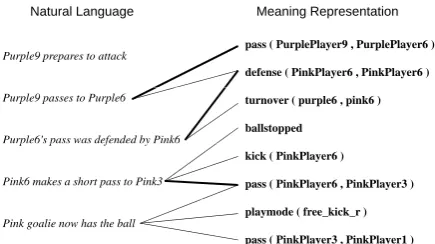
In our experiments, we use the Robocup sportscasting data produced by Chen et al. (2010), which includes both English and Korean com-mentaries. The data was collected by having both English and Korean speakers commentate the fi-nal games from the RoboCup simulation soccer league for each year from 2001 through 2004. Ta-ble 1 presents some statistics on this sportscasting data. To construct the ambiguous training data, each NL commentary sentence is paired with MRs for all extracted simulation events that occurred in the previous 5 seconds (an average of 2.5 events). Figure 2 shows a sample trace from the Robocup English data. Each NL commentary sen-tence normally has several possible MR matches that occurred within the 5-second window, in-dicated by edges between the NL and MR. Bold edges represent gold standard matches con-structed solely for evaluation purposes. Note that not every NL has a gold matching MR. This oc-curs because the sentence refers to unrecognized or undetected events or situations or because the matching MR lies outside the 5-second window.
5 Generative Model
Like Liang et al. (2009)’s generative alignment model, our model is designed to estimateP(w|s), wherewis an NL sentence andsis a world state containing a set of possible MR logical forms that can be matched to w. However, our approach is intended to support both determining the most likely match between an NL and its MR in its world state,andsemantic parsing, i.e. finding the
Natural Language Meaning Representation
Purple9 prepares to attack pass ( PurplePlayer9 , PurplePlayer6 ) defense ( PinkPlayer6 , PinkPlayer6 )
Purple9 passes to Purple6
Purple6's pass was defended by Pink6
turnover ( purple6 , pink6 )
ballstopped u ple6 s pass was defended by ink6
Pink6 makes a short pass to Pink3
kick ( PinkPlayer6 )
pass ( PinkPlayer6 , PinkPlayer3 )
Pink goalie now has the ball
playmode ( free_kick_r )
[image:4.595.77.293.73.157.2]pass ( PinkPlayer3 , PinkPlayer1 )
Figure 2: Sample trace from Robocup English data.
most probable mapping from a given NL sentence to an MR logical form.
Our generative model consists of two stages:
• Event selection: P(e|s), chooses the evente in the world statesto be described.
• Natural language generation: P(w|e), mod-els the probability of generating natural-language sentencewfrom the MR specified by evente.
5.1 Event selection model
The event selection model specifies the probabil-ity distribution for picking an event that is likely to be commented upon amongst the multiple MR logical forms in the world states. The probabil-ity of picking an event is assumed to depend only on its event type as given by the predicate of its MR. For example, the MRpass(pink10, pink11) has event type pass and arguments pink10 and
pink11.
Our model is similar to Liang et al. (2009)’s
record choicemodel, but we only model their
no-tion of salience, denoting that some event types are more likely to be described than others. We do not model their notion ofcoherence, which mod-els the order of event types in the commentary. We found that for sportscasting the order of described events depends only on the sequence of events in the game and does not exhibit any additional de-tectable pattern due to linguistic preferences.
The probability of picking an eventeof typete
is denoted by p(te). If there are multiple events
of typetin states. Therefore, the probability of
picking an event is given by:
P(e|s) =p(te)
1
|s(te)| (1)
5.2 Natural language generation model
The natural-language generation model defines the probability distribution of NL sentences given an MR specified by the previously selected event. We use Lu et al. (2008)’s generative model for this step, in which:
P(w|e) = X ∀T over(w,m)
P(T,w|m) (2)
wheremis the MR logical form defined by event eandT is a hybrid tree defined over the NL–MR pair(w,m).
The probabilityP(T,w|m)is calculated using the generative semantic parsing model of Lu et al. (2008) using the joint probability of the NL–MR pair (w,m), i.e. the inside probability of gener-ating(w,m). The likelihood of a sentencewis then the sum over all possible hybrid trees defined by the NL–MR pair(w,m).1
The natural language generation model covers the roles of both thefield choicemodel andword
choice models of Liang et al. (2009). Since our
event selection model only chooses an event based on its type, the order of its arguments still needs to be addressed. However, Lu et al.’s generative model includes ordering the MR arguments (as specified by MR production rules) as well as the generation of NL words and phrases to express these arguments. Thus, it is unnecessary to sepa-rately model argument ordering in our approach.2
1Lu et al. (2008) propose 3 models for generative seman-tic parsing: unigram, bigram, and mixgram (interpolation be-tween the two). We used the bigram model, where the gen-eration of a hybrid-tree component (NL word or semantic category) depends on the previously generated component as well as the parent MR production. The bigram model always performed the best on all tasks in our experimental evalua-tion.
2We also tried using a Markov model to order arguments like Liang et al. (2009), but preliminary experimental results showed that this additional component actually decreased performance rather than improving it.
6 Learning and Inference
This composite generative model is trained using conventional EM methods. The process is similar to Lu et al. (2008)’s, an inside-outside style al-gorithm using dynamic programming to generate a hybrid tree from the NL–MR pair(w,m), ex-cept our model’s estimation process additionally deals with calculating expected counts under the posteriorP(e|w,s;θ)in the E-step and normaliz-ing the counts to optimize parameters. The whole process is quite efficient; training time takes about 30 minutes to run on sportscasts of three games in either English or Korean.
Unfortunately, we found that EM tended to get stuck at local maxima with respect to learning the event-type selection probabilities, p(t). There-fore, we also tried initializing these parameters with the corresponding strategic generation values learned by the IGSL method of Chen and Mooney (2008). Since IGSL was shown to be quite effec-tive at predicting which event types were likely to be described, the use of IGSL priors provides a good starting point for our event selection model. Our model is built on top of Lu et al. (2008)’s generative semantic parsing model, which is also trained in several steps in its best-performing ver-sion.3 Thus, the overall model is vulnerable to
getting stuck in local optima when running EM across these multiple steps. We also tried using random restarts with different initialization of pa-rameters, but initializing with IGSL priors per-formed the best in our experimental evaluation.
7 Experimental Evaluation
testing for semantic parsing and tactical genera-tion. Matching performance is measured in train-ing data, since the goal is to disambiguate this data. All results are averaged across these 4 folds. We also use the same performance metrics as Chen and Mooney (2008). The accuracy of matching and semantic parsing are measured us-ing F-measure, the harmonic mean of precision and recall, where precision is the fraction of the system’s annotations that are correct, and recall is the fraction of the annotations from the gold-standard that the system correctly produces. Gen-eration is evaluated using BLEU score (Papineni et al., 2002) between generated sentences and ref-erence NL sentences in the test set. We com-pare our results to previous results from Chen and Mooney (2008) and Chen et al. (2010) and to matching results on Robocup data from Liang et al. (2009).
7.1 NL–MR Matching
The goal of matching is to find the most probable NL–MR alignment for ambiguous examples con-sisting of an NL sentence and multiple potential MR logical forms. In Robocup sportscasting, the MRs for a given sentence correspond to all game events that occur within a 5-second window prior to the NL comment. Not all NL sentences have a matching MR in this window, but most do. Dur-ing testDur-ing, an NL wis matched to an MRmif and only if the learned semantic parser produces m as the most probable parse of w. Thus, our model does not force every NL to match an MR. If the most probable semantic parse of a sentence does not matchanyof the possible recent events, it is simply left unmatched. Matching is evaluated against the gold-standard matches supplied with the data, which are used for evaluation purposes only. The gold matching data is never used during training.
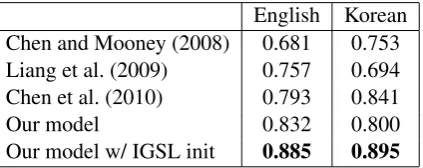
Table 2 shows the detailed results for both English and Korean data.4 Our best approach
outperforms all previous methods for both En-glish and Korean by quite large margins. Note
4Since the Korean data was not yet available for use by either Chen and Mooney (2008) or Liang et al. (2009), we present the results reported by Chen et al. (2010) for these methods.
English Korean Chen and Mooney (2008) 0.681 0.753 Liang et al. (2009) 0.757 0.694 Chen et al. (2010) 0.793 0.841
Our model 0.832 0.800
[image:6.595.308.520.70.154.2]Our model w/ IGSL init 0.885 0.895
Table 2: NL–MR Matching Results (F-measure). Results are the highest reported in the cited work.
English Korean Chen and Mooney (2008) 0.702 0.720 Chen et al. (2010) 0.803 0.812
Our learned parser 0.742 0.764 Lu et al. + our matching 0.810 0.794 WASP+ our matching 0.786 0.808
[image:6.595.305.521.205.315.2]Lu et al. + Liang et al. 0.790 0.690 WASP+ Liang et al. 0.803 0.740
Table 3: Semantic Parsing Results (F-measure). Results are the highest reported in the cited work.
that initializing our EM training with IGSL’s es-timates improves performance significantly, and this approach outperforms Chen et al. (2010)’s best method, which also uses IGSL.
In particular, our proposed model outperforms the generative alignment model of Liang et al. (2009), indicating that the extra linguistic infor-mation and MR grammatical structure used by Lu et al. (2008)’s generative language model make our overall model more effective than a simple Markov + bag-of-words model for language gen-eration.
7.2 Semantic Parsing
Semantic parsing is evaluated by determining how accurately NL sentences in the test set are cor-rectly mapped to their meaning representations. Results are presented in Table 3.5 6 For our
model, we report results using the parser learned directly from the ambiguous supervision, as well 5The best result of Chen and Mooney (2008) is for WASPER-GEN, and that of Chen et al. (2010) is for WASPER
with Liang et al.’s matching initialization for English and for WASER-GEN-IGSL-METEORwith Liang et al.’s initialization for Korean.
as results for training a supervised parser (both WASP and Lu et al. (2009)’s) on the NL–MR
matching produced by our model. We also present results for training Lu et al.’s parser and WASPon
Liang et al.’s NL–MR matchings.
Our initial learned semantic parser does not per-form better than the best results reported by Chen et al. (2010), but it is clearly better than the ini-tial results of Chen and Mooney (2008). Train-ing WASP and Lu et al.’s supervised parser on
our method’s highly accurate set of disambiguated NL–MR pairs improved the results. Retraining Lu et al.’s parser gave the best overall results for En-glish, and retraining WASPgave the second
high-est results for Korean, only failing to beat the very best results of Chen et al. (2010). It is somewhat surprising that simply retraining on the hardened set of most probable NL–MR matches gives bet-ter results than the parser trained using EM, which actually exploits the uncertainty in the underly-ing matches. Further investigations of this phe-nomenon are indicated.
Comparing with the corresponding results for training WASP and Lu et al.’s supervised parser
on the NL–MR matchings produced by Liang et al.’s alignment method, it is clear that our match-ings produce more accurate semantic parsers ex-cept when training WASPon English.
7.3 Tactical Generation
Tactical generation is evaluated based on how well the learned model generates accurate NL sen-tences from MR logical forms. Without integrat-ing a language model for the NL, the existintegrat-ing generative model is not very effective for tactical generation. Lu et al. (2009) introduced an effec-tive language generator for the hybrid tree frame-work using a Tree-CRF model; however, we did not have access to this system. Therefore, for tactical generation, we used the publicly avail-able WASP−1system (Wong and Mooney, 2007a)
trained on disambiguated NL–MR matches. This approach also allows direct comparison with the results of Chen and Mooney (2008) and Chen et al. (2010), who also used WASP−1 for tactical
generation. Our objective is to show that the more accurate matchings produced by our generative model can improve tactical generation.
English Korean Chen and Mooney (2008) 0.4560 0.5575 Chen et al. (2010) 0.4599 0.6796 WASP−1+ Liang et al. 0.4580 0.5828
WASP−1+ our matching 0.4727 0.7148
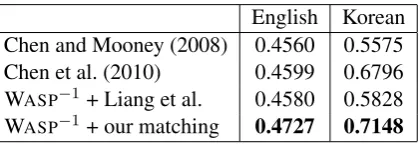
Table 4: Tactical Generation Results (BLEU score). Results are the highest reported in the cited work.
The results are shown in Table 4.7 8 Overall,
WASP−1 trained on the NL–MR matching from
our alignment model performs better than all pre-vious methods. In particular, using the matchings from our method to train WASP−1 produces
bet-ter tactical generators than using matchings from Liang et al.’s approach.
7.4 Discussion
Overall, our model performs particularly well at matching NL and MRs under ambiguous supervi-sion, and the difference is larger for English than Korean. However, improved matching results do not necessarily translate into significantly better semantic parsers. For English, the improvement in matching is almost 10 percentage points in F-measure, but the semantic parsing result trained with this more accurate matching shows only 1 point improvement.
Compared to Liang et al. (2009), our more ac-curate (i.e. higher F-measure) matchings provide a clear improvement in both semantic parsing and tactical generation. The only exception is English parsing using WASP, which seems to be due to
some misleading noise in our alignments. WASP
seems to be affected more than Lu et al.’s system by such extraneous noise. However, in tactical generation, this extraneous noise does not seem to lead to worse performance, and our approach al-ways gives the best results. As discussed by Chen and Mooney (2008) and Chen et al. (2010), tac-tical generation is somewhat easier than seman-tic parsing in that semanseman-tic parsing needs to learn 7The best result of Chen and Mooney (2008) is for WASPER-GEN, and that of Chen et al. (2010) is for WASPER
with Liang et al.’s matching initialization for English and for WASER-GENwith Liang et al. initialization for Korean.
[image:7.595.309.519.69.141.2]to map a variety of synonymous natural-language expressions to the same meaning representation, while tactical generation only needs to learn one way to produce a correct natural language descrip-tion of an event. This difference in the nature of semantic parsing and tactical generation may be the cause of the different trends in the results.
8 Conclusions and Future Work
We have presented a novel generative model capa-ble of probabilistically aligning natural-language sentences to their correct meaning representa-tions given the ambiguous supervision provided by a grounded language acquisition scenario. Our model is also capable of simultaneously learning to semantically parse NL sentences into their cor-responding meaning representations. Experimen-tal results in Robocup sportscasting show that the NL–MR matchings inferred by our model are sig-nificantly more accurate than those produced by all previous methods. Our approach also learns competitive semantic parsers and improved lan-guage generators compared to previous methods. In particular, we showed that our alignments pro-vide a better foundation for learning accurate se-mantic parsers and tactical generators compared to those of Liang et al. (2009), whose genera-tive model is limited by a simple bag-of-words as-sumption.
In the future, we plan to test our model on more complicated data with higher degrees of am-biguity as well as more complex meaning repre-sentations. One immediate direction is evaluat-ing our approach on the datasets of weather fore-casts and NFL football articles used by Liang et al. (2009). However, our current model does not sup-port matching multiple meaning representations to the same natural-language sentence, and needs to be extended to allow multiple MRs to generate a single NL sentence.
Acknowledgements
We thank Wei Lu and Wee Sun Lee for sharing their software and giving helpful comments for the paper. We also thank Percy Liang for sharing his code and experimental results with us. Ad-ditionally, we thank David Chen in UTCS ML
group for his comments and advice. Finally, we thank the anonymous reviewers for their com-ments. This work was funded by the NSF grant IIS. 0712907X. The experiments were executed and run on the Mastodon Cluster, provided by NSF Grant EIA-0303609.
References
Chen, David L. and Raymond J. Mooney. 2008. Learning to sportscast: a test of grounded language acquisition. In ICML ’08: Proceedings of the 25th International Conference on Machine Learn-ing, pages 128–135, New York, NY, USA. ACM.
Chen, David L., Joohyun Kim, and Raymond J. Mooney. 2010. Training a multilingual sportscaster: Using perceptual context to learn lan-guage. Journal of Artificial Intelligence Research, 37:397–435.
Ge, Ruifang and Raymond J. Mooney. 2005. A sta-tistical semantic parser that integrates syntax and semantics. In Proceedings of the Ninth Confer-ence on Computational Natural Language Learning (CoNLL-2005), pages 9–16, Ann Arbor, MI, July.
Kate, Rohit J. and Raymond J. Mooney. 2006. Us-ing strUs-ing-kernels for learnUs-ing semantic parsers. In
Proceedings of the 21st International Conference on Computational Linguistics and 44th Annual Meet-ing of the Association for Computational LMeet-inguis- Linguis-tics (COLING/ACL-06), pages 913–920, Morris-town, NJ, USA. Association for Computational Lin-guistics.
Kate, Rohit J. and Raymond J. Mooney. 2007. Learn-ing language semantics from ambiguous supervi-sion. In Proceedings of the Twenty-Second Con-ference on Artificial Intelligence (AAAI-07), pages 895–900, Vancouver, Canada, July.
Liang, Percy, Michael I. Jordan, and Dan Klein. 2009. Learning semantic correspondences with less super-vision. In ACL-IJCNLP ’09: Proceedings of the Joint Conference of the 47th Annual Meeting of the ACL and the 4th International Joint Conference on Natural Language Processing of the AFNLP: Vol-ume 1, pages 91–99, Morristown, NJ, USA. Associ-ation for ComputAssoci-ational Linguistics.
Lu, Wei, Hwee Tou Ng, Wee Sun Lee, and Luke S. Zettlemoyer. 2008. A generative model for pars-ing natural language to meanpars-ing representations. In
Lu, Wei, Hwee Tou Ng, and Wee Sun Lee. 2009. Nat-ural language generation with tree conditional ran-dom fields. In EMNLP ’09: Proceedings of the 2009 Conference on Empirical Methods in Natural Language Processing, pages 400–409, Morristown, NJ, USA. Association for Computational Linguis-tics.
Papineni, Kishore, Salim Roukos, Todd Ward, and Wei-Jing Zhu. 2002. BLEU: a method for auto-matic evaluation of machine translation. In Pro-ceedings of the 40th Annual Meeting of the Asso-ciation for Computational Linguistics (ACL-2002), pages 311–318, Philadelphia, PA, July.
Wong, Yuk Wah and Raymond J. Mooney. 2007a. Generation by inverting a semantic parser that uses statistical machine translation. In Proceedings of Human Language Technologies: The Conference of the North American Chapter of the Association for Computational Linguistics (NAACL-HLT-07), pages 172–179, Rochester, NY.
Wong, Yuk Wah and Raymond J. Mooney. 2007b. Learning synchronous grammars for semantic pars-ing with lambda calculus. In Proceedings of the 45th Annual Meeting of the Association for Com-putational Linguistics (ACL-07), pages 960–967, Prague, Czech Republic, June.
Zelle, John M. and Raymond J. Mooney. 1996. Learn-ing to parse database queries usLearn-ing inductive logic programming. InProceedings of the Thirteenth Na-tional Conference on Artificial Intelligence (AAAI-96), pages 1050–1055, Portland, OR, August.
Zettlemoyer, Luke S. and Michael Collins. 2005. Learning to map sentences to logical form: Struc-tured classification with probabilistic categorial grammars. In Proceedings of 21st Conference on Uncertainty in Artificial Intelligence (UAI-2005), Edinburgh, Scotland, July.