Paraphrasing with Search Engine Query Logs
Shiqi Zhao†‡, Haifeng Wang†, and Ting Liu‡ †Baidu Inc.
‡HIT Center for Information Retrieval, Harbin Institute of Technology {zhaoshiqi, wanghaifeng}@baidu.com, [email protected]
Abstract
This paper proposes a method that extracts paraphrases from search engine query logs. The method first extracts paraphrase query-title pairs based on an assumption that a search query and its correspond-ing clicked document titles may mean the same thing. It then extracts paraphrase query-query and title-title pairs from the query-title paraphrases with a pivot ap-proach. Paraphrases extracted in each step are validated with a binary classifier. We evaluate the method using a query log from Baidu1, a Chinese search engine.
Experimental results show that the pro-posed method is effective, which extracts more than 3.5 million pairs of paraphrases with a precision of over 70%. The results also show that the extracted paraphrases can be used to generate high-quality para-phrase patterns.
1 Introduction
The use of paraphrases is ubiquitous in hu-man languages, which also presents a challenge for natural language processing (NLP). Previous studies have shown that paraphrasing can play im-portant roles in plenty of areas, such as machine translation (MT) (Callison-Burch et al., 2006; Kauchak and Barzilay, 2006), question answer-ing (QA) (Duboue and Chu-Carroll, 2006; Riezler et al., 2007), natural language generation (NLG) (Iordanskaja et al., 1991), and so on. As a result, the research on paraphrasing and its applications have attracted significant interest.
1www.baidu.com
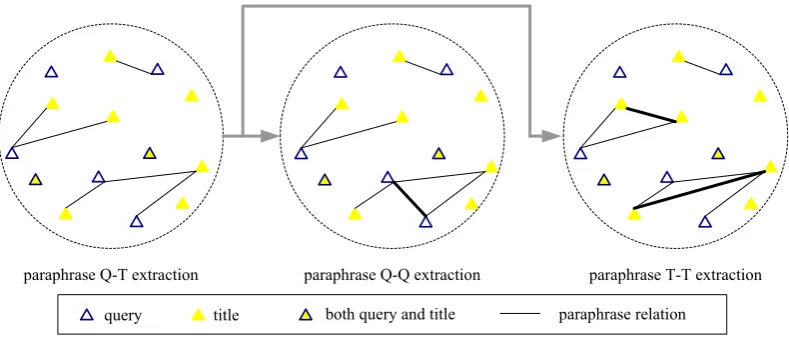
This paper proposes a method that uses search engine query logs for extracting paraphrases, which is illustrated in Figure 1. Specifically, three kinds of paraphrases can be extracted with our method, which include (1) query-title (Q-T): a query and a document title that users clicked on; (2) query-query (Q-Q): two queries, for which users clicked on the same document title; (3) title-title (T-T): two title-titles that users clicked on for the same query. We train a classifier for each kind to filter incorrect pairs and refine the paraphrases.
Extracting paraphrases using query logs has many advantages. First, query logs keep growing, which have no scale limitation. Second, query logs reflect web users’ real needs, hence the ex-tracted paraphrases may be more useful than that from other kinds of corpora. Third, paraphrases extracted from query logs can be directed applied in search engines for query suggestion and doc-ument reranking. In addition, we find that both queries and titles contain a good many question sentences, which can be useful in developing QA systems.
We conduct experiments using a query log of a commercial Chinese search engine Baidu, from which we extracted about 2.7 million pairs of paraphrase T, 0.4 million pairs of paraphrase Q-Q, and 0.4 million pairs of paraphrase T-T. The precision of the paraphrases is above 70%. In addition, we generate paraphrase patterns using the extracted paraphrases. The results show that 73,484 pairs of paraphrase patterns have been gen-erated, with a precision of over 78%.
re-paraphrase Q-T extraction
query title both query and title
paraphrase Q-Q extraction paraphrase T-T extraction
paraphrase relation
Figure 1: Illustration of the proposed method.
sults. Section 5 concludes the paper and discusses future directions.
2 Related Work
In this section, we briefly review previous studies on paraphrase extraction and query log mining in information retrieval (IR).
2.1 Paraphrase Extraction
A variety of data resources have been exploited for paraphrase extraction. For example, some re-searchers extract paraphrases from multiple trans-lations of the same foreign novel (Barzilay and McKeown, 2001; Ibrahim et al., 2003), while some others make use of comparable news arti-cles that report on the same event within a small time interval (Shinyama et al., 2002; Barzilay and Lee, 2003; Dolan et al., 2004). Besides the mono-lingual corpora, bimono-lingual parallel corpora have also been used for extracting paraphrases (Ban-nard and Callison-Burch, 2005; Callison-Burch, 2008; Zhao et al., 2008). Their basic assumption is that phrases that align with the same foreign phrase may have the same meaning.
The above methods have achieved promising results. However, their performances are usually constrained due to the scale and domain limita-tion. As an alternative, researchers have tried to acquire paraphrases from large-scale web cor-pora (Lin and Pantel, 2001; Pas¸ca and Dienes, 2005; Bhagat and Ravichandran, 2008) or directly based on web mining (Ravichandran and Hovy,
2002). These methods are guided by an extended version of distributional hypothesis, namely, if two phrases often occur in similar contexts, their meanings tend to be similar. The disadvantage of these methods is that the underlying assump-tion does not always hold. Phrases with opposite meanings can also occur in similar contexts, such as “X solves Y” and “X worsens Y” (Lin and Pan-tel, 2001). In addition, the extracted paraphrases are generally short fragments with two slots (vari-ables) at both ends.
2.2 Query Log Mining in IR
Query logs are widely used in the IR commu-nity, especially for mining similar queries. For ex-ample, Wen et al. (2002) clustered queries based on user click information. Their basic idea is that if some queries result in similar user clicks, the meanings of these queries should be similar. Such methods have also been investigated in (Gao et al., 2007) for cross-lingual query suggestion and (Zhao et al., 2007) for synonymous questions identification. This paper is partly inspired by their studies. However, we do not simply use click information as clues for mining similar queries. Instead, we mine paraphrases across queries and clicked document titles.
H1: If a queryqhits a titlet, thenqand tare likely to be paraphrases.
H2: If queriesq1andq2 hit the same titlet, q1andq2are likely to be paraphrases.
H3: If a queryqhits titlest1andt2, then t1 andt2are likely to be paraphrases.
Table 1: Hypotheses for extracting paraphrases.
expansion terms for new queries. Note that the expansion terms are merely related terms of the queries, not necessarily paraphrases.
There are other studies that use query logs for constructing ontologies (Sekine and Suzuki, 2007), learning named entities (Pas¸ca, 2007), building user profiles (Richardson, 2008), correct-ing spellcorrect-ing errors (Ahmad and Kondrak, 2005), and so forth.
3 The Proposed Method 3.1 Basic Idea
Nowadays, more and more users tend to search long queries with search engines. Many users even directly search questions to get exact an-swers. By analyzing our query log that records rich information including user queries, clicked urls, titles, etc., we find that most titles of clicked documents are highly related with search queries. Especially, paraphrases can be easily found from long queries and the corresponding clicked ti-tles. This motivates us to extract paraphrases from query-title pairs. Here we introduce a concepthit that will be frequently used: given a query q, a web documentd, andd’s titlet, if there exist some
users that click on dwhen searching q, then we
sayqhitst.
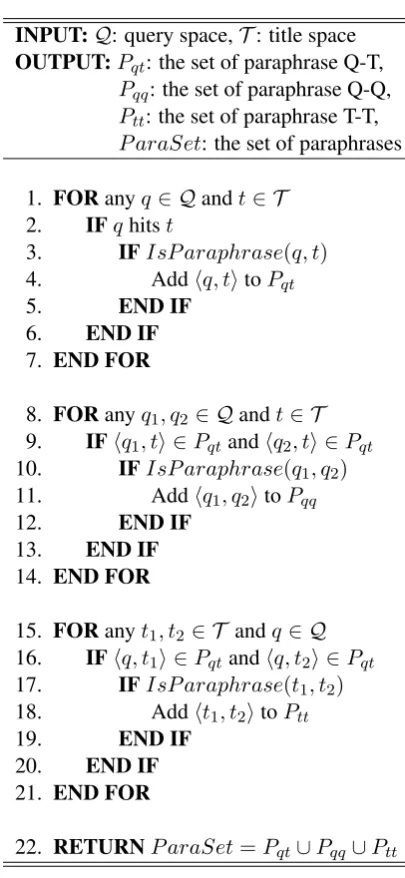
The hypothesis for extracting paraphrase Q-T is shown in Table 1 (H1). In addition, we find that when several queries hit the same title, the queries are likely to be paraphrases of each other. The other way round, when a query hits several titles, paraphrases can also be found among the ti-tles. We therefore further extract paraphrase Q-Q and T-T from the paraphrase Q-T. The underly-ing hypotheses can be found in Table 1 (H2 and
INPUT:Q: query space,T: title space
OUTPUT:Pqt: the set of paraphrase Q-T,
Pqq: the set of paraphrase Q-Q,
Ptt: the set of paraphrase T-T,
P araSet: the set of paraphrases
1. FORanyq ∈ Qandt∈ T
2. IFqhitst
3. IFIsP araphrase(q, t)
4. Add⟨q, t⟩toPqt
5. END IF
6. END IF
7. END FOR
8. FORanyq1, q2 ∈ Qandt∈ T
9. IF⟨q1, t⟩ ∈Pqtand⟨q2, t⟩ ∈Pqt 10. IFIsP araphrase(q1, q2)
11. Add⟨q1, q2⟩toPqq
12. END IF
13. END IF
14. END FOR
15. FORanyt1, t2∈ T andq∈ Q
16. IF⟨q, t1⟩ ∈Pqtand⟨q, t2⟩ ∈Pqt 17. IFIsP araphrase(t1, t2)
18. Add⟨t1, t2⟩toPtt
19. END IF
20. END IF
21. END FOR
22. RETURNP araSet=Pqt∪Pqq∪Ptt
Table 2: Algorithm for extracting paraphrases.
H3). Note that, based on H2 and H3, paraphrase Q-Q and T-T can be directly extracted from raw Q-T pairs. However, in consideration of preci-sion, we extract them from paraphrase Q-T. We call our paraphrase Q-Q and T-T extraction ap-proach as a pivot apap-proach, since we use titles as pivots (queries as targets) when extracting para-phrase Q-Q and use queries aspivots(titles as tar-gets) when extracting paraphrase T-T.
3.2 Algorithm
para-phrase Q-T from the query log. Lines 8∼14 and 15∼21 extract paraphrase Q-Q and T-T,
respec-tively. Line 22 combines the paraphrase T, Q-Q, and T-T together. To filter noise, the extracted Q-T, Q-Q, and T-T pairs are all validated using a function IsP araphrase(s1, s2). In this work,
we recast paraphrase validation as a binary clas-sification problem. Any pair of⟨s1, s2⟩ is
classi-fied as 1 (paraphrase) or 0 (non-paraphrase) with a support vector machine (SVM) classifier. The features used for classification will be detailed in Section 3.3.
In practice, we exploit a query log that contains 287 million Q-T pairs, which are then filtered us-ing the followus-ing constraints: (1) exclude Q-T pairs that are too short, i.e., either queryqor tittle
tcontains less than three terms; (2) exclude Q-T
pairs whereq subsumestor vice versa, e.g., “牛 肉(beef)” and “牛肉 的 做法(cooking method of beef)”; (3) exclude Q-T pairs in which the similar-ity betweenqandtis below a predefined threshold T2; (4) exclude Q-T pairs whose tcontains
fre-quent internet terms, such as “主页(home page)”, “网站(web site)”, “在线(online)”, since such ti-tles are mostly organization home pages, online videos, downloadable resources, etc., which are useless for our purpose of paraphrase extraction.
3.3 Features for Paraphrase Validation Given a pair of candidate paraphrases⟨s1, s2⟩, in
whichs1ands2can be either a query or a title, we
exploit the following features in the classification-based paraphrase validation.
• Frequency Feature FF. FF is defined based on each⟨s1, s2⟩’s frequency. We expect that more frequent⟨s1, s2⟩should be more reliable.
FF(s1, s2) ={
c(s1,s2)
C if c(s1, s2)< C
1 if c(s1, s2)≥C
(1) wherec(s1, s2) denotes the number of times that
the⟨s1, s2⟩pair occurs in the corpus. C is a
nor-malizing factor (C= 10in our experiments).
2The similarity is computed based on word overlap rate, which will be described in detail in section 3.3. We setT = 0.6in the experiments.
•Length Rate FeatureFLR:
FLR(s1, s2) =
min{cw(s1), cw(s2)} max{cw(s1), cw(s2)} (2)
wherecw(s)denotes the number of words ins.
•Word Overlap Rate FeatureFW OR:
FW OR(s1, s2) =
cw(s1∩s2)
max{cw(s1), cw(s2)} (3)
where “s1∩s2” is the intersection ofs1ands2.
•Character Overlap Rate FeatureFCOR. Chi-nese words are composed of characters. It is quite often that words with similar characters share similar meanings, such as “爽快 (comfortable)” and “痛快(comfortable)”, “出售 (sell)” and “销 售(sell)”. Here we useFCORto measure the sim-ilarity between s1 and s2 at the character level.
Detailedly, we segment s1 and s2 into sets of
characters and compute the overlap rate based on Equation (3)3.
•Cosine Similarity FeatureFCS. InFCS, both
s1 ands2 are represented as vectors and their
co-sine similarity is computed as:
FCS(s1, s2) =
vecw(s1)·vecw(s2)
∥vecw(s1)∥ × ∥vecw(s2)∥ (4)
wherevecw(s)is the vector of words ins, “·” de-notes the dot product of two vectors, ∥vecw(s)∥ is the norm of a vector. Here, the weight of each wordwin a vector is computed using a heuristic
similar to tf-idf:
W(w) =tf(w)×log( N
c(w) + 0.1) (5)
wheretf(w)is the frequency ofwin the givens,
c(w) is the number of times thatwoccurs in the
corpus,N = maxwc(w).
• Edit Distance Feature FED. LetED(s1, s2)
be the edit distance at the word level betweens1
ands2, we computeFED as follows:
FED(s1, s2) = 1− ED(s1, s2)
max{cw(s1), cw(s2)} (6)
3InF
•Named Entity (NE) Similarity FeatureFN E. NE information is critical in paraphrase identifica-tion (Shinyama et al., 2002). We therefore com-pute the NE similarity betweens1ands2and take
it as a feature. We employ a Chinese NE recog-nition tool that can recognizeperson names, loca-tions,organizations, andnumerals. The NE simi-larity is computed as:
FN E(s1, s2) =
cne(s1∩s2) + 1
max{cne(s1), cne(s2)}+ 1 (7)
where cne(s) denotes the number of NEs in s. Equation (7) guaranteesFN E = 1if there are no NEs in eithers1ors2.
• Pivot Fertility Feature FP F: FP F is a fea-ture specially designed for paraphrase Q-Q and T-T extraction, which are based on the pivot ap-proach4. Specifically, we definefertilityof a pivot
as the number of targets it corresponds to. Our ob-servation indicates that the larger the fertility of a pivot is, the more noisy the targets are. Hence we defineFP F as:
FP F(s1, s2) = max
p
1
f(p) (8)
wheres1 =q1,s2 = q2,p =twhen classifying
Q-Q, whiles1 =t1,s2 =t2,p =q when
classi-fying T-T.f(p)denotes the fertility of the pivotp.
The value is maximized overpifs1ands2can be
extracted with multiple pivots.
3.4 Generating Paraphrase Patterns
A key feature of our method is that the extracted paraphrases are particularly suitable for generat-ing paraphrase patterns, especially for the hot do-mains that are frequently searched. For example, there are quite a few paraphrases concerning the therapy of various diseases, from which we can easily induce patterns expressing the meaning of “How to treat [X] disease”, such as “[X] 病 如 何 治疗”, “怎么 治疗 [X]病”, and “[X] 病 的 治疗 方法”. Therefore, in this work, we try to generate paraphrase patterns using the extracted paraphrases.
In our preliminary experiments, we only induce paraphrase patterns from paraphrases that contain
4F
P F is not used in paraphrase Q-T validation.
SAME RELA DIFF
percent (%) 55.92 44.08
-Table 3: Human labeling of candidate Q-T.
no more than 6 words. In addition, only one slot is allowed in each pair of paraphrase patterns. Let
s1ands2be a pair of paraphrases extracted above.
If there exist wordsw∈s1andv∈s2that satisfy
(1)w = v, (2)wandv are not stop words, then
we can induce a pair of paraphrase patterns by re-placingwins1 andvins2with a slot “[X]”. It is
obvious that several pairs of paraphrase patterns may be induced from one pair of paraphrases.
4 Experiments
We experiment with a query log that contains a total of 284,316,659 queries. Statistics reveal that 170,315,807 queries (59.90%) lead to at least one user click, each having 1.69 clicks on average. We extract 287,129,850 raw Q-T pairs using the query log, from which 4,448,347 pairs of candidate Q-T are left after filtering as described in Section 3.2. Almost all queries and titles are written in Chinese, though some of them contain English or Japanese words. The preprocessing of candidate Q-T includes Chinese word segmentation (WSeg) and NE recognition (NER). Our WSeg tool is im-plemented based on forward maximum matching, while the NER tool is based on a NE dictionary mined from the web.
4.1 Evaluation of Candidate Q-T
We first evaluate candidate Q-T without valida-tion. To this end, we randomly sampled 5000 pairs of candidate Q-T and labeled them manu-ally. Each pair is labeled into one of the 3 classes: SAME -qandthave the same meaning; RELA -q
andthave related meanings; DIFF -qandthave
clearly different meanings. The labeling results are listed in Table 3. We can see that no candidate Q-T is in the DIFF class. This is not surprising, since users are unlikely to click on web pages un-related to their queries.
1000 pairs of candidate Q-T from the 5000 pairs labeled above, in which 563 are in the SAME class, while the other 437 are in the RELA class. Our analysis suggests that candidate Q-T in the SAME class can be divided into 4 subtle types:
• Trivial change (12.61%): changes of
punctu-ation or stop words, such as “考研 失败 怎 么 办” and “考研 失败 怎么 办 ?”.
• Word or phrase replacement (68.38%):
re-placements of synonymous words or phrases, such as “咖 啡 斑 的 治 疗 多 少 钱 (how mach is ...)” and “咖啡 斑 的 治疗 费用 是 多少(what is the price of ...)”.
• Structure change (7.10%): changes of both words and word orders, such as “减肥 中 水 果 可以 吃 什么(what fruit can I eat on a diet)” and “吃 什么 水果 可以 瘦身(what fruit can help loss weight)”.
• Others (11.90%): candidate Q-T that cannot
be classified into the 3 types above.
The above analysis reveals that more than two thirds of candidate Q-T in the SAME class are in the “word or phrase replacement” type, while the ones with structure changes are slightly more than 7%. We believe this is mainly because queries and titles are relatively short and their structures are simple. Thus structure rewriting can hardly be conducted. This distribution is in line with that reported in (Zhao et al., 2008).
As for the RELA class, we find that 42.33% of such candidate Q-T share a problem of named en-tity mismatch, such as “美 国 (US) 大 型 水 利 工 程” and “中 国 (China) 急 需 大 型 水 利 工 程”. This indicates that the NE similarity feature is necessary in paraphrase validation.
4.2 Evaluation of Paraphrase Q-T
The candidate Q-T extracted above are classified with a SVM classifier5 under its default setting.
To evaluate the classifier, we run 5-fold cross val-idation with the 5000 human annotated data, in which we use 4000 for training and the rest 1000 for testing in each run. The evaluation criteria are 5We use libsvm-2.82 toolkit, which can be downloaded from http://www.csie.ntu.edu.tw/ cjlin/libsvm/
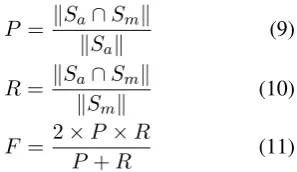
precision (P), recall (R), and f-measure (F), which are defined as follows:
P = ∥Sa∩Sm∥
∥Sa∥ (9)
R= ∥Sa∩Sm∥
∥Sm∥ (10)
F = 2×P×R
P+R (11)
whereSa is the set of paraphrases automatically recognized with the classifier, Sm is the set of paraphrases manually annotated. Precision, re-call, and f-measure are averaged over 5 runs in the 5-fold cross validation.
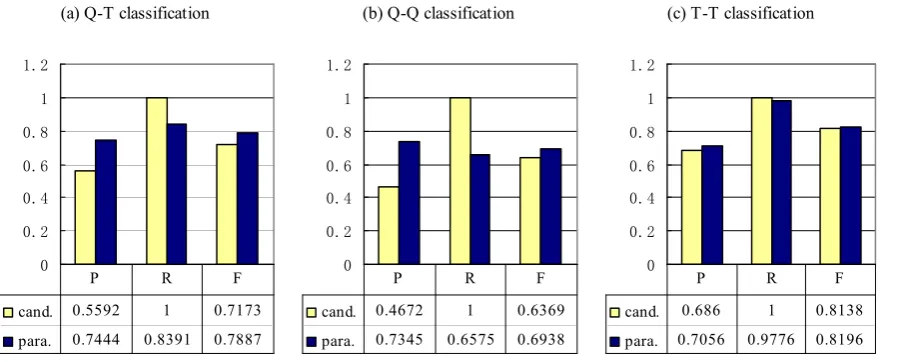
Figure 2 (a) shows the classification results (dark bars). For comparison, we also show the precision, recall6, and f-measure of the candidate
Q-T (light bars). As can be seen, the precision is improved from 0.5592 to 0.7444 after classifica-tion. F-measure is also evidently enhanced. This result indicates that the classification-based para-phrase validation is effective. We then use all of the 5000 annotated data to train a classifier and classify all the candidate Q-T. Results show that 2,762,291 out of 4,448,347 pairs of candidate Q-T are classified as paraphrases.
4.3 Evaluation of Paraphrase Q-Q and T-T From the paraphrase Q-T, we further extracted 934,758 pairs of candidate Q-Q and 438,954 pairs of candidate T-T (without validation). We rdomly sampled 5000 from each for human an-notation. The results show that the precisions of candidate Q-Q and T-T are 0.4672 and 0.6860, re-spectively. As can be seen, the precision of can-didate Q-Q is much lower than that of cancan-didate T-T. Our analysis reveals that it is mainly because candidate Q-Q are more noisy, since user queries contain quite a lot of spelling mistakes and infor-mal expressions.
The candidate Q-Q and T-T are also refined based on classification. We first evaluate the clas-sification performance using the 5000 human la-beled data. The experimental setups for Q-Q and
(a) Q-T classification
0 0.2 0.4 0.6 0.8 1 1.2
cand. 0.5592 1 0.7173
para. 0.7444 0.8391 0.7887
P R F
(b) Q-Q classification
0 0.2 0.4 0.6 0.8 1 1.2
cand. 0.4672 1 0.6369
para. 0.7345 0.6575 0.6938
P R F
(c) T-T classification
0 0.2 0.4 0.6 0.8 1 1.2
cand. 0.686 1 0.8138
para. 0.7056 0.9776 0.8196
P R F
Figure 2: Classification precision (P), recall (R), and f-measure (F).
T-T classification are the same as that of Q-T clas-sification, in which we run 5-fold cross validation with a SVM classifier using its default parameters. Figure 2 (b) and (c) give the classification results (dark bars) as well as the precision, recall, and f-measure of the candidates (light bars).
We can see that the precision of Q-Q is signifi-cantly enhanced from 0.4672 to 0.7345 after clas-sification, which suggests that a substantial part of errors and noise are removed. The increase of f-measure demonstrates the effectiveness of clas-sification despite the decrease of recall. Mean-while, the quality of candidate T-T is not clearly improved after classification. The reason should be that the precision of candidate T-T is already pretty high. We then use all 5000 human labeled data to train a classifier for Q-Q and T-T respec-tively and classify all candidate Q-Q and T-T. Re-sults show that 390,920 pairs of paraphrase Q-Q and 415,539 pairs of paraphrase T-T are extracted after classification.
4.4 Evaluation of Paraphrase Patterns Using the method introduced in Section 3.4, we have generated 73,484 pairs of paraphrase pat-terns that appear at least two times in the cor-pus. We randomly selected 500 pairs and labeled them manually. The results show that the preci-sion is 78.4%. Two examples are shown in Ta-ble 4, in whichp1andp2 are paraphrase patterns.
Some slot fillers are also listed below. We
real-p1 [X]文件 怎么 打开
p2 如何 打开[X]文件
(how to open [X] file)
slot 7z; ashx; aspx; bib; cda; cdfs; cmp; cpi; csf; csv; cur; dat; dek...
p1 关于[X]的 诗词 p2 有关[X]的 诗歌
(poems about [X])
slot 草原(prairies);长江(Yangtze River); 泰山(Mount Tai);乡愁(nostalgia)...
Table 4: Examples of paraphrase patterns.
ize that the method currently used for inducing paraphrase patterns is simple. Hence we will im-prove the method in our following experiments. Specifically, multiple slots will be allowed in a pair of patterns. In addition, we will try to ap-ply the alignment techniques in the generation of paraphrase patterns, as Zhao et al. (2008) did.
4.5 Analysis
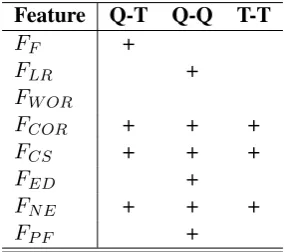
Feature Q-T Q-Q T-T
FF +
FLR +
FW OR
FCOR + + +
FCS + + +
FED +
FN E + + +
FP F +
Table 5: Feature contribution.
feature (FN E) are the most useful, which play im-portant roles in all the three classifiers. The other features are useful in some of the classifiers ex-cept the word overlap rate feature (FW OR). The classification results reported in prior sections are all achieved with the optimal feature combination. Analysis of the Paraphrases. We combine the extracted paraphrase Q-T, Q-Q and T-T and get a total of 3,560,257 pairs of unique paraphrases. Statistics show that only 8380 pairs (0.24%) are from more than one source, which indicates that the intersection among the three sets is very small. Further statistics show that the average length of the queries and titles in the paraphrases is 6.69 (words).
To have a detailed analysis of the extracted paraphrases, we randomly selected 1000 pairs and manually labeled the precision, types, and do-mains. It is found that more than 43% of the para-phrases are paraphrase questions, in which how (36%), what (19%), andyes/no (14%) questions are the most common. In addition, we find that the precision of paraphrase questions (84.26%) is evidently higher than non-question paraphrases (65.14%). Those paraphrase questions are useful in question analysis and expansion in QA, which can hardly be extracted from other kinds of cor-pora.
As expected, the paraphrases we extract cover a variety of domains. However, around 50% of them are in the 7 most popular domains7,
includ-ing: (1) health and medicine, (2) documentary download, (3) entertainment, (4) software, (5) ed-7Note that pornographic queries have been filtered from the query log beforehand.
ucation and study, (6) computer game, (7) econ-omy and finance. This analysis reflects what web users are most concerned about. These domains, especially (4) and (6), are not well covered by the parallel and comparable corpora previously used for paraphrase extraction.
5 Conclusions and Future Directions In this paper, we put forward a novel method that extracts paraphrases from search engine query logs. Our contribution is that we, for the first time, propose to extract paraphrases from user queries and the corresponding clicked document titles. Specifically, three kinds of paraphrases are extracted, which can be (1) a query and a hit title, (2) two queries that hit the same title, and (3) two titles hit by the same query. The extracted paraphrases are refined based on clas-sification. Using the proposed method, we ex-tracted over 3.5 million pairs of paraphrases from a query log of Baidu. Human evaluation results show that the precision of the paraphrases is above 70%. The results also show that we can gener-ate high-quality paraphrase patterns from the ex-tracted paraphrases.
Our future research will be conducted along the following directions. Firstly, we will use a much larger query log for paraphrase extraction, so as to enhance the coverage of paraphrases. Secondly, we plan to have a deeper study of the transitivity of paraphrasing. Simply speaking, we want to find out whether we can extract⟨s1, s3⟩as paraphrases
given that⟨s1, s2⟩and⟨s2, s3⟩are paraphrases.
6 Acknowledgments
We would like to thank Wanxiang Che, Hua Wu, and the anonymous reviewers for their useful comments on this paper.
References
Farooq Ahmad and Grzegorz Kondrak. 2005. Learn-ing a SpellLearn-ing Error Model from Search Query Logs. InProceedings of HLT/EMNLP, pages 955-962.
Regina Barzilay and Lillian Lee. 2003. Learning to Paraphrase: An Unsupervised Approach Using Multiple-Sequence Alignment. In Proceedings of HLT-NAACL, pages 16-23.
Regina Barzilay and Kathleen R. McKeown. 2001. Extracting Paraphrases from a Parallel Corpus. In
Proceedings of ACL/EACL, pages 50-57.
Rahul Bhagat and Deepak Ravichandran. 2008. Large Scale Acquisition of Paraphrases for Learning Sur-face Patterns. In Proceedings of ACL-08: HLT, pages 674-682.
Chris Callison-Burch, Philipp Koehn, and Miles Os-borne. 2006. Improved Statistical Machine Trans-lation Using Paraphrases. In Proceedings of HLT-NAACL, pages 17-24.
Chris Callison-Burch. 2008. Syntactic Constraints on Paraphrases Extracted from Parallel Corpora. In
Proceedings of EMNLP, pages 196-205.
Hang Cui, Ji-Rong Wen, Jian-Yun Nie, Wei-Ying Ma. 2002. Probabilistic Query Expansion Using Query Logs InProceedings of WWW, pages 325-332.
Bill Dolan, Chris Quirk, and Chris Brockett. 2004. Unsupervised Construction of Large Paraphrase Corpora: Exploiting Massively Parallel News Sources. In Proceedings of COLING, pages 350-356.
Pablo Ariel Duboue and Jennifer Chu-Carroll. 2006. Answering the Question You Wish They Had Asked: The Impact of Paraphrasing for Question Answering. InProceedings of HLT-NAACL, pages 33-36.
Wei Gao, Cheng Niu, Jian-Yun Nie, Ming Zhou, Jian Hu, Kam-Fai Wong, and Hsiao-Wuen Hon. 2007. Cross-Lingual Query Suggestion Using Query Logs of Different Languages. In Proceedings of SIGIR, pages 463-470.
Ali Ibrahim, Boris Katz, Jimmy Lin. 2003. Extract-ing Structural Paraphrases from Aligned Monolin-gual Corpora. InProceedings of IWP, pages 57-64.
Lidija Iordanskaja, Richard Kittredge, and Alain Polgu`ere. 1991. Lexical Selection and Paraphrase in a Meaning-Text Generation Model. In C´ecile L. Paris, William R. Swartout, and William C. Mann (Eds.): Natural Language Generation in Artificial Intelligence and Computational Linguistics, pages 293-312.
David Kauchak and Regina Barzilay. 2006. Para-phrasing for Automatic Evaluation. InProceedings of HLT-NAACL, pages 455-462.
De-Kang Lin and Patrick Pantel. 2001. Discovery of Inference Rules for Question Answering. In Natu-ral Language Engineering7(4): 343-360.
Marius Pas¸ca and P´eter Dienes. 2005. Aligning Nee-dles in a Haystack: Paraphrase Acquisition Across the Web. In Proceedings of IJCNLP, pages 119-130.
Marius Pas¸ca. 2007. Weakly-supervised Discovery of Named Entities using Web Search Queries. In
Proceedings of CIKM, pages 683-690.
Deepak Ravichandran and Eduard Hovy. 2002. Learn-ing Surface Text Patterns for a Question AnswerLearn-ing System. InProceedings of ACL, pages 41-47.
Matthew Richardson. 2008. Learning about the World through Long-Term Query Logs. InACM Transac-tions on the Web2(4): 1-27.
Stefan Riezler, Alexander Vasserman, Ioannis Tsochantaridis, Vibhu Mittal and Yi Liu. 2007. Statistical Machine Translation for Query Expan-sion in Answer Retrieval. InProceedings of ACL, pages 464-471.
Satoshi Sekine and Hisami Suzuki. 2007. Acquiring Ontological Knowledge from Query Logs. In Pro-ceedings of WWW, pages 1223-1224.
Yusuke Shinyama, Satoshi Sekine, and Kiyoshi Sudo. 2002. Automatic Paraphrase Acquisition from News Articles. In Proceedings of HLT, pages 40-46.
Ji-Rong Wen, Jian-Yun Nie, and Hong-Jiang Zhang. 2002. Query Clustering Using User Logs. InACM Transactions on Information Systems20(1): 59-81, 2002.
Shiqi Zhao, Haifeng Wang, Ting Liu, and Sheng Li. 2008. Pivot Approach for Extracting Paraphrase Patterns from Bilingual Corpora. InProceedings of ACL-08:HLT, pages 780-788.
Shiqi Zhao, Ming Zhou, and Ting Liu. 2007. Learning Question Paraphrases for QA from Encarta Logs. In