Using Explicit Discourse Connectives in Translation
for Implicit Discourse Relation Classification
Wei Shi1, Frances Yung1, Raphael Rubino1,3 and Vera Demberg1,2 1Dept. of Language Science and Technology
2Dept. of Mathematics and Computer Science, Saarland University 3German Research Center for Artificial Intelligence (DFKI)
Saarland Informatic Campus, 66123 Saarbr¨ucken, Germany {w.shi, frances, vera}@coli.uni-saarland.de
Abstract
Implicit discourse relation recognition is an extremely challenging task due to the lack of indicative connectives. Various neural network architectures have been proposed for this task recently, but most of them suffer from the shortage of la-beled data. In this paper, we address this problem by procuring additional training data from parallel corpora: When humans translate a text, they sometimes add con-nectives (a process known as explicita-tion). We automatically back-translate it into an English connective, and use it to in-fer a label with high confidence. We show that a training set several times larger than the original training set can be generated this way. With the extra labeled instances, we show that even a simple bidirectional Long Short-Term Memory Network can outperform the current state-of-the-art.
1 Introduction
When humans comprehend language, their inter-pretation consists of more than just the sum of the content of the sentences. Additional seman-tic relations (known as coherence relations or dis-course relations) are inferred between sentences in the text. Identification of discourse relations is useful for various NLP applications such as ques-tion answering (Jansen et al.,2014;Liakata et al.,
2013), summarization (Maskey and Hirschberg,
2005;Yoshida et al., 2014; Gerani et al., 2014), machine translation (Guzm´an et al., 2014;Meyer et al.,2015) and information extraction (Cimiano et al.,2005). Recently, the task has drawn increas-ing attention, includincreas-ing two CoNLL shared tasks (Xue et al.,2015,2016).
Discourse relations are sometimes expressed
with an explicit discourse connective (DC), such as “because”, “but”, “if”. Example1shows an ex-plicit discourse relation marked by “because”; the text spans between which the relation holds are marked as Arg1 and Arg2. DCs serve as strong cues and allow us to classify discourse relations with high accuracy (Pitler et al.,2008,2009;Lin et al.,2014).
However, more than half of the discourse rela-tions in a text are not signalled by a connective. See for example2: a contrastive relation can be in-ferred between the text spans marked asArg1and
Arg2. Implicit relation classification is very chal-lenging and represents a bottleneck of the entire discourse parsing system.
1. [The city’s Campaign Finance Board has re-fused to pay Mr Dinkins$95,142 in matching funds]Arg1 because [his campaign records are incomplete.]Arg2
— Explicit, Contingency.Cause
2. [They desperately needed somebody who showed they cared for them, who loved them.]Arg1 [The last thing they needed was another drag-down blow.]Arg2
—Implicit, Comparison.Contrast
In order to classify an implicit discourse rela-tion, it is necessary to represent the semantic con-tent of the relational arguments, which may give a cue to the coherence relation, e.g. “care” – “drag-down blow” in2. Early methods have focused on designing various features to overcome data spar-sity and more effectively identify relevant con-cepts in the two discourse relational arguments. (Lin et al., 2009; Zhou et al., 2010; Biran and McKeown,2013;Park and Cardie,2012; Ruther-ford and Xue,2014), while recent efforts use dis-tributed representations with neural network ar-chitectures (Zhang et al.,2015;Ji and Eisenstein,
2015; Ji et al., 2016; Chen et al., 2016; Qin et al.,2016,2017). Both streams of methods suf-fer from insufficient annotated data (Wang et al.,
2015), since the Penn Discourse Treebank (PDTB) (Prasad et al.,2008), which is the discourse anno-tated resource mostly used by the community, con-sists of just 12763 implicit instances in the usual training set and 761 relations in the test set. Some second-level relations only have about a dozen in-stances. It is therefore crucial to obtain extra data for machine learning.
In this paper, we propose a simple approach to automatically extract samples of implicit dis-course relations from parallel corpus via back-translation: Our approach is motivated by the fact that humans sometimes omit connectives during translation (implicitation), or insert connectives not originally present in the source text ( explici-tation) (Laali and Kosseim,2014;Koppel and Or-dan, 2011; Cartoni et al., 2011; Hoek and Zuf-ferey, 2015; Zufferey, 2016). When explicitat-ing an implicit relation, the human translator is, in other words, disambiguating the source implicit relation with an explicit DC in the target language. Our contribution is twofold: Firstly, we propose a pipeline to automatically label English implicit discourse relation samples based on explicitation of DCs in human translation, which is the target side of a parallel corpus. Secondly, we show that the extra instances mined by the proposed method improve the performance of a standard neural clas-sifier by a large margin, when evaluated on the PDTB 2.0 benchmark test set as well as by cross-validation (Shi and Demberg,2017).
2 Related Work
Early works addressing discourse relation pars-ing were trypars-ing to classify unmarked discourse relations by training on explicit discourse rela-tions with the marker been removed (Marcu and Echihabi, 2002). While this method promised to provide almost unlimited training data, it was shown that explicit relations differ in systematic ways from implicit relations (Asr and Demberg,
2012), so that performance on implicits is very poor when learning on explicits only (Sporleder and Lascarides,2008).
The release of PDTB (Prasad et al., 2008), the largest available corpus which annotates im-plicit examples, lead to substantial improvements in classification of implicit relations, and spurred
a variety of approaches to the task, including feature-based methods (Pitler et al., 2009; Lin et al., 2009; Park and Cardie, 2012; Biran and McKeown,2013;Rutherford and Xue,2014) and neural network models (Zhang et al.,2015;Ji and Eisenstein,2015;Ji et al.,2016;Chen et al.,2016;
Qin et al.,2016,2017). However, the limited size of the annotated corpus, in combination with the difficulty of the task of inferring the type of re-lation between given text spans, presents a prob-lem both in training (Rutherford et al.(2017) find that a simple feed-forward architecture can outper-form more complex architectures, and argues that the larger number of parameters can not be esti-mated adequately on the small amount of training data) and testing (Shi and Demberg(2017) report experiments showing that results on the standard test set are not reliable due to the small set of just 761 relations).
Data extension has therefore been a longstand-ing goal in discourse relation classification. The main idea has been to select explicit discourse in-stances that are similar to implicit ones to add to the training set. Wang et al. (2012) proposed to differentiate typical and atypical examples for each discourse relation, and augment training data for implicits only by typical explicits. In a similar vein, Rutherford and Xue (2015) proposed crite-ria for selecting among explicitly marked relations ones that contain discourse connectives which can be omitted without changing the interpretation of the discourse. These relations are then added to the implicit instances in training.
On the other hand, Lan et al. (2013) pre-sented multi-task learning based systems, which in addition to the main implicit relation classifi-cation task, contain the task of predicting previ-ously removed connectives for explicit relations, and profit from shared representations between the tasks. Similarly, Hernault et al. (2010) ob-serves features that occur in both implicit and ex-plicit discourse relations, and exploit such fea-ture co-occurrence to extend the feafea-tures for clas-sifying implicits using explicitly marked rela-tions. Mih˘ail˘a and Ananiadou(2014) and Hidey and McKeown (2016) proposed semi-supervised learning and self-learning methods to improve recognition of patterns that typically signal causal discourse relations.
train-ing data only by originally implicit relations, and obtain the label through the disambiguation that sometimes happens in human translation.
Parallel corpora have been exploited as a re-source of discourse relation data in previous work but have mostly been used with goals different from ours: Cartoni et al.(2013) and Meyer et al.
(2015) use parallel corpora to label and disam-biguate discourse connectives in the target lan-guage based on explicitly marked English rela-tions, in order to help machine translation. A second application has been to project discourse annotation from English onto other languages through parallel corpora, in order to construct dis-course annotated resources for the target language (Versley,2010;Zhou et al.,2012;Laali and Kos-seim,2014).
The approach that is in spirit most similar to ours is by Wu et al. (2016), who extracted bilingual-constrained synthetic implicit data from a sentence-aligned English-Chinese corpus and got improvements by incorporating these data via a multi-task neural network on the 4-way classifi-cation.
3 Method
Our proposed method aims at sentence pairs in the parallel corpora where an implicit discourse relations on the source English side has been translated by human translators into an explicitly marked relation on the target side. The inserted connective hence disambiguates the originally im-plicit relation, and the discourse relation can be classified with confidence (under the assumption that the same discourse relation holds in the origi-nal source text).
The pipeline of our approach is detailed in be-low steps.
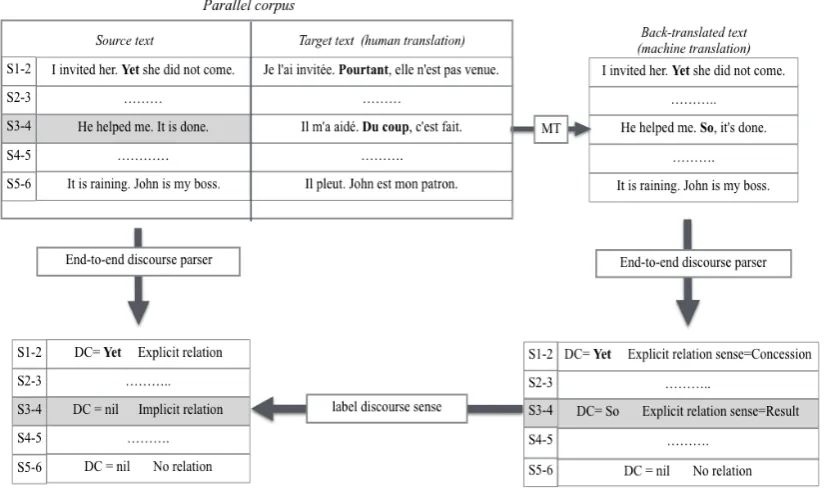
1. The target side of a sentence-aligned paral-lel corpus, with English as the source text, is back-translated to English using a pre-trained machine translation system.
2. An end-to-end discourse relation parser for English is run on both the source side and the back-translated target side. The parser will output a list of explicit and implicit re-lations, including the relation sense and argu-ment spans of each relation.
3. Implicit-to-explicit discourse relation align-ments are identified according to the output
of the end-to-end parser. Implicit relations in the PDTB are only ever annotated between consecutive sentences. Therefore, we specif-ically extract pairs of consecutive sentences on the source English side:
• that are identified as the Arg1andArg2
of animplicitdiscourse relation1; • whose corresponding back-translated
target sentences are identified as the
Arg1andArg2of anexplicitrelation;
• that are not part of the Arg1orArg2 of any other discourse relations2.
4. Label the source English implicit relation with the relation class of the explicit relation in back-translated target text. The two con-secutive sentences are marked as Arg1 and
Arg2respectively.
Figure1 illustrates the pipeline of our approach, which takes an English-to-French parallel corpus as input and outputs a list of implicit discourse re-lations, each containing two arguments from the source English text and a relation class according to the back-translated French DC.
We then compare the performance of a neural implicit discourse relation classifier trained with the annotated implicit relation samples in PDTB alone and also with the extra training samples mined from the parallel corpus. The classifier per-formance is evaluated on the standard PDTB im-plicit relation test set and by cross-validation.
3.1 Advantages of using back-translation
In the proposed method, we disambiguate implicit relations according to the explicitated translation. Instead of directly classifying the explicit relation in the target language, we back-translate the target text to the source language by machine translation (MT) because:
• Discourse parsers on low-resource languages do not perform well, or are even not available.
• Different languages have different sets of dis-course relation classes defined. By the means of back-translation, we can use an English discourse parser on the target text, and thus
1 Relations signaled by Alternative Lexicalization are counted as implicit relations and extracted as samples. How-ever,NoRelandEntRelare excluded.
Figure 1: Pipeline showing how an implicit discourse relation sample, sentence pair 3-4, is extracted and labeled using a parallel corpus.
label the implicit relations with the same set of relation labels defined for English.
• The quality of the MT system has limited im-pact on our approach. Since the DC tokens are powerful features to disambiguate an ex-plicit relation, limited contextual features are required. We just need correct translation of the explicit DC tokens, irrespective of word order and the rest of the translation.
3.2 Inter-sentential and intra-sentential relations
Only inter-sentential implicit relations are anno-tated in the PDTB, due to time and resource con-straints (Prasad et al.,2008). However, this does not mean that implicit relations only hold between consecutive sentences.
We decided to extract intra-sentential relation samples from the parallel corpus based on two motivations: Firstly, we hypothesize that intra-sentential implicit relations share similar features as inter-sentential ones. Including both types may hence increase dataset size. In fact, we will see in the experiment results that intra-sentential training samples largely improve classification of implicit relations, even though the test data from PDTB contains inter-sentential samples only. An analysis on what we learn from the intra-sentential samples is presented in Section6.1.
Secondly, intra-sentential relations can poten-tially be identified with higher reliability: Paral-lel corpora are typically sentence-aligned. This makes it a lot easier to extract sentences that are detected by the end-to-end discourse relation parser as explicit in the (back-)translation target side but not on the original source side, without needing to worry about whether any sentences in the dataset were removed or the order changed during preprocessing (which would be detrimen-tal for detecting intra-sentential relations).
3.3 Argument spans
It is possible but not entirely trivial to determine the argument spans of the discourse relations la-beled with the back-translation method. In this paper, we chose a neural network model that con-catenates theArg1 andArg2 representations (see Section4.4), so that determining exact text spans of Arg1 and Arg2 was not necessary. We are not the first one to do like this, in the work by
4 Experiment 4.1 Data
Parallel Corpora The corpora used for the ex-traction of implicit discourse relation samples are publicly available bilingual English-French paral-lel datasets compiled byRabinovich et al.(2015).3
They consist of European parliamentary proceed-ings, literary works and the Hansard corpus – gen-res that are different from the PDTB, because we want to expand the diversity of discourse rela-tion samples available in the PDTB. These corpora contain a total of∼ 1.9M sentence pairs with an average of22.7words per English sentence. Each corpus contains an originally written part in En-glish (used as target for the MT system) and its corresponding human translation in French (used as source). We use the same corpora to train the French–English MT system (Section4.2), to back-translate the French side into English and to ex-tract additional discourse training data.
The Penn Discourse Treebank (PDTB) We use the Penn Discourse Treebank 2.0 (Prasad et al.,
2008) for the training and testing of the implicit discourse relation classifier. PDTB is the largest available manually annotated corpus of explicit and implicit discourse relations based on one mil-lion word tokens from the Wall Street Journal. Each discourse relation is annotated with at most two senses from a three-level hierarchy of dis-course relations. The first level roughly catego-rizes the relations into four major classes, each of which is further categorized in to more dis-tinct relation types. Conventionally, discourse re-lation classifiers are either evaluated by the accu-racy of the first-level 4-way classification(Pitler et al., 2009; Rutherford and Xue, 2014; Chen et al., 2016), or the second-level 11-way classifi-cation (Lin et al., 2009; Ji and Eisenstein, 2015;
Qin et al.,2016,2017).
4.2 Machine Translation System
We train an MT system to back-translate the target side of the parallel corpus to English. To produce the highest-quality back-translation, we use a neu-ral MT system trained on the same paneu-rallel corpus. The system is implemented by Open-source Neu-ral Machine Translation (OpenNMT) (Klein et al.,
2017). Source words are first mapped to word vec-tors and then fed into a recurrent neural network.
3All corpora are available athttp://cl.haifa.ac.
il/projects/translationese/
At each target time step,attentionis applied over the source RNN and combined with the current hidden state to produce a prediction of the next word, and this prediction would be fed back into the target RNN.
We evaluate the MT system on newstest2014
and newsdiscusstest2015, reaching 24.63 and
22.58BLEU respectively. The French side of the training data back-translated into English is evalu-ated against the originally written English source, leading to a BLEU score of 34.17.4 The
evalu-ation of the back-translated corpus indicates that the source text is not exactly reproduced. Criti-cally, we assume that the MT system preserves the explicitness of the target DCs, instead of explici-tating or impliciexplici-tating DCs as in the human trans-lation.
4.3 End-to-end discourse parser
We employ the PDTB-style End-to-End Discourse Parser (Lin et al.,2014) to identify and classify the explicit instances from the back-translated English sentences. It achieved about 87% F1 score for ex-plicit relations on level-2 types, even higher than human agreement of 84%. The accuracy on ex-plicit DC identification is 96%.
On the source side, the end-to-end parser is ap-plied to pick implicit relations from other types of relations, i.e. explicit relations or no relation, in order to extract implicit-to-explicit DC translation from the parallel corpus5. On the back-translation,
the end-to-end parser is applied to identify only explicitly marked discourse relations.
4.4 Implicit relation classification model
We use a Bidirectional Long Short-Term Memory (LSTM) network as the implicit relation classifica-tion model to evaluate the samples extracted by the proposed method. This architecture inspects both left and right contextual information and has been proven effective in relation classification (Zhou et al.,2016;R¨onnqvist et al.,2017).
The model is illustrated in Figure2, where each word from the two discourse relational arguments is represented as a vector, which is found through a look-up word embedding. Given the word repre-sentations [w1,w2,...,wn] as the input sequence, an
4Case sensitive BLEU implemented in mteval-v13a.pl. Test sets available at http://www.statmt.org/ wmt15/translation-task.html
Figure 2: The bidirectional LSTM Network for the task of implicit discourse relation classification.
LSTM computes the state sequence [h1,h2,...,hn]
with the following equations:
it=σ(Wiwwt+Wihht−1+Wicwt−1+bi)
ft=σ(Wfwwt+Wfhht−1+Wfcwt−1+bf)
gt=tanh(Wcwwt+Wchht−1+bc) ct=ftJct−1+itJgt
ot=σ(Wowwt+Wohht−1+bo) ht=tanh(ct)Jot
The forward and backward LSTM layers tra-verse the sequenceei, producing sequences of
vec-torshif andhib respectively, which are summed
together in the coming sum layer.
Following the preprocessing method in (Lin et al., 2009), relations with too few instances (Contingency.Condition, Pragmatic Condition; Comparison.Pragmatic Contrast, Pragmatic Con-cession; Expansion.Exception) are removed dur-ing traindur-ing and evaluation, resultdur-ing in 11 types of relations. Among instances annotated with two relation senses, we only use the first sense.
The model is implemented in Keras6, which is
capable of running on top of Theano. We use word embeddings of 300 dimensions, which are trained on the original English side of the parallel corpora as well as PDTB with the Skip-gram architecture in Word2Vec (Mikolov et al., 2013). We
initial-6https://keras.io/
Relation intra- inter- Total explicit→explicit 199,047 111,090 310,137 explicit→implicit 101,381 29,964 131,345 implicit→explicit 77,228 25,086 102,314
1“→” means from source to target side.
Table 1: Numbers of intra/inter-sentence sam-ples extracted from parallel corpora.
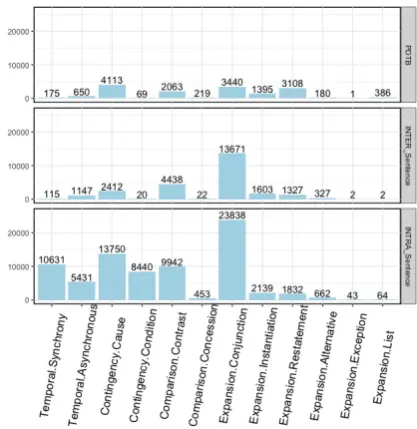
Figure 3: Relation sense distribution of implicit relations in PDTB and the extra intra- and inter-sentence samples
ize the weights with uniform random; use standard cross-entropy as our loss function; employ Ada-grad as the optimization algorithm of choice and set dropout layers after the embedding layer and output layer with a drop rate of 0.2 and 0.5 respec-tively. Each LSTM has a vector dimension of 300, matching the embedding size.
We split the PDTB data and evaluate the clas-sifier in two settings. Firstly, we adopt the stan-dard PDTB splitting convention, where section 2-21, 22, and 23 are used as train, validation and test sets respectively (Lin et al.,2009). Secondly, we conduct 10-fold cross validation on the whole cor-pus including sections 0-24, as advocated in (Shi and Demberg,2017). And extra samples are only added into training folds in the CV setting, which means that testing fold consists of instances from PDTB only. Models trained with and without ex-tra samples we exex-tracted, on top of the PDTB data, are compared.
5 Distribution of additional instances
In total, 102,314 implicit discourse relation samples are extracted, of which 25,086 are inter-sentential relations and 77,228 are intra-sentential7. Inter-sentential relations are much less
abundant because stricter screening strategy is ap-plied (the end of point3 in Section3). From Ta-ble1we can also see that majority of DCs in the
Models PDTB Test Set Cross Validation
Most common class 25.36 25.59
Lin et al.(2009) 40.20
-Qin et al.(2016) 43.81
-Qin et al.(2017) 44.65
-Rutherford et al.(2017) 39.56
-Shi and Demberg(2017) (no surface features) 37.68 34.44
Ours
PDTB only 34.32 30.01
PDTB + inter-sentential samples 42.29 34.14 PDTB + intra-sentential samples 44.29 35.08
PDTB + all samples 45.50 37.84
1 “-” means no result currently.
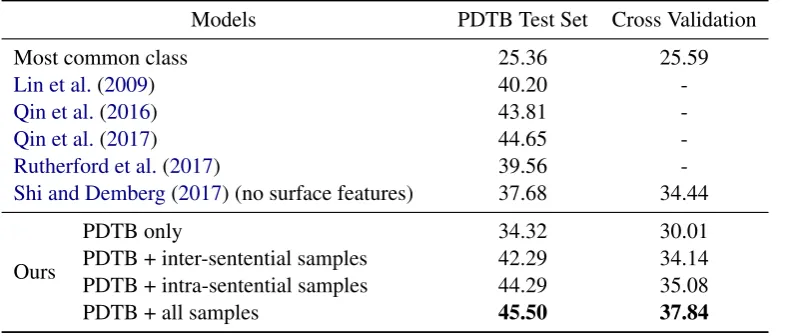
Table 2: Accuracy of 11-way classification of implicit discourse relations on PDTB test set and by cross validation.
source side have been translated into the target side explicitly.
Figure 3 compares the distribution of relation senses among the annotated implicit relations in the PDTB and our extracted samples. The relation distribution generally corresponds to the distribu-tion in PDTB, but some reladistribu-tions, such as Tem-poralandContingency.Condition, are particularly numerous in the intra-sentential samples.
6 Results
We compare our model with current state-of-the-art models that were evaluated under the same set-ting (11-way classification, PDTB section 23 as test set) (Qin et al.,2016,2017;Rutherford et al.,
2017), as well as a model based on linguistic fea-tures (Lin et al., 2009) that uses this setting for evaluation.
Qin et al. (2017) developed an adversarial model, which consists of two CNNs in which ar-guments are represented separately, a four-layer Perceptron and a dense layer for classification, to enable an adaptive imitation scheme through com-petition between the implicit network and a ri-val feature discriminator. Our model substantially differs from that setup, as it uses a much sim-pler network architecture and represents the two discourse relation arguments jointly, i.e. without knowledge of the arguments’ spans. We can see that our baseline model performs substantially less well than the state of the art, and also less well than (Shi and Demberg,2017), who also use an LSTM but represent discourse relational arguments sepa-rately. As adding training data can be expected to
be largely orthogonal to the choice of classifica-tion model, we are here most interested in seeing whether adding the new instances improves over the baseline model with identical architecture.
Table 2 shows that including the extra inter-and intra-sentential instances leads to very sub-stantial improvements in classification accuracy. Using the additional data, our method not only im-proves performance by 11%-points on the PDTB test set compared to training on the PDTB implicit relations only, but also outperforms much more complex neural network models (Qin et al.,2016,
2017) on this task.
The evaluation using cross-validation (around 8% point improvement over the baseline) further-more shows that the obtained improvements do not only hold for the PDTB standard test set but also are stable across the whole PDTB data. These re-sults strongly support the effectiveness of the im-plicit relation samples mined from parallel texts.
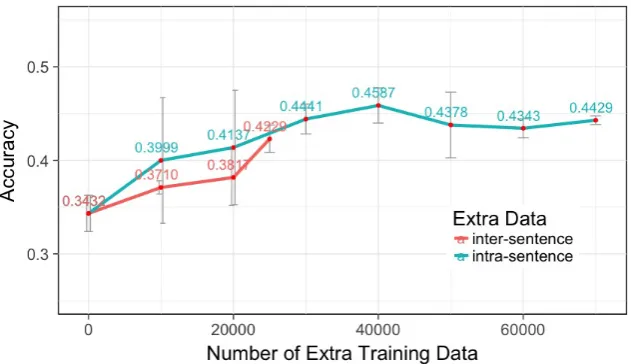
Figure 4: Average and variance of classification accuracy evaluated on the PDTB test set with different sample size.
evaluation is a lot larger in this setting, and hence yields more stable performance estimates.
6.1 Qualitative Analysis
In order to illustrate what kinds of instances our method extracts, we show an instances below. The underlined DC is the explicit DC identified in the back-translated target text; the discourse rela-tion is automatically classified based on the back-translation.
3. [Justice demands it.]Arg1 but [The minister refuses.]Arg2
— Comparison.Contrast
One strength of the proposed method is that it can mine and label discourse relations that are not commonly regarded as discourse relations and hence not annotated in PDTB. Below are some ex-amples where the bold DC was identified in the (back-)translation:
4. A conservative member was kicked out of his caucus for defending Nova Scotians.
—because, Contingency.Cause 5. A failure to do so would affect our attitude to their
even-tual accession.
—if, Contingency.Condition
These extra samples are in fact an invaluable resource of discourse-informative patterns, which are not available to discourse relation parsers that are trained only on the PDTB dataset. These cases provide evidence that our proposed method can not only provide instances that are similar to im-plicit labelled instances, but detect additional pat-terns, as attempted in (Mih˘ail˘a and Ananiadou,
2014;Hidey and McKeown, 2016) for causal re-lations, and generalize from the semantic content observed in such relations to actual implicit dis-course relations.
For example, as reported in Section 5, numer-ousTemporalrelations are mined from the paral-lel corpus. These include cases where the origi-nal text contained a verbal construction which ex-presses the temporal relation, which through back-translation gets expressed as a discourse relation, or where explicit relations include gerunds in the Arg2, e.g.
“any plan takes time to have the effect required”→“before getting the effect required”
“how much longer do women have to wait for fairness?”→“before women have fairness.”
“having gone over the estimates”→“after go-ing over the estimates.”
(source text followed by (back-)translation, where the explicitated DC is underlined).
6.2 Quantitative Analysis
In order to get detailed insights on how much extra data is most beneficial to the task, we also trained our classifier with different numbers of additional extracted samples. Figure 4 compares the clas-sification accuracy when training on incremental number of extra instances. We find that the perfor-mance increases with samples size, but plateaus after40,000intra-sentential samples.
In fact, this sample size produces the high-est averaged classification accuracy of 45.87%, which is even higher than our model which in-cludes all extracted samples. A possible reason for not seeing further improvement in adding more intra-sentential examples is the difference in dis-tribution and properties of these extra samples compared to the PDTB data. We also experi-mented with training on the parallel-text samples only (i.e., without any PDTB training samples), but the result was worse than using PDTB only. Adding more inter-sententialsamples might fur-ther improve the performance, as these instances are closer to the PDTB data.
6.3 Methodological Discussion
Our proposed method uses back-translated target DCs to label implicit relations. The quality of the relation label is intrinsically subject to the transla-tion policy of the parallel corpora and also extrin-sically subject to the accuracy of explicit DC clas-sification by the end-to-end parser and the qual-ity of the MT system. For example, a partic-ularly high proportion of Contingency.Condition
relations is found in the intra-sentential samples. Analyzing these samples, we found numerous in-stances where the word ‘if’ is wrongly identified as a DC (e.g. He asked if it was correct.). It is not surprising to have noisy samples extracted be-cause limited screening strategy is applied in the current method.
As a reference for the quality of the relation la-bel produced, we analysed the intra-sentential re-lations in the parallel corpus that are explicit on the source side and also in the (back-)translation. We found that68%of the originally explicit DCs are (back-)translated to the same explicit DCs and
75%to DCs of the same level-2 sense, according to automatic explicit DC classification of the end-to-end parser.
7 Conclusion and Future work
We showed that explicitation during human trans-lation can provide a valuable signal for expanding datasets for implicit discourse relations. As the ex-pansion of training instances is orthogonal to the mechanism of DR classification, this method can be applied to improve any methods of implicit DR classification.
We see plenty of room for further improvement by controlling the sample quality, such as selec-tion based on explicit discourse connective iden-tification confidence, restraining the discourse re-lation structure, identifying Arg1 and Arg2 such that approaches which use two separate represen-tations for arguments instead of a single concate-nated vector become possible, reducing language-specific bias by mining from parallel corpora of other language pairs, and fine-tuning the MT sys-tem for discourse connective translation. We leave the exploration of these areas to future work.
Acknowledgments
We would like to thank the anonymous reviewers for their careful reading, valuable and insightful comments. This work was funded by the German Research Foundation (DFG) as part of SFB 1102 “Information Density and Linguistic Encoding”.
References
Fatemeh Torabi Asr and Vera Demberg. 2012. Im-plicitness of discourse relations. In Proceedings of COLING 2012. The COLING 2012 Organizing Committee, Mumbai, India, pages 2669–2684.
Or Biran and Kathleen McKeown. 2013. Aggregated word pair features for implicit discourse relation dis-ambiguation. In Proceedings of the 51st Annual Meeting of the Association for Computational Lin-guistics. Association for Computational Linguistics, Sofia, Bulgaria, pages 69–73.
Bruno Cartoni, Sandrine Zufferey, and Thomas Meyer. 2013. Annotating the meaning of discourse connec-tives by looking at their translation: The translation-spotting technique.D&D4(2):65–86.
Jifan Chen, Qi Zhang, Pengfei Liu, Xipeng Qiu, and Xuanjing Huang. 2016. Implicit discourse relation detection via a deep architecture with gated rele-vance network. InProceedings of the 54th Annual Meeting of the Association for Computational Lin-guistics. Association for Computational Linguistics, pages 1726–1735.
Philipp Cimiano, Uwe Reyle, and Jasmin ˇSari´c. 2005. Ontology-driven discourse analysis for informa-tion extracinforma-tion. Data & Knowledge Engineering
55(1):59–83.
Shima Gerani, Yashar Mehdad, Giuseppe Carenini, Raymond T. Ng, and Bita Nejat. 2014. Abstractive summarization of product reviews using discourse structure. In Proceedings of the 2014 Conference on Empirical Methods in Natural Language Pro-cessing. Association for Computational Linguistics, pages 1602–1613.
Francisco Guzm´an, Shafiq R. Joty, Llu´ıs M`arquez, and Preslav Nakov. 2014. Using discourse structure im-proves machine translation evaluation. In Proceed-ings of the 52nd Annual Meeting of the Associa-tion for ComputaAssocia-tional Linguistics. Association for Computational Linguistics, pages 687–698.
Hugo Hernault, Danushka Bollegala, and Mitsuru Ishizuka. 2010. A semi-supervised approach to im-prove classification of infrequent discourse relations using feature vector extension. In Proceedings of the 2010 Conference on Empirical Methods in Nat-ural Language Processing. Association for Compu-tational Linguistics, pages 399–409.
Christopher Hidey and Kathleen McKeown. 2016. Identifying causal relation using parallel wikipedia articles. InProceedings of the 54th Annual Meeting of the Association for Computational Linguistics. Association for Computational Linguistics, pages 1424–1433.
Jet Hoek and Sandrine Zufferey. 2015. Factors in-fluencing the implicitation of discourse relations across languages. In Proceedings 11th Joint ACL-ISO Workshop on Interoperable Semantic Annota-tion (isa-11). TiCC, Tilburg center for Cognition and Communication, pages 39–45.
Peter Jansen, Mihai Surdeanu, and Peter Clark. 2014. Discourse complements lexical semantics for non-factoid answer reranking. In Proceedings of the 52nd Annual Meeting of the Association for Compu-tational Linguistics. Association for Computational Linguistics, pages 977–986.
Yangfeng Ji and Jacob Eisenstein. 2015. One vector is not enough: Entity-augmented distributed semantics for discourse relations. Transactions of the Associa-tion for ComputaAssocia-tional Linguistics3:329–344. Yangfeng Ji, Gholamreza Haffari, and Jacob
Eisen-stein. 2016. A latent variable recurrent neural net-work for discourse relation language models. In
Proceedings of the 2016 Conference of the North American Chapter of the Association for Computa-tional Linguistics on Human Language Technology. Association for Computational Linguistics, pages 332–342.
Guillaume Klein, Yoon Kim, Yuntian Deng, Jean Senellart, and Alexander M. Rush. 2017. Opennmt: Open-source toolkit for neural machine translation.
arXiv preprint arXiv:1701.02810.
Moshe Koppel and Noam Ordan. 2011. Translationese and its dialects. InProceedings of the 49th Annual Meeting of the Association for Computational Lin-guistics. Association for Computational Linguistics, pages 1318–1326.
Majid Laali and Leila Kosseim. 2014. Inducing dis-course connectives from parallel texts. In Proceed-ings of the 25th International Conference on Com-putational Linguistics (COLING-2014). pages 610– 619.
Man Lan, Yu Xu, Zheng-Yu Niu, et al. 2013. Leverag-ing synthetic discourse data via multi-task learnLeverag-ing for implicit discourse relation recognition. In Pro-ceedings of the 51st Annual Meeting of the Associa-tion for ComputaAssocia-tional Linguistics. Association for Computational Linguistics, pages 476–485.
Maria Liakata, Simon Dobnik, Shyamasree Saha, Colin R. Batchelor, and Dietrich Rebholz-Schuhmann. 2013. A discourse-driven content model for summarising scientific articles evaluated in a complex question answering task. In Proceed-ings of the 2013 Conference on Empirical Methods in Natural Language Processing. Association for Computational Linguistics, pages 747–757.
Ziheng Lin, Min-Yen Kan, and Hwee Tou Ng. 2009. Recognizing implicit discourse relations in the penn discourse treebank. InProceedings of the 2009 Con-ference on Empirical Methods in Natural Language Processing. Association for Computational Linguis-tics, Singapore, pages 343–351.
Ziheng Lin, Hwee Tou Ng, and Min-Yen Kan. 2014. A pdtb-styled end-to-end discourse parser. Natural Language Engineering20(02):151–184.
Daniel Marcu and Abdessamad Echihabi. 2002. An unsupervised approach to recognizing discourse re-lations. InProceedings of the 40th Annual Meeting on Association for Computational Linguistics. As-sociation for Computational Linguistics, pages 368– 375.
Thomas Meyer, Najeh Hajlaoui, and Andrei Popescu-Belis. 2015. Disambiguating discourse connec-tives for statistical machine translation. Transac-tions on Audio, Speech, and Language Processing
23(7):1184–1197.
Claudiu Mih˘ail˘a and Sophia Ananiadou. 2014. Semi-supervised learning of causal relations in biomedical scientific discourse. Biomedical engineering online
13(2):1.
Tomas Mikolov, Ilya Sutskever, Kai Chen, Greg S. Cor-rado, and Jeff Dean. 2013. Distributed representa-tions of words and phrases and their compositional-ity. InAdvances in neural information processing systems. pages 3111–3119.
Joonsuk Park and Claire Cardie. 2012. Improving im-plicit discourse relation recognition through feature set optimization. InProceedings of the 13th Annual Meeting of the Special Interest Group on Discourse and Dialogue. Association for Computational Lin-guistics, pages 108–112.
Emily Pitler, Annie Louis, and Ani Nenkova. 2009. Automatic sense prediction for implicit discourse re-lations in text. In Proceedings of the 47th Annual Meeting of the Association for Computational Lin-guistics. Association for Computational Linguistics, Suntec, Singapore, pages 683–691.
Emily Pitler, Mridhula Raghupathy, Hena Mehta, Ani Nenkova, Alan Lee, and Aravind K. Joshi. 2008. Easily identifiable discourse relations. In Proceed-ings of the 22nd International Conference on Com-putational Linguistics (COLING-2008). Manch-ester, UK, pages 85–88.
Rashmi Prasad, Nikhil Dinesh, Alan Lee, Eleni Milt-sakaki, Livio Robaldo, Aravind K. Joshi, and Bon-nie L. Webber. 2008. The penn discourse treebank 2.0. InLREC. European Language Resources Asso-ciation, Marrakech, Morocco.
Lianhui Qin, Zhisong Zhang, and Hai Zhao. 2016. Im-plicit discourse relation recognition with context-aware character-enhanced embeddings. In Proceed-ings of COLING 2016, the 26th International Con-ference on Computational Linguistics.
Lianhui Qin, Zhisong Zhang, Hai Zhao, Zhiting Hu, and Eric P. Xing. 2017. Adversarial connective-exploiting networks for implicit discourse relation classification. In Proceedings of the 55th An-nual Meeting of the Association for Computational Linguistics (Volume 1: Long Papers). Association for Computational Linguistics, Vancouver, Canada, pages 1006–1017.
Ella Rabinovich, Shuly Wintner, and Ofek Luis Lewin-sohn. 2015. The haifa corpus of translationese.
arXiv preprint arXiv:1509.03611.
Samuel R¨onnqvist, Niko Schenk, and Christian Chiar-cos. 2017. A recurrent neural model with attention
for the recognition of chinese implicit discourse re-lations. In Proceedings of the 55th Annual Meet-ing of the Association for Computational LMeet-inguistics (Volume 2: Short Papers). Association for Compu-tational Linguistics, Vancouver, Canada, pages 256– 262.
Attapol Rutherford, Vera Demberg, and Nianwen Xue. 2017. A systematic study of neural discourse mod-els for implicit discourse relation. InProceedings of the 15th Conference of the European Chapter of the Association for Computational Linguistics. Associa-tion for ComputaAssocia-tional Linguistics, pages 281–291. Attapol Rutherford and Nianwen Xue. 2014.
Discover-ing implicit discourse relations through brown clus-ter pair representation and coreference patclus-terns. In
Proceedings of the 14th Conference of the European Chapter of the Association for Computational Lin-guistics. Association for Computational Linguistics, pages 645–654.
Attapol Rutherford and Nianwen Xue. 2015. Improv-ing the inference of implicit discourse relations via classifying explicit discourse connectives. In Pro-ceedings of the 2015 Conference of the North Amer-ican Chapter of the Association for Computational Linguistics on Human Language Technology. Asso-ciation for Computational Linguistics, pages 799– 808.
Wei Shi and Vera Demberg. 2017. On the need of cross validation for discourse relation classification. In
Proceedings of the 15th Conference of the European Chapter of the Association for Computational Lin-guistics. Association for Computational Linguistics, pages 150–156.
Caroline Sporleder and Alex Lascarides. 2008. Using automatically labelled examples to classify rhetori-cal relations: An assessment. Natural Language En-gineering14(3):369–416.
Yannick Versley. 2010. Discovery of ambiguous and unambiguous discourse connectives via annotation projection. InAEPC. pages 83–82.
Peilu Wang, Yao Qian, Frank K Soong, Lei He, and Hai Zhao. 2015. Word embedding for recurrent neural network based tts synthesis. In Acoustics, Speech and Signal Processing (ICASSP), 2015 IEEE Inter-national Conference on. IEEE, pages 4879–4883. Xun Wang, Sujian Li, Jiwei Li, and Wenjie Li. 2012.
Implicit discourse relation recognition by select-ing typical trainselect-ing examples. In Proceedings of the 24th International Conference on Computational Linguistics (COLING-2012). pages 2757–2772. Changxing Wu, Xiaodong Shi, Yidong Chen, Yanzhou
Nianwen Xue, Hwee Tou Ng, Sameer Pradhan, Rashmi Prasad, Christopher Bryant, and Attapol Rutherford. 2015. The conll-2015 shared task on shallow dis-course parsing. In Proceedings of the CoNLL-15 Shared Task. Association for Computational Lin-guistics, pages 1–16.
Nianwen Xue, Hwee Tou Ng, Attapol Rutherford, Bon-nie Webber, Chuan Wang, and Hongmin Wang. 2016. Conll 2016 shared task on multilingual shallow discourse parsing. In Proceedings of the CoNLL-16 shared task. Association for Computa-tional Linguistics, pages 1–19.
Yasuhisa Yoshida, Jun Suzuki, Tsutomu Hirao, and Masaaki Nagata. 2014. Dependency-based dis-course parser for single-document summarization. In Proceedings of the 2014 Conference on Empiri-cal Methods in Natural Language Processing. Asso-ciation for Computational Linguistics, pages 1834– 1839.
Biao Zhang, Jinsong Su, Deyi Xiong, Yaojie Lu, Hong Duan, and Junfeng Yao. 2015. Shallow convolu-tional neural network for implicit discourse relation recognition. InProceedings of the 2015 Conference on Empirical Methods in Natural Language Pro-cessing. Association for Computational Linguistics, pages 2230–2235.
Lanjun Zhou, Wei Gao, Bin Li, Zhong Wei, and Kam-Fai Wong. 2012. Cross-lingual identification of ambiguous discourse connectives for resource-poor language. In Proceedings of COLING 2012: Posters. The COLING 2012 Organizing Committee, pages 1409–1418.
Peng Zhou, Wei Shi, Jun Tian, Zhenyu Qi, Bingchen Li, Hongwei Hao, and Bo Xu. 2016. Attention-based bidirectional long short-term memory net-works for relation classification. In Proceedings of the 54th Annual Meeting of the Association for Computational Linguistics. Association for Compu-tational Linguistics, pages 207–212.
Zhi-Min Zhou, Yu Xu, Zheng-Yu Niu, Man Lan, Jian Su, and Chew Lim Tan. 2010. Predicting discourse connectives for implicit discourse relation recog-nition. In Proceedings of the 23rd International Conference on Computational Linguistics (COLING 2010). Association for Computational Linguistics, Beijing, China, pages 1507–1514.