Animacy Acquisition Using Morphological Case
Riyaz Ahmad Bhat
LTRC, IIIT-Hyderabad, India
Dipti Misra Sharma
LTRC, IIIT-Hyderabad, India [email protected]
Abstract
Animacy is an inherent property of en-tities that nominals refer to in the phys-ical world. This semantic property of a nominal has received much attention in both linguistics and computational linguis-tics. In this paper, we present a robust unsupervised technique to infer the ani-macy of nominals in languages with rich morphological case. The intuition behind our method is that the control/agency of a noun depicted by case marking can ap-proximate its animacy. A higher control over an action implies higher animacy. Our experiments on Hindi show promising re-sults withFβandP urityscores of 89 and 86 respectively.
1 Introduction
Animacy can either be defined as a biological property or a grammatical category of nouns. In a strictly biological sense, living entities are ani-mate, while all non living entities are inanimate. However, in its linguistic sense, the term is syn-onymous with a referent’s ability to act or instigate events volitionally (Kittil¨a et al., 2011). Although seemingly different, linguistic animacy can be im-plied from biological animacy. In linguistics, the manifestation of animacy and its relevance to lin-guistic phenomena have been studied quite exten-sively. Animacy has been shown, cross linguisti-cally, to control a number of linguistic phenomena. Case marking, argument realization, topicality or discourse salience are some phenomena highly correlated with the property of animacy (Aissen, 2003; Bresnan et al., 2007; De Swart et al., 2008; Branigan et al., 2008). In linguistic theory,
how-ever, animacy is not seen as a dichotomous vari-able, rather a range capturing finer distinctions of linguistic relevance. Animacy hierarchy proposed in Silverstein’s influential article on “animacy hi-erarchy” (Silverstein, 1986) ranks nominals on a scale of the following gradience:1st pers>2nd pers >3rd anim>3rd inanim. Several such hierarchies of animacy have been proposed following (Silver-stein, 1986). One basic scale taken from (Aissen, 2003) makes a three-way distinction as humans> animates>inanimates. These hierarchies can be said to be based on the likelihood of a referent of a nominal to act as an agent in an event (Kittil¨a et al., 2011). Thus higher a nominal on these hier-archies higher the degree of agency/control it has over an action. In morphologically rich languages, the degree of agency/control is expressed by case marking. Case markers capture the degree of con-trol a nominal has in a given context (Hopper and Thompson, 1980; Butt, 2006). They rank nomi-nals on the continuum of control as shown in (1)1. Nominals marked with Ergative case have highest control and the ones marked with Locative have lowest.
Erg>Gen>Inst>Dat>Acc>Loc (1)
In this work, we demonstrate that the correla-tion between the aforemencorrela-tioned linguistic phe-nomena is highly systematic, therefore can be ex-ploited to predict the animacy of nominals. In or-der to utilize the correlation between these phe-nomena for animacy prediction, we choose to use an unsupervised learning method. Since, using a supervised learning technique is not always fea-sible. The resources required to train supervised algorithms are expensive to create and unlikely to
1Ergative, Genitive, Instrumental, Dative, Accusative and
Locative in the given order.
exist for the majority of languages. We show that an unsupervised learning method can achieve re-sults comparable to supervised learning in our set-ting (see Section 5). Further, based on our case study of Hindi, we propose that given the mor-phological case corresponding to Scale (1), ani-macy can be predicted with high precision. Thus, given the morphological case our approach should be portable to any language. In the context of In-dian languages, in particular, our approach should be easily extendable. In many Indo-Aryan lan-guages2, the grammatical cases listed on Scale (1) are, in fact, morphologically realized (Masica, 1993, p. 230) (Butt and Ahmed, 2011).
In what follows, we first present the related work on animacy acquisition in Section 2. In Sec-tion 3, we will describe our approach for acquiring animacy in Hindi using case markers listed in (2). Section 3.1 describes the data used in our exper-iments, followed by discussion on feature extrac-tion and normalizaextrac-tion. In Secextrac-tion 4, we discuss the extraction of data sets from Hindi Wordnet for the evaluation of results of our experiments. In Section 5, we describe the results with thorough error analysis and conclude the paper with some future directions in Section 6.
2 Related Work
In NLP, the role of animacy has been re-cently realized. It provides important informa-tion, to mention a few, for anaphora resolution (Evans and Orasan, 2000), argument disambigua-tion (Dell’Orletta et al., 2005), syntactic pars-ing (Øvrelid and Nivre, 2007), (Bharati et al., 2008) and verb classification (Merlo and Steven-son, 2001). Lexical resources like wordnet usually feature animacy of nominals of a given language (Fellbaum, 2010; Narayan et al., 2002). How-ever, using wordnet, as a source for animacy, is not straightforward. It has its own challenges (Or-san and Evans, 2001; Ora(Or-san and Evans, 2007). Also, it’s only a few privileged languages that have such lexical resources available. Due to the un-availability of such resources that could provide animacy information, there have been some no-table efforts in the last few years to automati-cally acquire animacy. The important and worth mentioning works in this direction are (Øvrelid, 2006) and (Øvrelid, 2009). The works focus on Swedish and Norwegian common nouns using
dis-2Indo-Aryan is a major language family in India.
tributional patterns regarding their general syn-tactic and morphological properties. Other works in the direction are (Bowman and Chopra, 2012) for English and (Baker and Brew, 2010) for En-glish and Japanese. All these works use super-vised learning methods on a manually labeled data set. These works use highly rich linguistic fea-tures (e.g., grammatical relations) extracted using syntactic parsers and anaphora resolution systems. The major drawback of these approaches is that they can not be extended to resource poor lan-guages because these lanlan-guages can not satisfy the prerequisites of these approaches. Not only the availability of manually annotated training data, but also the features used restrict their portabil-ity to resource poor languages. Our approach, on the other hand, is based on unsupervised learning from raw corpus using a small set of case markers. Therefore, it can be extended to any language with morphologically realized grammatical case listed on Scale (1).
3 Our Approach
As noted by Comrie (1989, p. 62), a nominal can have varying degrees of control in varying con-texts irrespective of its animacy. The noun phrase
its literal animacy, i.e., animates should more fre-quently be used in contexts of high control while in-animates should be used in contexts of low con-trol. A high degree of animacy necessarily implies high degree of control. So the prototypical use of animates is in the contexts of high control and of inanimates in the contexts of low control. As the discussion suggests, animates should occur more frequently with the case markers towards the left of the Scale (1), while inanimates should occur more frequently with the ones towards the right of the Scale. Thus, animates should have a left-skewed distribution on Scale (1), while inanimates should have a right-skewed distribution.
In this work, we have exploited the systematic correlations between the linguistic phenomena, as discussed, to approximate animacy of Hindi nomi-nals. Our methodology relies on the distributional patterns of a nominal with case markers capturing its degree of control. Distributions of each nomi-nal are extracted from a large corpus of Hindi and then they are clustered using fuzzycmeans algo-rithm. Next, we discuss our choice of clustering, feature extraction and normalization.
3.1 Feature Extraction and Normalization
In order to infer animacy of a nominal, we ex-tracted its distributions with the case markers cor-responding to (1) except genitives3. Case markers of Hindi corresponding to (1) are listed in (2) (Mo-hanan, 1990, p. 72).
ne>kaa>se>ko>ko>{mem, par, tak, se, ko} (2)
Sincekoandseare ambiguous, as shown in (2), we approximated them to the prototypical cases they are usually used for. kois approximated to dative while se is approximated to instrumental case. The ambiguity in these case makers, how-ever, has a profound impact on our results as dis-cussed in Section 5. A mixed-domain corpora of 87 million words is used to ensure enough case marked instances of a nominal. The extraction of distributional counts is simple and straightfor-ward in Hindi. Words immediately preceding case markers are considered as nouns since case mark-ers almost always lie adjacent to the nominals they mark, however, occasionally they are separated by emphatic particles like hi ‘only’. In such cases particles are removed to extract the distribution by
3Genitives are highly ambiguous in Hindi and hardly
dis-criminate animates from in-animates.
using a list of stop words. Since, Hindi nouns de-cline for number, gender and case, we use Hindi morph-analyzer, built in-house, to generate lem-mas of inflected word forms so that their distribu-tions can be accumulated under their correspond-ing lemmas. Further, the distributional counts of each nominal are scaled to unity so as to guard against the bias of word frequencies in our clus-tering experiments. Consider a distribution of two nominals A andB with case markersX andY. Say A occurs 900 times with X and 100 times withY andBoccurs 18 times withXand 2 times with Y. Although, these nominals seem to have different distributions, apart from being similarly skewed, both of them have similar relative fre-quency of occurrence with X and Y. We aim, therefore, to normalize the distributional counts of a nominal with the case markers it occurs with. The distributional counts are normalized to unity by the frequency of a given nominal in the cor-pora, as shown in (3). This ensures that only the nominals of similar relative frequency distribu-tions are clustered together. Beside, normalizing the distributions, we set a frequency threshold, for a nominal to be included for clustering to > 10, which ensures its enough instances to unravel its unmarked or prototypical behavior.
x0= Pkxi
i=1xi
(3)
x0is the normalized dimensions in a feature vector of a nominalx.kis the number of coordinates and
xiis theithcoordinate ofx.
3.2 Soft Clustering
Animacy is an inherent and a non varying property of entities that nominals refer to. However, due to lexical ambiguity animacy of a nominal can vary as the context varies. In Hindi, the ambiguity can be attributed to the following:
• Personal Names: In Hindi, common nouns are frequently used as person names or as a component of them. For example, noun ‘baadal’ meaning ‘cloud(s)’ can also be used as a ‘person name’; similarly ‘vijay’ can either mean ‘victory’ or can be a ‘person name’.
a geographical place or a group of individ-uals depending on the context of use. These words are not ambiguous per se but show dif-ferent aspects of their semantics in difdif-ferent contexts (logically polysemous). For exam-ple,Indiacan either refer to a geographical place or its inhabitants.
These ambiguities imply that some nominals can belong to both animate and inanimate classes. In order to address this problem of mixed mem-bership, we used soft clustering approach in this work. In comparison with hard clustering meth-ods, in which a pattern belongs to a single cluster, soft clustering algorithms allow patterns to belong to all clusters with varying degrees of member-ship. One of the most widely used soft clustering algorithms is the fuzzyc-means algorithm (hence-forth FCM) (Bezdek et al., 1984). The FCM algo-rithm attempts to partition a finite set ofnobjects
K ={k1, ..., kn}into a collection ofcfuzzy clus-ters with respect to some given criterion. Given a finite set of data, the algorithm returns a list ofc
cluster centersC ={c1, ..., cc}and a partition ma-trixW =wi,j ∈[0,1], i = 1, ..., n, j = 1, ..., c, where each elementwij tells the degree to which elementkibelongs to clustercj. Like the k-means algorithm, the FCM aims to minimize an objective function, given as:
Jm(U, β) = c X
i=1 n X
k=1
umikDik(xk, βi) (4)
where
uik is the membership of thekth object in theith cluster;
βirepresents theith cluster prototype;
m≥1is the degree of fuzziness;
c≥2is the number of cluster;
nrepresents the number of data points;
Dik(xk, βi)is the Euclidean distance betweenkth object andithcluster center.
4 Evaluation
In this section, we discuss the extraction of evalu-ation sets for the validevalu-ation of the clustering re-sults. When a clustering solution has been ob-tained for a data set, it must also be presented in a manner which provides an overview of the content of each cluster. For that matter, we need an eval-uation set that can provide class labels for each nominal a priori. The clustering task is then to
assign these nominals to a given number of clus-ters such that each cluster contains all and only those nominals that are members of the same class. Given the ground truth class labels, it is trivial to determine how accurate the clustering results are. This evaluation set is built using the Hindi wordnet4(Narayan et al., 2002), a lexical resource composed of synsets and semantic relations. An-imacy of a nominal is taken from concept ontolo-gies listed in the wordnet. We created two data sets using Hindi Wordnet:
• SET-1: This set contains nominals that are ei-ther animate or inanimate across senses listed in the wordnet. For example, nominals like
baalak ‘boy’ with all senses animate and
patthar ‘stone’ with all senses inanimate would fall under this set, whereas kuttaa
‘dog’ or ‘pawl’ with varying animacy across senses would not qualify to be included in this set. The sense hierarchies corresponding to animate (dog) and inanimate (pawl) senses of nounkuttaaare represented in Figure 1. There are 6039 nominals in this set. It is used to evaluate the results and determine the ac-curacy of clustering.
• SET-2: In this set all the nominals listed in wordnet are extracted irrespective of their an-imacy. There are around 7030 (SET-1+991) nominals in this set. It is used to evaluate the borderline cases with equal likelihood to fall in any cluster.
Noun
Animate
Fauna
Mammal
Noun
Inanimate
Object
Artifact
Figure 1: Animate and Inanimate Senses of nounkuttaa
It must be noted that only those nominals that satisfy the marked threshold of >10 are considered, as discussed in Subsection 3.1.
5 Experiments and Results
In this section, we will discuss our clustering ex-periments followed by a thorough error analysis of
Animate In-animate
Precision Recall F-score Precision Recall F-score
Baseline 66.99 44.45 53.44 97.82 39.78 56.56
SVM 78.90 77.70 78.24 95.15 95.43 95.29
Cmeans 57.8 89.18 70.0 97.3 85.65 91.15
Swedish 81.9 64.0 71.8 96.4 98.6 97.5
Table 1: Comparison of Results.
the results achieved. In order to put our approach into perspective, we will first setup a baseline and establish a supervised benchmark for the task. For both the classification and clustering experiments (discussed shortly), we use SET-1. All the experi-ments are performed with the feature vectors rep-resenting the behavior of the corresponding nomi-nals towards the case system of Hindi. The results are listed in Table 1.
5.1 Baseline
As discussed in Section 3, animates should occur more frequently with the case markers to the left of the Scale (2), while inanimates should occur more frequently with the ones to the right of the Scale. Thus, we used the frequency of a nominal with the case markers on the edges of the Scale (2), i.e.,ne
andmem, to set up the baseline. If a nominal oc-curs more frequently withne, it is considered as animate, whereas if it occurs more frequently with
mem, it is considered as inanimate. As the Table 1 shows, we could only achieve an average recall of 42 by this approach. This implies that the inter-action of a nominal with the overall case system of a language, rather than an individual case marker, provides a better picture about its animacy.
5.2 Supervised Classification
For supervised classification, we used Support Vector Machines (SVMs). To train and test the SVM classifier, we used the LIBSVM package (Chang and Lin, 2011). We performed a 5-fold cross validation with a random 80-20 split of SET-1 for training and testing the classifier. The aver-age accuracies are reported in Table 1. Although, the overall accuracy of supervised classification is higher, it comes with a cost of manual annotation of training data.
5.3 Clustering
A clustering experiment is performed with FCM clustering algorithm on SET-1 and SET-2, with
parametersc‘number of clusters’ and m ‘degree of fuzziness’ set to 2. We used the Fβ5 and
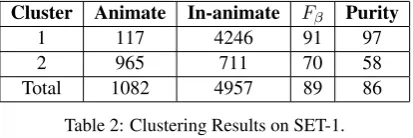
purity to evaluate the accuracy of our clustering results, which are two widely used external clus-tering evaluation metrics (Manning et al., 2008). In order to evaluate the results, each nominal in SET-1 is assigned to the cluster j for which its cluster membership wkc (the degree of member-ship of a nominalk to cluster j) is highest; i.e., argmaxc∈C{wkc}. As shown in Table 2, the clus-tering solution by FCM has achievedFβ and pu-rity scores of 89 and 86. Further, cluster 1 roughly corresponds to the Hindi wordnet inanimate class of nominals (86 recall) and cluster 2 corresponds to the Hindi wordnet animate class (89 recall). In (Øvrelid, 2009) and (Bowman and Chopra, 2012) animate nouns are reported as a difficult class to learn. The problem is attributed to the skewness in the training data. Animate nouns occur less frequently than inanimate nouns. In our cluster-ing experiments, however, animates have shown higher predictability than inanimates. We have achieved a high recall on both animate as well as inanimate nominals. Further, we infer animacy of all types of nominals while (Øvrelid, 2009) and (Bowman and Chopra, 2012) have restricted the learning only for common noun lemmas. Further-more, our method also identifies ambiguous nom-inals, as shown in Table 4. Although less feasible, we also present the results produced by Øvrelid (2009) (>10) in Table 1 for a rough comparison.
Cluster Animate In-animate Fβ Purity
1 117 4246 91 97
2 965 711 70 58
Total 1082 4957 89 86
Table 2: Clustering Results on SET-1.
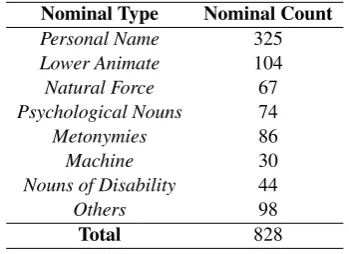
As presented in Table 3, there are 828 instances
5βis a coefficient of the relative strengths of precision and
of wrong clustering. However, upon close inspec-tion the clustering of these instances seems theo-retically grounded, thus adding more weight to our results. We discuss these instances below:
1. Personal Names: As discussed in Section 3.1, personal names are ambiguous and can be used as common nouns with generic ref-erence. Hindi Wordnet doesn’t enlist per-sonal names (except for very popular names), though their common usages are listed. For example the noun baadal ‘cloud’ is present in wordnet while its use as personal name is not listed. In the corpora used for the extraction of distributions, around 325 such nouns are actually used as personal names. Although, these nouns are correctly clustered as animates, they are evaluated as instances of wrong clustering, because of the inani-mate sense they have in the Hindi Wordnet. This addresses the problem oflow precision
andlow purityfor animate nominals in our experiments. Similarly, the names used for gods, goddesses and spirits are also treated as inanimates in Hindi Wordnet. However, corpus distributions project them as animates due to their high ability to instigate an action. An example case that was wrongly clustered israb‘God’.
2. Lower Animates: Although wordnet lists these nominals as animates which in fact they are, they are linguistically seen as inanimates and thus are clustered as such. In our experi-ments,titlii‘butterfly’ is clustered with inan-imates.
3. Natural Forces:These nominals have a high control over an action and their distributions are more like higher animates. bhuchaal
‘earthquake’ is an instance of this over gen-eralization.
4. Psychological Nouns: Nouns like
pare-shaanii‘stress’ are conceptualized as a force
affecting us psychologically. These nominals are thus distributed like nominals of high control, which leads to an over generalization of these nouns as animates.
5. Metonymies:Nouns like country names, as discussed in Section 3.1, apart from refer-ring to geographical places can also refer to
their inhabitants, teams, governments. Word-net only treats these terms as inanimates (place). Australia, though treated as inmate in Hindi Wordnet, is clustered with ani-mates in our experiments.
6. Machines:A few cases of machines are also seen to be over generalized as animates. Ma-chines show an animate like control (directly or indirectly) over an action.
7. Nouns of Disability: As these expressions refer to animates with some disability, they lack any control over an action and are distributed like inanimates. An example of this over generalization is noun ghaayal
‘wounded’.
8. Others:These are actual instances of wrong clustering and as we noticed, these instances could probably be addressed by choosing an optimal frequency threshold to capture the unmarked (prototypical) behavior of a nomi-nal. We have not addressed the tuning of this parameter in this work. However, we plan to take it up in future.
Nominal Type Nominal Count
Personal Name 325
Lower Animate 104
Natural Force 67
Psychological Nouns 74
Metonymies 86
Machine 30
Nouns of Disability 44
Others 98
Total 828
Table 3: Error Classification on SET-1
been used only in animate or inanimate sense in the corpora used in our experiments. Table 4 also shows that 187 nominals have a uniform distribu-tion over the factors that discriminate animacy. Among these 150 nouns are listed as inanimate in Hindi Wordnet. Upon close inspection, these cases were found to be metonymies. As discussed earlier, Hindi Wordnet treats metonymies as inanimate, but in fact they are ambiguous. Thus our clustering of these nominals is justified.
Cluster Animate In-animate Ambiguous
1 107 4149 535
2 955 658 439
wkc=∼0.5 20 150 17
Total 1082 4957 991
Table 4: Clustering Results on SET-2
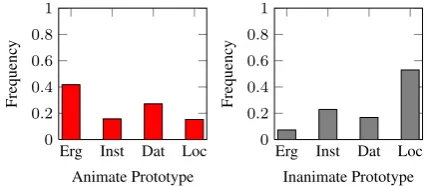
In Section 3, we stated that the distributions of nominals will be skewed on the control hierarchy. The results have clearly indicated that such skew-ness does in fact exist in the data, as shown in Figure 2. The cluster prototypes, returned by the fuzzy clustering, show animates are left skewed while inanimates are right skewed on the hierar-chy of control. However, in our clustering ex-periments the order of dative/accusative and in-strumental case markers on the control hierarchy (Scale 1) has been swapped. The dative/accusative case is more biased towards animates while instru-mental case shows the reverse tendency. The rea-son for this is the ambiguity in these case mark-ers. The instrumental casese mark roles such as cause, instrument, source and material. Among which cause and instrument imply high control while source and material imply a low control over an action. Almost 82% of instances of instrumen-tal case depict a non-causal role while only 18% show a causal relation as annotated in the Hindi dependency treebank (Bhatt et al., 2009). Simi-larly, the dative/accusative casekois used for ex-periencer subject, direct and indirect objects (Mo-hanan, 1990, p. 72). Among these, only direct ob-jects realized by definite inanimates arekomarked (Differential Object Marking), thus making it a more probable case marker for animates.
Before concluding the paper, we will discuss some of the issues related to the portability of our approach to other languages with rich morpholog-ical case. We will briefly discuss these issues be-low:
Erg Inst Dat Loc
0
Erg Inst Dat Loc
0
Figure 2: Skewed Marked Distribution of Cluster Prototypes.
• Case Ambiguity or Case Syncretism: For an ideal performance, we expect a separate case marker for each individual case listed on Scale 1. Unfortunately, case markers are usually ambiguous. A case marker can have more than one case function in a language. In our work on Hindi, we saw that case am-biguity does have an impact on the results. We could afford to exclude highly ambiguous genitive case marker from our experiments (Mohanan, 1990). However, how case am-biguity will impact the animacy prediction in other languages remains to be seen.
• Nominal Ambiguity:As a matter of fact, an-imacy is an inherent and a non-varying prop-erty of nominal referents. However, due to lexical ambiguity (particularly metonymy), animacy of a word form may vary across con-texts. We have addressed this problem by capturing the mixed membership of such am-biguous nominals. However, since animacy of a nominal is judged on the basis of its dis-tribution, the animacy of an ambiguous nom-inal will be biased towards the sense with which it occurrs in a corpora.
6 Conclusion
In this work we report a technique to exploit the systematic correspondences between different lin-guistic phenomena to infer the important semantic category of animacy. The case marked distribu-tions of nominals are clustered with fuzzycmeans
clustering into two clusters that approximate the binary dimensions of animacy. We achieved sat-isfactory results on the binary distinction of nom-inals on animacy. A Fβ score of 89 and purity of 86 confirm efficiency of our approach. How-ever, the performance of our system can be further improved by incorporating features from a depen-dency parser and an anaphora resolution system, as discussed in (Øvrelid, 2009).
In view of the Indo-Wordnet project (Bhat-tacharyya, 2010) that aims to build wordnet for major Indian languages, our approach can be used to predict animacy of nouns to leverage the cost and time associated with manual creation of such resources. Given the availability of large data on web for many Indian languages, our method can predict this information with satisfactory results. In the future, we also plan to explore the interac-tion between control and verb semantics, so as to classify verbs based on the amount of control re-quired. This information can also be incorporated into the process of building Indo-wordnets.
Acknowledgments
We would like to thank the anonymous review-ers for their useful comments which helped to im-prove this paper. We furthermore thank Sambhav Jain for his help and useful feedback.
References
Judith Aissen. 2003. Differential object marking: Iconicity vs. economy. Natural Language & Lin-guistic Theory, pages 435–483.
Kirk Baker and Chris Brew. 2010. Multilingual an-imacy classification by sparse logistic regression.
Information Concerning OSDL OHIO STATE DIS-SERTATIONS IN LINGUISTICS, page 52.
James C Bezdek, Robert Ehrlich, and William Full. 1984. FCM: The fuzzy c-means clustering algo-rithm. Computers & Geosciences, pages 191–203.
Akshar Bharati, Samar Husain, Bharat Ambati, Samb-hav Jain, Dipti Sharma, and Rajeev Sangal. 2008. Two semantic features make all the difference in parsing accuracy.Proceedings of International Con-ference on Natural Language Processing (ICON08).
Rajesh Bhatt, Bhuvana Narasimhan, Martha Palmer, Owen Rambow, Dipti Misra Sharma, and Fei Xia. 2009. A multi-representational and multi-layered treebank for hindi/urdu. InProceedings of the Third Linguistic Annotation Workshop, pages 186–189. Association for Computational Linguistics.
Pushpak Bhattacharyya. 2010. IndoWordNet.
Samuel R Bowman and Harshit Chopra. 2012. Au-tomatic animacy classification. In Proceedings of the 2012 Conference of the North American Chap-ter of the Association for Computational Linguistics: Human Language Technologies: Student Research Workshop, pages 7–10. Association for Computa-tional Linguistics.
Holly P Branigan, Martin J Pickering, and Mikihiro Tanaka. 2008. Contributions of animacy to gram-matical function assignment and word order during production. Lingua, 118(2):172–189.
Joan Bresnan, Anna Cueni, Tatiana Nikitina, R Harald Baayen, et al. 2007. Predicting the dative alterna-tion. Cognitive foundations of interpretation, pages 69–94.
Miriam Butt and Tafseer Ahmed. 2011. The redevel-opment of Indo-Aryan case systems from a lexical semantic perspective. Morphology, pages 545–572.
Miriam Butt. 2006. The dative-ergative connection.
Empirical issues in syntax and semantics, pages 69– 92.
Chih-Chung Chang and Chih-Jen Lin. 2011. Lib-svm: a library for support vector machines. ACM Transactions on Intelligent Systems and Technology (TIST), page 27.
Bernard Comrie. 1989. Language universals and lin-guistic typology: Syntax and morphology. Univer-sity of Chicago press.
William Croft. 2002. Typology and universals. Cam-bridge University Press.
Peter De Swart, Monique Lamers, and Sander Lestrade. 2008. Animacy, argument structure, and argument encoding. Lingua, 118(2):131–140.
Felice Dell’Orletta, Alessandro Lenci, Simonetta Mon-temagni, and Vito Pirrelli. 2005. Climbing the path to grammar: A maximum entropy model of sub-ject/object learning. In Proceedings of the Work-shop on Psychocomputational Models of Human Language Acquisition, pages 72–81. Association for Computational Linguistics.
Richard Evans and Constantin Orasan. 2000. Im-proving anaphora resolution by identifying ani-mate entities in texts. In Proceedings of the Dis-course Anaphora and Reference Resolution Confer-ence (DAARC2000), pages 154–162.
Paul J Hopper and Sandra A Thompson. 1980. Tran-sitivity in grammar and discourse. Language, pages 251–299.
Seppo Kittil¨a, Katja V¨asti, and Jussi Ylikoski. 2011.
Case, Animacy and Semantic Roles. John Ben-jamins Publishing.
Christopher D Manning, Prabhakar Raghavan, and Hinrich Sch¨utze. 2008. Introduction to information retrieval. Cambridge University Press Cambridge.
Colin P Masica. 1993. The Indo-Aryan Languages. Cambridge University Press.
Paola Merlo and Suzanne Stevenson. 2001. Automatic verb classification based on statistical distributions of argument structure. Computational Linguistics, pages 373–408.
Tara Mohanan. 1990. Arguments in Hindi. Ph.D. the-sis, Stanford University.
Dipak Narayan, Debasri Chakrabarty, Prabhakar Pande, and Pushpak Bhattacharyya. 2002. An ex-perience in building the indo wordnet-a wordnet for hindi. In First International Conference on Global WordNet, Mysore, India.
Constantin Orasan and Richard Evans. 2007. Np ani-macy identification for anaphora resolution. J. Artif. Intell. Res.(JAIR), 29:79–103.
Constantin Orsan and Richard Evans. 2001. Learning to identify animate references. In Proceedings of the 2001 workshop on Computational Natural Lan-guage Learning-Volume 7, page 16. Association for Computational Linguistics.
Lilja Øvrelid and Joakim Nivre. 2007. When word order and part-of-speech tags are not enough – Swedish dependency parsing with rich linguistic features. In Proceedings of the International Con-ference on Recent Advances in Natural Language Processing (RANLP), pages 447–451.
Lilja Øvrelid. 2006. Towards robust animacy clas-sification using morphosyntactic distributional fea-tures. InProceedings of the 2006 Conference of the European Chapter of the Association for Computa-tional Linguistics (EACL): Student Research Work-shop, pages 47–54.
Lilja Øvrelid. 2009. Empirical evaluations of animacy annotation. InProceedings of the 12th Conference of the European Chapter of the Association for Com-putational Linguistics (EACL).