Free-text input vs menu selection: exploring the difference with a
tutorial dialogue system.
Jenny McDonald1, Alistair Knott2and Richard Zeng1 1Higher Education Development Centre, University of Otago
2Department of Computer Science, University of Otago [email protected]
Abstract
We describe the in-class evaluation of two versions of a tutorial dialogue sys-tem with 338 volunteers from a first-year undergraduate health-sciences class. One version uses supervised machine-learning techniques to classify student free-text re-sponses; the other requires students to se-lect their preferred response from a series of options (menu-based). Our results indi-cate that both the free-text and menu-based tutors produced significant gains on imme-diate post-test scores compared to a control group. In addition, there was no significant difference in performance between students in the free-text and menu-based conditions. We note specific analysis work still to do as part of this research and speculate briefly on the potential for using tutorial dialogue systems in real class settings.
1 Introduction
In large undergraduate classes (1500-1800 stu-dents), it is time-consuming, costly and seldom practical to provide students with feedback on their conceptions other than by computer-based marking of formative assessments. Typical exam-ples of this include Learning Management System (LMS) based multiple-choice quizzes or similar. Most computer-assisted assessment involves stu-dents being able to recognise a correct response rather than recall and independently generate an answer. In the context of the first-year undergrad-uate health sciences course that we studied, cur-rently all computer-assisted assessment takes this form. In 2008, the coordinator of a first year un-dergraduate health sciences class asked us about ways in which technologies might assist students
to practice writing short-answer questions. As a result of this request, we wanted to investigate whether students answering questions with free-text or multiple-choice(menu-based) selections in a tutorial dialogue setting would result in perfor-mance gains on student test scores and whether there would be any difference in performance be-tween students who generated free-text answers and those who selected their preferred answer from a number of options. In the next section we begin with a brief literature review from the fields of both Education and Cognitive Science. Next, we briefly describe the design and features of our tutorial dialogue system. The experimen-tal design, and results are described in subsequent sections and we conclude with a discussion of our key findings.
2 Background
This study is situated at the boundaries between at least three established fields of inquiry: ed-ucational assessment research; psychological re-search, in particular the study of memory, recog-nition and recall; and finally intelligent tutoring systems (ITS) and natural language processing (NLP) research.
Since the 1920s the positive benefits on stu-dent performance of answering practice, or for-mative assessment, questions have been demon-strated in classroom studies (Frederiksen, 1984). Similar positive effects have been demonstrated in psychology laboratory studies since the 1970s. (McDaniel et al., 2007) Large meta-analytic ed-ucational studies looking at the impact of prac-tice tests on student outcomes indicate that on av-erage, the provision of practice assessments dur-ing a course of study does confer a clear
tage, although the effect of increasing practice-test frequency is less clear. (Crooks, 1988). More recently, the role for computer-based assessment has been reviewed and Gipps (2005) writing in Studies in Higher Education has noted that,
the provision of feedback to the learner, both motivational (evaluative) and sub-stantive (descriptive), is crucially im-portant to support learning. The devel-opments in automated diagnostic feed-back in short answer and multiple-choice tests are therefore potentially very valuable. If feedback from assess-ment could be automated, while main-taining quality in assessment, it could certainly be a powerful learning tool.
She goes on to say that use of computer-marking for anything other than MCQ-style ques-tions, while showing some promise, is seldom used in practice in higher education institutions.
Recent research from the Cognitive Science and ITS domain, for example Chi (2009) and Van-Lehn (2011), suggests that tutor behaviour, hu-man or machine, which encourages or promotes constructive or interactive behaviour by the stu-dent is likely to yield greater learning gains than passive or active behaviour. It also suggests that opportunities for extended interactive dialogue between teacher and student in a given domain are likely to produce the largest gains.
On the basis of this considerable body of re-search we felt that an opportunity to practice an-swering questions with formative feedback, in this case in a tutorial dialogue setting, should pro-duce learning gains over and above those expected from working with existing study resources and formative tests. We were also interested to test whether there is a difference in performance be-tween students who generate free-text responses and those who select an answer from a series of options in the course of a tutorial dialogue. There is some literature which specifically explores this, however the number of studies is limited and the results are inconclusive. Gay (1980) found that in retention tests students who practiced answer-ing short-answer (SA) or free-text questions per-formed as well as or better than students who practiced MCQs but this effect was also depen-dent on the mode of retention testing. Specif-ically, retention test results where the test was
conducted using SA were better for both MCQ-practice and SA-MCQ-practice, whereas there was no difference between the two practice groups where the retention test mode was MCQ. In 1984, re-viewing the education and psychology literature at the time, Frederiksen (1984) concluded that,
testing increases retention of the ma-terial tested and that the effects are quite specific to what was tested. There is some evidence that short-answer or completion tests may be more con-ducive to long-term retention.
In a related area in his comprehensive review of classroom evaluation practice, Crooks (1988) suggested,
there is no strong evidence...to support widespread adoption of any one [ques-tion] item format or style of task. In-stead, the basis for selecting item for-mats should be their suitability for test-ing the skills and content that are to be evaluated.
Support for this view is found in a met-analysis of 67 empirical studies which inves-tigated the contruct equivalence of MCQ and constructed-response (SA) questions (Rodriguez, 2003). Where the content or stem of the MCQ and short-answer questions were the same Rodriguez found a very high correlation between the differ-ent formats. In other words, where the questions relate to the same content they will measure the same trait in the student. However, even if the same traits are measured by performance on ques-tions in different formats, this says nothing about whether using practice questions in different for-mats results in differential learning gains for the students on subsequent retention tests.
consistent with the much earlier educational re-view conducted by Frederiksen (1984).
In real-class settings, there is considerable time and effort involved in developing and implement-ing tutors which can provide immediate feedback on student short-answer responses and in partic-ular, natural language dialogue systems (for ex-ample, Murray (1999)). This means that it is cru-cially important to understand what the potential benefits of these systems could be for both stu-dents and teachers.
The tutor we describe in the next section is sub-stantially different from the Geometry and Alge-bra Tutors. Unlike these systems, it is not a formal step-based tutor; that is, it is not asking students to explain specific steps in a problem-solving pro-cess and providing feedback at each step. Our Di-alogue Tutor simply engages students in a conver-sation, much like an online chat-session, where the Tutor poses questions which are directly re-lated to students’ current area of study about the human cardiovascular system and the student ei-ther types in their response or selects a response from a series of options. Nevertheless, in common with other ITS, our tutor does provide immediate formative feedback to the student and offers a se-ries of options for proceeding depending on the student response.
3 Natural Language Tutor Design 3.1 Tutorial dialogue design
The structure of the tutorial dialogue is deter-mined entirely by the dialogue script. We wanted to use a finite-state model for the dialogue since this permits an organic authoring process and im-poses no theoretical limit to how deep or broad the dialogue becomes. The script structure is based on Core and Allen’s (1997) dialogue coding scheme and has been described previously (Mc-Donald et al., 2011).
The current study utilises a single-initiative di-rected dialogue; however the opportunity for lim-ited mixed-initiative is incorporated into the sys-tem design through classifying question contribu-tions at any stage of the dialogue and searching for possible answers within the dialogue script.
Design of the tutorial dialogue began with the development of an initial script covering the cur-riculum on cardiovascular homeostasis. This was developed in close consultation with course
teach-ing staff and was written by a medical graduate using lecture notes, laboratory manuals and self-directed learning material from the course itself. The initial script was refined through a series of pilot interactions with student and staff volunteers and released to the first year undergraduate class on a voluntary basis at the beginning of their mod-ule on the human cardiovascular system. The default position in this early script was to pro-vide the correct answer and move on unless con-fidence was high that an appropriate match had been made, using minimum-edit distance between student response and model answers. A handful of dialogues were interrupted because of system-related problems but the majority that terminated before completion did so because the students simply ended their session. Feedback from course tutors and comments from the students supported our intuition that poor system ‘understanding’ of student dialogue contributions was a key reason for the fall-off in use. Nevertheless, student per-ceptions of this early tutorial were broadly posi-tive and it served its purpose in capturing a rea-sonable quantity of student responses (between 127-242 responses to 50 tutorial questions) for the next stage of tutorial dialogue development.
de-fault node in the script (Dede-fault).
DC-Classifier
Question
Dont-know
Dont-understand
C D
A B
DK
DU
Default Q
E > e
E > e
E > e
E > e
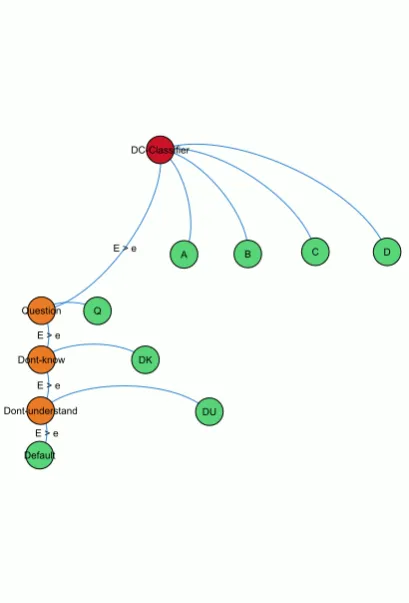
Figure 1: Classifier flow diagram.
For each dialogue context a training set was created from the corpus. Typically the first 100 student responses for each tutor question were classified by a human marker. This training set was divided into 5 folds and a Maximum Entropy classifier trained on 4/5 folds using simplebag of wordsas the featureset and then tested on the re-maining fold. A 5-way cross-validation was car-ried out and accuracies for each of the 5 test sets calculated. The average accuracy across the 5 test sets and standard deviation was also recorded. This process was repeated using different combi-nations of featuresets (for example, bag of words, word length, first word, with/without stemming, with/without stopwords etc) until the highest ac-curacy and least variability in test set results was achieved. (The mean accuracy on test data across all 62 classifiers built for each dialogue context in the complete dialogue was 0.93. The minimum was 0.73, maximum was 1.00 and the first quartile was 0.89)
Tutor questions with multi-part answers, for example, ‘Can you think of three main factors
which affect cardiac contractility?’, lent them-selves to chaining together a series of binary clas-sifiers, using the NLTK MultiBinary Classifier wrapper, rather than including all possible classes of response within a single classifier. This is the best approach given the relatively small amount of training data compared to the large number of possible classes of response. For example, in the question given above, three possible factors to list gives a total of eight possible classes of an-swer. For some combinations there are only very small, but nevertheless important training sets, and this leads to poor classfier performance over-all. Training three binary classifiers which iden-tify each of the factors sought as either present or not and then writing a function which returns a list of the factors found by all three binary clas-sifiers for a given input effectively increases the amount of training data per factor. While this ap-proach yielded some improvement, theclass im-balance problem(Refer to, for example, Japkow-icz(2000)) was still evident for some combina-tions.
The classifier is evaluated with previously un-seen data and scored relative to a human marker. The entropy of the probability distribution (E) is calculated for each unseen response and this is used to determine appropriate thresholds for clas-sification. For example, if E is close to zero the classifier confidence is generally very high. E>
1 indicates low confidence and less difference be-tween the class rankings. An appropriate entropy threshold (e) for each classifier is determined by the script designer. This is really a subjective judgement and is made based on the classifier performance as well as the dialogue script con-text and the likely impact of a false negative or false positive classification. (The mean accuracy on unseen test data across all 62 classifiers with manually set entropy thresholds was 0.95. The minimum was 0.70, maximum was 1.00 and the first quartile was 0.93) There is the potential to automate this process however this will require a method to assess the cost of false positive and false negative classification for each dialogue con-text.
3.2 Dialogue system architecture
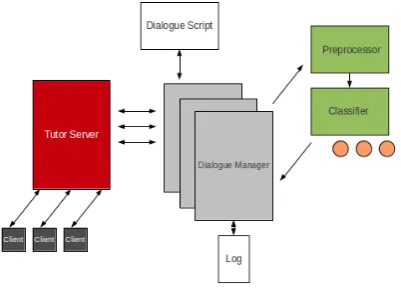
The dialogue system is written in Python and utilises several NLTK libraries, Peter Norvig’s ‘toy’ spell checker, and the Asyncore and Asyn-chat libraries to manage multiple simultaneous client connections. The server can readily com-municate with any web-application front end us-ing XML-formatted messages and we have built a java-based web application through which multi-ple clients can connect to the tutorial server. Fig-ure 2. provides an overview of our system archi-tecture.
Figure 2: Architecture of Dialogue System.
Each client connection to the system creates an instance of the dialogue manager which sends tutor contributions to the client according to the preloaded script and receives student contribu-tions which are then classified and determine the next tutor contribution. The dialogue manager de-sign has been described previously (McDonald et al., 2011).
3.3 Free-text and menu based versions A small addition to the dialogue script and the ad-dition of a switch to the dialogue manager code allowed us to create two systems for the price of one. The free-text entry system uses the classifiers to categorise student responses and the menu-based system simply presents students with pos-sible options added to the script from which they can select. The addition of<menu>tags to each dialogue context in the script is shown in the fol-lowing example:
<contribution-node id="check-hr" parent-node="start"
default="true">
<backward class="yes"> <acknowledge/>
</backward>
<forward>
<assert>We’re going to talk about what blood pressure is....
</assert>
<info-request value="How would you check what someone's HR is?" define="You could take their pulse."/>
<menu>
<item value="correct">Count the pulse.</item>
<item value="simpler">With a blood pressure cuff and stethoscope.</item>
<item value="simpler">Use an ECG.</item>
<item value="incomplete">Pulse. </item>
<item value="dont-know">I don’t know.</item>
</menu>
</forward>
</contribution-node>
case, the student is prompted to think of a simpler method.
4 Experimental Design
Students from the 1st year Health Sciences course (N=1500) were asked to volunteer for the exper-iment. The first year Health Sciences course is a prerequisite for all professional health science programmes, such as Medicine, Dentistry, Phar-macy, . . . . Entry into these programmes is highly competitive and is dependent, amongst other things, on students achieving excellent grades in their 1st year courses. The only incentive of-fered to students was that taking part in the study would give them an opportunity to practice and develop their understanding of the cardiovascu-lar section of the course by answering a series of questions related to the lectures they had re-ceived during the preceeding two weeks. Students were told that different styles of questions, short-answer and MCQ, might be used in different com-binations and that not all students would receive the same style of questions. They were also told to allow 20-40 minutes to complete the questions. They could answer the questions by logging in to an online system at anytime during a three-week period which ran concurrently with their normal laboratory and self-paced study sessions on the cardiovascular system.
All student responses in the experiment were anonymised and appropriate ethics approval was obtained.
Students who logged into the system were ran-domly assigned to one of three conditions: A free-text condition where they completed a pre-test, then the free-text version of the tutorial dia-logue, and concluded with an immediate post-test; a menu-based condition where they completed a pre-test, then the multi-choice version of the tuto-rial dialogue, followed by an immediate post-test, and a control condition where they simply com-pleted pre- and post-tests.
The pre- and post-tests in each case consisted of equal numbers of MCQ and short-answers (3+3 for the test and 7+7 for the post-test). The pre-test directly reflected material taught in the lec-tures students had just received and the post-test reflected material explicitly covered in the tutorial dialogues.
All student interactions with the system in each experimental condition were recorded and logged
to a database. At the end of the experimental pe-riod only completed sessions (i.e. pre-test, post-test and tutorial condition completed) were in-cluded for analysis. The principal investigator marked all pre- and post-test short-answer ques-tions and MCQs were scored automatically. One member of the teaching staff for the course also marked a sample of short-answer questions to check for inter-rater reliability.
Given the findings from the literature reported in Section 2, the hypotheses we wanted to test were: A. Any intervention results in better post-test performance than none; B. Free-text input re-sults in better post-test performance overall than MCQ, because there is something special about students recalling and constructing their own re-sponse; C. Free-text tutorials lead to increased performance on short-answer questions; and D. MCQ tutorials lead to increased performance on MCQ questions.
Delayed post-tests are still to be completed and will involve correlation with short-answer and MCQ student results on the cardiovascular section of the final examination.
We describe our early results and analysis of the immediate post-test data in the next section.
5 Results
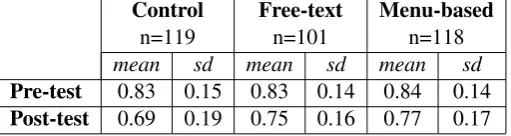
720 students logged into the experimental system during the 3 week period in which it was avail-able. Of these, 578 students completed the session through to the end of the post-test and these were relatively evenly distributed across the three con-ditions suggesting that there are no sampling bias effects across conditions. We report here the re-sults from the first 338 of the 578 completed tuto-rials/tests. Short-answer sections of both pre- and post-tests were checked for inter-rater reliability. A Cohen’s kappa of 0.93 (p=0) confirmed very high agreement between 2 markers on pre- and post-test questions for a sample of 30 students.
Control Free-text Menu-based
n=119 n=101 n=118
mean sd mean sd mean sd
Pre-test 0.83 0.15 0.83 0.14 0.84 0.14 Post-test 0.69 0.19 0.75 0.16 0.77 0.17
Table 1: Descriptive Statistics
The dependent variable to test our first hypoth-esis was taken as the difference between pre- and post-test performance for each student with the pre-test result serving as a common baseline in each case. The differences between pre- and post-test scores were normally distributed which al-lowed us to use parametric tests to see if there were differences between the means in each con-dition. A between subjects Anova gave an F value of 4.95 and a post-hoc Tukey multiple comparison of means at 95% confidence level showed a signif-icant difference when compared with the control for both the free-text tutorial condition (p=0.03) and the menu-based tutorial condition (p=0.01) .
However, there was no support for our sec-ond hypothesis that free-text input results in bet-ter post-test performance overall than menu-based input; comparison between the mean scores for free-text condition and menu-based condition was not significant (p=0.94). Given this result it was also clear that there was no demonstrated bene-fit for text tutorials improving scores on free-text questions in the post-test nor multiple-choice questions improving post-test performance on the MCQs.
We discuss the implications of these early re-sults in the final section and also outline our plan for further detailed analysis of the data obtained.
6 Discussion
Several features stand out from the results. The most striking initial feature is the much higher tutorial completion rate ( 80%) for this system compared with the original tutorial system ( 23%) which was fielded in order to collect student re-sponses ((McDonald et al., 2011)) as discussed in Section 3. Formal evaluation of the free-text version classifier performance is currently under-way and will be reported separately but the over-all higher completion rate and only slightly lower numbers completing the dialogue tutorial ( 29% of the 578 completions) compared with the
multi-choice tutorial ( 34% of the 578 completions) is suggestive of a considerable improvement.
On average, students performed better in the pre-test than they did in the post-test. This was ex-pected: the pre-test was designed to measure the degree to which students had comprehended key points from the lectures they had just attended, while the post-test was designed to be more chal-lenging. It is worth noting that in real in-class settings it is not uncommon for students to form well in initial tests and subsequently per-form less well as they work to make sense and meaning of the subject under study (see for ex-ample, Cree and Macaulay (2000)). However in this specific context, given that the pre-test was designed to measure the degree to which students had comprehended key points from the lectures they had just attended it is not too surprising that they did uniformly well in the pre-test. The post-test was designed to be more challenging and re-quired an ability to demonstrate understanding as well as the ability to manipulate key cardiovas-cular variables and understand whether and how these relate to each other. These skills and abili-ties are developed through experience in the lab-oratory teaching sessions and with self-directed study materials; they are also directly covered in each of the tutorial conditions. Certainly the re-sults confirmed that students in each condition started at a similar level and support our hypothe-sis that post-test performance is significantly im-proved through exposure to either tutorial condi-tion when compared to the control condicondi-tion.
many others make the point that in general an ef-fect size larger than 0.40 is suggestive of an inter-vention worth pursuing but that this also depends on local context. In the context of this study, for the ‘price’ of a single relatively brief intervention, an average effect size increase of between 6 to 8 percentage points on the immediate post-test sug-gests that engagement with either tutorial, partic-ularly in a high stakes course, where every per-centage point counts, does produce a gain worth having. With such a brief one-off intervention it would be surprising indeed to have found much larger effect sizes.
Examination of the variability of pre- and post-test results in each of the three conditions shows a highly consistent distribution of marks in all three conditions on the pre-test but a wider variation in results in the post-test control group (sd=0.19) than in either of the tutorial groups (sd=0.16 in menu-based condition and sd=0.17 in free-text condition). Again, given that the post-test was specifically testing material taught in the tutorial this is perhaps not suprising. You would hope that in any teaching situation student marks would start to converge in a positive direction! Never-theless, once the complete set of student results is marked we will investigate this further. Of partic-ular interest is to see whether poorer performing students benefit more from the tutorial than oth-ers.
Finally, the lack of difference between the two tutorial conditions, free-text and menu-based, was consistent with indications from existing litera-ture. However, we found no advantage for free-text entry over menu-based choice overall, nor in-deed did either condition confer any advantage in performance when post-testing was in the same mode. However, given previous research results we are keen to explore this further. In particu-lar we want to examine specific questions from the post-test and see whether there is a difference between conditions on questions which required simple recall and those which required further analysis or description by the student. We also intend to look at several other factors: whether the average length of written responses to the tu-torial in the free-text condition has any bearing on performance in either condition, time on task relative to performance and the stage at which the student logged in to the experimental system. (For example, did the group which took the
tuto-rial later, once they had more laboratory work and self-study time under their belts, perform better in either condition than those who took the tutorial earlier?)
Additional work still to do includes correlat-ing these experimental results with student perfor-mance on relevant questions in the final course ex-amination (short-answer and MCQ); this will ef-fectively provide delayed post-test data. Also, we will be gathering student feedback on their expe-rience and perceptions of the tutorial systems via a course evaluation questionnaire.
Developing a deeper understanding of the po-tential role of natural language tutorial dialogue systems in improving student performance has been the focus of this paper. Nevertheless a strik-ing side-effect from undertakstrik-ing this research has been realising the role dialogue systems like this may be able to play in providing feedback to teachers on the conceptions held by students in large classes about the material they are being taught. The range and depth of large numbers of student free-text responses provide important clues about student conceptions. The ability to describe these conceptions is invaluable for teach-ing (Marton and Saljo, 1976). The facility to do this in an automated or semi-automated way for large classes, presumably, is even more so. Teaching staff who have had some involvement in the project have commented on the usefulness of being able to see student responses to questions grouped into categories: this grouping provides a powerful way for teachers to gauge the range of responses which they receive to their questions.
References
Vincent Aleven, Amy Ogan, Octav Popescu, Cristen Torrey, and Kenneth Koedinger. 2004. Evaluating the effectiveness of a tutorial dialogue system for self-explanation. InIn, pages 443–454. Springer. Steven Bird. 2006. NLTK: the natural language
toolkit. InProceedings of the COLING/ACL on In-teractive presentation sessions, COLING-ACL ’06, pages 69–72, Stroudsburg, PA, USA. Association for Computational Linguistics.
Michelene T. H. Chi. 2009. Active-constructive-interactive: A conceptual framework for differen-tiating learning activities. Topics in Cognitive Sci-ence, 1(1):73–105.
descrip-tions in analyzing algebra example soludescrip-tions. In
Proceedings of the 7th international conference on Learning sciences, ICLS ’06, pages 99–105. Inter-national Society of the Learning Sciences.
Mark G. Core and James F. Allen. 1997. Coding di-alogs with the damsl annotation scheme. In Work-ing Notes of the AAAI Fall Symposium on Com-municative Action in Humans and Machines, pages 28–35, Cambridge, MA, November.
Viviene Cree and Cathlin Macaulay. 2000. Transfer of Learning in Professional and Vocational Education. Routledge, London: Psychology Press.
Terence J. Crooks. 1988. The impact of classroom evaluation practices on students. Review of Educa-tional Research, 58(4):pp. 438–481.
Norman Frederiksen. 1984. The real test bias: Influ-ences of testing on teaching and learning. American Psychologist, 39(3):193–202.
Lorraine R. Gay. 1980. The comparative effects of multiple-choice versus short-answer tests on re-tention. Journal of Educational Measurement, 17(1):45–50.
Caroline V. Gipps *. 2005. What is the role for ict-based assessment in universities? Studies in Higher Education, 30(2):171–180.
J. Hattie. 2008. Visible Learning: A synthesis of over 800 meta-analyses relating to achievement. Taylor & Francis.
N. Japkowicz. 2000. The class imbalance problem: Significance and strategies. In Proceedings of the 2000 International Conference on Artificial Intelli-gence (ICAI2000), volume 1, pages 111–117. F. Marton and R. Saljo. 1976. On qualitative
differ-ences in learning: Ioutcome and process*. British Journal of Educational Psychology, 46(1):4–11. Mark A. McDaniel, Janis L. Anderson, Mary H.
Der-bish, and Nova Morrisette. 2007. Testing the test-ing effect in the classroom. European Journal of Cognitive Psychology, 19(4-5):494–513.
J. McDonald, A. Knott, R. Zeng, and A. Cohen. 2011. Learning from student responses: A domain-independent natural language tutor. InProceedings of the Australasian Language Technology Associa-tion Workshop 2011, volume 148, page 156. Tom Murray. 1999. Authoring intelligent tutoring
systems: An analysis of state of the art. Interna-tional Journal of Artificial Intelligence in Educa-tion, 10:98–129.
Michael C. Rodriguez. 2003. Construct equivalence of multiple-choice and constructed-response items: A random effects synthesis of correlations. Journal of Educational Measurement, 40(2):163–184. Kurt VanLehn. 2011. The relative effectiveness of