Red-faced ROUGE:
Examining the Suitability of ROUGE for Opinion Summary Evaluation
Wenyi Tay1,2, Aditya Joshi2, Xiuzhen Zhang1, Sarvnaz Karimi2and Stephen Wan2 1RMIT University, Australia
2CSIRO Data61, Australia
{wenyi.tay, xiuzhen.zhang}@rmit.edu.au
{Aditya.Joshi, Sarvnaz.Karimi, Stephen.Wan}@data61.csiro.au
Abstract
One of the most common metrics to automat-ically evaluate opinion summaries is ROUGE, a metric developed for text summarisation. ROUGE counts the overlap of word or word units between candidate summaries and refer-ence summaries. This formulation treats all words in the reference summary equally. In opinion summaries, however, not all words in the reference are equally important. Opin-ion summarisatOpin-ion requires to correctly pair two types of semantic information: (1) opin-ion target, or aspect; and, (2) polarity of can-didate and reference summaries. We inves-tigate the suitability of ROUGE for evaluat-ing opinion summaries of online reviews. We design three experiments to evaluate the be-haviour of ROUGE for opinion summarisa-tion on the ability to capture aspect and po-larity. We show that ROUGE cannot distin-guish opinion summaries of the same or op-posite polarities for the same aspect. More-over, ROUGE scores have significant variance under different configuration settings. As a re-sult, we present three recommendations for fu-ture work on evaluating opinion summaries.
1 Introduction
Popular e-commerce websites allow users to ex-press their opinion about products or services in the form of reviews. An opinion is formally defined as a combination of aspect (an attribute of the product or service as the opinion target, expressed through aspect words), and sentiment polarity (either positive or negative, expressed through opinion words) (Liu, 2012). The opin-ion expressed in online reviews potentially helps prospective buyers to make decisions. Given the large volume of reviews, it is time-consuming and often impractical for a user of these websites to read all reviews pertaining to the set of products that they are considering to purchase. This makes opinion summarisation important because it al-lows users to obtain aggregate key opinions about
the product or service based on its reviews. Given the value of opinion summaries, automatic opinion summarisation is an active area of research with the focus of producing high-quality opinion sum-maries.
The quality of an opinion summary would ide-ally be evaluated by human annotators. For ex-ample, annotators may read a summary and rate it according to quality measures such as informa-tiveness, ability to capture sentiment polarity, co-herence and redundancy (Angelidis and Lapata,
2018). However, human evaluation is resource-intensive and not scalable. This motivates auto-matic evaluation. In the case of autoauto-matic evalua-tion, for a set of product reviews, reference sum-maries are written by human experts apriori. Ref-erence summariesare the ground truth summaries against which candidate summaries to be evalu-ated.
Using reference and candidate summaries, au-tomatic evaluation of opinion summaries adopts metrics from text summarisation (Lin,2004) and machine translation (Papineni et al.,2002;Lavie and Denkowski, 2009). We focus on the most frequently reported metric for opinion summari-sation, Recall-Oriented Understudy for Gisting Evaluation (ROUGE) (Lin, 2004) and leave the analysis of other evaluation metrics to future stud-ies. ROUGE counts the overlap of word or word units between the candidate summary and refer-ence summary with respect to the word units in the reference summary. A higher ROUGE score means a larger overlap of word units while a lower ROUGE score means a smaller overlap of word units. The ROUGE scores can then be used as a criterion to compare summaries and systems.
case of opinion summaries. For example, a lack of match to aspect terms in the reference summary may be due to the different ways people refer to the same aspect, or that it does not contain that as-pect and thus the opinion is not present. The lack of a match to sentiment-bearing terms can mean there is no opinion present in the summary, the opinion is consistent but expressed differently or the opinion is opposite to the reference summary. That ROUGE does not differentiate the reasons for the lack of a word match or the reasons for mis-match has implications to evaluate opinions sum-maries. To date, opinion summarisation has been considered a special case of text summarisation. Therefore, the popularity of ROUGE for opinion summarisation seems intuitive. However, the dis-tinction between opinion summarisation and text summarisation warrants a critical examination of the utility of ROUGE for opinion summarisation. Our research question is:
‘Can ROUGE scores be used to correctly compare summaries to ensure that the candidate summary is accurate to the opinion aspect and polarity in the reference summary?’
This paper makes two-fold contributions: (1) Through experiments, we demonstrate that ROUGE is not able to accurately evaluate the opinions in the candidate summary against the ref-erence summary1; and (2) Our discussion pro-vides three recommendations for further research on opinion summary evaluation.
2 Related Work
Early work in opinion summarisation conducted their evaluation using metrics other than ROUGE.
Pang and Lee (2004), an early work in extrtive opinion summarisation, use sentence-level ac-curacy. Lerman et al. (2009) pre-date the exis-tence of opinion summarisation datasets. There-fore, they use human evaluation for their systems.
Pitler et al. (2010) propose an automatic metric for summarisation. This metric captures linguis-tic quality using a set of features. They con-clude that syntactic features are the best indica-tors for linguistic quality of summaries. Follow-ing the availability of datasets with opinion maries, ROUGE could be used for opinion sum-marisation. However, its value has been
under-1Although the current analysis focuses on ROUGE for
evaluating opinion summaries, the limitations of using word matching for evaluation is also a problem faced by text sum-marisation and text generation.
stood to be limited for the evaluation of opinion summarisation. Jayanth et al.(2015) observe that ROUGE is influenced by topic terms more than sentiment terms. Therefore, they report two met-rics: ROUGE scores and sentiment correlation.
Mackie et al.(2014) show that, for microblog sum-marisation, ROUGE does not correlate with hu-man judgment as well as a more na¨ıve indicator: fraction of topic words. In addition, limitations of ROUGE to evaluate text summarisation have also been reported. Conroy and Schlesinger (2008) show that ROUGE may not correlate well with hu-man evaluation for text summarisation, and needs to be combined with human scores. More recently,
Graham (2015) present an extensive comparison of 192 variants of ROUGE, and show that the met-rics have contrasting conclusions. Table 1 sum-marises key studies and the choice of automatic evaluation metrics used for opinion summarisa-tion.
Despite the limitations, ROUGE is the most popular metric for opinion summarisa-tion (Moussa et al., 2018). It continues to be used as an automatic evaluation in recent papers either on its own (Anchiˆeta et al., 2017) or in combination with other automatic metrics such as METEOR (Amplayo and Lapata, 2019).
Angelidis and Lapata (2018) report ROUGE for multi-document opinion summarisation.
Alternatives to ROUGE have been proposed.
Kabadjov et al. (2009) use sentiment intensity to measure sentiment summarisation. Kunneman et al. (2018) use gold standard summaries avail-able in the forum as reference summaries, and re-port precision, recall and F1 scores. Poddar et al.
(2017) use a combination of lexical and senti-ment similarity to capture sentisenti-ment-aware simi-larity between sentences.
We note that past work states the limitations of ROUGE as a part of the discussion of the results of their proposed systems, while examining these limitations is the focus of our work.
3 ROUGE
ROUGE measures content coverage of candi-date summaries against reference summaries (Lin,
Dataset Task ROUGE Others
Ganesan et al.(2010) Opinosis Abstractive R-1,R-2,R-SU4 No
Jayanth et al.(2015) Movie Abstractive R-1,R-2 Senti Corr
Wang and Ling(2016) RottenTomatoes Abstractive R-SU4 BLEU, METEOR
Angelidis and Lapata(2018) Oposum Extractive R-1,R-2,R-L No
Kunneman et al.(2018) ProductReviews Abstractive No Precision, Recall and F1
Amplayo and Lapata(2019) RottenTomatoes Abstractive R-1 R-2,R-L,R-SU4 METEOR
Table 1: Summary of automatic evaluation metrics used to evaluate opinion summaries.
Reference:The rooms were neat and clean. Summary1:Clean room. Summary2:The rooms were dirty.
Configuration R-1 R-2 R-L R-SU4 R-1 R-2 R-L R-SU4
None 0.250 0.000 0.250 0.087 0.600 0.500 0.600 0.400
Stemming 0.500 0.000 0.250 0.174 0.600 0.500 0.600 0.400
StopWordRemoval 0.400 0.000 0.400 0.222 0.400 0.000 0.400 0.222
StopWordRemoval+Stemming 0.800 0.000 0.400 0.444 0.400 0.000 0.400 0.222
Table 2: F1score of ROUGE metrics under different configurations.
summaries respectively. The formula for ROUGE-N is shown in equation 1, where gramn is the choice of n-gram andSis the reference summary:
ROUGE-N= P
gramn∈SCountmatch(gramn)
P
gramn∈SCount(gramn) .
(1)
The following considerations are important when using ROUGE:
1. Multiple reference summaries: A candidate summary with highest score for each pair-wise evaluation of the candidate summary against each reference summary will be the ROUGE score for the summary. In this pa-per, we assume one reference summary.
2. Pre-processing configurations: Different pre-processing configurations can be taken into account. These typically include stem-ming and stop word removal. There are no recommended or commonly agreed pre-processing configurations. In this paper, we compare multiple combinations of these pre-processing configurations.
3. Other configurations: Although ROUGE
is a recall-based metric, there is an option to report precision and F1 scores with each
ROUGE metric. The precision score takes the overlapping word units with reference to the word units of the Candidate summary. The F1 score is the harmonic mean of the
recall and precision score. In our work,
we investigate the different configurations of ROUGE for opinion summary evaluation.
4. Comparing different systems: ROUGE
scores can be used to compare summarisa-tion systems by taking the mean or median of all the summaries generated by the system. Should the ROUGE score at summary level be incorrect, the error propagates to the sys-tem level. We focus on the ROUGE scores at the summary level.
To demonstrate how ROUGE is computed, we consider the following hypothetical examples:
Reference summary: The rooms were neat and
clean.
Candidate summary 1: Clean room.
Candidate summary 2: The rooms were dirty.
The opinion in Candidate summary 1 is consis-tent with the Reference summary since the two re-fer to clean rooms. Candidate summary 2 gives an opinion that is opposite to the Reference summary because it states that the rooms were dirty. Intu-itively, Candidate summary 1 should be evaluated better as compared to Candidate summary 2.
“Stop-No. of gold standard summaries 223 Min No. of Words in a summary 3 Max No. of Words in a summary 62 Average No. of Words in a summary 16.7 Median No. of Words in a summary 15
Table 3: Statistics of Opinosis Dataset.
WordRemoval”, both summaries are the same. However, for “StopWordRemoval+Stemming”, ROUGE metrics score Candidate summary 1 higher than Candidate summary 2. This demon-strates that the selection of the pre-processing con-figuration for ROUGE metrics may affect the scor-ing of summaries thus affectscor-ing the comparison of summaries.
The previous motivating example highlights that opinion summary evaluation requires a dif-ferent notion of content coverage compared to text summarisation. Content coverage for opinion summaries is not just matching words. Opinion summary evaluation requires differential compar-ison of two groups of words, the aspect terms and sentiment-bearing words. We design three exper-iments that create summaries to reflect semantic and sentiment variability. They are described in the forthcoming section.
4 Experiment and Results
Opinosis is a opinion summary dataset by Gane-san et al. (2010). It contains 51 documents, where each document is a collection of opinions from online reviews on one aspect of hotels, cars and products. Examples of aspects are service for hotels, mileage of cars and size of netbooks (Note that aspects are called topics in the Opinosis dataset (Ganesan et al., 2010).) Each document is associated with three to five gold standard sum-maries. The gold standard summaries are created by human annotators by asking them to summarise the major opinions in the document. We observe duplicates in the gold standard summaries. After removing duplicates, there are 223 gold standard summaries left. Some key statistics of the dataset are listed in Table3.
4.1 Summary Triplet Experiment
Our first experiment investigates a trivial case: “How does ROUGE respond when evaluating can-didate summaries of similar or different aspects to the reference summary?”
We investigate this problem using summary triplets. Each triplet is made up of: (1) a reference summary (Reference); (2) a candidate summary of the same aspect (Summ-SameAsp); and (3) a candidate summary of a different aspect ( Summ-DiffAsp). We begin by taking one gold standard summary asReference. Summ-SameAspis a ran-domly selected gold standard summary with the same aspect asReference. ForSumm-DiffAsp, we randomly select a summary with a different aspect fromReference. We repeat this process for every gold standard summary in the dataset. We have a total of 223 summary triplets.
Since the same aspect can be referred to by dif-ferent words, we wish to avoid the bias from the same (different) aspect terms in the second (third) summary for the ROUGE metrics. Therefore, we mask the aspect terms in summaries2. Table 4
shows two examples of summary triplets. Observe that the terms in the Summ-DiffAspare generally different from those inSumm-SameAsp.
Table 5 shows the proportion of triplets that Summ-SameAsp is scored higher than Summ-DiffAsp; higher values indicate better performance of ROUGE for ranking candidate summaries. The Recall score of ROUGE variants perform reason-ably well with around 60% “accuracy” except for R-2. This result confirms our observation that there are few overlapping words between the candidate summary and reference summary when they are of different aspects.
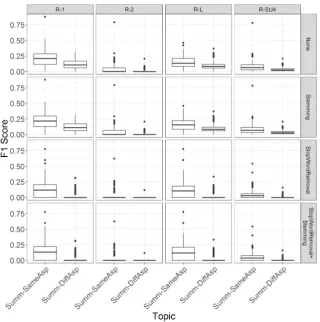
We closely analyse the poor performance of R-2 and we found that it is due to the many ties in the scores ofSumm-SameAsp andSumm-DiffAsp. In particular, many candidate summaries have a R-2 score of zero, as shown in Figure 1. When ROUGE scores are zero for both candidate sum-maries, scores are no longer meaningful for evalu-ation of candidate summaries.
We also observe that, with “Stemming”, the proportion is higher than otherwise. One possible explanation is that “Stemming” relaxes the exact word match requirement to allow matching of dif-ferent word forms.
We further examine how the choice of Recall, Precision or F1 score affects the suitability of
us-ing ROUGE to compare summaries. In Table
5, we report the proportion of triplets that score
2For two aspects, summaries do not contain the given
Reference Summ-SameAsp Summ-DiffAsp R-1Summ-SameAsp R-1Summ-DiffAsp
Great hperformancei and handling. hPerformancei, styling and quality have good value for money.
Adequate hperformancei, nice looks, long dis-tance cruiser. Overall
hperformanceigood, poor engine hperformancei, gas mileage 22 highway and poor comfort level.
hPricei was good. Best
hpricesion other websites than Holiday Inn.
0.069 0.125
The hroomsi were very neat and clean.
The hroomsi are clean, large and comfortable. Not the most modern decor, however.
The Best Western in San Francisco is a decent, in-expensive option for one’s stay in the city. It’s
hlocationiis terrific , be-ing near many attractions, and the rooms, while small, are clean.
0.222 0.0.95
Table 4: Two examples of summary triplets. Summ-SameAspis a randomly selected gold standard summary on the same aspect. whereasSumm-DiffAspis on a different aspect. Words in angle bracket are the aspect terms we masked. We report the R-1 F1score with stemming and stop word removal.
Recall F1score
Configuration R-1 R-2 R-L R-SU4 R-1 R-2 R-L R-SU4
None 0.659 0.323 0.578 0.677 0.758 0.345 0.744 0.767
Stemming 0.682 0.341 0.596 0.695 0.771 0.359 0.744 0.776
StopWordRemoval 0.610 0.108 0.592 0.610 0.646 0.108 0.628 0.646
StopWordRemoval+Stemming 0.641 0.139 0.632 0.641 0.677 0.139 0.677 0.677
Table 5: Proportion of 223 summary triplets thatSumm-SameAspis scored higher thanSumm-DiffAsp, by Recall and F1score, when the aspect terms are masked.
Summ-SameAsphigher thanSumm-DiffAsp, using Recall and F1score. When using Recall score, the
proportion of correctly assessed triplets is lower. Using F1 score, the proportion is higher suggests
that the Precision score plays a part in the compar-ison of candidate summaries of two different as-pects and in a way controls for the different lengths in the candidate summaries.
There are three learning points to this experi-ment: (1) ROUGE gives a low score to candi-date summary of a different aspect to the refer-ence summary; (2) ROUGE-N score decreases as n-gram increases. It is possible that ROUGE-N scores are zero. Hence, is useful to plot the dis-tribution of ROUGE scores; and, (3) Results sug-gest that “Stemming” increases ROUGE’s ability to compare summaries.
4.2 Same Polarity Triplet Experiment
We had two annotators read all 223 gold standard summaries for 51 aspects and assign either a pos-itive or negative sentiment polarity to each sum-mary. When there is a conflict between the two as-signed labels, a third annotator decides if the
sum-mary is positive or negative. Out of the 51 aspects, for 38 aspects (74.5%) the gold summaries of each aspect were consistent in their polarity whereas for 13 aspects (24.6%) the gold summaries were op-posite.
an-Figure 1: Boxplot of ROUGE scores show that scores forSumm-DiffAspare generally lower than scores for Summ-SameAsp. Also, R-2 scores with “StopWordRemoval” are close to zero for candidate summaries which makes it less meaningful to be used to compare summaries.
other summary that is of same aspect but opposite polarity, Summ-Ant. This forms the second and third summaries of the triplet. This experiment controls for all the matching of the other words except for the sentiment-bearing words. Hence, we can study the impact of matching sentiment-bearing words in the reference summary.
To generate the synonym and antonym version of a summary, we first identify the sentiment-bearing words in the summary. A sentiment-bearing word is an adjective, adverb or verb and its lemmatised word form contains a sentiment score in SentiWordNet (Baccianella et al.,2010). The pre-processing steps of part-of-speech tag-ging, lemmatisation and looking it up in Senti-Wordnet was performed through python’sNLTK
package (Bird et al.,2009). We obtain synonyms and antonyms3fromWiktionaryusing the python packagewiktionaryparser. Table6reports the
pro-3We also experimented with WordNet (Fellbaum,1998)
to get synonym and antonym of a sentiment-bearing word, however, the pairs we obtained from WordNet had lower cov-erage than Wiktionary.
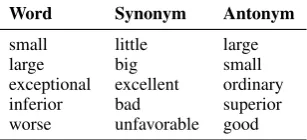
portion of sentiment-bearing words present in the gold standard summaries and Table 7 shows ex-amples of the synonyms and antonyms from Wik-tionary.
Intuitively, Summ-Syn is accurate toReference summary. As such, we expect Summ-Syn to be evaluated as a better summary over Summ-Ant. But, based on the ROUGE formula, we expect similar ROUGE scores for both candidate sum-maries.
Not all triplets have a synonym and antonym summary due to the nature of the synonym and antonym extraction method. We exclude triplets where there are no synonym and antonym sum-maries. We are left with 104 summary triplets with synonym and antonym summaries with at least one sentiment-bearing word replaced. On average, 0.124 of the summary is replaced by antonyms or synonyms. Table8shows two examples of sum-mary triplet and Table9 shows the proportion of triplets that ROUGE scored both summaries the same score.
Proportion Examples
Adjectives 0.122 easy, clean, friendly Adverbs 0.050 not, very, too Verbs 0.110 is, like, was
Table 6: Proportion of sentiment-bearing words of all words in gold standard summaries according to their part-of-speech tag.
Word Synonym Antonym
small little large large big small exceptional excellent ordinary inferior bad superior worse unfavorable good
Table 7: Five examples of sentiment-bearing words with its synonym and antonym.
score as expected from our understanding of the ROUGE formula. ROUGE scores cannot be used to differentiate summaries that are accurate to the reference summary in terms of sentiment polarity.
4.3 Opposite Polarity Triplet Experiment
Our third experiment is on the 13 aspects where gold summaries are not consistent in sentiment polarity. For example, for the topic “but-tons amazon kindle”, there are 1 negative sum-mary and 3 positive summaries. We create a triplet consisting of: (1) a reference summary ( Refer-ence); (2) a candidate summary that is consistent in aspect and sentiment polarity (Summ-SamePol); and, (3) a candidate summary of the same aspect but opposite sentiment polarity (Summ-DiffPol). We took all possible combinations with the anno-tated gold standard summaries. We have a total of 142 summary triplets. An example of the triplet is shown in Table10.
We report the proportion of the 142 summary triplets where Summ-SamePol is scored higher than Summ-DiffPol in Table 11. R-2 is excluded as the R-2 scores of both candidate summaries are mostly zero, which are not meaningful to com-pare summaries. We observe that in general, the proportion of triplets where ROUGE scores the second summary higher is lower than 50%. This suggests that ROUGE is not able to correctly rank candidate summaries of the same polarity with the reference summary. Also, we observe that configurations with “StopWordRemoval” is always lower than the configurations without.
From all experiments, the inclusion of “StopWor-dRemoval” often reduces the effectiveness of the the ability to use ROUGE scores to compare can-didate summaries.
5 Discussion
Our empirical analysis for examining whether ROUGE is suitable for evaluating opinion sum-maries leads us to three suggestions for future studies for automatic evaluation in opinion sum-marisation:
1. The configurations for ROUGE can change or reverse the order of scores of summary. We observe that F1 scores appear to compare
summaries better than Recall. Also, “Stop-WordRemoval” seems to reduce the ability of ROUGE scores for comparing summaries for our dataset. Including “Stemming” often im-prove the ability to compare candidate sum-maries for our dataset. Hence, when report-ing ROUGE scores, in addition to reportreport-ing ROUGE variants, we recommend reporting the configurations under which ROUGE was computed.
2. ROUGE scores will be low when candidate summary is of a different aspect from the ref-erence summary. This is because opinions for different aspects are described by differ-ent sets of words. As such, there is little word overlap which leads to low ROUGE scores. Hence, for improvements to the opinion sum-mary evaluation, we recommend checking for a match of the aspect in candidate and ref-erence summary as a differentiating criteria.
3. It is not possible to infer from ROUGE scores if the candidate summary is accurate to the reference especially for sentiment po-larity. ROUGE requires an exact match of the sentiment-bearing words in the reference summary. But reviewers express opinions differently which can result in the lack of match of sentiment-bearing words. We rec-ommend sentiment agreement of candidate and reference summaries as another criteria for evaluation.
6 Conclusions
Reference Summ-Syn Summ-Ant R-1Summ-Syn R-1Summ-Ant
Great hperformancei and handling. hPerformancei, styling and quality have good value for money.
Adequate hperformancei, charming looks, long distance cruiser. Over-all hperformancei good, impoverished engine
hperformancei, gas mileage 22 highway and impoverished comfort level.
Adequate hperformancei, horrible looks, long dis-tance cruiser. Overall
hperformancei good, rich engine hperformancei, gas mileage 22 highway and rich comfort level.
0.069 0.069
Thehroomsiwere very neat and clean.
Thehroomsiare clean, big and comforting. Not the most contemporary decor, however.
The hroomsi are clean, small and comfortless. Not the most ancient decor, however.
0.222 0.222
Table 8: Two examples of summary triplet. Summ-Syn is a synonym version of a gold standard summary. Summary-Ant is an antonym version of a gold standard summary. We report the R-1 F1 score with stemming and stop word removal. The words that are replaced in the original summary are underlined.
Configuration R-1 R-2 R-L R-SU4
None 0.952 1.000 0.952 0.952
Stemming 0.933 1.000 0.942 0.933
StopWordRemoval 0.952 1.000 0.942 0.952
StopWordRemoval+Stemming 0.913 0.990 0.904 0.913
Table 9: Proportion of 104 summary triplets with same ROUGE scores forSumm-SynandSumm-Ant.
Reference Summ-SamePol Summ-DiffPol R-1Summ-SamePol R-1Summ-DiffPol
New hbuttonsi are easy to use and effective. No more accidentalhbuttonipresses.
hButtonsi make navigation easy.
Magical five wayhbuttoni. Next pagehbuttonion both side of kindle. No reset
hbuttoni.
It is not user friendly and thehbuttonsiare not easily pressed.
0.000 0.118
Table 10: An examples of summary triplet.Summ-SamePolandSumm-DiffPolare gold standard summaries of the same aspect asReferencewith same and different polarity respectively. We report the R-1 F1score with stemming and stop word removal.
Configuration R-1 R-L R-SU4
None 0.479 0.465 0.493
Stemming 0.479 0.465 0.500
StopWordRemoval 0.430 0.387 0.437
StopWordRemoval+Stemming 0.451 0.394 0.444
Table 11: Proportion of 142 summary triplets where Summ-SamePolis scored higher thanSumm-DiffPol.
is not sufficient for the evaluation of opinion sum-maries. The word count overlap is not an indicator of accurate opinion summarisation. Our experi-ments simulate scenarios where inaccurate sum-maries are automatically generated. We observe that ROUGE is unable to differentiate summaries that are accurate and summaries that are inaccu-rate. For future work, we will investigate opinion
summaries that contain multiple opinions. Based on the learning points from the investigation, we aim to propose a new metric that incorporates se-mantic similarity in terms of opinion target and opinion polarity.
Acknowledgments
We thank the anonymous reviewers for their thor-ough and insightful comments. Wenyi is sup-ported by an Australian Government Research Training Program Scholarship and a CSIRO Data61 Top-up Scholarship.
References
arXiv preprint arXiv:1909.02322.
Rafael Anchiˆeta, Rogerio Figueredo Sousa, Raimundo Moura, and Thiago Pardo. 2017. Improving opinion summarization by assessing sentence importance in on-line reviews. In Proceedings of the Brazilian Symposium in Information and Human Language Technology, pages 32–36, Uberlˆandia, Brazil.
Stefanos Angelidis and Mirella Lapata. 2018. Sum-marizing Opinions: Aspect Extraction Meets Senti-ment Prediction and They Are Both Weakly Super-vised. InProceedings of the Conference on Empiri-cal Methods in Natural Language Processing, pages 3675–3686, Brussels, Belgium.
Stefano Baccianella, Andrea Esuli, and Fabrizio Sebas-tiani. 2010. SentiWordNet 3.0: An enhanced lexi-cal resource for sentiment analysis and opinion min-ing. In Proceedings of the conference on Interna-tional Language Resources and Evaluation, Valletta, Malta.
Steven Bird, Ewan Klein, and Edward Loper. 2009. Natural Language Processing with Python, 1st edi-tion. O’Reilly Media, Inc.
John M Conroy and Judith D Schlesinger. 2008. CLASSY and TAC 2008 Metrics. InProceedings of the Text Analysis Conference, Gaithersburg, MD.
Christiane Fellbaum, editor. 1998. WordNet: An Elec-tronic Lexical Database. MIT Press, Cambridge, MA.
Kavita Ganesan, ChengXiang Zhai, and Jiawei Han. 2010. Opinosis: A Graph Based Approach to Ab-stractive Summarization of Highly Redundant Opin-ions. In Proceedings of the International Confer-ence on Computational Linguistics, pages 340–348, Beijing, China.
Yvette Graham. 2015. Re-evaluating Automatic Sum-marization with BLEU and 192 Shades of ROUGE. In Proceedings of the Conference on Empirical Methods in Natural Language Processing, pages 128–137, Lisbon, Portugal.
Jayanth Jayanth, Jayaprakash Sundararaj, and Pushpak Bhattacharyya. 2015. Monotone submodularity in opinion summaries. InProceedings of the Confer-ence on Empirical Methods in Natural Language Processing, pages 169–178, Lisbon, Portugal.
Mijail Kabadjov, Alexandra Balahur, and Ester Boldrini. 2009. Sentiment intensity: Is it a good summary indicator? InLanguage and Technology Conference, pages 203–212. Springer.
Florian Kunneman, Sander Wubben, Antal van den Bosch, and Emiel Krahmer. 2018. Aspect-based summarization of pros and cons in unstructured product reviews. InProceedings of the International Conference on Computational Linguistics, pages 2219–2229, Santa Fe, NM.
Alon Lavie and Michael J. Denkowski. 2009. The meteor metric for automatic evaluation of machine translation.Machine Translation, 23(2-3):105–115.
Kevin Lerman, Sasha Blair-Goldensohn, and Ryan Mc-Donald. 2009. Sentiment summarization: evaluat-ing and learnevaluat-ing user preferences. InProceedings of the Conference of the European Chapter of the As-sociation for Computational Linguistics, pages 514– 522, Athens, Greece.
Chin-Yew Lin. 2004. ROUGE: A package for auto-matic evaluation of summaries. InText Summariza-tion Branches Out, pages 74–81, Barcelona, Spain.
Bing Liu. 2012. Sentiment Analysis and Opinion Min-ing. Morgan & Claypool Publishers.
Stuart Mackie, Richard McCreadie, Craig Macdonald, and Iadh Ounis. 2014. On choosing an effective au-tomatic evaluation metric for microblog summarisa-tion. InProceedings of the Information Interaction in Context Symposium, pages 115–124.
Mohammed Elsaid Moussa, Ensaf Hussein Mohamed, and Mohamed Hassan Haggag. 2018. A survey on opinion summarization techniques for social me-dia. Future Computing and Informatics Journal, 3(1):82–109.
Bo Pang and Lillian Lee. 2004. A sentimental edu-cation: Sentiment analysis using subjectivity sum-marization based on minimum cuts. InProceedings of the Annual Meeting on Association for Computa-tional Linguistics, page 271, Barcelona, Spain.
Kishore Papineni, Salim Roukos, Todd Ward, and Wei-Jing Zhu. 2002. Bleu: A method for automatic eval-uation of machine translation. InProceedings of the Annual Meeting on Association for Computational Linguistics, pages 311–318, Philadelphia, PA.
Emily Pitler, Annie Louis, and Ani Nenkova. 2010. Automatic evaluation of linguistic quality in multi-document summarization. InProceedings of the An-nual Meeting of the Association for Computational Linguistics, pages 544–554, Uppsala, Sweden.
Lahari Poddar, Wynne Hsu, and Mong Li Lee. 2017. Author-aware Aspect Topic Sentiment Model to Re-trieve Supporting Opinions from Reviews. In Pro-ceedings of the Conference on Empirical Methods in Natural Language Processing, pages 472–481, Copenhagen, Denmark.