S H O R T R E P O R T
Open Access
Confusions in orbivirus protein classification
Meik Dilcher
*and Manfred Weidmann
Abstract
An extensive comparative analysis of orbivirus genomes revealed four cases of unclear numeration and protein
designation, due to confused reference to protein size or segment size by which they are encoded. A concise
nomenclature based on type species, sequence homology and functional characteristics independent of segment
or protein size is suggested.
Keywords:
Reoviridae
,
Orbivirus
, Protein classification
Background
The genus
Orbivirus
is one of 15 in the family of
Reoviri-dae
containing 22 serogroups (species) and at least 160
different serotypes (strains) [1]. Orbiviruses are
transmit-ted by insects (midges, flies, mosquitoes) or by ticks.
Their double-stranded RNA (dsRNA) genomes consist of
10 segments coding for seven structural and at least
three non-structural proteins. Orbiviruses have no
enve-lope but a double-shelled icosahedral capsid [2] and
in-clude pathogenic agents of wild animals (Epizootic
hemorrhagic disease virus (EHDV)), domestic animals
(Bluetongue virus (BTV) and African horse sickness
virus (AHSV)), and of man (Kemerovo virus (KEMV))
[3]. Type species of the genus is the
Culicoides
midge
transmitted BTV. Insect-borne orbiviruses are much
bet-ter characbet-terized than tick-transmitted orbiviruses for
which few sequences have been described: Broadhaven
virus (BRDV, partial) [4], Sandy Bay virus (SBaV, partial
(formerly Nugget virus)) [5-8], St Croix River virus
(SCRV, complete genome) [9], Great Island virus (GIV,
complete genome) [7].
Recently we determined the complete genomes of
Tri-be
č
virus (TRBV) and KEMV in a pyrosequencing
ap-proach [10] complementing available partial information
on segments 1, 2 and 6 of these viruses and of Lipovnik
virus (LIPV) [7].
During our extensive comparative analysis of orbivirus
genomes we noticed four cases of unclear numeration
and protein designation (see Tables 1 and 2). Some
la-boratories classify orbivirus proteins according to the
size of the proteins whereas others use the size of
gen-ome segments from which they are encoded.
(i) The inner shell protein T2 for example can be
encoded by segment 2 (tick- and mosquito-borne
orbiviruses) or segment 3 (C
ulicoides
-borne
orbiviruses). This leads to some laboratories labeling
this protein VP2(T2) (e.g. GIV), while others
designate it VP3(T2) as in the type species BTV.
For Peruvian horse sickness virus (PHSV) however,
the segment 2 encoded protein is designated VP3
(T2) although it is larger (925 amino acids) than the
segment 3 encoded VP2 protein (881 amino acids)
[
11
]. To avoid confusion with the outer shell
protein VP2 we suggest to exclusively use VP3(T2)
for all T2 proteins.
(ii) VP2 and VP2 homologous proteins can be encoded
by segments 2, 3, 4 and 5 and are designated VP2,
VP3 (YUOV, SCRV) or VP4 (BRDV segment 4
([
12
,
13
], sequence entry to GenBank missing)), GIV
segment 5). Because of the location on the outer
capsid and the described sequence similarity with
other VP2 proteins, we suggest that the VP4
proteins (BRDV, GIV) as well as the VP3 proteins
(YUOV, SCRV) should be uniformly termed VP2,
even though tick-borne VP2 proteins have only half
the size of insect-borne VP2 proteins [
13
].
(iii) The capping enzyme VP4(CaP) can be encoded by
segment 4 (BTV, YUOV, SCRV etc.) or segment 3
(TRBV, KEMV). In GIV this protein is designated
VP3(CaP) [
7
] and should be renamed VP4(CaP) to
avoid confusions with VP3(T2).
(iv) In most cases VP5 is encoded by segment 6 and
comprises a component of the outer shell that
* Correspondence:[email protected]
Department of Virology, University Medical Center Göttingen, Kreuzbergring 57, D-37075 Göttingen, Germany
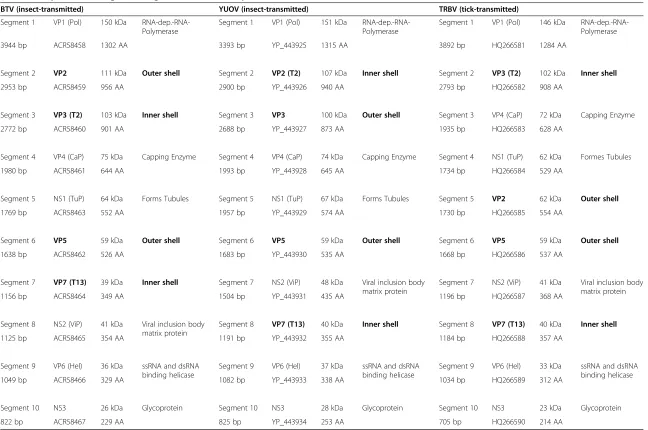
Table 1 Comparison of the genome segments and encoded proteins of BTV, YUOV, TRBV, KEMV and GIV
BTV (insect-transmitted) YUOV (insect-transmitted) TRBV (tick-transmitted) Segment 1 VP1 (Pol) 150 kDa
RNA-dep.-RNA-Polymerase
Segment 1 VP1 (Pol) 151 kDa RNA-dep.-RNA-Polymerase
Segment 1 VP1 (Pol) 146 kDa RNA-dep.-RNA-Polymerase
3944 bp ACR58458 1302 AA 3393 bp YP_443925 1315 AA 3892 bp HQ266581 1284 AA
Segment 2 VP2 111 kDa Outer shell Segment 2 VP2 (T2) 107 kDa Inner shell Segment 2 VP3 (T2) 102 kDa Inner shell
2953 bp ACR58459 956 AA 2900 bp YP_443926 940 AA 2793 bp HQ266582 908 AA
Segment 3 VP3 (T2) 103 kDa Inner shell Segment 3 VP3 100 kDa Outer shell Segment 3 VP4 (CaP) 72 kDa Capping Enzyme
2772 bp ACR58460 901 AA 2688 bp YP_443927 873 AA 1935 bp HQ266583 628 AA
Segment 4 VP4 (CaP) 75 kDa Capping Enzyme Segment 4 VP4 (CaP) 74 kDa Capping Enzyme Segment 4 NS1 (TuP) 62 kDa Formes Tubules
1980 bp ACR58461 644 AA 1993 bp YP_443928 645 AA 1734 bp HQ266584 529 AA
Segment 5 NS1 (TuP) 64 kDa Forms Tubules Segment 5 NS1 (TuP) 67 kDa Forms Tubules Segment 5 VP2 62 kDa Outer shell
1769 bp ACR58463 552 AA 1957 bp YP_443929 574 AA 1730 bp HQ266585 554 AA
Segment 6 VP5 59 kDa Outer shell Segment 6 VP5 59 kDa Outer shell Segment 6 VP5 59 kDa Outer shell
1638 bp ACR58462 526 AA 1683 bp YP_443930 535 AA 1668 bp HQ266586 537 AA
Segment 7 VP7 (T13) 39 kDa Inner shell Segment 7 NS2 (ViP) 48 kDa Viral inclusion body matrix protein
Segment 7 NS2 (ViP) 41 kDa Viral inclusion body matrix protein
1156 bp ACR58464 349 AA 1504 bp YP_443931 435 AA 1196 bp HQ266587 368 AA
Segment 8 NS2 (ViP) 41 kDa Viral inclusion body matrix protein
Segment 8 VP7 (T13) 40 kDa Inner shell Segment 8 VP7 (T13) 40 kDa Inner shell
1125 bp ACR58465 354 AA 1191 bp YP_443932 355 AA 1184 bp HQ266588 357 AA
Segment 9 VP6 (Hel) 36 kDa ssRNA and dsRNA binding helicase
Segment 9 VP6 (Hel) 37 kDa ssRNA and dsRNA binding helicase
Segment 9 VP6 (Hel) 33 kDa ssRNA and dsRNA binding helicase
1049 bp ACR58466 329 AA 1082 bp YP_443933 338 AA 1034 bp HQ266589 312 AA
Segment 10 NS3 26 kDa Glycoprotein Segment 10 NS3 28 kDa Glycoprotein Segment 10 NS3 23 kDa Glycoprotein
822 bp ACR58467 229 AA 825 bp YP_443934 253 AA 705 bp HQ266590 214 AA
Dilcher
and
Weidman
n
Virology
Journal
2012,
9
:166
Page
http://ww
w.virologyj.com
/content/
KEMV (tick-transmitted) GIV (tick-transmitted)
Segment 1 VP1 (Pol) 146 kDa
RNA-dep.-RNA-Polymerase
Segment 1 VP1 (Pol) 147 kDa
RNA-dep.-RNA-Polymerase
3896 bp HQ266591 1285 AA 3897 bp ADM88592 1285 AA
Segment 2 VP3 (T2) 103 kDa Inner shell Segment 2 VP2 (T2) 103 kDa Inner shell
2792 bp HQ266592 908 AA 2794 bp ADM88593 908 AA
Segment 3 VP4 (CaP) 72 kDa Capping Enzyme Segment 3 VP3 (CaP) 73 kDa Capping Enzyme
1934 bp HQ266593 632 AA 1936 bp ADM88594 635 AA
Segment 4 VP2 63 kDa Outer shell Segment 4 NS1 (TuP) 60 kDa Formes Tubules
1730 bp HQ266594 554 AA 1731 bp ADM88595 531 AA
Segment 5 NS1 (TuP) 60 kDa Formes Tubules Segment 5 VP4 62 kDa Outer shell
1719 bp HQ266595 529 AA 1722 bp ADM88596 551 AA
Segment 6 VP5 59 kDa Outer shell Segment 6 VP5 60 kDa Outer shell
1668 bp HQ266596 537 AA 1666 bp ADM88597 537 AA
Segment 7 NS2 (ViP) 41 kDa Viral inclusion body matrix protein
Segment 7 VP7 (T13) 40 kDa Inner shell
1197 bp HQ266597 368 AA 1181 bp ADM88598 357 AA
Segment 8 VP7 (T13) 40 kDa Inner shell Segment 8 NS2 (ViP) 39 kDa Viral inclusion body
matrix protein
1183 bp HQ266598 357 AA 1172 bp ADM88599 359 AA
Segment 9 VP6 (Hel) 34 kDa ssRNA and dsRNA
binding helicase
Segment 9 VP6 (Hel) 34 kDa ssRNA and dsRNA
binding helicase
1049 bp HQ266599 317 AA 1056 bp AMD88600 321 AA
Segment 10 NS3 23 kDA Glycoprotein Segment 10 NS3 19 kDa Glycoprotein
707 bp HQ266600 214AA 703 bp ADM88602 171 AA
Outer and inner shell proteins are labeled in bold. GenBank and SwissProt accession numbers are indicated.
Dilcher
and
Weidman
n
Virology
Journal
2012,
9
:166
Page
http://ww
w.virologyj.com
/content/
Table 2 Comparison of the genome segments and encoded proteins of SCRV, PHSV, BRDV and LIPV
SCRV (tick-transmitted) PHSV (isolates only known from horses)
Segment 1 VP1 (Pol) 151 kDa RNA-dep.-RNA-Polymerase Segment 1 VP1 (Pol) 151 kDa RNA-dep.-RNA-Polymerase
4089 bp YP_052942 1345 AA 3987 bp YP_460038 1311 AA
Segment 2 VP2 (T2) 98 kDa Inner shell Segment 2 VP3 (T2) 105 kDa Inner shell
2747 bp YP_052943 890 AA 2856 bp YP_460039 925 AA
Segment 3 VP3 74 kDa Outer shell Segment 3 VP2 104 kDa Outer shell
2024 bp YP_052944 654 AA 2747 bp YP_460040 881 AA
Segment 4 VP4 (CaP) 74 kDa Capping Enzyme Segment 4 VP4 (CaP) 74 kDa Capping Enzyme
2017 bp YP_052945 643 AA 1996 bp YP_460041 646 AA
Segment 5 VP5 57 kDa Outer shell Segment 5 NS1 (TuP) 64 kDa Forms Tubules
1664 bp YP_052946 517 AA 1784 bp YP_460045 554 AA
Segment 6 NS1 (TuP) 58 kDa Forms Tubules Segment 6 VP5 59 kDa Outer shell
1657 bp YP_052947 517 AA 1695 bp YP_460042 529 AA
Segment 7 NS2 (ViP) 51 kDa Viral inclusion body matrix protein Segment 7 NS2 (ViP) 48 kDa Viral inclusion body matrix protein
1463 bp YP_052948 462 AA 1613 bp YP_460046 435 AA
Segment 8 VP7 (T13) 41 kDa Inner shell Segment 8 VP7 (T13) 40 kDa Inner shell
1256 bp YP_052949 379 AA 1180 bp YP_460044 353 AA
Segment 9 VP6 (Hel) 26 kDa ssRNA and dsRNA binding helicase Segment 9 VP6 (Hel) 37 kDa ssRNA and dsRNA binding helicase
764 bp YP_052950 232 AA 1071 bp YP_460043 334 AA
Segment 10 NS3 24 kDa Glycoprotein Segment 10 NS3 28 kDa Glycoprotein
764 bp YP_052951 224 AA 819 bp YP_460047 255 AA
Dilcher
and
Weidman
n
Virology
Journal
2012,
9
:166
Page
http://ww
w.virologyj.com
/content/
BRDV (tick-transmitted) LIPV (tick-transmitted)
Segment 1 Segment 1 VP1 (Pol) 146 kDa RNA-dep.-RNA-Polymerase
3892 bp ADM88603 1284 AA
Segment 2 VP2 (T2) 103 kDa Inner shell Segment 2 VP2 (T2) 103 kDa Inner shell
P35934 908 AA 2793 bp ADM88604 908 AA
Segment 3 Segment 3
Segment 4 VP4† 63 kDa† Outer shell Segment 4
Segment 5 VP5 53 kDa Outer shell Segment 5
1658 bp P21230 480 AA
Segment 6 NS1 (TuP) 60 kDa Formes Tubules Segment 6 VP5 502 AA†† Outer shell
1714 bp 2115436A 537 AA 1509 bp†† ADM88605
Segment 7 VP7
(T13)
40 kDa Inner shell Segment 7
P35935 356 AA
Segment 8 Segment 8
Segment 9 Segment 9
Segment 10 NS3 22 kDa Glycoprotein Segment 10
P32555 205 AA
Outer and inner shell proteins are labeled in bold. GenBank and SwissProt accession numbers are indicated.
†: [12,13], GenBank entry missing.
††: partial sequence.
Dilcher
and
Weidman
n
Virology
Journal
2012,
9
:166
Page
http://ww
w.virologyj.com
/content/
might be involved in membrane fusion and
penetration [
14
]. TRBV and KEMV also encode VP5
on segment 6. The highest similarity of TRBV VP5
is to LIPV VP5 (95.6%), again encoded by segment
6 [
7
]. However, VP5 of BRDV is described as
encoded by segment 5 [
15
]. Since in the
classification of the viral genome segments bigger
segments have smaller segment numbers, and the
size of BRDV segment 6 (1714 bp) encoding the
NS1(TuP) [
16
] is larger than the size of BRDV
segment 5 (1658 bp) encoding VP5, a reassignment
of BRDV segment 5 and 6 (a vice versa switch)
seems necessary.
To summarize, it would be much more helpful if the
no-menclature of the viral proteins in orbiviruses would
re-flect the sequence homology and functional relationship
rather than protein size or encoding segment size, since
the sizes of the orbivirus genome segments sometimes
only differ slightly, which leads to even closely related
viruses such as TRBV and KEMV encoding VP2 and NS1
(TuP) on different genome segments. We therefore
sug-gest the following concise nomenclature based on the type
species BTV and on sequence homology and functional
characteristics independent of segment or protein size:
VP1(Pol), VP2, VP3(T2), VP4(CaP), VP5, VP6(Hel), VP7
(T13), NS1(TuP), NS2(ViP), NS3.
Competing interests
The authors declare that they have no competing interests.
Author’s contributions
MD and MW wrote the paper. Both authors read and approved the final manuscript.
Acknowledgments
This work was supported by the Federal Ministry of Education and Research (BMBF), grant number 01KI0710,“Research on Zoonotic Infectious Diseases” program,“Emerging arthropode-borne viral infections in Germany: Pathogenesis, diagnostics and surveillance”and the BMBF funded research program“Potential release-oriented biothreat emergency diagnostics (P.R.O.B. E)”for civil security of the German Federal Government as part of the high-tech strategy for Germany.
Received: 1 February 2012 Accepted: 24 July 2012 Published: 21 August 2012
References
1. Attoui H, Mertens PPC, Becnel J, Belaganahalli S, Bergoin M, Brussaard CP, Chappell JD, Ciarlet M, del Vas M, Dermody TS,et al:Orbiviruses, Reoviridae. InVirus taxonomy ninth report of the international committee on taxonomy of viruses. Edited by King AMQ, Adams MJ, Carstens EB, Lefkowitz EJ. Elsevier: Adacemic Press; 2011:592–603.
2. Attoui H, Jaafar FM, Belhouchet M, Aldrovandi N, Tao SJ, Chen BQ, Liang GD, Tesh RB, de Micco P, de Lamballerie X:Yunnan orbivirus, a new orbivirus species isolated from Culex tritaeniorhynchus mosquitoes in China.J Gen Virol2005,86:3409–3417.
3. Gorman BM:Variation in orbiviruses.J Gen Virol1979,44:1–15. 4. Moss SR, Jones LD, Nuttall PA:Comparison of the major structural core
proteins of tick-borne and culicoides-borne orbiviruses.J Gen Virol1992, 73:2585–2590.
collected at Macquarie Island, Southern Ocean.Am J Trop Med Hyg1975, 24:521–526.
6. Gorman BM, Taylor J, Morton HC, Melzer AJ, Young PR:Characterization of nugget virus, a serotype of the kemerovo group of orbiviruses.Aust J Exp Biol Med Sci1984,62:101–115.
7. Belhouchet M, Jaafar FM, Tesh RB, Grimes J, Maan S, Mertens P, Attoui H: Complete sequence of the Great Island virus and comparison with the T2 and outer-capsid proteins of Kemerovo, Lipovnik and Tribec viruses (genus Orbivirus, family Reoviridae).J Gen Virol2010,91:2985–2993. 8. Major L, Linn ML, Slade RW, Schroder WA, Hyatt AD,et al:Ticks associated
with Macquarie Island penguins carry arboviruses from four genera.PLoS One2009,4:e4375.
9. Attoui H, Stirling JM, Munderloh UG, Billoir F, Brookes SM, Burroughs JN, de Micco P, Mertens PPC, de Lamballerie X:Complete sequence characterization of the genome of the St Croix River virus, a new orbivirus isolated from cells of Ixodes scapularis.J Gen Virol2001, 82:795–804.
10. Dilcher M, Hasib L, Lechner M, Wieseke N, Middendorf M, Marz M, Koch A, Spiegel M, Dobler G, Hufert FT, Weidmann M:Genetic characterization of Tribečvirus and Kemerovo virus, two tick-transmitted human-pathogenic Orbiviruses.Virology2012,423:68–76.
11. Attoui H, Mendez-Lopez MR, Rao SJ, Hurtado-Alendes A, Lizaraso-Caparo F, Jaafar FM, Samuel AR, Belhouchet M, Pritchard LI, Melville L,et al:Peruvian horse sickness virus and Yunnan orbivirus, isolated from vertebrates and mosquitoes in Peru and Australia.Virology2009,394:298–310.
12. Moss SR, Nuttall PA:Subcore-like and core-like particles of Broadhaven Virus (Brdv), a tick-borne orbivirus, synthesized from baculovirus-expressed Vp2 and Vp7, the major core proteins of Brdv.Virus Res1994, 32:401–407.
13. Schoehn G, Moss SR, Nuttall PA, Hewat EA:Structure of Broadhaven virus by cryoelectron microscopy: Correlation of structural and antigenic properties of Broadhaven virus and bluetongue virus outer capsid proteins.Virology1997,235:191–200.
14. Zhang X, Boyce M, Bhattacharya B, Zhang XK, Schein S, Roy P, Zhou ZH: Bluetongue virus coat protein VP2 contains sialic acid-binding domains, and VP5 resembles enveloped virus fusion proteins.Proc Natl Acad Sci U S A 2010,107:6292–6297.
15. Moss SR, Fukusho A, Nuttall PA:Rna segment 5 of Broadhaven virus, a tick-borne orbivirus, shows sequence homology with segment-5 of bluetongue virus.Virology1990,179:482–484.
16. Moss SR, Nuttall PA:Comparison of the nonstructural protein, Ns1, of tick-borne and insect-tick-borne orbiviruses.Virus Res1995,36:287–292.
doi:10.1186/1743-422X-9-166
Cite this article as:Dilcher and Weidmann:Confusions in orbivirus
protein classification.Virology Journal20129:166.
Submit your next manuscript to BioMed Central
and take full advantage of:
• Convenient online submission
• Thorough peer review
• No space constraints or color figure charges
• Immediate publication on acceptance
• Inclusion in PubMed, CAS, Scopus and Google Scholar
• Research which is freely available for redistribution
Dilcher and WeidmannVirology Journal2012,9:166 Page 6 of 6