SLMotion – An extensible sign language oriented video analysis tool
Matti Karppa
∗, Ville Viitaniemi
∗, Marcos Luzardo
∗, Jorma Laaksonen
∗, Tommi Jantunen
†∗Department of Information and Computer Science,
Aalto University School of Science, Espoo, Finland, [email protected]
†Sign Language Centre, Department of Languages,
University of Jyv¨askyl¨a, Finland, [email protected]
Abstract
We present a software toolkit calledSLMotionwhich provides a framework for automatic and semiautomatic analysis, feature extraction and annotation of individual sign language videos, and which can easily be adapted to batch processing of entire sign language corpora. The program follows a modular design, and exposes a Numpy-compatible Python application programming interface that makes it easy and convenient to extend its functionality through scripting. The program includes support for exporting the annotations in ELAN format. The program is released as free software, and is available for GNU/Linux and MacOS platforms.
Keywords:automatic annotation, video analysis, sign language
1.
Introduction
SLMotion is a general purpose video analysis software toolkit that we have developed for analysing sign language corpora. The software allows researchers to perform differ-ent kinds of analyses on pre-existing video footage via non-invasive computer vision methods. This could be used, e.g., to verify theoretical statements concerning sign language phonetics, or be used as an assisting tool for semiautomatic or automatic annotation of pre-existing video corpora. Our software consists of two major parts: a generic con-trol framework that enables users to conduct experiments and analysis projects using Python scripts, and a library of independent analysis components that can be used as parts of such projects. While our use of the software has been limited to the analysis of sign language corpora (Karppa et al., 2012; Karppa et al., 2011; Viitaniemi et al., 2013; Luzardo et al., 2013), the framework itself does not con-tain inherent limitations that would prevent its application to other domains of video analysis, such as research of ges-tures or non-verbal interaction between speakers of spoken languages.
The usefulness of the software comes from the framework which allows the users to share their work with colleagues. The modular design of the component framework allows creation of self-contained components that can be applied to other projects in a plug & play manner. Scripting with the Python Application Programming Interface (API) enables users to share the scripts they have made and allows recy-cling of old projects. Users without a background in pro-gramming may choose to use premade scripts that accom-plish their desired tasks. Such scripts could, for example, define processes that annotate sequences of visual silence or lack of motion, measure velocities of the articulators, typically the hands, or create annotations corresponding to eye blinks.
The source code of the software, and Ubuntu Linux and MacOS X binaries are publicly available for download free
of charge athttp://research.ics.aalto.fi/cbir/ software/along with more extensive technical documen-tation. The software is licensed under the very permissive FreeBSD licence, so it can be used for commercial work in addition to academic settings.
The rest of the paper is organised as follows: Section 2. dis-cusses some related work. Section 3. describes the system and its capabilities. Section 4. lists some of the work where we have implemented our methods within the framework described here. Section 5. concludes the paper.
2.
Related work
A lot of work on computer-vision based approaches to-wards sign language analysis has surfaced in the recent years. This also includes large corpora, the appropriate analysis of which without automatic tools would be an in-surmountable task. For example, in (Forster et al., 2012), the authors describe a sign language recognition and trans-lation corpus based on weather forecasts signed in German Sign Language. They also describe experiments with hand and head tracking on the videos in the corpus. In (Charles et al., 2013), an automatic system is described for estimating human pose in long sequences of sign language video. However, to the authors’ best knowledge, no free software alternatives exist to SLMotion. This is because SLMotion works at a higher level of abstraction; it provides a frame-work for implementation and experimentation. Most re-lated work that has been released to the public in the form of software has focused on narrower, domain-specific prob-lems, and in many cases the proposed methods could be considered to be implemented as components within our system. Very little work can be found that operates at the same level of abstraction.
Video file(s)
FrameSource
Python Script
Component chain
BlackBoard Component 1
[image:2.595.80.283.72.241.2]Component n initialises
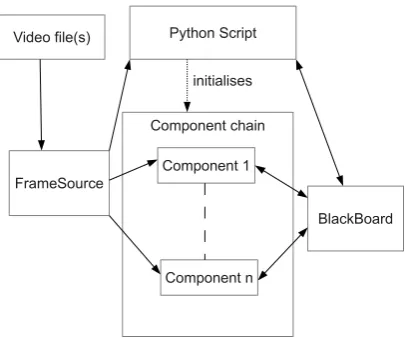
Figure 1: SLMotion execution model. The components only interact with one another through the black board. The Python script controls the execution at the top level, but it cannot directly influence the behaviour of the components once they have been initialised.
in (Lenkiewicz et al., 2012), the tracking of the hands and the head has been explored within the AVATecH project. However, to our knowledge, the described recognisers are not free in the free software sense, which may be consid-ered a limiting factor. Also, based on an assessment of the description in (Lenkiewicz et al., 2012), our scripting sys-tem could give the more technically-oriented user a more fine-grained level of control without sacrificing the simplic-ity of use, should the associated components be designed properly.
3.
System description
3.1. Framework architecture
Overall, the most important design principle behind SLMo-tion has been extensibility. This has yielded a modular structure that makes it possible to add new functionality in the form of self-contained components.
The execution model follows a black board model and is shown in Fig. 1. At the core is a component chain, i.e. a succession of self-contained processing tasks that are run for the input video one after another. Ideally, each compo-nent performs only one task at a time and is unaware of any other components in the chain. The only way for the com-ponents to interact with one another is through the black board which acts as an abstract data repository. The com-ponents will store their own results there and likewise load the results of previous components if they should depend on them. The components provide a range of metadata re-garding their requirements and the results they provide for other components so that the system can often verify that all necessary data will be available in time and tell the user what component might provide the missing data.
On a higher level, the initialisation of the component chain is performed by a Python script that runs in an embedded Python interpreter. The program exposes an API that al-lows the user to initialise the components to their desired settings, set up the desired visualisations for video output,
select which features to extract, manipulate the resulting data on the black board, or feed in data from an external source to the black board. The interface is also Numpy1
-compatible which should make a wide range of numeri-cal methods accessible. The state of the analysis can also be stored into a file as a “blackboard dump” and loaded back again. The dumps can be used for processing large videos in pieces, or performing multiple analyses on the same video without having to recompute results common to each task.
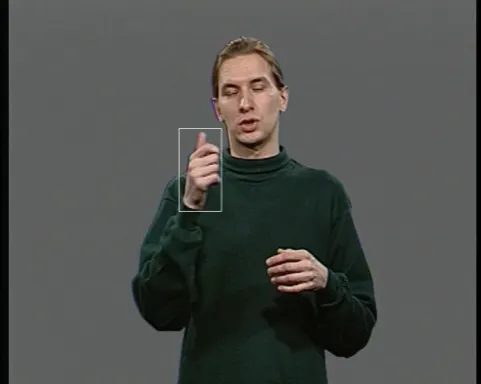
Listing 1 shows a simple example of a possible Python script that could be run with SLMotion. The second tex-tual line shows that the SLMotion API is accessed simply as a Python module. This is followed by the initialisa-tion of the component chain with the setComponents function. Components are created by passing a list of Component objects to the function. The Component objects act as component specifications. They include the name of the component and the parameters, passed as a dictionary with parameter names as keys and arguments as values. This behaviour is seen, for example, with the StaticElmSkinDetector component where the pa-rametermodelis set. The component chain in Listing 1 will first perform Viola-Jones face detection, skin detec-tion using a pre-trained Extreme Learning Machine (ELM) model, connected blob extraction to find contiguous pixel areas in the skin mask, and finally locating the hand using the preceeding results. The actual processing is triggered by a call to the processfunction. Finally, the visuali-sation options are set so that the results computed by the script are used to draw the location of the hand as a rect-angle superimposed on the input frame. The result can be seen in Fig. 2. The final lines demonstrate how the result data can be accessed from Python side. In this case, the re-sult would be a simple list of four integers, describing the rectangle. The output, corresponding to Fig. 2 where a sin-gle frame was used as input, would have been[267 194 63 122].
While the architecture gives the developer a lot of flexibility with design, it places certain limitations on the data that can be processed. Most importantly, since the video is scanned from the beginning to the end multiple times, and the dif-ferent components are run independently of one another, all results must be preserved in the main memory over the en-tire duration of the process. This can be a challenge if some of the components produce large matrices for each frame in the video, as the memory requirements can grow very large. This may limit the length of videos that are processed with certain components. In order to alleviate this effect, SLMo-tion can transparently apply Zlib compression to matrices. This is particularly effective in the case of binary matrices, such as skin masks. It is not possible to give numerical es-timates about maximum lengths of videos that can be pro-cessed since the limit is affected by the amount of RAM in the system, the resolution of the video, and most impor-tantly the results that the components require. Components that only provide data in the order of kilobytes per frame can practically handle arbitrarily long videos. On the other
Listing 1: A Python script example.
1 #!/usr/bin/python
3 from slmotion import *
import cv2
5
# create the component chain
7 setComponents([Component(’FaceDetector’),
Component(’StaticElmSkinDetector’,
9 {’model’: ’elm_skin_balanced.txt’}),
Component(’BlobExtractor’, {’minblobsize’: 1}),
11 Component(’HandLocator’, {’padding’: 5})])
13 process()
15 setVisualisation(’showFrame; showRect handlocation’) outputVideo()
17
# this is a simple example of how to access the results from Python end
19 for i in range(len(framesource)):
[image:3.595.53.294.338.530.2]print blackboard.get(’handlocation’, i)
Figure 2: The hand location as detected with the script in Listing 1.
hand, with components that create dense and poorly com-pressible matrices of size comparable to the input frame size, the practical limit may, in the case of high definition video input, be on the order of few minutes. Fortunately, even in the worst case, it is usually possible to process any video in pieces.
Also, since components expect random access to video frames, running independent components in parallel within one process is currently not supported, but luckily this prob-lem can be overcome in corpus processing by the fact that multiple separate processes can be run on parallel. Exper-iments conducted with parallelisation within a single pro-cess showed that the I/O overhead presented a major bot-tleneck, choking performance. This is made worse by the fact that in a lot of cases it is not possible to reliably fetch a given, arbitrary frame from the video stream. Experience has shown that the common video libraries tend to become
confused with exact frame indexing if seek to a random frame is requested, so the only way to ensure that frame numbering is consistent is by scanning the video from the very beginning one frame at a time until the desired frame has been reached. However, when processing video corpora where several independent video files are to be processed in a similar manner, the limitations with parallel processing can be overcome by simply performing the computations in a distributed manner. The scripts can be applied as such on several independent processes, each processing one video at a time, possibly on different computers on a computa-tional cluster.
3.2. User interface
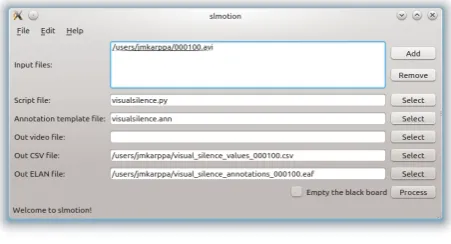
SLMotion comes with two user interfaces: a Command-Line Interface (CLI) that is used by default and a graphi-cal frontend for the command-line interface. The Graphi-cal User Interface (GUI) offers a fast and convenient way to use the program for analysing individual videos. If the user has a Python script at hand – either his or her own, or possibly from the community – all the user needs to do is to select the script, the video file to process and any required output files. The GUI has been implemented with the Qt library and can be seen in Fig. 3.
Figure 3: The graphical user interface (GUI).
called hand location.pngby analysing a file called input.pngby issuing the following command:
$ slmotion input.png \
--script hand_location_test.py \ -o hand_location.png
Interface like this should be familiar to UNIX users, making scripting straightforward.
3.3. Interfacing with external systems
The default input format consists of either video files or im-age sequences. SLMotion also supports Kinect recordings via the OpenNI library, and the depth information is acces-sible to the analysis components in the same way as the ordinary RGB video data.
As to output, the standard way SLMotion stores features it has extracted from the data is via comma-separated value (CSV) files. If it should be necessary, no restrictions are in place to prevent the user from making more complicated or specialised file formats accessible through Python scripts. The program can also perform various visualisations of the input data at different stages of analysis, and the visualisa-tions can be stored in a video file. These visualisavisualisa-tions may include, e.g., drawing binary maps of some low-level pro-cessing stage, such as skin detection, or it may be the draw-ing of circles around detected facial landmark points. Vi-sualisations like this may provide a more intuitive access to computational processes and their results. They may help the researcher make sense of numerical results, or they can be used to assist human inspection, perhaps by highlight-ing important details of the video, such as blinks or other detected events. Most importantly, they allow the human observer to perform a sanity check on the key parts in the video analysis used to produce the results: the computa-tional methods are never perfect, but a human can often tell immediately if misdetections or other erroneous results have been produced, which may distort the numerical end results.
The program also works in conjunction with ELAN2
(Wit-tenburg et al., 2006) which is the standard annotation tool in sign language research. The CSV files created by SLMo-tion can be included in ELAN projects as such. In addiSLMo-tion, the program can create ELAN-compatible EAF annotation files according to user-specified rules, typically depending
2http://tla.mpi.nl/tools/tla-tools/elan/
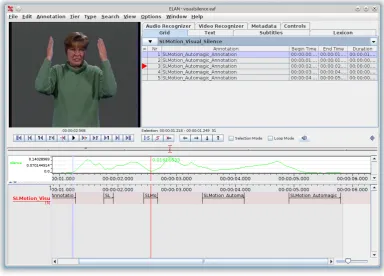
on the values of the features extracted. An example of au-tomatically generated annotations with our visual silence detector in ELAN can be seen in Fig. 4.
With minor modifications, it could be possible to adapt the program to work as an ELAN video recogniser. However, the recogniser API of ELAN places some limitations: the EAF file format does not offer a support for directly link-ing time series to the annotation files, maklink-ing the numerical data less useful than it could be. Also, while the recogniser API can be used to emulate our GUI, transferring data be-tween the programs is somewhat tedious, and the number of annotation tiers that will be added must be fixed on ELAN end while SLMotion could handle an arbitrary number of tiers.
3.4. Component library
We provide a range of native C++ components with SLMo-tion. Most of these components are directly related to the applications listed in Section 4. We try to make all the code we have used available to the public for scrutiny. Most importantly, this includes our original work, such as the hand-head occlusion detector described in (Vi-itaniemi et al., 2013) and the head pose estimator described in (Luzardo et al., 2013). The former attempts to de-tect the locations where one of the hands occludes the face, and the latter attempts to recover the head pose in terms of yaw, pitch, and roll angles. These are available as components called FaceOcclusionDetector and HeadPoseEstimator, respectively. For the latter com-ponent, pre-trained Support Vector Machine (SVM) models are provided along with the program package.
We have also implemented ourselves some applications of methods described in the literature. For example, as parts of the method described in (Karppa et al., 2011), we have implemented a variant of Kanade-Lucas-Tomasi (KLT) tracker (Shi and Tomasi, 1994), building heavily on the parts already implemented in the OpenCV library. The component is available in the library as KLTTracker. Within the same work, we also implemented a compo-nent for tracking Active Shape Models (ASM) (Cootes et al., 1995), trained to track the silhouettes of skin-coloured blobs in the image corresponding to the hands and the head. This component is available as AsmTracker. The li-brary also includes auxiliary components, often needed as a prerequisite by one of the more advanced components. These includeBlobExtractor, which extracts the con-tiguous pixel regions, the shape of which is tracked by the previously describedAsmTrackercomponent. Other helper components include skin detectors based on Extreme Learning Machines (ELM) (Huang et al., 2006), among others.
The Python API also provides a lightweight interface for users to create components of their own without having to touch the source code of the program itself. Examples are provided for getting started. This is a particularly appeal-ing approach in the case of the simpler components, such as theVisualSilenceDetector, which detects time se-quences where no motion occurs by the means of difference images. An example of the application of this component can be seen in Fig. 4 where the video has been automati-cally annotated for visual silence.
4.
Applications
We have successfully applied the developmental versions of SLMotion in several publications. The initial application was with the method we presented in (Karppa et al., 2011) and focused on kinematic analysis of hand and head move-ments. The method was built on tracking interest points with the KLT method (Shi and Tomasi, 1994), and simul-taneously tracking the silhouette of skin-coloured regions using ASMs (Cootes et al., 1995). The components used in this work, including Viola-Jones face detection (Viola and Jones, 2001), skin detection, and KLT and ASM trackers, are included in the component library (cf. Section 3.4.). Al-though the method may not be very robust, it can be used as an example of how the modular structure of our framework can be applied to such multistage processes.
The head movement data produced with SLMotion for (Karppa et al., 2011) was used in (Puupponen, 2012) to analyse the Finnish Sign Language head movements from phonetic and linguistic perspectives. (Karppa et al., 2011) was followed by an application of the same method to footage that was simultaneously recorded with motion capture equipment for reference. We performed correlation and regression analysis on the data obtained by our method, and it turned out to perform surprisingly well, despite ex-pected deficits with recovery of depth information. These results were presented in (Karppa et al., 2012).
More recently, we have implemented methods for hand-head occlusion detection within our framework in (Vi-itaniemi et al., 2013). There we describe a method based on a fusion of local video properties and global hand tracking. The method was tested for locating hand-head occlusions with a corpus of videos from the Suvi, the on-line dictio-nary of Finnish Sign Language (Finnish Association of the Deaf, 2003), and produced promising results. The method has also been used as part of our baseline solution to the sign spotting benchmark setting, based on the aforemen-tioned dictionary video material, described in (Viitaniemi et al., 2014). The baseline solution builds on Dynamic Time Warping (DTW) (Rabiner and Juang, 1993) matching of spatial non-face skin distribution histograms. All experi-ments were conducted with SLMotion.
We have also experimented with head pose estimation. In (Luzardo et al., 2013) we described a method based on SVMs for estimating the head pose in terms of yaw, pitch and roll angles. The method was tested with the Point-ing04 data set (Gourier et al., 2004). These methods are also available in the component library.
5.
Conclusion
With a public release, we hope to create a community of users who contribute to the development, create new com-ponents of their own, and share their scripts with us and other users. We will actively continue to develop SLMo-tion, adding new features as we go along with new work within the context of computer analysis of sign language.
Acknowledgment
This work has been funded by the following grants of the Academy of Finland: 140245, Content-based video analy-sis and annotation of Finnish Sign Language (CoBaSiL), 251170, Finnish Centre of Excellence in Computational Inference Research (COIN), 34433, Signs, Syllables, and Sentences (3BatS), and 269089, The aspects of the Gram-mar and Prosody of FinSL (ProGram).
6.
References
Auer, Eric, Wittenburg, Peter, Sloetjes, Han, Schreer, Oliver, Masneri, Stefano, Schneider, Daniel, and Tsch¨opel, Sebastian. (2010). Automatic annotation of media field recordings. InProceedings of the ECAI 2010 Workshop on Language Technology for Cultural Her-itage, Social Sciences, and Humanities (LaTeCH 2010), pages 31–34.
Charles, James, Pfister, Tomas, Everingham, Mark, and Zisserman, Andrew. (2013). Automatic and efficient hu-man pose estimation for sign language videos. Interna-tional Journal of Computer Vision.
Cootes, Timothy F., Cooper, David H., Taylor, Christo-pher J., and Graham, Jim. (1995). Active Shape Models - Their training and application. Computer Vision and Image Understanding, 61(1):38–59, January.
Finnish Association of the Deaf. (2003). http:// suvi.viittomat.net. First published in 2003, published on a new platform in 2013.
Forster, Jens, Schmidt, Christoph, Hoyoux, Thomas, Koller, Oscar, Zelle, Uwe, Piater, Justus, and Ney, Her-mann. (2012). Rwth-phoenix-weather: A large vocab-ulary sign language recognition and translation corpus. InProceedings of 8th Language Resources and Evalua-tion Conference (LREC 2012), pages 3785–3789, Istan-bul, Turkey.
Gourier, N., Hall, D., and Crowley, J.L. (2004). Estimating face orientation from robust detection of salient facial st ructures. InFG Net Workshop on Visual Observation of Deictic Gestures, pages 1–9.
Huang, G.B., Zhu, Q.Y., and Siew, C.K. (2006). Extreme learning machine: theory and applications. Neurocom-puting, 70(1-3):489–501.
Figure 4: Automatically annotated visual silence in a very short video clip in ELAN. The window shows a typical view where there is one automatically generated tier by placing a threshold on the numerical silence values. The values can be seen plotted in the time series view above.
Karppa, Matti, Jantunen, Tommi, Viitaniemi, Ville, Laaksonen, Jorma, Burger, Birgitta, and De Weerdt, Danny. (2012). Comparing computer vision analysis of signed language video with motion capture record-ings. In Proceedings of 8th Language Resources and Evaluation Conference (LREC 2012), pages 2421– 2425, Istanbul, Turkey, May. Available online at http://www.lrec-conf.org/proceedings/ lrec2012/pdf/321_Paper.pdf.
Lenkiewicz, Przemyslaw, Gebre, Binyam Gebrekidan, Schreer, Oliver, Masneri, Stefano, Schneider, Daniel, and Tsch¨opel, Sebastian. (2012). Avatech – auto-mated annotation through audio and video analysis. In
Proceedings of 8th Language Resources and Evalua-tion Conference (LREC 2012), pages 209–214, Istanbul, Turkey.
Luzardo, Marcos, Karppa, Matti, Laaksonen, Jorma, and Jantunen, Tommi. (2013). Head pose estimation for sign language video. InProceedings of the 18th Scan-dinavian Conference on Image Analysis, volume 7944 of
LNCS, Espoo, Finland, June. Springer Verlag.
Puupponen, Anna. (2012). Horisontaaliset ja vertikaaliset p¨a¨anliikkeet suomalaisessa viittomakieless¨a [Horizontal and vertical head movements in Finnish Sign Language]. Master’s thesis, University of Jyv¨askyl¨a, Jyv¨askyl¨a, Fin-land. In Finnish.
Rabiner, L. R. and Juang, B., (1993). Fundamentals of speech recognition, chapter 4. Prentice-Hall, Inc. Shi, Jianbo and Tomasi, Carlo. (1994). Good features to
track. In Proceedings of IEEE Computer Society
Con-ference on Computer Vision and Pattern Recognition (CVPR ’94), pages 593–600, June.
Uˇriˇc´aˇr, Michal, Franc, Vojtˇech, and Hlav´aˇc, V´aclav. (2012). Detector of facial landmarks learned by the structured output SVM. In Csurka, Gabriela and Braz, Jos´e, editors, VISAPP ’12: Proceedings of the 7th In-ternational Conference on Computer Vision Theory and Applications, volume 1, pages 547–556, Portugal, Febru-ary. SciTePress — Science and Technology Publications. Viitaniemi, Ville, Karppa, Matti, Laaksonen, Jorma, and Jantunen, Tommi. (2013). Detecting hand-head occlu-sions in sign language video. InProceedings of the 18th Scandinavian Conference on Image Analysis, volume 7944 ofLNCS, Espoo, Finland, June. Springer Verlag. Viitaniemi, Ville, Jantunen, Tommi, Savolainen, Leena,
Karppa, Matti, and Laaksonen, Jorma. (2014). S-pot – a benchmark in spotting signs within continuous signing. InProceedings of 9th Language Resources and Evalua-tion Conference (LREC 2014).
Viola, Paul and Jones, Michael. (2001). Rapid object de-tection using a boosted cascade of simple features. In
IEEE Computer Society Conference on Computer Vision and Pattern Recognition (CVPR’01), pages I:511–518. ˇSari´c, Marin. (2011). Libhand: A library for hand
articula-tion. Version 0.9.
Wittenburg, Peter, Brugman, Hennie, Russel, Albert, Klassmann, Alex, and Sloetjes, Han. (2006). Elan: a professional framework for multimodality research. In