R E S E A R C H
Open Access
Reverberation suppression using
non-negative matrix factorization to detect
low-Doppler target with continuous wave
active sonar
Seokjin Lee
1and Jun-seok Lim
2*Abstract
In active sonar systems, the detection of echo from targets can deteriorate due to reverberation. Detection becomes more difficult if targets have low-Doppler frequency and are located near the reverberation band, especially in an environment with low signal-to-reverberation ratio. In this paper, we propose an algorithm for the reverberation suppression of continuous wave signals using non-negative matrix factorization. To extract the target echo signal mixed with reverberations, the bases for the target echo and the reverberation are independently defined, and different constraints are applied for their corresponding estimation. We also derive constraints on temporal continuity and temporal length to estimate bases for the target echo. Experiments using simulated reverberations are performed to evaluate the proposed algorithm, and the results show an enhancement in the signal-to-noise ratio by 6–15 dB, as well as in the detection probability at several signal-to-reverberation ratios. Moreover, an experiment is conducted using reverberation measured from an ocean, and the results show that the proposed algorithm can effectively suppress reverberation and enhance detection performance in practical settings.
Keywords: Active sonar, Reverberation, Continuous wave signal, Non-negative matrix factorization
1 Introduction
Active sonar is used to detect a target under water using a reflected ping. However, in addition to reflection from the target, the received signal contains reverberations caused by reflection from scatterers. Conventional target detec-tion algorithms, including the matched filter, are sensitive to reverberations, and extensive research has been con-ducted to improve detection in this condition [1–11].
Although the reverberation can be addressed by the beamformer, adequate suppression of the reverberation is not achieved. In case of the low-Doppler target, the tar-get echo is located in the mainlobe and sidelobe of the beamformer, so additional algorithm is required to sup-press the reverberation [1, 2]. Methods of reverberation mitigation are twofold: transmission pulse design at the
*Correspondence:[email protected]
2Department of Electrical Engineering, Sejong University, Neungdong-ro 209, 05006 Seoul, Republic of Korea
Full list of author information is available at the end of the article
transmitter and signal processing for reverberation sup-pression at the receiver. Continuous wave (CW) pulses are commonly used active sonar signals used to detect tar-gets because this type of pulse allows the easy location of targets in the range-Doppler resolution but is vulnerable to reverberations [3]. On the contrary, linear frequency-modulated pulses are robust against reverberation but deliver a low-Doppler resolution [4]. Some research has focused on the generation of specific types of pulses, such as the geometric comb [5], triplet-pair comb [4], and other Doppler-sensitive pulses [2,3], to handle rever-berations. Although such pulses can mitigate the effects of reverberations, they cannot suppress them. Moreover, CW pulses and some variants [2] are still widely used in active sonar systems. Consequently, signal processing for suppressing reverberation at the receiver is needed, and some algorithms have been proposed in this vein [6–11].
For instance, algorithms based on whitening with autoregressive (AR) models have been developed [6, 7] for reverberation suppression. However, the effectiveness
of this approach deteriorates when the Doppler shifts of the reverberation and the target echo are simi-lar. To overcome this limitation, algorithms based on principal component inversion (PCI) have been devel-oped [8–10]. The signal subspace extraction (SSE) algo-rithm has recently been proposed as an improvement to the PCI-based algorithm by expressing the reverbera-tion model as a sum of higher and lower reverberareverbera-tion echoes [11].
In this paper, we focus on reverberation suppression for the detection of low-Doppler targets. Such targets can be easily confused with clutter in reverberation. The low-Doppler target detection problem occurs more frequently when the receiver moves because the energy of the rever-beration spreads over a frequency range proportional to the speed of the receiver [12]. Therefore, we also consider a moving receiver to develop a reverberation-suppression algorithm. Specifically, we use non-negative matrix fac-torization (NMF), a segmented signal representation [13], to suppress reverberations. While PCI-based algorithms detect the desired signal using only low ranks, we pro-pose using signal characteristics in the time–frequency domain.
NMF decomposes a non-negative matrix into a mul-tiplication of two non-negative matrices [13]. The spec-trogram of frequency and the time basis matrices can then be analyzed, as has been shown for sound signals [14]. Iterative algorithms for the NMF based on the mul-tiplicative update rule were first developed for the cost functions of the Euclidean distance and the Kullback– Leibler divergence [15] and were then expanded to other distance measures, such as Itakura–Saito divergence [16] and beta divergence [17]. Several update rules have also been researched, such as the alternating least squares [18] and expectation-maximization [19] algorithms. The appli-cation of NMF to music and speech signal processing have been researched actively to analyze music signals [20, 21], separate the desired source signals from the received signals [22, 23], and to denoise speech signals [24,25]. NMF-based algorithms are not limited to the pro-cessing of mono-channel signals and can also deal with multichannel acoustic signals [19, 26]. Although NMF-based algorithms for music and speech signals have been researched, it is challenging to find NMF-based sonar signal processing algorithms, excluding those for sonar image recognition [27]. Both the PCA and NMF algo-rithms are matrix decomposition techniques, and the NMF algorithm has advantage for analyzing the sparse components of a matrix, which is called “the part-based representation,” compared to the PCA algorithm [13]. It is expected that the NMF algorithm is also suitable for finding the target echo because the spectrogram of the tar-get echo is a sparse component of the spectrogram of the entire received signal.
The main contribution of this research article is the design of NMF-based reverberation suppression in con-tinuous wave active sonar, as no research has applied the NMF method to this problem, to the best of the authors’ knowledge. To develop the reverberation suppression algorithm, we divide NMF bases into two parts—echo bases and reverberation bases—and design a constraint to discriminate between them. We apply two constraints, on the temporal length and temporal continuity. The former constraint and its estimation algorithm are novel whereas the latter constraint is developed by Virtanen [22].
The remainder of this paper is organized as follows: Section2 presents the problem statement for this study and describes the time–frequency characteristics of the target echo and reverberation considering a moving receiver. Section3details the proposed NMF-based algo-rithm, and Section 4 describes the results of simulation and measurements using the proposed algorithm. Finally, we draw the conclusions of this article in Section5.
Notation:We denote vectors and matrices by boldface lowercase and boldface uppercase letters, respectively. Table1specifies the symbols and their meanings.
2 Problem statement
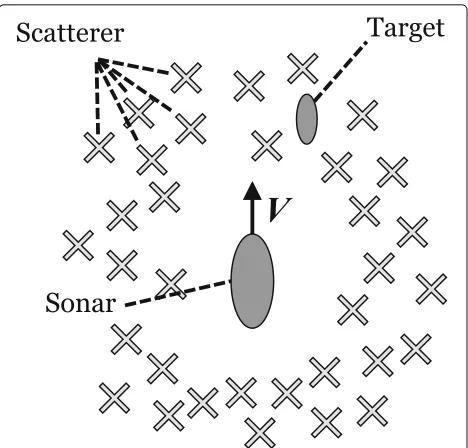
We assume that a sonar (receiver) is moving with con-stant velocity through a field with stationary scattering elements, as shown in Fig. 1. Echo signalse(t)from the target is a replica of transmitted ping signal st(t) with Doppler shiftfd:
Table 1Notation used in the paper
A MatrixA
a(t) The updated value ofaaftertiterations
A⊗B Hadamard (elementwise) multiplication ofAandB
A/B Elementwise division ofAandB
AT Transpose ofA
AC Positive parts of the gradient ofCwith respect toA
∇−
Fig. 1Problem scenario. A moving receiver should detect a low-Doppler target among scatterers
where ais an attenuation factor, td is time delay, and j
is the unit imaginary number. The frequency of se(t) is
given by
Se(f)=aSt(f−fd)exp
−j2πf −fd
td
. (2)
whereSt(f)is the Fourier transform ofst(t).
If the transmitted ping signal is a CW signal with a cen-ter frequencyf0, the received ping signal is a narrowband
signal with frequency(f0+fd). The reverberation signal sr(t)consists of a large number of replicas from scatterers:
sr(t)= i
aist(t−tdi)exp
j2πfdit
, (3)
with spectrum
Sr(f)=
i
aiSt(f −fdi)exp
−j2πf −fditdi, (4)
whereaiandtdiare an attenuation factor and a time delay
ofith scatterer, respectively, and the Doppler shiftfdi is
given by
fdi=
2Vcosψi
c f0, (5)
where V is the speed of the receiver, c is the speed of sound, andψiis the angle between the direction of motion
of the sonar and each scatterer. Equation (5) shows that the spectrum of reverberation has a range of frequency −2V
c
f0<f <
2V c
f0and, hence, has a wider band than
the echo signal when the sonar receiver moves.
Figures 2 and 3 show the spectrograms of the simu-lated target echo and the reverberation, respectively, for a transmitted CW ping signal. Clearly, the target echo
Fig. 2Spectrogram of simulated target echo. The spectrum is well localized in frequency and time, allowing for target detection
is a narrowband signal with frequency f0+ fd, whereas
the reverberation is a broadband signal in the range −2V
c
f0<f <
2V c
f0, as verified in (2) and (4),
respec-tively. Further, unlike reverberations, the spectrum of the target echo signal does not randomly fluctuate over time in response to a received signal. Moreover, the target echo signal last for a short period, whereas reverberation is more persistent.
In this study, we extract the target echo signal from a received signal that contains reverberation. To this end, we analyze the spectrogram of the mixed signal by using NMF with distinctive characteristics of the target echo signal, as detailed below.
3 Proposed method
3.1 Non-negative matrix factorization
NMF allows for the decomposition of a non-negative matrix into a multiplication of two non-negative matrices by using the following model:
V=WH+E, (6)
whereV∈R+K×N,W∈R+K×R,H∈R+R×N, andE∈RK×N.
When NMF is applied to acoustic signal processing,Vis the spectrogram of the input signal withKfrequency bins andNtime frames,WandHare the frequency and the time basis matrices, respectively, andRis the number of basis vectors. Then, NMF determines matricesWandH fromVby alternating estimations
W←arg min
W C(V|WH), (7)
H←arg min
H C(V|WH), (8)
whereC(A|B)is a divergence function betweenAandB. Lee and Seung [15] introduced the multiplicative update rule for two cost functions—namely, the Euclidean dis-tance and the Kullback–Leibler divergence—and Virtanen [22] subsequently generalized the update rule as
W←W⊗∇ −
WC(W,H)
∇W+C(W,H)
, (9)
H←H⊗∇ −
HC(W,H)
∇H+C(W,H)
, (10)
where ⊗ and the fractions represent Hadamard multiplication and elementwise divisions, respec-tively, ∇W+C(W,H), ∇W−C(W,H), ∇H+C(W,H), and ∇H−C(W,H)are elementwise non-negative terms that are
part of gradients
∇WC(W,H)=∇W+C(W,H)−∇W−C(W,H), (11)
∇HC(W,H)=∇H+C(W,H)− ∇H−C(W,H), (12)
and C(W,H) is an arbitrary cost function containing a divergence function and additional constraints.
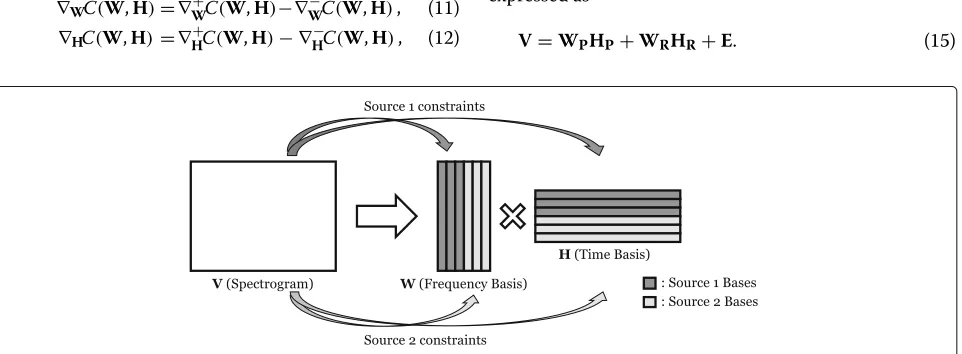
NMF decomposes the spectrogram of the input signal into several basis components in acoustic signal process-ing, with the number of components usually larger than that of the sources. Recently proposed algorithms apply different constraints to each basis group to handle the basis components, depending on the source signal, as illustrated in Fig.4.
3.2 Basis estimation
As shown in Figs.2and3, the target echo signal has dis-tinctive characteristics due to reverberation. The target echo signal is as follows:
• Is a frequency-shifted replica of the transmitted ping
• Has continuous values along the time axis (unlike those of reverberations, which randomly fluctuate)
• Is short and limited in the time domain (unlike reverberations, which are persistent)
To estimate each basis group separately, consider that the frequency and time basis matrices consist of the echo and the reverberation basis groups, respectively, as
W=
WP ... WR
, (13)
H=
HPT ... HRT T
, (14)
whereWP ∈ R+K×RPandHP ∈ R+RP×N are the frequency
and time bases of the echo basis group,WR∈R+K×RRand
HR ∈ R+RR×N are those of the reverberation basis group,
respectively, and RP and RR are numbers of echo and
reverberation bases, respectively. Then, each basis group should be estimated separately as described below.
Applying Eqs. (13) and (14) into Eq. (6), matrixVcan be expressed as
V=WPHP+WRHR+E. (15)
If we define the target echo portion as VP = WPHP
and the reverberation portion as VR = WRHR in the
magnitude spectrogram, Eq. (15) becomes
V=VP+VR+E. (16)
Therefore, the strategy of dividing into basis groups can help identify the energy contribution of each group to the spectrogram, if we apply appropriate constraints. This strategy enables easy application of prior knowledge of frequency and temporal structures, so it is widely used in current research for source separation and speech signal denoising problems [28].
3.2.1 Echo bases
As the target echo signal has a frequency similar in structure to the Doppler-shifted transmitted ping, the fre-quency basis matrix consists of Doppler-shifted replicas of frequency basiswTof the transmitted ping.
Frequency basiswT∈R+K×1and time basishT∈R+1×N
are modeled by rank–one NMF as VT ≈ wThT, where
VT ∈ R+K×N is the spectrogram of transmitted ping st(t). The cost function is defined by the Kullback–Leibler divergence betweenVTandwThT, andwTandhTcan be
are all one. Following convergence, the echo frequency-basis matrixWPconsists of frequency-shifted replicas of
frequency basiswTas follows:
WP=
the maximum number of bins of the Doppler shift to be observed. As shown in Eq. (19), the number of echo bases
RP is 2D+ 1. Equations (17)–(19) depend only on the
transmitted ping and not on the received signal. Hence, the iterative process can be carried out initially andWPis
fixed during runtime.
The time basis matrix of the echo signal is estimated using constraints on temporal continuity and temporal length limitation (TLL) to utilize the second and third characteristics of the echo signal, i.e., time continuity and limited duration, respectively. The cost function consists of error terms
C(WP,HP)=CE(WP,HP)+αCT(HP)+βCL(HP),
(20)
whereCE(WP,HP),CT(HP), andCL(HP)are the costs of
the reconstruction error, temporal continuity, and TLL,
respectively.αandβare the weights of the costs of tempo-ral continuity and TLL, respectively. The gradient of total cost is the weighted sum of the gradients of each cost:
∇HPC= ∇HPCE+α∇HPCT+β∇HPCL, (21) where we omit the parameters of the cost functions for convenience. Assuming that the derivative of each cost function can be expressed as a sum of positive and nega-tive terms, the total cost gradient is given by
∇HPC= ∇H+PCE−∇
andHPis iteratively estimated from (10) as
HP←HP⊗
∇H−PC ∇H+PC
. (25)
Reconstruction error CE is defined by the Kullback–
Leibler divergence, which is often used in NMF for source separation [15]:
fore, the positive and negative terms of the cost function derivative with respect toHPare given by [22]
∇H+PCE=WP
The temporal continuity constraints are defined as [22]
CT =
column. The gradient ofCT with respect toHPis derived
whereHP←1andHP→1are left and right shifts ofHPby
one, respectively,1N×N denotes a N×N matrix whose
elements are all one, and HP2 means an elementwise
square ofHP. By grouping the positive and negative terms,
∇H+PCT and∇
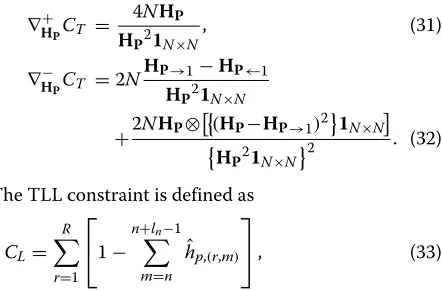
The TLL constraint is defined as
CL=
wherelnis the expected length of a ping. The maximum
value indicator functionhˆp,(r,n)is given as
The individual elements from the positive part∇H+ PCL
We consider the basis matrices of reverberation as com-ponents of the signal that are longer and more fluctuating than the target echo signal. Therefore, the frequency and time basis matrices can be estimated by the multiplicative update rule without additional constraints as
HR ←HR⊗
3.2.3 Reconstruction of the target echo signal
Following the iterative estimation of the basis matrices for the echo and reverberation, (25), (38), and (39) con-verge, and the estimated signal of the target echo can be reconstructed from its basis matrices. The spectrogram of the reconstructed echo signal is calculated from these matrices as
OVout=WPHP. (40)
To construct a complex spectrogram, phase informa-tion is needed. In several NMF-based algorithms, either the phase from the original spectrogram is used [22] or an approach based on the Wiener filter is applied to the orig-inal spectrogram [19]. We observed a similar performance by both methods, but prefer the phase of the original spec-trogram because it allows the easy construction of the complex spectrogram. The estimated target echo signal ˆ
se(t) is then obtained by the inverse short-time Fourier
transform.
The proposed algorithm is summarized in Table 2, whereHP,WR, andHRare initialized using non-negative
random values and iteratively estimated, whereasWP is
initialized and fixed by the frequency-shifted replicas of the transmitted ping spectrumwT.
3.2.4 Considerations on the convergence of the algorithm
Lee and Seung [15] proved that the cost function is non-increasing when the multiplicative update processes (Eqs. (9) and (10)) minimize the Kullback–Leibler diver-gence. Convergence is proved by designing an auxiliary function for the objective functions. The detailed proof can be found in [15, 17] and is briefly reviewed in Appendix2.
It is difficult to show that convergence is guaranteed when the NMF contains additional constraints because finding an appropriate auxiliary function is difficult. How-ever, we expect that the iterative algorithm converges well if α andβ are small, owing to the non-increasing prop-erty of the multiplicative update rules for the Kullback– Leibler divergence. Instead of a theoretical analysis of the
Table 2Proposed algorithm
HP,WR, andHRare randomly initialized with non-negative values, and WP is initialized using (17), (18), and (19). Following initialization, the following process is iteratively performed until convergence:
1. ∇H+
HPCLare calculated using (27), (28), (31), (32), (36), and (37), respectively;
Following convergence, the resulting spectrogramOVout is calculated
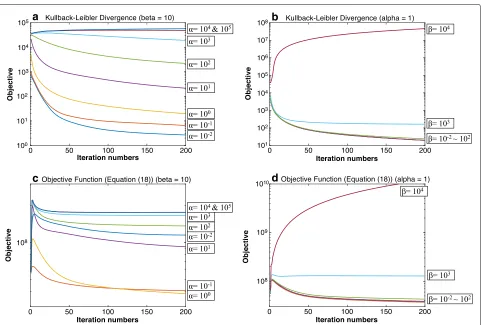
convergence condition, we check the convergence of the objective function with varyingαandβin the simulation experiments presented in Section 4. We observe that the objective function converges well in most cases except for those with very large values ofαandβ, such as 104.
4 Results and discussion
4.1 Simulation with synthesized reverberation
To evaluate the proposed algorithm, we perform simula-tions with synthesized reverberasimula-tions. Specifically, a sonar system transmits CW ping signals of 50 ms and moves forward with speedVsuch that2cV =0.07. The reverber-ation is synthesized using the non-Rayleigh underwater reverberation model [29]. Moreover, the target echo signal is received at 600 ms and the normalized Doppler(fd/f0)
of the target echo is 0.036 for this simulation.
To apply the proposed algorithm, we use the short-time Fourier transform for the received signal with a 16-ms Hamming window, a 75% overlap, and 128 Fourier trans-form points. The number of basis vectors for the echo
RP and reverberationRR of the proposed algorithm are
set to 19 and 60, respectively, and the weight factors for
temporal continuity and TLL constraints,αandβ, are set to 1.0 and 10.0, respectively. The expected ping lengthln
is set to 50 ms. The proposed algorithm is compared with the PCI [9], autoregressive (AR) pre-whitening [10], and SSE [11] algorithms. The length of the time frame and the order of the AR model are set to 64 ms and 20, respec-tively, and these values are selected as the optimal ones through trial and error. The thresholds for eigenvalues of the PCI and SSE algorithms are set to optimal values, assuming that the power of the reverberation is known.
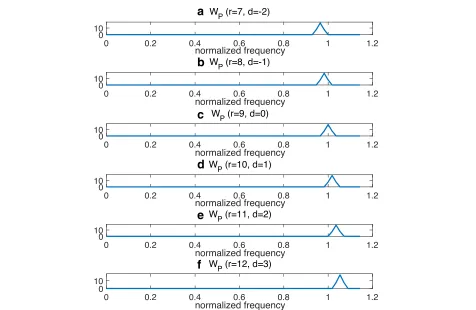
Figures5a–f and6a–f show examples of the basis matri-ces of the echo estimated by the proposed algorithm with an input signal-to-reverberation ratio (SRR) of −12 dB, fromr=7 tor=12, respectively. As shown in Fig.5, the ninth frequency basis vector correspond to the frequency structure of the transmitted CW ping signal, whereas the other basis vectors are shifted from the CW ping in d
bins. Figure6shows that the 11th time basis vector has large values between 600 and 650 ms, whereas the other basis vectors have relatively small values. As the differ-ence in frequency between adjacent bins is 0.018f0in this
experiment, the 11th frequency and time basis vectors
a
b
c
d
e
f
a
b
c
d
e
f
Fig. 6Echo time basis vectors atar=7,br=8,cr=9,dr=10,er=11, andfr=12 (input SRR= −12 dB)
corresponded to the target echo. Thus, the graphs show that the proposed constraints are suitable to find the target echo signal.
Figure7shows the waveforms of the ideal target echo (ground truth, Fig.7a), the received signal comprising the
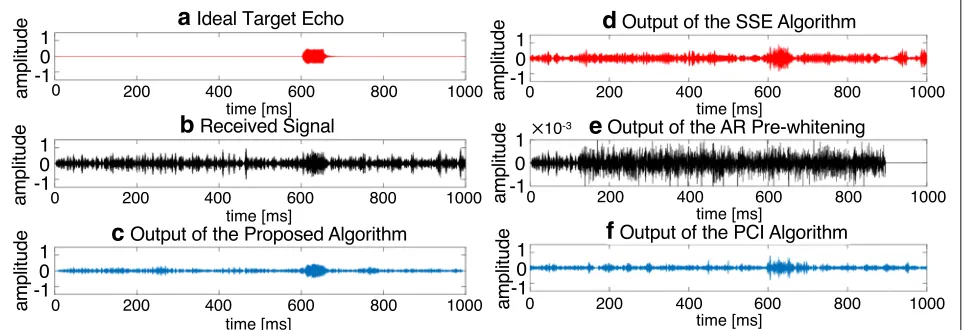
ideal target echo and reverberation (Fig.7b), the output signal obtained using the proposed algorithm (Fig. 7c), the SSE algorithm (Fig. 7d), the AR pre-whitening algo-rithm (Fig.7e), and the PCI algorithm (Fig.7f ). For the algorithms, we consider the input signal shown in Fig.7b.
a
d
b
e
c
f
Fig. 7Waveforms ofaideal target echo signal,breceived signal,coutput signal using the proposed algorithm,doutput by the SSE algorithm,e
Reverberations with amplitudes similar to that of the tar-get echo signal can be seen before applying the algorithm, but the reverberations are removed following the appli-cation of the proposed algorithm. Although the SSE and PCI algorithms can also suppress reverberation, parts of the reverberation signals persist upon application of these algorithms.
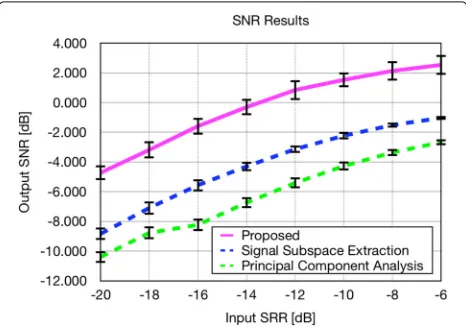
To evaluate the proposed algorithm for various input SRRs, we measure the output signal-to-noise ratio (SNR) using Monte Carlo simulations with 100 iterations per SRR ranging from−20 to−6 dB, with increments of 2 dB. The SNR is calculated as
SNR=
is the output signal obtained after applying the algorithm. Figure8shows the SNR of the proposed, the SSE, and the PCI algorithms. The proposed algorithm achieves an SNR gain of 6 to 15 dB compared to the input SRR and approx-imately 5 to 7 dB compared to the SSE and PCI algorithms. The SNR results of the AR pre-whitening algorithm could not be obtained because the output amplitude of the algorithm is too small. Thus, it is not appropriate to evaluate AR pre-whitening algorithm using the SNR values.
Given that reverberation suppression aims to improve target detection, we calculate the range-Doppler by applying a matched filter to the outputs of the algorithms. To calcu-late the map, we use the block-normalized matched filter [9,11], with the Doppler-shifted transmitted ping signal being
Fig. 8SNR retrieved from the proposed, SSE, and PCI algorithms for various input SRRs. The vertical error bars indicate the standard deviation
transmitted ping signal with Doppler frequency fd, and xi(n) is the ith block of the received signal. Figure9a–e
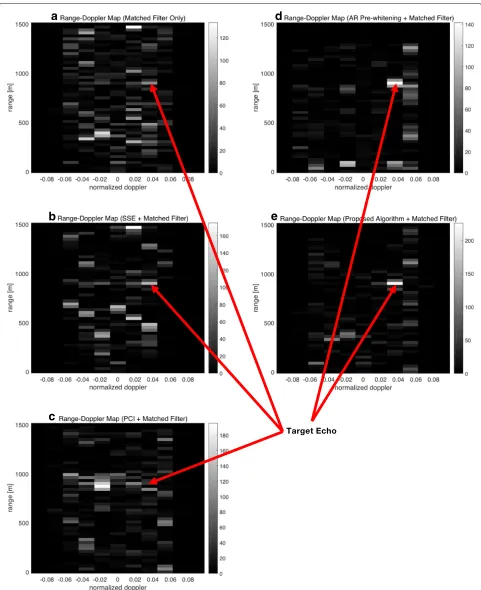
show the results of applying the matched filter only and applying the matched filter with the proposed algorithm, the SSE algorithm, the AR pre-whitening algorithm, and the PCI algorithm, respectively. Figure9a shows that the range-Doppler map has a large value at the location of the target echo, but has many false peaks. Figure 9b shows that the SSE algorithm enhances the target echo, but sev-eral false peaks still remain, and Fig.9c shows that the PCI algorithm retrieves some false peaks over several Doppler frequencies. Figure 9d shows that the AR pre-whitening algorithm yields relatively good performance for enhancing the target echo, but several large false peaks persist near the zero-meter range, for certain Doppler fre-quencies. Figure 9e shows that the proposed algorithm determines the true peak corresponding to the ideal tar-get echo with better intensity than for the other peaks. Therefore, it can reduce false positives when applying a threshold to the matched filter during target detection.
To evaluate detection performance, we calculate the probabilities of detection and false alarm after 1000 Monte Carlo simulations per SRR input. Apositiveis defined as the range-Doppler bin containing the target, whereas a
negativeis defined as a bin with no target. When the value of any bin in the range-Doppler map is greater than a pre-defined threshold, we define those bins as true positives (TPs) if they are positives, and as false positives (FPs) oth-erwise. The probabilities of detection and false alarm are respectively defined as
Detection prob.= Number of TPs
Number of positives, (43)
False alarm prob.= Number of FPs
Number of negatives. (44)
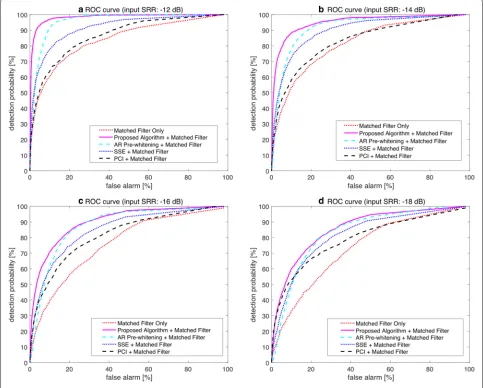
These probabilities are dependent on the threshold, and we thus calculate them for various thresholds to deter-mine the receiver operating characteristic (ROC) curves as shown in Fig.10.
a
d
e
b
c
Fig. 10ROC curves of target detection. The curves are calculated at SRRs ofa−12,b−14,c−16, andd−18 dB
smaller compared to the difference in the low false alarm conditions. Therefore, the proposed algorithm is consid-ered to be more advantageous than the AR pre-whitening algorithm. Figure11shows the detection probability with respect to input SRR conditions at a false alarm probabil-ity of 1%, and the results show that the proposed algorithm can significantly enhance detection performance at SRR inputs between –18 dB and –8 dB with a low probability of false alarms.
To verify the convergence of the proposed algorithm, we calculate the value of the objective functions during iterative estimation. Figure12a and b show the Kullback– Leibler divergence betweenVandWHused to estimate WRandHR(Eqs. (38) and (39)), respectively, and Fig.12c
and d show the objective function, including the costs of temporal continuity and TLL (Eq. (20)), used to estimate HP. The curves are calculated by an ensemble averaged
over 1000 Monte Carlo simulations. We check the value of the objective function by varying the SRR input from –20 dB to 0 dB, but the results are barely affected by the input SRR. We thus show the graph corresponding to –10 dB as input SRR only. As shown in Fig.12a and c, the objective functions do not diverge when the value ofαis less than 104. Figure12b and d show that the objective functions
converge withβless than 104. We test the convergence of the objective functions under several combinations ofα andβ, and the results show similar behaviors regardless of the value of each parameter.
Fig. 11Detection probabilities versus input SRR conditions at a false alarm probability of 1%
a
b
c
d
and the SSE and PCI algorithms use the built-in functions for singular-value decomposition. For a 1-s long signal, the proposed algorithm with 200 iterations requires 0.7 s, whereas the AR and SSE (PCI) algorithms require 0.025 and 0.6 s, respectively. The calculation times of the SSE and PCI algorithms are nearly identical. The proposed algorithm thus requires more calculation time than the conventional algorithms.
4.2 Simulation with measured reverberation
Having verified the performance of the proposed algo-rithm through a simulation, we test it on reverberation measurements acquired at the Eastern Sea of Pohang in the Republic of Korea from a 1-s transmitted CW ping. The reverberation of the CW signal is measured by a nested towed array consisting of 48 sensors moving at four knots.
During this experiment, we assume an input SRR of−12 dB, and the target echo is received after 2 s with a nor-malized Doppler of 1.0025. Its signal is thus interfering with the reverberation. We apply the short-time Fourier transform to the received signal with a 133-ms Hamming window, 75% overlap, and 2048 transform points. As for the simulations with synthesized reverberation, temporal continuity, and TLL weights,α andβ are set to 1.0 and 10.0, respectively, and the expected ping lengthln is set to 1 s. The length of the time frame and the order of the AR model are set to 530 ms and 50, respectively, and these values are selected as the optimal ones through trial and error. The thresholds for eigenvalues of the PCI and SSE algorithms are set to optimal values, assuming that the power of the reverberation is known.
Figure13shows the waveforms of the ideal target echo (ground truth, Fig. 13a), the received signal compris-ing the ideal target echo and reverberation (Fig. 13b), the output signal obtained using the proposed algorithm (Fig. 13c), the SSE algorithm (Fig. 13d), the AR pre-whitening algorithm (Fig. 13e), and the PCI algorithm (Fig. 13f ). It is challenging to identify the target echo from the received signal, whereas it is clearly distinguish-able when the proposed algorithm is applied. Although the SSE and PCI algorithms can also suppress reverbera-tion, parts of the reverberation signals persist following its application.
To analyze the proposed algorithm in the frequency domain, we calculate the spectrograms of the received sig-nal and the output sigsig-nals as shown in Fig. 14. Clearly, the received signal has many undistinguishable compo-nents as shown in Fig.14a, and parts of the reverberation signals persist following the application of SSE and PCI algorithms, as shown in Fig.14b and c, respectively. The AR pre-whitening algorithm suppresses the target echo as well as the reverberation as shown in Fig.14d, whereas the target echo signal is clearly visible in the spectrogram of the algorithm’s output as shown in Fig.14e. Therefore, the proposed algorithm can estimate both the Doppler frequency and the temporal location of the target echo.
Figure15shows the range-Doppler maps of the received signal without reverberation suppression and the pro-cessed signal using the SSE algorithm, PCI algorithm, AR pre-whitening, and the proposed algorithm, respec-tively. Each range-Doppler map is determined from the block-normalized matched filter, as for the simulation of synthesized reverberation. Figure 15a shows significant
Fig. 13Experimental results from measurements in an ocean.aThe ideal target echo,breceived signal comprising target echo and reverberation,
a
b
c
d
e
a d
b
c
e
Fig. 15Range-Doppler maps from measurement experiments. Maps ofareceived signal,boutput signal of the SSE algorithm,coutput signal of the PCI algorithm,doutput signal of the AR pre-whitening, andeoutput signal of the proposed algorithm that is determined using a
block-normalized matched filter
values in the two Doppler frequency bins, where values at the negative Doppler bin correspond to reverberations and those at the positive Doppler bin to the target echo. The values related to reverberations are large and can
suppress the reverberation peak, and Fig.15d shows that the result of AR pre-whitening has a large value near zero meters. Figure 15e shows that the proposed algorithm suppresses the peak of the reverberation and enhances that of the target echo, thus confirming that it performs well in practice.
5 Conclusion
In this work, the detection performance of the target echo from CW ping signals is enhanced in the presence of reverberations. To this end, a reverberation suppression algorithm is proposed based on NMF and distinguishing characteristics between the target echo and reverbera-tions. Specifically, three characteristics of the target are considered: the frequency structure of the target echo is similar to that of the Doppler-shifted transmitted sig-nal, the target echo has time-continuous values, and the target echo has relatively short and finite duration. To use these characteristics, the frequency bases of the tar-get echo are fixed by frequency-shifted transmitted pings, and constraints on the temporal continuity and TLL are developed.
Experiments are conducted with both simulated and measured reverberations to evaluate the proposed algo-rithm. The results of the simulations show the ability of the proposed algorithm to find the target echo signal by enhancing SNR from 6 to 15 dB compared to that of the received signal. ROC curves calculated by a Monte Carlo simulation confirm that the proposed algorithm enhances detection probability with a low false alarm rate. The performance of the proposed algorithm is also veri-fied in an ocean by measuring the reverberations. Overall, the results show that the proposed algorithm suppresses reverberations and enhances detection performance in simulations and practice. Expanding our algorithm to multichannel sonar signals and analyzing the convergence of the constrained NMF are expected to be considered in our future work.
Appendix 1: Gradients of the TLL constraints For the TLL constraint, the backward moving sum of each time basis signal is calculated as
¯ resents the sum of thenth moving block that has a frame index ranging from(n−ln+1)ton. The maximum value
To penalize all data from each time basis except for the moving block that has maximum energy, the TLL con-straint is defined as
The TLL penalty takes values between zero and one per basis r. As shown in (46), the maximum value of
n+ln−1
m=n hpˆ ,(r,m) is one, thus limiting the value of the constraint.
Figure16 shows an example of a simulated TLL con-straint on the basis of limited length corrupted by esti-mation errors. The time basis has a length-limited signal from the 21st to the 30th index, as shown in Fig.16a. The TLL constraint should ideally have large values outside this region because the TLL is designed to penalize the longer signal. The graphs in Fig.16b–d describe (45)–(47), respectively. The TLL constraint (Fig.16e) has large val-ues for every time index except for the region of the signal between the 21st and 30th indices and is thus consistent with the purpose of the design.
Gradient∇HPCL can be determined by the chain rule, but the derivative of (46) is challenging to find. Therefore, we use functionsoftmaxinstead ofmax:
ˆ
The TLL penalty withsoftmax is also between zero and one for each basisrbecause
1− easily determined by the chain rule as
∇hp,(r,n)CL=
Consequently, each element from∇H+
PCLand∇
a
b
c
d
e
f
Fig. 16Example of TLL penalty from length-limited time basis corrupted by error.aTime basishp,(r,n)for short signal.bBackward-moving-summed time basish¯p,(r,n).cMaximum value indicatorhˆp,(r,n).dForward-moving-summed indicatorn+ln−1
m=n hˆp(r,m). TLL constraintCLwithemaxandf
softmaxfunctions
shown in Fig.16e. Thus,softmaxcan be used instead of
maxto design the constraint for the length-limited basis.
Appendix 2: Review of convergence analysis of the NMF algorithm
We briefly review the auxiliary function approach to optimizingHwith the Kullback–Leibler divergence only (α = β = 0). LetCE(h(r,n))denote the Kullback–Leibler
divergence that is a function ofh(r,n)with a fixedw(k,r). An
auxiliary functionC+(h(r,n),h((rt),n))forCE(h(r,n))is defined
by a function that satisfies
C+ h(r,n),h((tr),n)
≥CE
h(r,n)
, (53)
C+h(r,n),h(r,n)
=CEh(r,n)
, (54)
whereh((tr),n)is the updated value ofh(r,n)aftertiterations
(definition 1 in [15]). If we updateh((tr+,n1))as
h((tr+,n1))=arg min
h(r,n)
C+ h(r,n),h((tr),n)
(55)
CE(h(r,n))is non-increasing during the update because
CE h((tr+,n1))
≤C+ h((rt+,n1)),h((tr),n)
≤C+h((tr),n),h((tr),n)
=CE h((tr),n)
.
(56)
Abbreviations
AR: Autoregressive; CW: Continuous wave; FP: False positive; NMF: Non-negative matrix factorization; PCI: Principal component inverse; ROC: Receiver operating characteristic; SNR: Signal-to-noise ratio; SRR:
Signal-to-reverberation ratio; SSE: Signal subspace extraction; TLL: Temporal length limitation; TP: True positive
Acknowledgements
This paper was supported by the Agency for Defense Development (ADD) in Korea (UD160015DD).
Authors’ contributions
SL and JSL conceived and designed the study. JSL defined the problem and directed the study. SL developed the detailed algorithm and performed the experiments. Both authors read and approved the final manuscript.
Competing interests
The authors declare that they have no competing interests.
Publisher’s Note
Springer Nature remains neutral with regard to jurisdictional claims in published maps and institutional affiliations.
Author details
1School of Electronics Engineering, Kyungpook National University, Daehak-ro
80, 41566 Daegu, Republic of Korea.2Department of Electrical Engineering,
Sejong University, Neungdong-ro 209, 05006 Seoul, Republic of Korea.
Received: 12 August 2018 Accepted: 27 January 2019
References
1. K. Mio, Y. Chocheyras, Y. Doisy, inOceans 2000 MTS/IEEE Conference and Exhibition, vol. 2. Space time adaptive processing for low frequency sonar (IEEE, Piscataway, 2000), pp. 1315–1319
2. Y. Doisy, L. Deruaz, S. van IJsselmuide, S. Beerens, R. Been, Reverberation suppression using wideband Doppler-sensitive pulses. IEEE J. Oceanic Eng.33(4), 419–433 (2008)
3. T. Collins, P. Atkins, Doppler-sensitive active sonar pulse designs for reverberation processing. IEE Proc.-Radar, Sonar Navig.145(6), 347–353 (1998)
4. J. Alsup, in33rd Asilomar Conference on Signals, Systems, and Computers, vol. 2. Comb Waveforms for Sonar (IEEE, Piscataway, 1999), pp. 864–869 5. H. Cox, H. Lai, inProceedings of 28th Asilomar Conference on Signals,
Systems and Computers, vol. 2. Geometric comb waveforms for reverberation suppression (IEEE, Piscataway, 1994), pp. 1185–1189 6. S. Kay, J. Salisbury, Improved active sonar detection using autoregressive
prewhiteners. J. Acoust. Soc. Am.87(4), 1603–1611 (1990) 7. V. Carmillet, G. Jourdain, inOCEANS’96 MTS/IEEE Prospects for the 21st
Century, vol. 3. Wideband sonar detection in reverberation using autoregressive models (IEEE, Piscataway, 1996), pp. 1435–1440 8. G. Ginolhac, G. Jourdain, inOCEANS 2000 MTS/IEEE Conference and
Exhibition, vol. 2. Detection in presence of reverberation (IEEE, Piscataway, 2000), pp. 1043–1046
9. G. Ginolhac, G. Jourdain, “Principal component inverse” algorithm for detection in the presence of reverberation. IEEE J. Oceanic Eng.27(2), 310–321 (2002)
10. W. Li, X. Ma, Y. Zhu, J. Yang, C. Hou, Detection in reverberation using space time adaptive prewhiteners. J. Acoust. Soc. Am.124(4), 236–242 (2008) 11. W. Li, Q. Zhang, X. Ma, C. Hou, Active sonar detection in reverberation via
signal subspace extraction algorithm. EURASIP J. Wirel. Commun. Netw.
2010(1), 11 (2010)
12. W. Burdic,Underwater Acoustic System Analysis. (Prentice Hall, NJ, 1991) 13. D. Lee, H. Seung, Learning the parts of objects by non-negative matrix
factorization. Nature.401(6755), 788–791 (1999)
14. P. Smaragdis, J. C. Brown, inIEEE Workshop on Applications of Signal Processing to Audio and Acoustics, vol. 3. Non-negative matrix factorization for polyphonic music transcription (IEEE, Piscataway, 2003), pp. 177–180
15. D. D. Lee, H. S. Seung, inAdvances in Neural Information Processing Systems. Algorithms for non-negative matrix factorization (MIT Press, Cambridge, 2001), pp. 556–562
16. C. Févotte, N. Bertin, J.-L. Durrieu, Nonnegative matrix factorization with the Itakura-Saito divergence: with application to music analysis. Neural Comput.21(3), 793–830 (2009)
17. M. Nakano, H. Kameoka, J. Le Roux, Y. Kitano, N. Ono, S. Sagayama, in Machine Learning for Signal Processing (MLSP), 2010 IEEE International Workshop On. Convergence-guaranteed multiplicative algorithms for nonnegative matrix factorization withβ-divergence (IEEE, Piscataway, 2010), pp. 283–288
18. H. Kim, H. Park, Nonnegative matrix factorization based on alternating nonnegativity constrained least squares and active set method. SIAM J. Matrix Anal. Appl.30(2), 713–730 (2008)
19. A. Ozerov, C. Févotte, Multichannel nonnegative matrix factorization in convolutive mixtures for audio source separation. IEEE Trans. Audio Speech Lang. Process.18(3), 550–563 (2010)
20. E. Vincent, N. Bertin, R. Badeau, inAcoustics, Speech and Signal Processing, 2008. ICASSP 2008. IEEE International Conference On. Harmonic and inharmonic nonnegative matrix factorization for polyphonic pitch transcription (IEEE, Piscataway, 2008), pp. 109–112
21. E. Benetos, S. Cherla, T. Weyde, in6th International Workshop on Machine Learning and Music. An efficient shift-invariant model for polyphonic music transcription (ACM, New York, 2013)
22. T. Virtanen, Monaural sound source separation by nonnegative matrix factorization with temporal continuity and sparseness criteria. IEEE Trans. Audio Speech Lang. Process.15(3), 1066–1074 (2007)
23. S. Ewert, M. Müller, inAcoustics, Speech and Signal Processing (ICASSP), 2012 IEEE International Conference On. Using score-informed constraints for NMF-based source separation (IEEE, Piscataway, 2012), pp. 129–132 24. K. W. Wilson, B. Raj, P. Smaragdis, A. Divakaran, inAcoustics, Speech and
Signal Processing, 2008. ICASSP 2008. IEEE International Conference On. Speech denoising using nonnegative matrix factorization with priors (IEEE, Piscataway, 2008), pp. 4029–4032
25. N. Mohammadiha, P. Smaragdis, A. Leijon, Supervised and unsupervised speech enhancement using nonnegative matrix factorization. IEEE Trans. Audio Speech Lang. Process.21(10), 2140–2151 (2013)
26. S. Lee, S. H. Park, K.-M. Sung, Beamspace-domain multichannel nonnegative matrix factorization for audio source separation. IEEE Sign. Process. Lett.19(1), 43–46 (2012)
27. Y. L. Hao, L. Wang, inAdvanced Materials Research, vol. 383. Compressed sensing recognition algorithm for sonar image based on non-negative matrix factorization and adjacency spectra feature (Trans Tech Publ, Singapore, 2012), pp. 5818–5823
28. C. Joder, F. Weninger, F. Eyben, D. Virette, B. Schuller, inInternational Conference on Latent Variable Analysis and Signal Separation. Real-time speech separation by semi-supervised nonnegative matrix factorization (Springer, Berlin, 2012), pp. 322–329