Volume 2006, Article ID 43759, Pages1–15 DOI 10.1155/WCN/2006/43759
Adaptive Rate-Scheduling with Reactive Delay Control for
Next Generation CDMA Wireless Mobile Systems
Oliver Yu, Emir Saric, and Anfei Li
Department of ECE, University of Illinois at Chicago, 851 S. Morgan Street, 1020 SEO, Chicago, IL 60607, USA
Received 1 October 2005; Revised 11 March 2006; Accepted 26 May 2006
To minimize QoS degradations during nonstationary packet loadings, predictive rate schedulers adapt the operation according to anticipated packet arrival rates deduced via specified estimation algorithm. Existing predictive rate schedulers are developed under the assumption of perfect estimation, which may not be possible in future CDMA-based cellular networks characterized with highly nonstationary and bursty traffic. Additional shortcoming of existing rate schedulers is the coupling of delay and bandwidth, that is, close interdependence of delay and bandwidth (rate), whereby controlling one is accomplished solely by changing the other. In order to mitigate for the arrival rate estimation errors and delay-bandwidth coupling, this paper presents the feedback-enhanced target-tracking weighted fair queuing (FT-WFQ) rate scheduler. It is an adaptive rate scheduler over multiclass CDMA systems with predictive adaptation control to adapt to nonstationary loadings; and feedback-enhanced reactive adaptation control to counteract arrival rate estimation errors. When the predictive adaptation control is not able to maintain long-term delay targets, feedback information will trigger reactive adaptation control. The objective of FT-WFQ scheduler is to minimize deviations from delay targets subject to maximum throughput utilization. Analytical and simulation results indicate that FT-WFQ is able to substantially reduce degradations caused by arrival rate estimation errors and to minimize delay degradations during nonstationary loading conditions.
Copyright © 2006 Oliver Yu et al. This is an open access article distributed under the Creative Commons Attribution License, which permits unrestricted use, distribution, and reproduction in any medium, provided the original work is properly cited.
1. INTRODUCTION
Next generation CDMA-based cellular wireless networks are slated to provide wide range of integrated multime-dia services with a guaranteed quality of service (QoS) (e.g., voice, video, high-speed data). This, in turn, will cre-ate heterogeneous traffic environment characterized with highly nonstationary and bursty transmissions. The uni-versal mobile telecommunication system (UMTS) is a 3rd generation (3G) mobile communication system developed by 3rd generation partnership project (3GPP). It defines “per-class” QoS provisioning, and classifies all traffic into four QoS classes, namely conversational, streaming, in-teractive, and background [1]. Each class has its own connection-level (or call-level) QoS requirements in terms of connection blocking/dropping probabilities, as well as application-level QoS requirements in terms of delay, jit-ter, throughput, BER, and burstiness. QoS provisioning with performance differentiation in a heterogeneous non-stationary environment requires efficient call admission control (CAC) and medium access control (MAC) proto-cols.
Given limited wireless resources, CAC enables connec-tion-level QoS guarantees by implementing class-prioritized admission control. It also enables minimum application-level performance guarantees by limiting the total num-ber of admitted connections. However, due to the bursty nature of packet traffic (especially from the connec-tions of nonreal-time classes) CAC alone is not adequate to provide optimal resource utilizations and application-level performance. MAC algorithm that includes effi -cient packet scheduler needs to accompany an admission controller. It is responsible for provisioning differenti-ated application-level QoS requirements to admitted con-nections by providing optimal resource allocations. This paper focuses on packet scheduler part of MAC algo-rithm that accompanies admission controller proposed in [2].
guarantees, throughput guarantees, delay-bandwidth decou-pling, and low complexity.
Many packet scheduling algorithms have been proposed for CDMA-based wireless networks. The capacity of CDMA systems (especially in uplink) is interference-limited, sub-ject to the variation of signal-to-interference ratios (SIRs), and bandwidth demands of users with limited power con-straints. CDMA system loading factor can be derived to de-note interference-based CDMA resources occupied by trans-mitting users. The schemes in [3–6] utilize interference-based loading and the variants of generalized processor shar-ing (GPS) fair schedulshar-ing discipline to dynamically allo-cate transmission rates and schedule packets in a CDMA-based system. Specifically, the authors in [3, 4] propose code-division GPS (CDGPS) scheduling scheme that max-imizes throughput by providing “weighted fairness” (i.e., relative provisioning) in terms of the rate and signal-to-interference ratio (SIR) guarantees. Similarly the scheme in [5] proposes a rate scheduler with explicit BER guarantees in a wideband CDMA system. The scheme in [6] is a rate scheduler based on the adjusted GPS concept that explic-itly takes into account current channel conditions. It maxi-mizes total throughput by providing “weighted-fair” rate al-locations with BER guarantees. The scheduler in [7] con-trols transmission power and dynamically allocates transmis-sion rates so as to maximize the number of users whose BER is satisfied. To solve such an optimization problem, the au-thors suggest search procedure based on the genetic algo-rithm. One of the drawbacks of the aforementioned schemes [3–7] is thedelay-bandwidth coupling whereby interdepen-dence of delay and bandwidth (e.g., reducing delay im-plies a larger bandwidth allocation) could lead to resource underutilizations. The importance of delay-bandwidth de-coupling is even more signified in the future multime-dia wireless networks supporting traffic with similar delay but considerably different bandwidth requirements or vice versa.
Schedulers in [8,9] dispense with delay-bandwidth cou-pling in a time-division-duplex (TDD) CDMA system by uti-lizing packet-prioritization that arrange transmissions in or-der to explicitly reduce packet delays. Similarly, authors in [10,11] propose token bank fair queuing (TBFQ) schedul-ing algorithm that provides soft QoS guarantees. TBFQ keeps track of previous transmissions and introduces a priority in-dex that determines which connections can utilize excess re-sources.
Time varying fair queuing (TVFQ) scheme in [12] is motivated by the delay-bandwidth decoupling problem. It extends dynamic (weighted) fair queuing concept into mul-ticode (MC) CDMA systems. TVFQ decouples delay and bandwidth by solving a nonlinear integer programming problem that explicitly minimizes queuing delays and pro-duces optimal weight (rate) assignments on a time-varying basis. The authors present computationally efficient solu-tion method based on dynamic programming. However, the problem with TVFQ algorithm as well as the adaptive rate schedulers in [3, 4] is that they rely upon the per-fect estimations of the future traffic arrival rates (or queue
size); estimation errors would degrade their performance. Due to nonstationary traffic expected in the future wire-less networks, arrival rate estimation errors are immi-nent. Consequently, estimation errors could lead to inef-ficient and erroneous resource distributions (i.e., rate as-signments) whereby over-provisioning of some traffic classes might occur even when other classes are not meeting QoS targets. Moreover, TVFQ adapts weights (or rates) based on the future queue size (and predefined priority in-dices) without any regard to absolute delay targets. In a highly nonstationary environment characterized with fre-quent packet bursts, however, it is possible to have a con-nection with large instantaneous queue size (due to sud-den arrival burst) but whose mean delay is significantly below its delay target. Hence, to utilize resources effi -ciently in a nonstationary traffic environment, adaptive rate scheduler needs additional delay target-tracking con-straints so as to minimize delay deviations from absolute tar-gets.
In order to dispense with delay-bandwidth coupling as well as to counteract arrival rate estimation errors and to achieve efficient resource distributions with absolute de-lay target-tracking, this paper proposes feedback-enhanced target-tracking weighted fair queuing (FT-WFQ) scheduler. It dynamically adapts transmission rates on a “per-class” ba-sis such as to minimize overall delay deviations from abso-lute delay targets subject to maximum throughput utiliza-tion. FT-WFQ utilizes predictive adaptation control based on estimated arrival rates, but it also implements concur-rent feedback-enhanced reactive control that detects imper-fections, such as estimation errors, and counteracts them. Feedback control unit monitors average delays of each class and if it detects that a class is degraded (possibly be-cause of estimation errors) it corrects the problem in or-der to achieve efficient resource distributions and mini-mize overall delay deviations from corresponding delay tar-gets.
This paper is organized as follows. InSection 2, system model as well as problem statements are described. Then, in
Section 3, CDMA “bandwidth” in terms of the
interference-based loading is derived. Also, maximum loading-capacity is computed. The proposed FT-WFQ scheduler is thoroughly presented inSection 4. InSection 5analysis and simulation models for performance evaluation are presented.Section 6
displays numerical results and comparison. Finally,Section 7
concludes the paper.
2. SYSTEM MODEL AND PROBLEM STATEMENTS
2.1. System model
allocates resources on a dynamic basis (i.e., every schedul-ing time interval). Transmission is packetized with fixed-length packets and time is divided into frames of equal lengthTf (e.g.,Tf = 10 ms in UMTS). A class-based sys-tem is assumed where packets of each user belong to one of N traffic-classes (e.g., N = 4 in UMTS). Packets of each class have a distinct time-out value (i.e., delay require-ment denoted by a delay target) measured in frames and if not transmitted by this time, they are useless. It is as-sumed that each mobile user has a large enough buffer, so that packets are lost only if not scheduled and transmitted on time (time-out expiration), and not due to buffer over-flow.
Let the maximum uplink capacity of CDMA system (i.e., resource capacity measured in terms of interference-based loading) in the nth time interval be denoted by ηT[n]. The maximum capacity in terms of CDMA load-ing, subject to BER constraints, is analytically derived in the next section (Section 3). In each scheduling time interval n, the job of a packet scheduler is to optimally allocate the available capacity among active (i.e., transmitting) mobile users.
It is implied that the admission control has been con-ducted previously, and only users that are admitted into the system can send packet transmission requests. Admission control is such that each traffic class i (i = 1, 2,. . .,N) is guaranteed minimum allocation rateRi,min(packets/frame).
Packet scheduling is performed to further exploit bursty na-ture of user traffic.
Consequently, whenever active admitted users have packets ready for transmission in the next time interval, they send packet transmission requests (i.e., small signal-ing packets) to the base station (BS) in the current time interval on special uplink random access request chan-nels. It is assumed in this paper that some efficient ran-dom access technique is employed and that ranran-dom ac-cess delay is negligible. Users seeking medium acac-cess in-dicate the number of packets ready for transmission in the next time interval, as well as traffic class of each packet.
BS collects all transmission requests (i.e., small sig-naling packets) for the following time interval. It first
classifies all requests according to their traffic class and then places classified packet requests (one for each packet requested) into N traffic queues on a first-come-first-served basis (see Figure 1). Note that besides new packet requests each queue may also contain unexpired back-logged packet requests that were invoked in previous intervals but were not accommodated for transmission yet.
At the end of the scheduling time interval BS performs the proposed adaptive scheduling algorithm as explained in next sections. The algorithm returns the optimal rate allo-cations (in packets/frame) for each traffic-queue that would minimize delay cost function, namely R∗i,i = 1, 2,. . .,N. Based on these, BS notifies the owners (i.e., users) of the R∗i head-of-line packet requests in the traffic-queue i(i =
Figure 1: Packet scheduler at base station (with N = 4 traffic classes).
the next interval. The notification is through a downlink broadcast control channel. After listening to broadcast con-trol channel, mobile users, which are granted permission to transmit, forward their packets to BS on uplink dedicated channels in the corresponding frame of time intervaln+ 1. The whole process is repeated every scheduling time inter-val.
2.2. Problem statements
2.2.1. Packet arrival rate estimation errors and efficient resource distributions
Adaptation of the existing dynamic scheduling schemes such as time varying fair queuing (TVFQ) [12] is highly sensitive on the real-time estimation of future packet ar-rival rates (or some other measure of future traffic). Traf-fic in the future wireless networks is, however, expected to be highly nonstationary. Due to small cell size and in-creased handoffrates even traffic of real-time classes (con-versational and streaming) observed at BS is expected to fluctuate and be nonstationary. The performance of the adaptive scheduler degrades in the presence of arrival rate estimation errors inherent in nonstationary environ-ment.
Estimation errors could lead to inefficient resource (i.e., rate) distributions and unequal delay deviations from the targets. For instance, classes whose arrival rate is over-estimated will (erroneously) allocate more resources than needed to keep their delays at the corresponding targets. This, in turn, will capture resources from other classes whose delay as a result might rise above targets. Con-sequently, this could lead to a situation where for some classes, large negative deviations from delay targets could be present even when positive delay deviations are ob-served for other classes. Ideally, however, there should not be any negative deviations when positive ones are ob-served.
at the previous time interval. The second one is to use av-erage arrival rate based on observed history (i.e., λi[n] = n−1
j=1λi[j]/(n−1)). The third method they suggest is based on moving average of the first two methods. From these es-timation techniques it is evident that they are prone to er-rors in a highly nonstationary environment subject to sud-den bursts of packet arrivals.
Furthermore, TVFQ scheduler does not consider abso-lute delay targets when dynamically adapting weights (or rates). In a highly nonstationary environment even under perfect traffic estimations it is possible to have connections whose traffic queue size is large due to sudden traffic bursts but whose mean delay is significantly below corresponding delay target. Thus, for efficient rate adaptations, target track-ing constraints that minimize delay deviations need to be in-corporated.
2.2.2. Delay-bandwidth coupling
One of the major shortcomings of dynamic rate scheduler, such as the ones based on GPS, is the coupling of delay and bandwidth. It refers to close interdependence of delay and rate (i.e., bandwidth) parameters, whereby provision-ing one parameter (e.g., delay) can only be accomplished by changing the other (e.g., rate). For instance, in GPS, the delay of a class-queue is controlled by changing its allo-cated rate (i.e., bandwidth). Since delay and bandwidth can-not be modified independently, the BS scheduler would al-locate high rate to a class-queue with low delay requirement even if this class has low bandwidth requirement. This would lead to high bandwidth underutilizations. Delay-bandwidth coupling problem is even more signified in a future multi-class environment where multi-classes with similar delay ments might have significantly different bandwidth require-ments (e.g., voice and video). In order to utilize resources efficiently, a dynamic scheduler needs to decouple delay and bandwidth such that both parameters can be guaranteed in-dependently.
3. LOADING AND MAXIMUM LOADING CAPACITY IN CDMA SYSTEM
This section presents the concept of loading as an integrated measure of resource-usage in a multiclass CDMA system. The maximum possible loading capacity subject to BER con-straints is also derived. These results are used by the dynamic resource monitor of the proposed scheduler as explained in detail inSection 4.
3.1. CDMA interference-based loading
LetGp,ibe the processing gain (or the spreading factor) of a user that belongs to traffic-classi(i = 1,. . .,N), defined asGp,i=W/ri, whereW is the system bandwidth in Hz (or chip rate), andriis the bit rate of auserof traffic classi. The signal energy per bit to noise-plus-interference ratio (Eb/I0)i
of a user of classi,i=1, 2,. . .,N(observed at BS) is given as
whereSiis the received signal power of a user of classi, and Itotalis the total received wideband power including thermal
noise powerPN in the BS. Assume a perfect power control such that the received power levelsSi of all users belonging to the same classiare equal. Letγibe the minimum value of (Eb/I0)i required for acceptable BER (for a user of class i). Therefore, for satisfactory BER, the following constraints need to be satisfied (∀i): It can be shown that the received power levels are mini-mized when the above equation is satisfied with equality. Let S∗i be the received power level of a user of classisuch that the above equation is satisfied with equality. Thus,
S∗i = 1
1 +Gp,i/γi·Itotal.
(3)
Note, however, that the received power level Si is bounded by the maximum valueSi,maxwhich is dependent on
(mobile) transmit power, and achieving feasibleS∗i ≤Si,max
is a requirement that limits maximum interferenceItotalthat
a system is able to tolerate, as elaborated in the next sub-section. Let the load factor incrementΔηiof a user of class ibe defined asΔηi≡S∗i /Itotal.Therefore,
Δηi= 1
1 +Gp,i/γi. (4)
AssumingNiusers of classiare in the system,Itotalis given as
Itotal=
N
i=1
Ni·S∗i +PN. (5)
Using terminology of the last section, note that the bit rate of the “class”iis given asRi=Ni·ri. Let noise riseNRbe defined as the ratio of total received wideband noise power in BS to the thermal noise power (NR=Itotal/PN). Substituting into the above formulas,
NR=Itotal
3.2. Maximum loading capacity
Theoretically, the maximum loading, denoted as ηT, is 1. In reality, however,ηT is limited by utmost interference (or loading) a system is able to tolerate (given BER and limited powerSi,maxconstraints). From the above (5) and (7), the
to-tal interferenceItotalcan be expressed in terms of loadingηas Itotal=PN/(1−η). Then, the BER constraints of (2) become
Therefore, loading bound, or the maximum loadingηT tolerated by a system is given as
ηT =min WEIGHTED FAIR QUEUING (FT-WFQ)
Two versions of FT-WFQ rate scheduling scheme are pro-posed, namely, heuristic and optimal. The proposed scheme is characterized with the following features.
(i) It supports a multiclass prioritized adaptive rate scheduling with “per-class” QoS support including guaranteed rate, delay, and BER. To maintain QoS guarantees the proposed scheme adapts to changing traffic conditions by employing predictive adaptation based on estimation of future packet arrival rates as well as feedback-enhanced reactive adaptation control. (ii) It exploits feedback-enhanced reactive control in or-der to maintain delay targets (target tracking) and to counteract arrival rate estimation errors. When pre-dictive adaptation fails to maintain delay targets (due to arrival rate estimation errors or high congestions) feedback information is utilized to correct rate alloca-tions. Feedback control ensures that deviations from delay targets are minimized by efficient allocation of resources during failure condition.
(iii) It decouples delay and bandwidth (i.e., rate) param-eters. Maintaining delay targets and rate allocation are accomplished through a separate control. Total scheduling delay is explicitly minimized while rate guarantees are still met.
(iv) It utilizes cross-layered design, whereby dynamic re-source monitor ensures that allocated rates are feasible in the sense that BER is satisfied for all transmitting users. Interference-based loading is used to denote re-source usage in a CDMA system.
4.1. FT-WFQ architecture
The unifying architecture that applies to both versions (heuristic and optimal) of feedback-enhanced target-track-ing weighted fair queutarget-track-ing (FT-WFQ) scheduler is shown
in Figure 2. The scheduler consists of feedback-enhanced
scheduling unit (F-SU) fed and controlled by arrival rate estimator block (AE), feedback control unit (FCU) and
dy-namic resource monitor (DRM). F-SU defines an
optimiza-tion problem that optimally allocates transmission rates every scheduling time interval. The optimization problem within F-SU is shaped by the information provided by AE, FCU, and DRM, and its objective is to minimize delay cost function as defined in the next subsections. AE block pro-vides estimated arrival rates for the following time inter-val, while FCU monitors average delay incurred by each class, and adjusts optimization problem within F-SU if de-lays exceed pre-defined targets (i.e., it provides a corrective feedback). The feedback adjustment (as well as optimiza-tion problem within F-SU) is heuristicoroptimal depend-ing on the version of scheduler and as elaborated in the fol-lowing subsections. DRM on the other hand dynamically recalculates total resources (i.e., CDMA capacity) available and checks if scheduling assignment is feasible by adding (cross-layer) resource constraint in the optimization prob-lem.
4.2. Heuristic-based scheme
Let λi[n] be the estimated arrival rate of class i (i = 1, 2,. . .,N) for thenth scheduling time interval measured in packets per frame (note that the actual estimation method is not considered in this paper). It is provided by the ar-rival rate estimator block (AE) (Figure 2). Also, let Qi[n] be the queue size (in packets) of class i at the beginning
of the nth (scheduling) time interval. Note that Qi[n] is known to the BS scheduler as it represents the current packet backlog. Considering thenth time interval in isolation, the scheduling delay (in frames) of classipacket-queue is given by
Di[n]=Qi
[n] +λi[n]·T
Ri[n] , (12)
Class 1
Figure2: Architecture of FT-WFQ scheduler (with four traffic classes).
In order to mitigate for the estimation error, as well as to meet mean delay objectives as efficiently as possible, the followingheuristic-based feedback control unit (FCU) that initiated adjustment of the optimization problem in F-SU is proposed. Let Td,i denote mean delay target for pack-ets of class i (measured in frames). It is an operator spe-cific value based on the level of QoS guarantee provided. The FCU monitorsmean packet scheduling delays of each class. Let the running average of monitored packet delay of class i at the time interval n be denoted as Di[n]. Start-ing from the highest priority class (class 1) with descend-ing priority, FCU finds classi(if any) whose delayDi[n] is above targeted thresholdTd,i (i.e.,Di[n] > Td,i). This sig-nals that the estimation error occurred (with high proba-bility) and that class iwas degraded due to wrong assign-ments. FCU then “preempts” all classes j = iwhose mean delayDj[n] is below corresponding targeted threshold (i.e., all classes j for whichDj[n] < Td,j). A “preempted” class is constrained to minimum guaranteed rate and it is pre-vented from sharing excess resources (in that time inter-val). “Preemption” is conducted by sending feedback infor-mation that changes corresponding constraints in optimiza-tion problem within (heuristic) F-SU in the nth interval. This ensures that class jreceives only minimum guaranteed service rate until delay of class i has stabilized. The pseu-docode of FCU-initiated heuristic adjustment is shown in
Figure 3.
Let the set of preempted classes (in thenth time interval) be denoted byP. LetηT[n] denote the total capacity avail-able as evaluated by dynamic resource monitor (DRM), and let constantpiindicate different priorities in the system, such that if classihas higher priority than class j, then pi > pj. Then, the optimization problem of (heuristic) F-SU in the
intervalnis formulated (for clarity of presentation indexnis dropped) as follows. lay below its delay target Td,i. However, in order to make the solution feasible in the case of unpredicted bursts, each class is only guaranteed service rate Ri,min, which is the
Heuristic FCU in intervaln:
Figure3: Pseudocode of FCU-initiated heuristic.
4.3. Optimal scheme
The objective of the optimal scheduling scheme (i.e., F-SU) is to minimize the overall delay and in the case of arrival rate estimation errors or high loading congestions to minimize mean delay deviations from the corresponding targeted ob-jectives. It is “optimal” in the sense that it explicitly mini-mizes delay deviations from targeted objectives and as such allocates resources as efficiently as possible. It is, however, not overall optimal as it only considers single time interval in iso-lation, whereas the overall optimal scheme would consider a larger time horizon.
The optimization problem is defined as follows. Let the
indicator functionID[n] in thenth time interval be defined as
ID[n]=
where as in the last subsectionDi[n] denotes the mean (FCU) monitored scheduling delay of class i at the time interval n, andTd,iis the mean delay target for packets of class ias measured in frames. Therefore, the binary indicator function ID[n] is set to 1 if mean delay ofanyclass exceeds its delay tar-getTd,i. This signals that resources were assigned erroneously either due to arrival rate estimation errors or due to very high congestion. The indicator function is set by the (opti-mal) feedback control unit (FCU) (recall that FCU explicitly monitorsmeanpacket scheduling delaysDi[n] of each class i). Using the same terminology as in the last subsection, the optimization problem of the optimal F-SU in the intervaln is formulated (for clarity of presentation indexnis dropped) as follows. Note that the proposed optimization problem will mini-mize total deviations from delay targets if FCU detects that mean delay of any class exceeds corresponding delay tar-get (i.e., if the indicator function ID[n] is set to 1), oth-erwise it will minimize the total delay (i.e., if the indica-tor function ID[n] is set to 0). The reasoning behind this is that if the mean delay of all classes is below their re-spective delay targets, then the objective is to minimize the overall delay, whereas if delay of any class is above its corresponding delay target, the resources should be redis-tributed so as to keep delay of all classes as close to their delay targets as possible. In other words if there is any class whose mean delay is above its corresponding delay tar-get, there should be no classes whose mean delay is below theirs.
The constraints in (17a) and (17b) are analogous to the corresponding constraints in a heuristic-based problem of the last subsection with constraint in (17b) due to DRM.
5. PERFORMANCE ANALYSIS AND SIMULATION MODELS
In this section, the analysis and simulation models are devel-oped for the proposed FT-WFQ scheduler in nonstationary traffic environment. Four traffic classes (i.e.,N=4) defined in UMTS network are considered (seeTable 1). Performance measures are mean delay and service rate assigned to each class.
5.1. Delay analysis with nonstationary packet
arrival rate and estimation error
Assume that packets of class i (i = 1, 2, 3, 4) arrive ac-cording to a nonstationary Poisson arrival process with mean arrival rate of λi(t) (packets/frame). Nonstationary Poisson arrival process is characterized by time-varying mean arrival rate λi(t) modeled as follows. Time is di-vided into equal length (scheduling) time intervals of du-ration T frames. In the nth interval (n = 1, 2, 3,. . .) mean arrival rate λi(n·t) (denoted as λi[n]) takes a ran-dom value according to a uniform distribution. It re-tains this value for the duration of interval n. Without any loss of generality, the four aforementioned nonstation-ary Poisson arrival processes are assumed to be indepen-dent.
Table1: Numerical values of QoS parameters for each class.
Traffic classi Traffic type (UMTS QoS class) Delay tolerance (frames) orpacket timeout value Tdi
QoS requirements
Minimum rateRi,min BER requirement
1 Conversational <1 12 kbps 10−3
2 Streaming 1–2 128 kps 10−4
3 Interactive 2–4 32 kbps 10−5
4 Background >8 0 10−7
the scheduling algorithm (in thenth interval). As discussed previously the estimator is not perfect, and consequently it is assumed that an additive white Gaussian errorεnis intro-duced in each intervaln, that is,
λi[n]=λi[n] +εn. (18) As noted above,εnis a white Gaussian random process with meanε, and variance 0.1·ε, for alln. Also,E[εn·εk]=0 for alln=k(E[·] is the expectation operator).
In thenth time interval, class i (i = 1, 2, 3, 4) packet-queue receives service rateR∗i [n] (packets/frame) in accor-dance with the solution of the optimization problem de-fined in (13) for the heuristic-based scheduler or (16) for the optimal scheduler. Hence, each classiqueue can be con-sidered in isolation with time-varying arrival rateλi[n] and time-varying service rateR∗i[n]. Such a queue can be rep-resented by anM[n]/D[n]/1 system, whereM[n] represents the nonstationary packet arrival process as defined above andD[n] stands fordeterministic server operating at opti-mal rates ofR∗i[n]. Because of its time-varying nature, it is very difficult to analyze M[n]/D[n]/1 system directly (i.e., to solve Kolmogorov forward equations). However, various approximations have been proposed in the literature. One very simple approximation is called point-wise stationary approximation(PSA) also known as quasistationary approx-imation [14,15]. According to PSA, in each time interval n,M[n]/D[n]/1 system can be approximated by a station-aryM/D/1 model where the current value ofλi[n] is used as “stationary” arrival rate and the current value ofR∗i[n] is used as deterministic service rate in that particular in-terval. For PSA approximation to be valid, duration of the time interval (T) should be 4–5 times greater than the packet service time, so that the system can asymptotically reach a steady-state. Consequently, in analytical approximationT frames (for some large enoughT) constitute one time inter-valn.
Assuming M/D/1 model in each time-interval n (n =
1, 2,. . .), instantaneous PSA delay for class i (denoted as Di[n]) is given by Pollaczek-Khinchin delay formula [16]:
Di[n]= λi[n]/
R∗i[n]
2
21−λi[n]/R∗i[n] + 1
R∗i[n].
(19)
Then, PSArunning averagedelay of classiused by feedback control unit (FCU) is defined as
Di[n]=Di[n−1]·(n−1) +Di[n]
n . (20)
In the accordance with the proposed scheduler, FCU monitors PSA running average delay of each classi(20) and adjusts optimization problem in the nth time interval ac-cordingly, as explained inSection 4. Hence, the optimization problem is solved in each time intervalnas given in (13) for the heuristic-based or (16) for the optimal scheduler. MAT-LAB (optimization toolbox) was utilized to solve the actual optimization problem in thenth time interval.
5.2. Simulation model with nonstationary packet
arrival rate and estimation error
Proposed scheduling scheme was simulated in a nonstation-ary environment using an event-driven simulation tool OP-NET [17]. The model consists of four traffic generators (one for each class), and the base station (BS) where the schedul-ing algorithm is implemented. As in the analysis section, time is divided into equal-duration intervalsnof lengthTframes. Traffic generators generate traffic according to four indepen-dent nonstationary Poisson processes as in the last subsec-tion. As in the analysis, it is assumed that the additive white Gaussian estimation errorεnis present when estimating the actual arrival rate. The meanεof the estimation error was used as a simulation parameter.
In order to solve the optimization problem in (13) or (16) using optimization toolbox provided by MATLAB, a co-simulation interface model of OPNET and MATLAB was de-veloped. The “mx” interface provided by MATLAB was used, as explained in detail in [18]. (This is very useful if one needs to use MATLAB algorithms when simulating complex com-munications systems with discrete event simulator.) The run-ning average delay statistic was collected for each class dur-ing simulation run-time. In accordance with the proposed scheduling scheme, this information was used by feedback control unit (FCU) to adjust optimization problem in each time interval.
6. ANALYSIS AND SIMULATION NUMERICAL RESULTS
1.4 1.2 1 0.8 0.6 0.4 0.2 0
Dela
y
(fr
ames)
0 80 160 240 320 400
Time FT-WFQ (optimal) FT-WFQ (heuristic)
TVFQ TargetTd1 (a)
2 1.8 1.6 1.4 1.2 1 0.8 0.6 0.4 0.2 0
Dela
y
(fr
ames)
0 80 160 240 320 400
Time FT-WFQ (optimal) FT-WFQ (heuristic)
TVFQ TargetTd2 (b)
5 4.5 4 3.5 3 2.5 2 1.5 1 0.5 0
Dela
y
(fr
ames)
0 80 160 240 320 400
Time FT-WFQ (optimal) FT-WFQ (heuristic)
TVFQ TargetTd3 (c)
10 9 8 7 6 5 4 3 2 1 0
Dela
y
(fr
ames)
0 80 160 240 320 400
Time FT-WFQ (optimal) FT-WFQ (heuristic)
TVFQ TargetTd4 (d)
Figure4: Analysis: delay for classes 1–4 (no estimation error).
proposed in [12]. Consistent with the last section, four traf-fic classes are considered.
6.1. No arrival rate estimation error
Due to nonstationary traffic conditions, even under per-fect traffic estimations, the selection of priority weights pi needed to maintain delay targets becomes a difficult task for the TVFQ scheduler. In this subsection, the performance of TVFQ scheme [12] is compared to the proposed scheduling schemes under such conditions (i.e., nonstationary arrivals
Table2: Summary of analysis and simulation parameters.
Parameter Value
Class 1 arrival process Poisson, uniform range: 0≤λ1≤0.4·ηT
Class 2 arrival process Poisson, uniform range: 0≤λ2≤0.3·ηT
Class 3 arrival process Poisson, uniform range: 0≤λ3≤0.38·ηT
Class 4 arrival process Poisson, uniform range: 0≤λ4≤0.25·ηT
Delay targetsTdi(in frames) Td1=0.9 Td2=1.7 Td3=3.5Td4=8
Interval sizeT(in frames) 20
Maximum powerSi,max 100 (mW)
Mean estimation errorε −0.5 (also varied)
Priority weightpi p1=6 p2=4 p3=2 p4=1
20 15
10
5 0
5
1 2 3 4 5
Class
P
er
centage
(%)
Normalized percent change from target
Total deviation
Dtotal
Optimal FT-WFQ Heuristic FT-WFQ TVFQ
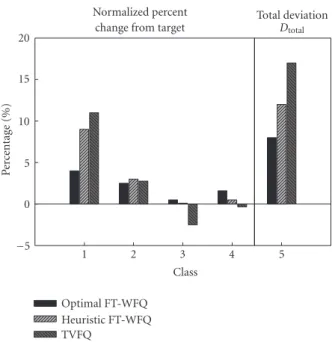
Figure5: Analysis: delay percent change from target (no estimation error).
bar charts shown on the left part ofFigure 5that show nor-malized mean delay deviation of each class from the respec-tive delay target (normalization is with respect to priority weights, that is, for classishown ispi/ p1·actual deviation).
As evident fromFigure 4and the bar chart on the left part
ofFigure 5, TVFQ scheme performs the worst resource
allo-cations among the compared schemes as it does not imple-ment any target-tracking constraints. It forces high positive delay deviations from targets for classes 1 and 2, respectively,
even when large negative delay deviations for classes 3 and 4 are present (see left part ofFigure 5). Thus it wastes resources by over-feeding classes 3 and 4 during their light packet ar-rivals, when these excess resources could have been allocated to classes 1 and 2, respectively. FromFigure 4and bar chart in
Figure 5, it can be seen that the proposed FT-WFQ schemes
(heuristic and optimal) achieve far better resource distribu-tions and that the total delay deviadistribu-tions from the targets are minimized. By utilizing feedback-enhanced reactive control designed to explicitly minimize delay deviations from the corresponding delay targets, the heuristic-based and optimal FT-WFQ schemes slightly increase the mean delay of classes 3 and 4, respectively by reducing resources (i.e., rates) allo-cated to them, but nevertheless keeps them close to their re-spective targets. As evident fromFigure 4and the bar chart on the left ofFigure 5, this in turn provides more resources to accommodate heavy traffic arrival from classes 1 and 2, re-spectively, thereby reducing their mean delay deviations from the targets. It can also be seen that the optimal FT-WFQ scheme achieves better resource allocations than heuristic-based scheme as its objective is to explicitly minimize delay deviations.
Total performance gain/loss is quantified as follows. From the bar charts on the left in Figure 5, the total de-viation from targets Dtotal is defined and calculated as Dtotal =
|DVi|whereDViis the normalized deviation of classi(i=1, 2, 3, and 4). Hence, evaluating from the left part ofFigure 5for TVFQ:Dtotal=0.11(11%) + 0.0275(2.75%) +
1.4 1.2 1 0.8 0.6 0.4 0.2 0
Dela
y
(fr
ames)
0 100 200 300 400
Time FT-WFQ (optimal) FT-WFQ (heuristic)
TVFQ TargetTd1 (a)
2
1.5
1
0.5
0
Dela
y
(fr
ames)
0 100 200 300 400
Time FT-WFQ (optimal) FT-WFQ (heuristic)
TVFQ TargetTd2 (b)
5 4 3 2 1 0
Dela
y
(fr
ames)
0 100 200 300 400
Time FT-WFQ (optimal) FT-WFQ (heuristic)
TVFQ TargetTd3 (c)
10 8 6 4
2 0
Dela
y
(fr
ames)
0 100 200 300 400
Time FT-WFQ (optimal) FT-WFQ (heuristic)
TVFQ TargetTd4 (d)
Figure6: Delay: for classes 1–4 (no estimation error).
The corresponding OPNET simulations results, namely, running averages of delays and delay deviations are shown in Figures 6 and 7, respectively. The results are in close agreement with the corresponding analytical results (from Figures 4 and5) with differences in instantaneous values
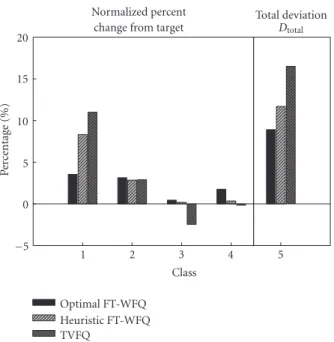
mainly due to highly random nature of nonstationary ar-rival process as defined in the previous section. As the an-alytical results, simulations from Figures 6 and7 demon-strate that the proposed schemes are able to minimize de-viations from corresponding delay targets and allocate re-sources efficiently. The total deviationsDtotalobserved form
Figure 7 for TVFQ, heuristic, and optimal FT-WFQ are
16.5%, 11.7%, and 8.9%, respectively. It is also worth men-tioning that analysis and simulation results in Figures 4
and6, respectively, show that the system stabilizes relatively quickly.
6.2. Results under arrival rate estimation error
20 15
10 5 0
5
1 2 3 4 5
Class
P
er
centage
(%)
Normalized percent change from target
Total deviation
Dtotal
Optimal FT-WFQ Heuristic FT-WFQ TVFQ
Figure7: Simulation: delay percent change from target (no estimation error).
error is assumed in this subsection with mean errorεof−0.5. Subsequently, the study was repeated using different error-mean values.
The analytical delay running averages (measured in frames) versus time for classes 1–4, respectively, are shown
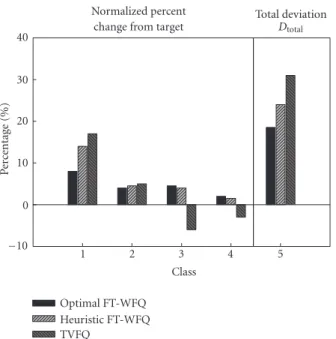
in Figure 8(for ε = −0.5). The corresponding bar charts
showing (normalized) mean delay deviations from delay tar-gets for each class as well as the total deviations Dtotal are
shown on the left and right parts, respectively, ofFigure 9. As expected and evident from Figures 8 and9, the regu-lar TVFQ is the most affected by an estimation error as it is not able to correctly adapt resource (i.e., rate) alloca-tions. FromFigure 9it can be seen that class 1 is affected the most as TVFQ degrades its mean delay to 15% above cor-responding delay target. Note that resources not allocated to class 1 are utilized by lower priority classes as evident by unintended decrease of their mean delay (seeFigure 9). Thus, TVFQ wastes resources by allowing positive (nor-malized) deviations from the targets (classes 1 and 2) even when negative (normalized) deviations are present (classes 3 and 4). By employing feedback-enhanced reactive adapta-tion control, proposed FT-WFQ schemes achieve much bet-ter resource distributions thereby keeping mean (normal-ized) delays closer to corresponding targets (see Figures 8
and9, respectively) and are thus able to substantially mitigate for the arrival rate error effect. FromFigure 9, mean (nor-malized) delay deviations of class 1 for the heuristic-based and optimal FT-WFQs are 14% and 7.5%, respectively. Cal-culating similarly as in the last subsection from Figure 9, the total deviation from targets Dtotal for TVFQ,
heuris-tic, and optimal FT-WFQs are 29.5%, 24.5%, and 19.5%, respectively (shown on the right part of Figure 9). Thus,
the heuristic FT-WFQ achieves a reduction in mean devia-tion as compared to regular TVFQ, while the optimal FT-WFQ as expected distributes resources the most efficiently and achieves the largest reduction in the total deviation. It is also worth mentioning that when other mean-error val-ues ε are used instead, similar results are observed. These results are verified by OPNET simulation model, but are not shown due to space limitations. It is worth mentioning that simulation and analytical results are in strong agree-ment.
To compare results under different error conditions, the above analysis (and simulation) is repeated for other mean values of errorε.Figure 10shows the total deviation (Dtotal)
versus mean-estimation error (ε) observed for the compared schemes using PSA analysis. Shown are results for both un-derestimation (ε <0) and overestimation (ε >0) cases. Ob-serve that the optimal FT-WFQ achieves the lowest total deviations for all mean-estimation errors (ε), and as the magnitude of error increases so does the gain of the op-timal FT-WFQ compared to the other schemes. Almost identical results are obtained by OPNET simulation (not shown).
7. CONCLUSIONS
1.4 1.2 1 0.8 0.6 0.4 0.2 0
Dela
y
(fr
ames)
0 50 100 150 200 250 300 350 400 Time
FT-WFQ (optimal) FT-WFQ (heuristic)
TVFQ TargetTd1 (a)
2.5
2
1.5
1
0.5
0
Dela
y
(fr
ames)
0 50 100 150 200 250 300 350 400 Time
FT-WFQ (optimal) FT-WFQ (heuristic)
TVFQ TargetTd2 (b)
4 3.5 3 2.5 2 1.5 1 0.5 0
Dela
y
(fr
ames)
0 50 100 150 200 250 300 350 400 Time
FT-WFQ (optimal) FT-WFQ (heuristic)
TVFQ TargetTd3 (c)
9 8 7 6 5 4 3 2 1 0
Dela
y
(fr
ames)
0 50 100 150 200 250 300 350 400 Time
FT-WFQ (optimal) FT-WFQ (heuristic)
TVFQ TargetTd4 (d)
Figure8: Analysis: delay for classes 1–4 (estimation error).
control. Predictive control adjusts rate allocations based on the anticipated network conditions reflected by estimated arrival rates. When the predictive adaptation control fails to maintain delay targets (due to estimation errors or ex-tremely high loading), the corrective feedback-enhanced re-active control ensures that deviations from delay targets are minimized.
40
Figure9: Analysis: delay percent change from target (estimation error).
Figure10: Analysis: total deviation versus estimation error.
ACKNOWLEDGMENTS
This work was supported in part by the National Science Foundation (NSF) under Contract SCI-0129527. The au-thors are thankful to the editors of this special issue and to the anonymous reviewers for their valuable comments and suggestions.
REFERENCES
[1] H. Holma and A. Toskala,WCDMA for UMTS, John Wiley & Sons, West Sussex, UK, 2000.
[2] O. Yu, E. Saric, and A. Li, “Fairly adjusted multimode dynamic guard bandwidth admission control over CDMA systems,” IEEE Journal on Selected Areas in Communications, vol. 24, no. 3, pp. 579–592, 2006.
[3] L. Xu, X. Shen, and J. W. Mark, “Dynamic bandwidth alloca-tion with fair scheduling for WCDMA systems,”IEEE Wireless Communications, vol. 9, no. 2, pp. 26–32, 2002.
[4] L. Xu, X. Shen, and J. W. Mark, “Dynamic fair scheduling with QoS constraints in multimedia wideband CDMA cellular net-works,”IEEE Transactions on Wireless Communications, vol. 3, no. 1, pp. 60–73, 2004.
[5] X. Wang, “An FDD wideband CDMA MAC protocol with minimum-power allocation and GPS-scheduling for wireless wide area multimedia networks,”IEEE Transactions on Mobile Computing, vol. 4, no. 1, pp. 16–28, 2005.
[6] C. Li and S. Papavassiliou, “Fair channel-adaptive rate scheduling in wireless networks with multirate multimedia services,”IEEE Journal on Selected Areas in Communications, vol. 21, no. 10, pp. 1604–1614, 2003.
[7] M. Moustafa, I. Habib, and M. N. Naghshineh, “Efficient radio resource control in wireless networks,”IEEE Transactions on Wireless Communications, vol. 3, no. 6, pp. 2385–2395, 2004. [8] I. F. Akyildiz, D. A. Levine, and I. Joe, “A slotted CDMA
pro-tocol with BER scheduling for wireless multimedia networks,” IEEE/ACM Transactions on Networking, vol. 7, no. 2, pp. 146– 158, 1999.
[9] X. Wang, “A new scheduling scheme for the wideband TD-CDMA MAC protocol,” inProceedings of IEEE International Conference on Communications (ICC ’01), vol. 3, pp. 974–978, Helsinki, Finland, June 2001.
[10] W. K. Wong, H. Zhu, and V. C.M. Leung, “Soft QoS provision-ing usprovision-ing the token bank fair queuprovision-ing schedulprovision-ing algorithm,” IEEE Wireless Communications, vol. 10, no. 3, pp. 8–16, 2003. [11] W. K. Wong, H. Y. Tang, and V. C. M. Leung, “Token bank
fair queuing: a new scheduling algorithm for wireless multi-media services,”International Journal of Communication Sys-tems, vol. 17, no. 6, pp. 591–614, 2004.
[12] A. Stamoulis, N. D. Sidiropoulos, and G. B. Giannakis, “Time-varying fair queueing scheduling for multicode CDMA based on dynamic programming,” IEEE Transactions on Wireless Communications, vol. 3, no. 2, pp. 512–523, 2004.
[13] C.-C. Li, S.-L. Tsao, M. C. Chen, Y. Sun, and Y.-M. Huang, “Proportional delay differentiation service based on weighted fair queuing,” inProceedings of the 9th International Conference on Computer Communications and Networks (ICCCN ’00), pp. 418–423, Las Vegas, Nev, USA, October 2000.
[14] O. B. Jennings and W. A. Massey, “A modified offered load approximation for nonstationary circuit switched networks,” Telecommunication Systems, vol. 7, no. 1–3, pp. 229–251, 1997. [15] L. Green and P. Kolesar, “The pointwise stationary approxi-mation for queues with nonstationary arrivals,”Management Science, vol. 37, no. 1, pp. 84–97, 1991.
[16] T. Robertazzi,Computer Networks and Systems: Queueing The-ory and Performance Evaluation, Springer, New York, NY, USA, 2000.
[18] V. Dham, L. A. DaSilva, A. Annamalai, and V. Srivastava, “A phased array antenna model for space division multiple access in wireless networks,” inProceedings of OPNETWORK Confer-ence, Washington, DC, USA, August 2002.
Oliver Yureceived the B.A.S. (1981), M.A.S.
(1991), and Ph.D. (1997) degrees in elec-trical and computer engineering from the University of British Columbia in Canada. He had extensive industry research and de-velopment experiences. He had held techni-cal leadership and engineering management positions in Microtel, Nortel, Hughes, and Motorola. He is currently a Research Asso-ciate Professor at the Department of
Elec-trical and Computer Engineering in the University of Illinois at Chicago. His research interests are in the areas of fourth-generation wireless systems, all-optical photonic networks, next generation In-ternet, and computing grid systems. He has been working on re-search projects that are funded by the National Science Foundation (NSF) and the Department of Energy (DOE). He received the Ca-reer Award from DOE in 2003.
Emir Saric received the B.S. and M.S.
degrees in electrical and computer engi-neering from the University of Illinois at Chicago (UIC) in 2001, and 2004, respec-tively. He is currently working towards the Ph.D. degree in electrical and computer en-gineering at UIC. Since 2004, he has been a Research Assistant for Professor O. Yu at the Networking and Wireless Communications Laboratory, UIC. His research interests
in-clude QoS provisioning (MAC and admission control) and perfor-mance evaluation of future cellular wireless networks and cognitive wireless networks.
Anfei Lireceived the B.S. degree from