On the detections of C
60and derivatives in circumstellar environments
Yong Zhang and Sun Kwok
Department of Physics, University of Hong Kong, Pokfulam, Hong Kong, China
(Received October 31, 2012; Revised May 20, 2013; Accepted June 18, 2013; Online published October 24, 2013)
C60(buckminsterfullerene) was recently discovered in a variety of circumstellar environments by theSpitzer
Space Telescope, suggesting that the envelopes around evolved stars are active sites for the synthesis of fullerenes. However, the physical state, excitation mechanism, and formation route of circumstellar C60are not completely understood so far. These open issues are discussed in this paper. For that purpose we investigate the observed wavelengths and strengths of C60 bands and compare them with the experimental values. We also statistically study the environments and emission properties of the C60 sources. We would like to stress that improved flux measurements and more accurate Einstein coefficients are required to draw solid conclusions. Furthermore, we present possible detections of hydrogenated C60and C+60, and discuss their implications on fullerene chemistry in circumstellar environments.
Key words:Infrared, ISM, AGB and post-AGB, circumstellar matter, molecules.
1.
Introduction
The Ih-symmetrical buckminsterfullerene C60, arranged as 12 pentagons and 20 hexagons, is the smallest closed car-bon cage molecule (fullerene) satisfying the isolated pen-tagon rule (IPR; followed by higher fullerenes C70, C74, C76, C78, C80, and so on), and thus is remarkably stable. Although its existence has been early predicted (Osawa, 1970; Bochvar and Galpern, 1973), C60 was first discov-ered in laboratory experiments simulating the circumstellar chemistry (Krotoet al., 1985). Kr¨atschmeret al.(1990b) developed a method to efficiently produce C60 in the lab-oratory, making it possible to study in detail its electronic and vibrational properties. Because of its high stability and symmetry, C60can be taken as a benchmark to study other fullerenes. C60and its derivatives have long been suspected to be present in the universe. The search for this compound in nature started soon after its synthesis in the laboratory, and its detections in geological materials and meteorites have been reported by several groups (e.g. Buseck et al., 1992; Becker and Bada, 1994; Beckeret al., 1994; Hey-mannet al., 1996)1.
The detection of C60 in deep space has proven a long lasting challenging task (Snow and Seab, 1989; Claytonet al., 1995; Kwok et al., 1999; Moutou et al., 1999; Her-big, 2000; Sassaraet al., 2001). C60has three broad peaks at 216, 264, and 339 nm in its electronic spectrum, and four infrared (IR) vibrational modes at 7.0, 8.5, 17.4, and 18.9μm. Hydrogpoor and carbon-rich circumstellar en-velopes, such as R Coronae Borealis (RCB) stars (Goeres and Sedlmayr, 1992), are analogous to the laboratory con-ditions for the synthesis of fullerenes and thus were
sug-Copyright cThe Society of Geomagnetism and Earth, Planetary and Space Sci-ences (SGEPSS); The Seismological Society of Japan; The Volcanological Society of Japan; The Geodetic Society of Japan; The Japanese Society for Planetary Sci-ences; TERRAPUB.
doi:10.5047/eps.2013.06.003
gested to be ideal sites to search for C60; however, this was not supported by observations (Garc´ıa-Hern´andez et al., 2011b). So far, there is no successful report on the de-tection of electronic transitions of C60. The Infrared Spec-trograph (IRS; Houck et al., 2004) on the Spitzer Space Telescope (Spitzer; Werner et al., 2004) now provides an unprecedented opportunity to detect the IR vibrational tran-sitions. The first convincing detection was recently made by Cami et al. (2010), who detected C60 and C70 in the
Spitzer/IRS spectrum of the young planetary nebula (PN) Tc 1. Soon after, C60 was detected in a variety of evolved stars, including PNs in the Milky Way and the Magellanic Clouds, a protoplanetary nebula (PPN), post asymptotic gi-ant branch (AGB) stars, modestly hydrogen-deficient RCB stars, and a peculiar binary object (Garc´ıa-Hern´andezet al., 2010, 2011a, b; Claytonet al., 2011; Gielenet al., 2011; Zhang and Kwok, 2011; Evanset al., 2012; Robertset al., 2012). Fullerenes may also be widely present in the inter-stellar medium (ISM). C+60has been proposed as the possi-ble carrier of diffuse interstellar bands (L´egeret al., 1988), and its electronic spectra in Ar and Ne matrices indeed show a reasonable match to two near-IR diffuse bands (Foing and Ehrenfreund, 1994). Photoabsorption by fullerenes and multi-layered fullerenes (buckyonions) has been suggested as the origin of the 217 nm extinction feature (de Heer and Ugarte, 1993; Iglesias-Groth, 2004; Li et al., 2008). Re-cently, the C60 IR bands have been detected in reflection nebulae (RNs) and the Orion nebula (Sellgrenet al., 2010; Rubinet al., 2011). Furthermore, Robertset al.(2012) de-tected C60 in pre-main-sequence objects including young stellar objects and a Herbig Ae/Be star. These detections suggest that C60can be formed in a short time scale between AGB and PN stages, and can survive (or be resynthesized under favorable conditions) in the ISM.
However, based on a laboratory spectroscopic investiga-tion, Duley and Hu (2012) presented that the 7.0, 8.5, 17.4, and 18.9μm features in the spectra dominated by aromatic infrared bands (AIBs) actually arise from proto-fullerenes that are precursors of C60, and thus the C60molecules were detected only in sources that do not show AIBs. Garc´ıa-Hern´andezet al.(2012b) did not detect C60electronic tran-sitions in the optical spectrum of a RCB star that exhibit AIBs and the (supposed) C60 IR features, and suggested that this supported the conclusion of Duley and Hu (2012). However, it is surprising that C60electronic transitions are not detected in the high-quality optical spectrum of the strongest C60 source without AIB emission, Tc 1 (Garc´ıa-Hern´andez and D´ıaz-Luis, 2013).
The formation route of C60 is a subject of debate. In-vestigating this problem may provide significant insights into the circumstellar chemistry. The experiments of Kroto
et al. (1985) suggest that small carbon clusters can self-assemble into C60in a hydrogen-poor environment (bottom-up), and otherwise the formation of polycyclic aromatic hydrocarbons (PAHs) is favored. This scenario is sup-ported by the fact that no AIBs are detected in the PN Tc 1 (Camiet al., 2010). Nevertheless, J¨ageret al.(2009) found that fullerenes can be formed by gas-phase con-densation reactions in the presence of hydrogen at very high temperature (>3500 K). Another formation mecha-nism of C60 is through shock- or UV-induced decomposi-tion of hydrogenated amorphous carbon (HAC) grains (top-down), through which PAHs can be simultaneously formed (Garc´ıa-Hern´andezet al., 2010; Bernard-Salaset al., 2012; Micelotta et al., 2012). The supporting evidence comes from the facts that most of the C60 sources also exhibit AIBs, and C60 is not detected in extremely hydrogen-poor RCB stars (Garc´ıa-Hern´andez et al., 2011b). A similar mechanism was proposed by Bern´e and Tielens (2012), in which C60is formed through UV-induced dehydrogenation and isomerization of graphenes. This model can explain the observation of the RN NGC 7023 by Sellgrenet al.(2010) that the C60/AIB flux ratios decrease with increasing dis-tance from the central star. Moreover, Boersmaet al.(2012) found that C60 can coexist with the carriers of AIBs in the shielded regions of Orion.
A related question is what drives the excitation of C60 IR emission. Thermal excitation of solid fullerenes (Cami
et al., 2010; Garc´ıa-Hern´andez et al., 2011a) and UV-excitation of gas-phase C60 molecules (Sellgren et al., 2010) have been discussed. The first systematical compar-ison of the two mechanisms was made by Bernard-Salas
et al.(2012) who found that the IR spectra of three PNs with strong C60features favor fluorescence as the excitation mechanism. However, Roberts et al. (2012) and Garc´ıa-Hern´andezet al.(2012a) argued that thermal excitation can better explain the observed C60flux ratios.
Mapping the spatial distributions of C60and AIBs is es-sential to understand the formation routes of fullerenes in astrophysics. However, this is very difficult for circumstel-lar envelopes given their compactness and the weakness of C60emission. Another approach to investigate this problem is to probe hydrides of fullerenes (fulleranes). The pres-ence of fulleranes in space has been predicted (e.g.
Web-ster, 1992, 1993; Petrie and Bohme, 2000; Cataldo and Iglesias-Groth, 2009). When hydrogen atoms are attached to carbon atoms of C60, the conversion of delocalizedπ -into σ-character orbitals decreases the bond angle strain. Therefore, when exposed to atomic hydrogen, C60 can be quickly hydrogenated into C60Hm (m = 2,4,...,60). On the other hand, heavily hydrogenated C60is highly unstable because of large strain resulting from hydrogen-hydrogen repulsion. It follows that moderately hydrogenated C60 is likely to exist in circumstellar environments. Indeed, in lab-oratory conditions, it is easy to produce C60H36that can fur-ther form C60H18through thermal annealing (e.g. Iglesias-Grothet al., 2012) but the production of fulleranes with a larger or lower degree of hydrogenation is much more diffi-cult. Robertset al.(2012) noticed that two C60sources also exhibit the very rare C-H emission from hydrogen-coated nanodiamonds, a species that can be formed together with fullerenes, so it is reasonable to believe that C-H emission from C60Hmis also detectable in some C60sources.
In this paper, we study the properties of all the reported C60sources and compare the observations with existing ex-perimental and theoretical results. In Section 2, we investi-gate the wavelengths and widths of the C60IR bands, aim-ing at understandaim-ing the physical state of circumstellar C60. In Sections 3 and 4, we respectively discuss the excitation and formation problems of fullerenes based on the mea-sured band strengths. In Section 5, we present a search for fulleranes in the carbon-rich PPN IRAS 01005+7910 utiliz-ing the spectrum obtained by theInfrared Space Observa-tory(ISO; Kessleret al., 1996), and briefly discuss C+60and C−60in the PN Tc 1. The conclusions are given in Section 6.
2.
Wavelengths of the IR-active Bands
C60has 174 normal vibrational modes that are distributed among 46 frequencies owning to its icosahedral symme-try. Of these modes, only 4 IR-active vibrational bands of F1u symmetry and 10 Raman-active bands of Ag and Hg symmetries have been observed in laboratory experiments. Throughout this paper we only focus on the four IR C60 bands that are of astrophysical interest. Because of inter-molecular interactions, the wavelengths of IR bands from solid C60 clusters might differ from those from gas-phase molecules and depend on the environment temperatures. Therefore, the comparison between the observed and ex-perimental wavelengths of the C60 IR bands enables us to investigate the physical state of circumstellar fullerenes.
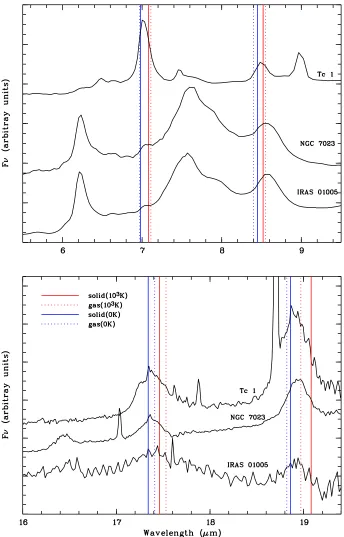
Fig. 1. The comparison of the experimental wavelengths of the four IR bands of solid- and gas-phase C60. The solid black curves are the observed spectra of IRAS 01005+7910, NGC 7023, and Tc 1 (courtesy of Kris Sellgren, Jan Cami, and Jeronimo Bernard-Salas). Note that the 7.0, 8.5, and 17.4μm features are blended with AIBs in the spectra of NGC 7023 and IRAS 01005+7910.
the circumstellar envelopes are probably in a similar phys-ical state. An inspection of Fig. 1 indicates that the peak wavelengths of the 17.4μm feature seem to suggest that circumstellar C60 is in the solid phase at a low tempera-ture (<500 K) rather than in the gas phase. The conclusion, however, is arguable in that the spectra of NGC 7023 and IRAS 01005+7910 exhibit the 16.4μm features, and thus the 17.4μm feature is probably blended with an AIB (Sell-grenet al., 2010; Bern´e and Tielens, 2012). The observed peak-wavelengths of the other three C60features lie well
in-side the experimental wavelength ranges of both solid- and gas-phase C60. Therefore, we cannot completely rule out a gas-phase origin although a solid-phase origin is favored.
Experimentally, the 17.4 and 18.9μm features in the
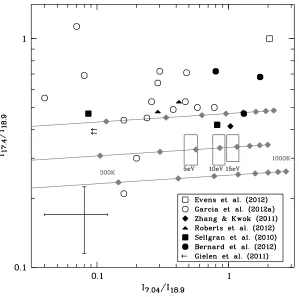
Fig. 2. The 17.4μm / 18.9μm versus 7.0μm / 18.9μm band ratios for NGC 7023, IRAS 01005+7910, and Tc 1. The effective temperatures of their excitation sources are given in brackets. The closed boxes represent the predictions of UV-excitation model by Sellgrenet al.(2010). The average photon-energy is given within each box. The curve marked with lozenges represents the predictions of thermal model. The A-values for both models are taken from the same literature (Choiet al., 2000).
gas-phase IR spectrum have a full-width at half maximum (FWHM) of about 0.4μm at 1065 K (Frum et al., 1991). Chaseet al.(1992) found that the band widths of C60shift little in the solution and in the solid state, suggesting that C60 in the solid state is virtually a gas-phase-like, freely rotating molecule. The band widths are partially due to vibration-rotation coupling, scaling roughly with the square root of the temperature. Therefore, one can, in principle, estimate the temperature by comparing the observed band widths with the experimental values. A comparison be-tween the experimental results of Frumet al. (1991) and Chaseet al.(1992) suggests that the band widths of solid-phase C60 are 2–3 times narrower than those of gas-phase at the same temperature. The FWHMs of the observed 17.4 and 18.9μm features are 0.26–0.36μm, implying a gas temperature of 400–900 K. The implicated temperature might be higher if C60 is in the solid phase. While inter-esting, these results should be viewed with some caution because they might be related to the experimental condi-tions, which are quite different from those of circumstellar envelopes. The 17.4 and 18.9μm features might be blended with weak C70 emission (see, e.g., figure 1 of Camiet al., 2010), slightly affecting their FWHMs. Moreover, if the C60 bands arise from regions with large temperature fluc-tuations, the situation will be complicated in that the shifts of peak wavelengths can make an additional contribution to the band broadening.
3.
On the Excitation of C60
Vibrational Spectra
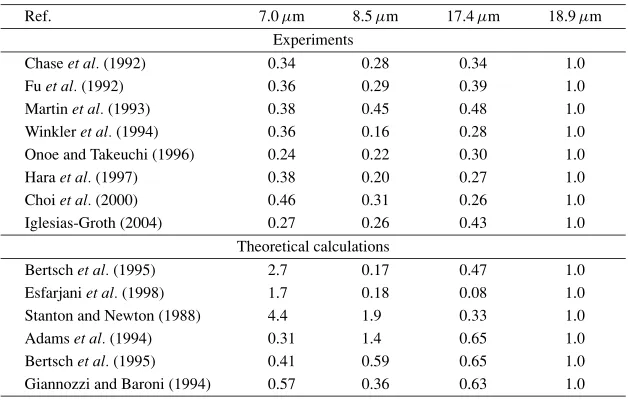
It is essential to understand the excitation mechanism of fullerene emission as it enables us to accurately determine the abundance of C60and establish how useful the C60bands are to probe circumstellar environments. Two possible sce-narios have been discussed in previous paper, but results remain conflicting. Camiet al. (2010) found that a ther-mal model can interpret the C60 emission in Tc 1. In that case, C60is attached to dust grains which are in equilibrium with the UV radiation field, and one can calculate the ther-mal temperature from the Boltzmann excitation diagram of C60 band ratios. Garc´ıa-Hern´andezet al. (2011a) derived thermal temperatures of 200–500 K for a sample of C60 -detected PNs. On the other hand, Sellgren et al. (2010) assumed that C60is isolated free molecules in the gas phase and has a similar excitation mechanism with PAHs as dis-cussed by Allamandolaet al.(1989). In this scenario, C60is excited to high electronic states by absorbing UV starlight, and then the electronic energy is quickly redistributed via internal conversion, followed by IR emission through cas-cading down the vibrational ladder to the ground vibrational state. Since the probabilities of UV-photon absorption and IR-photon emission respectively depend on the absorption cross-sections and Einstein A-values of the corresponding energy levels, a Monte Carlo technique3can be used to sim-ulate this process. Therefore, if the UV-excitation model is valid, the C60 IR bands can be used to probe the cir-cumstellar radiation field. The model of Sellgren et al.ob-Table 1. C60band strengths normalized to that of the 18.9μm feature.
Ref. 7.0μm 8.5μm 17.4μm 18.9μm
Experiments
Chaseet al.(1992) 0.34 0.28 0.34 1.0
Fuet al.(1992) 0.36 0.29 0.39 1.0
Martinet al.(1993) 0.38 0.45 0.48 1.0
Winkleret al.(1994) 0.36 0.16 0.28 1.0
Onoe and Takeuchi (1996) 0.24 0.22 0.30 1.0
Haraet al.(1997) 0.38 0.20 0.27 1.0
Choiet al.(2000) 0.46 0.31 0.26 1.0
Iglesias-Groth (2004) 0.27 0.26 0.43 1.0
Theoretical calculations
Bertschet al.(1995) 2.7 0.17 0.47 1.0
Esfarjaniet al.(1998) 1.7 0.18 0.08 1.0
Stanton and Newton (1988) 4.4 1.9 0.33 1.0
Adamset al.(1994) 0.31 1.4 0.65 1.0
Bertschet al.(1995) 0.41 0.59 0.65 1.0
Giannozzi and Baroni (1994) 0.57 0.36 0.63 1.0
served in NGC 7023, but predicts too large I7.0/I18.9 ratios in NGC 2023. A recent study of three PNs by Bernard-Salas
et al.(2012) does not favor the thermal model because (1) the excitation classes of these PNs are very different while the C60flux ratios are fairly similar, and (2) C60is located in a region far from the central star and would be difficult to be heated to the deduced thermal temperatures. However, a different conclusion was subsequently drawn by Garc´ıa-Hern´andezet al.(2012a) who subtracted the contribution of C70to the observed 7.0μm flux and found that the UV-excitation model cannot explain the C60 flux ratios for a larger sample of PNs. Bernard-Salaset al.(2012) did not take into account the contribution of C70because the band strengths cannot be accurately estimated without appropri-ate excitation model.
To investigate this problem, in Fig. 2 we compare the 17.4 μm / 18.9 μm and 7.0 μm / 18.9 μm band ratios for three well C60-detected sources at different evolutionary stages. The predictions of UV-excitation (Sellgren et al., 2010) and thermal models are also plotted in Fig. 2, where the A-values are derived from Choiet al. (2000) for both models. The thermal model is constructed using the same way as described by Bernard-Salaset al. (2012). Similar to the thermal model for>500 K, the UV-excitation model predicts a nearly invariable 17.4 μm / 18.9μm band ra-tio (also see Bernard-Salaset al., 2012). An inspection of Fig. 2 shows that the observations are situated at positions closer to the predictions of the UV-excitation model. In the scenario of UV-excitation, the 7.0μm / 18.9μm band ratios increase with increasing UV radiation. This is consistent with the observational facts that among the three sources the central star of the PN Tc 1 has the highest effective tem-perature, and it is followed by the PPN IRAS 01005+7910 and the RN NGC 7023. Nevertheless, the observed 17.4μm / 18.9μm band ratios appear larger than the model predi-cations. This is partially due to the contamination of an
3The Monte Carlo model of Sellgrenet al.(2010) applies to single-photon excitation. If the UV radiation field is sufficiently intense, it is more ap-propriate to use the statistical equilibrium method (A. Li, private commu-nication).
AIB to the 17.4μm feature (except for Tc 1 which does not show AIBs). Another possible cause is that the A17.4value of Choiet al.(2000) has been underestimated. This is also shown in figures 5 and 6 of Bernard-Salaset al.(2012).
In Fig. 3, we compare the A-values obtained from the band strengths given in previous literatures, as listed in Table 1. The theoretical band strengths are remarkably inconsistent with the experimental values. The theoreti-cal theoreti-calculations, based on semi-empiritheoreti-cal or first-principle models, differ significantly in the resultant band strengths, especially for the 7.0μm / 18.9μm band ratios. The exper-imental band strengths are more concentrated in Fig. 3 than the theoretical values, yielding an average strength ratio of (0.35±0.07) : (0.27±0.09) : (0.34±0.08) : 1.0 for the 7.0, 8.5, 17.4, and 18.9μm bands. We can see that, in-deed, the A17.4value of Choiet al.(2000) is a factor of 1.3 lower than the average value. Through the comparison, we estimate that the A-values have a 20–30% error. It should be noted that all the experiments were performed in con-densed phases and the results might be perturbed by inter-molecular effects. Experiments of gas-phase C60will be in-valuable to improve the A-values in the future. In addition, the UV-excitation model also relies on the photoabsorption cross section of C60which contains some uncertainties (Ya-sumatsuet al., 1996; Iglesias-Grothet al., 2002; Yagiet al., 2009).
prob-Fig. 3. The comparison of Einstein coefficients (A-values) taken from previous literatures. The open and filled circles represent the theoretical and experimental values, respectively. The insert at the low-left corner is a zoom-in view of the experimental values.
Fig. 5. The 8.5μm / 18.9μm versus 7.0μm / 18.9μm band ratios. The symbols are the same as in Fig. 4. Note that the 7.0μm band strengths of Garc´ıa-Hern´andezet al.(2012a) were estimated from thermal models, and thus cannot be used to argue against the fluorescence model (see the text).
ably have rather large uncertainties. For example, even for the strongest fullerene emission PN Tc 1, Bernard-Salaset al.(2012) and Garc´ıa-Hern´andezet al.(2012a) gave quite different flux ratios.
The C608.5μm band can be detected only in objects that do not exhibit strong AIBs. In Fig. 5, we compare the 8.5 μm / 18.9μm and 7.0μm / 18.9μm band ratios. Compared with those by Bernard-Salaset al.(2012), the band ratios obtained by Garc´ıa-Hern´andezet al.(2012a) systematically shift toward the left side of the figure. This is attributed to the different estimates for the contamination of C70 emis-sion. Assuming a Boltzmann population ratio, Garc´ıa-Hern´andezet al.(2012a) estimated the strengths of the C60 7.0μm band from the 8.5, 17.4, and 18.9μm bands. Thus, it is only natural that the data points of Garc´ıa-Hern´andez
et al.(2012a) are more close to the predictions of thermal models, which cannot be used to argue against the con-clusion of Bernard-Salaset al.(2012). The main problem of the thermal model is that a high fullerene temperature (mostly>300 K) is required, and hardly agrees with those implicated by dust thermal emission. On the other hand, Fig. 5 demonstrates that the UV-excitation model predicts an unacceptably low average photon energy (mostly <5 eV). This is the main argument of Garc´ıa-Hern´andez et al.(2012a) against the UV-excitation model. However, the UV-excitation model of Sellgrenet al.(2010) applies only for free-flying C60molecules. If the circumstellar fullerenes are in a cluster state, more intense radiation field will be ex-pected to excite the C60IR bands, and the model of Sellgren
et al.(2010) only gives the lower limits of the average pho-ton energy. If this was the case, the scattering band ratios in
Figs. 4 and 5 would partially reflect the variation of cluster sizes in these sources.
Some alternative mechanisms, such as the release of chemical energy (Duley and Williams, 2011) and atom im-pacts (Papoular, 2012), have been introduced to explain the excitation of AIBs. It remains unknown whether these mechanisms play a role on the excitation of C60IR bands.
4.
On the Origin of C60
is strongly suppressed. However, C60 has been detected in O-rich binary post-AGB stars (Gielenet al., 2011), contrary to what is required by the bottom-up route4.
In Table 2 we compare the effective temperatures of the central stars and the other emission features of C60 ob-jects. They all have effective temperatures of<35,000 K, suggesting that fullerenes cannot form or survive in strong UV-radiation fields. This situation is similar to that of the unidentified 21μm feature that has been discovered in a small number of PPNs (Kwoket al., 1989). Most of the sources exhibit AIBs arising from C-H modes, consistent with the experimental results of hydrocarbon combustion. Not all of them show the 30μm feature and the 15–20μm plateau. It is intriguing that the plateau emission at 6– 10μm and 10–14μm is revealed in all the sources, indi-cating that their carriers are likely to be related to fullerene formation. Kwok and Zhang (2011) presented that AIBs and plateau emission can be uniformly attributed to stretch-ing and bendstretch-ing modes of mixed aromatic-aliphatic or-ganic nanoparticles (MAONs), and during stellar evolu-tion, aliphatic chains can be processed into aromatic rings. Garc´ıa-Hern´andezet al.(2010) and Micelottaet al.(2012) proposed that fullerenes can be formed from HAC grains and “arophatic” clusters, both of which have a structure similar to that of MAONs. Thus, we infer that circumstellar fullerenes are produced by MAONs following the scheme suggested by Micelottaet al.(2012). In this scenario, proto-fullerenes, as proposed by Duley and Hu (2012), are first formed through dehydrogenation of MAONs accompanied by introduction of pentagons following the IPR and a path-way of minimizing the number of dangling bonds, and later on are processed into vibrational-excited closed cages by re-ducing the number of dangling bonds to zero. The fullerenic cages can be transformed into the most stable isomers by means of a series of Stone-Wales rearrangements. Finally, the fullerenic cages are shrink to smaller cages like C60 by releasing excess energy. The dehydrogenation may be in-duced by either UV photons or shocks, but the latter seems to be favored at least for a few C60 sources whose central stars have relatively low effective temperatures (<7000 K; Table 2). The percentage of carbon in circumstellar C60 is estimated to be less than 0.3% (Zhang and Kwok, 2011; Garc´ıa-Hern´andezet al., 2012a). Since the carriers of AIBs presumably lock up 6% of the cosmic carbon (Cerrigone
et al., 2009), we infer that only small amounts of MAONs can be transformed into C60even under the most favorable conditions.
Because MAONs have a 3D structure, the formation pro-cess of fullerenic cages can take place in a layered struc-ture. This provides a possible route for the formation of buckyonions, which have been suggested as the carrier of the 217 nm interstellar absorption feature.
The C70/C60abundance ratio has important implications in understanding the formation route of fullerenes. The C70/C60 ratio of PNs ranges from 0.02 to 0.21 (Garc´ıa-Hern´andezet al., 2012a), comparable to the values of ge-ological fullerenes (0.08 in the Allende meteorite, Becker
4The detection of C
et al., 1994; 0.21–0.36 in terrestrial clays, Heymannet al., 1996). In laboratory, the C70/C60 ratio is highly variable. The hydrocarbon combustion process yields a C70/C60 ra-tio ranging from 0.26 to 0.57 (Howardet al., 1991), which tends to increase with increasing pressure. This ratio is much larger than that obtained through graphite evapora-tion methods (0.02–0.18, e.g. Ajieet al., 1990). One can-not simply argue that the low C70/C60 ratio in PNs seems not to favor the top-down scenario, because the circumstel-lar envelopes have a significantly lower pressure than lab-oratories and the fullerene formation in combustion exper-iments is not completely understood. Moreover, this range of C70/C60ratio is very uncertain since C70has been mea-sured only in a very few sources. The abundance of gener-ated higher fullerenes beyond C70 is relatively low, which cannot be theoretically explained. In addition, we cannot rule out the possibility that the C70/C60ratio can be modi-fied by chemical processes in circumstellar envelopes. Cir-cumstellar envelopes around evolved stars, therefore, pro-vide an unique laboratory to investigate fullerene formation and processes under low pressure environments.
5.
Derivatives of C60
5.1 A possible detection of fullerane in IRAS
01005+7910
The pioneer work of Webster (1992) suggested that the wavelength of the aliphatic C-H stretching vibration may shifts toward longer wavelengths from 3.4μm due to the absence of hydrogen atoms on neighboring carbon atoms. Each carbon atom of C60Hmhas three neighboring carbon atoms, results in three possibilities of the absence of hydro-gen atoms. Therefore, C60Hm is expected to exhibit three peaks in the wavelength range longer than 3.4μm. The ex-perimental spectra of C60H18 (Iglesias-Grothet al., 2012) do exhibit three peaks in the wavelength range from 3.4– 3.6μm. Iglesias-Grothet al.(2012) proposed that because the C-H stretching band of C60Hmis intense and can be eas-ily distinguished from other features, it can serve as an indi-cator to search for these molecules in astrophysical environ-ments. This band, however, is out of the wavelength range accessible toSpitzer/IRS.
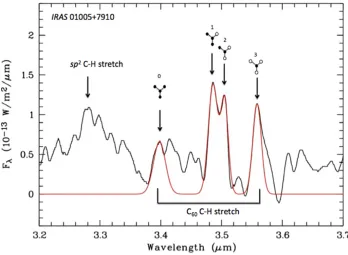
Previously, we have detected C60 and AIBs in IRAS 01005+7910 (Zhang and Kwok, 2011). If C60 and hydro-gen are located in the same region, fulleranes are very likely to be present in this object. As a PPN, IRAS 01005+7910 does not emit atomic lines, and thus provides a good plat-form to search for fulleranes. TheISOspectrum of IRAS 01005+7910 has been described by Hrivnaket al.(2000). Figure 6 displays the continuum-subtracted ISOspectrum of IRAS 01005+7910 in the C-H stretching region. The
sp2C-H stretch at 3.3μm has been detected by Hrivnaket al.(2000). The weak peak at 3.42μm might be due to the asymmetric stretch of -CH2- groups or just an artifact. The three peaks, presumably ascribed to fulleranes by Webster (1992), are clearly visible at 3.48, 3.51, and 3.58μm, and have fluxes comparable to the 3.3μm feature. Through a multi-Gaussian fitting, we estimate the fluxes of the four features, corresponding to 0, 1, 2, and 3 non-H-bonded neighboring carbon atoms (referred as R0, R1, R2, and R3 hereafter), to be 1.64×10⁻¹⁵, 2.69×10⁻¹⁵, 1.78×10⁻¹⁵,
and 1.61×10⁻¹⁵W m−2, respectively. Note that the R 3 fea-ture might be blended with an unknown feafea-ture (Fig. 6).
Assuming that the C60 emission and the C-H stretching emission of C60Hmorigin from UV-excitation, the fractions of carbon locked up in fullerenes and fulleranes (fC60
C and
fC60Hm
C ) can be estimated using the method described by Bern´e and Tielens (2012). Based on the fluxes of C60bands given by Zhang and Kwok (2011), we find fC60
C /f C60Hm
C ≈
1, suggesting that about 50 percent of fullerenes have been hydrogenated.
Under the assumption that all the features have the same oscillator strength, the relative strengths of R0, R1, R2, and R3are equal to the relative probabilities of the four cases (0, 1, 2, 3 non-H-bonded neighboring carbon atoms), and thus the relative strengths of the four C60Hmfeatures can reflect the degree of hydrogenation (the mvalue). With increas-ing number of C atoms bonded with H, the strength of R3 decreases compared to R0. Figure 7 depicts the calculated relative strengths as functions ofm values. The observed strengths indicate that themvalue is very likely to lie within the range from 25–40. This is consistent with the experi-mental results in which C60H36is the dominant product of hydrogenation reaction of C60. Furthermore, experiments show that C60H36can be transferred to C60H18through ther-mal annealing. We find that the relative strength of R3 is slightly higher than that expected for C60H36 (Fig. 7), sug-gesting that C60H18 might be also present. On the other hand, the calculations were purely from a mathematical consideration and did not take into account the chemical structure. Therefore, the fraction of R3relative to R0might be underestimated due to ignoring the hydrogen-hydrogen repulsion.
IRAS 01005+7910 does not exhibit the 21μm feature. Many candidate carriers of this feature have been proposed in previous studies (see Zhanget al., 2009, and references therein), among which Justtanontet al.(1996) and Garc´ıa-Lario et al. (1999) have attributed it to the mixture of fullerenes with various degree of hydrogenation. The ab-sence of the 21μm feature in IRAS 01005+7910 and the non-detection of C60 in 21μm-detected PPNs do not sup-port this identification.
During the post-AGB phase, the UV radiation field grad-ually increases with the evolution of the central star, and molecular H2 is more likely to be photodissociated into atomic H. Moreover, shocks created by fast stellar winds tend to dissociate H2through collisions. This enhances the possibility of hydrogenation of C60. If C60is highly hydro-genated, the bond-breaking may occur due to large angle strain, and thus destruct this compound. Besides, intense UV light can directly destroy fullerenes. This can account for the fact that fullerenes were never observed in evolved PNs.
5.2 C+60and C−60in Tc 1
Fig. 6. TheISOspectrum of IRAS 01005+7910 in the C-H stretching region. The peaks for 0, 1, 2, and 3 non-H-bonded neighboring carbon atoms are marked. The red line is a multi-Gaussian fitting.
Fig. 7. The calculated probabilities of the four cases (0—black, 1—red, 2—green, and 3—blue non-H-bonded neighboring carbon atoms) for a hydrogen bonded carbon atom of C60Hmvs. themvalues. The observed fractional strengths of the four corresponding features are overplotted with lozenges.
in that electron attachment to C60 is prohibited due to its high activation barrier (0.26 eV). However, there are alter-native routes generating C−60(Petrie and Bohme, 2000). Re-cently, Bern´eet al.(2013) detected C+60IR emission bands in NGC 7023. C−60have never been detected in space so far. Based on an experiment in 5 K neon matrices, Fularaet al.(1993) obtained the IR spectrum of C+60and C−60, which reveals the vibrational features at 7.11 and 7.51μm from C+60, and those at 7.22 and 8.32μm from C−60. Figure 8
Fig. 8. TheSpitzerspectrum of Tc 1 at 6–9μm. The experimental wavelengths of C60, C+60, and C−60are marked. Note that there is a strong [ArII] forbidden line at 7.0μm. The decomposition of the C+607.51μm feature is shown in the insert where the solid and dashed curves respectively represent the observed and fitted spectra, and the dotted curves denote the individual components.
6–10μm plateau emission, we decompose this feature, as shown in the insert of Fig. 8. A broaden 7.51μm band with a FWHM of 0.1μm and two narrow atomic lines that are interpreted as HIand [NeVI] lines can reasonably fit the observations. According to the fitting, the flux of the C+60 7.51μm band is estimated to be about 1.0×10⁻¹⁵W m−2. The abundance of C+60 can be determined using the for-mulae given by Moutouet al.(1999). For the calculations (see equation 4 of Moutou et al., 1999), the C/H abun-dance ratio was taken from Pottaschet al.(2011), and the 7.11μm / 7.51μm cross-section ratio was assumed to be 2.2. Based on a blackbody fitting of theSpitzerspectrum of Tc 1, we estimate that the total IR emission from dust is (1.5–3.0)×10−12W m−2. As a result, we obtained that about 0.12%–0.23% carbon is locked up in C+60 in Tc 1 if the detection is real. This is comparable to the upper limit of 0.26% in NGC 7023 (Moutouet al., 1999), and the value of 0.3%–0.9% in the ISM that was estimated by Foing and Ehrenfreund (1994) from two near-IR diffuse bands.
However, as noted recently by Bern´eet al.(2013), a new spectroscopic measurement performed by Kernet al.(2012) suggests that the 7.51μm band might be due to C−60 rather than C+60. Thus the above discussion is only tentative.
6.
Conclusions
C60 and higher fullerenes have been detected in circum-stellar and geological environments. This strengthens the idea that a variety of carbon-based compounds, including fullerenes, can be efficiently produced by stars, be ejected into the ISM, reach the early Solar System, and be par-tially brought to Earth by comets and asteroids (Kwok, 2011). The study of C60 and its derivatives in circumstel-lar envelopes can help to understand the chemical evolu-tion of galaxies. However, it is unclear how circumstellar
C60is formed and excited. In this paper, we investigate the relations between the emission properties of C60-detected sources, as well as between the observations and existing experimental results. Through a comparison of wavelengths and fluxes of C60bands, we conclude that the UV-excitation of C60 in cluster state may account for the observations, although other excitation schemes, such as the release of chemical energy, remain possible. We would like to em-phasize that the Einstein A-values and flux measurements are too uncertain to allow definite conclusions. We also pro-pose that C60is one of the products of the dehydrogenation of MAONs through a scenario presented by Micelotta et al.(2012). The fullerene formation thus reflects a transfor-mation fromsp3tosp2hybridization in MAONs. We have tentatively detected hydrogenated C60in IRAS 01005+7910 and C+60 in Tc 1. The presence of C60 derivatives has the implications that fullerenes have been UV photochemically processed during the post-AGB evolution and the C70/C60 ratio can be significantly modified. A combination of fur-ther experiments and observations are required to obtain complete picture of fullerene formation and processes in circumstellar environments.
Acknowledgments. YZ would like to thank the SOC of the 5th meeting on Cosmic Dust for the invitation to give this talk at Center for Planetary Science, c/o Integrated Research Center of Kobe University. We also thank two anonymous referees for helpful comments. Financial support for this work was provided by the Research Grants Council of the Hong Kong under grants HKU7073/11P.
References
Adams, G. B., J. B. Page, O. F. Sankey, and M. O’Keeffe, Polymerized C60studied by first-principles molecular dynamics,Phys. Rev. B,50, 17471–17479, 1994.
and C70,J. Phys. Chem.,94, 8630–8633, 1990.
Allamandola, L. J., A. G. G. M. Tielens, and J. R. Barker, Interstellar poly-cyclic aromatic hydrocarbons—The infrared emission bands, the exci-tation/emission mechanism, and the astrophysical implications, Astro-phys. J. Suppl.,71, 733–775, 1989.
Becker, L. and J. L. Bada, Fullerenes in Allende meteorite,Nature,372, 507–507, 1994.
Becker, L., J. L. Bada, R. E. Winans, J. E. Hunt, T. E. Bunch, and B. M. French, Fullerenes in the 1.85-billion-year-old Sudbury impact struc-ture,Science,265, 642–645, 1994.
Bernard-Salas, J., J. Cami, E. Peeters, A. P. Jones, E. R. Micelotta, and M. A. T. Groenewegen, On the excitation and formation of circumstellar fullerenes,Astrophys. J.,757, 41, 2012.
Bern´e, O. and A. G. G. M. Tielens, Formation of buckminsterfullerene (C60) in interstellar space,PNAS,109, 401–406, 2012.
Bern´e, O., G. Mulas, and C. Joblin, Interstellar C60+,Astron. Astrophys., 550, L4, 2013.
Bertsch, G. F., A. Smith, and K. Yabana, Optical properties of C60 vibra-tions,Phys. Rev. B,52, 7876–7878, 1995.
Bochvar, D. A. and E. G. Galpern, Hypothetical systems: carbododecahe-dron, s-icosahecarbododecahe-dron, and carbo-s-icosahecarbododecahe-dron,Dokl. Acad. Nauk SSSR, 209, 610–612, 1973 (in Russian).
Boersma, C., R. H. Rubin, and L. J. Allamandola, Spatial analysis of the polycyclic aromatic hydrocarbon features southeast of the Orion Bar,
Astrophys. J.,753, 168, 2012.
Buseck, P. R., Geological fullerenes: review and analysis,Earth Planet. Sci. Lett.,203, 781–792, 2002.
Buseck, P. R., S. J. Tsipursky, and R. Hettich, Fullerenes from the geolog-ical environment,Science,257, 215–217, 1992.
Cami, J., J. Bernard-Salas, E. Peeters, and S. E. Malek, Detection of C60 and C60in a young planetary nebula,Science,329, 1180–1182, 2010. Cataldo, F. and S. Iglesias-Groth, On the action of UV photons on
hydro-genated fulleranes C60H36and C60D36,Mon. Not. R. Astron. Soc.,400, 291–298, 2009.
Chase, B., N. Herron, and E. Holler, Vibrational spectroscopy of fullerenes (C60and C70) temperature dependant studies,J. Phys. Chem.,96, 4262– 4266, 1992.
Cerrigone, L., J. L. Hora, G. Umana, and C. Trigilio, Spitzer Detection of polycyclic aromatic hydrocarbons and silicate features in post-AGB stars and young planetary nebulae,Astrophys. J.,703, 585, 2009. Choi, C. H., M. Kertesz, and L. Mihaly, Vibrational assignment of all 46
fundamentals of C60and C660−: Scaled quantum mechanical results per-formed in redundant internal coordinates and compared to experiments,
J. Phys. Chem. A,104, 102–112, 2000.
Clayton, G. C., D. M. Kelly, J. H. Lacy, I. R. Little-Marenin, P. A. Feldman, and P. F. Bernath, A mid-infrared search for C60in R Coronae Borealis stars and IRC+10216,Astron. J.,109, 2096, 1995.
Clayton, G. C.et al., The dust properties of two hot R Coronae Borealis stars and a Wolf-Rayet central star of a planetary nebula: In search of a possible link,Astron. J.,142, 54, 2011.
de Heer, W. A. and D. Ugarte, Carbon onions produced by heat treatment of carbon soot and their relation to the 217.5 nm interstellar absorption feature,Chem. Phys. Lett.,207, 480–486, 1993.
de Vries, M. S.et al., A search for C60 in carbonaceous chondrites,
Geochim. Cosmochim. Acta,57, 933–938, 1993.
Duley, A. A. and A. Hu, Fullerenes and proto-fullerenes in interstellar carbon dust,Astrophys. J.,745, L11, 2012.
Duley, A. A. and D. A. Williams, Excitation of the aromatic infrared emission bands: Chemical energy in hydrogenated amorphous carbon particles?,Astrophys. J.,737, L44, 2011.
Ebbesen, T. W.et al., Origins of fullerenes in rocks,Science,268, 1634– 1635, 1995.
Esfarjani, K., Y. Hashi, J. Onoe, K. Takeuchi, and Y. Kawazoe, Vibrational modes and IR analysis of neutral photopolymerized C60dimers,Phys.
Rev. B,57, 223–229, 1998.
Evans, A.et al., Solid-phase C60in the peculiar binary XX Oph?,Mon.
Not. R. Astron. Soc.,421, L92, 2012.
Foing, B. H. and P. Ehrenfreund, Detection of two interstellar absorption bands coincident with spectral features of C+60,Nature,369, 296–298, 1994.
Frum, C. I., R. Engelman, H. G. Hedderich, P. F. Bernath, L. D. Lamb, and D. R. Huffman, The infrared emission spectrum of gas-phase C+60 (buckmisterfullerene),Chem. Phys. Lett.,176, 504–508, 1991. Fu, K.-J.et al., Giant vibrational resonances in A6C60compounds,Phys.
Rev. B,46, 1937–1940, 1992.
Fulara, J., M. Jakobi, and J. P. Maier, Electronic and infrared spectra of
C+60and C−60in neon and argon matrices,Chem. Phys. Lett.,21, 227– 234, 1993.
Garc´ıa-Hern´andez, D. A. and J. J. D´ıaz-Luis, Diffuse interstellar bands in fullerene planetary nebulae: The fullerenes—diffuse interstellar bands connection,Astron. Astrophys.,550, L6, 2013.
Garc´ıa-Hern´andez, D. A.et al., Formation of fullerenes in H-containing planetary nebulae,Astrophys. J.,724, L39, 2010.
Garc´ıa-Hern´andez, D. A.et al., The formation of fullerenes: Clues from new C60, C60, and (possible) planar C60detections in Magellanic Cloud planetary nebulae,Astrophys. J.,737, L30, 2011a.
Garc´ıa-Hern´andez, D. A., R. N. Kameswara, and D. L. Lambert, Are C60molecules detectable in circumstellar shells of R Coronae Borealis stars?,Astrophys. J.,729, 126, 2011b.
Garc´ıa-Hern´andez, D. A.et al., Infrared study of fullerene planetary neb-ulae,Astrophys. J.,760, 197, 2012a.
Garc´ıa-Hern´andez, D. A., R. N. Kameswara, and D. L. Lambert, High-resolution optical spectroscopy of DY Cen: Diffuse interstellar bands in a proto-fullerene circumstellar environment?,Astrophys. J.,759, L21, 2012b.
Garc´ıa-Lario, P., A. Manchado, A. Ulla, and M. Manteiga, Infrared space observatory observations of IRAS 16594-4656: A new Proto-planetary nebula with a strong 21 micron dust feature,Astrophys. J.,513, 941, 1999.
Giannozzi, P. and S. Baroni, Vibrational and dielectric properties of C60 from densityfunctional perturbation theory,J. Chem. Phys.,100, 8537, 1994.
Gielen, C., J. Cami, J. Bouwman, E. Peeters, and M. Min, Carbonaceous molecules in the oxygen-rich circumstellar environment of binary post-AGB stars. C60fullerenes and polycyclic aromatic hydrocarbons,
As-tron. Astrophys.,536, 54, 2011.
Goeres, A. and E. Sedlmayr, The envelopes of R Coronae Borealis stars. I—A physical model of the decline events due to dust formation,Astron. Astrophys.,265, 216–236, 1992.
Hara, T., J. Onoe, and K. Takeuchi, In Situ High-Resolution FT-IR Study of the Glass Transition in a C60Film,J. Phys. Chem. B,101, 9532–9536, 1997.
Herbig, G. H., The search for interstellar C60,Astrophys. J.,542, 334–343, 2000.
Heymann, D.,Astrophys. J.,489, 111, 1997.
Heymann, D.et al., Fullerenes of possible wildfire origin in Cretaceous-Tertiary boundary sediments,Geol. Soc. Am. Spec. Pap.,307, 453–464, 1996.
Houck, J. R.et al., The Infrared Spectrograph (IRS) on the Spitzer Space Telescope,Astrophys. J. Suppl.,154, 18–24, 2004.
Howard, J. B., J. T. McKinnon, Y. Makarovsky, A. L. Lafleur, and M. E. Johnson, Fullerenes C60and C70in flames,Nature,352, 139–141, 1991. Hrivnak, B. J., K. Volk, and S. Kwok, 2-45 micron infrared spectroscopy of carbon-rich proto-planetary nebulae,Astrophys. J.,535, 275–292, 2000. Iglesias-Groth, S., Fullerenes and buckyonions in the interstellar medium,
Astrophys. J.,608, L37–L40, 2004.
Iglesias-Groth, S., A. Ruiz, J. Bret´on, and J. M. G´omez Llorente, Photoab-sorption spectra of icosahedral fullerenes: A semiempirical approach,J. Chem. Phys.,116, 10648, 2002.
Iglesias-Groth, S., F. Cataldo, and A. Manchado, Infrared spectroscopy and integrated molar absorptivity of C60and C70fullerenes at extreme temperatures,Mon. Not. R. Astron. Soc.,413, 213–222, 2011. Iglesias-Groth, S., D. A. Garc´ıa-Hern´andez, F. Cataldo, and A. Manchado,
Infrared spectroscopy of hydrogenated fullerenes (fulleranes) at extreme temperatures,Mon. Not. R. Astron. Soc.,423, 2868–2878, 2012. J¨ager, C., F. Huisken, H. Mutschke, I. L. Jansa, and T. Henning, Formation
of Polycyclic aromatic hydrocarbons and carbonaceous solids in gas-phase condensation experiments,Astrophys. J.,696, 706–712, 2009. Justtanont, K., M. J. Barlow, C. J. Skinner, P. F. Roche, D. K. Aitken,
and C. H. Smith, Mid-infrared spectroscopy of carbon-rich post-AGB objects and detection of the PAH molecule chrysene,Astron. Astrophys., 309, 612–628, 1996.
Kern, B., D. Strelnikov, P. Weis, A. B¨ottcher, and M. M. Kappes, C+60and C−60in neon and argon matrices,in 67th International Symposium on Molecular Spectroscopy, 2012.
Kessler, M. F.et al., The Infrared Space Observatory (ISO) mission, As-tron. Astrophys.,315, L27–L31, 1996.
Kr¨atschmer, W., The infrared and ultraviolet absorption spectra of laboratory-produced carbon dust: Evidence for the presence of the C60 molecule, K. Fostiropoulos, and D. R. Huffman,Chem. Phys. Lett.,170, 167–170, 1990a.
new form of carbon,Nature,347, 354–358, 1990b.
Kroto, H. W., J. R. Heath, S. C. Obrien, R. F. Curl, and R. E. Smalley, C60: buckminsterfullerene,Nature,318, 162–163, 1985.
Kwok, S., Amorphous organic solids as a component of interstellar dust,
Earth Planets and Space,63, 1021–1026, 2011.
Kwok, S. and Y. Zhang, Mixed aromatic-aliphatic organic nanoparticles as carriers of unidentified infrared emission features,Nature,479, 80–83, 2011.
Kwok, S., K. Volk, and B. J. Hrivnak, A 21 micron emission feature in four proto-planetary nebulae,Astrophys. J.,345, L51–L54, 1989.
Kwok, S., S. Volk, and B. J. Hrivnak, Chemical evolution of carbonaceous materials in the last stages of stellar evolution,Astron. Astrophys.,350, L35–L38, 1999.
L´eger, A., L. D’Hendecourt, L. Verstraete, and W. Schmidt, Remark-able candidates for the carrier of the diffuse interstellar bands—C60(+) and other polyhedral carbon ions,Astron. Astrophys.,203, L145–L148, 1988.
Leidlmair, C.et al., On the possible presence of weakly bound fullerene-H2complexes in the interstellar medium,Astrophys. J.,738, L4, 2011. Li, A., J.-H. Chen, M.-P. Li, Q.-J. Shi, and Y.-J. Wang, On buckyonions as
an interstellar grain component,Mon. Not. R. Astron. Soc.,390, 39–42, 2008.
Martin, M. C., D. Koller, and L. Mihaly,In situinfrared transmission study of Rb- and K-doped fullerenes,Phys. Rev. B,47, 14607–14610, 1993. Micelotta, E. R., A. P. Jones, J. Cami, E. Peeters, J. Bernard-Salas, and G.
Fanchini, The formation of cosmic fullerenes from arophatic clusters,
Astrophys. J.,761, 35, 2012.
Moutou, C., K. Sellgren, L. Verstraete, and A. L´eger, Upper limit on C60 and C60(+) features in the ISO-SWS spectrum of the reflection nebula NGC 7023,Astron. Astrophys.,347, 949–956, 1999.
Nemes, L.et al., Gas-phase infrared emission spectra of C60and C70. Temperature-dependent studies,Chem. Phys. Lett.,218, 295–303, 1994. Onoe, J. and K. Takeuchi,In situhigh-resolution infrared spectroscopy of
a photopolymerized C60film,Phys. Rev. B,54, 6167–6171, 1996. Osawa, E., Superaromaticity,Kagaku,25, 854–863, 1970 (in Japanese). Papoular, R., Excitation of unidentified infrared bands by H atom impacts,
Mon. Not. R. Astron. Soc.,419, 2396–2406, 2012.
Petrie, S. and D. K. Bohme, Laboratory studies of ion/molecule feactions of fullerenes: Chemical derivatization of fullerenes within dense in-terstellar clouds and circumstellar shells,Astrophys. J.,540, 869–885, 2000.
Pottasch, S. R., R. Surendiranath, and J. Bernard-Salas, Abundances in
planetary nebulae: NGC 1535, NGC 6629, He2-108, and Tc1,Astron. Astrophys.,531, A23, 2011.
Roberts, K. R. G., K. T. Smith, and P. J. Sarre, Detection of C60in embed-ded young stellar objects, a Herbig Ae/Be star and an unusual post-asymptotic giant branch star,Mon. Not. R. Astron. Soc.,421, 3277– 3285, 2012.
Rubin, R. H.et al., Spitzer reveals what is behind Orion’s Bar,Mon. Not. R. Astron. Soc.,410, 1320–1348, 2011.
Sassara, A., G. Zerza, M. Chergui, and S. Leach, Absorption wavelengths and bandwidths for interstellar searches of C60 in the 2400–4100 ˚A region,Astrophys. J. Suppl.,135, 263–273, 2001.
Sellgren, K., M. W. Werner, J. G. Ingalls, J. D. T. Smith, T. M. Carleton, and C. Joblin, C60in reflection nebulae,Astrophys. J.,722, L54–L57, 2010.
Snow, T. P. and C. G. Seab, A search for interstellar and circumstellar C60,
Astron. Astrophys.,213, 291–294, 1989.
Stanton, R. E. and M. D. Newton, Normal vibrational modes of buckmin-sterfullerene,J. Phys. Chem.,92, 2141–2145, 1988.
Webster, A., Unsaturated fulleranes and the minor features of the uniden-tified infrared emission near 3 microns,Mon. Not. R. Astron. Soc.,257, 463–470, 1992.
Webster, A., A theory of the diffuse interstellar bands,Mon. Not. R. Astron. Soc.,262, 831–838, 1993.
Werner, M.et al., The Spitzer Space Telescope mission,Astrophys. J. Suppl.,154, 1–9, 2004.
Winkler, R., T. Pichler, and H. Kuzmany, Vibrational analysis of IR reflection-transmission from single crystal C60,Phys. Rev. B,96, 39– 45, 1994.
Yagi, H.et al., Photoabsorption cross section of C60thin films from the visible to vacuum ultraviolet,Carbon,47, 1152–1157, 2009.
Yasumatsu, H., T. Kondow, H. Kitagawa., K. Tabayashi, and K. Shobatake, Absorption spectrum of C60in the gas phase: Autoionization via core-excited Ryberg states,J. Chem. Phys.,104, 899, 1996.
Zhang, K., B.-W. Jiang, and A. Li, On the carriers of the 21μm emission feature in post-asymptotic giant branch stars,Mon. Not. R. Astron. Soc., 396, 1247–1256, 2009.
Zhang, Y. and S. Kwok, Detection of C60in the protoplanetary nebula IRAS 01005+7910,Astrophys. J.,730, 126, 2011.