ROWE, JONATHAN PAUL. Narrative-Centered Tutorial Planning with Concurrent Markov Decision Processes. (Under the direction of Dr. James C. Lester.)
Narrative-centered learning environments are a class of educational games that embed learning in interactive story scenarios. A key promise of narrative-centered learning environments is the ability to tightly integrate educational subject matter with engaging stories. While narrative-centered learning environments offer motivational benefits, students may struggle to employ effective problem-solving strategies in these settings without tailored pedagogical guidance. A potential solution is devising narrative-centered tutorial planners, which dynamically generate and revise story events in accordance with educational goals and students’ needs. By augmenting interactive narratives to provide targeted remediation and story-embedded scaffolding, narrative-centered tutorial planners can deliver individualized pedagogical guidance while preserving the motivational benefits of narrative-centered learning.
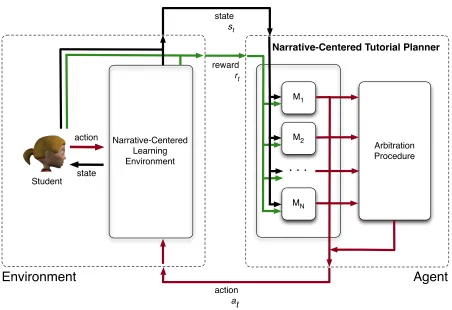
This dissertation presents a data-driven framework for devising narrative-centered tutorial planners with concurrent Markov decision processes. The framework decomposes interactive narratives into several independent adaptable event sequences (AESs), which are modularized story structures that can be realized in multiple forms within an interactive narrative. Dynamically adapting an event sequence is modeled as a Markov decision process (MDP), with rewards computed from students’ experiential outcomes, such as learning gains and problem-solving results. Distinct policies are independently machine-learned for each AES, and the policies are then re-combined using arbitration procedures to form a composite narrative-centered tutorial planner. The proposed framework is well suited to machine learning interactive narrative planners directly from actual students’ data. By inducing models from student data, the approach offers promise for yielding effective and practical models, as well as insights into student learning and design of narrative-centered learning environments.
by
Jonathan Paul Rowe
A dissertation submitted to the Graduate Faculty of North Carolina State University
in partial fulfillment of the requirements for the Degree of
Doctor of Philosophy
Computer Science
Raleigh, North Carolina
2013
APPROVED BY:
_______________________________ ______________________________
Dr. James C. Lester Dr. R. Michael Young
Committee Chair
DEDICATION
To my parents, who provided the foundation for all I do, my wife Kristen, whose love and support make it possible,
BIOGRAPHY
Jonathan Paul Rowe was born in Reading, Pennsylvania on August 5, 1984. He received his first computer, a Compaq PC with an 80386 Intel processor, from his stepfather, a refurbished hand-me-down from the offices at Connors Investor Services. During these years, Jonathan developed a passion for computers and videogames, deciding that he would one day make videogames for a living. In addition to these interests, Jonathan was active in the Boy Scouts of America, eventually earning its highest award: the Eagle Scout rank.
He graduated from Schuylkill Valley High School in 2002, and went on to attend Lafayette College in Easton, Pennsylvania. At Lafayette, he majored in Computer Science with a minor in Mathematics. In addition to his classwork, Jonathan was a member of the College Men’s Track and Field team, where he served as the Men’s Team Captain for two years, and was eventually named to ESPN The Magazine Academic All-District II First Team. Jonathan earned his Bachelor of Science degree from Lafayette in 2006, graduating summa cum laude.
The next Fall, Jonathan began his graduate career at North Carolina State University. During his time in graduate school, he had two stints at summer internships: in 2007 he interned at USC’s Institute for Creative Technologies researching story-authoring support tools, and in 2011 he interned at the SAS Institute’s Education Practice working on mobile learning applications. He earned his Master of Science degree in Computer Science in 2010.
ACKNOWLEDGMENTS
First, I would like to thank my advisor James Lester. James has provided an exceptional model of scholarly professionalism throughout my graduate career. Further, his collegiality, enthusiasm, and friendship have left profound imprints that extend far beyond this dissertation. I would also like to thank the members of my committee, Michael Young, Dave Roberts, and Pat Fitzgerald, for their encouragement, insights, and feedback. They have each influenced and strengthened this dissertation considerably. Thanks as well to Rob St. Amant, who helped to inspire my interests in human-computer interaction, and provided crucial assistance during the final stages of my dissertation process.
I have been privileged to work with several great mentors throughout my graduate career, and in each case their work has deeply influenced my own. I am particularly indebted to Brad Mott, whose insights, encouragement, and technical expertise have proven indispensible throughout the research described in this dissertation. Scott McQuiggan and Mark Riedl also provided valuable mentorship during research opportunities outside the brick-laden walls of NCSU, substantially broadening my view of scholarly research.
Arnav Jhala, Alex Kuhl, Jim Thomas, and Stephen Ware for their support, camaraderie, and stimulating conversations throughout the many stages of my graduate career.
I have been fortunate to participate in collaborative research with several faculty members from other colleges and departments at NCSU. In particular, I am grateful to Hiller Spires, who made the initial connections with schools interested in using CRYSTAL ISLAND in their classrooms. I also wish to thank John Nietfeld and James Minogue for many stimulating conversations about student learning, instruction, and life.
This research would not have been possible without the teachers, students, and administrators of Johnston County Schools and Centennial Campus Magnet Middle School. In particular, I wish to thank Elwood Peters, Chris Godwin, Vickie Boyette, Kathy Feola, Rebecah Spraggon, Kelly Mance, Heidi Adams, Michelle Zimmerman, and Divern Combs.
Many thanks to the IT Staff at the William & Ida Friday Institute, particularly Bob Haggerty and Mustapha Jawara, for their support during the multiple studies with CRYSTAL ISLAND reported in this dissertation. Furthermore, thanks to the staff of the Department of Computer Science, with special thanks to Carol Allen, Susan Peaslee, Linda Honeycutt, and Margery Page for their frequent assistance involving matters large and small.
Finally, I want to thank my wife Kristen, whose love, patience, and support have remained steadfast throughout the many late nights and years of graduate school. Throughout my graduate career, she has selflessly taken on extra household responsibilities, while juggling her own professional career, to support me as I have pursued a Ph.D. I also wish to thank my parents, Sherry and Ron Seher, for their regular encouragement and unconditional love. Without their sacrifices and influence, I would not be where I am today.
TABLE OF CONTENTS
LIST OF TABLES ... viii
LIST OF FIGURES ... ix
CHAPTER 1 Introduction ... 1
1.1 Problem ... 2
1.2 Approach ... 3
1.3 Thesis Statement and Hypotheses ... 6
1.4 Contributions ... 7
1.5 Organization ... 9
CHAPTER 2 Background and Related Work ... 10
2.1 Narrative-Centered Learning Environments ... 10
2.2 Intelligent Tutoring Systems ... 19
2.3 Dynamic Adaptation of Interactive Narratives ... 22
2.4 Decision-Theoretic Approaches for Narrative Adaptation ... 25
CHAPTER 3 Inducing Narrative-Centered Tutorial Planners ... 30
3.1 Modular Reinforcement Learning ... 30
3.2 Narrative-Centered Tutorial Planning with Concurrent Markov Decision Processes ... 36
3.3 Inducing Narrative-Centered Tutorial Planning Policies ... 52
3.4 Theoretical Analysis ... 57
CHAPTER 4 CRYSTAL ISLAND ... 63
4.1CRYSTAL ISLAND Narrative-Centered Learning Environment ... 64
4.2 Human Subject Study ... 70
4.3 Student Learning, Problem-Solving and Engagement Findings ... 74
4.4 Individual Difference Findings ... 77
CHAPTER 5 Training Corpus Collection ... 83
5.1 Modified CRYSTAL ISLAND ... 84
5.2 Corpus Collection Studies ... 90
5.2.1 Population ... 91
5.2.2 Design ... 91
5.2.3 Pre-Study Materials ... 92
5.2.4 Post-Study Materials ... 93
5.2.5 Apparatus ... 94
5.2.6 Procedure ... 95
5.3 Structure of Narrative-Centered Tutorial Planning Corpus ... 96
CHAPTER 6 Evaluation Study ... 101
6.1 An Implemented Narrative-Centered Tutorial Planner ... 101
6.2 Evaluation Experiment ... 108
6.2.1 Population ... 109
6.2.3 Procedure ... 110
6.3 Profile of Induced Narrative-Centered Tutorial Planner’s Decisions ... 111
CHAPTER 7 Results ... 118
7.1 Content Learning Results ... 118
7.2 Problem Solving Results ... 119
7.3 Engagement Results ... 129
CHAPTER 8 Discussion ... 132
8.1 Enhancing Students’ Problem-Solving Processes with Narrative Adaptations ... 133
8.2 Limitations ... 138
CHAPTER 9 Conclusion ... 142
9.1 Hypotheses Revisited ... 143
9.2 Summary ... 145
9.3 Future Work ... 147
9.4 Concluding Remarks ... 149
REFERENCES ... 151
APPENDICES ... 167
Appendix A: Demographics and Game-Playing Experience Survey ... 168
Appendix B: Self-Efficacy for Science Questionnaire ... 170
Appendix C: CRYSTAL ISLAND Curriculum Test v2.0 ... 171
Appendix D: Adapted Perceived Interest Questionnaire ... 175
Appendix E: CRYSTAL ISLAND Handout Materials ... 176
Appendix F: CRYSTAL ISLAND Curriculum Test v3.0 ... 179
Appendix G: CRYSTAL ISLAND Narrative Questionnaire ... 184
LIST
OF
TABLES
Table 1. Procedure for modeling a narrative-centered tutorial planner with concurrent
Markov decision processes ... 62
Table 2. Point values for calculating final game score ... 73
Table 3. Regression predicting students’ microbiology post-test scores ... 75
Table 4. Hierarchical regression predicting students’ microbiology post-test scores ... 76
Table 5. Breakdown of student actions in the planning corpus ... 97
Table 6. Breakdown of narrative adaptations in the planning corpus. ... 98
Table 7. Contingency table for Quentin's Revelation AES ... 113
Table 8. Contingency table for Bryce's Revelation AES ... 113
Table 9. Contingency table for Mystery Solution AES ... 114
Table 10. Contingency table for Initial Lab Test Count AES ... 114
LIST
OF
FIGURES
Figure 1. Student interaction with a narrative-centered tutorial planner ... 4
Figure 2. Agent-environment architecture for classical reinforcement learning ... 31
Figure 3. Agent-environment architecture for narrative-centered tutorial planner based on modular reinforcement learning ... 38
Figure 4. Feature selection for narrative-centered tutorial planner states ... 46
Figure 5. Partial order among sub-goals in the CRYSTAL ISLAND narrative scenario ... 65
Figure 6. Conversation with CRYSTAL ISLAND's camp nurse ... 66
Figure 7. Diagnosis worksheet for recording findings in CRYSTAL ISLAND ... 67
Figure 8. Interior of the camp infirmary in CRYSTAL ISLAND ... 69
Figure 9. Testing device in the camp’s laboratory ... 69
Figure 10. Distribution of students’ final game scores ... 78
Figure 11. Individual differences prior to gameplay, in-game, and after gameplay ... 79
Figure 12. State representation for induced narrative-centered tutorial planner ... 103
Figure 13. Students’ conversational behaviors with the virus specialist ... 122
Figure 14. Students’ conversational behaviors with the bacteria specialist ... 122
Figure 15. Students’ conversational behaviors with the camp nurse ... 123
Figure 16. Students’ conversational behaviors with the sick lead scientist ... 124
Figure 17. Students’ conversational behaviors with the camp cook ... 124
Figure 18. Students’ Salmonellosis poster-viewing behaviors ... 125
Figure 19. Students’ Anthrax poster-viewing behaviors ... 126
Figure 20. Students’ Botulism poster-viewing behaviors ... 126
CHAPTER 1
Introduction
The past decade has witnessed a growing recognition of the potential for digital games to deliver effective and engaging learning experiences. In 2006, experts convened at the National Summit on Educational Games agreed “gaming could help address one of the nation’s most pressing needs — strengthening our system of education and preparing workers for 21st century jobs” (Federation of American Scientists, 2006). The National Academies’ Board of Science Education recently released a report that asserted “[Games] enable learners to see and interact with representations of natural phenomena that would otherwise be impossible to observe … games can motivate learners with challenges and rapid feedback and tailor instruction to individual learners’ needs and interests” (Honey & Hilton, 2011). In addition to commissioned reports, there is a growing literature discussing the pedagogical potential of educational games (Gee, 2007; Prensky, 2001; Shaffer, 2006). This literature argues that well-designed games inherently promote learning, and the skills taught by games are vital for success in the modern economy, such as critical thinking, communication, teamwork, and problem solving.
environments, converse with casts of believable characters, and experience fantasy events that cannot be easily emulated in classrooms, all in the service of promoting effective and engaging learning experiences.
In order to promote learning, narrative-centered learning environments tap into students’ innate facilities for crafting and understanding stories (Bruner, 1991; Graesser & Ottati, 1996; Polkinghorne, 1988). Narrative-centered learning environments provide meaningful contexts for problem-solving activities, which illustrate connections between theories and applications (Jonassen & Hernandez-Serrano, 2002). In addition, narrative-centered learning environments encourage engaged learning by tightly integrating pedagogy and narrative elements. In recent years, narrative-centered learning environments have been investigated for a range of domains, such as language learning (Johnson, 2010), anti-bullying education (Vannini, et al., 2011), intercultural negotiation training (Kim, et al., 2009), middle school science (Ketelhut, Dede, Clarke, & Nelson, 2010), and network security (Thomas & Young, 2010). Learning unfolds in many different ways within these environments, such as practicing intercultural negotiations through story-driven interactions with virtual characters (Traum, et al., 2008), or performing scientific inquiry within interactive mysteries where students play the roles of detectives (Ketelhut, et al., 2010).
1.1 Problem
narrative-centered learning environments, students often employ non-typical problem-solving methods or require context-specific instructional assistance to make substantive progress. A one-size-fits-all approach to interactive narrative and pedagogical design is ill suited to the requirements of narrative-centered learning. The motivational benefits of narrative-centered learning environments are likely to be lost if students flounder due to inadequate instructional support.
One-on-one, face-to-face human tutoring has long been considered the gold standard for effective instruction because of its significant pedagogical benefits compared to traditional classroom lectures. Work by the intelligent tutoring systems community has sought to emulate effective tutoring—such as personalized feedback, scaffolding, and problem sets—for a range of educational subjects (VanLehn, 2006; Woolf, 2008). However, most intelligent tutoring systems do not possess built-in mechanisms for reasoning about interactive narrative plots; the learning scenarios in intelligent tutoring systems typically abstract away narrative contexts in order to focus on educational subject matter. Embedding intelligent tutoring systems within narrative-centered learning environments requires integration with intelligent narrative technologies capable of dynamically generating and managing interactive stories (Mott & Lester, 2006b). However, research on integrating intelligent tutoring systems and narrative-centered learning environments is still in a nascent stage. To address this gap, this dissertation will examine the following research question: how can we devise effective technologies that dynamically tailor events in narrative-centered learning environments to support complex problem solving?
1.2 Approach
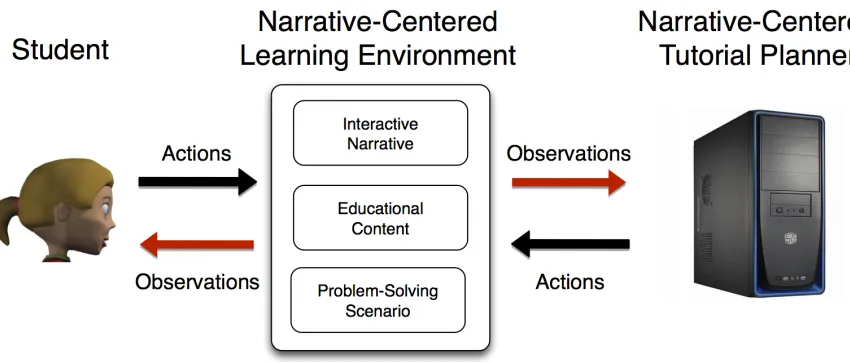
range of story manipulations are possible in narrative-centered learning environments, such as dynamically augmenting plot sequences (introducing events, re-ordering events), modifying character states (revising character goals, adjusting character abilities), or presenting narrative-embedded instructional resources (delivering hints, introducing cognitive tools).Narrative-centered tutorial planners should be capable of performing a range of manipulations in order to achieve instructional objectives, such as scaffolding student problem solving, customizing scenario difficulty, or presenting alternate story experiences to enhance replayability and encourage time-on-task. A diagram depicting a student interaction with a narrative-centered tutorial planner is shown in Figure 1.
Narrative-centered tutorial planning unifies two related experience management problems: pedagogical planning and drama management. Pedagogical planners dynamically sequence learning exercises and deliver context-specific, tailored problem-solving supports in intelligent tutoring systems (VanLehn, 2006; Woolf, 2008). Drama managers perform dynamic adjustments to interactive narratives in order to heighten dramatic impact, foster narrative believability, or preserve authorial intent (Mateas & Stern, 2005; Riedl, Saretto, & Young, 2003; Roberts & Isbell, 2008). There has been some work leveraging drama
management technologies in narrative-centered learning environments (Aylett, et al., 2005; Si, Marsella, & Pynadath, 2005), but there are relatively few examples of systems that tightly integrate intelligent tutoring and computational models of interactive narrative (Thomas & Young, 2010; Mott & Lester, 2006b; Lee, Mott & Lester, 2012).
While narrative-centered tutorial planners show promise for addressing students’ individualized needs, there is limited research available about how to design such systems effectively. As a consequence, data-driven approaches to devising narrative-centered tutorial planners are particularly attractive. Data-driven planners act in a principled manner—based on past observations of student behavior—while reducing the need for labor-intensive hand authoring of rules.
Narrative-centered tutorial planners should meet several operational requirements. First, they should perform instructional interventions through the affordances of stories. In other words, narrative-centered tutorial planners should primarily act by adjusting story events, character behaviors, and discourse elements, and these manipulations should take place within coherent and compelling plots. Second, narrative-centered tutorial planners should have a broad and diverse repertoire of story manipulations at their disposal. These capabilities are critical for maintaining flexibility in how planners aid students during various story contexts. Third, narrative-centered tutorial planners should explicitly address the multiple goals of narrative-centered learning, such as supporting complex problem solving, enhancing content learning, and fostering student engagement. Finally, narrative-centered tutorial planners must meet the real-time performance requirements of interactive narratives.
techniques with previous students’ data. The sub-problems are solved individually, and the solutions are combined to form an overall decision-making policy. The policies are explicitly trained to optimize designer-specified metrics that embody key goals of narrative-centered learning. The induced policies are ultimately re-incorporated into a narrative-centered learning environment to support new students’ interactions with the system.
1.3 Thesis Statement and Hypotheses
This dissertation investigates the following thesis statement:
Modeling narrative-centered tutorial planning with concurrent Markov decision processes is an effective approach for dynamically tailoring story events to enhance student problem solving in narrative-centered learning environments.
Assessing the quality and effectiveness of a narrative-centered tutorial planner is a multi-faceted problem. This investigation examines planner effectiveness by focusing on four principal requirements: 1) performing instructional interventions that are naturally embedded within an interactive narrative, 2) accommodating a broad range of potential story manipulations, 3) explicitly addressing the instructional goals of narrative-centered learning, and 4) satisfying the real-time performance requirements of interactive narratives.
measuring presence and intrinsic motivation to assess students’ post hoc responses to narrative-centered learning environments.
In order to study the effectiveness of our framework for inducing narrative-centered tutorial planners with concurrent Markov decision processes, we investigate four primary hypotheses. We use the phrase Induced Planner to refer to a narrative-centered tutorial planner obtained through our framework.
• Hypothesis 1: Students who use a narrative-centered learning environment with an Induced Planner will solve complex problem-solving tasks more quickly and more frequently than students who use a baseline version of the environment.
• Hypothesis 2: Students who use a narrative-centered learning environment with an
Induced Planner will demonstrate more deliberate problem-solving practices than students who use a baseline version of the environment.
• Hypothesis 3: Students who use a narrative-centered learning environment with an Induced Planner will achieve greater content learning gains than students who use a baseline version of the environment.
• Hypothesis 4: Students who use a narrative-centered learning environment with an
Induced Planner will demonstrate greater engagement than students who use a baseline version of the environment.
1.4 Contributions
This dissertation reports on research that has made the following contributions:
• An implemented narrative-centered learning environment that reliably yields
significant science content learning gains, as well as promising levels of student engagement (Rowe, Shores, Mott, & Lester, 2011; Sabourin, Rowe, Mott, & Lester, 2011).
• An empirical account of student learning outcomes, engagement outcomes, and
2010a; Rowe, et al., 2011; Sabourin, et al., 2011; Spires, Rowe, Mott, & Lester, 2011).
• An empirical framework for devising narrative-centered tutorial planning policies that
is based on concurrent Markov decision processes. This framework improves upon prior approaches to building narrative-centered tutorial planners by inducing narrative adaptation strategies directly from student interaction data.
• This dissertation reports on the first deployed interactive narrative director agent
whose narrative decision-making behavior is solely induced from user interaction data. The model does not require hand-authored rules about narrative decision-making strategies, or explicit demonstrations of narrative decision-decision-making by humans.
• A sizable corpus of student data from interactions with a narrative-centered tutorial planner. The corpus includes planner actions that are intentionally exploratory, and it can serve as a resource for a range of approaches to devising narrative-centered tutorial planners, as well as empirical studies of narrative-centered learning (Sabourin, et al., 2011;Sabourin, Rowe, Mott, & Lester, 2012).
• A narrative-centered learning environment that dynamically adapts story events to
enhance students’ problem-solving processes. The planner is comprised of a suite of narrative adaptation policies, which are implemented as lookup tables mapping MDP states to planner actions, and meet the real-time performance requirements of interactive narratives. The system also supports easy modification of narrative adaptation policies for future investigations.
1.5 Organization
CHAPTER 2
Background and Related Work
Recent years have seen a growing interest in integrating narratives and digital games for educational purposes. Research on narrative-centered learning environments is situated at the intersection of two fields: interactive narrative systems and intelligent tutoring systems. By combining techniques from intelligent tutoring systems and interactive narrative systems, narrative-centered learning environments can create adaptive story experiences that promote engaged learning and are tailored to individual students.
This chapter describes background and related work on dynamically tailoring story events in narrative-centered learning environments. Section 2.1 discusses the motivation for incorporating narratives in education, and it describes several existing narrative-centered learning environments. Section 2.2 describes work on intelligent tutoring systems, which use artificial intelligence (AI) technologies to dynamically coach and scaffold students’ learning experiences. Section 2.3 surveys work by the intelligent narrative technologies community that is focused on dynamically adapting plots and discourses in interactive narrative systems. Section 2.4 describes several decision-theoretic frameworks for interactive narrative director agents, which share key features with the concurrent Markov decision process framework presented in this dissertation.
2.1 Narrative-Centered Learning Environments
than expository forms. By extension, stories offer significant promise for enhancing learning and problem solving (Jonassen & Hernandez-Serrano, 2002). Stories are ubiquitous tools for sharing experiential knowledge, recounting prior problem solutions, and fostering vicarious experience. They can provide problem-solving guidance by serving as examples to be adapted to current situations. Additionally, stories are instrumental in assessment by virtue of their ability to present novel situations to test transfer of generalizable skills.
Despite the fact that narrative has long been believed to hold significant potential for education, it has traditionally been static rather than interactive, which has limited the types of narrative-centered learning experiences possible in educational settings. Only in recent years have advances in commercial game technologies enabled rich narratives to be integrated into virtual environments featuring cinematic presentations, believable characters, and dramatic plots. By repurposing these technologies for educational objectives, narrative-centered learning environments overcome the passive nature of traditional storytelling, while maintaining their motivational and pedagogical benefits.
There are three primary goals behind efforts to integrate narratives and digital games for education. The first goal is enhancing student motivation and engagement. Narratives and games are ubiquitous forms of entertainment, and work on narrative-centered learning environments aims to utilize their engaging qualities to evoke student interest and sustain learning. The second goal is to support students’ meaning making processes, leveraging humans’ natural facility for narratives to reinforce associations with educational material. The third goal is enhancing students’ problem-solving skills. Given stories’ role in supporting complex problem solving, narrative-centered learning environments are designed to guide students as they develop generalizable problem-solving skills.
environments can take several forms. Students may directly influence a narrative by completing actions in order to solve a problem, or they may indirectly influence events by providing guidance to autonomous virtual characters. Narrative-centered learning environments have been developed to support both single and multiple players, they have been realized using realistic 3D graphics engines as well as abstract cartoon-like representations, and they have structured problem-solving activities within overarching narratives, as well as sequences of related vignettes.
There have also been efforts to incorporate AI technologies into narrative-centered learning environments, including work on autonomous virtual characters (Aylett, et al., 2005; Kim et al., 2009; Marsella, Johnson, & Labore, 2003), natural language processing (Johnson, 2010; Kim et al., 2009), intelligent tutoring (Johnson, 2010; Kim et al., 2009; Thomas & Young, 2010), and narrative director agents (Marsella, Johnson, & Labore, 2003; Thomas & Young, 2010; Lee, Mott, & Lester, 2012). Following are descriptions of several narrative-centered learning environments.
River City. Developed at Harvard, River City is a multi-user virtual environment aimed at improving middle school students’ deep inquiry skills and science content knowledge (Nelson, 2007; Ketelhut, et al., 2010). The game’s narrative takes place in a late nineteenth century city whose residents have mysteriously fallen ill. Students control in-game avatars and work in teams to explore the virtual city, collect clues and evidence concerning the mysterious illness, formulate and test hypotheses, and compare research findings. Science content is integrated with historical, social, and geographical content. River City is accompanied by a 2–4 week in-class curriculum and is designed to replace traditional science lessons. Over the past decade, the software has been used in hundreds of classrooms with tens of thousands of students throughout the United States.
game. Several empirical studies of students’ gameplay and learning data indicated that increased usage of the guidance system improved students’ learning outcomes (Nelson, 2007). However, it was found that students with low self-efficacy for science used the guidance system less frequently than high self-efficacy students, and the guidance system was insufficient for closing the learning gap between low and high self-efficacy groups (Nelson & Ketelhut, 2008). The dynamic guidance system in River City focuses solely on tutorial support as opposed to narrative experience, and therefore comprises a restricted class of narrative adaptations: non-diegetic cognitive prompts. In other words, tutorial guidance is not naturally embedded within the interactive narrative. Instead, tutorial messages appear to come from a source external to the storyworld. Further, the delivery of guidance messages is based on extensive human-authored rules.
Quest Atlantis. Quest Atlantis is a narrative-centered, multi-user virtual environment developed at Indiana University that has been used by over fifty thousand students internationally (Barab, Gresalfi, & Ingram-Goble, 2010; Hickey, Ingram-Goble, & Jameson, 2009). The software features a complex storyline about the fictional world of Atlantis. The Atlantians’ planet is in rapid decline, and students must help to restore lost Atlantian knowledge that has precipitated the world’s social and environmental decay. Gameplay activities are distributed across several virtual worlds. The virtual worlds feature distinct problem-solving scenarios that connect to national and local academic standards. For example, the Taiga Park world focuses on a riverside community with a declining fish population (Hickey, Ingram-Goble, & Jameson, 2009). In Taiga Park, students complete a series of quests that incorporate socioscientific inquiry and ecological science concepts, incrementally addressing the community’s looming ecological and economic dilemma. Students interact with virtual characters, collect and analyze data, and write and submit reports in order to remediate the river.
language arts (Barab et al., 2010; Warren, Dondlinger, & Barab, 2008). Empirical studies with a range of student populations have found that Quest Atlantis provides significant learning and engagement benefits compared to traditional, text-based classroom activities. However, Quest Atlantis’s core research team has not investigated AI technologies for dynamically tailoring students’ learning experiences. Recent work by Shute and colleagues (2010) has proposed a Bayesian network framework for stealth assessment in narrative-centered learning scenarios like Taiga Park, but to our knowledge it has not been implemented and evaluated in the Quest Atlantis software.
Carmen’s Bright IDEAS. Developed at the University of Southern California, Carmen’s Bright IDEAS is an interactive pedagogical drama designed to teach social problem-solving skills to mothers of pediatric cancer patients (Marsella, Johnson, & Labore, 2003; Marsella, Johnson, & LaBore, 2000). Learners influence the choices of the main character, Carmen, as she copes with the difficulties inherent in caring for a chronically ill child. Carmen is given coaching by Gina—a second autonomous agent—to implement the Bright IDEAS approach to social problem solving. The environment’s autonomous virtual characters implement multi-layer state-machine dialogue models, models for gesture and non-verbal behavior, and an appraisal-based model of emotion, to foster dramatic interactions between the narrative’s two characters. By carefully coordinating the dialog, emotional, and non-verbal behaviors of the Gina and Carmen animated agents, as well as decisions made by director and cinematographic agents, Carmen’s Bright IDEAS aims to balance the demands of narrative, interactivity, and learning. A prototype version of the system was investigated through exploratory clinical trials involving twenty-six human participants (Marsella, Johnson, & Labore, 2003). The participants responded positively, reporting that the narrative seemed believable and was helpful for understanding how to apply the Bright IDEAS framework.
drama and effective learning in a range of contexts, introduces considerable challenges. Furthermore, the system’s narrative adaptations are primarily focused on believable and dramatic character performances; they are not explicitly designed to maximize student learning gains and engagement. To our knowledge, no empirical findings have been reported about the learning and engagement effects of the system’s dynamic narrative adaptations.
FearNot! FearNot! is a character-driven, interactive narrative learning environment that
promotes anti-bullying social education (Aylett, et al., 2005; Vannini, et al., 2011). The system uses affectively-driven autonomous agents to dynamically generate dramatic, educational vignettes about bullying. In between non-interactive vignettes, virtual bullying victims consult the student for advice on coping strategies, and then use this feedback to inform their behavior in subsequent vignettes. The system’s autonomous agents use an emotion model that implements a double appraisal process to predict the affective impact of actions on other agents (Aylett & Louchart, 2008). The double appraisal process serves as a metacognitive reasoning step for guiding agent behaviors to produce interesting narrative experiences. FearNot! uses an emergent narrative approach to story generation; the technique is contrasted with top-down interactive narrative generators that leverage explicit plot models to drive story generation and adaptation.
FearNot! has been the subject of large-scale, cross-cultural evaluations, but it has not been observed to significantly impact students’ knowledge about bullying or coping strategies (Watson et al., 2010). While the system’s emergent approach to narrative generation is likely to produce believable and dramatic narrative experiences, its use of minimally interactive bullying vignettes reduces user control and agency. Further, the system provides little explicit tutorial support to enhance learning gains.
Tactical Language and Culture Training System. The Tactical Language and Culture
2010). Primarily developed at Alelo Inc., TLCTS uses a combination of interactive lessons and narrative scenarios to train culturally embedded spoken and non-verbal communication skills. The Skill Builder component of the system provides interactive instruction about relevant cultural and language content. The Mission Game component provides opportunities to apply communication skills through task-based narrative scenarios involving face-to-face interactions with virtual characters. TLCTS has been the subject of several in vivo studies involving hundreds of military personnel (Johnson, 2010). These evaluations have found that TLCTS consistently elicits significant language and culture learning gains, as well as self-efficacy and motivational benefits.
TLCTS uses AI technologies extensively throughout its more than one hundred hours of training content; AI serves a key role in lesson authoring, automated speech recognition, virtual character dialogue and non-verbal behavior, tutorial feedback, and student modeling facilities. While initial versions of TLCTS also incorporated AI technologies for interactive narrative adaptation (Si, Marsella, & Pynadath, 2005), recent versions have forgone this functionality.
BiLAT. BiLAT is a serious game developed at the USC Institute for Creative Technologies
(Kim et al., 2009). However, no discernible benefits were observed for users with substantial prior negotiation experience. Challenges associated with assessing ill-defined knowledge (such as negotiation skills) point to the need for further research.
BiLAT leverages several AI technologies for dynamically tailoring students’ learning experiences. The system implements a rule-based dialogue model for driving virtual characters’ conversational dynamics, as well as a negotiation model based on the PsychSim simulation tool (Pynadath & Marsella, 2005). Intelligent tutoring facilities deliver individualized guidance in the form of hints and feedback, as well as structured after-action reviews. Narrative adaptations are achieved through variations in virtual character behaviors and non-diegetic coaching messages. To our knowledge, empirical evaluations have not yet been conducted that isolate the individual impacts of the system’s intelligent tutoring or character behavior components.
FixIt. FixIt is an exploratory narrative-centered learning environment about computer
Annie’s tutorial and narrative adaptations provide guidance about the preconditions and effects of important problem-solving actions in a learning environment (Thomas, 2011). The narrative adaptations performed by Annie provide leveled coaching that observes the “prompt, hint, show, teach, do” stages of pedagogical assistance. Annie’s remediation actions can be realized in three forms: text-based messages, short cinematic sequences, and concrete actions that are performed by temporarily taking control of the player character. A pilot study found that Annie effectively predicts students’ self-assessments of knowledge after they interact with the FixIt narrative-centered learning environment (Thomas & Young, 2010). A second study found that Annie also enhances student task completion in the FixIt environment (Thomas, 2011). However, the two studies did not find evidence that Annie enhances students’ learning and engagement outcomes. This may have been due to the short duration of the learning experiences, and limited statistical power stemming from small numbers of study participants.
Several of the narrative-centered learning environments described in this section employ AI technologies to dynamically manage students’ learning experiences. However, most of these systems loosely couple tutorial scaffolding with narrative adaptation decisions; explicit pedagogical supports are rarely delivered through naturalistic story structures. Furthermore, all of these systems sequence pedagogical supports based on hand-authored knowledge structures; none use empirical models to drive narrative and tutorial decision making. The nascent field of narrative-centered tutorial planning research has not yet developed a set of best practices for narrative-centered learning environment design. Given the dearth of theoretical and practical guidance, employing data-driven approaches to narrative decision making is a promising approach.
2.2 Intelligent Tutoring Systems
An intelligent tutoring system is a type of educational software that uses explicit models of students’ learning processes in order to dynamically tailor instruction and pedagogical assistance to individual learners. Using one-on-one human tutoring as a model, intelligent tutoring systems monitor students’ cognitive, affective, and metacognitive states in order to revise instructional plans, manage educational scaffolding, and deliver empathetic support (Shute & Psotka, 1996; Woolf, 2008). Intelligent tutoring systems have been developed for a broad range of academic subjects, including mathematics (Koedinger, Anderson, Hadley, & Mark, 1997), science (Graesser et al., 2004; VanLehn et al., 2005), writing (Britt, Wiemer-Hastings, Larson, & Perfetti, 2004), and language learning (Johnson, 2010), as well as training tasks, such as aircraft troubleshooting (Mislevy & Gitomer, 1995) and naval ship systems operation (Rickel & Johnson, 1999). Intelligent tutors have also been shown to provide significant educational benefits, yielding learning gains that are up to one standard deviation unit better than traditional classroom instruction (Koedinger, et al., 1997; VanLehn et al., 2005).
Over the past decade, general frameworks have emerged for characterizing the behavior of intelligent tutoring systems (VanLehn, 2006). According to VanLehn (2006), intelligent tutors operate in terms of two loops: an outer loop and an inner loop. The outer loop is responsible for making coarse-grained adjustments to the direction of a tutoring experience. The loop iterates over learning tasks, and strategically sequences instructional opportunities based on students’ abilities. For example, the outer loop de-emphasizes skills that a student has already mastered, and increases time on topics requiring additional practice. The inner loop is responsible for delivering tailored feedback and hints during problem solving. Inner loop adaptations typically address a single educational exercise, feedback is context-sensitive, and pedagogical support is tailored to individual students’ needs.
networks, and constraint pairs have been especially prevalent. The Cognitive Tutor family of systems represents students' procedural knowledge using cognitive science-inspired knowledge bases of if-then rules (Anderson, Boyle, Corbett, & Lewis, 1990). The knowledge models are based on the ACT-R cognitive architecture, and they store comprehensive, fine-grained representations of students’ domain knowledge to drive context-specific feedback and hints. The Stat Lady intelligent tutor leverages hierarchical semantic networks of student knowledge, which specify instructional relationships between symbolic, procedural, and conceptual knowledge components to guide content sequencing (Shute, 1995). SQL Tutor uses a constraint-based approach to knowledge representation that avoids direct storage of comprehensive knowledge models (Mitrovic & Ohlsson, 1999). Instead, SQL Tutor focuses on characteristics of completed problem solutions, defined as constraint pairs, in order to facilitate error identification and remediation during problem solving.
Symbolic approaches remain common in intelligent tutoring, but statistical representations have become increasingly prevalent for pedagogical reasoning and assessment. Probabilistic graphical models have been incorporated into several intelligent tutors in the forms of Bayesian belief networks. One example is Andes, which automatically generates problem-specific Bayesian networks to drive plan recognition and knowledge tracing in a tutor for college-level physics (VanLehn et al., 2005). Bayesian networks provide a principled representation for reasoning about the uncertainty inherent in models of students’ plans and knowledge. Andes’ probabilistic assessments are used to select tailored hints and feedback that are appropriate for students’ inferred problem-solving plans. In a successor project called DT Tutor, Andes’ Bayesian networks were extended into dynamic decision networks, tightly integrating student modeling and pedagogical decision making through a unified decision-theoretic framework (Murray, VanLehn, & Mostow, 2004).
intelligent tutoring systems community for a range of tasks. For example, hidden Markov models are used for knowledge tracing throughout the Cognitive Tutor suite of educational systems (Corbett & Anderson, 1994). The Java Tutor system leverages hidden Markov models to emulate conversational patterns during tutorial dialogues (Boyer et al., 2010). The models are trained from corpora of human-human tutoring sessions in which students work with a tutor to solve introductory programming exercises. Jeong et al. (2008) use hidden Markov models to identify students’ learning behavior patterns in the Betty’s Brain learning-by-teaching environment.
Intelligent tutoring can be viewed as an instance of the experience management problem (Riedl, Stern, Dini, & Alderman, 2008). An alternative experience management task is dynamically adapting story structures in interactive narrative systems. While the two tasks raise distinct challenges and objectives, they also share a common emphasis on dynamically augmenting software interactions in order to enhance users’ experiences. The intersection of these two areas is central to the work presented in this proposal. The next section provides a high-level summary of computational issues and approaches for dynamically augmenting interactive narrative experiences.
2.3 Dynamic Adaptation of Interactive Narratives
Interactive narrative systems are a type of digital storytelling media in which users play active roles in ongoing narratives. A key objective of interactive narrative systems is promoting user agency (Murray, 1998). This emphasis on agency is predicated on the assumption that accommodating impactful actions in virtual story worlds enhances users’ sense of narrative transportation.
digital games has investigated dynamically altering the presentation and content of story events so that they are tailored to individual users’ preferences (Thue, Bulitko, Spetch, & Wasylishen, 2007).
Architectures for performing interactive narrative planning are often characterized in terms of story-centric approaches and character-centric approaches (Porteous, Cavazza, & Charles, 2010; Si, Marsella, & Riedl, 2008). Story-centric approaches use explicit models of stories in order to guide interactive narrative generation. Decision-making capabilities are localized in an omnipotent director agent (or drama manager) that maintains a global perspective of the story and reasons about the state and progression of the plot (Mateas & Stern, 2005; Riedl, Saretto, & Young, 2003; Roberts, et al., 2006). Alternatively, narrative planning can be decentralized by employing character-based approaches to interactive narrative generation. This family of approaches emphasizes autonomous agents that act in a natural and believable manner within a story environment (Aylett, et al., 2005; Cavazza, Charles, & Mead, 2002; Si, Marsella, & Pynadath, 2005). In this approach, narratives emerge through interactions between agents and the user. This approach is well suited for producing believable character dynamics, but it often lacks mechanisms for ensuring particular plot sequences occur or preserving authorial intent. Hybrid approaches have also been investigated, which combine centralized director agents and virtual agents that perform locally autonomous behaviors (Riedl, et al., 2008). The narrative-centered tutorial planning framework presented in this dissertation adopts an alternative hybrid: a decentralized story-centric approach. The planner maintains an omnipotent view of the interactive narrative, but the narrative-centered tutorial planning task is decomposed into independent sub-problems.
Plan-based director agents monitor and revise the executions of story plans in order to respond to users’ actions and preserve desirable narrative properties such as story coherence (Riedl, Saretto, & Young, 2003). In addition to classical planning techniques, reactive planners have been investigated for dynamically responding to user actions under real-time performance constraints. Several of these systems incorporate special-purpose data structures inspired by narrative concepts, such as dilemmas or beats, in order to bundle story content for reactive delivery (Barber & Kudenko, 2007; Mateas & Stern, 2005).
Search-based approaches have been investigated for dynamically managing interactive narratives. Search-based approaches attempt to find plot sequences that optimize designer-specified evaluation functions (Nelson & Mateas, 2005; Weyhrauch, 1997). These formalisms often use memoization or depth-bounded search techniques in order to constrain their computation times. However, they are sensitive to the narrative evaluation functions employed, which may be difficult to craft for a range of artistic aesthetics.
Case-based reasoning techniques have been used in several story-centric interactive narrative systems. The OPIATE story director dynamically responds to user actions by retrieving Proppian sub-plots rooted in particular story contexts (Fairclough, 2004). Sub-plot suitability is determined by using a k-nearest neighbor technique that considers character attitudes and storyworld states. In situations where a suitable case cannot be retrieved, multiple cases are combined to form a new sub-plot for delivery in the interactive narrative. Work by Sharma et al. (2007) modifies the search-based drama management approach of (Weyhrauch, 1997) by incorporating a case-based player model that approximates users’ plot preferences. The cases are based on prior users’ interactions with the narrative environment, and a drama manager uses the preference model to inform its narrative adaptation decisions.
SayAnything identifies a corresponding sentence from the corpus and presents it as a new addition to the emerging story. SayAnything differs from many interactive narrative systems in that it does not seek to achieve particular authorial objectives. Instead, the system dynamically creates original story experiences. Additionally, its adoption of corpus-based approaches eliminates the authorial burden and domain-specificity constraints of many interactive narrative systems.
Recently, Lee, Mott, & Lester (2012) introduced a supervised machine learning framework for controlling interactive narrative director agents by training models from human demonstrations. This work involves conducting “Wizard of Oz” studies, where human users control embodied director agents and interact with other users in the storyworld, to collect corpora for training director agents. The human wizards’ directorial decisions become labels for machine learning strategies for how and when to perform narrative adaptations. An investigation of Dynamic Bayesian networks for modeling interactive narrative director agents found that the machine-learned model was highly effective at enhancing users’ interactive narrative experiences compared to baseline director agent techniques. However, the logistical challenges inherent in conducting Wizard of Oz studies are a notable downside of this approach; wizards require advance preparation, and they can become a major bottleneck while collecting training data. While more real-world variations of this design are possible (e.g., players are randomly paired during interactions in an online environment, one serving as the protagonist and the other serving as the director agent), such variations have not yet been systematically investigated.
Another important class of narrative adaptation techniques relies on decision-theoretic planning algorithms. This category is most closely related to the concurrent Markov decision process framework that is the focus of this dissertation. A more detailed summary of this work is presented in the next section.
2.4 Decision-Theoretic Approaches for Narrative Adaptation
selecting narrative adaptations (Mott & Lester, 2006a; Nelson, Roberts, Isbell, & Mateas, 2006; Si, Marsella, & Pynadath, 2009). Several features typify decision-theoretic approaches to interactive narrative planning. First, they leverage explicit models of narrative utility and reward to drive reasoning. Second, they forecast future story events in order to compare the consequences of different courses of action. Third, they model the inherent uncertainty in user interactions with virtual story worlds. By reasoning about narrative events’ relative values, as well as probabilities associated with those estimates, decision-theoretic approaches provide principled methods for selecting among competing narrative planner actions.
Evaluation is an essential aspect of decision-theoretic interactive narrative systems. Assessments often rely on objective evaluation functions or narrative-based metrics. Viewing narrative through an “objective lens” can be controversial because subjectivity and aesthetics are integral to artistic story experiences. However, decision-theoretic methods provide a useful paradigm for rational decision making, and they are particularly useful for interactive story environments with extrinsic objectives such as education.
U-DIRECTOR is an example of a decision-theoretic director agent that was implemented in an early version of the CRYSTAL ISLAND narrative-centered learning environment (Mott & Lester, 2006a). The director agent triggers story-based hints that assist students while they investigate an interactive science mystery. U-DIRECTOR reasons about multiple aspects of an interactive narrative experience—plot state, pedagogical state, and student state—using dynamic decision networks for recurrently selecting and evaluating directorial actions. During each time step, the director observes the current state of the narrative-centered learning experience, updates its decision network, and selects an action that maximizes expected narrative utility. While U-DIRECTOR’s dynamic decision networks are theoretically compatible with machine learning approaches, in practice the model is automatically generated by hand-authored rules due to practical constraints associated with learning complex decision network structures and parameters.
Marsella, & Pynadath, 2005). THESPIAN endows virtual characters with goal-oriented decision-making models that are loosely based on partially observable Markov decision processes. Characters’ goals are defined numerically and denote degrees of achievement for particular narrative states. This arrangement provides a means for defining characters’ narrative and pedagogical priorities, and by extension their personalities, in order to guide narrative decision making. Additionally, each virtual character implements a recursive “theory of mind” model in order to reason about how its actions impact the beliefs and goals of other agents. One particularly attractive characteristic of THESPIAN is that characters’ goals can be automatically configured by “fitting” them to a corpus of linear scripts. This reduces the authorial burden associated with crafting virtual characters that fill particular roles within a story or educational experience. However, unlike other machine learning approaches for devising interactive narrative models, the automated fitting process does not explicitly optimize users’ narrative or educational experiences. Therefore, the system provides few guarantees about the quality of the generated interactive narratives.
More than other computational frameworks, declarative optimization-based drama management (DODM) is closely related to this dissertation’s approach to narrative-centered tutorial planning. Primarily investigated by researchers at the Georgia Institute of Technology (Nelson, et al., 2006; Roberts, et al., 2006), DODM encompasses a group of interactive narrative techniques that model drama management as a Markov decision process. DODM encompasses models based on classical reinforcement learning (Nelson, et al., 2006) as well as targeted trajectory distribution Markov decision processes (Roberts, et al., 2006). Key components of the DODM framework include: discrete state representations that are defined in terms of plot point sequences, finite drama manager action sets, and hand-crafted reward functions that assess the aesthetic qualities of narratives or desired probability distributions over narrative experiences. DODM models’ parameters are automatically induced using on-line reinforcement learning techniques (such as temporal-difference learning) with large interactive narrative corpora generated from simulated users.
reinforcement learning, and it shares several representational characteristics with DODM. Both frameworks model interactive narrative adaptation in terms of Markov decision processes. Both frameworks leverage data-driven techniques to induce model parameters, and they both use explicit objective functions to guide this process. However, the proposed narrative-centered tutorial planning framework differs from DODM in several important ways. Existing DODM implementations centralize directorial control within a single monolithic drama manager. The current proposal presents a framework that decentralizes narrative-centered tutorial planning in a plot-centric manner. Decentralization is achieved by decomposing the decision-making task into independent sub-problems. Solutions are obtained for each sub-problem, and they are combined through arbitration procedures in order to comprise a unified narrative-centered tutorial planner.
An additional distinction between the two frameworks is the source of training data they use. Existing DODM implementations are data intensive, and they have traditionally relied on corpora generated by simulated users. In contrast, the framework presented in this dissertation emphasizes modularity and constrained Markov decision process definitions, which enable usage of smaller corpora. These constraints make it possible to induce narrative-centered tutorial planning policies directly from student data, thereby reducing (or eliminating) the need for simulated users. This is particularly attractive for complex domains with ill-understood dynamics and multiple simultaneous objectives such as narrative-centered learning.
CHAPTER 3
Inducing Narrative-Centered Tutorial Planners
This chapter introduces a general framework for formalizing narrative-centered tutorial planning in terms of concurrent Markov decision processes, as well as techniques for addressing key issues that arise from this modeling process. Section 3.1 provides background on modular reinforcement learning, which provides the conceptual basis for the framework. Section 3.2 discusses the motivation for representing narrative-centered tutorial planning in terms of concurrent Markov decision processes, as well as operational details about this formalization. Section 3.3 discusses data-driven techniques for inducing narrative-centered tutorial planners in this framework. This includes a discussion of approaches for inducing effective narrative-centered tutorial planning policies, as well as employing arbitration techniques for combining modularized policies. Section 3.4 provides a theoretical analysis of the framework, examining both training corpus size requirements, as well as time complexity during model induction.
3.1 Modular Reinforcement Learning
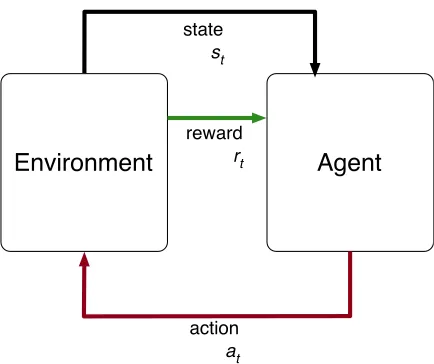
states. The agent is capable of observing the environment’s state and using its observations to guide decisions about which actions to perform. In contrast to supervised machine learning, the agent is not provided with external instruction about which actions to take. Instead, the environment produces rewards that provide positive or negative feedback about the agent’s actions. This feedback indicates whether the actions contribute toward achievement of the desired goal. The agent’s task is to utilize the reward signal in order to learn a policy, denoted π, which maps observed states to actions and maximizes its total accumulated
reward. Figure 2 illustrates the relationships between an agent, an environment, actions, states, and rewards in a classical reinforcement learning task.
A reinforcement learning problem is typically formalized as a Markov decision process (MDP) (Kaelbling, Littman, & Moore, 1996; Sutton & Barto, 1998). Solution methods for MDPs typically assume that the decision-making task satisfies the Markov property, which requires that future events in the environment be independent of past events, given the environment’s current state and the agent’s current action. An MDP is formally defined by a tuple M = (S, A, P, R), where S is the set of environment states; A represents the
Environment Agent
state st
action at reward rt
set of actions that the agent can perform; P is the state transition model, P:{S × A × S} → [0, 1],which specifies the probability of transitioning to state st+1∈S after
performing an action at ∈ A(st) in state st ∈ S at time step t; and R is the reward model, R: {S × A × S } → ℜ, which specifies the expected scalar reward rt ∈ ℜ associated with
performing action at in state st and transitioning to state st+1. The solution to an MDP is an
optimal policy, π*(st) → A, that maps states to actions and yields maximum expected reward
for the agent1.
In the classical version of reinforcement learning, the environment is fully observable, states and actions are both finite and discrete, the environment is static (i.e. the probabilities in the state transition model do not change), and proximal rewards possess greater value than distal rewards of equivalent magnitude. Additionally, reinforcement learning problems can be episodic, where an agent’s action sequences are divided into multiple independent episodes, or continuing, where the agent performs actions without regard for a terminal condition. It should be noted that the formulation described here represents the most elementary form of a reinforcement learning task. Considerable work has investigated problems that involve relaxing the aforementioned assumptions (Doya, 2000; Jaakkola, Singh, & Jordan, 1995; Littman, 1994), but these extensions are not essential for understanding our framework for narrative-centered tutorial planning.
Over the past decade, reinforcement learning techniques have been investigated for a range of complex applications, such as robotic soccer (Riedmiller, Gabel, Hafner, & Lange, 2009; Stone, Sutton, & Kuhlmann, 2005), automated vehicle control (Abbeel, Coates, Quigley, & Ng, 2007), and game playing (Amato & Shani, 2010; Sharma, Holmes, et al., 2007). Many real-world reinforcement learning problems require large training data sets. In these cases, simulations are the primary approach for gathering adequate training data.
1 Notation for the formal description of MDPs is borrowed from (Sutton & Barto, 1998) and
Reinforcement learning frameworks have also been investigated in intelligent user interfaces, such as dialogue systems (Chi, VanLehn, & Litman, 2010; Singh, Litman, Kearns, & Walker, 2002) and intelligent tutors (Barnes & Stamper, 2008; Beck et al., 2000). Human users play a critical role in determining the dynamics of these systems, but the inherent uncertainty associated with modeling human users introduces notable challenges in comparison to physical systems. Several efforts to utilize reinforcement learning for intelligent user interfaces have eschewed simulation-generated corpora in favor of corpora comprised of human user data (Chi, VanLehn, & Litman, 2010; Singh, Litman, Kearns, & Walker, 2002). However, collecting human user data is costly. These investigations have required steps to abstract reinforcement learning tasks in terms of approximate representations, trading optimality in exchange for learning efficiency.
Ideally, reinforcement learning models use state representations that encompass the agent’s full history and include all state features that are relevant for decision making. However, reinforcement learning methods suffer from the curse of dimensionality, which holds that the problem’s state space grows exponentially in the number of state features considered. One approach to addressing the curse of dimensionality is by mapping trueMDP states to approximate states, which are often comprised of small sets of carefully selected state features (Singh, Kearns, Litman, & Walker, 1999). These features are often coarsely discretized. In some cases, approximate states may not even be strictly Markovian, but they often yield good policies in practice by approximating the Markov property.