ISSN(Online) : 2319-8753 ISSN (Print) : 2347-6710
I
nternational
J
ournal of
I
nnovative
R
esearch in
S
cience,
E
ngineering and
T
echnology
(An ISO 3297: 2007 Certified Organization)Website: www.ijirset.com
Vol. 6, Issue 3, March 2017
Efficient Utilization of Resources and
Reutilization of Unused Resources Using
Green Computing
Manjula.R1, Bhavani.B2, Nivedita.N3, Rangeela.D4, Renuka.M5
Associate Professor, Department of Information Technology, Panimalar Engineering College, Nazarathpet,
Tamil Nadu, India 1
UG Students, Department of Information Technology, Panimalar Engineering College, Nazarathpet,
Tamil Nadu, India2,3,4,5
ABSTRACT: Green computing refers to the practice of using resources more efficiently, while maintaining or increasing the overall performance. Green computing is the environmentally responsible and Eco-friendly use of computers and their resources.Green computing is also known as green information technology (green IT). It enables organizations to improve environmental stewardship by increasing efficiency of energy, to improve information management and to provide appropriate capability in analytical manner. We are going to implement green computing by creating applications. This helps in effective utilization of underutilized resources. The created applications are monitored by a monitoring application. This releases the reserved memory and allocates it the new application.
KEYWORDS: Green computing, Eco-friendly, Green IT, Energy efficiency, Underutilized resources, Reserved memory.
I.INTRODUCTION
ISSN(Online) : 2319-8753 ISSN (Print) : 2347-6710
I
nternational
J
ournal of
I
nnovative
R
esearch in
S
cience,
E
ngineering and
T
echnology
(An ISO 3297: 2007 Certified Organization)Website: www.ijirset.com
Vol. 6, Issue 3, March 2017
GREEN COMPUTING FOR EFFECTIVE RESOURCE MANAGEMENT
Every organization or a person by individual is socially liable and responsible to take care of the earth, its environment and its resources. It’s their as social responsibility towards saving the environment through optimal usage of energy resources and by enhancing the usage of alternate energy resources, by using renewable and recyclable energy resources or through such practices which could help in reduction of consumption of energy resources. Now, governments of few countries, various environmentalists, and social welfare organizations are really worried to estimate the approaching energy crisis. Green in general refers to environment upholding activities that are necessary to be followed to favor the human beings as well as every creature on this earth to have a sustainable and a healthier life. Now, as per the today’s ever increasing needs,and with the increase in the usage of various computational and electronic devices like smart phones, laptops, tablets, Plasma systems etc., the promotion of environment favoring and environment protection techniques and systems are required to be promoted. Green computing, also known as Green IT, encompasses policies, procedures, and personal computing practices associated with the role of Information Technology.
NEED OF RESOURCE MANAGEMENT
With the change in needs of human beings, and increase in demands, trends and lifestyle, sharing of resources is reducing day-by-day, and the practice of using independent and single hand devices like, laptops, smart phones etc., is increasing day-by-day by almost every age group. Those days are nearly vanished, when one person was used to share computer,mobile phones etc. In current scenario, we are in practice of using latest models of systems personally on individually, leaving obsolete systems unused. Nowadays, we have separate electronic gadgets and systems at home or at our workplace for a more facilitated lifestyle. Unawareness about the fact that these devices incur carbon footprint, whether they are in use or left as outdated, even after knowing the facts, we are not able to put control on the increase in usage of all electronic gadgets. Similarly, the usage of gadgets and technology is accelerating in commercial world, with a greater rate,to match their pace with up gradations of technology and information access methods, demand of centralized data, system’s network and connectivity requirements, to excel in the organizational advancements, to cross through their competitive edges and many more. All such current organizational needs, lead us towards the enhancement of the IT infrastructure in organizations and thus consequently increasing the energy burden on the entire system. As per the rising demand for energy, a continuous and smooth supply for energy and energy resources is also raised. But, since our earth has its own limitations in providing resources, an efficient resource utilization and effective resource management is highly needed to come out from the problem of resource scarcity in present scenario.
II. RELATED WORK
Resource scheduling is achieved by using energy based efficient resource scheduling algorithm [1].It uses this for maintaining architectural principles for energy efficient management of clouds and it uses energy efficient resource allocation strategies and scheduling algorithm considering Quality of Service (QoS) outlooks. This performs better in all three cases such as low, high and random resource usage. The major drawback is that it considers only energy as QoS parameter.
Dynamic Voltage Frequency Scaling (DVFS) [2] is used for dynamic adjustment of voltage and frequency of the processor in execution time. The major purpose is to manage dynamic resources with energy saving mechanism by measuring CPU utilization. In this work, along with saving of energy, CPU utilization is also minimized. The major issue is that when the workload is heavy, real time migration is performed for achieving more effective usage of resources but a lot of migration increases energy consumption.
This work is to minimize the total energy consumption of physical machines in high performance cloud and thus satisfies QoS [3]. The advantage is that it uses heterogeneous physical machines and saves more energy. The drawback is that it saves only minimal amount of energy.
ISSN(Online) : 2319-8753 ISSN (Print) : 2347-6710
I
nternational
J
ournal of
I
nnovative
R
esearch in
S
cience,
E
ngineering and
T
echnology
(An ISO 3297: 2007 Certified Organization)Website: www.ijirset.com
Vol. 6, Issue 3, March 2017
benefits, researches have made important strides in conserving energy in servers. Inspired by this initial progress, researches are delving deeper into this topic. In this paper, survey the previous work, describe ongoing efforts, and discuss the challenges.
III.PROPOSED SYSTEM
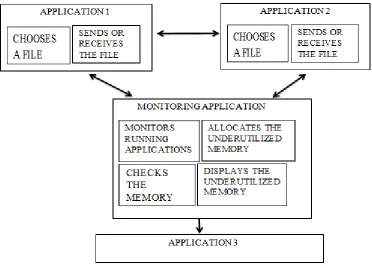
In order to overcome the issues in the existing system, we combine the unused memory spaces of applications and provide it to another application. Hence the system’s performance will increase and we can utilize unused memory in an effective manner. In this proposed system, we are introducing a new concept of re utilizing the under utilized resources from different applications. These underutilized resources are given to a new application rather than allocating a separate memory space for the new one. This concept helps to save more internal memory as we are not utilizing the resources but re utilizing the underutilized resources. Every application will take some separate memory space as reserved. This space is left underutilized throughout the running time of the application. In our system, we are going to release the reserved and underutilized memory of different applications by using a separate monitoring application which monitors the current memory usage of the running applications. This monitoring application displays the used and underutilized memory of the applications and allocates it to the new application instead of separate memory allocation to the new one. This concept helps in conserving memory and in turn will help in improving the system’s performance.Applications can be developed with the help of any application developing toolkit. This concept of monitoring the memory utilization of applications by a separate application is not available in any existing system. Therefore this work may help in effective resource utilization and abruptly suits the concept of green computing. In order to make few changes in the existing system which will make it better, is to implement the concept of energy and memory consumption.
ISSN(Online) : 2319-8753 ISSN (Print) : 2347-6710
I
nternational
J
ournal of
I
nnovative
R
esearch in
S
cience,
E
ngineering and
T
echnology
(An ISO 3297: 2007 Certified Organization)Website: www.ijirset.com
Vol. 6, Issue 3, March 2017
IV.EXPERIMENTAL WORK
It collects the running application list, collects the reserved memory details. If the memory is completely utilized, no reserved memory can be collected. If the memory is underutilized, it will be notified it to the monitoring application. Monitoring application monitors the memory utilization details. If new memory reservation request is made,then it will release the underutilized reserved memory. Allocation of the reserved memory to the new application can be done. Therefore underutilized resource(here memory) is utilized in a efficient manner. Fig 3.0 illustrates the architecture of the proposed system.
SNAPSHOTS
Fig1:
(a) (b)
(c) (d)
Fig1: (a)Sender application (b) Base station (c) Receiver application (d) File to be transferred is selected in sender application.
Figure 1 illustrates the applications and the works that can be carried out by these applications. (a) shows the sender application’s window, (b) shows the basestation application’s window, (c) shows the receiver application’s window, (d) displays the sender window during the process of selection of file.
ISSN(Online) : 2319-8753 ISSN (Print) : 2347-6710
I
nternational
J
ournal of
I
nnovative
R
esearch in
S
cience,
E
ngineering and
T
echnology
(An ISO 3297: 2007 Certified Organization)Website: www.ijirset.com
Vol. 6, Issue 3, March 2017
(d) (e)
(f) (g)
Fig2: (d) Monitoring application window (e) Monitoring application displays list of currently running applications (f)Window of monitoring application which enables us to select application to release its unused memory (g)Displays
occupied and released memory of selected application.
RESOURCE RECLAIMING ALGORITHM
Resource reclaiming refers to the problem of utilizing resources left unused a task when it executes less than its worst case computation time. The actual computation time of a task can be less than its worst case computation time due to data dependent loops and conditional statements in the task code. Architectural features of system such as cache hits and branch predictions.
RESOURCE RECLAIMING PROPERTIES
In Correctness, there is no run-time anomaly. The overhead cost of a resource reclaiming should be very low compared to tasks computation times. The bounded complexity of resource reclaiming algorithm should be independent of the number of tasks in the schedule. The Effectiveness of resource reclaiming is effective only when its performance is better than that of when no resource reclaiming is used.
V. CONCLUSION
ISSN(Online) : 2319-8753 ISSN (Print) : 2347-6710
I
nternational
J
ournal of
I
nnovative
R
esearch in
S
cience,
E
ngineering and
T
echnology
(An ISO 3297: 2007 Certified Organization)Website: www.ijirset.com
Vol. 6, Issue 3, March 2017
REFERENCES
[1] Takouna I., Dawoud W., Meinel C. - Energy efficient scheduling of HPC-jobs on virtualize clusters using host and VM dynamic configuration, ACM SIGOPS Operating Systems Review 46 (2012) 19-27.
[2] Liang-Teh Lee,Kang-Yuan Liu, Hui-Yang Huang and Chia-Ying Tseng, “A Dynamic Resource Management with Energy Saving Mechanism for Supporting Cloud Computing”, ,International Journal of Grid and Distributed Computing Vol. 6, No.1, February, 2013.
[3] Nguyen Quang-Hung, Nam Thoai,Nguyen Thanh Son, “Energy Efficient Allocation of Virtual Machines in HighPerformance Computing Cloud” , Journal of Science and Technology 51 (4B)(2013) 173-182.
[4] R. Bianchini and R.Rajamony, "power and energy management for server systems," IEEE Computer, voI.37, no. ll, pp.68-74, 2004.
[5] B. Priya, E. S. Pilli and R. C. Joshi, (Eds.), “A Survey on Energy and Power Consumption Models for Greener Cloud”, Proceeding of the IEEE 3rd International Advance Computing Conference (IACC),(2013), February 22-23; Ghaziabad.
[6] Pushtikant Malviya, Shailendra Singh, “A Study about Green Computing” International Journal of Advanced Research in Computer Science and Software Engineering, Volume 3, Issue 6, June 2013.
[7] Sonu Choudhary , (IJCSIT) International Journal of Computer Science and Information Technologies, Vol. 5.
[8] Chia-Tien Dan Lo and Kai Qian,, “Green Computing Methodology for Next Generation ComputingScientists”, 2010 IEEE 34thAnnual Computer
Software and Applications Conference.
[9] “FeiFei Chen, Jean-Guy Schneider, Yun Yang, John Grundy, and Qiang He, “An Energy Consumption Model and Analysis Tool for Cloud Computing Environments”,, GREENS 2012.
[10] George Perreas, Petros Lampsas, “A Centralized Architecture for Energy-Efficient Job Management in Data Centers”, CLOUD COMPUTING. [11] Rivoire, S., M.A. Shah, P.Ranganathan,C.kozyrakis, and J.Meza, “Models and Metrics to Enable Energy-Efficiency optimizationa,” IEEE Computer Society,pp.39-48, December 2007.