RFID Based Intimation to the Authority
M.Sirisha1, Ch.Sireesha2, K.Peda Raju3, K.Divya Teja4, V. Sita Ramanjineyulu5 Asst. Professor, Dept. of ECE, CIET, LAM, Guntur, AP, India [1]
Student, Dept. of ECE, CIET, LAM, Guntur, AP, India [2][3][4][5]
ABSTRACT:Intimating system is mainly the application based on faculty attending system. The faculty attending to
the class in time is very much required for the smooth running of an institute. It is the responsibility of higher authorities like HOD at monitoring the faculty attending in time to a class. It is very difficult to observe all the sections and classes oftheir department. In this project we are proposing a method to solve their problem by RFID and RTC. Thus, we will help active members of faculty attending in time to the class and can adjust the class. By implementing this type of systems discipline in the faculty and students can be maintained for thesuccess ofinstitution.
KEYWORDS: Arduino software, RF Transmitter and Receiver.
I. INTRODUCTION
ISSN(Online): 2319-8753 ISSN (Print): 2347-6710
International Journal of Innovative Research in Science,
Engineering and Technology
(A High Impact Factor, Monthly, Peer Reviewed Journal) Visit: www.ijirset.com
Vol. 7, Issue 3, March 2018
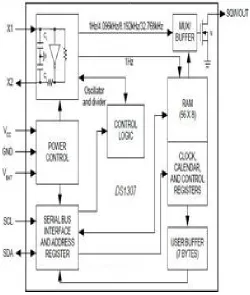
The DS1307 serial real-time clock (RTC) is a low-power, full binary-coded decimal (BCD) clock/calendar plus 56 bytes of NV SRAM is shown in fig 1.2. Address and data are transferred serially through an I2C, bidirectional bus. The clock/calendar provides seconds, minutes, hours, day, date, month, and year information. The end of the month date is automatically adjusted for months with fewer than 31 days, including corrections for leap year. The clock operates in either the 24hour or 12-hour format with AM/PM indicator. The DS1307 has a built-in power-sense circuit that detects power failures and automatically switches to the backup. supply. Timekeeping operation continues while the part operates from the backup supply.
Fig 1.2: Circuit diagram
A buzzer or beeper is a signalling device, usually electronic, typically used in Auto mobiles, household appliances such as a microwave oven or game. It most commonly consists of a number of switches or sensors connected to a control unit that determines if and which button was pushed or a present time has lapsed, and usually illuminates a light on the appropriate button or control panel and sounds a warning in the form of a continuous or intermittent buzzing or beeping sound.
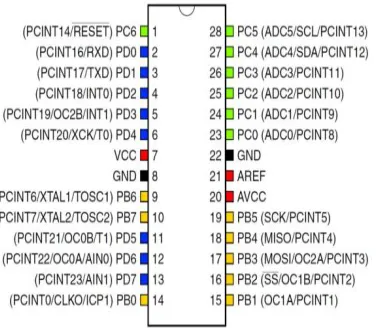
Fig 1.3: pin diagram
In this project we have power supplies with +5V & -5V option normally +5V is enough for total circuit. Another (-5V) supply is used in case of OP amp circuit .Transformer primary side has 230/50HZ AC voltage whereas at the secondary winding the voltage is step downed to 12/50hz and this voltage is rectified using two full wave rectifiers .the rectified output is given to a filter circuit to filter the unwanted ac in the signal After that the output is again applied to a regulator LM7805(to provide +5v) regulator. Whereas LM7905 is for providing –5V regulation.
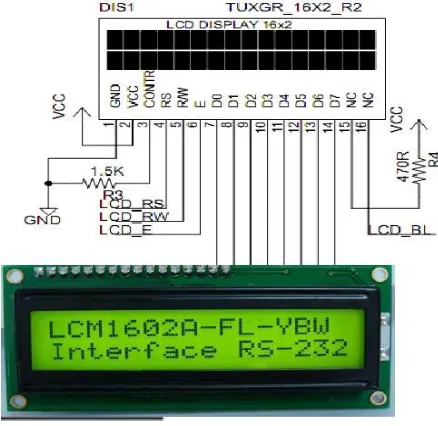
A liquid crystal display (LCD) is a thin, flat display device made up of any number of colour or monochrome pixels arrayed in front of a light source or reflector as shown in above fig 1.4 Each pixel consists of a column of liquid crystal molecules suspended between two transparent electrodes, and two polarizing filters, the axes of polarity of which are perpendicular to each other. Without the liquid crystals between them, light passing through one would be blocked by the other. The liquid crystal twists the polarization of light entering one filter to allow it to pass through the other.
ISSN(Online): 2319-8753 ISSN (Print): 2347-6710
International Journal of Innovative Research in Science,
Engineering and Technology
(A High Impact Factor, Monthly, Peer Reviewed Journal) Visit: www.ijirset.com
Vol. 7, Issue 3, March 2018
II. EXISTING SYSTEM
In the existing system it is very difficult for every faculty to go and give authentication or give signature as they have attended to the college or school.To overcome this problem, we are implementing faculty intimation to the higher authority using RFID. Thus, we will help active members at faculty attending in time to the class and can take attendance of such easy and adjust the class. by implementing this type at systems discipline in the faculty and students can be maintained for the success of institution. Thus, we will help active members at faculty attending in time to the class and can take attendance [2] and it is easy to adjust the class.
III. PROPOSED SYSTEM
Block diagram
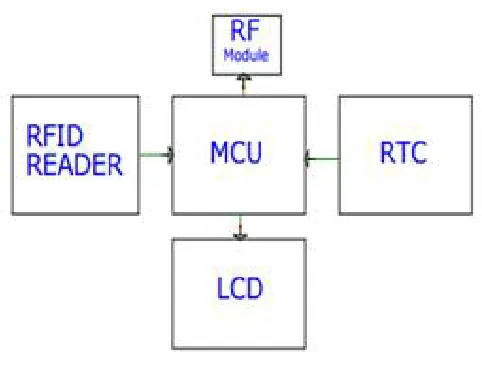
Fig 2: Block diagram
With the improvements and advantages in the technology we can provide solution to the drawbacks of existing system. In the proposed system we are making use of RFID and RTC. In this RF module,RF Reader and RTC are interfaced with micro controller unit. Arduino is interfaced with LCD to display whatever required to be placed on display as shown in block diagram 2.1
IV.WORKING
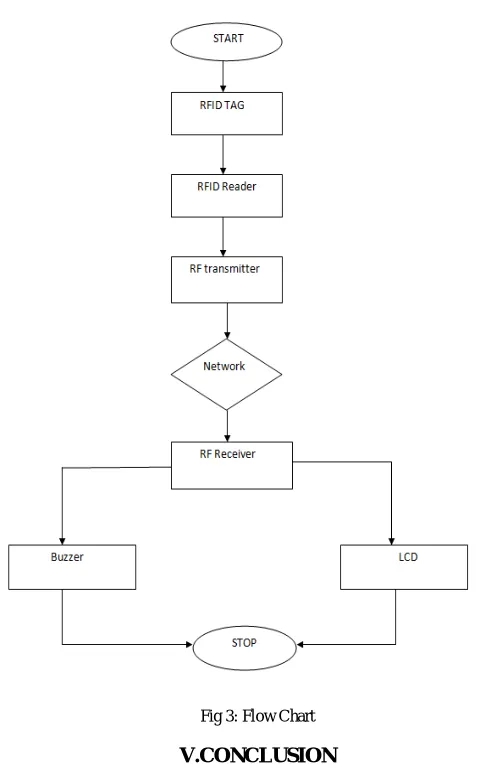
Fig 3: Flow Chart
V.CONCLUSION
This designed RFID based intimation system to the authority is a simple,economic,and produce effective solution to reduce the duplicate data. Thus, we will help active members of faculty attending in time to the class and can adjust the class very easily. By implementing this type of systems discipline in the faculty and students can be maintained for the success of institution.
VI.RESULT
ISSN(Online): 2319-8753 ISSN (Print): 2347-6710
International Journal of Innovative Research in Science,
Engineering and Technology
(A High Impact Factor, Monthly, Peer Reviewed Journal) Visit: www.ijirset.com
Vol. 7, Issue 3, March 2018
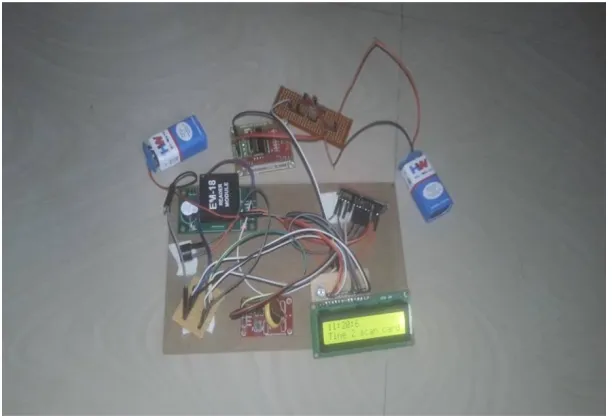
Fig 4: Experimental Setup
VII. FUTURE SCOPE
The future scope is to adopt the video visual to the authority and time table of each teacher can be added and even display can be placed in the authority cabin for the easy use.
REFERENCES
[1]. S.R.Bharamagoudar1, Geeta .B.2, “Web Based faculty Information Management System” S.G.Totad3.( International Journal of Advanced Research in Computer and Communication Engineering Vol. 2, Issue 6, June 2013).
[2]. Rajesh Shah, MakhanKumbhkar “Cloud-Based College Management Information System” for Autonomous Institute Christian Eminent College Indore, MP, India.( Volume 5, Issue 5, May 2015.
[3]. A. Patel1”Framework for Faculty Management System”. Unnati (International Journal of Application or Innovation in Engineering & Management (IJAIEM)Volume 2, Issue 12, December 2013).
[4]. Mary Jane Magno-Tan, Allan V. Crisostomo, Bill Villaflorand James C. Faller. “Cloud-Based College Management Information System” for Universities, “International Journal of Information and Education Technology”, Vol. 4, No. 6, December 2014.
[5]. V Shehu, A Dika “Using real time computer vision algorithms in automatic attendance management systems” (ITI), 2010 32nd International Conference on, 2010 .
[6]. G.SatyanarayanaReddy,RallabandiSrinivasu,Srikanth Reddy Rikkula,VudaSreenivasa Rao,” Management Information System To Help Managers For Providing Decision Making In An Organization”, International Journal of Reviews in Computing, ISSN: 2076-3328, EISSN: 2076-3336.
[7]. Published in:Computer Science and Information Technology - Spring Conference, 2009. IACSITSC '09. International Association of. Date of Conference: 17-20 April 2009 Page(s):174 - 177 Print ISBN: 978-0-76953653-8.
[8]. V.Ramesh, P.Parkavi and K.Ramar, “Predicting student performance: A statistical and data mining approach,” International Journal of Computer Applications (IJCA), vol. 63-No.8,February 2013.
[9]. P.MeenaKumari, SK.Abdul Nabi and PuppalPriyanka,”Educational data mining and its role in educational field,” International Journal of Computer Science and Information Technologies (IJCSIT),vol. 5(2),2014.
[10]. Dr.Mohd Maqsood Ali,”Role of data mining in education sector,” International Journal of Computer Science and Mobile Computing(IJCSMC),vol 2,issue 4,April 2013.
[11]. Kumar, “An Empirical Study of the Applications of Data Mining Techniques in Higher Education”. IJACSA - International Journal of Advanced Computer Science and Applications, 2011.