FPGA Implementation of Background
Subtraction and Image Threshold method for
Object Detection
Prof.V.V.Deotare, Bhushan Bapat,
Department of Electronics, SIT Lonavala, Pune, India
ABSTRACT: Object Tracking is a procedure of locate the object to associate the target in successive video frame over time and it finds wide scale applications in the field of security and surveillance, video communication, augmented reality, traffic control, medical imaging etc. This paper describe an image detection technique by background subtraction algorithm was developed to identify moving objects from a stable system in which visual inspection plays a major role. Among all presented algorithms running average mean algorithm after subtraction was selected due to low computational difficulty which is the major factor of time in VLSI. The concept of the background subtraction is to subtract the existing image with respect to the reference image and compare it with to the certain threshold values. At this time we have written the core Processor SPARTAN-6 is intended in Verilog-HDL (VHSIC hardware description language), implemented using XILINX ISE 14.2 Design suite the algorithm is written in system C Language and tested in SPARTAN-6 FPGA kit. Area and the speed of the algorithm are also evaluated.
KEYWORDS: Image features, FPGA, and Matlab, Background Subtraction, Micro blaze, Object Detection, UART, VHDL.
I. INTRODUCTION
Extracting moving objects from image sequences is basic problems in computer vision systems that are utilized in a variety of applications, such as video surveillance, human tracking, movement examination and image synthesis .To sense the object, we use methods such as background subtraction [1], inter –frame difference and optical flow. The frame difference method is highly adaptable to dynamic environments, but in general it is not a good option to extract the complete forms of certain types of objects in motion. The optical flow [2] is an approximation of the movement of the local image and specifies how much each pixel of the image moves between the adjacent images. Optical flow is a very complex algorithm, which requires high memory resources and is also difficult to apply in real time due to its high computational cost. In most cases, a fixed camera is used, which means that background subtraction techniques can be complete object detection. The simplest implementation of background subtraction is to estimate the difference between a background image and the current image in a pixel mode, and then determine the difference value to determine the pixels that belong to moving objects.
complex computational capacity. This quality makes them exceedingly reasonable for planning network executing calculations. Along these lines FPGAs are chosen to do the Image preparing calculations.
There are two methodology in FPGA based preparing firstly it is conceivable to exchange the memory-based methodology from programming based picture handling to FGPAs. This may have little advantages, as it is conceivable to have a high parallelism with FPGAs. Be that as it may, it is likewise required to have a lot of memory accessible. Besides, the read and compose paths of such a memory can turn into a restricting element because of high parallelism. This sort of picture handling is frequently alluded to as disconnected from the net picture preparing. The second approach is stream-based handling. Rather than perusing and composing picture information from and to the memory, the picture information is spilled line-wise, pixel after pixel, through equipment segments.
In stream preparing, the equipment framework is timed with an altered pixel clock. With each clock cycle, another pixel is spilled into an equipment part. The equipment part as a rule has a yield of one pixel esteem for every clock cycle. This should effectively be possible in one clock cycle. This sort of picture handling has a few ramifications that should be considered when planning stream-preparing calculations. The most serious ramifications are that it is impractical to stop the info. The second ramifications are that irregular pixel access is impractical. At the point when taking a shot at a picture in the memory, all pixels of the picture can be gotten to. In the spilling mode, pixels that take after the present pixel are not accessible yet, and pixels that went before the present one must be put away keeping in mind the end goal to secure further get to.
In this paper we proposed a technique commonly used for the segmentation of movement in static images. It will detect moving regions by subtracting the current pixel image per pixel from a reference background image that is created by mediating images over time in an initialization period. The basic idea of the background subtraction method is to first initialize a background and then subtract the current frame in which the moving object is present, that the current frame is subtracted with the background frame to detect the moving object. This method is simple and easy to capture and accurately extract the characteristics of the target data, but is sensitive to changing the external environment, so it is applicable to the condition that the background is known.
II. OBJECTIVE OF THE PROJECT
The scope of project is to do research in image processing techniques and algorithms. The techniques which can be implemented on FPGA for the optimizing in Speed of operation, resource utilization, memory requirements and algorithms used to extract objects The possible implementation of tracking objects and anticipating there further location to reduce the overall resource requirements on processor. A reliable and robust background subtraction algorithm should handle:
1. Sudden or gradual illumination changes,
2. High frequency, repetitive motion in the background (such as tree leaves, flags, waves.), and 3. Long-term scene changes (a car is parked for a month).
III. ALGORITHMIC DEVELOPMENT
The following modules construct the Object Tracking System: 1. Separating image frame on time frame and storing in BRAM
2. Object extraction by difference between frames (Background Subtraction algorithm) 3. Thresholding on mean value bases. (Threshold Method)
4. Trace Identification and display. Object Tracking System
these basic components gives an illusion of color of that particular spot. The image here is considered in 2D matrix with pixel size of 64x64 pixels. This is stored in block RAM as an input to algorithms.
2. The Object extraction (background subtraction algorithm)
The alienating of object pixels as compared to pixels on same location as compared with previous image is done in this step and after we separate the image frame on time bases. The current image is treated as foreground image and it is denoted by FK(x, y). and the hold frame of time k-1 is denoted byBK-1 (x, y). This
hold frame is the base image or background image over which changes has to be detected. After obtaining the background image BK-1 (x, y), we subtract the background image BK-1 (x, y) from the current frame Fk(x, y) as
shown in Figure 1.
Figure:- 1 Difference of Image program flow for image of pixel [64] x [64] resolution
3. Thresholding on mean value bases. (Threshold Method)
If the pixel difference is greater than the configured threshold T, then it determines that the pixels appear in the moving object, otherwise, as background pixels. The Algorithmic sequence is as shown in Figure 2.The moving object can be detected after the threshold operation. Its expression is the following:
( , ) = 1 | ( , )− −1( , )| > 0 ℎ
Threshold Expression
Where Dk(x,y) is binary image (which is calculated by differential image result).T is a gray scale threshold; its size determines the accuracy of the identification of the object. Since algorithm T is a fixed value, only for an ideal situation, it is not suitable for complex environments with changing lighting. Therefore, this document proposes the dynamic threshold method, dynamically changing the threshold value according to the variations in the illumination of the two images obtained.
Figure:3 The flow chart of moving object detection.
4. Trace Identification and display.
After the object detection we have to display it on VGA display. This image pixel is then stream on VGA display and then result is shown. Through observation, we can find that when an object appears on the move appears on the scene.
IV. HARDWARE IMPLEMENTATION
The hardware part, used mainly for the VGA part, was developed in Xilinx Spartan-3E FPGA (XC6SLX9, FG414). The frequency of the system is 50MHz. Our Vga controller communicates with the bus through the Fast Simple Link (FSL). In our project, data should only be sent to the VGA driver if the data is prepared for FSL and memory access is not required. BRAM is used only for data storage and software instructions. The VGA port on the SPARTAN-6 card uses 10-pin FPGA signals to create an 8-bit color VGA port and two standard synchronizations (VS-Vertical Sync). There are eight signal levels in the red and green VGA signals and four levels in blue, so you can see 256 different colors, one for each of the 8-bit input data. The image on the screen is obtained by continuously refreshing the pixel from top to bottom of the lower right corner. Both synchronization signals and pixel color signals must be generated so you can track what you want on the screen.
In our project, we use the VGA driver to generate VGA display and sync signals to generate color signals for each pixel. The block diagram of the VGA part is shown. The VGA driver has to retrieve and apply video data to the screen just as the electronic beam moves through a given pixel. Therefore it has to generate HS and VS timing signals and coordinate the output of pixel data as a function of the pixel clock.
Figure:-5 VGA Block diagram
V. EXPERIMENTAL SETUP AND RESULTS
Figure:-6 experimental setup for project.
the black background / stable background is obtained. The object can be identified due to high difference in the mean value of its luminance as compared to the background image. As compare to Hybrid back ground subtraction method ,Horprasert model and blob detection Algorithm which utilizes 6% , 47% and 2% onVertex at 100 MHz frequency respectively of available hardware resource and 4 block RAM for complete processing, this experiment setup use only 1% of hardware and 2 block RAM when implemented over in Xilinx Spartan-3E FPGA (XC6SLX9, FG414) where the frequency of the system is 50MHz.
Figure:-8 Area used by proposed system
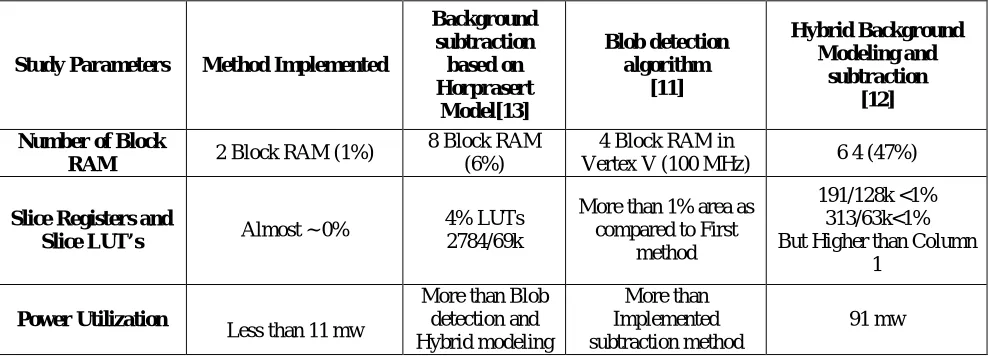
Table 1 gives a comparitive study of some methods used for background subtraction application to detect object is compared in below chart. For the system used for applications like surveillance / security or in thermal imaging or night vision sensors where the object is present in monochromatic format the Proposed method proves to be superior over the existing methods. In terms of the block RAM or flip flops used, LUT and Registers memory used in the method.
Study Parameters Method Implemented
Background subtraction based on Horprasert Model[13] Blob detection algorithm [11] Hybrid Background Modeling and subtraction [12]
Number of Block
RAM 2 Block RAM (1%)
8 Block RAM (6%)
4 Block RAM in
Vertex V (100 MHz) 6 4 (47%)
Slice Registers and
Slice LUT’s Almost ~ 0%
4% LUTs 2784/69k
More than 1% area as compared to First
method
191/128k <1% 313/63k<1% But Higher than Column
1
Power Utilization
Less than 11 mw
More than Blob detection and Hybrid modeling More than Implemented subtraction method 91 mw
Table:- 1 Comparison study of Implemented method with other methods
VI. CONCLUSION
frequency. The Slice Registers and LUTs are also compared and found less required in the experimented model as compare to other two algorithms. This shows that the power requirement also comes in ascending order from implemented method to the Hybrid method. Thus making the system efficient in its area as well as power efficient factor as compare to other algorithm.
REFERENCES
[1] Sen-Ching S. Cheung and ChandrikaKamath, “Robust Techniques forBackground Subtraction in Urban Traffic Video,” EURASIP Journalon Applied Signal Processing, vol. 2005, pp. 2330-2340, Jan. 2005.
[2] Donovan H. Parks and Sidney S. Fels, “Evaluation ofBackground Subtraction Algorithm with Post-Processing,” inIEEE Fifth International Conference on Advanced Video &Signal Based Surveillance, 2008, p.192-199.
[3] Ahmed Elgammal, David Harwood and Larry Davis , “Non-parametric Model for Background Subtraction,” in Proceedings of the 6thEuropean Conference on Computer Vision-Part II, 2000, p. 751-767.
[4] Muhammad Shoaib, Ralf Dragon and JornOstermann, “ShadowDetection For Moving Humans Using Gradient-Based Background Subtraction,” in ICASSP, 2009, p.773-776.
[5] S. Hinterstoisser, S. Holzer, C. Cagniart,S. Ilic, K. Konolige, N. Navab, V. Lepetit, “Multimodal templates for real-time detection of textureless objects in heavily cluttered scenes,” Computer Vision (ICCV), IEEE International Conference on, pp. 858-865, 2011.
[6] A. Trevor, S. Gedikli, R. Rusu, H. Christensen, “Efficient Organized Point Cloud Segmentation with Connected Components,” 3rd Workshop on Semantic Perception Mapping and Exploration (SPME), Karlsruhe, Germany. May, 2013.
[7] Koheri Arai, Ali RidhoBarakbah,“Hierarchical K-means: an algorithmfor Centroids initialization for k-means”, department of information science and Electrical Engineering Politechnique in Surabaya, Facultyof Science and Engineering, Saga University, Vol. 37, No.1, 2007.
[8] L. Li, W. Huang, I. Y.-H. Gu, and Q. Tian, “Statistical modeling of complex backgrounds for foreground object detection,” IEEETrans.Image Process., vol. 13, no. 11, pp. 1459–1472, Nov. 2004.
[9] D. Culibrk, O. Marques, D. Socek, H. Kalva, and B. Furht,“Neuralnetwork approach to background modeling for video objectSegmentation,”IEEE Trans. Neural Netw., vol. 18, no. 6, pp. 1614–1627, Dec.2007.
[10] A. Elgammal, R. Duraiswami, D. Harwood, and L. S. Davis,“Background and foreground modeling using nonparametric kerneldensity estimation for visual surveillance,” Proc. IEEE, vol. 90, no. 7,pp. 1151–1163, Jul. 2002.
[11] DivyaKiran, Abdul Imran, RasheedHariharanRamasangu “FPGA Implementation of Blob Detection Algorithm for Object Detection in Visual Navigation” Proc. IEEECircuits, Controls and Communications (CCUBE), 2013 International conference on27-28 Dec. 2013.
[12] Muhammad Imran, MattiasO’Nils, HumaMunir, Benny Thörnberg“Low Complexity FPGA Based Background SubtractionTechnique for Thermal Imagery,” ICDSC '15 Proceedings of the 9th International Conference on Distributed Smart Camera, Seville, Spain, on September 08 - 11, 2015.