ISSN(Online): 2319-8753 ISSN (Print): 2347-6710
I
nternational
J
ournal of
I
nnovative
R
esearch in
S
cience,
E
ngineering and
T
echnology
(A High Impact Factor, Monthly, Peer Reviewed Journal) Visit: www.ijirset.com
Vol. 6, Issue 12, December 2017
Reducing Denial-Of-Service Attacks Using
Software Puzzle
K. Asha Rani, G. Vijay Kumar
Department of CSE, Osmania University, Hyderabad, Telangana, India
ABSTRACT: Denial-of-service (DoS) and distributed DoS (DDoS) are the major threats in cyber-security. As a countermeasure to such threats client puzzle scheme is implemented. The client puzzle demands a client to perform computationally expensive operations before being granted services to the client from a server. However, an attacker can inflate the capability of DoS/DDoS attacks with fast puzzle solving software and/or built-in graphics processing unit (GPU) hardware to significantly weaken the effectiveness of client puzzles. In order to prevent DoS/DDoS attackers from inflating the puzzle-solving capabilities, a new client puzzle referred to as software puzzle is implemented. Unlike the existing client puzzle schemes, which publish their puzzle algorithms in advance, a puzzle algorithm in the implemented software puzzle scheme is randomly generated only after a client request is received at the server side and the algorithm is generated such that: a) an attacker is unable to prepare an implementation to solve the puzzle in advance and b) the attacker needs considerable effort in translating a central processing unit puzzle software to its functionally equivalent GPU version such that the translation cannot be done in real time.
I. INTRODUCTION
DENIAL of Service (DoS) attacks and Distributed DoS (DDoS) attacks attempt to deplete an online service resources such as memory, network bandwidth, and computation power by devastating the service with bogus requests. [1] For example, a malicious client sends a large number of garbage requests to an HTTPS bank server. As the server has to spend a lot of CPU time in completing SSL handshakes, it may not have sufficient resources left to handle service requests from its customers, resulting in lost businesses and reputation. DoS and DDoS attacks are not only theoretical, but also realistic. DoS and DDoS are effective if attackers spend much less resources than the victim server or are much more powerful than normal users [1]. In the example stated above, the attacker spends negligible effort in producing a request, but the server has to spend much more computational effort in HTTPS handshake (e.g., for RSA decryption). In this case, conventional cryptographic tools do not enhance the availability of the services; in fact, they may degrade service quality due to expensive cryptographic operations. The seriousness of the DoS/DDoS problem and their increased frequency has led to the advent of numerous defense mechanisms[6]. Let γ denote the ratio of resource consumption by a client and a server. Obviously, a countermeasure to DoS and DDoS is to increase the ratio γ , i.e., increase the computational cost of the client or decrease that of the server. Client puzzle[7] is a well-known approach to increase the cost of clients as it forces the clients to carry out heavy operations before being granted services. Generally a client puzzle scheme consists of three steps:
i) puzzle generation
ii) Puzzle solving by the client
iii) Puzzle verification by the server.
Hash-reversal is an important client puzzle scheme which increases a client cost by forcing the client to crack a one-way hash instance. Technically, in the puzzle generation step, given a public puzzle function P derived from one-way functions such as SHA-1 or block cipher AES, a server randomly chooses a puzzle challenge x, and sends x to the client. In the puzzle-solving and verification steps, the client returns a puzzle response (x, y), and if the server confirms
ISSN(Online): 2319-8753 ISSN (Print): 2347-6710
I
nternational
J
ournal of
I
nnovative
R
esearch in
S
cience,
E
ngineering and
T
echnology
(A High Impact Factor, Monthly, Peer Reviewed Journal) Visit: www.ijirset.com
Vol. 6, Issue 12, December 2017
ISSN(Online): 2319-8753 ISSN (Print): 2347-6710
I
nternational
J
ournal of
I
nnovative
R
esearch in
S
cience,
E
ngineering and
T
echnology
(A High Impact Factor, Monthly, Peer Reviewed Journal) Visit: www.ijirset.com
Vol. 6, Issue 12, December 2017
A. NOTATIONS USED
x: challenge chosen by server.
m: message collected by server from outside environment. y: solution to the puzzle challenge x.
(xˈ, yˈ): puzzle response returned from client. P(.): puzzle algorithm such that x=P(y , m).
C: software implementation of P(.) which is considered as puzzle core. C0x : puzzle which embeds the information of x into C.
C1x : Obfuscated C0x.
γ: ratio of resource consumption by a client and a server. ts: time taken by server to generate the puzzle x. tc: time taken by client to solve the puzzle x. >>: much greater than.
B. DIFFERENCE BETWEEN CPU AND GPU
Unlike modern CPUs, modern GPU executes massively data parallel programs in quite predictable way. Although both CPU and GPU software can be implemented using the same higher language such as C, their low level instruction sets are totally different. Particularly some instruction operations are not supported in GPU software. For example, self- modifying code, widely used in software protection, modifies the software itself on the fly so as to raise the bar of hacking. As all the GPU cores share the same kernel, if one thread modifies the kernel, the final software output is hard to predict due to independent threads.
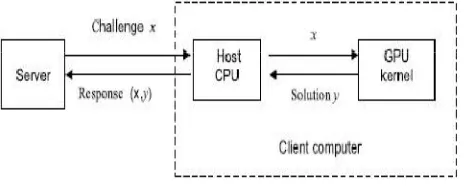
Fig 4.1 GPU – Inflated DoS attack against data puzzle
A CPU processor is usually much slower than a GPU processor, but one CPU core is much faster than one GPU core. In addition, one CPU dominates its resources such as memory and cache, but all GPU cores share resources including memory and cache. If a GPU kernel were to ask many shared resource, the number of cores used in the application would be much smaller than the available cores such that the potential of GPU would not be fully utilized. In this case, GPU may be slower than CPU.
II. SOFTWARE PUZZLE
A client puzzle is classified into two types: data puzzle and a software puzzle.
DATA PUZZLE: If a puzzle function P, is fixed and disclosed in advance, which is similar to all existing client puzzle schemes[8], then it is said to be data puzzle.
SOFTWARE PUZZLE: If a puzzle function P, is arbitrary and not known in advance, then it is said to be Software puzzle.
ISSN(Online): 2319-8753 ISSN (Print): 2347-6710
I
nternational
J
ournal of
I
nnovative
R
esearch in
S
cience,
E
ngineering and
T
echnology
(A High Impact Factor, Monthly, Peer Reviewed Journal) Visit: www.ijirset.com
Vol. 6, Issue 12, December 2017
includes a dynamically generated software C(.) including a data puzzle function as a component. Although a software puzzle scheme does not publish the puzzle function in advance, it follows the Kerchoffˈs Principle because an adversary knows the algorithm for constructing software puzzles, and is able to reverse-engineer the software puzzle C1x to know puzzle function P(.) several minutes later after receiving the software puzzle.
A. GPU-INFLATED DOS ATTACK
When a client wants to obtain a service, she/he sends a request to the server. After receiving the client request, the server responds with puzzle challenge x. If the client is genuine, she/he will find the puzzle solution y directly on the host CPU and sends the response (x,y) to the server. However , there may be a chance for the malicious user who contrls the host may send the challenge x to GPU and exploit the GPU resource to accelerate the puzzle-solving process.
B.SOFTWARE PUZZLE FRAMEWORK
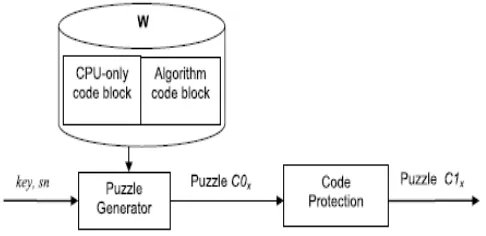
In order to defeat the GPU-inflated DoS attack, data puzzle is extended to software puzzle. At the server, the software puzzle scheme has a code block warehouse W storing various software instruction blocks. Additionally, it includes two modules: generating the puzzle COx by randomly assembling code blocks extracted from the warehouse, and obfuscating the puzzle COx for high security puzzle C1x.
Fig 4.2 Software Puzzle generated with secret key and nonce
C. CONSTRUCTION OF CODE BLOCK WAREHOUSE
The code block warehouse W stores compiled instruction blocks in Java bytecode or C binary code. The purpose to store compiled codes rather than source code is to save serverˈs time as the server has to take extra time to compile source codes into compile codes in the process of puzzle generation. The requirements for each block are:
In order to assemble the code blocks together, each block has well-defined input and output parameters such that the output from one block can be used as the input for the following blocks.
The size of each code block is decided by the security parameter k. Given that the size of software puzzle is constant, if the block size is smaller, there are more blocks on average such that more puzzles can be generated. Thus smaller block size implies higher security level because an attacker has to spend more effort to figure out a puzzle. The disadvantage of small block size is that the server has to spend more time in extracting the basic blocks and assembling the extracted blocks into software puzzle.
ISSN(Online): 2319-8753 ISSN (Print): 2347-6710
I
nternational
J
ournal of
I
nnovative
R
esearch in
S
cience,
E
ngineering and
T
echnology
(A High Impact Factor, Monthly, Peer Reviewed Journal) Visit: www.ijirset.com
Vol. 6, Issue 12, December 2017
cross platform deployment. In general, code blocks can be classified into two categories namely CPU-only instruction block and data puzzle algorithm block.
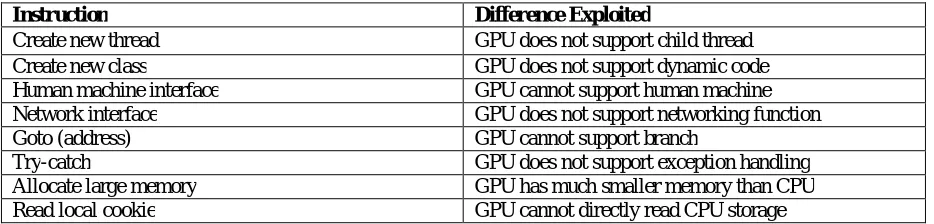
CPU-ONLY INSTRUCTION BLOCK: Unlike CPU, GPU is designed for the predictable graphic processing such as matrix operations, not generic logic processing. As branching operations such goto, try-catch-finally are inherently non-predictable and are non-paralleable, executing them in GPU is slow such that the major merit of GPU cannot be exploited by the attacker. Moreover, some hardware related operations such as reading hardware input and surfing network cannot be performed on GPU. Further, the state of the art GPUs do not support dynamic thread generation. Finally, the high speed shared memory is shared by all the GPU thread blocks together such that the size of fast accessible memory available to each thread is small. Therefore, if the puzzle kernel demands large shared memory, the GPU parallelism potential will be restricted seriously, or the threads have to access the global memory at a much slower speed.
Instruction Difference Exploited
Create new thread GPU does not support child thread
Create new class GPU does not support dynamic code
Human machine interface GPU cannot support human machine
Network interface GPU does not support networking function
Goto (address) GPU cannot support branch
Try-catch GPU does not support exception handling
Allocate large memory GPU has much smaller memory than CPU
Read local cookie GPU cannot directly read CPU storage
Table I Examples of CPU only instructions
II. DATA PUZZLE ALGORITHM BLOCK: Similar to the blocks in data puzzle, algorithm blocks perform the mathematical operations only. For ex. In an AES round, ShiftRows code block outputs a transformed message matrix which can be used as input of any other operation such as MixColumn code block without incurring parameter mismatch errors.
D.SOFTWARE PUZZLE GENERATION
In order to construct a software puzzle, the server has to execute three modules namely: puzzle core generation, puzzle challenge generation, software puzzle encrypting.
PUZZLE CORE GENERATION: From the code block warehouse, the server first choses n code blocks based on hash functions and a secret, eg., the jth instruction block bij , where ij = H1(y , j), and y = H2(key , sn), with one-way functions H1(.) and H2(.), key is the serverˈs secret and sn is nonce or timestamp. All the chosen blocks are assembled into a puzzle core, denoted as C(.) = (bi1,bi2,....bin).
PUZZLE CHALLENGE GENERATION:
Given some auxiliary input messages such as IP addresses and in-line constants, the server calculates a message m from public data such as their IP addresses, port numbers and cookies, and produces a challenge x = C(y,m), which is similar to encrypting plaintext m with key y to produce cipher text x.
ISSN(Online): 2319-8753 ISSN (Print): 2347-6710
I
nternational
J
ournal of
I
nnovative
R
esearch in
S
cience,
E
ngineering and
T
echnology
(A High Impact Factor, Monthly, Peer Reviewed Journal) Visit: www.ijirset.com
Vol. 6, Issue 12, December 2017
CODE PROTECTION:
Code obfuscation is able to thwart the puzzle translation threat to some extent. Though, there are no generic obfuscation techniques which can prevent a patient and a hacker from understanding a program in theory , results in show that the obfuscation does increase the cost of reverse-engineering. Thus, although code obfuscation may not be satisfactory in long-term software defense against hacking, it is suitable for fortifying software puzzles which demand a protection period of several seconds only.
A software puzzle consists of instructions and each instruction has a form (opCode, [operands]), where opCode indicates which operation such as addition, shift, jump etc, while the operands , varying with opCode, are the parameters like target address of jump instruction to complete the operations. As a popular obfuscation technology, code encryption technology treats software code as data string and encrypts both operand and opCode. Concretely, given the code COx, the server generates an encrypted puzzle C1x = E(y , COx), where E(.) is a cipher such as AES and y is used as the encryption key.
In all, there are two-layer encryptions. The outer layer is used to encrypt the software puzzle COx, and the inner layer uses the puzzle software to encrypt the challenge as like data puzzle. Therefore, after receiving C1x, the client has to try yˈ = y, the original software puzzle COx can be recovered and further used to solve the challenge.
III. PACKAGING SOFTWARE PUZZLE
Once a software puzzle C1x is created at the server side and compiled into a Java class file C1x.class, it will be delivered to the client who requests for services over an insecure channel such as Internet, and run at the clients side. To demonstrate the applicability of software puzzle, Applet is used to implement software puzzles such that the software puzzle implementation has the same merits as easy deployment.
ALGORITHM 1:
init.class structure for reloading puzzle class on JVM. If a correct solution y is found, C1x.class shall be the same as the original puzzle C0x.class.
Read C1x.class Repeat
Randomly chose a small yˈ
Decrypt C1x.class with key yˈ into class C0x.class Load class C0x.class
Invoke C0x.class to obtain mˈ and further xˈ = C0(yˈ, mˈ) Until xˈ = x
Output (xˈ , yˈ)
ALGORITHM 2:
init.class structure for activating puzzle class on dedicated sandbox. Read C1x.class
Load class C1x.class Repeat
Randomly chose a small yˈ
Decrypt C1x.class with key yˈ into class C0x.class Invoke C0x.class to obtain mˈ and further xˈ = C0(yˈ , mˈ) Until xˈ = x
ISSN(Online): 2319-8753 ISSN (Print): 2347-6710
I
nternational
J
ournal of
I
nnovative
R
esearch in
S
cience,
E
ngineering and
T
echnology
(A High Impact Factor, Monthly, Peer Reviewed Journal) Visit: www.ijirset.com
Vol. 6, Issue 12, December 2017
IV. SECURITY ANALYSIS
Software puzzle aims to prevent GPU from being used in the puzzle solving process based on different instruction sets and real-time environments between GPU and CPU. Conversely, an adversary may attempt to deface the software puzzle scheme by simulating the host on GPU, cracking puzzle algorithm, re-producing GPU-version puzzle, abusing the access priority in puzzle solving which are discussed below.
EMPLOYING HOST SIMULATOR ON GPU
If an attacker is able to run a CPU simulator over GPU environment, the software puzzle can be executed on GPU directly. However, this simulator based attack can be impractical in accelerating the puzzle solving process due to the following reasons.
“VM software must emulate the entire hardware environment, so that problems can arise if the properties of hardware resources are significantly different in the host and the guest” [9]. To the best of knowledge, there is no host simulator on GPU at present. Indeed, it is not trivial to develop a full-functional CPU simulator on GPU because the CPU environment including Operating System, and all the imported Java libraries (and their imported libraries and so on) must be simulated. If only a portion of simulator functions is implemented, the GPU kernel may have to communicate with the host for the non-simulated functions. In this case, the GPU-inflation function is reduced significantly because it cannot run in a parallel way and the GPU-CPU communication channel is much slower than its internal memory access.
A software running over a simulator is much slower than over its guest environment directly because there are more processing steps to execute the software instructions.
CRACKING DATA PUZZLE ALGORITHM
According to Algorithm 1 or Algorithm 2, an adversary obtains the puzzle solution (xˈ , yˈ) to the software puzzle C1x , such that x = xˈ = C0x (yˈ ,mˈ), where number x is hard-coded in the software puzzle and m˜ is derived on the fly. Since the software puzzle is encrypted with the standard cipher, an adversary has to recover the puzzle software by brute force. Moreover, for the inner-layer encryption, as C(·) is an encryption function, theoretically, an adversary cannot find a valid solution ( xˈ, yˈ) in a better way than brute force given that y is over a small interval. Hence, the practical strategy of the attacker is to accelerate the brute force process by exploiting the parallel computation capability of GPU cores. Even the code blocks (e.g., AES round transformations) are cryptographic primitives, their combination may be not as secure as the original ones for the basic software puzzle. But in software puzzle, by randomly adding some round transformations into the existing AES code. As the new added transformation will increase the diffusion effect, the AES variants have at least the same security level as standard AES.
REPLAYING DATA PUZZLE
ISSN(Online): 2319-8753 ISSN (Print): 2347-6710
I
nternational
J
ournal of
I
nnovative
R
esearch in
S
cience,
E
ngineering and
T
echnology
(A High Impact Factor, Monthly, Peer Reviewed Journal) Visit: www.ijirset.com
Vol. 6, Issue 12, December 2017
V. EXPERIMENTAL EVALUATION
In this experiment, Apache Tomcat server is used to respond for clients requests. The server, on receiving a request from the client, the servlet will generate software puzzle. An experimental server is built which included CPU only instructions and AES round operations a module for puzzle generation and a module for code encryption.
EXPERIMENT RESULTS
The most popular on-line transaction protocol is SSL/TLS and the corresponding server performs an expensive RSA decryption operation for each client-connection request, thus the generated software puzzle is vulnerable to DoS attack. For decryption RSA is used to evaluate the defense effectiveness.
Assume the time to perform one RSA decryption be t0, and the time to generate and verify one software puzzle be ts . Suppose the number of attacker’s requests be na, and the number of genuine client requests be nc, the server’s computational time required for replying all the requests is τ1 = (na + nc)×t0 if there is no software puzzle; otherwise, τ2 = (na + nc) × ts + nc×t0 given that the adversary does not return valid solutions to the puzzles. Thus, software puzzle defense is effective if
τ1≥ τ2, i.e., na≥ nc
VI. CONCLUSION AND FUTURE WORK
Software puzzle scheme is implemented to overcome the drawbacks of existing client puzzle scheme which generates a client puzzle in advance and also to overcome GPU-inflated DoS attack. The implemented software puzzle scheme adopts software protection technologies to ensure challenge data confidentiality and code security for an appropriate time period. Hence, it has different security requirement from the conventional cipher which demands long-term confidentiality only. Since the software puzzle may be built upon a data puzzle, it can be integrated with any existing server-side data puzzle scheme, and easily deployed as the present client puzzle schemes do. Although this scheme focuses on GPU-inflation attack, its idea can be extended to thwart DoS attackers which exploit other inflation resources such as Cloud Computing. For example, suppose the server inserts some anti-debugging codes for detecting Cloud platform into software puzzle, when the puzzle is running, the software puzzle will reject to carry on the puzzle-solving processing on Cloud environment such that the Cloud-inflated DoS attack fails. In the implemented software puzzle, the server has to spend time in constructing the puzzle.
0 20 40 60 80 100 120
0 2 4 6 8 10
N
u
m
b
e
r
o
f
se
rv
e
d
c
lie
n
ts
Number of malicious requests per second Comparison of service capability of server
with/without software puzzle
Puzzle
ISSN(Online): 2319-8753 ISSN (Print): 2347-6710
I
nternational
J
ournal of
I
nnovative
R
esearch in
S
cience,
E
ngineering and
T
echnology
(A High Impact Factor, Monthly, Peer Reviewed Journal) Visit: www.ijirset.com
Vol. 6, Issue 12, December 2017
As a future enhancement, the server time has to be saved to construct the client-side software puzzle for better performance.
REFERENCES
[1] Yongdong Wu, Zhigang Zhao, Feng Bao and Robert. H. Deng (2015): “Software Puzzle-A countermeasure to Resource inflated Denial-of Service attacks”. IEEE Transaction Information Forensics and Security, vol 10, pp 168-177
[2] NVIDIA CUDA(2012): “ NVIDIA CUDA C Programming Guide” Version 4.2.
[3] E. Kaiser and W.-C. Feng (2007): “mod_kaPoW: Mitigating DoS with transparent proof-of-work,” in Proc. ACM CoNEXT Conf., 2007, p. 74.
[4] D. Keppel, S. J. Eggers, and R. R. Henry (1991): “A case for runtime code generation” Dept. Comput. Sci. Eng, Univ. Washington, Seattle, WA, USA, Tech. Rep. CSE-11-04-91.
[5] R. Shankesi, O. Fatemieh, and C. A. Gunter(2010): “Resource inflation threats to denial of service countermeasures,” Dept. Comput. Sci, UIUC, Champaign, IL, USA, Tech. Rep, Oct. 2010.
[6] C. Douligeris and A. Mitrokotsa (2004): “DDoS attacks and defense mechanisms: Classification and state-of-the-art” Comput. Netw., vol. 44, no. 5, pp. 643–666.
[7] A. Juels and J. Brainard (1999): “Client puzzles: A cryptographic countermeasure against connection depletion attacks,” in Proc. Netw. Distrib. Syst. Secur. Symp.,pp.151–165.
[8] T. J. McNevin, J.-M. Park, and R. Marchany (2004): “pTCP: A client puzzle protocol for defending against resource exhaustion denial of service attacks,” Virginia Tech Univ., Dept. Elect. Comput. Eng., Blacksburg, VA, USA, Tech. Rep. TR-ECE-04-10, Oct. 2004.
[9] J. E. Smith and R. Nair, Virtual Machines (2005): “Versatile Platforms for Systems and Processes”. San Mateo, CA, USA: Morgan Kaufmann, , p. 19.