Attainment of Course Outcomes for
Microcontroller Course by using
Direct-Indirect Method
Sushama Kolhe 1, Vidya Palve 2, Sagar Vetal 3 , Yogen Lohite 4
Head, Department of Electronics &Telecommunication, Guru Gobind Singh Polytechnic, Maharashtra, India1
Lecturer, Department of Electronics &Telecommunication, Guru Gobind Singh Polytechnic, Maharashtra, India2, 3, 4
ABSTRACT: Course Outcomes (COs) plays an important role in Outcome-Based Education (OBE). The attainment of Program Outcomes (POs) is depends on the attainment of Course Outcomes (COs). In this paper, we have measured the CO attainment for specific course on the basis of various tools such as direct and indirect method in which students internal and external assessment marks and feedback from Course Exit Survey have been considered as an input data. The attempt is made here to find out accurate attainment of COs so that corrective actions can be taken for the next batch to improve the teaching learning process. We have shown attainment level achievement using both direct and indirect methods.
KEYWORDS: Course Outcomes (COs), National Board of Accreditation (NBA), Outcome-Based Education (OBE), Program Outcomes (POs).
I. INTRODUCTION
Outcome based Education (OBE) are already adopted, in engineering education system, from last few years along with National Board of Accreditation (NBA) [1][6][7]. In OBE, individual course outcomes need to be attained up to some minimum level [2].
The attainment level of course outcome may vary with different courses but at least 50% attainment is mandatory for all courses. In our Institute, we have extended that range up to 70%. In this paper we have given detail explanation for evaluation of CO attainment. Here we have selected Microcontroller course of final year diploma students of electronics and telecommunication.
There are ten program outcomes (POs) developed at department level and six course outcomes for each subject [3] [9]. Further we have described attainment of CO using both direct and indirect methods in brief. Six course outcomes specified for microcontroller course i.e. it is expected that after completing this course successfully, students must be able to
CO1: Apply engineering fundamentals to differentiate between microprocessor and microcontroller architectures. CO2: Identify hardware features internal registers and SFR with their functions.
CO3: Apply knowledge of instruction set and addressing modes for writing program. CO4: Simulate, Analyse and develop programs using assembly language.
Program Outcomes (POs)
Students of Diploma in Electronics & Telecommunication Engineering should be able to Basic knowledge: Apply basic knowledge of mathematics, science and engineering in identifying and analysing routine problems in Electronic and Telecommunication industries such as maintenance and repair, testing, calibration, simulation and PCB designing.
a. Discipline knowledge: Identify, formulate, and solve industrial and systems related electronics and telecommunication engineering problems.
b. Experiments and practice: Conduct experiments on electronics and telecommunication circuits and systems, also and interpret data and prepare report.
c. Engineering Tools: Use modern engineering tools (Eagle, MATLAB, Keil, Xilinx, etc.) and techniques for design and development of circuits and systems.
d. The engineer and society: Demonstrate ability related to social, health, safety, maintenance, etc. related to biomedical instruments, consumer electronics, security services and communication services.
e. Environment and sustainability: Design, evaluate, implement, electronics and telecommunication systems for sustainable development to meet desired needs within realistic constrains such as economic, environmental, social, public health and safety considerations.
f. Ethics: Commit to professional ethics and social responsibilities in dealing with day to day situations in the field of Electronics and Communication Engineering.
g. Individual and team work: Contribute effectively as team member or leader in diverse/ multidisciplinary technical teams to achieve the targets in different areas such as circuit design, testing, troubleshooting, production and operations.
h. Communication: Communicate effectively using orally and written communication techniques such for preparing reports, proposals, drawings, plans, presentations, instructions, feedbacks, etc.
i. Life-long learning: Continuously update through undertaking self-development and life-long learning activities.
The approach in evaluating the attainment of CO is using existing data from students’ marks, from the class test results, final board exam, assignment and lab report (term work). Here we have used two methods one is direct and another is indirect to measure the attainment of microcontroller course in academic year 2015-16 [4] [5] [8].
II. RELATED WORK
Direct Assessment Methods
1. Assignments
2. Class Test
3. Laboratory performance (Term Work)
4. MSBTE Theory Result
Direct Method
:
In our institute, the assessment methods are divided into 2 categories: Class test, Assignments, Laboratory performance (Term Work) and MSBTE Theory Result. The data used for evaluating CO attainment is obtained from the students mark from these assessments. In this paper CO attainment of Microcontroller (17534) course for academic year 2015-16 is evaluated [12].Indirect Assessment Methods:
1. Course Exit Survey
2. Alumni Survey
3. Employer Survey
4. Co-curricular Activities
Indirect Method:
In Indirect method evaluation the Course Outcome (COs) attainment does considered the marks obtained by students directly from class or final term end examinations taking in particular academic year. Instead of that we have used feedback of the students, which is taken at the end of the course and referred it as course end feedback. Course end feedback is taken from all students [10] [11].
Course Exit Surveys (CES) are an excellent means to obtain feedback from students. Questions on subject related Course Outcome (COs) are prepared and uploaded through Google form.
III.RESULT
Details of CO Attainment through Direct approach:
Table1: COs Attainment through direct method.
Table 1 shows different assessment tool are used to attain course outcomes (COs). The attainment of course outcomes (Cos) is the average of mentioned assessment tool percentage. In this way all COs are calculated.
Fig. 1. Graphical representation of attainment of COs using direct method.
Details of CO Attainment through Indirect approach:
Course
Outcome Question in Questionnaire
Assessment in %
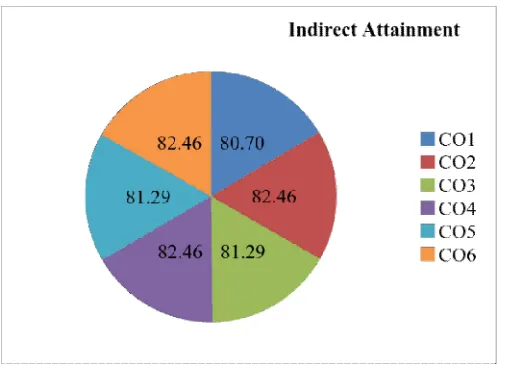
CO1 Can you select appropriate Microcontroller for project/ any application? 80.70
CO2 Have you understood the functions of SFR (Special Function Register)? 82.46
CO3 Are you able to use instructions while writing an Assembly Language Program? 81.29
CO4 Can you simulate, analyze and develop programs using SIDE-51 or Keil
software? 82.46
CO5 Are you able to interface stepper motor, DAC, LED, keyboard and Memory with
8051? 81.29
CO6 Can you understand the concept of Timer and interrupt? 82.46
Table 2: Indirect assessment of Course Outcomes through Course Exit Survey
Table 2 shows course exit survey to check knowledge level of students and based on response achievement level of each CO is evaluated.
Fig. 2. Graphical representation of attainment of COs using indirect method.
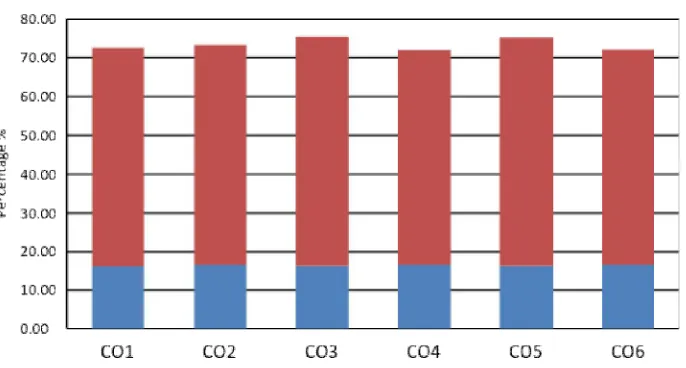
The overall attainment is calculated by considering the separate weight age to each method, i.e. 80% and 20% Weightages are given to direct and indirect methods respectively shown in table 3.
Course Outcome
Mapping with Program Outcome (PO)
Assessment in %
Target Set
Total Attainment in % Indirect
20% Direct 80%
CO1 a,b,c,e,f,g,h,j 80.70 16.1 70.38 56.30 70% 72.44
CO2 a,b,c,f,g,h,j 82.46 16.5 70.79 56.63 70% 73.12
CO3 a,b,c,d,e,f,g,h,i,j 81.29 16.3 73.66 58.92 70% 75.18
CO4 a,b,c,d,e,f,g,h,i,j 82.46 16.5 69.37 55.50 70% 71.99
CO5 a,b,c,d,e,g,h,j 81.29 16.3 73.50 58.80 70% 75.06
CO6 a,b,c,d,e,f,g,h,i,j 82.46 16.5 69.44 55.55 70% 72.04
Table 3: CO Attainment through direct and indirect method
Fig.3. Graphical representation of attainment of COs using direct and indirect method.
Figure 3 indicates attainment of Course Outcomes in terms of percentage using direct and indirect method.
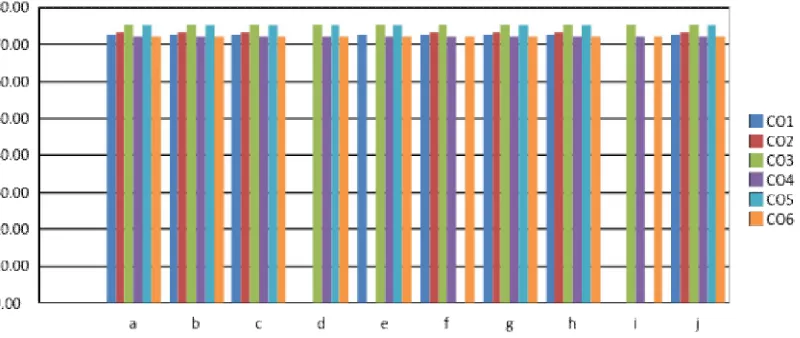
Table 4: Program Outcomes Attainment through course outcomes
Fig. 4. Graphical representation of attainment of Cos, POs using direct and indirect method.
III. CONCLUSION
CO attainment level of Microcontroller (17534) is evaluated using direct and indirect methods. The result obtained in
academic year 2015-16 has been analyzed. The overall CO attainment is obtained by both direct and indirect methods, whereas different weightages have been considered for each methodology i.e. 80% for direct and 20% for indirect approach. It is observed that all six course outcomes have been satisfied the minimum requirement of 70%. The students are good in understanding the Assembly language programming and microcontroller interfacing with peripherals as CO3 and CO5 attained with 75.18% and 75.06% respectively. Remaining CO’s has satisfactory attainments as the level set for attainment was 70%, but need to improve by applying innovative teaching methodologies. It is decided to strengthen the threshold value of CO attainment up to 80% in next academic year 2016-17.
REFERENCES
[1] National Board of Accreditation Manual for Diploma Engineering Programmes (Tier-II), January 2013.
[2] Zamri Mohamed, Mohd Yusof Taib, M.S. Reza,“Assessment Method for Course Outcome and Program Outcome in Outcome Based Education (OBE)”, Malaysian Technical Universities Conference on Engineering and Technology, June 28-29, 2010.
[3] National Board of Accreditation: Orientation Workshop on Outcome Based Accreditation, New Delhi 110003, 2010.
[4] Izham Zainal Abidin, Adzly Anuar and Norshah Hafeez Shuaib, “Assessing the attainment of course outcomes (CO) for an engineering course”, in International Conference of Teaching and Learning (ICTL 2009) INTI University College, Malaysia. 657
[6] Masni-Azian, A., Rahimah, A.H. and M.S., Othman, IOSR Journal of Research & Method in Education (IOSR-JRME) e-ISSN: 2320-7388 p-ISSN: 2320-737X.Volume 4, Issue 2Ver. III (Mar-Apr. 2014), PP55-61, www.iosrjournals.org.
[7] Ungku Anisa Ungku Amirulddin, Miszaina Osman, Fazrena Azlee Hamid, "Analysis of Programme Outcomes Achievement for Electrical Engineering Programmes in UNITEN", International Conference on Engineering Education (lCEED 2009), December 7-8, 2009, KualaLumpur, Malaysia.
[8] Mahadevan, Ramachandran; Shivaprakash, N C ;Khobragade, N T; Raju, KVL ; Nageswara Rao, V V , "Implementing a sustainable methodology For assessment of course outcomes and program outcomes in an Indian Engineering Institute",IEEE International Conference on Teaching, Assessment and Learning for Engineering (TALE), 2013.
[9] National Board of Accreditation (NBA), India, www.nbaind.org.
[10] Manual of Accreditation, National Board of Accreditation (NBA), All India Council for Technical Education, New Delhi, India, 2004-2013. [11] Accreditation Board for Engineering & Technology (ABET), www.abet.org.